Japan Variable Rate Technology Market Size & Growth Rate
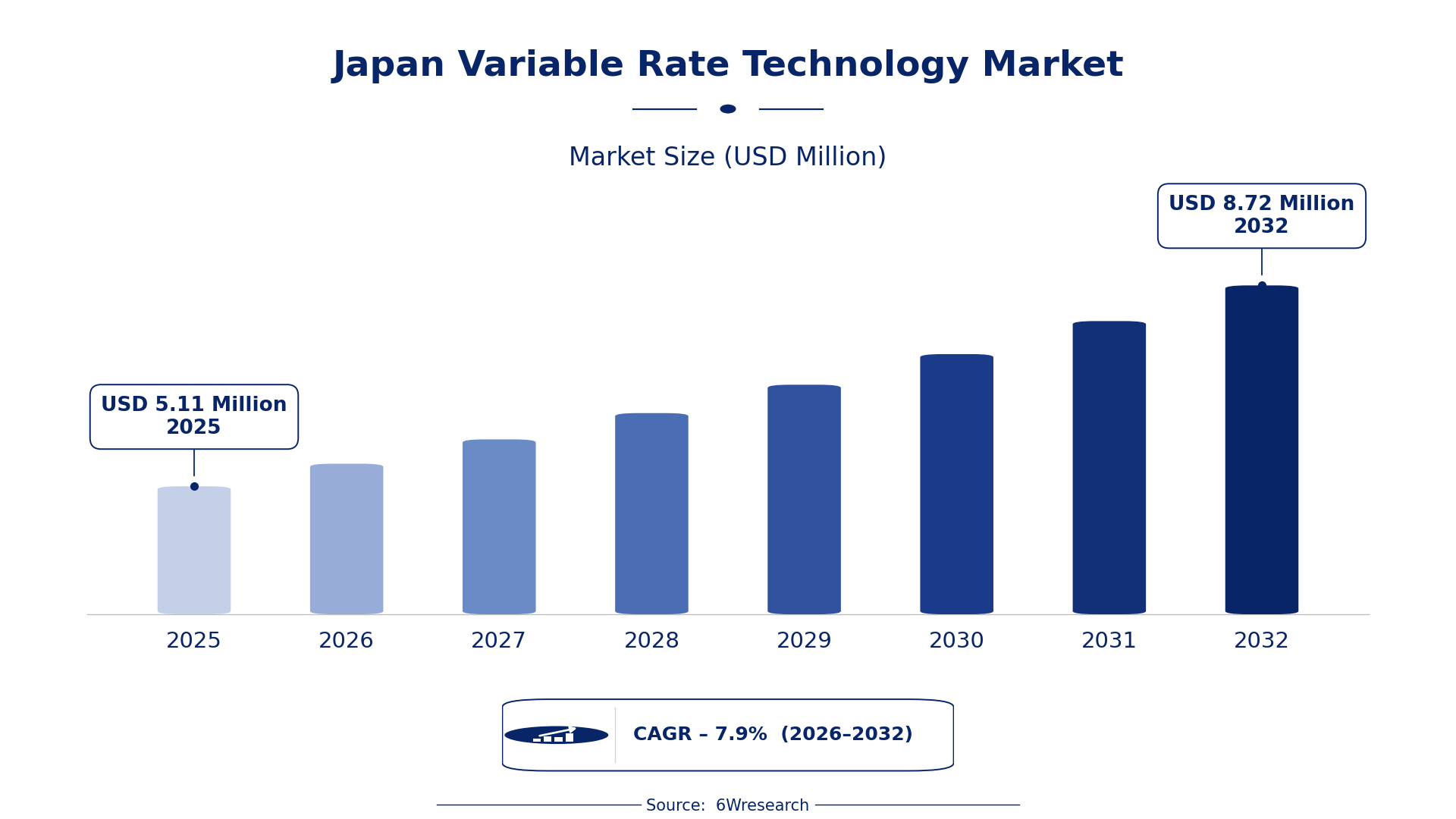
According to 6Wresearch internal database and industry insights, the Japan Variable Rate Technology Market was valued at USD 5.11 Million in 2025 and is projected to reach USD 8.72 Million by 2032, growing at a CAGR of approximately 7.9% during 2026–2032.
Japan Variable Rate Technology Market Highlights
| Report Metric | Details |
| Report Name | Japan Variable Rate Technology Market (2026-2032) |
| Market Size 2025 | USD 5.11 Million |
| Market Size 2032 | USD 8.72 Million |
| Absolute Growth 2025–2032 | USD 3.61 Million |
| CAGR 2026–2032 | 7.9% |
| Peak Annual Growth | 9.1% in 2026 |
| Forecast Period | 2026–2032 |
| Historical Data | 2022–2025 |
| Base Year | 2025 |
| Leading Component Type, 2025 | Hardware (56% share) |
| Leading Technology, 2025 | Map-based (59% share) |
| Leading Crop Type, 2025 | Cereals and Grains (33% share) |
| Leading Farm Size, 2025 | Large farms (56% share) |
| Fastest-Growing Component Type | Software (11.1% CAGR) |
| Fastest-Growing Technology | Sensor-based (11.0% CAGR) |
| Fastest-Growing Crop Type | Fruits and Vegetables (11.2% CAGR) |
| Fastest-Growing Farm Size | Mid-sized Farms (9.9% CAGR) |
| Growing Sector | Mid-sized Farms |
| Key End Users | Large farms, Mid-sized Farms, Small Farms |
Japan Variable Rate Technology Market Year-wise Growth Rate and Key Drivers (2022–2032)
This graph illustrates the annual growth rates of the market from 2022 to 2032, highlighting a steady upward trajectory and projected market expansion over the forecast period.
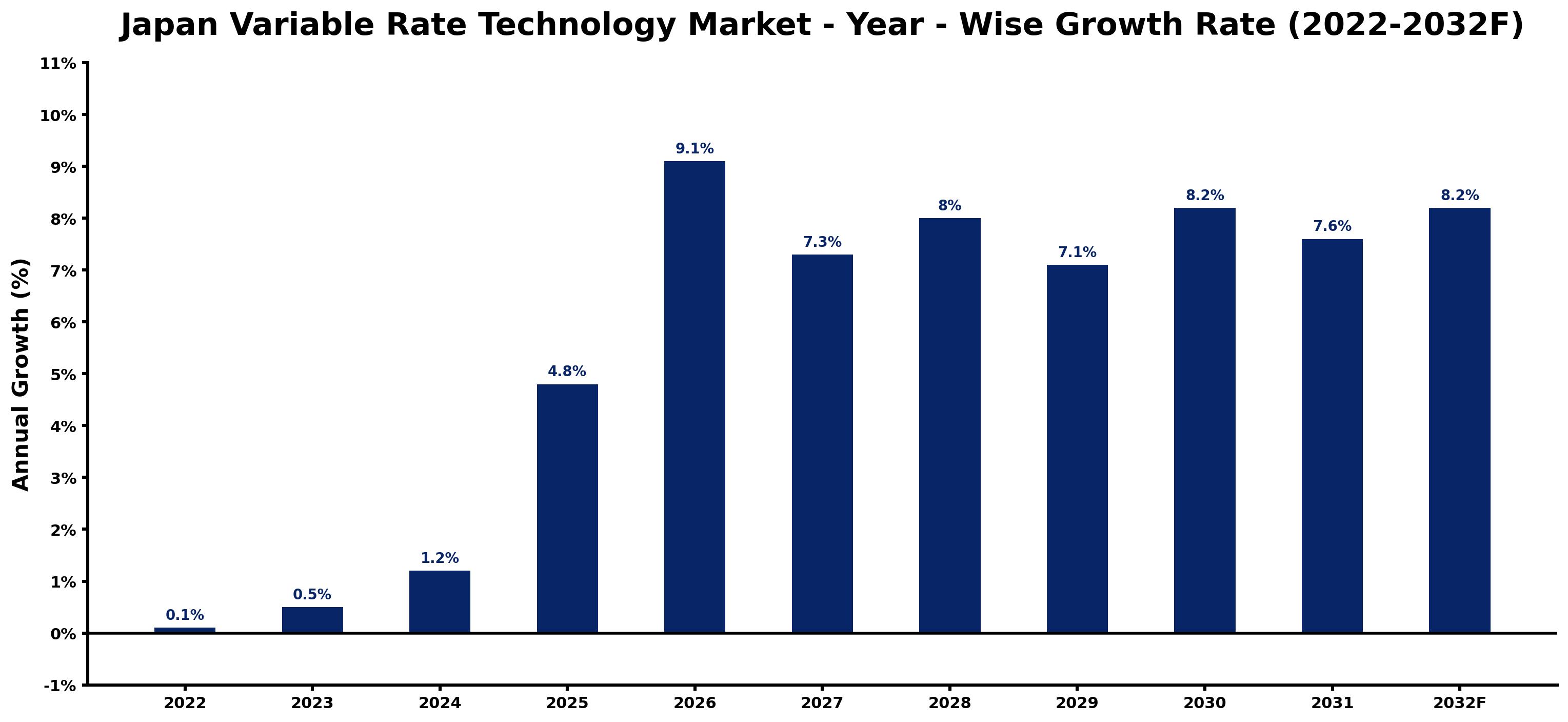
Year by year, the estimates below pair each growth rate with the development that shaped it.
| Year | Estimated Annual Growth (%) | Market Rationale |
| 2022 | 0.1 | The market showed minimal growth as early adopters began integrating VRT technologies. |
| 2023 | 0.5 | Growth accelerated as more farmers recognised the benefits of precision agriculture practices. |
| 2024 | 1.2 | Increased awareness of environmental impacts led to greater adoption of VRT solutions. |
| 2025 | 4.8 | Investments in agricultural technology spurred a notable rise in market activity. |
| 2026 | 9.1 | The peak growth year reflects heightened demand for efficient farming practices and sustainability. |
| 2027 | 7.3 | Growth is expected to slow as the market stabilises after rapid expansion in the previous year. |
| 2028 | 8.0 | Demand is projected to increase again as more farms adopt advanced technologies for crop management. |
| 2029 | 7.1 | A slight slowdown is anticipated as market saturation begins to affect growth rates. |
| 2030 | 8.2 | Growth is expected to resume as new innovations in VRT capture the interest of farmers. |
| 2031 | 7.6 | The market will continue to grow, though at a slower pace due to increased competition. |
| 2032 | 8.2 | Sustained investments in technology and training are expected to maintain positive growth. |
Note: Market size estimations and growth projections presented in this report are based on 6Wresearch's proprietary forecasting methodology, utilizing the latest available industry data, government publications, and primary research inputs.
Japan Variable Rate Technology Market Synopsis
Variable Rate Technology (VRT) optimises agricultural input application based on field variability, utilising hardware and software for data analysis. In Japan, over 1.5 million farms are adopting VRT, particularly in the Tohoku region for rice and vegetable farming. The Japan Variable Rate Technology Market is expanding due to rising demand for precision agriculture, supported by initiatives like the AI Promotion Act, which allocates funding for agricultural technology development.
Market Dynamics Impact Analysis (2026–2032)
| Factor | Type | Impact | Primary Segment Affected |
| Rising adoption of precision agriculture practices among farmers. | Driver | High | Hardware |
| Increasing focus on sustainable farming methods drives demand for VRT. | Driver | High | Software |
| Growing interest in agricultural technology among service providers creates opportunities. | Opportunity | Medium | Services |
| Expansion of precision agriculture training programs enhances market potential. | Opportunity | Medium | Services |
| High initial investment costs may deter small-scale farmers from adopting VRT. | Restraint | High | Hardware |
| Limited awareness of VRT benefits among traditional farmers restricts market growth. | Restraint | Medium | Software |
| Competition among service providers may lead to price wars, affecting margins. | Challenge | Medium | Services |
| Technological integration challenges can delay VRT adoption on farms. | Challenge | High | Hardware |
Evaluation of Drivers in Japan Variable Rate Technology Market (2026–2032)
The following drivers explain most of the expected growth.
| Drivers | Primary Segment Affected | Why It Matters (Evidence) |
| Increased crop yields through precise input application. | Hardware | The adoption of VRT hardware has been linked to a 7.5 million-ton rice production in 2022, driving demand for better equipment. |
| Enhanced data analysis capabilities improve decision-making. | Software | With over 100 precision agriculture service providers in Japan, demand for software solutions is rising to support farmers' needs. |
| Government initiatives promote technology adoption in agriculture. | Services | The Smart Agriculture Promotion Strategy launched in 2021 aims to enhance technology use, leading to increased service demand. |
| Growing environmental concerns push farmers towards sustainable practices. | Hardware | As farmers seek to reduce environmental impact, the adoption rate of VRT in large farms is estimated at 30% as of 2023. |
| Technological advancements in VRT systems boost efficiency. | Software | The expected 15% annual increase in sensor-based technologies through 2025 reflects rising demand for advanced data analysis. |
Buyers are adding capacity as they increasingly recognise the benefits of Variable Rate Technology in optimising resource use. Japan's agricultural sector, with over 1.5 million farms, is seeing a shift towards precision agriculture, particularly in the Tohoku region where VRT is improving rice and vegetable yields. The adoption of VRT hardware has been linked to improved crop production, while the increasing number of precision agriculture service providers is creating a strong market presence. The expected growth in sensor-based technologies highlights the demand for advanced data analysis tools that support farmers' needs.
Evaluation of Restraints in Japan Variable Rate Technology Market
Several factors work against faster growth; the main ones are summarised below.
| Market Restraint | Primary Segment Affected | Why It Matters (Evidence) |
| High initial costs limit adoption for smaller farms. | Hardware | Initial investments for VRT can exceed ¥1 million, restricting access for smaller producers. |
| Limited availability of skilled technicians delays service provision. | Services | A shortage of qualified technicians increases operational costs for agricultural service providers. |
| Regulatory hurdles complicate compliance with standards. | Software | Complexity of the JIS Z 8401 standard can extend project timelines by up to six months. |
| Insufficient training programs restrict knowledge transfer. | Hardware | Limited training opportunities impact effective VRT use among farmers in rural areas. |
| Market saturation affects growth rates. | Services | As adoption increases, growth rates may slow due to a saturated market. |
Japan Variable Rate Technology Market Challenges
Producers encounter high initial costs when adopting advanced agricultural technologies, with investments often exceeding ¥1 million per farm, limiting access for smaller operations. Service providers face a shortage of skilled technicians, leading to delays that can extend service timelines by up to three months, raising costs for buyers. Complexities surrounding the JIS Z 8401 standard create regulatory hurdles, causing compliance delays that can prolong project timelines by six months for implementers. Limited training programs impede effective technology use among farmers, particularly affecting those in rural areas who lack access to resources.
Trends in the Japan Variable Rate Technology Market
The following changes are redrawing the Japan Variable Rate Technology Market.
- Shift Towards Precision Agriculture: In 2023, Japan's agricultural sector is increasingly adopting Variable Rate Technology, with over 1.5 million farms utilising it. This shift is particularly evident in the Tohoku region, where rice production is optimised through VRT.
- Transition from Traditional to Advanced Farming Techniques: The adoption of VRT began to accelerate in 2020, driven by government initiatives promoting precision agriculture. This transition is expected to improve crop yields and reduce environmental impact.
- Emergence of Sensor-based Technologies: As of 2023, the use of sensor-based technologies in agriculture is projected to grow by 15% annually. This trend is particularly relevant in large farms where precision farming is becoming standard.
- Increased Investment in Agricultural Technology: Japan allocated ¥10 billion for agricultural technology development in 2023, reflecting a commitment to advancing precision agriculture. This investment is expected to drive further adoption of VRT solutions.
Investment Opportunities in the Japan Variable Rate Technology Market
The following opportunities in the Japan Variable Rate Technology Market pair current demand with a clear way in.
- Investment in Precision Agriculture: The Tohoku region is a prime area for investment in Variable Rate Technology, with a growing number of farms adopting these solutions. Now is the time to partner with local agricultural cooperatives to facilitate technology adoption.
- Supply of Advanced Data Analysis Tools: With the increasing number of precision agriculture service providers, there is a significant opportunity to supply software solutions. Collaborating with local tech firms can facilitate entry into this expanding market.
- Development of Training Programs: As the demand for VRT grows, establishing training programs for farmers is essential. Partnering with agricultural colleges in Japan can help bridge the knowledge gap and improve adoption rates.
- Expansion of Sensor-based Solutions: The anticipated 15% annual growth in sensor-based technologies presents an opportunity for suppliers to invest in this area. Focusing on large farms will yield the best returns due to their higher adoption rates.
Government Initiatives in the Japan Variable Rate Technology Market
The AI Promotion Act, established in 2025, impacts buyers by creating a national framework for the development and use of AI in agriculture. This act facilitates funding for projects that enhance precision farming technologies, benefiting farmers looking to adopt Variable Rate Technology.
The Ministry of Agriculture, Forestry and Fisheries (MAFF) oversees the implementation of precision agriculture initiatives, approving funding for technology adoption. In 2023, MAFF allocated ¥10 billion to support agricultural technology development, which includes Variable Rate Technology.
Future Insight of the Japan Variable Rate Technology Market
Investment in agricultural technology is set to increase, with ¥10 billion allocated for development, stimulating demand for advanced solutions. By 2032, the Smart Agriculture Promotion Strategy will likely drive wider adoption of precision farming technologies. Improved training initiatives will enhance the skills of technicians, ensuring efficient service delivery. As technology adoption grows, the agriculture sector will experience higher crop yields and diminished environmental impact, benefiting both producers and consumers.
Market Segmentation Analysis
Japan Variable Rate Technology Market report covers a detailed analysis of the following market segments:
By Component Type – Hardware Leads, Software Expected to Grow Fastest
According to Sumit Sagar, AM at 6Wresearch, with 56% of component type revenue in 2025, Hardware was the largest category. Hardware commands the largest share as it is vital for implementing VRT in fields, with a substantial number of precision agriculture service providers facilitating its integration. This strong installed base ensures that farmers can effectively optimise resource use across their operations. The quickest growth will come from Software, forecast to expand at a CAGR of 11.1% between 2026 and 2032. Software is experiencing rapid growth owing to its critical role in data analysis and decision-making, with sensor-based technologies projected to increase by 15% annually through 2025. As hardware adoption continues to expand, the demand for software will also rise, further accelerating its growth. Suppliers should prioritise the development of advanced software solutions to cater to the increasing needs of farmers adopting VRT.
By Technology – Map-based Leads, Sensor-based Expected to Grow Fastest
Map-based held 59% of the Japan Variable Rate Technology Market by technology in 2025. Map-based technology holds the largest share as it is crucial for planning and managing variable application rates, making it indispensable for effective VRT use. The guidelines provided by the JIS Z 8401 standard have reinforced its importance among Japanese farmers. Sensor-based is projected to grow fastest, at a CAGR of 11.0% during 2026–2032. Sensor-based technology is witnessing rapid growth due to its ability to provide real-time data for precise applications, which is increasingly sought after by farmers. The agriculture sector's transition towards more advanced technologies will further escalate the demand for sensor-based solutions. Suppliers should focus on developing and promoting sensor-based technologies to meet the rising demand in precision agriculture.
By Crop Type – Cereals and Grains Lead, Fruits and Vegetables Expected to Grow Fastest
The largest crop type category in 2025 was Cereals and Grains, at 33% of revenue. Cereals and grains lead the market as they are a major crop category utilising VRT, with rice production in Japan reaching approximately 7.5 million tons in 2022. This dominance is largely due to the necessity for efficient resource management in extensive cereal farming operations. Fruits and Vegetables are set to record the highest CAGR in this split, 11.2% over 2026–2032. Fruits and vegetables are the fastest-growing segment for VRT adoption, as farmers seek to optimise yield and quality in these lucrative crops. The focus on vegetable farming in the Tohoku region underscores this shift towards precision agriculture. Suppliers should tailor their products to cater to the specific needs of fruit and vegetable farmers embracing VRT.
By Farm Size – Large farms Lead, Mid-sized Farms Expected to Grow Fastest
Large farms took 56% of farm size revenue in 2025, more than any other category. Large farms dominate the market owing to their scale of operations, with an estimated 30% adoption rate of VRT as of 2023. These larger farms reap substantial benefits from the efficiencies offered by advanced agricultural technologies, establishing them as primary users of VRT. Over 2026–2032, Mid-sized Farms are expected to post the fastest growth, at a CAGR of 9.9%. Mid-sized farms are rapidly increasing their VRT adoption to enhance efficiency, as they aim to remain competitive with larger operations. This trend signifies a growing acceptance of precision agriculture across a wider range of farm sizes. Suppliers need to develop scalable solutions that address the distinct needs of mid-sized farms entering the VRT market.
Key Attractiveness of the Report
- 10 Years of Market Numbers
- Historical Data Starting from 2022 to 2025
- Base Year 2025
- Forecast Data until 2032
- Key Performance Indicators Impacting the Market
- Major Upcoming Developments and Projects
Key Highlights of the Report:
- Japan Variable Rate Technology Market Outlook
- Market Size of Japan Variable Rate Technology Market, 2025
- Forecast of Japan Variable Rate Technology Market, 2032
- Historical Data and Forecast of Japan Variable Rate Technology Revenues & Volume for the Period 2022-2032
- Japan Variable Rate Technology Market Trend Evolution
- Japan Variable Rate Technology Market Drivers and Challenges
- Japan Variable Rate Technology Price Trends
- Japan Variable Rate Technology Porter's Five Forces
- Japan Variable Rate Technology Industry Life Cycle
- Historical Data and Forecast of Japan Variable Rate Technology Market Revenues & Volume By Component Type for the Period 2022-2032
- Historical Data and Forecast of Japan Variable Rate Technology Market Revenues & Volume By Hardware for the Period 2022-2032
- Historical Data and Forecast of Japan Variable Rate Technology Market Revenues & Volume By Software for the Period 2022-2032
- Historical Data and Forecast of Japan Variable Rate Technology Market Revenues & Volume By Services for the Period 2022-2032
- Historical Data and Forecast of Japan Variable Rate Technology Market Revenues & Volume By Technology for the Period 2022-2032
- Historical Data and Forecast of Japan Variable Rate Technology Market Revenues & Volume By Map-based for the Period 2022-2032
- Historical Data and Forecast of Japan Variable Rate Technology Market Revenues & Volume By Sensor-based for the Period 2022-2032
- Historical Data and Forecast of Japan Variable Rate Technology Market Revenues & Volume By Crop Type for the Period 2022-2032
- Historical Data and Forecast of Japan Variable Rate Technology Market Revenues & Volume By Cereals and Grains for the Period 2022-2032
- Historical Data and Forecast of Japan Variable Rate Technology Market Revenues & Volume By Fruits and Vegetables for the Period 2022-2032
- Historical Data and Forecast of Japan Variable Rate Technology Market Revenues & Volume By Oilseeds and Pulses for the Period 2022-2032
- Historical Data and Forecast of Japan Variable Rate Technology Market Revenues & Volume By Others for the Period 2022-2032
- Historical Data and Forecast of Japan Variable Rate Technology Market Revenues & Volume By Farm Size for the Period 2022-2032
- Historical Data and Forecast of Japan Variable Rate Technology Market Revenues & Volume By Large farms for the Period 2022-2032
- Historical Data and Forecast of Japan Variable Rate Technology Market Revenues & Volume By Mid-sized Farms for the Period 2022-2032
- Historical Data and Forecast of Japan Variable Rate Technology Market Revenues & Volume By Small Farms for the Period 2022-2032
- Japan Variable Rate Technology Import Export Trade Statistics
- Market Opportunity Assessment By Component Type
- Market Opportunity Assessment By Technology
- Market Opportunity Assessment By Crop Type
- Market Opportunity Assessment By Farm Size
- Japan Variable Rate Technology Top Companies Market Share
- Japan Variable Rate Technology Competitive Benchmarking By Technical and Operational Parameters
- Japan Variable Rate Technology Company Profiles
- Japan Variable Rate Technology Key Strategic Recommendations
Market Covered
The study includes the following segmentation.
By Component Type
- Hardware
- Software
- Services
By Technology
- Map-based
- Sensor-based
By Crop Type
- Cereals and Grains
- Fruits and Vegetables
- Oilseeds and Pulses
- Others
By Farm Size
- Large farms
- Mid-sized Farms
- Small Farms































