Japan Vehicle Access Control Market Size & Growth Rate
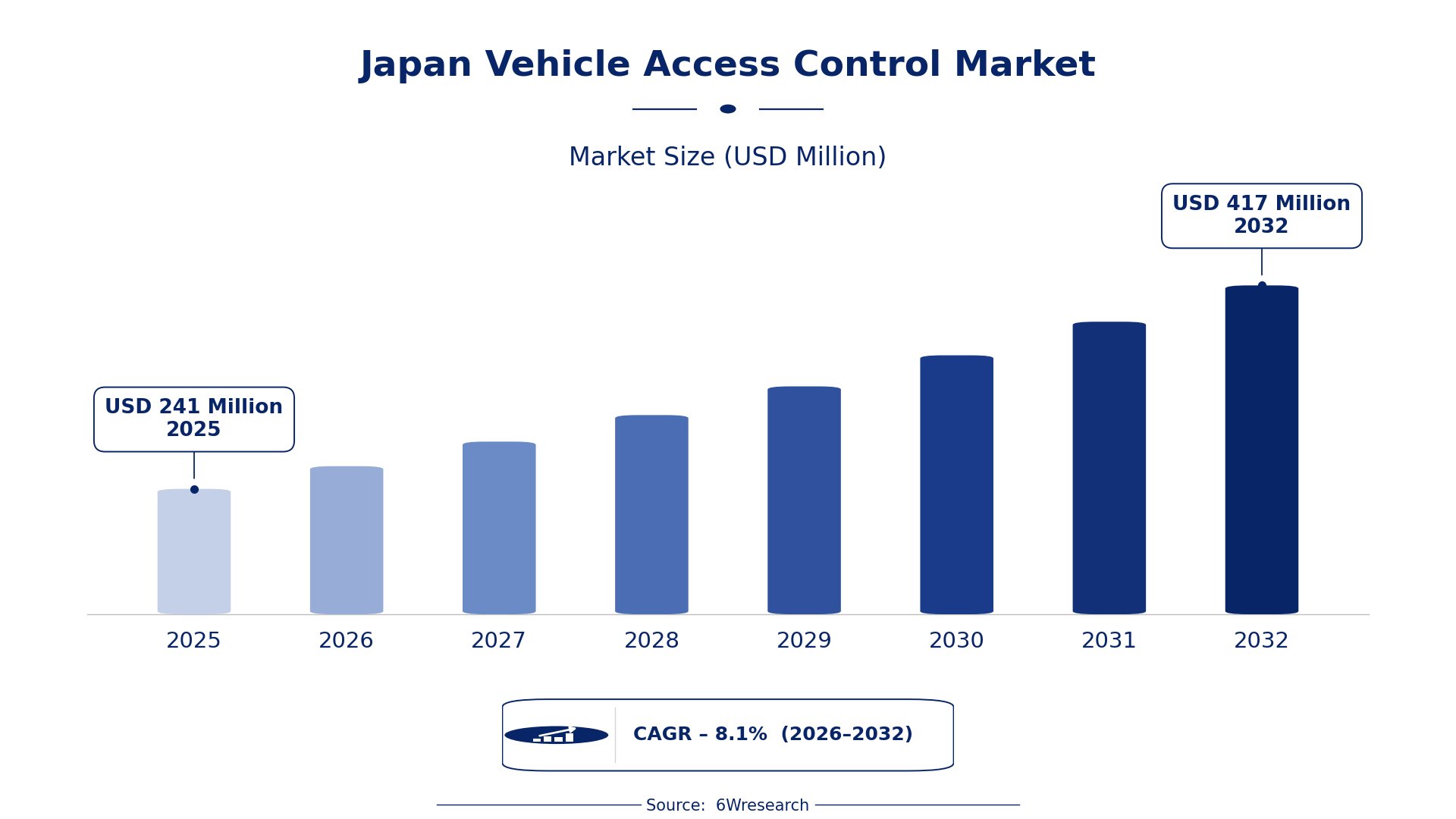
According to 6Wresearch internal database and industry insights, the Japan Vehicle Access Control Market was valued at USD 241 Million in 2025 and is projected to reach USD 417 Million by 2032, growing at a CAGR of approximately 8.1% during 2026–2032.
Japan Vehicle Access Control Market Highlights
| Report Metric | Details |
| Report Name | Japan Vehicle Access Control Market (2026-2032) |
| Market Size 2025 | USD 241 Million |
| Market Size 2032 | USD 417 Million |
| Absolute Growth 2025–2032 | USD 176 Million |
| CAGR 2026–2032 | 8.1% |
| Peak Annual Growth | 9.2% in 2028 |
| Forecast Period | 2026–2032 |
| Historical Data | 2022–2025 |
| Base Year | 2025 |
| Leading Biometric, 2025 | Fingerprint (36% share) |
| Leading Non-biometric, 2025 | Stolen Vehicle Assist (38% share) |
| Leading Technology, 2025 | Bluetooth (48% share) |
| Fastest-Growing Biometric | Face (10.2% CAGR) |
| Fastest-Growing Non-biometric | Keyless (10.4% CAGR) |
| Fastest-Growing Technology | NFC (11.0% CAGR) |
| Growing Sector | NFC |
| Key End Users | Bluetooth, NFC, RFID, Wi-Fi |
Japan Vehicle Access Control Market Year-wise Growth Rate and Key Drivers (2022–2032)
This graph illustrates the annual growth rates of the market from 2022 to 2032, highlighting a steady upward trajectory and projected market expansion over the forecast period.
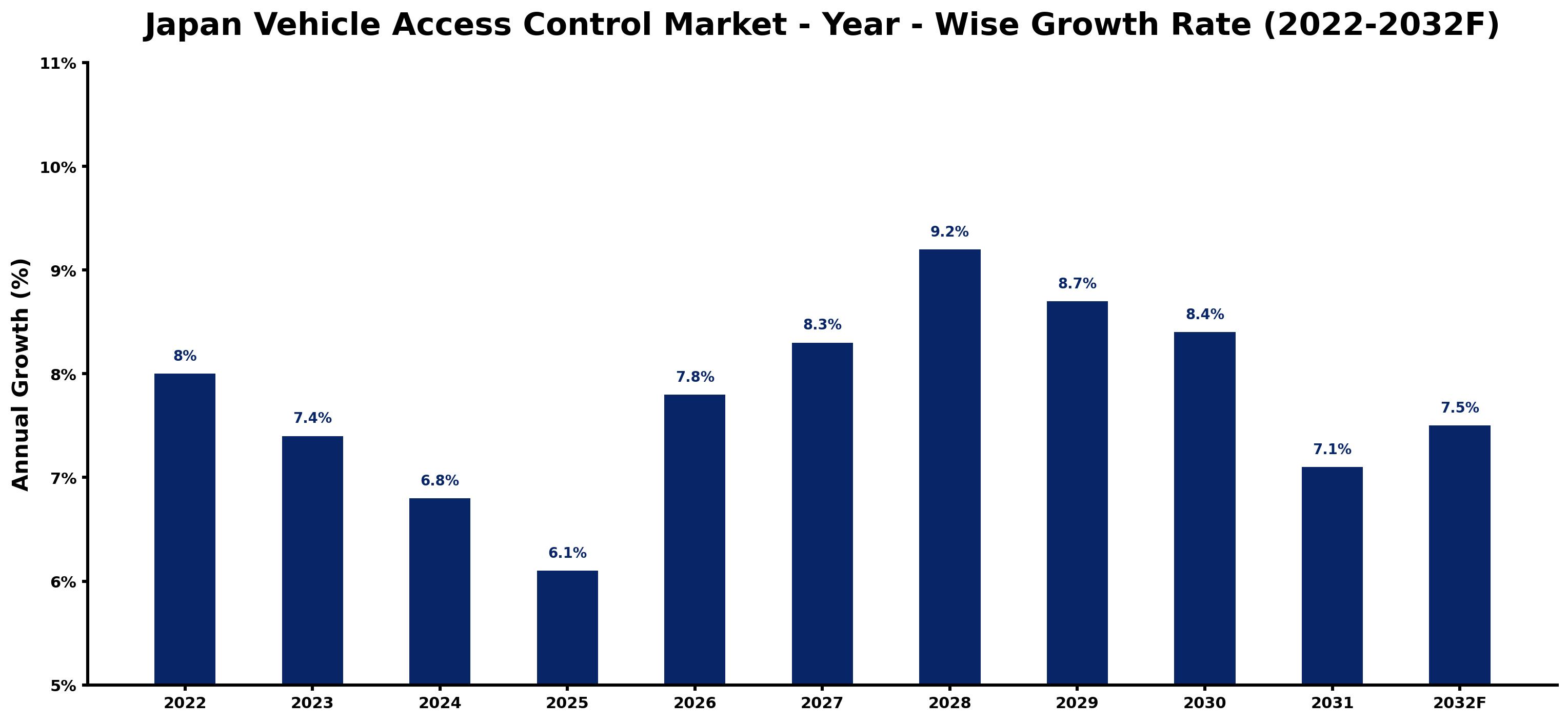
Each row of the following table gives one year's estimated growth and the event or demand shift that explains it.
| Year | Estimated Annual Growth (%) | Market Rationale |
| 2022 | 8.0 | The market experienced strong demand from automotive manufacturers and domestic users. |
| 2023 | 7.4 | Demand growth slowed as the market adjusted to previous high levels of activity. |
| 2024 | 6.8 | Growth continued but at a slower pace due to market saturation. |
| 2025 | 6.1 | Moderate growth occurred as buyers focused on existing technologies rather than new investments. |
| 2026 | 7.8 | Increased demand is expected as new technologies gain traction. |
| 2027 | 8.3 | Demand is projected to rise as consumers seek improved security features in vehicles. |
| 2028 | 9.2 | The market will peak with the introduction of advanced access control systems. |
| 2029 | 8.7 | Growth will slow as market maturity sets in and competition increases. |
| 2030 | 8.4 | Demand is expected to stabilise as buyers become more selective in their purchases. |
| 2031 | 7.1 | A further slowdown is anticipated as innovation cycles lengthen. |
| 2032 | 7.5 | Growth is anticipated to pick up again as new technologies emerge. |
Note: Market size estimations and growth projections presented in this report are based on 6Wresearch's proprietary forecasting methodology, utilizing the latest available industry data, government publications, and primary research inputs.
Japan Vehicle Access Control Market Synopsis
Vehicle access control systems manage access and improve security through various methods, including biometrics and non-biometric solutions. Key buyer groups such as automotive manufacturers and domestic users drive the Japan Vehicle Access Control Market. Rising vehicle theft rates, increased adoption of keyless entry systems, and a government initiative aimed at improving vehicle security contribute to a projected market size by 2032.
Market Dynamics Impact Analysis (2026–2032)
| Factor | Type | Impact | Primary Segment Affected |
| Rising vehicle theft incidents drive demand for enhanced security solutions. | Driver | High | Stolen Vehicle Assist |
| The increasing adoption of keyless entry systems enhances convenience and security. | Driver | High | Keyless |
| Growing vehicle population creates a larger market for access control technologies. | Opportunity | High | Fingerprint |
| The launch of smart mobility initiatives encourages investment in advanced vehicle security. | Opportunity | Medium | Fingerprint |
| High costs associated with advanced biometric systems may limit adoption. | Restraint | Medium | Fingerprint |
| Market saturation could hinder growth as existing technologies dominate. | Restraint | High | Fingerprint |
| Supply chain disruptions may delay the rollout of new technologies. | Challenge | High | Fingerprint |
| Intense competition among manufacturers could lead to price wars. | Challenge | Medium | Fingerprint |
Evaluation of Drivers in Japan Vehicle Access Control Market (2026–2032)
Key forces behind demand, with the segment each one moves most, are listed below.
| Drivers | Primary Segment Affected | Why It Matters (Evidence) |
| Increasing vehicle theft rates drive demand for security solutions. | Stolen Vehicle Assist | With 5,000 vehicle thefts reported in Tokyo in 2022, consumers seek effective recovery solutions. |
| The rise of smart mobility initiatives boosts investment in vehicle security. | Fingerprint | The 2023 smart mobility initiative aims to improve vehicle security, prompting manufacturers to adopt advanced systems. |
| Growing preference for keyless entry systems enhances convenience. | Keyless | Over 50% of new vehicles sold in Japan feature keyless entry, reflecting consumer demand for ease of access. |
| Technological advancements in biometrics improve security features. | Fingerprint | Fingerprint systems are projected to increase in adoption by 15% by 2025, improving user identification. |
| Government regulations promote the adoption of safety standards. | Fingerprint | ISO 26262 standards drive manufacturers to implement advanced safety technologies in vehicles. |
Volumes grow on the back of rising vehicle theft rates, with 5,000 incidents reported in Tokyo in 2022 prompting consumers to seek effective recovery solutions. The increasing adoption of keyless entry systems, found in over 50% of new vehicles sold, reflects a strong demand for convenience and security. Advancements in fingerprint recognition are expected to improve user identification, while compliance with ISO 26262 standards pushes manufacturers towards better safety measures. Overall, these factors contribute to a dynamic market environment for vehicle access control systems in Japan.
Evaluation of Restraints in Japan Vehicle Access Control Market
The main factors holding the market back are set out below.
| Market Restraint | Primary Segment Affected | Why It Matters (Evidence) |
| High costs associated with advanced biometric systems may limit adoption. | Fingerprint | The average price of biometric systems can deter budget-conscious consumers, limiting market penetration. |
| Market saturation could hinder growth as existing technologies dominate. | Fingerprint | With established solutions already in place, new entrants may struggle to gain market share. |
| Supply chain disruptions may delay the rollout of new technologies. | Fingerprint | Global supply chain issues could impact the availability of components necessary for advanced systems. |
| Consumer reluctance to adopt new technologies can slow market growth. | Keyless | Concerns over security vulnerabilities in keyless systems may lead to hesitation among potential buyers. |
| Limited awareness of advanced security options may restrict market expansion. | Stolen Vehicle Assist | Many consumers remain unaware of the benefits of recovery solutions, hindering adoption rates. |
Japan Vehicle Access Control Market Challenges
A lack of differentiation among producers fuels intense competition, resulting in price reductions that erode profit margins for manufacturers. This situation stems from the high number of domestic firms in Japan, compelling them to compete aggressively, which leads to financial strain. Buyers face increased security concerns as vehicle thefts reached 5,000 incidents in 2022, pushing them to invest in advanced access control systems, which incurs additional costs. Regulatory pressures from the Ministry of Land, Infrastructure, Transport and Tourism impose compliance costs on producers, further raising operational expenses. Skills shortages in technology sectors impede product innovation, delaying launches for manufacturers.
Trends in the Japan Vehicle Access Control Market
Several trends are reshaping the Japan Vehicle Access Control Market; the most important are set out below.
- Shift towards Biometric Security Solutions: Japan increasingly adopts biometric security solutions for vehicle access, with fingerprint systems leading the way. In 2023, biometric systems are projected to see a 15% increase in adoption, reflecting a growing preference for improved security.
- Transition from Traditional to Keyless Entry Systems: The automotive market in Japan is shifting from traditional keys to keyless entry systems, with over 50% of new vehicles sold featuring this technology. This transition is driven by consumer demand for convenience and security.
- Emergence of Smart Mobility Initiatives: The launch of the smart mobility initiative in 2023 reshapes vehicle security standards in Japan. This programme aims to improve vehicle safety and security, influencing manufacturers to adopt advanced technologies.
- Growing Integration of NFC Technology: NFC technology is becoming more prevalent in new vehicle models, with 20% of them incorporating this feature. This trend reflects a shift towards connectivity and convenience in vehicle access control.
Investment Opportunities in the Japan Vehicle Access Control Market
The following opportunities in the Japan Vehicle Access Control Market pair current demand with a clear way in.
- Market Gap for Advanced Security Solutions: With high vehicle theft rates, there is a substantial opportunity to supply advanced security systems. Automotive manufacturers in urban areas particularly require enhanced recovery solutions.
- Partnerships for Technology Development: Collaborating with local automotive manufacturers can ease entry into the market for advanced vehicle access control systems. This strategy allows for shared expertise and resources.
- Investment in Biometric Systems: The projected 15% increase in biometric system adoption by 2025 presents an opportunity for suppliers to meet rising demand. Targeting automotive manufacturers can ensure successful market entry.
- Focus on Keyless Entry System Expansion: With over 50% of new vehicles featuring keyless entry, there is a growing need for suppliers to provide innovative solutions. Engaging with automotive manufacturers can help tap into this demand.
Government Initiatives in the Japan Vehicle Access Control Market
The Electrical Appliance and Material Safety Act (1961) regulates the safety of electrical appliances and materials sold in Japan, ensuring that vehicle access control systems meet safety standards. This law has shaped the compliance landscape for manufacturers, requiring rigorous testing and certification processes to ensure consumer safety.
The Ministry of Land, Infrastructure, Transport and Tourism oversees vehicle safety regulations, including the implementation of the smart mobility initiative launched in 2023. This initiative aims to enhance vehicle security and safety standards, encouraging manufacturers to adopt advanced technologies and practices.
Future Insight of the Japan Vehicle Access Control Market
The push for a 46% reduction in greenhouse-gas emissions by 2030 will drive demand for advanced vehicle access control systems. The smart mobility initiative launched in 2023 will encourage investments in new security technologies, benefiting both buyers and suppliers. By 2025, biometric access control systems are projected to increase in adoption, creating opportunities for producers. As the vehicle population reaches 78 million, the need for enhanced security measures will become increasingly critical.
Market Segmentation Analysis
Japan Vehicle Access Control Market report covers a detailed analysis of the following market segments:
By Biometric – Fingerprint Leads, Face Expected to Grow Fastest
According to Summon Dutta, Assistant Manager at 6Wresearch, with 36% of biometric revenue in 2025, Fingerprint was the largest category. Fingerprint access control systems dominate the market in Japan due to their extensive application in secure vehicle entry, particularly among automotive manufacturers. This method is preferred for its reliability and is a common feature in many new vehicles sold, ensuring high user trust. The quickest growth will come from Face, forecast to expand at a CAGR of 10.2% between 2026 and 2032. The rapid adoption of face recognition systems is fuelled by increasing consumer expectations for advanced security features in vehicles. With a projected 15% increase in adoption by 2025, this technology is becoming a preferred choice for users prioritising safety. Suppliers should prioritise the development of biometric solutions to align with the growing demand for secure vehicle access.
By Non-biometric – Stolen Vehicle Assist Leads, Keyless Expected to Grow Fastest
Stolen Vehicle Assist accounted for 38% of the market by non-biometric in 2025. Stolen Vehicle Assist systems dominate the non-biometric segment as they provide essential recovery solutions, appealing to vehicle owners concerned about theft. This service is particularly relevant in urban areas, where vehicle theft rates are higher, such as Tokyo. Keyless is set to record the highest CAGR in this split, 10.4% over 2026–2032. Keyless entry systems are experiencing rapid growth due to their convenience and security benefits, with over 50% of new vehicles sold in Japan equipped with this technology. The increasing vehicle population further fuels this trend, making it a priority for manufacturers. Buyers will increasingly seek non-biometric solutions that offer both security and convenience in their vehicle access systems.
By Technology – Bluetooth Leads, NFC Expected to Grow Fastest
In 2025, Bluetooth led the technology split with a 48% share. Bluetooth technology holds the largest share in the market due to its extensive use in vehicle connectivity, enabling various functionalities that enhance user experience. Its presence in a wide range of vehicle models underscores its importance in modern automotive applications. NFC is projected to grow fastest, at a CAGR of 11.0% during 2026–2032. NFC technology is experiencing rapid growth as it is integrated into 20% of new vehicle models, providing convenient access solutions for users. This aligns with the government's smart mobility initiatives, which aim to bolster vehicle security and user convenience. Suppliers should prioritise the development of NFC technology to capitalise on its growing presence in the vehicle access control market.
Key Attractiveness of the Report
- 10 Years of Market Numbers
- Historical Data Starting from 2022 to 2025
- Base Year 2025
- Forecast Data until 2032
- Key Performance Indicators Impacting the Market
- Major Upcoming Developments and Projects
Key Highlights of the Report:
- Japan Vehicle Access Control Market Outlook
- Market Size of Japan Vehicle Access Control Market, 2025
- Forecast of Japan Vehicle Access Control Market, 2032
- Historical Data and Forecast of Japan Vehicle Access Control Revenues & Volume for the Period 2022-2032
- Japan Vehicle Access Control Market Trend Evolution
- Japan Vehicle Access Control Market Drivers and Challenges
- Japan Vehicle Access Control Price Trends
- Japan Vehicle Access Control Porter's Five Forces
- Japan Vehicle Access Control Industry Life Cycle
- Historical Data and Forecast of Japan Vehicle Access Control Market Revenues & Volume By Biometric for the Period 2022-2032
- Historical Data and Forecast of Japan Vehicle Access Control Market Revenues & Volume By Fingerprint for the Period 2022-2032
- Historical Data and Forecast of Japan Vehicle Access Control Market Revenues & Volume By Face for the Period 2022-2032
- Historical Data and Forecast of Japan Vehicle Access Control Market Revenues & Volume By Iris for the Period 2022-2032
- Historical Data and Forecast of Japan Vehicle Access Control Market Revenues & Volume By Voice for the Period 2022-2032
- Historical Data and Forecast of Japan Vehicle Access Control Market Revenues & Volume By Non-biometric for the Period 2022-2032
- Historical Data and Forecast of Japan Vehicle Access Control Market Revenues & Volume By Stolen Vehicle Assist for the Period 2022-2032
- Historical Data and Forecast of Japan Vehicle Access Control Market Revenues & Volume By Keyless for the Period 2022-2032
- Historical Data and Forecast of Japan Vehicle Access Control Market Revenues & Volume By Immobilizer for the Period 2022-2032
- Historical Data and Forecast of Japan Vehicle Access Control Market Revenues & Volume By Alarm for the Period 2022-2032
- Historical Data and Forecast of Japan Vehicle Access Control Market Revenues & Volume By Steering Lock for the Period 2022-2032
- Historical Data and Forecast of Japan Vehicle Access Control Market Revenues & Volume By Technology for the Period 2022-2032
- Historical Data and Forecast of Japan Vehicle Access Control Market Revenues & Volume By Bluetooth for the Period 2022-2032
- Historical Data and Forecast of Japan Vehicle Access Control Market Revenues & Volume By NFC for the Period 2022-2032
- Historical Data and Forecast of Japan Vehicle Access Control Market Revenues & Volume By RFID for the Period 2022-2032
- Historical Data and Forecast of Japan Vehicle Access Control Market Revenues & Volume By Wi-Fi for the Period 2022-2032
- Japan Vehicle Access Control Import Export Trade Statistics
- Market Opportunity Assessment By Biometric
- Market Opportunity Assessment By Non-biometric
- Market Opportunity Assessment By Technology
- Japan Vehicle Access Control Top Companies Market Share
- Japan Vehicle Access Control Competitive Benchmarking By Technical and Operational Parameters
- Japan Vehicle Access Control Company Profiles
- Japan Vehicle Access Control Key Strategic Recommendations
Market Covered
The report covers the following segments.
By Biometric
- Fingerprint
- Face
- Iris
- Voice
By Non-biometric
- Stolen Vehicle Assist
- Keyless
- Immobilizer
- Alarm
- Steering Lock
By Technology
- Bluetooth
- NFC
- RFID
- Wi-Fi































