Japan Vehicle Connectivity Market Size & Growth Rate
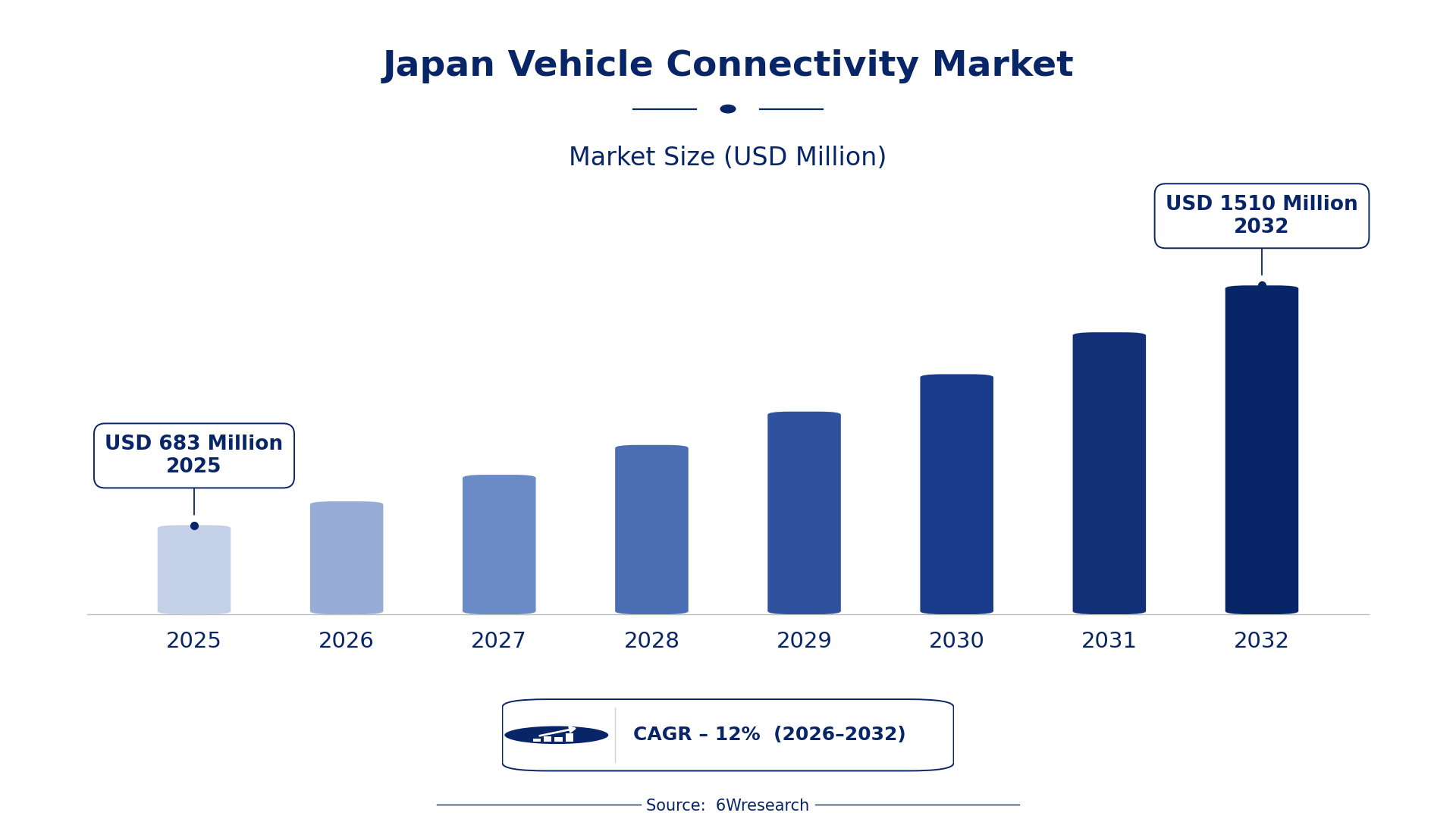
According to 6Wresearch internal database and industry insights, the Japan Vehicle Connectivity Market was valued at USD 683 Million in 2025 and is projected to reach USD 1,510 Million by 2032, growing at a CAGR of approximately 12% during 2026–2032.
Japan Vehicle Connectivity Market Highlights
| Report Metric | Details |
| Report Name | Japan Vehicle Connectivity Market (2026-2032) |
| Market Size 2025 | USD 683 Million |
| Market Size 2032 | USD 1,510 Million |
| Absolute Growth 2025–2032 | USD 827 Million |
| CAGR 2026–2032 | 12% |
| Peak Annual Growth | 12.7% in 2030 |
| Forecast Period | 2026–2032 |
| Historical Data | 2022–2025 |
| Base Year | 2025 |
| Leading Connectivity Type, 2025 | V2I (Vehicle-to-Infrastructure) (52% share) |
| Leading Technology Used, 2025 | 5G / Cellular (39% share) |
| Leading Application Use, 2025 | Safety & Collision Avoidance (37% share) |
| Leading End User, 2025 | Smart Vehicle OEMs (39% share) |
| Fastest-Growing Connectivity Type | V2C (Vehicle-to-Cloud) (17.4% CAGR) |
| Fastest-Growing Application Use | Traffic Optimization (16.3% CAGR) |
| Fastest-Growing End User | Fleet Operators (16.4% CAGR) |
| Growing Sector | Smart Vehicle Technologies |
| Key End Users | Smart Vehicle OEMs, Government Transport Departments, Fleet Operators, Autonomous Tech Providers |
Japan Vehicle Connectivity Market Year-wise Growth Rate and Key Drivers (2022–2032)
This graph illustrates the annual growth rates of the market from 2022 to 2032, highlighting a steady upward trajectory and projected market expansion over the forecast period.
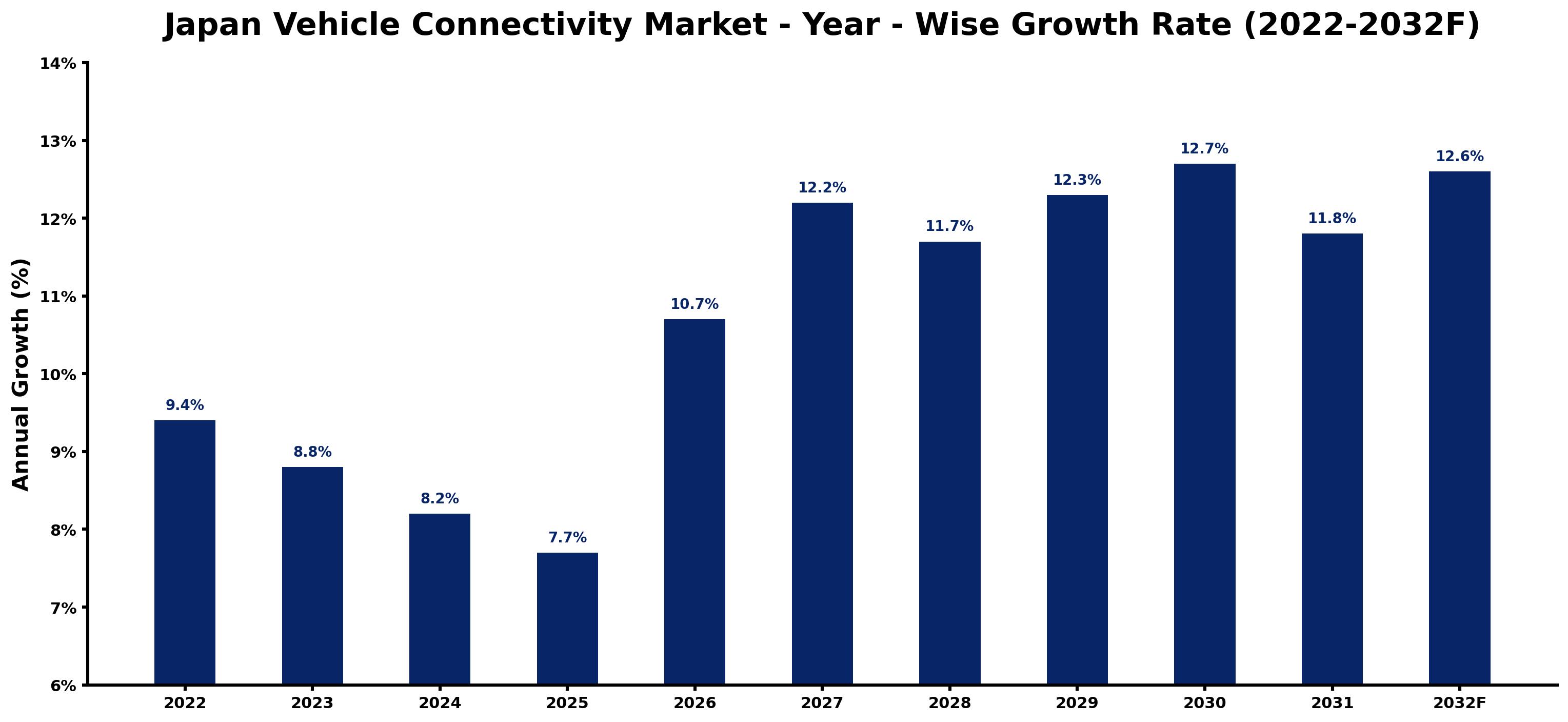
Each row of the following table gives one year's estimated growth and the event or demand shift that explains it.
| Year | Estimated Annual Growth (%) | Market Rationale |
| 2022 | 9.4 | The market experienced solid growth due to increasing consumer interest in connected vehicle technologies. |
| 2023 | 8.8 | Growth slowed as manufacturers adjusted to evolving technology standards and consumer preferences. |
| 2024 | 8.2 | Market expansion continued but at a reduced pace as competition intensified among connectivity providers. |
| 2025 | 7.7 | Demand was sustained, but growth decelerated as the market approached saturation in urban areas. |
| 2026 | 10.7 | Growth is set to accelerate with the rollout of new 5G infrastructure, enhancing connectivity capabilities. |
| 2027 | 12.2 | The market will see a further increase driven by rising investments in smart vehicle technologies. |
| 2028 | 11.7 | Growth will moderate slightly as the market stabilises after rapid expansion. |
| 2029 | 12.3 | Demand is expected to surge again as new applications of vehicle connectivity gain traction. |
| 2030 | 12.7 | The market will peak with heightened adoption of advanced connectivity solutions across sectors. |
| 2031 | 11.8 | Growth will slow as the market matures, with established players consolidating their positions. |
| 2032 | 12.6 | Demand is anticipated to rise again as new technologies and applications emerge. |
Note: Market size estimations and growth projections presented in this report are based on 6Wresearch's proprietary forecasting methodology, utilizing the latest available industry data, government publications, and primary research inputs.
Japan Vehicle Connectivity Market Synopsis
Vehicle connectivity encompasses technologies that facilitate communication between vehicles and infrastructure, primarily through protocols like DSRC and 5G. The number of connected vehicles in Japan is expected to reach 10 million by 2025, driven by increasing demand from domestic users and government initiatives. The Tokyo metropolitan area serves as a major hub for these advancements, supported by strategic government programmes aimed at improving smart mobility.
Market Dynamics Impact Analysis (2026–2032)
| Factor | Type | Impact | Primary Segment Affected |
| Growing adoption of 5G technology enhances vehicle communication capabilities. | Driver | High | 5G / Cellular |
| Increasing focus on safety and collision avoidance features drives demand. | Driver | High | Safety & Collision Avoidance |
| Investment in smart transport projects creates opportunities for connectivity solutions. | Opportunity | High | V2I (Vehicle-to-Infrastructure) |
| The rise of smart cities presents new avenues for vehicle connectivity applications. | Opportunity | High | Traffic Optimization |
| High costs of implementing advanced connectivity systems can limit market access. | Restraint | Medium | V2C (Vehicle-to-Cloud) |
| Regulatory compliance with safety standards can delay market entry for new technologies. | Restraint | Medium | DSRC / C-V2X |
| Competition among connectivity providers can lead to price wars, impacting margins. | Challenge | High | V2V (Vehicle-to-Vehicle) |
| Technological complexity in integrating systems may hinder adoption rates. | Challenge | Medium | Remote Monitoring |
Evaluation of Drivers in Japan Vehicle Connectivity Market (2026–2032)
Demand rests on the following drivers, each shown with the segment it touches most.
| Drivers | Primary Segment Affected | Why It Matters (Evidence) |
| Expansion of 5G networks across urban areas supports vehicle connectivity. | 5G / Cellular | Increased network coverage facilitates the deployment of connected vehicle technologies, with 5G expected to account for 39% of connectivity solutions by 2025. |
| Rising consumer demand for safety features boosts vehicle connectivity adoption. | Safety & Collision Avoidance | The focus on reducing traffic accidents drives investments in advanced connectivity solutions, with the safety segment expected to hold a 37% share by 2025. |
| Government initiatives promote vehicle connectivity. | V2I (Vehicle-to-Infrastructure) | These measures encourage collaboration between public and private sectors, improving infrastructure and supporting the Connected Car Roadmap. |
| The number of connected vehicles in Japan is expected to reach 10 million by 2025. | V2C (Vehicle-to-Cloud) | This growth reflects increasing consumer acceptance and technological advancements in connectivity, enhancing data exchange capabilities. |
| Public transport departments are investing in V2I technologies for better traffic management. | Traffic Optimization | These investments aim to improve urban mobility and reduce congestion through smart solutions, aligning with the Smart Mobility Strategy. |
Purchasing is picking up as the number of connected vehicles in Japan is expected to reach 10 million by 2025, driving demand for advanced solutions. The expansion of 5G networks across urban areas improves vehicle communication capabilities, leading to increased adoption among smart vehicle OEMs. Rising consumer demand for safety features propels the integration of connectivity technologies, while public transport departments invest in V2I technologies to optimise traffic management. These factors contribute to a vibrant market for vehicle connectivity solutions.
Evaluation of Restraints in Japan Vehicle Connectivity Market
These are the pressures that could keep growth below its potential.
| Market Restraint | Primary Segment Affected | Why It Matters (Evidence) |
| High implementation costs for advanced connectivity systems can deter smaller players. | V2C (Vehicle-to-Cloud) | This financial barrier limits market access for emerging companies and startups, hindering innovation in the sector. |
| Compliance with safety standards such as ISO 26262 can delay product launches. | DSRC / C-V2X | Manufacturers must invest time and resources to meet stringent regulatory requirements, extending development timelines. |
| Technological integration challenges can slow down the adoption of new systems. | Remote Monitoring | Complexity in merging different technologies may lead to delays in deployment, affecting overall market growth. |
| Market saturation in urban areas can limit growth opportunities for connectivity providers. | V2I (Vehicle-to-Infrastructure) | As competition increases, differentiation becomes more challenging for existing players, impacting profitability. |
| Regulatory hurdles may restrict the introduction of new connectivity solutions. | V2V (Vehicle-to-Vehicle) | Navigating compliance can prolong the time to market for new technologies, affecting competitive positioning. |
Japan Vehicle Connectivity Market Challenges
In Japan, regulatory requirements from the Ministry of Land, Infrastructure, Transport and Tourism have raised compliance costs for producers, delaying product launches by up to six months. Buyers face confusion due to inconsistent connectivity standards, which can extend decision-making times by an average of 20%. High development costs, averaging ¥10 billion per project, restrict many producers from adopting advanced technologies, limiting their market competitiveness. Rapid technological advancements can render existing systems obsolete within two years, forcing buyers to invest in frequent upgrades, which adds substantial financial strain.
Trends in the Japan Vehicle Connectivity Market
Buyers and suppliers in the Japan Vehicle Connectivity Market are adjusting to the following trends.
- Shift towards Advanced Safety Features: Since 2023, there has been a marked increase in the integration of safety features in vehicles, reflecting consumer demand. The Tokyo Motor Show showcased advancements in safety technologies, focusing on vehicle-to-everything (V2X) applications, which enhance overall road safety.
- Transition from Traditional to Smart Mobility: The 'Smart Mobility Strategy' launched in 2023 aims to integrate vehicle connectivity with urban planning. This initiative is expected to improve traffic management and urban mobility, aligning with Japan's sustainability goals and reducing congestion.
- Emergence of 5G as a Core Technology: As 5G networks expand, they are becoming the backbone of vehicle connectivity. By 2025, 39% of connectivity solutions are anticipated to utilise 5G technology, significantly improving data transfer speeds and enabling real-time communication.
- Urban Areas Leading Connectivity Adoption: The Tokyo metropolitan area is at the forefront of vehicle connectivity advancements, with a high concentration of smart vehicle OEMs. This region is projected to see a surge in connected vehicles, contributing to overall market growth.
Investment Opportunities in the Japan Vehicle Connectivity Market
The following areas offer the clearest openings for investors and suppliers in the Japan Vehicle Connectivity Market.
- Investment in Smart Transport Projects: Now is an ideal time to invest in smart transport projects, with the government allocating ¥50 billion in 2023. Collaborating with public transport departments can facilitate entry into the V2I market, enhancing urban mobility.
- Partnerships with Smart Vehicle OEMs: The anticipated growth of connected vehicles presents opportunities for partnerships with smart vehicle OEMs. With 10 million connected vehicles projected by 2025, suppliers can benefit from aligning with industry leaders to capture market share.
- Focus on Traffic Optimization Solutions: As urban areas face congestion, there is a growing demand for traffic optimization technologies. Investing in V2I solutions can position suppliers advantageously in the market, particularly in regions like Tokyo, where traffic management is critical.
- Expansion of 5G Infrastructure: With 5G networks being deployed, there is an opportunity for suppliers to offer connectivity solutions. Engaging with local technology providers in urban hubs can strengthen market presence and facilitate collaboration.
Government Initiatives in the Japan Vehicle Connectivity Market
The framework for vehicle connectivity in Japan is shaped by key laws, including the ISO 26262 safety standard, which mandates rigorous testing and certification of automotive systems. The GX Promotion Act, adopted in 2023, supports initiatives for sustainable transport solutions. These measures ensure that producers comply with safety and performance standards, creating a secure environment for connected vehicle technologies.
Public transport departments are utilising the GX Promotion Act to implement vehicle connectivity solutions. The Ministry of Land, Infrastructure, Transport and Tourism oversees the integration of V2I technologies, with funding allocated for smart transport projects. In 2023, the government allocated ¥50 billion to support these initiatives, promoting collaboration between public and private sectors to improve urban mobility.
Future Insight of the Japan Vehicle Connectivity Market
By 2032, buyers will benefit from enhanced vehicle connectivity as the government accelerates 5G network deployment, improving communication between vehicles and infrastructure. The 'Connected Car Roadmap' will ensure that vehicle connectivity aligns with urban planning initiatives. With the number of connected vehicles projected to reach 10 million by 2025, suppliers must prepare for a surge in demand for advanced solutions. The 'Japan Smart Mobility Challenge' will drive innovation, encouraging startups to develop new vehicle connectivity technologies.
Market Segmentation Analysis
Japan Vehicle Connectivity Market report covers a detailed analysis of the following market segments:
By Connectivity Type – V2I (Vehicle-to-Infrastructure) Leads, V2C (Vehicle-to-Cloud) Expected to Grow Fastest
According to Saurav Kr Singh, Senior Research Analyst at 6Wresearch, in 2025, V2I (Vehicle-to-Infrastructure) led the connectivity type split with a 52% share. V2I holds the largest share as it integrates vehicles with traffic management systems, which are vital for urban areas like Tokyo. The Japanese government's initiatives, such as the 'Smart Mobility Strategy', further enhance the demand for V2I technologies. Over 2026–2032, V2C (Vehicle-to-Cloud) is expected to post the fastest growth, at a CAGR of 17.4%. V2C is rapidly growing due to the increasing adoption of cloud-based services for data analytics. With projections indicating that connected vehicles will reach 10 million by 2025, V2C's significance will continue to rise. Suppliers should prioritise V2C solutions to address the growing demand for data-driven services.
By Technology Used – 5G / Cellular Leads and Records the Fastest Growth
5G / Cellular accounted for 39% of the market by technology used in 2025. 5G / Cellular technology leads the market as it facilitates high-speed data transfer crucial for effective vehicle connectivity. The ongoing deployment of 5G networks in major urban areas of Japan enhances the functionality of connected vehicles. 5G / Cellular is also forecast to expand faster than any other category, at a CAGR of 14.0% over 2026–2032. As the leading technology, 5G / Cellular's rapid deployment will further boost the growth of vehicle connectivity solutions. This will widen the gap between 5G and other technologies as new applications are developed. Suppliers must invest in 5G technologies to remain competitive in the fast-evolving vehicle connectivity market.
By Application Use – Safety & Collision Avoidance Leads, Traffic Optimization Expected to Grow Fastest
Safety & Collision Avoidance held 37% of the Japan Vehicle Connectivity Market by application use in 2025. Safety & Collision Avoidance is the foremost application of vehicle connectivity, driven by the necessity for improved road safety measures. The implementation of ISO 26262 as a safety standard underscores the significance of this application. Traffic Optimization is projected to grow fastest, at a CAGR of 16.3% during 2026–2032. Traffic Optimization is gaining momentum as urban areas strive to enhance traffic flow and alleviate congestion through advanced connectivity solutions. The government's 'Smart Mobility Strategy' underscores the urgency of tackling traffic management challenges. Buyers should concentrate on solutions that improve traffic optimization capabilities to maintain competitiveness in urban settings.
By End User – Smart Vehicle OEMs Lead, Fleet Operators Expected to Grow Fastest
With 39% of end user revenue in 2025, Smart Vehicle OEMs was the largest category. Smart Vehicle OEMs dominate the market as they are primary users of connectivity technologies, incorporating them into their vehicle designs. The concentration of smart vehicle manufacturers in the Tokyo region bolsters this segment's leadership. The quickest growth will come from Fleet Operators, forecast to expand at a CAGR of 16.4% between 2026 and 2032. Fleet Operators are increasingly embracing connectivity solutions to improve operational efficiency and cut costs. This trend is propelled by the rising demand for effective fleet management in a competitive landscape. Suppliers should customise their offerings to cater to the specific requirements of fleet operators to capture this expanding market.
Key Attractiveness of the Report
- 10 Years of Market Numbers
- Historical Data Starting from 2022 to 2025
- Base Year 2025
- Forecast Data until 2032
- Key Performance Indicators Impacting the Market
- Major Upcoming Developments and Projects
Key Highlights of the Report:
- Japan Vehicle Connectivity Market Outlook
- Market Size of Japan Vehicle Connectivity Market, 2025
- Forecast of Japan Vehicle Connectivity Market, 2032
- Historical Data and Forecast of Japan Vehicle Connectivity Revenues & Volume for the Period 2022-2032F
- Japan Vehicle Connectivity Market Trend Evolution
- Japan Vehicle Connectivity Market Drivers and Challenges
- Japan Vehicle Connectivity Price Trends
- Japan Vehicle Connectivity Porter's Five Forces
- Japan Vehicle Connectivity Industry Life Cycle
- Historical Data and Forecast of Japan Vehicle Connectivity Market Revenues & Volume By Connectivity Type for the Period 2022-2032F
- Historical Data and Forecast of Japan Vehicle Connectivity Market Revenues & Volume By V2V (Vehicle-to-Vehicle) for the Period 2022-2032F
- Historical Data and Forecast of Japan Vehicle Connectivity Market Revenues & Volume By V2I (Vehicle-to-Infrastructure) for the Period 2022-2032F
- Historical Data and Forecast of Japan Vehicle Connectivity Market Revenues & Volume By V2C (Vehicle-to-Cloud) for the Period 2022-2032F
- Historical Data and Forecast of Japan Vehicle Connectivity Market Revenues & Volume By V2P (Vehicle-to-Pedestrian) for the Period 2022-2032F
- Historical Data and Forecast of Japan Vehicle Connectivity Market Revenues & Volume By Technology Used for the Period 2022-2032F
- Historical Data and Forecast of Japan Vehicle Connectivity Market Revenues & Volume By DSRC / C-V2X for the Period 2022-2032F
- Historical Data and Forecast of Japan Vehicle Connectivity Market Revenues & Volume By 5G / Cellular for the Period 2022-2032F
- Historical Data and Forecast of Japan Vehicle Connectivity Market Revenues & Volume By LTE / 5G / Wi-Fi for the Period 2022-2032F
- Historical Data and Forecast of Japan Vehicle Connectivity Market Revenues & Volume By BLE / NFC for the Period 2022-2032F
- Historical Data and Forecast of Japan Vehicle Connectivity Market Revenues & Volume By Application Use for the Period 2022-2032F
- Historical Data and Forecast of Japan Vehicle Connectivity Market Revenues & Volume By Safety & Collision Avoidance for the Period 2022-2032F
- Historical Data and Forecast of Japan Vehicle Connectivity Market Revenues & Volume By Traffic Optimization for the Period 2022-2032F
- Historical Data and Forecast of Japan Vehicle Connectivity Market Revenues & Volume By Remote Monitoring for the Period 2022-2032F
- Historical Data and Forecast of Japan Vehicle Connectivity Market Revenues & Volume By Urban Safety Integration for the Period 2022-2032F
- Historical Data and Forecast of Japan Vehicle Connectivity Market Revenues & Volume By End User for the Period 2022-2032F
- Historical Data and Forecast of Japan Vehicle Connectivity Market Revenues & Volume By Smart Vehicle OEMs for the Period 2022-2032F
- Historical Data and Forecast of Japan Vehicle Connectivity Market Revenues & Volume By Government Transport Depts for the Period 2022-2032F
- Historical Data and Forecast of Japan Vehicle Connectivity Market Revenues & Volume By Fleet Operators for the Period 2022-2032F
- Historical Data and Forecast of Japan Vehicle Connectivity Market Revenues & Volume By Autonomous Tech Providers for the Period 2022-2032F
- Japan Vehicle Connectivity Import Export Trade Statistics
- Market Opportunity Assessment By Connectivity Type
- Market Opportunity Assessment By Technology Used
- Market Opportunity Assessment By Application Use
- Market Opportunity Assessment By End User
- Japan Vehicle Connectivity Top Companies Market Share
- Japan Vehicle Connectivity Competitive Benchmarking By Technical and Operational Parameters
- Japan Vehicle Connectivity Company Profiles
- Japan Vehicle Connectivity Key Strategic Recommendations
Market Covered
The study includes the following segmentation.
By Connectivity Type
- V2V (Vehicle-to-Vehicle)
- V2I (Vehicle-to-Infrastructure)
- V2C (Vehicle-to-Cloud)
- V2P (Vehicle-to-Pedestrian)
By Technology Used
- DSRC / C-V2X
- 5G / Cellular
- LTE / 5G / Wi-Fi
- BLE / NFC
By Application Use
- Safety & Collision Avoidance
- Traffic Optimization
- Remote Monitoring
- Urban Safety Integration
By End User
- Smart Vehicle OEMs
- Government Transport Depts
- Fleet Operators
- Autonomous Tech Providers































