Japan Vehicle Control Module Market Size & Growth Rate
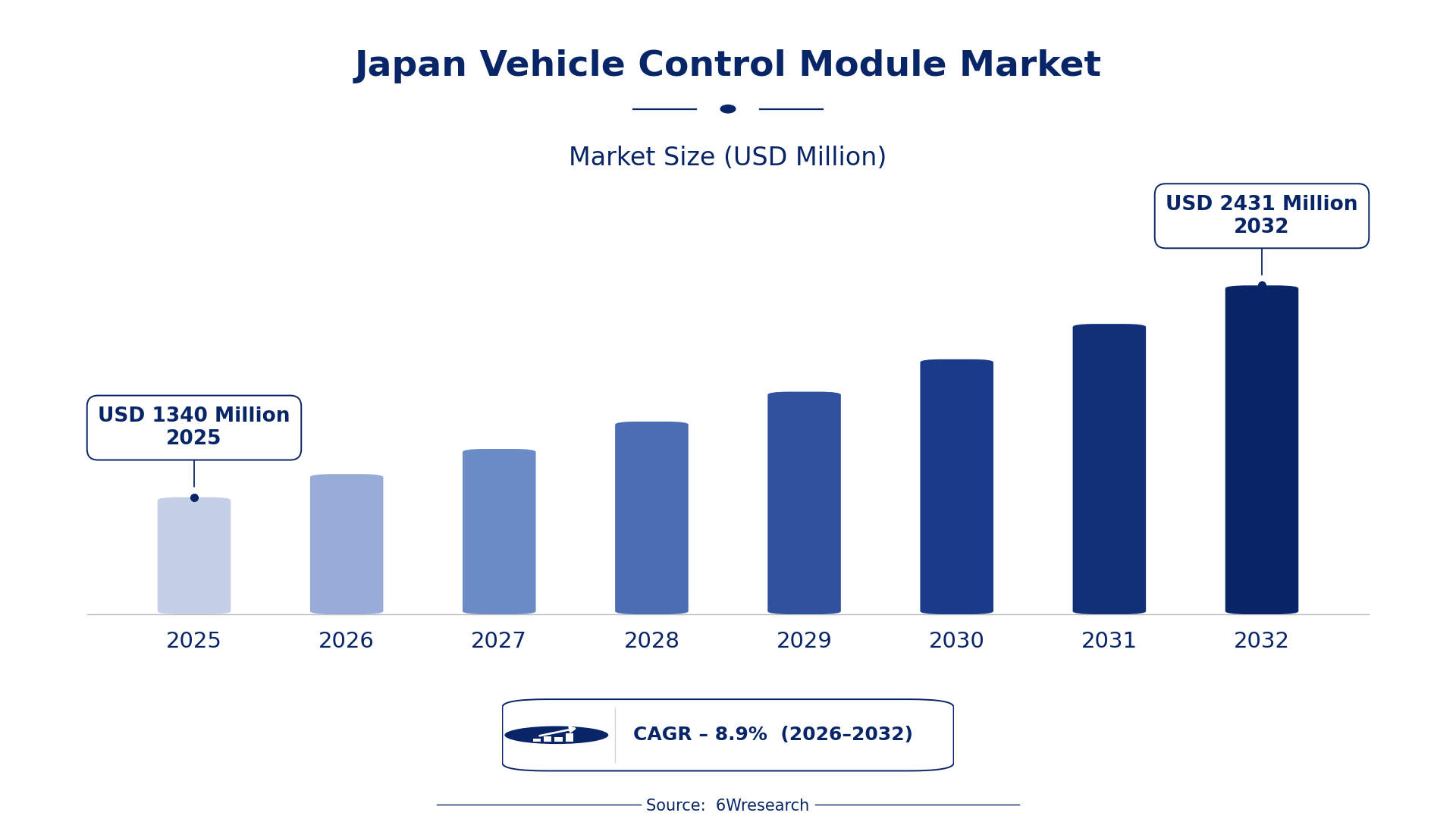
According to 6Wresearch internal database and industry insights, the Japan Vehicle Control Module Market was valued at USD 1,340 Million in 2025 and is projected to reach USD 2,431 Million by 2032, growing at a CAGR of approximately 8.9% during 2026–2032.
Japan Vehicle Control Module Market Highlights
| Report Metric | Details |
| Report Name | Japan Vehicle Control Module Market (2026-2032) |
| Market Size 2025 | USD 1,340 Million |
| Market Size 2032 | USD 2,431 Million |
| Absolute Growth 2025–2032 | USD 1,091 Million |
| CAGR 2026–2032 | 8.9% |
| Peak Annual Growth | 10.0% in 2029 |
| Forecast Period | 2026–2032 |
| Historical Data | 2022–2025 |
| Base Year | 2025 |
| Leading Module Type, 2025 | ECU (Engine Control Unit) (49% share) |
| Leading Controlled Function, 2025 | Powertrain Management (42% share) |
| Leading Communication Protocol, 2025 | CAN/LIN (47% share) |
| Leading End User, 2025 | ICE Vehicle Manufacturers (38% share) |
| Fastest-Growing Module Type | BCM (Body Control Module) (12.3% CAGR) |
| Fastest-Growing Controlled Function | Cabin Electronics (11.4% CAGR) |
| Fastest-Growing Communication Protocol | FlexRay (11.6% CAGR) |
| Fastest-Growing End User | Passenger Car OEMs (12.0% CAGR) |
| Growing Sector | automotive manufacturing |
| Key End Users | ICE Vehicle Manufacturers, Electric Vehicle Brands, Automotive OEMs |
Japan Vehicle Control Module Market Year-wise Growth Rate and Key Drivers (2022–2032)
This graph illustrates the annual growth rates of the market from 2022 to 2032, highlighting a steady upward trajectory and projected market expansion over the forecast period.
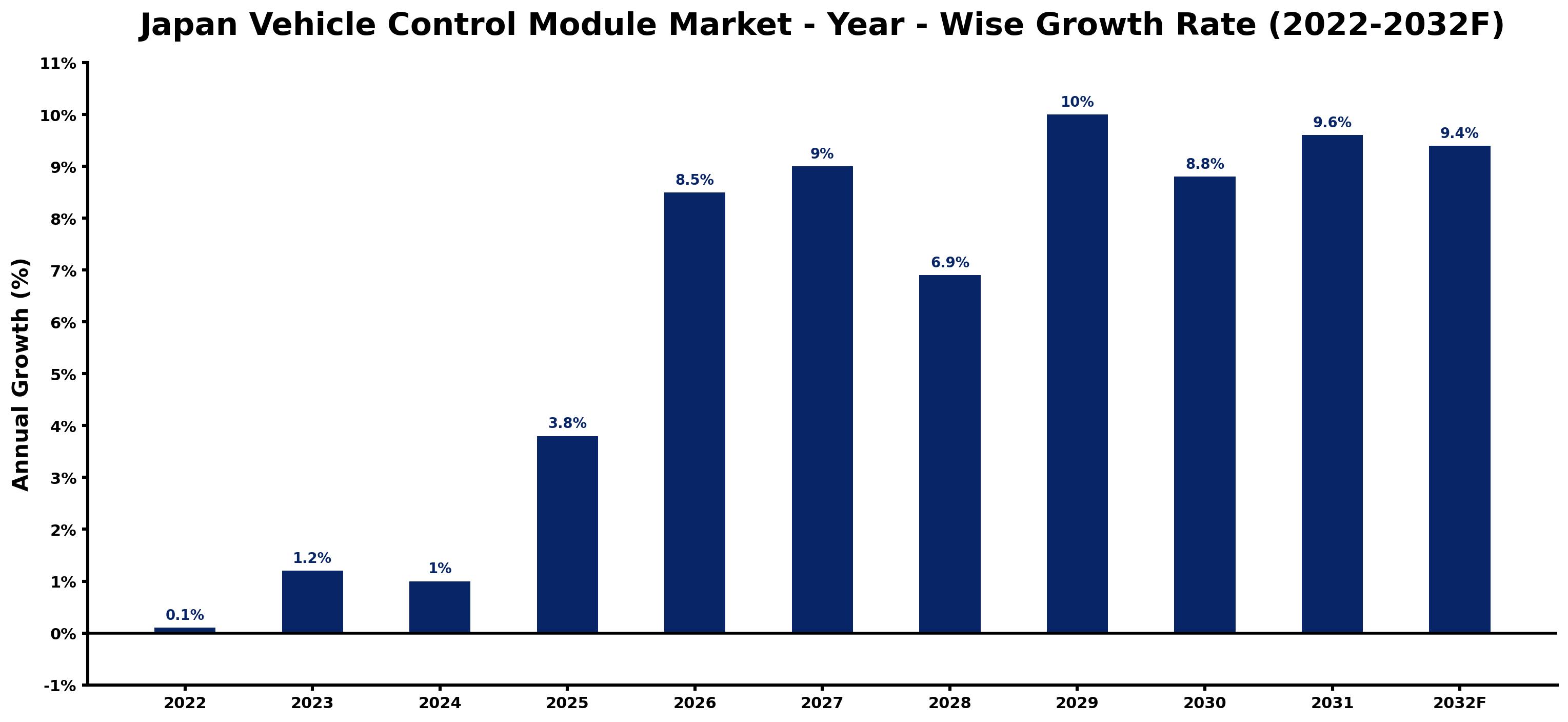
Each row of the following table gives one year's estimated growth and the event or demand shift that explains it.
| Year | Estimated Annual Growth (%) | Market Rationale |
| 2022 | 0.1 | The market showed minimal growth due to ongoing adjustments in production capacity. |
| 2023 | 1.2 | Demand increased as manufacturers began to recover from supply chain disruptions. |
| 2024 | 1.0 | Growth slowed as sourcing components became more challenging for manufacturers. |
| 2025 | 3.8 | The market grew faster as production ramped up following improved supply chains. |
| 2026 | 8.5 | Demand is expected to surge with increased investments in electric vehicle technologies. |
| 2027 | 9.0 | Growth will continue as automotive manufacturers expand their production capabilities. |
| 2028 | 6.9 | A slowdown is projected as the market stabilises after rapid growth. |
| 2029 | 10.0 | The market will peak due to heightened demand for advanced vehicle technologies. |
| 2030 | 8.8 | Growth is expected to slow as manufacturers adjust to market saturation. |
| 2031 | 9.6 | Demand will rise again as new technologies are adopted in vehicles. |
| 2032 | 9.4 | The market will continue to grow, driven by ongoing innovations in vehicle control. |
Note: Market size estimations and growth projections presented in this report are based on 6Wresearch's proprietary forecasting methodology, utilizing the latest available industry data, government publications, and primary research inputs.
Japan Vehicle Control Module Market Synopsis
Vehicle Control Modules (VCMs) are electronic devices that manage functions such as engine performance and climate settings. The Japan Vehicle Control Module Market is growing, with the automotive sector producing approximately 8.3 million vehicles in 2022. Key drivers include investments in electric vehicle technologies and a strong emphasis on reducing emissions. Government initiatives to promote electric vehicle adoption and the push for advanced automotive technologies create a vibrant market environment that supports growth.
Market Dynamics Impact Analysis (2026–2032)
| Factor | Type | Impact | Primary Segment Affected |
| Rising investments in electric vehicle technologies are driving demand for advanced VCMs. | Driver | High | Powertrain Management |
| The increasing number of automotive patents filed indicates a focus on innovation. | Driver | High | Cabin Electronics |
| The push for electric vehicle adoption creates opportunities for advanced control modules. | Opportunity | High | Electric Vehicle Brands |
| Growing demand for enhanced vehicle safety features opens new markets for VCMs. | Opportunity | High | ICE Vehicle Manufacturers |
| Supply chain disruptions have affected the availability of components for VCMs. | Restraint | High | HVAC Control Module |
| The average age of vehicles in Japan limits the replacement rate of VCMs. | Restraint | Medium | ECU (Engine Control Unit) |
| High development costs for advanced VCMs can deter smaller manufacturers. | Challenge | High | ECU (Engine Control Unit) |
| Competition from international manufacturers may pressure local producers. | Challenge | Medium | ECU (Engine Control Unit) |
Evaluation of Drivers in Japan Vehicle Control Module Market (2026–2032)
The main growth drivers and the segments they affect most are set out below.
| Drivers | Primary Segment Affected | Why It Matters (Evidence) |
| Increased investment in electric vehicle technologies drives demand for VCMs. | Powertrain Management | Japan's automotive industry invests approximately $20 billion annually in R&D. |
| Growing focus on reducing vehicle emissions fuels demand for advanced VCMs. | HVAC Control Module | Japan targets a 46% cut in greenhouse-gas emissions by 2030. |
| The rise in automotive patents indicates a trend towards innovation in VCMs. | Cabin Electronics | The number of automotive patents filed in Japan reached 15,000 in 2022. |
| Expansion of automotive manufacturing in the Tokyo region boosts VCM demand. | ECU (Engine Control Unit) | The Tokyo region is a major hub for automotive manufacturing. |
| The increasing number of registered electric vehicles expands the market for VCMs. | Electric Vehicle Brands | The number of registered electric vehicles in Japan reached 300,000 in 2023. |
Buyers are adding capacity as investments in electric vehicle technologies rise, with approximately $20 billion allocated annually by the automotive industry. The focus on reducing greenhouse gas emissions, targeting a 46% cut by 2030, drives demand for advanced Vehicle Control Modules. The surge in automotive patents reflects a strong trend towards innovation in vehicle control systems. The expansion of automotive manufacturing in key regions boosts demand for Body Control Modules. The growing number of registered electric vehicles further expands the market for VCMs.
Evaluation of Restraints in Japan Vehicle Control Module Market
The main factors holding the market back are set out below.
| Market Restraint | Primary Segment Affected | Why It Matters (Evidence) |
| Supply chain disruptions have limited the availability of essential components for VCMs. | HVAC Control Module | Manufacturers faced challenges in sourcing components due to global supply chain issues. |
| The average age of vehicles in Japan restricts the frequency of VCM replacements. | ECU (Engine Control Unit) | With an average vehicle age of around 13 years, replacement rates are low. |
| High development costs for advanced VCMs may deter smaller manufacturers from entering the market. | Powertrain Management | Smaller firms struggle to invest in the necessary technology and R&D. |
| Limited consumer awareness of advanced vehicle technologies can hinder market growth. | Cabin Electronics | Consumers may not fully understand the benefits of advanced VCMs. |
| Regulatory hurdles can slow down the introduction of new VCM technologies. | Powertrain Management | Compliance with standards like ISO 26262 requires significant investment and time. |
Japan Vehicle Control Module Market Challenges
High production costs for vehicle control modules limit buyers' options, as Japan's national minimum wage rose to JPY 1,055 per hour in October 2024, raising overall expenses. Regulatory requirements from the Ministry of Land, Infrastructure, Transport and Tourism create complexities for suppliers, causing delays that can extend product launch timelines by up to six months. Rapid technological changes in automotive electronics necessitate substantial investment, which can strain smaller suppliers and threaten their market viability. Intense competition among over 100 automotive OEMs in Japan drives prices down, squeezing margins for producers and restricting their capacity to invest in new technologies.
Trends in the Japan Vehicle Control Module Market
Below are the shifts with the largest effect on the Japan Vehicle Control Module Market.
- Transition from Conventional to Electric Vehicle Control Modules: Japan is transitioning from traditional VCMs to those designed for electric vehicles, reflecting the need for advanced control systems. The number of registered electric vehicles reached 300,000 in 2023, indicating a market shift.
- Surge in Patents for Automotive Technologies: The automotive sector is experiencing a rise in patent filings, reflecting a strong focus on innovation. In 2022, Japan filed around 15,000 automotive patents, showcasing the industry's commitment to advancing vehicle technologies.
- Growing Demand for Enhanced Vehicle Safety Features: There is an increasing emphasis on safety features in vehicles, leading to higher demand for advanced VCMs. The automotive industry in Japan contributed about 20% to the country's manufacturing output, highlighting its importance.
- Expansion of Automotive Manufacturing in Tokyo: The Tokyo region is becoming a key hub for automotive manufacturing, driving demand for VCMs. Japan produced approximately 8.3 million vehicles in 2022, underscoring the region's significance in the automotive sector.
Investment Opportunities in the Japan Vehicle Control Module Market
The following opportunities in the Japan Vehicle Control Module Market pair current demand with a clear way in.
- Electric Vehicle Brands Seeking Advanced Control Modules: Electric Vehicle Brands are seeking advanced Vehicle Control Modules to improve performance. With Japan's target for 100% electric vehicle sales by 2035, suppliers can invest in tailored VCM solutions.
- Timing for Investment in Climate-Safe Technologies: The push for climate-safe technologies is creating a ripe opportunity for new investments. Japan's goal for 100% electric vehicle sales by 2035 presents a market entry point for innovative solutions.
- Automotive Manufacturing Facilities in Tokyo: The automotive manufacturing facilities in the Tokyo region are expanding, creating demand for VCMs. Suppliers can enter this market by establishing partnerships with local manufacturers.
- Rising Demand for Innovative Body Control Modules: The demand for innovative Body Control Modules is increasing as manufacturers aim to enhance vehicle comfort. Investing in R&D for these modules can meet the needs of ICE Vehicle Manufacturers.
Government Initiatives in the Japan Vehicle Control Module Market
The Electrical Appliance and Material Safety Act, enacted in 1961, regulates the safety of electrical components in vehicles, ensuring that Vehicle Control Modules meet stringent safety standards. The Green Growth Strategy, updated in 2021, identifies key sectors for growth, including automotive technology, promoting investments in advanced vehicle control systems.
The Ministry of Land, Infrastructure, Transport and Tourism oversees automotive regulations, ensuring compliance with safety standards. The Battery Industry Strategy, launched in August 2022, aims to boost domestic battery manufacturing capacity, supporting the electric vehicle sector and influencing the demand for advanced Vehicle Control Modules.
Future Insight of the Japan Vehicle Control Module Market
The investment pipeline in automotive R&D will expand, driven by the sector's allocation of approximately $20 billion annually, creating demand for vehicle control modules. By 2032, Japan's commitment to a 46% reduction in greenhouse gas emissions will accelerate the adoption of advanced standards like ISO 26262, improving safety in automotive electronics. The government's goal for 100% electric vehicle sales by 2035 will stimulate market growth and create new opportunities for suppliers. As the industry evolves, the number of registered electric vehicles reached 300,000 in 2023, indicating a growing market for innovative technologies.
Market Segmentation Analysis
Japan Vehicle Control Module Market report covers a detailed analysis of the following market segments:
By Module Type – ECU (Engine Control Unit) Leads, BCM (Body Control Module) Expected to Grow Fastest
According to Saurav Kr Singh, Senior Research Analyst at 6Wresearch, ECU (Engine Control Unit) took 49% of module type revenue in 2025, more than any other category. The ECU commands the largest share due to its vital role in managing engine performance, which directly impacts vehicle efficiency and emissions. With Japan producing approximately 8.3 million vehicles in 2022, the demand for ECUs is robust and consistent. BCM (Body Control Module) is projected to grow fastest, at a CAGR of 12.3% during 2026–2032. The BCM is witnessing rapid growth driven by increasing consumer preferences for enhanced comfort and control features in vehicles. As the average age of vehicles in Japan is around 13 years, older models are being upgraded with advanced body control functionalities, fuelling this demand. Suppliers should focus on developing BCM solutions to meet the rising consumer expectations for vehicle comfort.
By Controlled Function – Powertrain Management Leads, Cabin Electronics Expected to Grow Fastest
The largest controlled function category in 2025 was Powertrain Management, at 42% of revenue. Powertrain Management holds the leading position as it is crucial for optimising vehicle performance, ensuring efficiency and compliance with emissions regulations. The automotive sector's contribution of about 20% to Japan's manufacturing output highlights the importance of this function for manufacturers. Over 2026–2032, Cabin Electronics is expected to post the fastest growth, at a CAGR of 11.4%. Cabin Electronics is experiencing rapid growth as consumer preferences shift towards enhanced user experiences and advanced control systems in vehicles. The current push for electric vehicle adoption is further accelerating the demand for sophisticated cabin technology. Buyers will benefit from investing in advanced cabin electronics to improve user satisfaction and vehicle appeal.
By Communication Protocol – CAN/LIN Leads, FlexRay Expected to Grow Fastest
CAN/LIN accounted for 47% of the market by communication protocol in 2025. CAN/LIN protocols dominate the market as they are standard communication methods in vehicles, ensuring compatibility and reliability across various systems. Their widespread adoption among over 100 automotive OEMs in Japan reinforces their leading position. The quickest growth will come from FlexRay, forecast to expand at a CAGR of 11.6% between 2026 and 2032. FlexRay is gaining traction due to its application in high-speed automotive systems, particularly in advanced driver-assistance technologies. As the automotive industry invests heavily in R&D, the demand for faster communication protocols is expected to rise. Suppliers should consider expanding their offerings to include FlexRay solutions to cater to the growing need for high-speed communication.
By End User – ICE Vehicle Manufacturers Lead, Passenger Car OEMs Expected to Grow Fastest
With 38% of end user revenue in 2025, ICE Vehicle Manufacturers was the largest category. ICE Vehicle Manufacturers represent the largest user group of VCMs in traditional vehicles, reflecting the ongoing reliance on internal combustion engines within Japan's automotive sector. With over 5 million people employed in this industry, their demand for VCMs remains significant. Passenger Car OEMs are set to record the highest CAGR in this split, 12.0% over 2026–2032. Passenger Car OEMs are growing quickly as they adapt to changing market dynamics and consumer preferences, particularly in relation to electric vehicle transitions. This shift is likely to increase their consumption of various VCM types, driving further growth in the segment. Suppliers should align their strategies with the evolving needs of passenger car OEMs to seize emerging market opportunities.
Key Attractiveness of the Report
- 10 Years of Market Numbers
- Historical Data Starting from 2022 to 2025
- Base Year 2025
- Forecast Data until 2032
- Key Performance Indicators Impacting the Market
- Major Upcoming Developments and Projects
Key Highlights of the Report:
- Japan Vehicle Control Module Market Outlook
- Market Size of Japan Vehicle Control Module Market, 2025
- Forecast of Japan Vehicle Control Module Market, 2032
- Historical Data and Forecast of Japan Vehicle Control Module Revenues & Volume for the Period 2022-2032F
- Japan Vehicle Control Module Market Trend Evolution
- Japan Vehicle Control Module Market Drivers and Challenges
- Japan Vehicle Control Module Price Trends
- Japan Vehicle Control Module Porter's Five Forces
- Japan Vehicle Control Module Industry Life Cycle
- Historical Data and Forecast of Japan Vehicle Control Module Market Revenues & Volume By Module Type for the Period 2022-2032F
- Historical Data and Forecast of Japan Vehicle Control Module Market Revenues & Volume By ECU (Engine Control Unit) for the Period 2022-2032F
- Historical Data and Forecast of Japan Vehicle Control Module Market Revenues & Volume By BCM (Body Control Module) for the Period 2022-2032F
- Historical Data and Forecast of Japan Vehicle Control Module Market Revenues & Volume By TCU (Transmission Control) for the Period 2022-2032F
- Historical Data and Forecast of Japan Vehicle Control Module Market Revenues & Volume By HVAC Control Module for the Period 2022-2032F
- Historical Data and Forecast of Japan Vehicle Control Module Market Revenues & Volume By Controlled Function for the Period 2022-2032F
- Historical Data and Forecast of Japan Vehicle Control Module Market Revenues & Volume By Powertrain Management for the Period 2022-2032F
- Historical Data and Forecast of Japan Vehicle Control Module Market Revenues & Volume By Cabin Electronics for the Period 2022-2032F
- Historical Data and Forecast of Japan Vehicle Control Module Market Revenues & Volume By Gear Shifting for the Period 2022-2032F
- Historical Data and Forecast of Japan Vehicle Control Module Market Revenues & Volume By Climate Settings for the Period 2022-2032F
- Historical Data and Forecast of Japan Vehicle Control Module Market Revenues & Volume By Communication Protocol for the Period 2022-2032F
- Historical Data and Forecast of Japan Vehicle Control Module Market Revenues & Volume By CAN/LIN for the Period 2022-2032F
- Historical Data and Forecast of Japan Vehicle Control Module Market Revenues & Volume By FlexRay for the Period 2022-2032F
- Historical Data and Forecast of Japan Vehicle Control Module Market Revenues & Volume By OBD-II for the Period 2022-2032F
- Historical Data and Forecast of Japan Vehicle Control Module Market Revenues & Volume By Proprietary Bus for the Period 2022-2032F
- Historical Data and Forecast of Japan Vehicle Control Module Market Revenues & Volume By End User for the Period 2022-2032F
- Historical Data and Forecast of Japan Vehicle Control Module Market Revenues & Volume By ICE Vehicle Manufacturers for the Period 2022-2032F
- Historical Data and Forecast of Japan Vehicle Control Module Market Revenues & Volume By Passenger Car OEMs for the Period 2022-2032F
- Historical Data and Forecast of Japan Vehicle Control Module Market Revenues & Volume By Automotive OEMs for the Period 2022-2032F
- Historical Data and Forecast of Japan Vehicle Control Module Market Revenues & Volume By Electric Vehicle Brands for the Period 2022-2032F
- Japan Vehicle Control Module Import Export Trade Statistics
- Market Opportunity Assessment By Module Type
- Market Opportunity Assessment By Controlled Function
- Market Opportunity Assessment By Communication Protocol
- Market Opportunity Assessment By End User
- Japan Vehicle Control Module Top Companies Market Share
- Japan Vehicle Control Module Competitive Benchmarking By Technical and Operational Parameters
- Japan Vehicle Control Module Company Profiles
- Japan Vehicle Control Module Key Strategic Recommendations
Market Covered
This report examines the market across the segments below.
By Module Type
- ECU (Engine Control Unit)
- BCM (Body Control Module)
- TCU (Transmission Control)
- HVAC Control Module
By Controlled Function
- Powertrain Management
- Cabin Electronics
- Gear Shifting
- Climate Settings
By Communication Protocol
- CAN/LIN
- FlexRay
- OBD-II
- Proprietary Bus
By End User
- ICE Vehicle Manufacturers
- Passenger Car OEMs
- Automotive OEMs
- Electric Vehicle Brands































