Japan Vehicle Control Sensor Market Size & Growth Rate
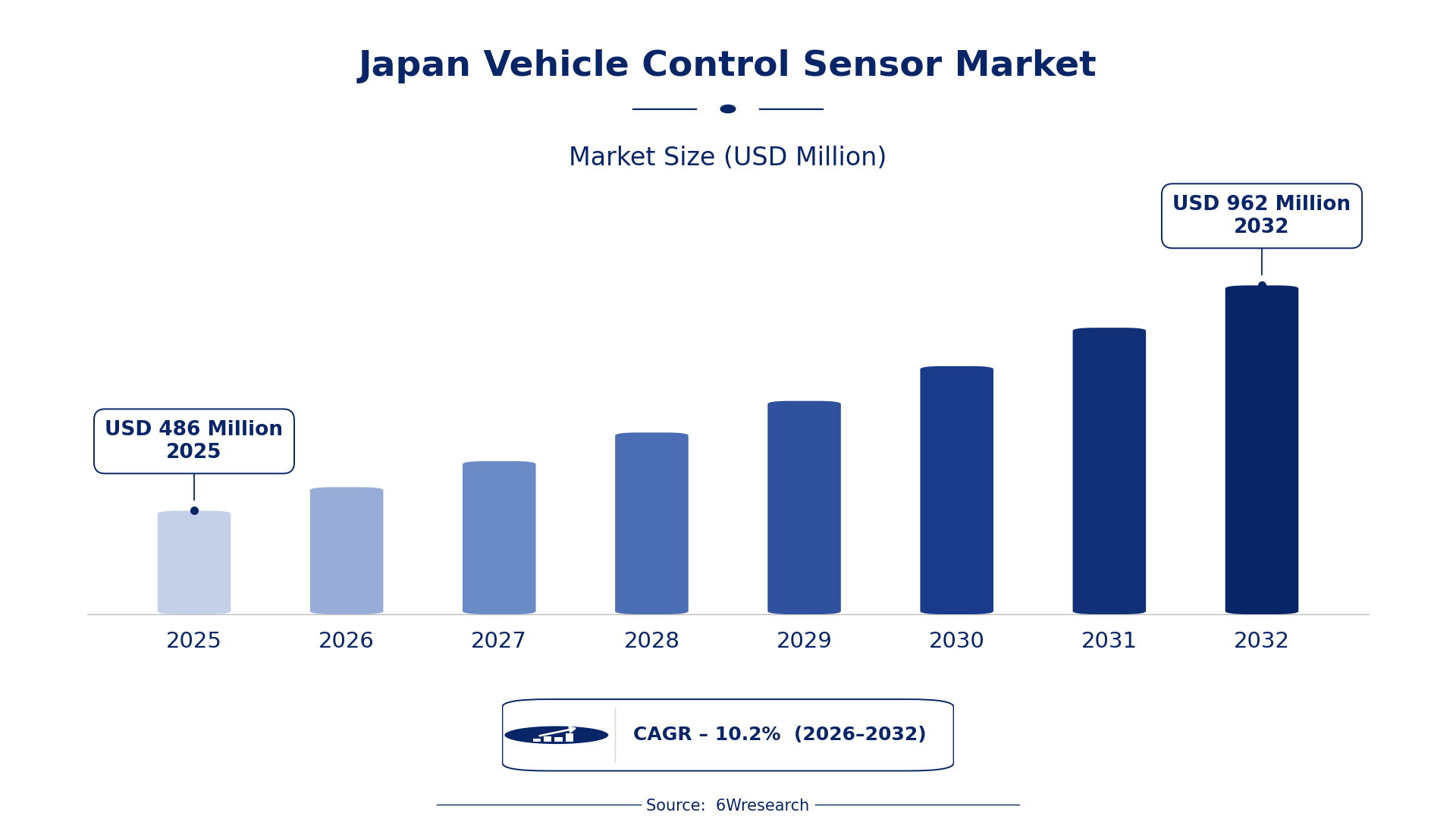
According to 6Wresearch internal database and industry insights, the Japan Vehicle Control Sensor Market was valued at USD 486 Million in 2025 and is projected to reach USD 962 Million by 2032, growing at a CAGR of approximately 10.2% during 2026–2032.
Japan Vehicle Control Sensor Market Highlights
| Report Metric | Details |
| Report Name | Japan Vehicle Control Sensor Market (2026-2032) |
| Market Size 2025 | USD 486 Million |
| Market Size 2032 | USD 962 Million |
| Absolute Growth 2025–2032 | USD 476 Million |
| CAGR 2026–2032 | 10.2% |
| Peak Annual Growth | 11.1% in 2028 |
| Forecast Period | 2026–2032 |
| Historical Data | 2022–2025 |
| Base Year | 2025 |
| Leading Sensor Type, 2025 | Brake Pedal Position Sensor (39% share) |
| Leading Detection Target, 2025 | Pressure/Position (36% share) |
| Leading Signal Output Type, 2025 | Analog/Digital (37% share) |
| Leading End User, 2025 | ABS System Manufacturers (36% share) |
| Fastest-Growing Sensor Type | Steering Angle Sensor (14.7% CAGR) |
| Fastest-Growing Detection Target | Rotation Input (13.2% CAGR) |
| Fastest-Growing Signal Output Type | CAN Output (14.9% CAGR) |
| Fastest-Growing End User | ADAS Integrators (13.6% CAGR) |
| Growing Sector | ADAS Integrators |
| Key End Users | ABS System Manufacturers, ADAS Integrators, ICE OEMs, Electric Car OEMs |
Japan Vehicle Control Sensor Market Year-wise Growth Rate and Key Drivers (2022–2032)
This graph illustrates the annual growth rates of the market from 2022 to 2032, highlighting a steady upward trajectory and projected market expansion over the forecast period.
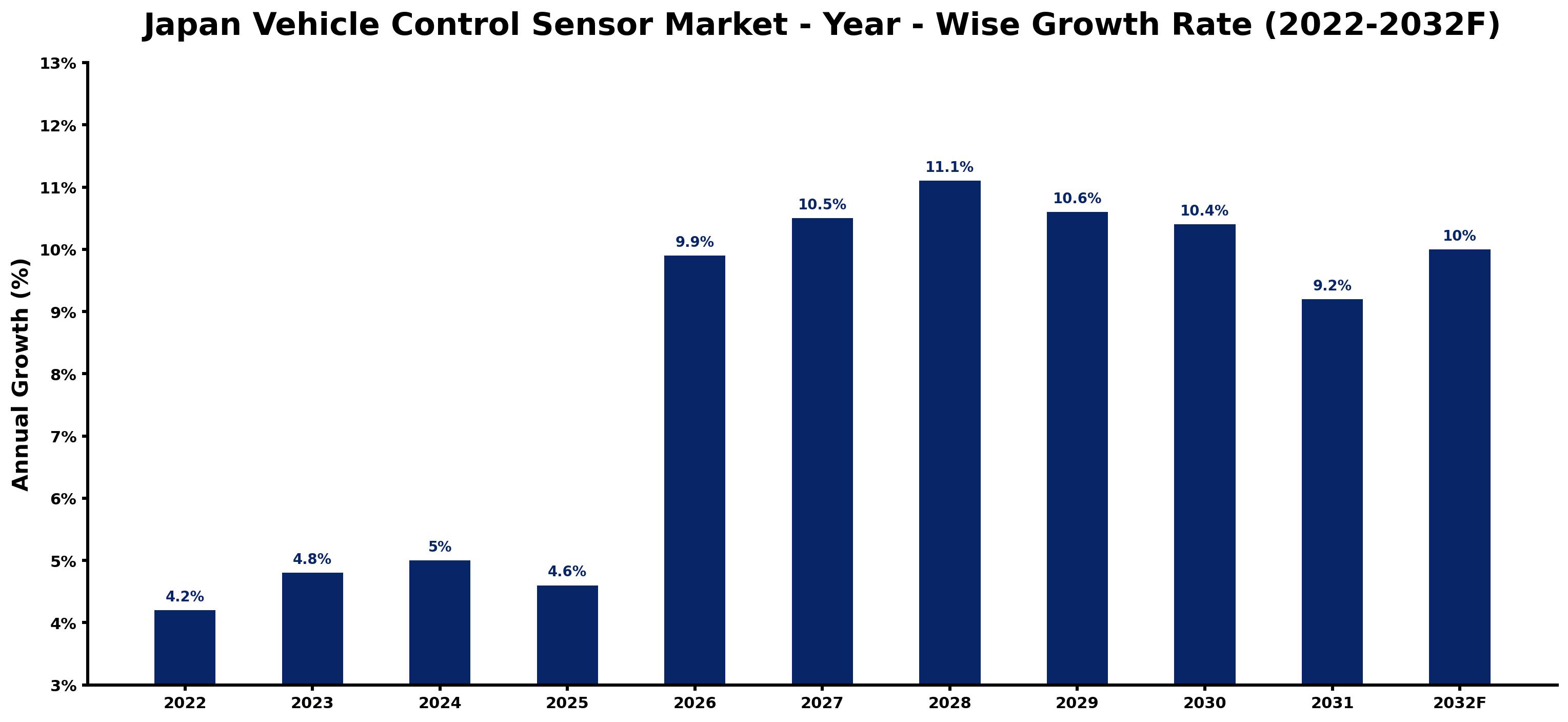
The following figures match every annual growth estimate with the main market development of that year, giving the reasoning behind each rise or slowdown.
| Year | Estimated Annual Growth (%) | Market Rationale |
| 2022 | 4.2 | The market saw steady growth due to strong automotive production figures. |
| 2023 | 4.8 | Growth accelerated as manufacturers increased sensor integration in vehicles. |
| 2024 | 5.0 | Demand continued to rise, driven by advancements in vehicle safety technologies. |
| 2025 | 4.6 | Growth slowed slightly as manufacturers adjusted to market saturation. |
| 2026 | 9.9 | A surge in electric vehicle production is expected to boost sensor demand. |
| 2027 | 10.5 | Increased focus on advanced driver-assistance systems will spur further growth. |
| 2028 | 11.1 | Demand is projected to peak as new regulations mandate improved safety features in vehicles. |
| 2029 | 10.6 | Growth will slow as the market begins to stabilise after rapid expansion. |
| 2030 | 10.4 | A slight slowdown in growth is expected as manufacturers face supply chain challenges. |
| 2031 | 9.2 | Market growth will continue to slow as competition intensifies among suppliers. |
| 2032 | 10.0 | Demand is expected to rise again as new technologies are introduced. |
Note: Market size estimations and growth projections presented in this report are based on 6Wresearch's proprietary forecasting methodology, utilizing the latest available industry data, government publications, and primary research inputs.
Japan Vehicle Control Sensor Market Synopsis
Vehicle control sensors are electronic devices that monitor and control critical functions in vehicles, such as braking and acceleration. The Japan Vehicle Control Sensor Market is expanding, driven by the production of 8.3 million vehicles in 2022 and the increasing integration of advanced driver-assistance systems. Investments in automotive research and development, amounting to ¥1 trillion in 2022, are advancing sensor technology. The rising focus on compliance with safety regulations is propelling market demand as manufacturers aim to meet evolving standards.
Market Dynamics Impact Analysis (2026–2032)
| Factor | Type | Impact | Primary Segment Affected |
| Increasing vehicle production in Japan is driving sensor demand. | Driver | High | Brake Pedal Position Sensor |
| The rise of electric vehicles necessitates advanced sensor integration. | Driver | High | Steering Angle Sensor |
| The Tokyo region's automotive manufacturing hub creates opportunities for sensor suppliers. | Opportunity | High | Throttle Position Sensor |
| Growing investments in automotive R&D present avenues for sensor innovation. | Opportunity | High | Gear Selector Sensor |
| Supply chain disruptions hinder timely sensor production. | Restraint | Medium | Pressure/Position |
| Stringent safety regulations may increase compliance costs for manufacturers. | Restraint | High | Rotation Input |
| Competition from international sensor manufacturers pressures local suppliers. | Challenge | High | Acceleration Input |
| Technological advancements require continuous investment from manufacturers. | Challenge | Medium | Gear State |
Evaluation of Drivers in Japan Vehicle Control Sensor Market (2026–2032)
These are the developments adding the most demand over the forecast period.
| Drivers | Primary Segment Affected | Why It Matters (Evidence) |
| Rising vehicle production in Japan fuels sensor demand. | Brake Pedal Position Sensor | Japan produced 8.3 million vehicles in 2022, increasing the need for essential braking sensors. |
| Electric vehicle adoption drives demand for advanced sensors. | Steering Angle Sensor | The Electric Vehicle Strategy 2030 aims for 20% of new vehicles to be electric, necessitating enhanced sensor integration. |
| The integration of advanced driver-assistance systems boosts sensor requirements. | Throttle Position Sensor | Over 90% of new vehicles in Japan are equipped with ADAS, increasing the need for various sensors. |
| Investments in automotive R&D enhance sensor technology development. | Gear Selector Sensor | In 2022, Japan's automotive sector invested ¥1 trillion in R&D, impacting sensor innovations. |
| Compliance with safety regulations necessitates sensor upgrades. | Pressure/Position | The JIS D 0201 standard governs automotive sensor performance, driving demand for compliant products. |
Most of the extra volume comes from the rising vehicle production in Japan, which reached 8.3 million units in 2022, driving demand for essential braking sensors. The integration of advanced driver-assistance systems has led to over 90% of new vehicles being equipped with these technologies, further increasing demand for various sensors. The ongoing shift towards electric vehicles is also a key factor, necessitating advanced integration to support new functionalities. Compliance with the JIS D 0201 standard drives manufacturers to upgrade their sensor offerings, ensuring they meet the latest safety requirements.
Evaluation of Restraints in Japan Vehicle Control Sensor Market
The key brakes on demand, and where they bite hardest, are shown below.
| Market Restraint | Primary Segment Affected | Why It Matters (Evidence) |
| Supply chain disruptions hinder timely sensor production. | Pressure/Position | Manufacturers face delays in sourcing materials, impacting sensor availability and production timelines. |
| Stringent safety regulations may increase compliance costs for manufacturers. | Rotation Input | Compliance with evolving standards raises operational costs for sensor producers, affecting pricing strategies. |
| Competition from international sensor manufacturers pressures local suppliers. | Acceleration Input | Local manufacturers struggle to compete with lower-cost imports, impacting market share and profitability. |
| Technological advancements require continuous investment from manufacturers. | Gear State | Staying competitive necessitates ongoing R&D spending, straining financial resources for smaller firms. |
| Market saturation limits growth potential for existing sensor products. | Throttle Position Sensor | With many vehicles already equipped with sensors, new sales opportunities are constrained. |
Japan Vehicle Control Sensor Market Challenges
In 2022, Japan produced 8.3 million vehicles, yet a shortage of skilled workers has delayed sensor production timelines, impacting manufacturers' ability to meet rising demand. Local suppliers face increased competition from international markets, forcing them to lower prices, which compromises the quality and reliability of sensors for buyers. Supply chain disruptions in semiconductor availability have led to longer lead times for essential components, causing delays for automotive producers. Buyers now confront rising costs as the average vehicle is equipped with 30-40 sensors, pushing up overall vehicle prices amid tightening margins.
Trends in the Japan Vehicle Control Sensor Market
Several trends are reshaping the Japan Vehicle Control Sensor Market; the most important are set out below.
- Shift Towards Advanced Driver-Assistance Systems: In 2023, over 90% of new vehicles in Japan are equipped with advanced driver-assistance systems, highlighting a growing trend. This shift necessitates a greater demand for vehicle control sensors, improving safety and performance.
- Transition from Traditional to Electric Vehicles: The target of 20% of new vehicles being electric by 2030 is driving demand for advanced vehicle control sensors that support electric vehicle functionalities.
- Emerging Focus on Safety Regulations: The introduction of the JIS D 0201 standard in Japan has heightened the focus on safety regulations. This trend is prompting manufacturers to invest in higher-quality vehicle control sensors to meet compliance requirements.
- Growing Investment in Automotive R&D: Japan's automotive sector invested ¥1 trillion in R&D in 2022, reflecting a growing trend. This investment is driving innovation in vehicle control sensors, ensuring competitiveness in the global market.
Investment Opportunities in the Japan Vehicle Control Sensor Market
Investors looking at the Japan Vehicle Control Sensor Market should consider the following areas.
- Tokyo as a Hub for Sensor Production: The Tokyo region is a major hub for automotive manufacturing, with an increasing demand for vehicle control sensors. The market gap is clear as Japan produced 8.3 million vehicles in 2022, necessitating local partnerships for sensor supply.
- Investment in Electric Vehicle Components: With the aim for 20% of new vehicles to be electric by 2030, there is a notable opportunity to supply advanced vehicle control sensors. Collaborating with electric car OEMs in Aichi Prefecture can facilitate market entry.
- Growing Demand for Compliance Solutions: The rising focus on safety regulations presents an opportunity to develop compliant vehicle control sensors. Manufacturers can invest in R&D to meet the JIS D 0201 standard, ensuring market relevance.
- Expansion of ADAS Technologies: The increasing integration of advanced driver-assistance systems creates a demand for innovative vehicle control sensors. Suppliers can target ABS system manufacturers in the Tokyo region to meet this growing need.
Government Initiatives in the Japan Vehicle Control Sensor Market
The Economic Security Promotion Act (2022) supports supply-chain resilience for designated critical products and materials, adding to existing regulations. This measure encourages local manufacturers to invest in robust supply chains, ensuring timely production of vehicle control sensors.
In 2023, the government allocated ¥500 billion for green technology initiatives, including automotive sensors, administered by the Ministry of Land, Infrastructure, Transport and Tourism. This funding aims to improve the development and integration of advanced sensor technologies in vehicles.
Future Insight of the Japan Vehicle Control Sensor Market
The shift towards electric vehicles will drive sensor demand, as the government aims for 20% of new vehicles to be electric by 2030. By 2032, the adoption of the ISO 26262 standard will enhance safety protocols, ensuring sensors meet stringent functional safety requirements. The government's ¥500 billion investment in green technology initiatives will spur innovation in sensor technologies, benefiting both suppliers and buyers. As Japan targets a 46% reduction in greenhouse-gas emissions by 2030, the integration of advanced driver-assistance systems in vehicles will accelerate.
Market Segmentation Analysis
Japan Vehicle Control Sensor Market report covers a detailed analysis of the following market segments:
By Sensor Type – Brake Pedal Position Sensor Leads, Steering Angle Sensor Expected to Grow Fastest
According to Saurav Kr Singh, Senior Research Analyst at 6Wresearch, Brake Pedal Position Sensor took 39% of sensor type revenue in 2025, more than any other category. The Brake Pedal Position Sensor is indispensable for ensuring the braking system functions correctly, which is vital for vehicle safety. In Japan, where over 90% of new vehicles are equipped with advanced driver-assistance systems, this sensor type plays a crucial role in maintaining compliance with safety standards. Steering Angle Sensor is set to record the highest CAGR in this split, 14.7% over 2026–2032. The Steering Angle Sensor is essential for maintaining vehicle stability, and its demand is surging as manufacturers focus on improving safety features. With government initiatives aimed at boosting electric vehicle adoption, the need for advanced steering technologies will continue to drive growth in this segment. Suppliers should concentrate on enhancing steering angle sensor technologies to meet the rising demands from automotive manufacturers.
By Detection Target – Pressure/Position Leads, Rotation Input Expected to Grow Fastest
The largest detection target category in 2025 was Pressure/Position, at 36% of revenue. Pressure/Position sensors are fundamental in various control systems, ensuring accurate monitoring and management of critical vehicle functions. Their extensive use in Japan's automotive production, which reached 8.3 million vehicles in 2022, underscores their importance in the industry. Over 2026–2032, Rotation Input is expected to post the fastest growth, at a CAGR of 13.2%. Rotation Input sensors are vital for the operation of steering and braking systems, which are increasingly prioritised in modern vehicle designs. As the automotive sector invests heavily in research and development, the demand for these sensors is projected to rise significantly. Buyers should focus on acquiring rotation input sensors to align with the automotive industry's push for improved vehicle control technologies.
By Signal Output Type – Analog/Digital Leads, CAN Output Expected to Grow Fastest
Analog/Digital held 37% of the Japan Vehicle Control Sensor Market by signal output type in 2025. Analog/Digital signal outputs are widely used in sensor outputs, providing reliable communication between sensors and vehicle systems. This widespread adoption is driven by the need for consistent performance across the automotive sector. The quickest growth will come from CAN Output, forecast to expand at a CAGR of 14.9% between 2026 and 2032. The CAN Output type has become a standard in automotive communication, facilitating efficient data transfer between various vehicle components. As vehicles become more interconnected, the demand for CAN Output sensors is set to increase. Suppliers must ensure their products support CAN Output to remain competitive in the evolving automotive market.
By End User – ABS System Manufacturers Lead, ADAS Integrators Expected to Grow Fastest
ABS System Manufacturers accounted for 36% of the market by end user in 2025. ABS System Manufacturers are crucial end users of vehicle control sensors, relying on them to ensure the effectiveness of safety systems. The increasing emphasis on safety regulations in Japan further solidifies their position as a leading consumer of these sensors. ADAS Integrators are projected to grow fastest, at a CAGR of 13.6% during 2026–2032. ADAS Integrators require vehicle control sensors for advanced functionalities, and their demand is rapidly growing due to the industry's shift towards automation. Government initiatives that support electric vehicle adoption and enhanced safety features are accelerating this trend. Manufacturers should tailor their products to meet the specific needs of ADAS integrators to take advantage of the expanding market.
Key Attractiveness of the Report
- 10 Years of Market Numbers
- Historical Data Starting from 2022 to 2025
- Base Year 2025
- Forecast Data until 2032
- Key Performance Indicators Impacting the Market
- Major Upcoming Developments and Projects
Key Highlights of the Report:
- Japan Vehicle Control Sensor Market Outlook
- Market Size of Japan Vehicle Control Sensor Market, 2025
- Forecast of Japan Vehicle Control Sensor Market, 2032
- Historical Data and Forecast of Japan Vehicle Control Sensor Revenues & Volume for the Period 2022-2032F
- Japan Vehicle Control Sensor Market Trend Evolution
- Japan Vehicle Control Sensor Market Drivers and Challenges
- Japan Vehicle Control Sensor Price Trends
- Japan Vehicle Control Sensor Porter's Five Forces
- Japan Vehicle Control Sensor Industry Life Cycle
- Historical Data and Forecast of Japan Vehicle Control Sensor Market Revenues & Volume By Sensor Type for the Period 2022-2032F
- Historical Data and Forecast of Japan Vehicle Control Sensor Market Revenues & Volume By Brake Pedal Position Sensor for the Period 2022-2032F
- Historical Data and Forecast of Japan Vehicle Control Sensor Market Revenues & Volume By Steering Angle Sensor for the Period 2022-2032F
- Historical Data and Forecast of Japan Vehicle Control Sensor Market Revenues & Volume By Throttle Position Sensor for the Period 2022-2032F
- Historical Data and Forecast of Japan Vehicle Control Sensor Market Revenues & Volume By Gear Selector Sensor for the Period 2022-2032F
- Historical Data and Forecast of Japan Vehicle Control Sensor Market Revenues & Volume By Detection Target for the Period 2022-2032F
- Historical Data and Forecast of Japan Vehicle Control Sensor Market Revenues & Volume By Pressure/Position for the Period 2022-2032F
- Historical Data and Forecast of Japan Vehicle Control Sensor Market Revenues & Volume By Rotation Input for the Period 2022-2032F
- Historical Data and Forecast of Japan Vehicle Control Sensor Market Revenues & Volume By Acceleration Input for the Period 2022-2032F
- Historical Data and Forecast of Japan Vehicle Control Sensor Market Revenues & Volume By Gear State for the Period 2022-2032F
- Historical Data and Forecast of Japan Vehicle Control Sensor Market Revenues & Volume By Signal Output Type for the Period 2022-2032F
- Historical Data and Forecast of Japan Vehicle Control Sensor Market Revenues & Volume By Analog/Digital for the Period 2022-2032F
- Historical Data and Forecast of Japan Vehicle Control Sensor Market Revenues & Volume By CAN Output for the Period 2022-2032F
- Historical Data and Forecast of Japan Vehicle Control Sensor Market Revenues & Volume By Voltage Signal for the Period 2022-2032F
- Historical Data and Forecast of Japan Vehicle Control Sensor Market Revenues & Volume By Binary Data for the Period 2022-2032F
- Historical Data and Forecast of Japan Vehicle Control Sensor Market Revenues & Volume By End User for the Period 2022-2032F
- Historical Data and Forecast of Japan Vehicle Control Sensor Market Revenues & Volume By ABS System Manufacturers for the Period 2022-2032F
- Historical Data and Forecast of Japan Vehicle Control Sensor Market Revenues & Volume By ADAS Integrators for the Period 2022-2032F
- Historical Data and Forecast of Japan Vehicle Control Sensor Market Revenues & Volume By ICE OEMs for the Period 2022-2032F
- Historical Data and Forecast of Japan Vehicle Control Sensor Market Revenues & Volume By Electric Car OEMs for the Period 2022-2032F
- Japan Vehicle Control Sensor Import Export Trade Statistics
- Market Opportunity Assessment By Sensor Type
- Market Opportunity Assessment By Detection Target
- Market Opportunity Assessment By Signal Output Type
- Market Opportunity Assessment By End User
- Japan Vehicle Control Sensor Top Companies Market Share
- Japan Vehicle Control Sensor Competitive Benchmarking By Technical and Operational Parameters
- Japan Vehicle Control Sensor Company Profiles
- Japan Vehicle Control Sensor Key Strategic Recommendations
Market Covered
The following segment groups are covered in the report.
By Sensor Type
- Brake Pedal Position Sensor
- Steering Angle Sensor
- Throttle Position Sensor
- Gear Selector Sensor
By Detection Target
- Pressure/Position
- Rotation Input
- Acceleration Input
- Gear State
By Signal Output Type
- Analog/Digital
- CAN Output
- Voltage Signal
- Binary Data
By End User
- ABS System Manufacturers
- ADAS Integrators
- ICE OEMs
- Electric Car OEMs































