Japan Vehicle Control Software Market Size & Growth Rate
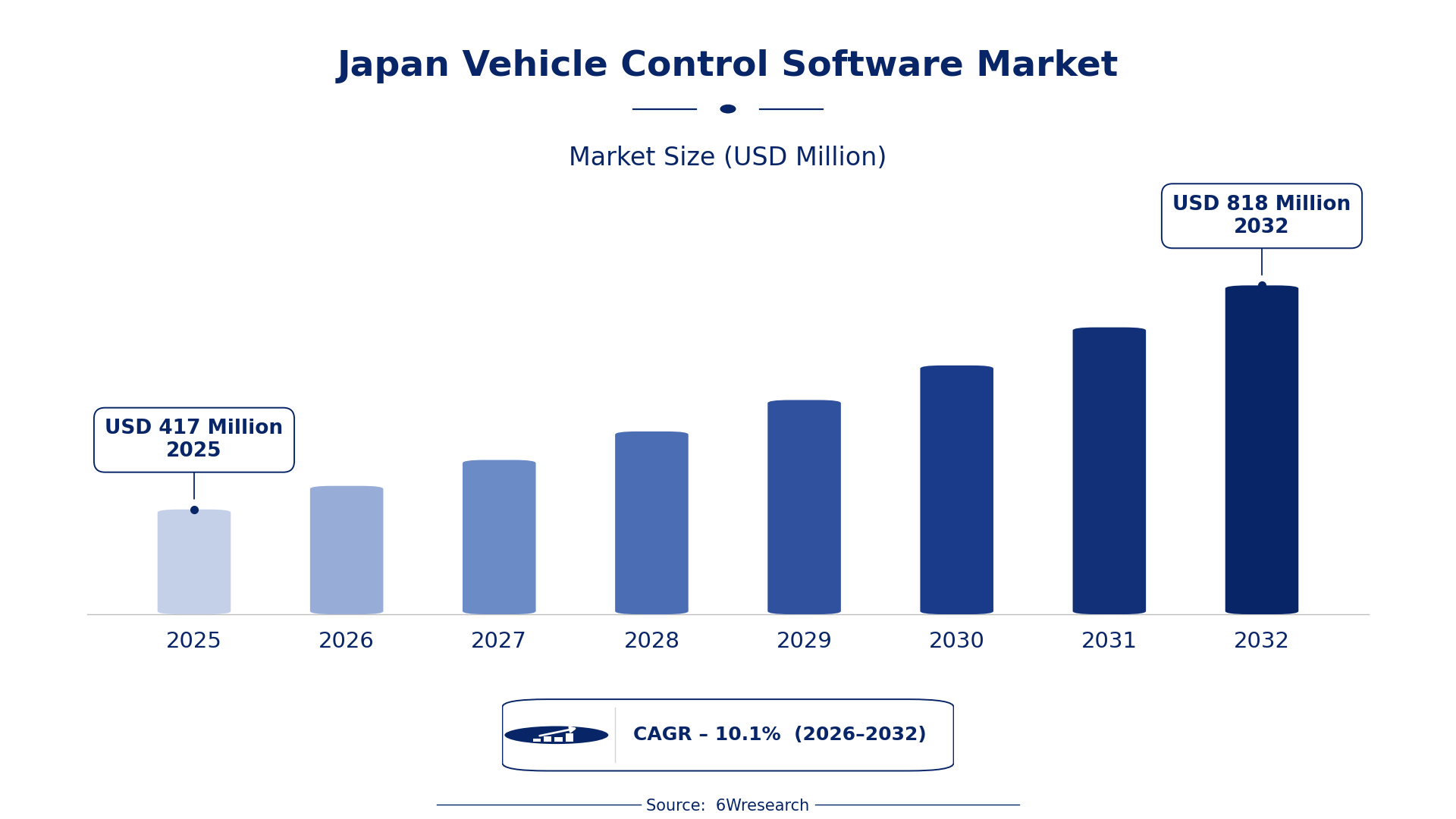
According to 6Wresearch internal database and industry insights, the Japan Vehicle Control Software Market was valued at USD 417 Million in 2025 and is projected to reach USD 818 Million by 2032, growing at a CAGR of approximately 10.1% during 2026–2032.
Japan Vehicle Control Software Market Highlights
| Report Metric | Details |
| Report Name | Japan Vehicle Control Software Market (2026-2032) |
| Market Size 2025 | USD 417 Million |
| Market Size 2032 | USD 818 Million |
| Absolute Growth 2025–2032 | USD 401 Million |
| CAGR 2026–2032 | 10.1% |
| Peak Annual Growth | 10.6% in 2030 |
| Forecast Period | 2026–2032 |
| Historical Data | 2022–2025 |
| Base Year | 2025 |
| Leading Software Type, 2025 | Engine Management Software (43% share) |
| Leading Control Function, 2025 | Fuel & Air Control (39% share) |
| Leading Deployment Platform, 2025 | Embedded ECU (50% share) |
| Leading End User, 2025 | ICE Car OEMs (52% share) |
| Fastest-Growing Software Type | Transmission Control Code (14.8% CAGR) |
| Fastest-Growing Control Function | Shift Optimization (13.5% CAGR) |
| Fastest-Growing Deployment Platform | TCU/ECU (14.9% CAGR) |
| Fastest-Growing End User | Transmission System Developers (12.9% CAGR) |
| Growing Sector | automotive software |
| Key End Users | ICE Car OEMs, ADAS Companies, Transmission System Developers |
Japan Vehicle Control Software Market Year-wise Growth Rate and Key Drivers (2022–2032)
This graph illustrates the annual growth rates of the market from 2022 to 2032, highlighting a steady upward trajectory and projected market expansion over the forecast period.
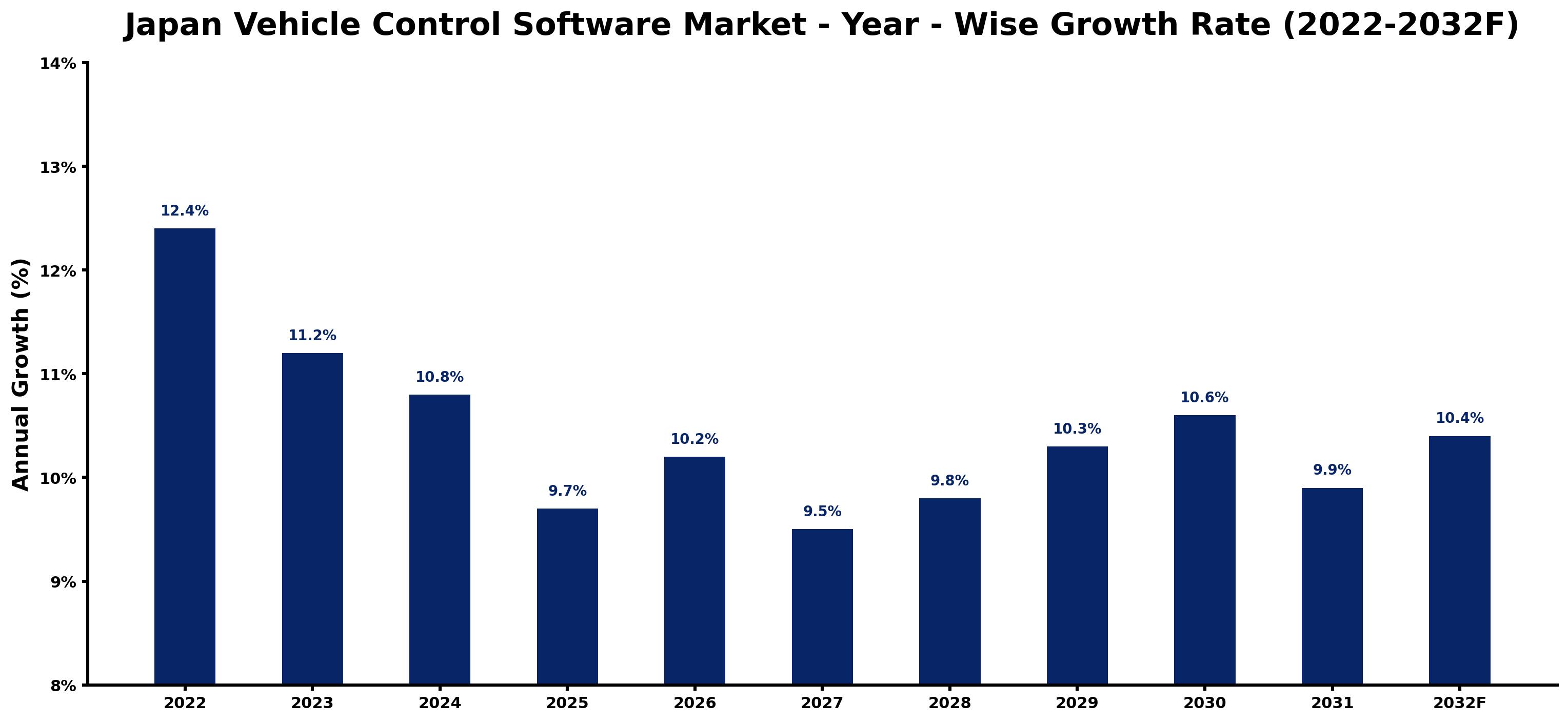
The yearly estimates that follow link every growth rate to its principal driver, so readers can see why the pace changed in each period.
| Year | Estimated Annual Growth (%) | Market Rationale |
| 2022 | 12.4 | The market experienced strong demand due to increased vehicle production and technology adoption. |
| 2023 | 11.2 | Growth slowed as the market adjusted to high levels of vehicle control software demand. |
| 2024 | 10.8 | Demand continued to moderate as manufacturers focused on integrating advanced safety features. |
| 2025 | 9.7 | The market growth rate decreased further as the industry faced challenges in evolving technological standards. |
| 2026 | 10.2 | Growth is expected to pick up as investments in electric vehicle technology materialise. |
| 2027 | 9.5 | The market will see slower growth as manufacturers adapt to new regulations and standards. |
| 2028 | 9.8 | Demand is anticipated to rise again due to increased adoption of advanced driver-assistance systems. |
| 2029 | 10.3 | Growth is projected to accelerate as vehicle manufacturers improve their software capabilities. |
| 2030 | 10.6 | The market is expected to peak as demand for advanced vehicle technologies reaches its highest point. |
| 2031 | 9.9 | A slight slowdown is anticipated as the market stabilises after rapid growth. |
| 2032 | 10.4 | Growth is projected to increase again as new technologies are integrated into vehicle control systems. |
Note: Market size estimations and growth projections presented in this report are based on 6Wresearch's proprietary forecasting methodology, utilizing the latest available industry data, government publications, and primary research inputs.
Japan Vehicle Control Software Market Synopsis
Vehicle control software optimises vehicle performance, safety, and comfort through coding and integration with vehicle hardware. The Japan Vehicle Control Software Market is projected to grow to USD 417 million by 2025, driven by the automotive sector's production of 8.3 million vehicles in 2022. Key growth factors include the rising adoption of advanced driver-assistance systems and ongoing innovations in vehicle technology, supported by government initiatives aimed at reducing greenhouse gas emissions.
Market Dynamics Impact Analysis (2026–2032)
| Factor | Type | Impact | Primary Segment Affected |
| Increasing adoption of advanced driver-assistance systems (ADAS) drives demand for software solutions. | Driver | High | ADAS Companies |
| Rising demand for electric vehicles creates opportunities for software development. | Opportunity | High | ICE Car OEMs |
| Compliance with environmental regulations necessitates advanced vehicle control software. | Restraint | High | Engine Management Software |
| Technological advancements in vehicle safety systems present new opportunities for software integration. | Opportunity | Medium | Brake/Steering Software |
| Integration challenges with new technologies can delay software deployment. | Challenge | High | Transmission Control Code |
| Ongoing maintenance and updates of software can strain resources and budgets. | Restraint | Medium | Climate Control Algorithms |
| Market competition may limit pricing power for software providers. | Restraint | Medium | Engine Management Software |
| Technological complexity can hinder rapid software development cycles. | Challenge | Medium | Brake/Steering Software |
Evaluation of Drivers in Japan Vehicle Control Software Market (2026–2032)
The factors lifting demand, and the evidence behind each, are summarised below.
| Drivers | Primary Segment Affected | Why It Matters (Evidence) |
| Rising demand for electric vehicles increases the need for sophisticated vehicle control software. | Engine Management Software | Japan has over 5 million registered electric vehicles as of 2023, driving software demand. |
| The push for safety features in vehicles drives the adoption of advanced software solutions. | Safety & Stability | ISO 26262 is a key standard for automotive safety in Japan, necessitating compliance. |
| Increased production of vehicles fuels the demand for integrated vehicle control systems. | Embedded ECU | Japan's automotive sector produced 8.3 million vehicles in 2022, boosting software requirements. |
| Technological advancements in automotive electronics create opportunities for software solutions. | Transmission Control Code | The automotive electronics market in Japan was valued at approximately $30 billion in 2023. |
| Government support for electric vehicle technology stimulates software development. | Climate Control Algorithms | The Japanese government supports electric vehicle technology through subsidies, enhancing market potential. |
Behind the steady rise in orders sits the increasing demand for electric vehicles, with over 5 million registered in Japan as of 2023. This surge drives the need for sophisticated engine management software to optimise performance and emissions. The automotive sector produced 8.3 million vehicles in 2022, further fuelling demand for integrated vehicle control systems. Compliance with ISO 26262 standards necessitates advanced safety features, prompting manufacturers to invest in safety and stability software. The automotive electronics market, valued at approximately $30 billion in 2023, showcases the potential for advanced software solutions across the industry.
Evaluation of Restraints in Japan Vehicle Control Software Market
These restraints slow adoption and weigh on supplier margins.
| Market Restraint | Primary Segment Affected | Why It Matters (Evidence) |
| Integration challenges with new technologies can delay software deployment. | Transmission Control Code | As manufacturers adopt new standards, they face difficulties in integrating existing systems with updated software. |
| Ongoing maintenance and updates of software can strain resources and budgets. | Climate Control Algorithms | The need for continuous compliance with safety and environmental regulations increases operational costs. |
| Market competition may limit pricing power for software providers. | Engine Management Software | With multiple players in the market, pricing strategies must remain competitive to attract OEMs. |
| Technological complexity can hinder rapid software development cycles. | Brake/Steering Software | As vehicles become more sophisticated, the time required for development and testing increases. |
| Regulatory compliance requirements can slow down product launches. | Safety & Stability | Adherence to stringent safety standards delays the introduction of new software solutions. |
Japan Vehicle Control Software Market Challenges
Tokyo's automotive software developers encounter rising costs due to Japan's increased minimum wage, which reached JPY 1,055 per hour in October 2024, leading to higher operational expenses for producers. Domestic manufacturers face delays in software delivery as compliance with ISO 26262 safety standards becomes more stringent, impacting project timelines and increasing costs for buyers. Regulatory changes enforced by the Ministry of Land, Infrastructure, Transport and Tourism require frequent updates to vehicle control systems, causing additional expenses for producers who must adapt their products. Supply chain disruptions arise from the ongoing push for electric vehicle technology, complicating the procurement of necessary components and extending lead times for buyers.
Trends in the Japan Vehicle Control Software Market
The following changes are redrawing the Japan Vehicle Control Software Market.
- Shift Towards Advanced Driver-Assistance Systems: Vehicle manufacturers are increasingly focusing on integrating advanced driver-assistance systems, as seen in the Tokyo Motor Show showcasing innovations. This shift is expected to drive demand for vehicle control software, with a projected increase in ADAS adoption.
- Transition from Traditional to Electric Vehicles: The automotive sector in Japan is transitioning towards electric vehicles, supported by government subsidies. In 2023, Japan had over 5 million registered electric vehicles, indicating a shift in consumer preferences.
- Emergence of Integrated Vehicle Control Systems: The demand for integrated vehicle control systems is rising, particularly in embedded ECUs. The automotive electronics market was valued at approximately $30 billion in 2023, reflecting the growing importance of software integration.
- Prioritisation of Safety Features in Vehicle Design: Safety features are becoming a priority for vehicle manufacturers, influenced by regulations like ISO 26262. This trend is reflected in the increasing investments in safety and stability software solutions.
Investment Opportunities in the Japan Vehicle Control Software Market
The openings below show where demand in the Japan Vehicle Control Software Market is visible and how suppliers can enter.
- Growing Demand for Electric Vehicle Software Solutions: With Japan targeting a 46% cut in greenhouse-gas emissions by 2030, there is an opportunity for software development focused on electric vehicles. ICE car OEMs are looking to improve their offerings to meet these targets.
- Investment in Advanced Safety Technologies: The rise in safety regulations creates a demand for advanced software solutions. Collaborating with ADAS companies can facilitate entry into this growing market, especially in urban areas like Tokyo.
- Expansion of Automotive Software Development: The automotive software market is projected to grow, with a focus on integrated systems. Establishing partnerships with transmission system developers can help capture this opportunity, particularly in major automotive hubs.
- Enhancement of Climate Control Systems: As consumer expectations for comfort rise, there is a growing need for climate control algorithms. Investing in this area can yield returns, especially in regions with extreme weather conditions.
Government Initiatives in the Japan Vehicle Control Software Market
The Electrical Appliance and Material Safety Act, enacted in 1961, regulates the safety of electrical appliances, including vehicle control software components. This law ensures that manufacturers adhere to safety standards, promoting consumer confidence in vehicle technologies. The AI Promotion Act, introduced in 2025, establishes a framework for AI research and development, further advancing the capabilities of vehicle control software.
In 2023, the Japanese government launched a program to enhance vehicle safety technologies, with funding of JPY 10 billion allocated for research and development. The Ministry of Land, Infrastructure, Transport and Tourism oversees the implementation of these initiatives, ensuring compliance with safety regulations and promoting innovation in the automotive sector.
Future Insight of the Japan Vehicle Control Software Market
The launch of advanced vehicle safety technology programs will reshape automotive software development by 2032. Increased adoption of electric vehicles, with over 5 million registered as of 2023, will drive demand for more sophisticated vehicle control solutions. Collaboration between the Ministry of Economy, Trade and Industry and automotive R&D initiatives will lead to advancements in vehicle performance and safety. By 2032, the automotive electronics market, valued at approximately $30 billion in 2023, will create opportunities for suppliers to develop cutting-edge software applications.
Market Segmentation Analysis
Japan Vehicle Control Software Market report covers a detailed analysis of the following market segments:
By Software Type – Engine Management Software Leads, Transmission Control Code Expected to Grow Fastest
According to Saurav Kr Singh, Senior Research Analyst at 6Wresearch, with 43% of software type revenue in 2025, Engine Management Software was the largest category. Engine Management Software holds the largest share as it is critical for optimising fuel efficiency and emissions control, essential for compliance with Japan's environmental regulations. The automotive sector's production of 8.3 million vehicles in 2022 underscores the reliance on this software for meeting stringent standards. Transmission Control Code is set to record the highest CAGR in this split, 14.8% over 2026–2032. Transmission Control Code is witnessing rapid growth due to its importance in managing gear shifts and performance, particularly with the rise of advanced driving technologies. As manufacturers increasingly focus on enhancing transmission capabilities, this segment's growth trajectory will likely continue to accelerate. Suppliers should focus on developing advanced transmission control solutions to meet the increasing demand from automotive manufacturers.
By Control Function – Fuel & Air Control Leads, Shift Optimization Expected to Grow Fastest
Fuel & Air Control took 39% of control function revenue in 2025, more than any other category. Fuel & Air Control leads the market as it is integral for engine performance and emissions reduction, making it vital for vehicle compliance with environmental standards. This function is particularly crucial for manufacturers aiming to achieve Japan's greenhouse gas reduction targets. Over 2026–2032, Shift Optimization is expected to post the fastest growth, at a CAGR of 13.5%. Shift Optimization is the fastest-growing area because it significantly enhances driving experience and efficiency, appealing to both manufacturers and consumers. The ongoing demand for improved vehicle performance is driving this segment's rapid expansion. Buyers should invest in shift optimisation technologies that enhance vehicle performance and align with consumer expectations.
By Deployment Platform – Embedded ECU Leads, TCU/ECU Expected to Grow Fastest
Embedded ECU held 50% of the Japan Vehicle Control Software Market by deployment platform in 2025. Embedded ECU is the dominant platform as it serves as the core component of vehicle control systems, enabling the integration of various software applications. Its widespread use across the automotive industry solidifies its position as the primary deployment method. The quickest growth will come from TCU/ECU, forecast to expand at a CAGR of 14.9% between 2026 and 2032. TCU/ECU is experiencing rapid growth due to its critical role in transmission and engine management, which are becoming more sophisticated with technological advancements. The increase in electric vehicle registrations further propels the demand for this platform. Suppliers need to enhance TCU/ECU capabilities to stay aligned with technological advancements in the automotive sector.
By End User – ICE Car OEMs Lead, Transmission System Developers Expected to Grow Fastest
In 2025, ICE Car OEMs led the end user split with a 52% share. ICE Car OEMs hold the largest share as they are the main users of vehicle control software, relying on these solutions to optimise vehicle performance. The strong automotive industry in Japan, producing millions of vehicles, ensures consistent demand from these manufacturers. Transmission System Developers are projected to grow fastest, at a CAGR of 12.9% during 2026–2032. Transmission System Developers are the fastest-growing end user group as they are essential for software integration in modern vehicles. The rising complexity of transmission systems requires advanced software solutions, driving growth in this segment. Suppliers must engage with transmission system developers to align their offerings with the changing needs of the automotive market.
Key Attractiveness of the Report
- 10 Years of Market Numbers
- Historical Data Starting from 2022 to 2025
- Base Year 2025
- Forecast Data until 2032
- Key Performance Indicators Impacting the Market
- Major Upcoming Developments and Projects
Key Highlights of the Report:
- Japan Vehicle Control Software Market Outlook
- Market Size of Japan Vehicle Control Software Market, 2025
- Forecast of Japan Vehicle Control Software Market, 2032
- Historical Data and Forecast of Japan Vehicle Control Software Revenues & Volume for the Period 2022-2032F
- Japan Vehicle Control Software Market Trend Evolution
- Japan Vehicle Control Software Market Drivers and Challenges
- Japan Vehicle Control Software Price Trends
- Japan Vehicle Control Software Porter's Five Forces
- Japan Vehicle Control Software Industry Life Cycle
- Historical Data and Forecast of Japan Vehicle Control Software Market Revenues & Volume By Software Type for the Period 2022-2032F
- Historical Data and Forecast of Japan Vehicle Control Software Market Revenues & Volume By Engine Management Software for the Period 2022-2032F
- Historical Data and Forecast of Japan Vehicle Control Software Market Revenues & Volume By Transmission Control Code for the Period 2022-2032F
- Historical Data and Forecast of Japan Vehicle Control Software Market Revenues & Volume By Brake/Steering Software for the Period 2022-2032F
- Historical Data and Forecast of Japan Vehicle Control Software Market Revenues & Volume By Climate Control Algorithms for the Period 2022-2032F
- Historical Data and Forecast of Japan Vehicle Control Software Market Revenues & Volume By Control Function for the Period 2022-2032F
- Historical Data and Forecast of Japan Vehicle Control Software Market Revenues & Volume By Fuel & Air Control for the Period 2022-2032F
- Historical Data and Forecast of Japan Vehicle Control Software Market Revenues & Volume By Shift Optimization for the Period 2022-2032F
- Historical Data and Forecast of Japan Vehicle Control Software Market Revenues & Volume By Safety & Stability for the Period 2022-2032F
- Historical Data and Forecast of Japan Vehicle Control Software Market Revenues & Volume By Thermal Regulation for the Period 2022-2032F
- Historical Data and Forecast of Japan Vehicle Control Software Market Revenues & Volume By Deployment Platform for the Period 2022-2032F
- Historical Data and Forecast of Japan Vehicle Control Software Market Revenues & Volume By Embedded ECU for the Period 2022-2032F
- Historical Data and Forecast of Japan Vehicle Control Software Market Revenues & Volume By TCU/ECU for the Period 2022-2032F
- Historical Data and Forecast of Japan Vehicle Control Software Market Revenues & Volume By Integrated Sensors for the Period 2022-2032F
- Historical Data and Forecast of Japan Vehicle Control Software Market Revenues & Volume By HVAC Systems for the Period 2022-2032F
- Historical Data and Forecast of Japan Vehicle Control Software Market Revenues & Volume By End User for the Period 2022-2032F
- Historical Data and Forecast of Japan Vehicle Control Software Market Revenues & Volume By ICE Car OEMs for the Period 2022-2032F
- Historical Data and Forecast of Japan Vehicle Control Software Market Revenues & Volume By Transmission System Developers for the Period 2022-2032F
- Historical Data and Forecast of Japan Vehicle Control Software Market Revenues & Volume By ADAS Companies for the Period 2022-2032F
- Historical Data and Forecast of Japan Vehicle Control Software Market Revenues & Volume By Luxury Car OEMs for the Period 2022-2032F
- Japan Vehicle Control Software Import Export Trade Statistics
- Market Opportunity Assessment By Software Type
- Market Opportunity Assessment By Control Function
- Market Opportunity Assessment By Deployment Platform
- Market Opportunity Assessment By End User
- Japan Vehicle Control Software Top Companies Market Share
- Japan Vehicle Control Software Competitive Benchmarking By Technical and Operational Parameters
- Japan Vehicle Control Software Company Profiles
- Japan Vehicle Control Software Key Strategic Recommendations
Market Covered
The report covers the following segments.
By Software Type
- Engine Management Software
- Transmission Control Code
- Brake/Steering Software
- Climate Control Algorithms
By Control Function
- Fuel & Air Control
- Shift Optimization
- Safety & Stability
- Thermal Regulation
By Deployment Platform
- Embedded ECU
- TCU/ECU
- Integrated Sensors
- HVAC Systems
By End User
- ICE Car OEMs
- Transmission System Developers
- ADAS Companies
- Luxury Car OEMs































