Japan Vehicle Control Valves Market Size & Growth Rate
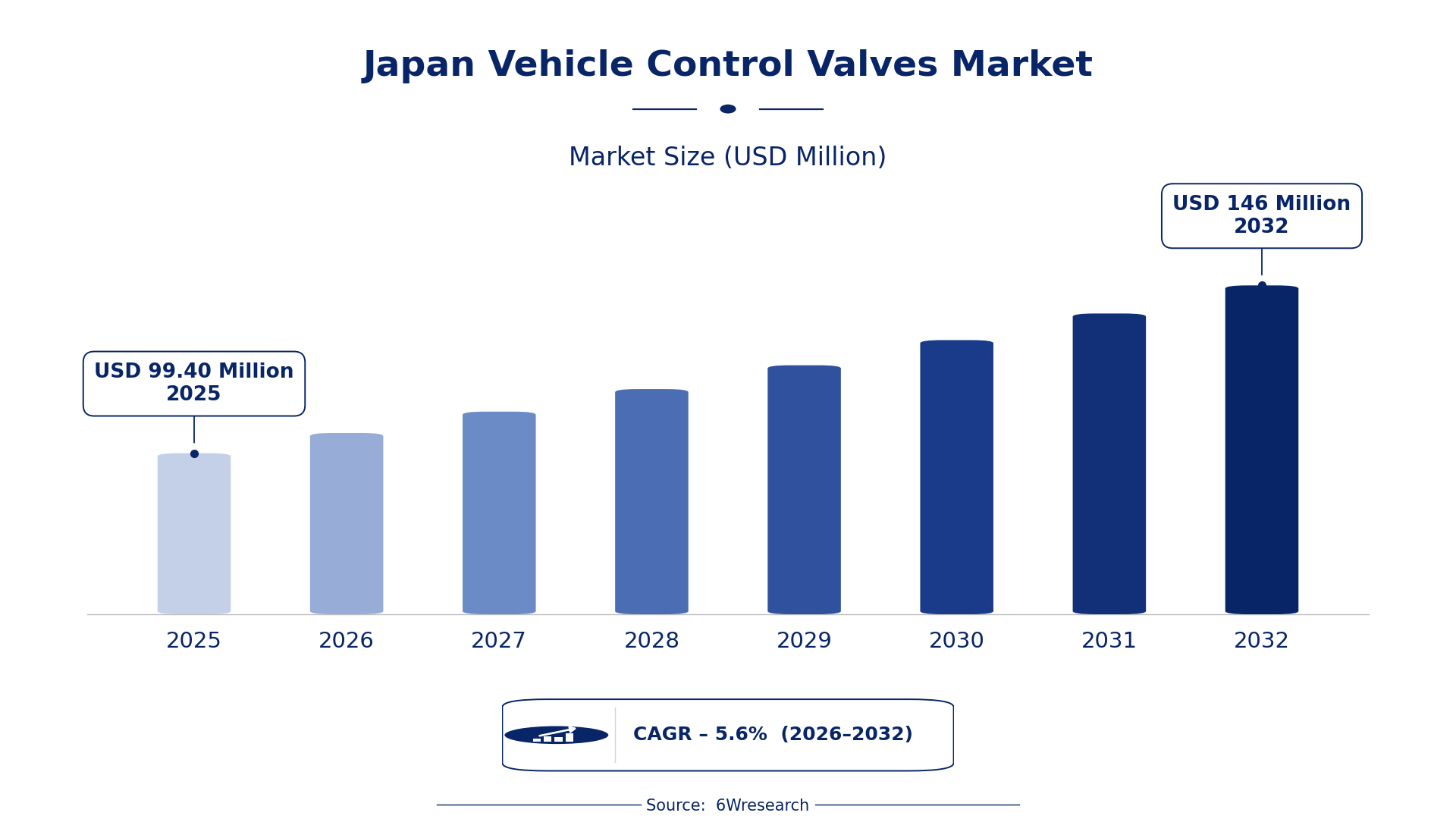
According to 6Wresearch internal database and industry insights, the Japan Vehicle Control Valves Market was valued at USD 99.40 Million in 2025 and is projected to reach USD 146 Million by 2032, growing at a CAGR of approximately 5.6% during 2026–2032.
Japan Vehicle Control Valves Market Highlights
| Report Metric | Details |
| Report Name | Japan Vehicle Control Valves Market (2026-2032) |
| Market Size 2025 | USD 99.40 Million |
| Market Size 2032 | USD 146 Million |
| Absolute Growth 2025–2032 | USD 46.60 Million |
| CAGR 2026–2032 | 5.6% |
| Peak Annual Growth | 6.7% in 2031 |
| Forecast Period | 2026–2032 |
| Historical Data | 2022–2025 |
| Base Year | 2025 |
| Leading Valve Type, 2025 | EGR Valves (40% share) |
| Leading Control Function, 2025 | Exhaust Gas Recirculation (36% share) |
| Leading Medium Controlled, 2025 | Emissions (41% share) |
| Leading End User, 2025 | Engine System Makers (39% share) |
| Fastest-Growing Valve Type | Solenoid Control Valves (7.9% CAGR) |
| Fastest-Growing Control Function | Hydraulic Flow Control (7.5% CAGR) |
| Fastest-Growing Medium Controlled | Transmission Fluids (7.4% CAGR) |
| Fastest-Growing End User | Gearbox OEMs (7.3% CAGR) |
| Growing Sector | Gearbox OEMs |
| Key End Users | Engine System Makers, Gearbox OEMs, Thermal System Suppliers, ICE Manufacturers |
Japan Vehicle Control Valves Market Year-wise Growth Rate and Key Drivers (2022–2032)
This graph illustrates the annual growth rates of the market from 2022 to 2032, highlighting a steady upward trajectory and projected market expansion over the forecast period.
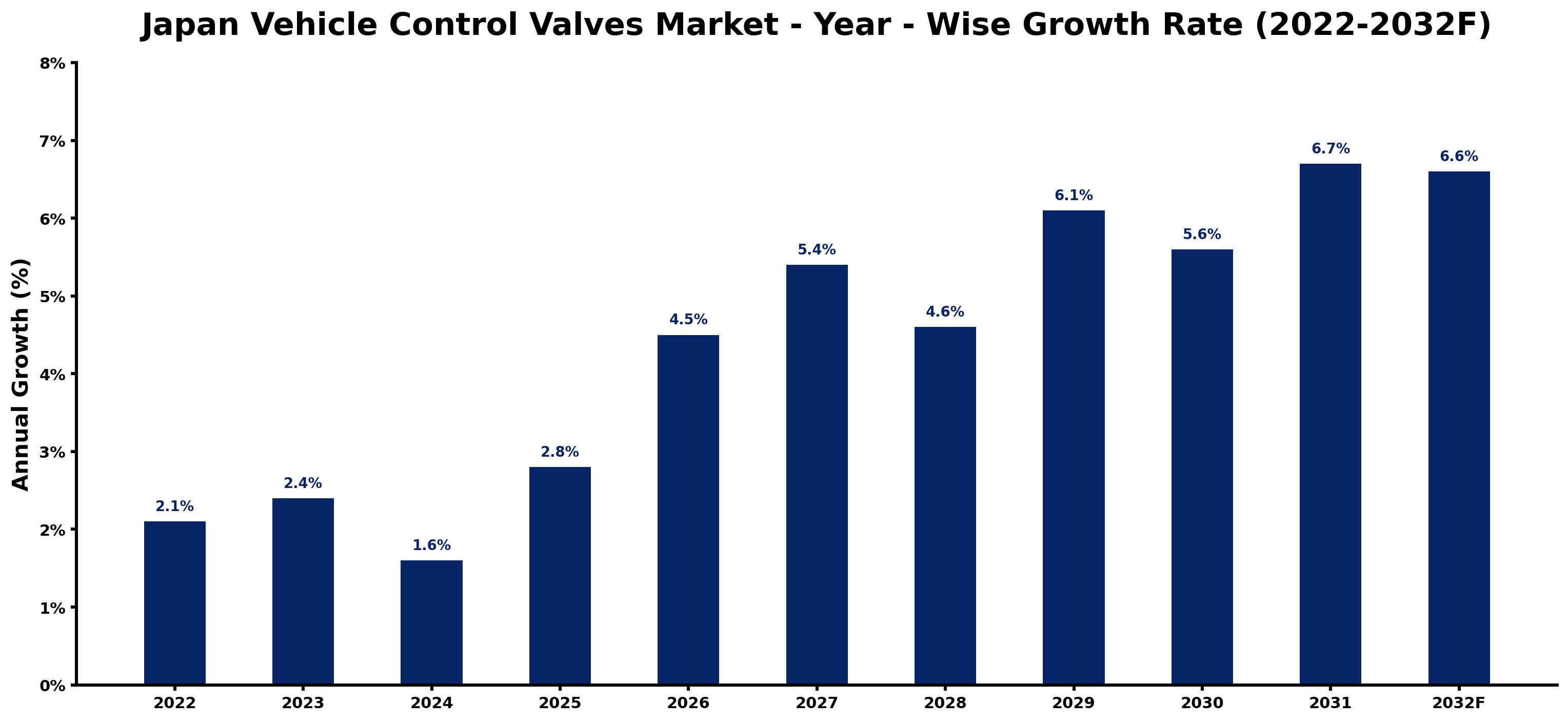
For each year, the table pairs the estimated growth rate with the leading influence on demand, showing how the drivers changed across the period.
| Year | Estimated Annual Growth (%) | Market Rationale |
| 2022 | 2.1 | The market experienced steady growth due to ongoing automotive production activities. |
| 2023 | 2.4 | Demand increased as manufacturers focused on improving vehicle efficiency and emissions control. |
| 2024 | 1.6 | Growth slowed as companies adjusted to changes affecting production standards. |
| 2025 | 2.8 | The market rebounded with renewed investment in cleaner technologies and vehicle innovations. |
| 2026 | 4.5 | Rising demand for advanced vehicle systems is expected to drive growth in control valve applications. |
| 2027 | 5.4 | Continued investments in R&D for emission reduction technologies will boost market performance. |
| 2028 | 4.6 | Growth is projected to moderate as the market adjusts to supply chain challenges and production capacities. |
| 2029 | 6.1 | Demand is expected to surge as automotive manufacturers embrace new technologies for improved performance. |
| 2030 | 5.6 | The market will see a slowdown as manufacturers face challenges in sourcing materials. |
| 2031 | 6.7 | Rapid advancements in vehicle technologies will lead to peak growth in control valve demand. |
| 2032 | 6.6 | Growth is projected to stabilise as the market matures and competition intensifies. |
Note: Market size estimations and growth projections presented in this report are based on 6Wresearch's proprietary forecasting methodology, utilizing the latest available industry data, government publications, and primary research inputs.
Japan Vehicle Control Valves Market Synopsis
Vehicle control valves regulate the flow of fluids and gases in automotive systems, essential for managing emissions and optimising performance. The Japan Vehicle Control Valves Market is growing due to automotive production, with over 8 million vehicles produced in 2022, alongside investments in cleaner technologies. The focus on advanced vehicle systems and stringent emissions regulations drives demand from domestic manufacturers and suppliers, creating opportunities for innovation in valve design and application.
Market Dynamics Impact Analysis (2026–2032)
| Factor | Type | Impact | Primary Segment Affected |
| Increased automotive production and innovation in vehicle technologies | Driver | High | EGR Valves |
| Growing emphasis on emission reduction technologies | Driver | High | Solenoid Control Valves |
| Emerging demand for hybrid and electric vehicle components | Opportunity | High | Coolant Control Valves |
| Investment in R&D for cleaner automotive technologies | Opportunity | High | Hydraulic Flow Control |
| Stringent regulations on vehicle emissions affecting design | Restraint | High | Exhaust Gas Recirculation |
| Aging vehicle fleet increasing demand for replacement parts | Restraint | Medium | Engine Coolant |
| Supply chain disruptions affecting production capacities | Challenge | High | Temperature Management |
| Competition from alternative technologies in vehicle systems | Challenge | Medium | Intake/Exhaust Systems |
Evaluation of Drivers in Japan Vehicle Control Valves Market (2026–2032)
Below are the drivers that matter most for revenue growth, with supporting evidence.
| Drivers | Primary Segment Affected | Why It Matters (Evidence) |
| Increased vehicle production | EGR Valves | Japan produced over 8 million vehicles in 2022, driving demand for emission control technologies. |
| Focus on emission reduction | Solenoid Control Valves | Japan's stringent regulations on vehicle emissions promote the adoption of advanced control valves, with over 8 million vehicles produced in 2022. |
| Rising demand for hybrid vehicles | Coolant Control Valves | The integration of coolant control valves in hybrid vehicles is essential for thermal management, supporting the production of over 8 million vehicles in 2022. |
| Investment in cleaner technologies | Hydraulic Flow Control | In 2023, Japan's automotive industry invested ¥1 trillion in R&D for cleaner technologies, boosting demand for hydraulic flow control valves. |
| Aging vehicle fleet | Engine Coolant | The average age of vehicles in Japan is around 13 years, increasing demand for replacement parts like engine coolant valves. |
What keeps demand rising is the production of over 8 million vehicles in 2022, which drives the need for EGR valves that reduce emissions. The rise of hybrid vehicles, which require efficient coolant control valves for thermal management, further boosts demand. In 2023, the automotive sector's investment of ¥1 trillion in cleaner technologies supports the growth of hydraulic flow control valves. The aging vehicle fleet, with an average age of 13 years, increases the need for engine coolant valves as manufacturers seek to maintain vehicle performance.
Evaluation of Restraints in Japan Vehicle Control Valves Market
The key brakes on demand, and where they bite hardest, are shown below.
| Market Restraint | Primary Segment Affected | Why It Matters (Evidence) |
| Competition among automotive parts suppliers | EGR Valves | Intensifying competition leads to price wars, eroding margins for producers and affecting profitability. |
| Supply chain disruptions | Solenoid Control Valves | Reliance on specific materials causes delays in production timelines for manufacturers, increasing costs. |
| Regulatory compliance costs | Coolant Control Valves | Stringent regulations on vehicle emissions require constant updates to valve designs, delaying product launches. |
| Rising costs of replacement parts | Engine Coolant | The average age of vehicles in Japan being around 13 years increases demand and leads to higher prices for some components. |
| Material sourcing challenges | Hydraulic Flow Control | Manufacturers face difficulties in sourcing materials, affecting production schedules and increasing operational costs. |
Japan Vehicle Control Valves Market Challenges
Competition among automotive parts suppliers intensifies as manufacturers seek cost-effective solutions, squeezing margins for producers. Supply chain disruptions arise from dependence on specific materials, leading to production delays for manufacturers and increasing costs by 15%. Strict vehicle emissions regulations require frequent updates to valve designs, causing delays in product launches for suppliers by several months. Buyers face rising prices for replacement parts, as the average age of vehicles in Japan is around 13 years, resulting in a 10% increase in costs for some components.
Trends in the Japan Vehicle Control Valves Market
These developments are changing demand patterns in the Japan Vehicle Control Valves Market.
- Shift towards Hybrid Vehicle Integration: In 2023, the integration of coolant control valves in hybrid vehicles is increasing, driven by the need for efficient thermal management. This trend supports the growing demand for advanced vehicle technologies.
- Transition to Advanced Emission Control Technologies: The Tokyo region is undergoing a transition to advanced emission control technologies, with over ¥1 trillion invested in R&D for cleaner technologies in 2023. This shift is necessary for meeting strict emissions standards.
- Emergence of Smart Vehicle Systems: The Automotive Industry Association of Japan is promoting smart vehicle systems, enhancing vehicle control capabilities. As a result, demand for advanced control valves is expected to rise significantly.
- Prioritisation of Sustainability in Automotive Design: Engine System Makers are prioritising sustainability in automotive design, aligning with Japan's target for a 46% cut in greenhouse-gas emissions by fiscal 2030. This focus is driving innovation in control valve technologies.
Investment Opportunities in the Japan Vehicle Control Valves Market
Where to invest in the Japan Vehicle Control Valves Market: the main openings are set out below.
- Tokyo Region as a Hub for Innovation: The Tokyo region is a major hub for automotive innovation, with over ¥1 trillion invested in cleaner technologies, creating opportunities for suppliers of advanced control valves.
- Supply of Advanced Control Valve Technologies: The demand for advanced control valve technologies is rising, driven by emission regulations. Engine System Makers are seeking innovative solutions to meet these standards.
- Entry through Joint Ventures: Entering the market through joint ventures with local manufacturers can facilitate access to the growing demand for control valves in Japan's automotive sector.
- Timing for Investment in Replacement Parts: With the average age of vehicles around 13 years, now is the ideal time to invest in replacement parts, as demand is expected to rise.
Government Initiatives in the Japan Vehicle Control Valves Market
The Electrical Appliance and Material Safety Act (1961; METI) regulates the safety of electrical appliances and materials sold in Japan, impacting the production of vehicle control valves by ensuring compliance with environmental regulations. The Battery Industry Strategy (METI, August 2022) targets 150 GWh of domestic battery manufacturing capacity by 2030, influencing the design and manufacturing processes of automotive components.
The Ministry of the Environment oversees the implementation of emission reduction technologies, supporting automotive manufacturers in adopting cleaner practices. The Automotive Industry Association of Japan plays a role in promoting sustainable practices, ensuring compliance with environmental standards, and facilitating innovation in automotive technologies.
Future Insight of the Japan Vehicle Control Valves Market
By 2032, buyers will see improved product offerings as suppliers adapt to Japan's goal of a 46% reduction in greenhouse-gas emissions from fiscal 2013 levels. Compliance with new safety standards introduced in 2023 will drive innovation among producers. The automotive sector's investment of ¥1 trillion in R&D for cleaner technologies will stimulate advancements in vehicle control valves. Integration of advanced thermal management systems in electric vehicles will create new opportunities for both buyers and suppliers.
Market Segmentation Analysis
Japan Vehicle Control Valves Market report covers a detailed analysis of the following market segments:
By Valve Type – EGR Valves Lead, Solenoid Control Valves Expected to Grow Fastest
According to Saurav Kr Singh, Senior Research Analyst at 6Wresearch, EGR Valves took 40% of valve type revenue in 2025, more than any other category. EGR valves hold the largest share in Japan's vehicle control valves market due to their essential role in reducing emissions from both gasoline and diesel engines. Their widespread use aligns with Japan's stringent regulations on vehicle emissions, making them a critical component in modern automotive design. Solenoid Control Valves are set to record the highest CAGR in this split, 7.9% over 2026–2032. The rapid growth of solenoid control valves is driven by their critical function in automatic transmission systems, which are increasingly prevalent in new vehicles. As the automotive industry invests heavily in cleaner technologies, the demand for these valves is expected to surge further, widening the lead of EGR valves. Suppliers must focus on enhancing their production capabilities for solenoid control valves to meet the rising demand in the market.
By Control Function – Exhaust Gas Recirculation Leads, Hydraulic Flow Control Expected to Grow Fastest
The largest control function category in 2025 was Exhaust Gas Recirculation, at 36% of revenue. Exhaust gas recirculation is the leading control function as it is integral to emission control systems, essential for compliance with Japan's environmental policies. The national commitment to significant reductions in greenhouse gas emissions reinforces the importance of this function in the automotive sector. Hydraulic Flow Control is projected to grow fastest, at a CAGR of 7.5% during 2026–2032. Hydraulic flow control is experiencing the fastest growth, driven by its necessity in hydraulic systems that are increasingly incorporated into modern vehicles. The automotive industry's shift towards advanced vehicle technologies is propelling the demand for hydraulic flow control solutions. Buyers should prioritise sourcing hydraulic flow control valves to stay updated with the latest advancements in vehicle technology.
By Medium Controlled – Emissions Lead, Transmission Fluids Expected to Grow Fastest
With 41% of medium controlled revenue in 2025, Emissions was the largest category. Emissions control is the dominant medium as it is directly tied to regulatory compliance, making it crucial for manufacturers to implement effective solutions. The Japanese government's initiatives aimed at reducing greenhouse gas emissions further underscore the importance of this medium in the automotive market. The quickest growth will come from Transmission Fluids, forecast to expand at a CAGR of 7.4% between 2026 and 2032. Transmission fluids are rapidly gaining importance, particularly in advanced automatic transmission systems that are becoming more prevalent in vehicles. The increasing complexity of vehicle designs drives the need for efficient management of transmission fluids, contributing to this segment's growth. Suppliers should adapt their product offerings to include advanced solutions for transmission fluids to align with the evolving automotive landscape.
By End User – Engine System Makers Lead, Gearbox OEMs Expected to Grow Fastest
Engine System Makers accounted for 39% of the market by end user in 2025. Engine system makers represent the largest end user group as they are the primary consumers of control valves, essential for both engine performance and emissions compliance. The robust automotive production in Japan ensures a consistent demand from this segment, solidifying its leading position. Over 2026–2032, Gearbox OEMs are expected to post the fastest growth, at a CAGR of 7.3%. Gearbox OEMs are the fastest-growing end user group, crucial for gearbox functionality as vehicle designs become more sophisticated. The increasing complexity of vehicles necessitates advanced gearbox solutions, driving the growth of this segment. Manufacturers should seek to establish partnerships with gearbox OEMs to capitalise on the expanding market opportunities.
Key Attractiveness of the Report
- 10 Years of Market Numbers
- Historical Data Starting from 2022 to 2025
- Base Year 2025
- Forecast Data until 2032
- Key Performance Indicators Impacting the Market
- Major Upcoming Developments and Projects
Key Highlights of the Report:
- Japan Vehicle Control Valves Market Outlook
- Market Size of Japan Vehicle Control Valves Market, 2025
- Forecast of Japan Vehicle Control Valves Market, 2032
- Historical Data and Forecast of Japan Vehicle Control Valves Revenues & Volume for the Period 2022-2032F
- Japan Vehicle Control Valves Market Trend Evolution
- Japan Vehicle Control Valves Market Drivers and Challenges
- Japan Vehicle Control Valves Price Trends
- Japan Vehicle Control Valves Porter's Five Forces
- Japan Vehicle Control Valves Industry Life Cycle
- Historical Data and Forecast of Japan Vehicle Control Valves Market Revenues & Volume By Valve Type for the Period 2022-2032F
- Historical Data and Forecast of Japan Vehicle Control Valves Market Revenues & Volume By EGR Valves for the Period 2022-2032F
- Historical Data and Forecast of Japan Vehicle Control Valves Market Revenues & Volume By Solenoid Control Valves for the Period 2022-2032F
- Historical Data and Forecast of Japan Vehicle Control Valves Market Revenues & Volume By Coolant Control Valves for the Period 2022-2032F
- Historical Data and Forecast of Japan Vehicle Control Valves Market Revenues & Volume By Vacuum Control Valves for the Period 2022-2032F
- Historical Data and Forecast of Japan Vehicle Control Valves Market Revenues & Volume By Control Function for the Period 2022-2032F
- Historical Data and Forecast of Japan Vehicle Control Valves Market Revenues & Volume By Exhaust Gas Recirculation for the Period 2022-2032F
- Historical Data and Forecast of Japan Vehicle Control Valves Market Revenues & Volume By Hydraulic Flow Control for the Period 2022-2032F
- Historical Data and Forecast of Japan Vehicle Control Valves Market Revenues & Volume By Temperature Management for the Period 2022-2032F
- Historical Data and Forecast of Japan Vehicle Control Valves Market Revenues & Volume By Intake/Exhaust Systems for the Period 2022-2032F
- Historical Data and Forecast of Japan Vehicle Control Valves Market Revenues & Volume By Medium Controlled for the Period 2022-2032F
- Historical Data and Forecast of Japan Vehicle Control Valves Market Revenues & Volume By Emissions for the Period 2022-2032F
- Historical Data and Forecast of Japan Vehicle Control Valves Market Revenues & Volume By Transmission Fluids for the Period 2022-2032F
- Historical Data and Forecast of Japan Vehicle Control Valves Market Revenues & Volume By Engine Coolant for the Period 2022-2032F
- Historical Data and Forecast of Japan Vehicle Control Valves Market Revenues & Volume By Air Pressure for the Period 2022-2032F
- Historical Data and Forecast of Japan Vehicle Control Valves Market Revenues & Volume By End User for the Period 2022-2032F
- Historical Data and Forecast of Japan Vehicle Control Valves Market Revenues & Volume By Engine System Makers for the Period 2022-2032F
- Historical Data and Forecast of Japan Vehicle Control Valves Market Revenues & Volume By Gearbox OEMs for the Period 2022-2032F
- Historical Data and Forecast of Japan Vehicle Control Valves Market Revenues & Volume By Thermal System Suppliers for the Period 2022-2032F
- Historical Data and Forecast of Japan Vehicle Control Valves Market Revenues & Volume By ICE Manufacturers for the Period 2022-2032F
- Japan Vehicle Control Valves Import Export Trade Statistics
- Market Opportunity Assessment By Valve Type
- Market Opportunity Assessment By Control Function
- Market Opportunity Assessment By Medium Controlled
- Market Opportunity Assessment By End User
- Japan Vehicle Control Valves Top Companies Market Share
- Japan Vehicle Control Valves Competitive Benchmarking By Technical and Operational Parameters
- Japan Vehicle Control Valves Company Profiles
- Japan Vehicle Control Valves Key Strategic Recommendations
Market Covered
The study includes the following segmentation.
By Valve Type
- EGR Valves
- Solenoid Control Valves
- Coolant Control Valves
- Vacuum Control Valves
By Control Function
- Exhaust Gas Recirculation
- Hydraulic Flow Control
- Temperature Management
- Intake/Exhaust Systems
By Medium Controlled
- Emissions
- Transmission Fluids
- Engine Coolant
- Air Pressure
By End User
- Engine System Makers
- Gearbox OEMs
- Thermal System Suppliers
- ICE Manufacturers































