Japan Vehicle Coolant Flow Control Market Size & Growth Rate
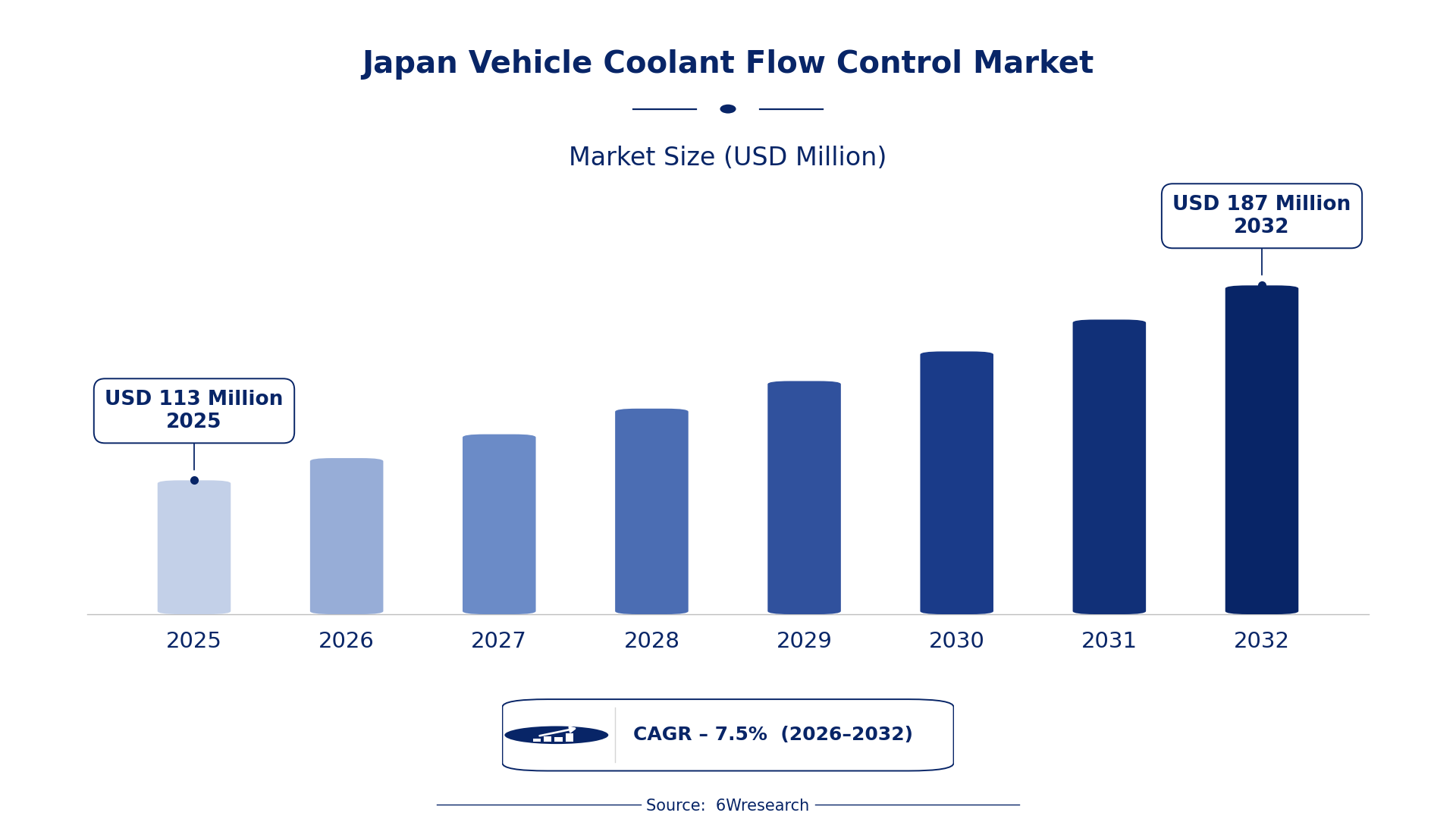
According to 6Wresearch internal database and industry insights, the Japan Vehicle Coolant Flow Control Market was valued at USD 113 Million in 2025 and is projected to reach USD 187 Million by 2032, growing at a CAGR of approximately 7.5% during 2026–2032.
Japan Vehicle Coolant Flow Control Market Highlights
| Report Metric | Details |
| Report Name | Japan Vehicle Coolant Flow Control Market (2026-2032) |
| Market Size 2025 | USD 113 Million |
| Market Size 2032 | USD 187 Million |
| Absolute Growth 2025–2032 | USD 74 Million |
| CAGR 2026–2032 | 7.5% |
| Peak Annual Growth | 8.5% in 2028 |
| Forecast Period | 2026–2032 |
| Historical Data | 2022–2025 |
| Base Year | 2025 |
| Leading Control Type, 2025 | Thermostatic Control Valves (52% share) |
| Leading Valve Technology, 2025 | Wax-Pellet Driven (39% share) |
| Leading Integration Area, 2025 | Engine Cooling Circuit (38% share) |
| Leading End User, 2025 | Radiator Manufacturers (48% share) |
| Fastest-Growing Control Type | Electronic Flow Controllers (10.4% CAGR) |
| Fastest-Growing Valve Technology | Servo-Controlled (11.1% CAGR) |
| Fastest-Growing Integration Area | EV Battery Cooling (9.4% CAGR) |
| Fastest-Growing End User | Electric Car OEMs (10.1% CAGR) |
| Growing Sector | Electric Car OEMs |
| Key End Users | Radiator Manufacturers, Electric Car OEMs, HVAC System Providers, Hybrid Car Manufacturers |
Japan Vehicle Coolant Flow Control Market Year-wise Growth Rate and Key Drivers (2022–2032)
This graph illustrates the annual growth rates of the market from 2022 to 2032, highlighting a steady upward trajectory and projected market expansion over the forecast period.
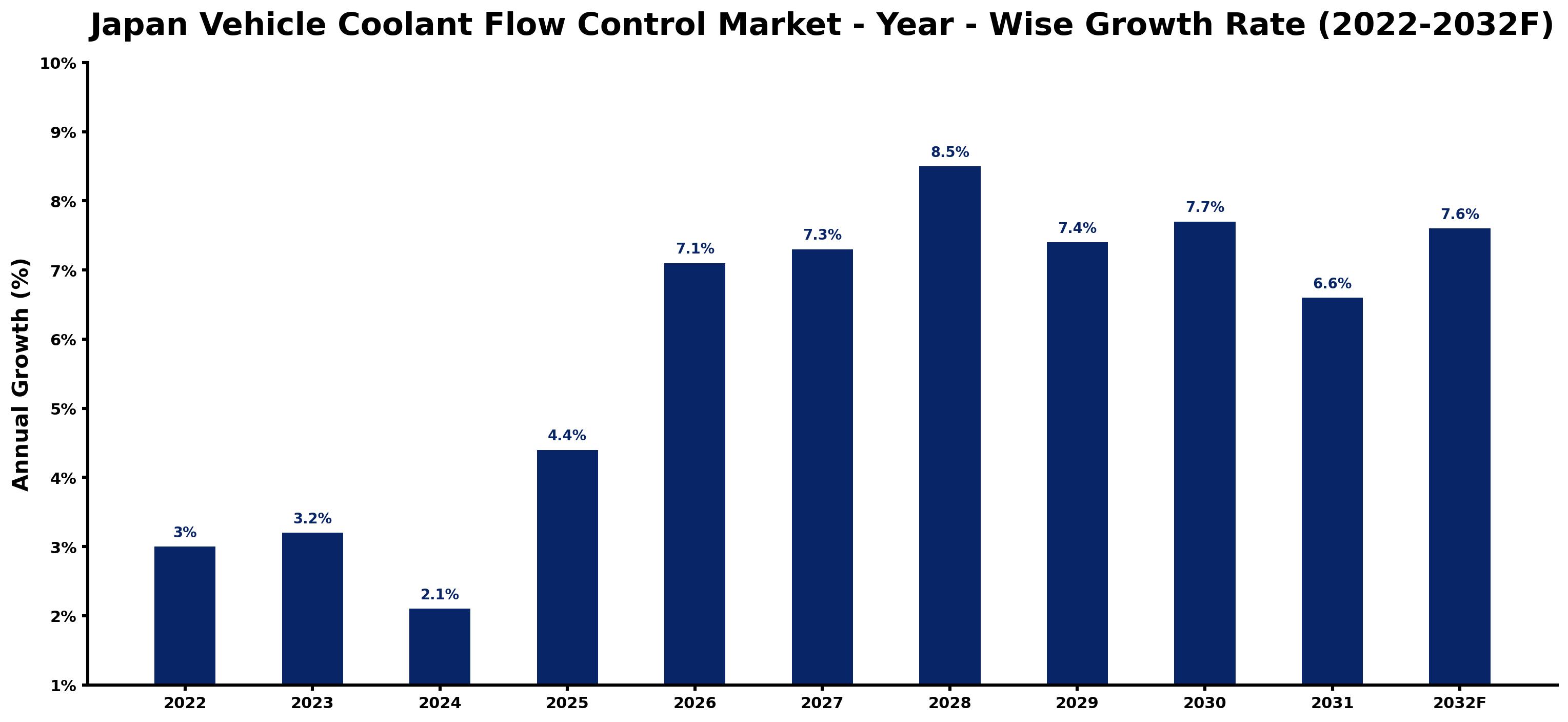
Below, each year's estimated growth is shown next to the factor that most influenced it.
| Year | Estimated Annual Growth (%) | Market Rationale |
| 2022 | 3.0 | The market experienced steady growth due to consistent automotive production levels. |
| 2023 | 3.2 | Growth accelerated as manufacturers increased output to meet rising demand. |
| 2024 | 2.1 | Growth slowed as supply chain disruptions impacted production schedules. |
| 2025 | 4.4 | Demand surged with the introduction of new vehicle models featuring advanced cooling systems. |
| 2026 | 7.1 | The market is projected to expand as electric vehicle adoption increases. |
| 2027 | 7.3 | Growth is expected to continue as technological advancements in coolant systems gain traction. |
| 2028 | 8.5 | The peak growth will stem from heightened investments in automotive innovations. |
| 2029 | 7.4 | Growth is anticipated to slow as manufacturers adjust to market saturation in certain segments. |
| 2030 | 7.7 | Demand is expected to rise again as environmental regulations prompt upgrades in vehicle technology. |
| 2031 | 6.6 | The market will grow at a slower rate due to increased competition among suppliers. |
| 2032 | 7.6 | Demand is projected to rise as the push for electric vehicles continues. |
Note: Market size estimations and growth projections presented in this report are based on 6Wresearch's proprietary forecasting methodology, utilizing the latest available industry data, government publications, and primary research inputs.
Japan Vehicle Coolant Flow Control Market Synopsis
Vehicle coolant flow control products are vital for managing engine temperatures in internal combustion and electric vehicles. Made from metals and polymers, these components ensure optimal performance and prevent overheating. The Japan Vehicle Coolant Flow Control Market is expanding due to the automotive sector, which produced 8.3 million vehicles in 2022. The increasing adoption of electric vehicles, supported by initiatives like the green vehicle subsidy program, drives demand for advanced cooling technologies, resulting in heightened purchases from radiator manufacturers and electric car OEMs.
Market Dynamics Impact Analysis (2026–2032)
| Factor | Type | Impact | Primary Segment Affected |
| Growing production of electric vehicles | Driver | High | EV Battery Cooling |
| Technological advancements in coolant flow control systems | Driver | High | Electronic Flow Controllers |
| Investment in advanced cooling technologies | Opportunity | Medium | Radiator Manufacturers |
| Expansion of electric vehicle market | Opportunity | High | Electric Car OEMs |
| Supply chain disruptions affecting production timelines | Restraint | High | Thermostatic Control Valves |
| Increased competition among suppliers leading to price pressure | Restraint | Medium | Servo-Controlled |
| High costs associated with advanced technology integration | Challenge | High | Hybrid Cooling |
| Regulatory compliance requirements for emissions standards | Challenge | Medium | Engine Cooling Circuit |
Evaluation of Drivers in Japan Vehicle Coolant Flow Control Market (2026–2032)
The table below links each growth driver to the segment it affects and the evidence for it.
| Drivers | Primary Segment Affected | Why It Matters (Evidence) |
| Increased production of electric vehicles | EV Battery Cooling | As of 2023, over 5 million electric vehicles are in Japan, driving demand for effective thermal management solutions. |
| Technological advancements in coolant systems | Electronic Flow Controllers | The automotive sector produced 8.3 million vehicles in 2022, necessitating more efficient cooling technologies. |
| Investment in advanced cooling technologies | Radiator Manufacturers | Radiator manufacturers are investing in new technologies to improve vehicle performance. |
| Government initiatives supporting EV adoption | Electric Car OEMs | The green vehicle subsidy program launched in 2023 encourages manufacturers to produce more electric vehicles. |
| Rising consumer demand for vehicle efficiency | Thermostatic Control Valves | The average age of vehicles on the road in Japan is 13.5 years, prompting upgrades in cooling systems. |
Much of the new demand stems from the rise in electric vehicle production, which exceeded 5 million units in 2023. This increase drives the need for effective battery cooling solutions, prompting manufacturers to invest in advanced thermal management technologies. The automotive sector produced 8.3 million vehicles in 2022, necessitating improved coolant systems to optimise efficiency. Manufacturers are investing in new cooling technologies to meet evolving consumer expectations.
Evaluation of Restraints in Japan Vehicle Coolant Flow Control Market
The following restraints limit how fast demand can grow.
| Market Restraint | Primary Segment Affected | Why It Matters (Evidence) |
| Supply chain disruptions affecting production timelines | Thermostatic Control Valves | In 2022, disruptions led to delays in component availability, impacting overall production schedules. |
| Increased competition among suppliers leading to price pressure | Servo-Controlled | As the market grows, suppliers face pressure to lower prices, which can reduce profit margins. |
| High costs associated with advanced technology integration | Hybrid Cooling | Investments in new technologies can exceed JPY 1 billion, deterring smaller manufacturers. |
| Regulatory compliance requirements for emissions standards | Engine Cooling Circuit | Manufacturers must invest in compliance measures, increasing overall production costs. |
| Market saturation in certain segments | Electronic Flow Controllers | As the market matures, growth rates are slowing due to limited new customer acquisition. |
Japan Vehicle Coolant Flow Control Market Challenges
Manufacturers face high compliance costs due to Japan's strict environmental regulations, which can raise production expenses by JPY 100,000 per vehicle. Suppliers encounter intense competition, forcing them to lower prices and potentially reducing profit margins by 15%, which limits their ability to invest in new solutions. Rapid technological advancements require frequent updates, leading to delays for buyers who may wait up to three months for compatible coolant flow control products. Rising material costs, exacerbated by global supply chain issues, can inflate production costs by 20%, impacting pricing strategies for producers.
Trends in the Japan Vehicle Coolant Flow Control Market
Several trends are reshaping the Japan Vehicle Coolant Flow Control Market; the most important are set out below.
- Shift from Traditional to Advanced Cooling Technologies: Japan is embracing advanced cooling technologies in vehicles, with radiator manufacturers investing in innovative solutions. In 2023, investments in these technologies rose markedly, reflecting the industry's shift towards efficiency.
- Transition from Internal Combustion to Electric Vehicles: The Tokyo region is undergoing a swift transition to electric vehicles, supported by government incentives. As of 2023, over 5 million electric vehicles are on the road, reshaping the demand for coolant systems.
- Emergence of Smart Cooling Systems: Smart cooling systems are gaining traction in the automotive sector, integrating IoT technology for real-time monitoring. The introduction of these systems is expected to improve vehicle efficiency, with a projected market growth of 10% by 2025.
- Prioritisation of Sustainability in Vehicle Design: Sustainability is becoming a priority in vehicle design, with manufacturers focusing on eco-friendly materials. The Green Growth Strategy aims for carbon neutrality by 2050, influencing product development in the automotive sector.
Investment Opportunities in the Japan Vehicle Coolant Flow Control Market
The opportunities below stand out in the Japan Vehicle Coolant Flow Control Market for new entrants and existing suppliers.
- Growing Demand for Electric Vehicle Components: With over 5 million electric vehicles in Japan, there is a pressing need for advanced coolant flow control systems. Radiator manufacturers should invest in new technologies to meet this demand.
- Investment in Advanced Cooling Technologies: The automotive sector is increasingly investing in advanced cooling solutions, motivated by the need for efficiency. Collaborating with radiator manufacturers can provide opportunities for suppliers to enter this market.
- Expansion of Electric Vehicle Production: The Tokyo region is expanding its electric vehicle production capabilities, creating a demand for effective thermal management solutions. Suppliers can partner with local manufacturers to meet this need.
- Focus on Sustainability in Automotive Design: The push for sustainable practices in vehicle design is creating opportunities for eco-friendly coolant systems. Suppliers should align their products with the Green Growth Strategy to capture this market.
Government Initiatives in the Japan Vehicle Coolant Flow Control Market
The Electrical Appliance and Material Safety Act (1961) ensures that vehicle coolant flow control products meet safety standards necessary for consumer protection. The Battery Industry Strategy, introduced in August 2022, targets 150 GWh of domestic battery manufacturing capacity by 2030, promoting the development of advanced automotive technologies.
The Ministry of Economy, Trade and Industry (METI) oversees the implementation of various initiatives, including funding for research and development in automotive technologies. The green vehicle subsidy program launched in 2023 supports manufacturers in producing electric vehicles, increasing the demand for coolant flow control products.
Future Insight of the Japan Vehicle Coolant Flow Control Market
Advancements in cooling technologies will reshape demand by 2032, as manufacturers adopt new materials to improve efficiency. The green vehicle subsidy program will significantly increase electric vehicle adoption, creating new opportunities for coolant flow control products. Japan's automotive sector is expected to produce 10 million vehicles by 2032, driving further investment in manufacturing capabilities. The government's goal of achieving net zero emissions will compel suppliers to develop eco-friendly coolant systems, aligning with national sustainability objectives.
Market Segmentation Analysis
Japan Vehicle Coolant Flow Control Market report covers a detailed analysis of the following market segments:
By Control Type – Thermostatic Control Valves Lead, Electronic Flow Controllers Expected to Grow Fastest
According to Saurav Kr Singh, Senior Research Analyst at 6Wresearch, the largest control type category in 2025 was Thermostatic Control Valves, at 52% of revenue. Thermostatic control valves are essential for regulating engine temperatures, making them indispensable for radiator manufacturers who depend on these components. Their leading position is evident as Japan produced 8.3 million vehicles in 2022, ensuring a robust market for these products. Electronic Flow Controllers are set to record the highest CAGR in this split, 10.4% over 2026–2032. Electronic flow controllers are experiencing rapid growth due to their ability to integrate advanced technology for dynamic coolant flow adjustments, which is crucial for enhancing vehicle efficiency. This growth is further propelled by the increasing adoption of electric vehicles, which exceeded 5 million in 2023. Suppliers should focus on advancing electronic flow controller technologies to meet the rising efficiency demands in the automotive sector.
By Valve Technology – Wax-Pellet Driven Leads, Servo-Controlled Expected to Grow Fastest
Wax-Pellet Driven held 39% of the Japan Vehicle Coolant Flow Control Market by valve technology in 2025. Wax-pellet driven valves are favoured for their reliable thermal response, making them a common choice among radiator manufacturers in Japan. Their strong market share is reinforced by the consistent production of millions of vehicles annually, ensuring a steady demand for these components. The quickest growth will come from Servo-Controlled, forecast to expand at a CAGR of 11.1% between 2026 and 2032. Servo-controlled valves are gaining momentum due to their enhanced control capabilities in modern vehicles, which are increasingly utilising advanced cooling technologies. This trend is supported by the automotive industry's ongoing commitment to innovation and efficiency improvements. Buyers should consider servo-controlled valve technologies to improve vehicle performance and comply with contemporary efficiency standards.
By Integration Area – Engine Cooling Circuit Leads, EV Battery Cooling Expected to Grow Fastest
In 2025, Engine Cooling Circuit led the integration area split with a 38% share. The engine cooling circuit is vital for maintaining engine performance, making it a primary focus for radiator manufacturers in Japan's automotive industry. Its significance is underscored by the production of millions of vehicles that rely on effective cooling solutions. EV Battery Cooling is projected to grow fastest, at a CAGR of 9.4% during 2026–2032. EV battery cooling is gaining momentum as it plays a critical role in battery thermal management, especially with the surge in electric vehicle adoption. The government's commitment to 100% electric vehicle sales by 2035 fuels this segment's rapid growth. Suppliers must adapt their offerings to include solutions for EV battery cooling to stay competitive in the evolving market.
By End User – Radiator Manufacturers Lead, Electric Car OEMs Expected to Grow Fastest
Radiator Manufacturers accounted for 48% of the market by end user in 2025. Radiator manufacturers play a crucial role as the primary users of coolant flow control products, ensuring optimal performance in Japan's expansive automotive sector. Their significant presence is underscored by the employment of approximately 5 million individuals in the industry, highlighting their pivotal role. Over 2026–2032, Electric Car OEMs are expected to post the fastest growth, at a CAGR of 10.1%. Electric car OEMs are rapidly growing, driven by the expanding electric vehicle market and government initiatives such as the green vehicle subsidy program. This shift signals a transition towards more sustainable automotive technologies and increased demand for relevant components. Suppliers should strategically target electric car OEMs to capitalise on the growth opportunities presented by the expanding electric vehicle market.
Key Attractiveness of the Report
- 10 Years of Market Numbers
- Historical Data Starting from 2022 to 2025
- Base Year 2025
- Forecast Data until 2032
- Key Performance Indicators Impacting the Market
- Major Upcoming Developments and Projects
Key Highlights of the Report:
- Japan Vehicle Coolant Flow Control Market Outlook
- Market Size of Japan Vehicle Coolant Flow Control Market, 2025
- Forecast of Japan Vehicle Coolant Flow Control Market, 2032
- Historical Data and Forecast of Japan Vehicle Coolant Flow Control Revenues & Volume for the Period 2022-2032F
- Japan Vehicle Coolant Flow Control Market Trend Evolution
- Japan Vehicle Coolant Flow Control Market Drivers and Challenges
- Japan Vehicle Coolant Flow Control Price Trends
- Japan Vehicle Coolant Flow Control Porter's Five Forces
- Japan Vehicle Coolant Flow Control Industry Life Cycle
- Historical Data and Forecast of Japan Vehicle Coolant Flow Control Market Revenues & Volume By Control Type for the Period 2022-2032F
- Historical Data and Forecast of Japan Vehicle Coolant Flow Control Market Revenues & Volume By Thermostatic Control Valves for the Period 2022-2032F
- Historical Data and Forecast of Japan Vehicle Coolant Flow Control Market Revenues & Volume By Electronic Flow Controllers for the Period 2022-2032F
- Historical Data and Forecast of Japan Vehicle Coolant Flow Control Market Revenues & Volume By Bypass Valves for the Period 2022-2032F
- Historical Data and Forecast of Japan Vehicle Coolant Flow Control Market Revenues & Volume By Dual-Mode Valves for the Period 2022-2032F
- Historical Data and Forecast of Japan Vehicle Coolant Flow Control Market Revenues & Volume By Valve Technology for the Period 2022-2032F
- Historical Data and Forecast of Japan Vehicle Coolant Flow Control Market Revenues & Volume By Wax-Pellet Driven for the Period 2022-2032F
- Historical Data and Forecast of Japan Vehicle Coolant Flow Control Market Revenues & Volume By Servo-Controlled for the Period 2022-2032F
- Historical Data and Forecast of Japan Vehicle Coolant Flow Control Market Revenues & Volume By Manual & Auto Switch for the Period 2022-2032F
- Historical Data and Forecast of Japan Vehicle Coolant Flow Control Market Revenues & Volume By Hybrid Cooling for the Period 2022-2032F
- Historical Data and Forecast of Japan Vehicle Coolant Flow Control Market Revenues & Volume By Integration Area for the Period 2022-2032F
- Historical Data and Forecast of Japan Vehicle Coolant Flow Control Market Revenues & Volume By Engine Cooling Circuit for the Period 2022-2032F
- Historical Data and Forecast of Japan Vehicle Coolant Flow Control Market Revenues & Volume By EV Battery Cooling for the Period 2022-2032F
- Historical Data and Forecast of Japan Vehicle Coolant Flow Control Market Revenues & Volume By Cabin Heating for the Period 2022-2032F
- Historical Data and Forecast of Japan Vehicle Coolant Flow Control Market Revenues & Volume By ICE-EV Platforms for the Period 2022-2032F
- Historical Data and Forecast of Japan Vehicle Coolant Flow Control Market Revenues & Volume By End User for the Period 2022-2032F
- Historical Data and Forecast of Japan Vehicle Coolant Flow Control Market Revenues & Volume By Radiator Manufacturers for the Period 2022-2032F
- Historical Data and Forecast of Japan Vehicle Coolant Flow Control Market Revenues & Volume By Electric Car OEMs for the Period 2022-2032F
- Historical Data and Forecast of Japan Vehicle Coolant Flow Control Market Revenues & Volume By HVAC System Providers for the Period 2022-2032F
- Historical Data and Forecast of Japan Vehicle Coolant Flow Control Market Revenues & Volume By Hybrid Car Manufacturers for the Period 2022-2032F
- Japan Vehicle Coolant Flow Control Import Export Trade Statistics
- Market Opportunity Assessment By Control Type
- Market Opportunity Assessment By Valve Technology
- Market Opportunity Assessment By Integration Area
- Market Opportunity Assessment By End User
- Japan Vehicle Coolant Flow Control Top Companies Market Share
- Japan Vehicle Coolant Flow Control Competitive Benchmarking By Technical and Operational Parameters
- Japan Vehicle Coolant Flow Control Company Profiles
- Japan Vehicle Coolant Flow Control Key Strategic Recommendations
Market Covered
Segments analysed in this report are listed below.
By Control Type
- Thermostatic Control Valves
- Electronic Flow Controllers
- Bypass Valves
- Dual-Mode Valves
By Valve Technology
- Wax-Pellet Driven
- Servo-Controlled
- Manual & Auto Switch
- Hybrid Cooling
By Integration Area
- Engine Cooling Circuit
- EV Battery Cooling
- Cabin Heating
- ICE-EV Platforms
By End User
- Radiator Manufacturers
- Electric Car OEMs
- HVAC System Providers
- Hybrid Car Manufacturers































