Japan Vehicle Coolant Fluids Market Size & Growth Rate
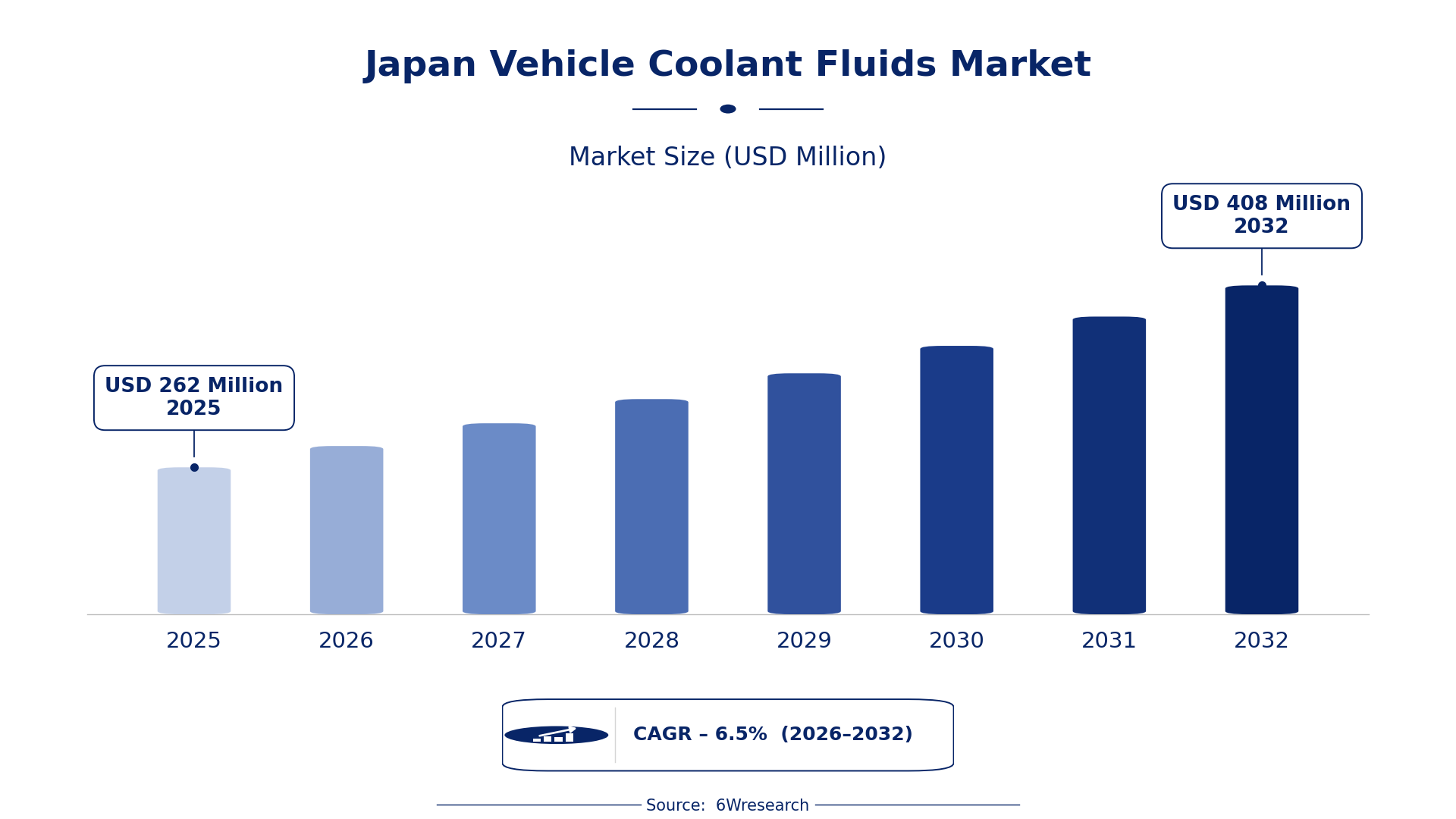
According to 6Wresearch internal database and industry insights, the Japan Vehicle Coolant Fluids Market was valued at USD 262 Million in 2025 and is projected to reach USD 408 Million by 2032, growing at a CAGR of approximately 6.5% during 2026–2032.
Japan Vehicle Coolant Fluids Market Highlights
| Report Metric | Details |
| Report Name | Japan Vehicle Coolant Fluids Market (2026-2032) |
| Market Size 2025 | USD 262 Million |
| Market Size 2032 | USD 408 Million |
| Absolute Growth 2025–2032 | USD 146 Million |
| CAGR 2026–2032 | 6.5% |
| Peak Annual Growth | 7.6% in 2028 |
| Forecast Period | 2026–2032 |
| Historical Data | 2022–2025 |
| Base Year | 2025 |
| Leading Coolant Type, 2025 | Ethylene Glycol-Based (34% share) |
| Leading Base Material, 2025 | Petroleum-Based (42% share) |
| Leading Use Case, 2025 | Conventional Vehicles (44% share) |
| Leading End User, 2025 | Auto Fluid Distributors (46% share) |
| Fastest-Growing Coolant Type | Propylene Glycol-Based (9.9% CAGR) |
| Fastest-Growing Base Material | Eco-Friendly (9.0% CAGR) |
| Fastest-Growing Use Case | EVs (8.6% CAGR) |
| Fastest-Growing End User | Coolant Manufacturers (8.3% CAGR) |
| Growing Sector | automotive aftermarket |
| Key End Users | auto fluid distributors, coolant manufacturers, fleet maintenance firms, high-end car OEMs |
Japan Vehicle Coolant Fluids Market Year-wise Growth Rate and Key Drivers (2022–2032)
This graph illustrates the annual growth rates of the market from 2022 to 2032, highlighting a steady upward trajectory and projected market expansion over the forecast period.
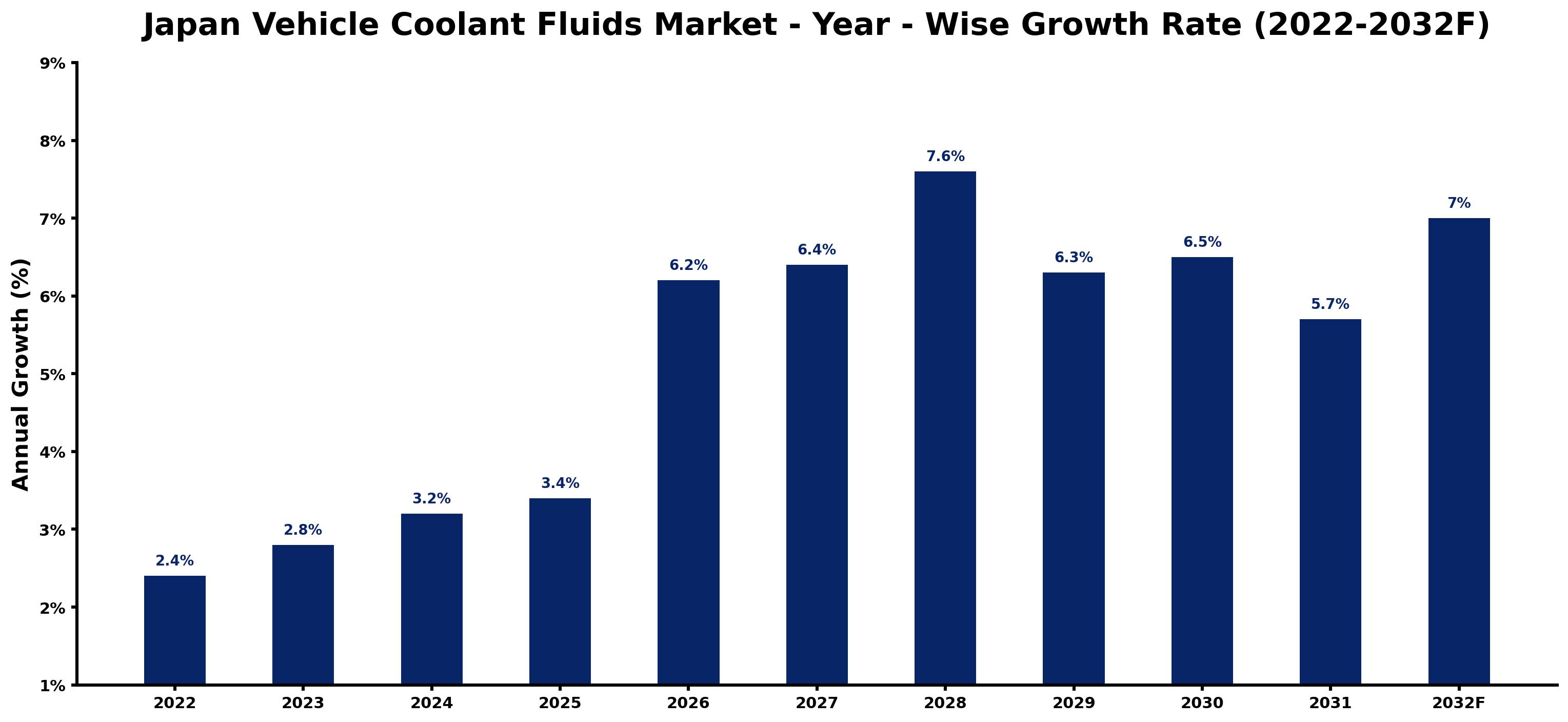
Each row of the following table gives one year's estimated growth and the event or demand shift that explains it.
| Year | Estimated Annual Growth (%) | Market Rationale |
| 2022 | 2.4 | The market maintained steady demand from the automotive sector during this year. |
| 2023 | 2.8 | Growth accelerated due to increased vehicle production and coolant requirements. |
| 2024 | 3.2 | Rising investments in sustainable technologies boosted coolant fluid demand. |
| 2025 | 3.4 | The automotive sector's expansion led to further increases in coolant consumption. |
| 2026 | 6.2 | Demand surged as the market began to embrace eco-friendly coolant solutions. |
| 2027 | 6.4 | Investments in electric vehicles drove higher coolant fluid usage in this sector. |
| 2028 | 7.6 | The peak growth rate was achieved as electric vehicle adoption increased significantly. |
| 2029 | 6.3 | Growth slowed slightly as the market adjusted to new supply dynamics. |
| 2030 | 6.5 | Sustained demand for eco-friendly products continued to drive market growth. |
| 2031 | 5.7 | A slight slowdown occurred as the market stabilised after rapid expansion. |
| 2032 | 7.0 | Growth resumed as investments in sustainable technologies gained momentum. |
Note: Market size estimations and growth projections presented in this report are based on 6Wresearch's proprietary forecasting methodology, utilizing the latest available industry data, government publications, and primary research inputs.
Japan Vehicle Coolant Fluids Market Synopsis
Vehicle coolant fluids are chemical solutions that regulate engine temperature and prevent overheating, primarily made from ethylene glycol or propylene glycol. In Japan, the automotive industry, producing over 8 million vehicles in 2023, drives demand for these fluids. Factors such as increased investments in sustainable technologies, the rise of electric vehicles, and a focus on eco-friendly products are propelling market growth, with the automotive aftermarket projected to expand significantly in the coming years.
Market Dynamics Impact Analysis (2026–2032)
| Factor | Type | Impact | Primary Segment Affected |
| Growing automotive production and demand for coolant fluids | Driver | High | Ethylene Glycol-Based |
| Rising interest in non-toxic coolant solutions | Driver | High | Propylene Glycol-Based |
| Increasing demand for eco-friendly coolant solutions | Opportunity | High | Eco-Friendly |
| Expansion of electric vehicle market requiring specialized coolants | Opportunity | High | EVs |
| Competition from alternative cooling technologies | Restraint | Medium | Organic Acid Technology |
| Fluctuating raw material prices affecting production costs | Restraint | Medium | Petroleum-Based |
| Supply chain disruptions impacting availability of coolant fluids | Challenge | High | Coolant Manufacturers |
| Technological advancements requiring constant innovation in formulations | Challenge | High | Performance Vehicles |
Evaluation of Drivers in Japan Vehicle Coolant Fluids Market (2026–2032)
The main growth drivers and the segments they affect most are set out below.
| Drivers | Primary Segment Affected | Why It Matters (Evidence) |
| Increased vehicle production | Ethylene Glycol-Based | Japan's automotive sector produced over 8 million vehicles in 2023, driving coolant demand. |
| Demand for non-toxic coolants | Propylene Glycol-Based | The growing awareness of health and environmental impacts boosts interest in propylene glycol-based solutions. |
| Investment in sustainable technologies | Eco-Friendly | In 2023, the automotive industry invested ¥1 trillion in R&D for sustainable technologies, driving eco-friendly coolant demand. |
| Rise of electric vehicles | EVs | The increasing adoption of electric vehicles necessitates specialized coolant solutions for efficient thermal management. |
| Focus on extended maintenance intervals | Organic Acid Technology | Organic Acid Technology coolants are preferred for vehicles requiring longer service intervals, increasing their market presence. |
Several shifts outside the market lift sales. The Japanese automotive sector produced over 8 million vehicles in 2023, which increased demand for coolant fluids. Rising awareness of health impacts leads to greater interest in propylene glycol-based coolants among environmentally conscious consumers. In 2023, the automotive industry invested ¥1 trillion in sustainable technologies, driving demand for eco-friendly coolant solutions. The rise of electric vehicles is notable, as these vehicles require specialized coolant solutions for efficient thermal management. The trend towards extended maintenance intervals supports the use of Organic Acid Technology coolants designed for longer service life.
Evaluation of Restraints in Japan Vehicle Coolant Fluids Market
Several factors work against faster growth; the main ones are summarised below.
| Market Restraint | Primary Segment Affected | Why It Matters (Evidence) |
| Competition from alternative cooling technologies | Organic Acid Technology | Emerging alternative cooling technologies may reduce demand for traditional coolant fluids. |
| Fluctuating raw material prices | Petroleum-Based | Volatility in raw material costs can impact production expenses for petroleum-based coolants. |
| Supply chain disruptions | Coolant Manufacturers | Recent global supply chain issues have affected the availability of essential components for coolant production. |
| Regulatory compliance costs | Eco-Friendly | Manufacturers face increased costs to meet stringent environmental regulations for eco-friendly products. |
| Limited awareness of advanced coolant technologies | Performance Vehicles | Some consumers remain unaware of the benefits of advanced coolant technologies, hindering market growth. |
Japan Vehicle Coolant Fluids Market Challenges
A shortage of skilled technicians in Japan's automotive sector hampers effective coolant application, delaying maintenance for over 1 million vehicles managed by fleet maintenance firms. Rapid advancements in coolant technology create a knowledge gap, leading to improper usage that can reduce engine performance and longevity. Supply chain disruptions have caused inconsistent availability of propylene glycol-based coolants, forcing buyers to rely on ethylene glycol alternatives, which can increase costs by 15%. Rising demand from the automotive aftermarket drives up prices, straining budgets for maintenance and repairs for buyers.
Trends in the Japan Vehicle Coolant Fluids Market
The shifts below are changing how Japan Vehicle Coolant Fluids Market products are bought and supplied.
- Shift towards Eco-Friendly Coolants: The Tokyo region is experiencing a notable shift towards eco-friendly coolant solutions as environmental concerns grow. In 2023, the Ministry of the Environment promoted sustainable products, leading to increased demand for non-toxic coolants.
- Rise of Electric Vehicles: Since 2023, the adoption of electric vehicles has accelerated, requiring specialized coolant solutions. With over 8 million vehicles produced in 2023, the demand for effective cooling systems has surged.
- Transition to Extended Maintenance Intervals: The trend towards longer maintenance intervals began in 2023, with vehicles increasingly requiring Organic Acid Technology coolants. This shift is driven by the need for improved engine protection and performance.
- Growth in Automotive Aftermarket: The automotive aftermarket in Japan is projected to grow, increasing coolant demand. In 2023, the market is expected to expand due to rising vehicle maintenance needs.
Investment Opportunities in the Japan Vehicle Coolant Fluids Market
The openings below show where demand in the Japan Vehicle Coolant Fluids Market is visible and how suppliers can enter.
- Investment in Eco-Friendly Production: The Tokyo region presents opportunities for investment in eco-friendly coolant production. With a projected growth of 9.0% for eco-friendly coolants, manufacturers can partner with local firms to meet rising demand.
- Supply of Specialized Coolants for EVs: Auto fluid distributors are increasingly seeking specialized coolants for electric vehicles. With the EV segment expected to grow at 8.6%, entering this market through joint ventures can be beneficial.
- Development of High-Performance Coolants: Performance vehicles require high-performance coolant solutions. With a growing market, coolant manufacturers can invest in R&D to create advanced formulations that meet these demands.
- Expansion of Fleet Maintenance Services: Fleet maintenance firms managing over 1 million vehicles present an opportunity. Suppliers can enter this market by offering tailored coolant solutions that improve vehicle upkeep.
Government Initiatives in the Japan Vehicle Coolant Fluids Market
The GX Basic Policy, adopted in 2023, aims to promote decarbonisation through public-private investments. This policy encourages producers of vehicle coolant fluids to develop eco-friendly solutions, aligning with Japan's target for net zero emissions by 2050. Compliance with the JIS K 2234 standard ensures quality and performance in coolant products, benefiting buyers seeking reliable solutions.
The Japan Coolant Association actively promotes sustainable practices within the automotive sector. It funds initiatives for eco-friendly coolant solutions and oversees compliance with environmental standards, ensuring that producers meet the necessary requirements for market entry. The association also supports industry standards, improving product quality and safety.
Future Insight of the Japan Vehicle Coolant Fluids Market
Japan will see substantial investments in sustainable technologies, generating demand for advanced coolant solutions by 2032. The introduction of eco-friendly coolant formulations will improve engine efficiency, benefiting both buyers and suppliers. Adherence to the JIS K 2234 standard will ensure higher quality products, fostering trust in the market. Government initiatives will promote the use of non-toxic coolants, aligning with the country's goal of achieving net zero emissions by 2050.
Market Segmentation Analysis
Japan Vehicle Coolant Fluids Market report covers a detailed analysis of the following market segments:
By Coolant Type – Ethylene Glycol-Based Leads, Propylene Glycol-Based Expected to Grow Fastest
According to Saurav Kr Singh, Senior Research Analyst at 6Wresearch, Ethylene Glycol-Based accounted for 34% of the market by coolant type in 2025. Ethylene glycol-based coolants hold the largest share due to their effective thermal properties, making them the preferred choice for most vehicles. The JIS K 2234 standard ensures their quality, further solidifying their dominance in the market. The quickest growth will come from Propylene Glycol-Based, forecast to expand at a CAGR of 9.9% between 2026 and 2032. Propylene glycol-based coolants are experiencing rapid growth as they gain traction for their non-toxic characteristics, appealing to environmentally conscious consumers. The Ministry of the Environment's promotion of eco-friendly solutions is a key factor driving this segment's expansion. Suppliers should focus on developing eco-friendly products to meet the increasing demand from consumers and regulatory bodies.
By Base Material – Petroleum-Based Leads, Eco-Friendly Expected to Grow Fastest
The largest base material category in 2025 was Petroleum-Based, at 42% of revenue. Petroleum-based coolants dominate the market as they serve as the traditional base for many coolant formulations, ensuring reliability and performance. The established supply chain for petroleum-based products supports their continued prevalence in the industry. Eco-Friendly is set to record the highest CAGR in this split, 9.0% over 2026–2032. Eco-friendly coolants are growing rapidly in popularity due to rising consumer awareness and demand for sustainable products. The automotive industry's investment in R&D for sustainable technologies is propelling this segment forward. Buyers are likely to seek more eco-friendly options, prompting suppliers to innovate in sustainable coolant formulations.
By Use Case – Conventional Vehicles Lead, EVs Expected to Grow Fastest
With 44% of use case revenue in 2025, Conventional Vehicles was the largest category. Conventional vehicles dominate the market as they represent the primary application for coolant fluids in the vast majority of vehicles on the road today. With Japan producing over 8 million vehicles in 2023, the reliance on these fluids remains a critical factor for automotive performance. Over 2026–2032, EVs are expected to post the fastest growth, at a CAGR of 8.6%. Electric vehicles are witnessing significant growth in coolant usage due to the increasing adoption of EV technology within the automotive industry. As more electric vehicles are manufactured, the demand for effective cooling systems is becoming essential to ensure optimal performance and longevity. This trend indicates that suppliers must adapt their offerings to cater to the growing needs of the electric vehicle segment.
By End User – Auto Fluid Distributors Lead, Coolant Manufacturers Expected to Grow Fastest
Auto Fluid Distributors held 46% of the Japan Vehicle Coolant Fluids Market by end user in 2025. Auto fluid distributors dominate the market as they are essential suppliers to the automotive industry, ensuring coolant fluids are readily available through various distribution channels. Their established networks with manufacturers help maintain a consistent supply to meet market needs. Coolant Manufacturers are projected to grow fastest, at a CAGR of 8.3% during 2026–2032. Coolant manufacturers are showing the highest growth rate as they develop a range of formulations for different applications, including environmentally friendly options. The focus on sustainability is prompting manufacturers to broaden their product offerings. Suppliers should consider forming strategic alliances with coolant manufacturers to capitalise on the increasing demand for diverse and sustainable coolant formulations.
Key Attractiveness of the Report
- 10 Years of Market Numbers
- Historical Data Starting from 2022 to 2025
- Base Year 2025
- Forecast Data until 2032
- Key Performance Indicators Impacting the Market
- Major Upcoming Developments and Projects
Key Highlights of the Report:
- Japan Vehicle Coolant Fluids Market Outlook
- Market Size of Japan Vehicle Coolant Fluids Market, 2025
- Forecast of Japan Vehicle Coolant Fluids Market, 2032
- Historical Data and Forecast of Japan Vehicle Coolant Fluids Revenues & Volume for the Period 2022-2032F
- Japan Vehicle Coolant Fluids Market Trend Evolution
- Japan Vehicle Coolant Fluids Market Drivers and Challenges
- Japan Vehicle Coolant Fluids Price Trends
- Japan Vehicle Coolant Fluids Porter's Five Forces
- Japan Vehicle Coolant Fluids Industry Life Cycle
- Historical Data and Forecast of Japan Vehicle Coolant Fluids Market Revenues & Volume By Coolant Type for the Period 2022-2032F
- Historical Data and Forecast of Japan Vehicle Coolant Fluids Market Revenues & Volume By Ethylene Glycol-Based for the Period 2022-2032F
- Historical Data and Forecast of Japan Vehicle Coolant Fluids Market Revenues & Volume By Propylene Glycol-Based for the Period 2022-2032F
- Historical Data and Forecast of Japan Vehicle Coolant Fluids Market Revenues & Volume By Organic Acid Technology for the Period 2022-2032F
- Historical Data and Forecast of Japan Vehicle Coolant Fluids Market Revenues & Volume By Hybrid Organic Acid Tech for the Period 2022-2032F
- Historical Data and Forecast of Japan Vehicle Coolant Fluids Market Revenues & Volume By Base Material for the Period 2022-2032F
- Historical Data and Forecast of Japan Vehicle Coolant Fluids Market Revenues & Volume By Petroleum-Based for the Period 2022-2032F
- Historical Data and Forecast of Japan Vehicle Coolant Fluids Market Revenues & Volume By Eco-Friendly for the Period 2022-2032F
- Historical Data and Forecast of Japan Vehicle Coolant Fluids Market Revenues & Volume By Corrosion Inhibition for the Period 2022-2032F
- Historical Data and Forecast of Japan Vehicle Coolant Fluids Market Revenues & Volume By Extended Lifespan for the Period 2022-2032F
- Historical Data and Forecast of Japan Vehicle Coolant Fluids Market Revenues & Volume By Use Case for the Period 2022-2032F
- Historical Data and Forecast of Japan Vehicle Coolant Fluids Market Revenues & Volume By Conventional Vehicles for the Period 2022-2032F
- Historical Data and Forecast of Japan Vehicle Coolant Fluids Market Revenues & Volume By EVs for the Period 2022-2032F
- Historical Data and Forecast of Japan Vehicle Coolant Fluids Market Revenues & Volume By Long-Duration Vehicles for the Period 2022-2032F
- Historical Data and Forecast of Japan Vehicle Coolant Fluids Market Revenues & Volume By Performance Vehicles for the Period 2022-2032F
- Historical Data and Forecast of Japan Vehicle Coolant Fluids Market Revenues & Volume By End User for the Period 2022-2032F
- Historical Data and Forecast of Japan Vehicle Coolant Fluids Market Revenues & Volume By Auto Fluid Distributors for the Period 2022-2032F
- Historical Data and Forecast of Japan Vehicle Coolant Fluids Market Revenues & Volume By Coolant Manufacturers for the Period 2022-2032F
- Historical Data and Forecast of Japan Vehicle Coolant Fluids Market Revenues & Volume By Fleet Maintenance Firms for the Period 2022-2032F
- Historical Data and Forecast of Japan Vehicle Coolant Fluids Market Revenues & Volume By High-End Car OEMs for the Period 2022-2032F
- Japan Vehicle Coolant Fluids Import Export Trade Statistics
- Market Opportunity Assessment By Coolant Type
- Market Opportunity Assessment By Base Material
- Market Opportunity Assessment By Use Case
- Market Opportunity Assessment By End User
- Japan Vehicle Coolant Fluids Top Companies Market Share
- Japan Vehicle Coolant Fluids Competitive Benchmarking By Technical and Operational Parameters
- Japan Vehicle Coolant Fluids Company Profiles
- Japan Vehicle Coolant Fluids Key Strategic Recommendations
Market Covered
Segments analysed in this report are listed below.
By Coolant Type
- Ethylene Glycol-Based
- Propylene Glycol-Based
- Organic Acid Technology
- Hybrid Organic Acid Tech
By Base Material
- Petroleum-Based
- Eco-Friendly
- Corrosion Inhibition
- Extended Lifespan
By Use Case
- Conventional Vehicles
- EVs
- Long-Duration Vehicles
- Performance Vehicles
By End User
- Auto Fluid Distributors
- Coolant Manufacturers
- Fleet Maintenance Firms
- High-End Car OEMs































