Japan Vehicle Cooling Solutions Market Size & Growth Rate
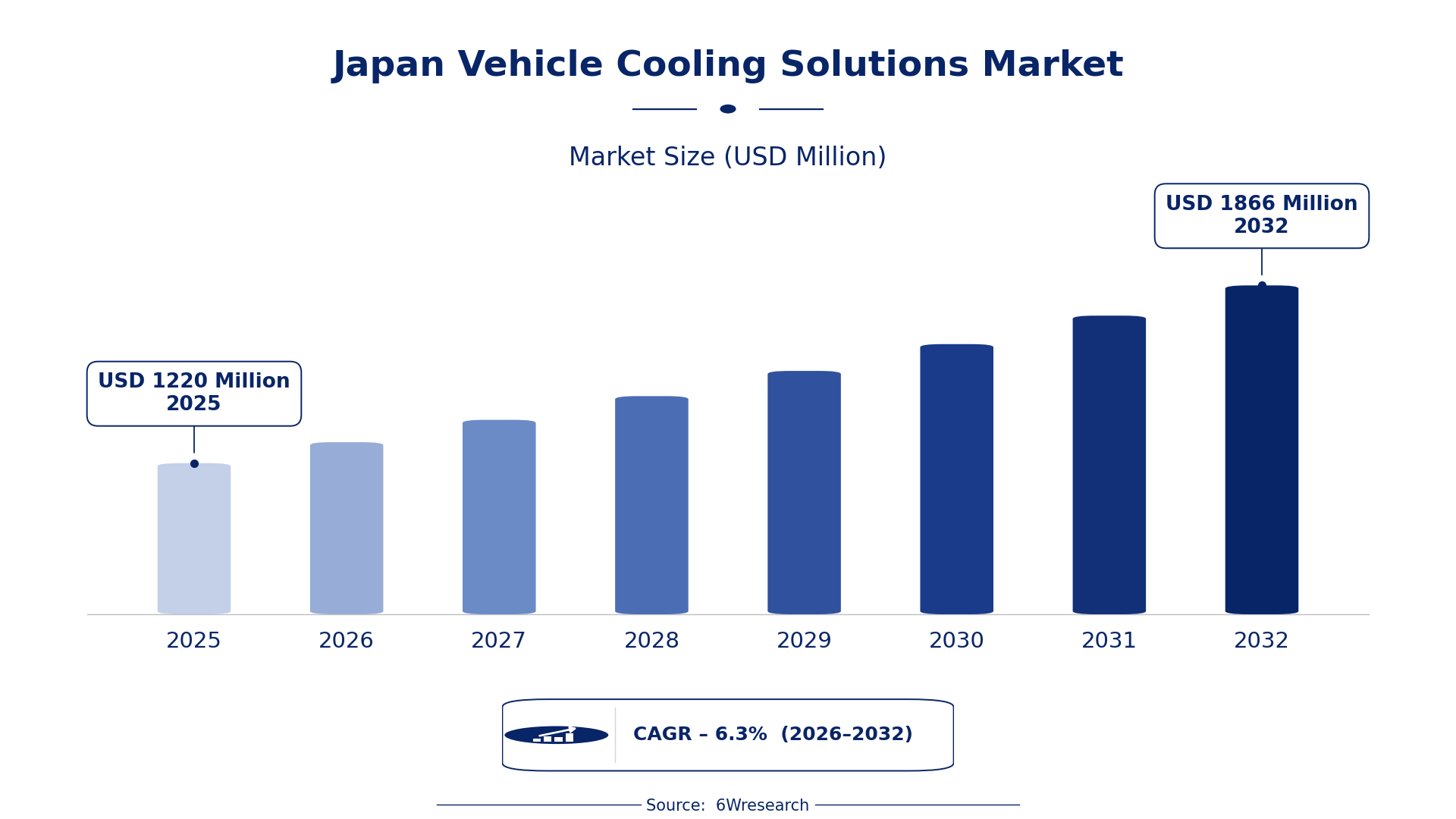
According to 6Wresearch internal database and industry insights, the Japan Vehicle Cooling Solutions Market was valued at USD 1,220 Million in 2025 and is projected to reach USD 1,866 Million by 2032, growing at a CAGR of approximately 6.3% during 2026–2032.
Japan Vehicle Cooling Solutions Market Highlights
| Report Metric | Details |
| Report Name | Japan Vehicle Cooling Solutions Market (2026-2032) |
| Market Size 2025 | USD 1,220 Million |
| Market Size 2032 | USD 1,866 Million |
| Absolute Growth 2025–2032 | USD 646 Million |
| CAGR 2026–2032 | 6.3% |
| Peak Annual Growth | 7.3% in 2028 |
| Forecast Period | 2026–2032 |
| Historical Data | 2022–2025 |
| Base Year | 2025 |
| Leading Cooling System Type, 2025 | Radiator-Based Systems (37% share) |
| Leading Control Method, 2025 | Thermostatic (36% share) |
| Leading Target Component, 2025 | Engines (44% share) |
| Leading End User, 2025 | Passenger Vehicle OEMs (50% share) |
| Fastest-Growing Cooling System Type | Battery Thermal Management (8.6% CAGR) |
| Fastest-Growing Control Method | Electric Pumps (9.0% CAGR) |
| Fastest-Growing Target Component | Battery Packs (9.4% CAGR) |
| Fastest-Growing End User | EV Manufacturers (8.1% CAGR) |
| Growing Sector | Electric Vehicles |
| Key End Users | Passenger Vehicle OEMs, EV Manufacturers, Sports Car Makers |
Japan Vehicle Cooling Solutions Market Year-wise Growth Rate and Key Drivers (2022–2032)
This graph illustrates the annual growth rates of the market from 2022 to 2032, highlighting a steady upward trajectory and projected market expansion over the forecast period.
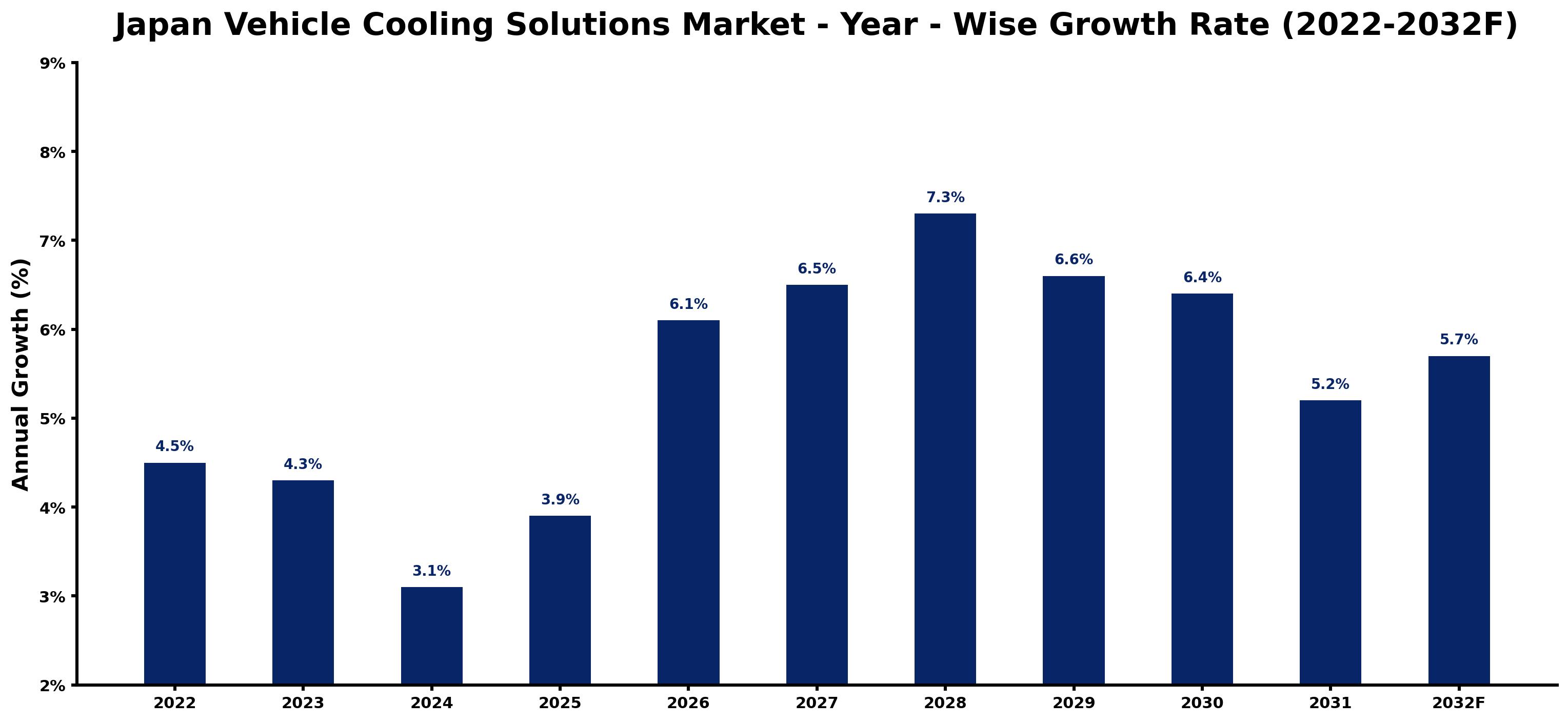
The following figures match every annual growth estimate with the main market development of that year, giving the reasoning behind each rise or slowdown.
| Year | Estimated Annual Growth (%) | Market Rationale |
| 2022 | 4.5 | The market experienced solid growth due to strong demand from domestic vehicle manufacturers. |
| 2023 | 4.3 | Growth slowed slightly as manufacturers adjusted to supply chain challenges and market conditions. |
| 2024 | 3.1 | A further slowdown occurred as the market faced increased competition and evolving consumer preferences. |
| 2025 | 3.9 | Growth picked up again as investments in electric vehicle technology gained momentum. |
| 2026 | 6.1 | Demand rises with the continued adoption of advanced cooling technologies in electric vehicles. |
| 2027 | 6.5 | The market sees sustained growth as passenger vehicle production increases in the Tokyo region. |
| 2028 | 7.3 | Peak growth is reached as innovative cooling solutions drive performance in new vehicle models. |
| 2029 | 6.6 | Growth slows as market saturation begins to affect new vehicle sales and cooling solution adoption. |
| 2030 | 6.4 | Demand stabilises as manufacturers focus on efficiency and sustainability in cooling technologies. |
| 2031 | 5.2 | Growth continues to slow as the market adjusts to changing consumer preferences and technology adoption. |
| 2032 | 5.7 | A resurgence in demand is expected as new regulations and standards promote advanced cooling solutions. |
Note: Market size estimations and growth projections presented in this report are based on 6Wresearch's proprietary forecasting methodology, utilizing the latest available industry data, government publications, and primary research inputs.
Japan Vehicle Cooling Solutions Market Synopsis
Vehicle cooling solutions are systems designed to manage the temperature of vehicle components, including radiators, oil coolers, and battery thermal management systems. The market is growing due to increased production in Japan's automotive sector, which produced 8.2 million vehicles in 2022, and a rising demand for electric vehicles, supported by government initiatives targeting 1 million new EVs by 2025. This growth stems from domestic vehicle manufacturers and the need for efficient cooling solutions to improve performance and passenger comfort.
Market Dynamics Impact Analysis (2026–2032)
| Factor | Type | Impact | Primary Segment Affected |
| Rising demand for electric vehicles | Driver | High | Battery Thermal Management |
| Increased vehicle production | Driver | High | Radiator-Based Systems |
| Emerging EV manufacturers seeking advanced cooling solutions | Opportunity | High | Battery Thermal Management |
| Growing focus on energy efficiency in automotive cooling | Opportunity | Medium | Oil Coolers |
| Competition from alternative cooling technologies | Restraint | High | Cabin Air Coolers |
| High costs associated with advanced cooling technologies | Restraint | Medium | Thermostatic |
| Supply chain disruptions affecting component availability | Challenge | High | Electric Pumps |
| Technological advancements requiring constant adaptation | Challenge | Medium | HVAC Integrated |
Evaluation of Drivers in Japan Vehicle Cooling Solutions Market (2026–2032)
Demand rests on the following drivers, each shown with the segment it touches most.
| Drivers | Primary Segment Affected | Why It Matters (Evidence) |
| Increased electric vehicle production | Battery Thermal Management | Electric vehicles require efficient thermal management systems to maintain battery performance, with a focus on high-capacity batteries. |
| Rising vehicle production levels | Radiator-Based Systems | Japan produced 8.2 million vehicles in 2022, driving demand for effective engine cooling solutions. |
| Growing consumer preference for energy-efficient vehicles | Oil Coolers | As consumers demand better fuel efficiency, oil coolers become essential for maintaining engine performance. |
| Technological advancements in cooling solutions | Thermostatic | Innovations in cooling technology improve system efficiency, leading to increased adoption by manufacturers. |
| Government initiatives promoting EV adoption | Battery Thermal Management | The government aims for 1 million new EVs by 2025, boosting demand for advanced thermal management systems. |
Spending rises because the automotive industry in Japan is adapting to the increasing demand for electric vehicles, which require advanced battery thermal management systems. In 2022, Japan produced 8.2 million vehicles, leading to higher demand for effective engine cooling solutions. The focus on energy efficiency drives the need for oil coolers, as consumers seek better fuel economy. Advancements in cooling solutions improve system performance, encouraging manufacturers to invest in thermostatic controls.
Evaluation of Restraints in Japan Vehicle Cooling Solutions Market
These restraints slow adoption and weigh on supplier margins.
| Market Restraint | Primary Segment Affected | Why It Matters (Evidence) |
| Competition from alternative cooling technologies | Cabin Air Coolers | As new technologies emerge, traditional cabin air coolers face pressure to innovate or risk losing market share. |
| High costs associated with advanced cooling technologies | Thermostatic | The investment required for advanced cooling solutions can deter manufacturers from upgrading existing systems. |
| Supply chain disruptions affecting component availability | Electric Pumps | Recent global supply chain challenges have led to delays in obtaining critical components for cooling systems. |
| Technological advancements requiring constant adaptation | HVAC Integrated | Manufacturers must continuously invest in R&D to keep pace with evolving cooling technologies and consumer expectations. |
| Regulatory compliance costs for new standards | Battery Thermal Management | Meeting stringent regulations increases operational costs for manufacturers, impacting pricing strategies. |
Japan Vehicle Cooling Solutions Market Challenges
Producers face supply chain disruptions due to reliance on specific materials for cooling systems, delaying production timelines by up to three months. Technology limitations in existing systems hinder the adoption of advanced thermal management solutions, resulting in increased operational costs for manufacturers. Buyers encounter rising expenses from compliance with the JIS B 8606 standard, inflating costs by approximately 15%. A shortage of skilled technicians in the automotive sector complicates installation processes for producers, potentially delaying vehicle deliveries and impacting overall market efficiency.
Trends in the Japan Vehicle Cooling Solutions Market
The trends below show where the Japan Vehicle Cooling Solutions Market is heading.
- Shift from Traditional to Advanced Cooling Technologies: Japan's automotive sector is increasingly adopting advanced cooling technologies to improve vehicle performance. The Tokyo Motor Show 2023 highlighted innovations in vehicle cooling systems, showcasing the industry's commitment to efficiency.
- Transition from Internal Combustion to Electric Vehicles: The shift towards electric vehicles is clear in Japan, with initiatives promoting EV adoption. By 2025, the target is to introduce 1 million new EVs, driving demand for battery thermal management systems.
- Emergence of Integrated Cooling Solutions: Integrated cooling systems are becoming standard in new vehicle designs, as seen in the latest models showcased at the Tokyo Motor Show 2023. This shift improves overall vehicle efficiency and performance.
- Increased Focus on Energy Efficiency: Automakers are prioritising energy-efficient solutions, particularly in response to consumer demand. The push for better fuel economy is reflected in the growing adoption of oil coolers and thermostatic controls.
Investment Opportunities in the Japan Vehicle Cooling Solutions Market
The following areas offer the clearest openings for investors and suppliers in the Japan Vehicle Cooling Solutions Market.
- Growing Demand for Battery Thermal Management: With the rise of electric vehicles, the need for efficient battery thermal management systems is critical. The government aims for 1 million new EVs by 2025, creating opportunities for suppliers in this sector.
- Investment in Advanced Cooling Technologies: Now is the time for manufacturers to invest in advanced cooling solutions, as the average age of vehicles in Japan is around 13 years, increasing the need for upgrades and replacements.
- Expansion in the Tokyo Region: The Tokyo region, a major automotive manufacturing hub, presents opportunities for suppliers of cooling systems. The installed base of approximately 78 million passenger vehicles drives demand for efficient cooling solutions.
- Focus on Climate-Friendly Technologies: Japan's commitment to reducing greenhouse gas emissions by 46% by 2030 opens avenues for investment in energy-efficient cooling technologies that align with sustainability goals.
Government Initiatives in the Japan Vehicle Cooling Solutions Market
The JIS B 8606 standard governs automotive cooling systems in Japan, ensuring that manufacturers adhere to specific performance and safety criteria. This regulation promotes efficient cooling technologies across the industry. Additionally, the Green Growth Strategy Through Achieving Carbon Neutrality in 2050, adopted in December 2020 and updated in 2021, identifies automotive cooling solutions as a key sector for innovation and investment.
In 2023, ¥500 million was allocated to support research and development in automotive technologies, including cooling systems. The Ministry of Land, Infrastructure, Transport and Tourism oversees these initiatives, ensuring that funding is directed towards projects that improve the efficiency and sustainability of vehicle cooling solutions.
Future Insight of the Japan Vehicle Cooling Solutions Market
The push for a 46% reduction in greenhouse-gas emissions will drive advancements in vehicle cooling technologies, prompting suppliers to enhance system efficiency. The initiative to promote 1 million new EVs by 2025 will elevate demand for innovative cooling solutions. New benchmarks from the Tokyo Motor Show 2023 will shape product development in the sector. Research funding of ¥500 million allocated in 2023 will accelerate progress in automotive cooling solutions, benefiting both buyers and suppliers.
Market Segmentation Analysis
Japan Vehicle Cooling Solutions Market report covers a detailed analysis of the following market segments:
By Cooling System Type – Radiator-Based Systems Lead, Battery Thermal Management Expected to Grow Fastest
According to Saurav Kr Singh, Senior Research Analyst at 6Wresearch, Radiator-Based Systems took 37% of cooling system type revenue in 2025, more than any other category. Radiator-based systems dominate the market as they are essential for engine cooling in the majority of vehicles, particularly in Japan's automotive sector which produced 8.2 million vehicles in 2022. This established technology benefits from a vast installed base, ensuring consistent demand from manufacturers and service providers. The quickest growth will come from Battery Thermal Management, forecast to expand at a CAGR of 8.6% between 2026 and 2032. Battery thermal management systems are experiencing rapid growth due to the increasing focus on electric vehicles, with the government targeting 1 million new EVs by 2025. This shift towards electrification necessitates advanced cooling solutions to maintain battery performance and longevity. Suppliers should prioritise innovation in battery thermal management to capitalise on the expanding electric vehicle market.
By Control Method – Thermostatic Leads, Electric Pumps Expected to Grow Fastest
Thermostatic accounted for 36% of the market by control method in 2025. Thermostatic control methods lead the market due to their effectiveness in regulating cooling system temperature, which is crucial for optimal engine performance. Their widespread application in Japan's extensive vehicle fleet, including millions of passenger vehicles, solidifies their dominant position. Over 2026–2032, Electric Pumps are expected to post the fastest growth, at a CAGR of 9.0%. Electric pumps are rapidly gaining traction as they enhance fluid circulation efficiency, a critical factor for modern cooling systems. This growth is particularly pronounced with the increasing adoption of electric vehicles, which require sophisticated thermal management solutions. Suppliers should prioritise the development of electric pump technologies to cater to the rising demand for advanced cooling systems.
By Target Component – Engines Lead, Battery Packs Expected to Grow Fastest
With 44% of target component revenue in 2025, Engines was the largest category. Engines are the primary components requiring cooling solutions, making them the largest segment in the market. The high volume of vehicles in Japan, with an installed base of approximately 78 million, ensures sustained demand for engine cooling technologies. Battery Packs are set to record the highest CAGR in this split, 9.4% over 2026–2032. Battery packs are emerging as the fastest-growing segment due to the surge in electric vehicle production and the need for effective thermal management. As battery technology advances, the demand for specialised cooling solutions will continue to rise. Suppliers must focus on developing tailored solutions for battery packs to meet the needs of the expanding electric vehicle sector.
By End User – Passenger Vehicle OEMs Lead, EV Manufacturers Expected to Grow Fastest
The largest end user category in 2025 was Passenger Vehicle OEMs, at 50% of revenue. Passenger vehicle OEMs command the largest share as they are the main consumers of cooling solutions, essential for their diverse vehicle offerings. The robust production of over 8 million vehicles annually in Japan underscores their pivotal role in the market. EV Manufacturers are projected to grow fastest, at a CAGR of 8.1% during 2026–2032. EV manufacturers represent the fastest-growing segment, driven by government initiatives that aim to increase electric vehicle adoption significantly. This trend reflects a major shift in the automotive industry towards electrification and advanced thermal management needs. Suppliers must adapt their products to address the unique thermal management requirements of EV manufacturers to capitalise on new market opportunities.
Key Attractiveness of the Report
- 10 Years of Market Numbers
- Historical Data Starting from 2022 to 2025
- Base Year 2025
- Forecast Data until 2032
- Key Performance Indicators Impacting the Market
- Major Upcoming Developments and Projects
Key Highlights of the Report:
- Japan Vehicle Cooling Solutions Market Outlook
- Market Size of Japan Vehicle Cooling Solutions Market, 2025
- Forecast of Japan Vehicle Cooling Solutions Market, 2032
- Historical Data and Forecast of Japan Vehicle Cooling Solutions Revenues & Volume for the Period 2022-2032F
- Japan Vehicle Cooling Solutions Market Trend Evolution
- Japan Vehicle Cooling Solutions Market Drivers and Challenges
- Japan Vehicle Cooling Solutions Price Trends
- Japan Vehicle Cooling Solutions Porter's Five Forces
- Japan Vehicle Cooling Solutions Industry Life Cycle
- Historical Data and Forecast of Japan Vehicle Cooling Solutions Market Revenues & Volume By Cooling System Type for the Period 2022-2032F
- Historical Data and Forecast of Japan Vehicle Cooling Solutions Market Revenues & Volume By Radiator-Based Systems for the Period 2022-2032F
- Historical Data and Forecast of Japan Vehicle Cooling Solutions Market Revenues & Volume By Battery Thermal Management for the Period 2022-2032F
- Historical Data and Forecast of Japan Vehicle Cooling Solutions Market Revenues & Volume By Oil Coolers for the Period 2022-2032F
- Historical Data and Forecast of Japan Vehicle Cooling Solutions Market Revenues & Volume By Cabin Air Coolers for the Period 2022-2032F
- Historical Data and Forecast of Japan Vehicle Cooling Solutions Market Revenues & Volume By Control Method for the Period 2022-2032F
- Historical Data and Forecast of Japan Vehicle Cooling Solutions Market Revenues & Volume By Thermostatic for the Period 2022-2032F
- Historical Data and Forecast of Japan Vehicle Cooling Solutions Market Revenues & Volume By Electric Pumps for the Period 2022-2032F
- Historical Data and Forecast of Japan Vehicle Cooling Solutions Market Revenues & Volume By Mechanical/Electric Fans for the Period 2022-2032F
- Historical Data and Forecast of Japan Vehicle Cooling Solutions Market Revenues & Volume By HVAC Integrated for the Period 2022-2032F
- Historical Data and Forecast of Japan Vehicle Cooling Solutions Market Revenues & Volume By Target Component for the Period 2022-2032F
- Historical Data and Forecast of Japan Vehicle Cooling Solutions Market Revenues & Volume By Engines for the Period 2022-2032F
- Historical Data and Forecast of Japan Vehicle Cooling Solutions Market Revenues & Volume By Battery Packs for the Period 2022-2032F
- Historical Data and Forecast of Japan Vehicle Cooling Solutions Market Revenues & Volume By Transmission Systems for the Period 2022-2032F
- Historical Data and Forecast of Japan Vehicle Cooling Solutions Market Revenues & Volume By Passenger Comfort for the Period 2022-2032F
- Historical Data and Forecast of Japan Vehicle Cooling Solutions Market Revenues & Volume By End User for the Period 2022-2032F
- Historical Data and Forecast of Japan Vehicle Cooling Solutions Market Revenues & Volume By Passenger Vehicle OEMs for the Period 2022-2032F
- Historical Data and Forecast of Japan Vehicle Cooling Solutions Market Revenues & Volume By EV Manufacturers for the Period 2022-2032F
- Historical Data and Forecast of Japan Vehicle Cooling Solutions Market Revenues & Volume By Sports Car Makers for the Period 2022-2032F
- Historical Data and Forecast of Japan Vehicle Cooling Solutions Market Revenues & Volume By Interior System Providers for the Period 2022-2032F
- Japan Vehicle Cooling Solutions Import Export Trade Statistics
- Market Opportunity Assessment By Cooling System Type
- Market Opportunity Assessment By Control Method
- Market Opportunity Assessment By Target Component
- Market Opportunity Assessment By End User
- Japan Vehicle Cooling Solutions Top Companies Market Share
- Japan Vehicle Cooling Solutions Competitive Benchmarking By Technical and Operational Parameters
- Japan Vehicle Cooling Solutions Company Profiles
- Japan Vehicle Cooling Solutions Key Strategic Recommendations
Market Covered
The report covers the following segments.
By Cooling System Type
- Radiator-Based Systems
- Battery Thermal Management
- Oil Coolers
- Cabin Air Coolers
By Control Method
- Thermostatic
- Electric Pumps
- Mechanical/Electric Fans
- HVAC Integrated
By Target Component
- Engines
- Battery Packs
- Transmission Systems
- Passenger Comfort
By End User
- Passenger Vehicle OEMs
- EV Manufacturers
- Sports Car Makers
- Interior System Providers































