Japan Vehicle Cooling System Components Market Size & Growth Rate
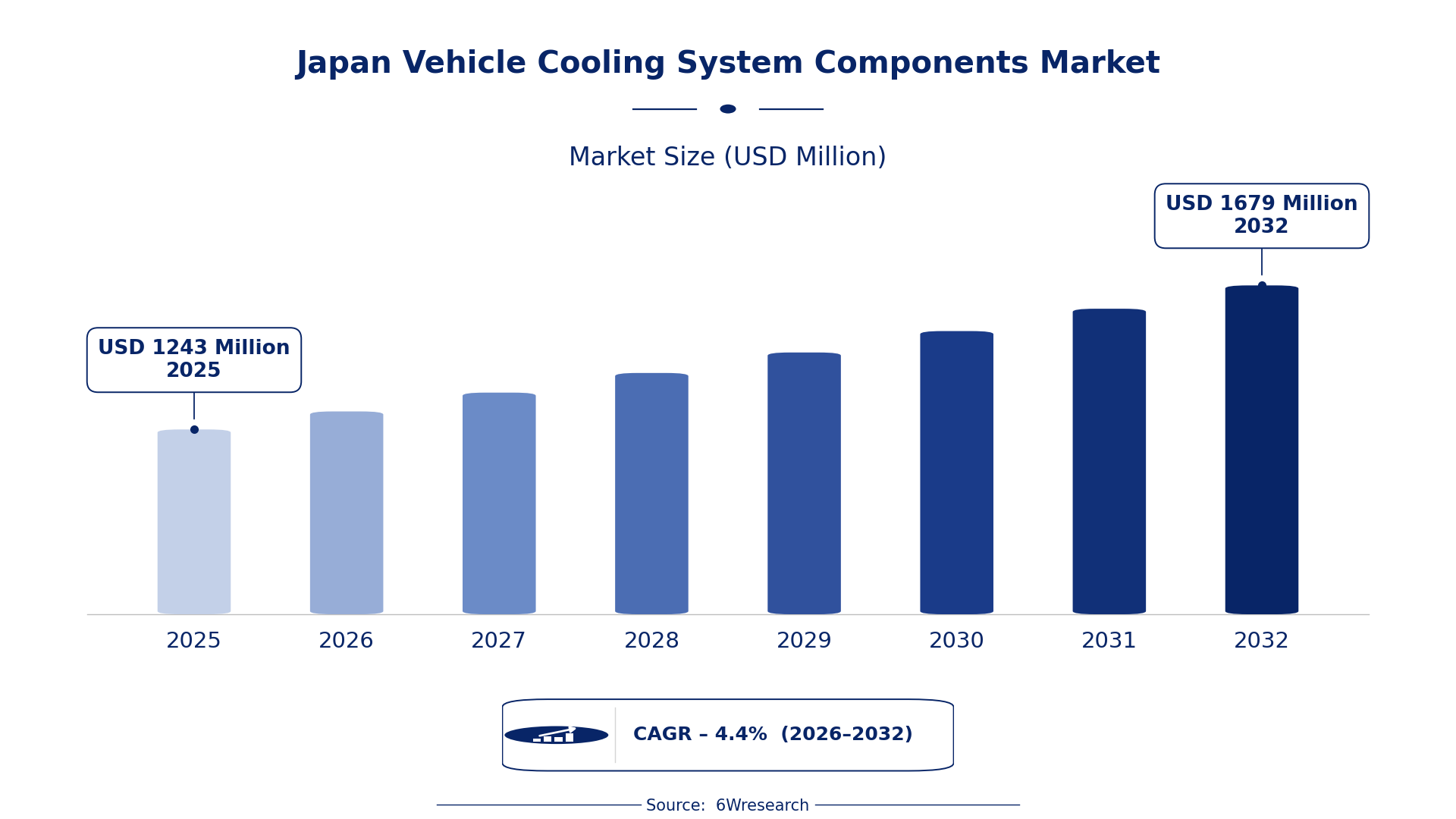
According to 6Wresearch internal database and industry insights, the Japan Vehicle Cooling System Components Market was valued at USD 1,243 Million in 2025 and is projected to reach USD 1,679 Million by 2032, growing at a CAGR of approximately 4.4% during 2026–2032.
Japan Vehicle Cooling System Components Market Highlights
| Report Metric | Details |
| Report Name | Japan Vehicle Cooling System Components Market (2026-2032) |
| Market Size 2025 | USD 1,243 Million |
| Market Size 2032 | USD 1,679 Million |
| Absolute Growth 2025–2032 | USD 436 Million |
| CAGR 2026–2032 | 4.4% |
| Peak Annual Growth | 5.2% in 2028 |
| Forecast Period | 2026–2032 |
| Historical Data | 2022–2025 |
| Base Year | 2025 |
| Leading Component Type, 2025 | Radiators (41% share) |
| Leading Function, 2025 | Heat Dissipation (40% share) |
| Leading Material Type, 2025 | Aluminum (37% share) |
| Leading End User, 2025 | Thermal System Manufacturers (50% share) |
| Fastest-Growing Component Type | Water Pumps (5.9% CAGR) |
| Fastest-Growing Function | Coolant Circulation (5.7% CAGR) |
| Fastest-Growing Material Type | Cast Iron/Plastic (6.0% CAGR) |
| Fastest-Growing End User | ICE Vehicle OEMs (5.5% CAGR) |
| Growing Sector | automotive industry |
| Key End Users | thermal system manufacturers, ICE vehicle OEMs, auto component suppliers |
Japan Vehicle Cooling System Components Market Year-wise Growth Rate and Key Drivers (2022–2032)
This graph illustrates the annual growth rates of the market from 2022 to 2032, highlighting a steady upward trajectory and projected market expansion over the forecast period.
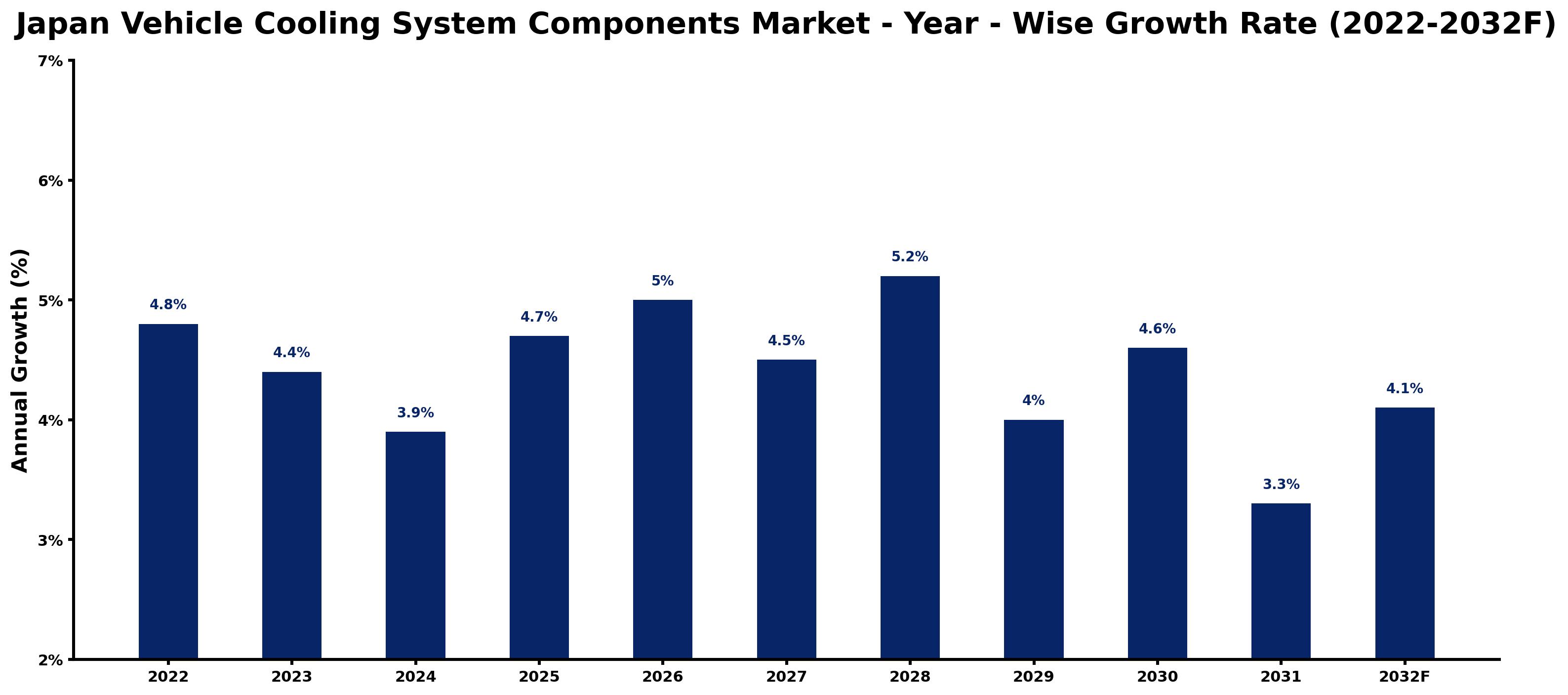
Annual growth estimates for each year appear below with the principal reason behind them, explaining the shifts that set the pace of the market.
| Year | Estimated Annual Growth (%) | Market Rationale |
| 2022 | 4.8 | The market showed strong performance due to high vehicle production levels. |
| 2023 | 4.4 | Growth slowed as manufacturers faced supply chain disruptions affecting component availability. |
| 2024 | 3.9 | Demand continued to slow as manufacturers adjusted to market conditions and production capabilities. |
| 2025 | 4.7 | Growth accelerated as vehicle production rebounded and new technologies were introduced. |
| 2026 | 5.0 | The market is expected to grow as investments in eco-friendly technologies increase. |
| 2027 | 4.5 | Growth is projected to slow as market saturation begins to affect demand levels. |
| 2028 | 5.2 | The market is expected to peak due to heightened demand for efficient cooling solutions. |
| 2029 | 4.0 | Growth is projected to slow as competition intensifies and market stabilises. |
| 2030 | 4.6 | Demand is expected to rise as manufacturers adopt new cooling technologies. |
| 2031 | 3.3 | Growth is projected to slow as the market approaches maturity and stabilisation occurs. |
| 2032 | 4.1 | Demand is expected to increase as eco-friendly initiatives gain traction. |
Note: Market size estimations and growth projections presented in this report are based on 6Wresearch's proprietary forecasting methodology, utilizing the latest available industry data, government publications, and primary research inputs.
Japan Vehicle Cooling System Components Market Synopsis
Vehicle cooling system components are vital for maintaining optimal engine temperatures in internal combustion engine vehicles, with applications in heat dissipation, coolant circulation, and air flow generation. The Japan Vehicle Cooling System Components Market is expanding, driven by the production of 8.3 million vehicles in 2022, highlighting the automotive sector's strength. Factors such as the government's 2023 programme promoting eco-friendly vehicle technologies and the presence of thermal system manufacturers are supporting ongoing demand for these components in Japan.
Market Dynamics Impact Analysis (2026–2032)
| Factor | Type | Impact | Primary Segment Affected |
| High vehicle production levels drive demand for cooling components. | Driver | High | Radiators |
| Investment in eco-friendly technologies unlocks new demand for efficient cooling systems. | Driver | High | Water Pumps |
| The shift towards lightweight materials creates opportunities for innovative component designs. | Opportunity | High | Cooling Fans |
| Growing demand for electric vehicles increases the need for advanced cooling solutions. | Opportunity | High | Expansion Tanks |
| Supply chain disruptions can limit the availability of essential components. | Restraint | High | Heat Dissipation |
| Market saturation may slow growth as competition intensifies. | Restraint | Medium | Coolant Circulation |
| Technological advancements require significant investment from manufacturers. | Challenge | High | Air Flow Generation |
| Regulatory changes may impose additional compliance costs on producers. | Challenge | Medium | Overflow Control |
Evaluation of Drivers in Japan Vehicle Cooling System Components Market (2026–2032)
The factors lifting demand, and the evidence behind each, are summarised below.
| Drivers | Primary Segment Affected | Why It Matters (Evidence) |
| Increased vehicle production rates drive demand for radiators. | Radiators | Japan produced 8.3 million vehicles in 2022, leading to higher radiator requirements. |
| Investment in lightweight materials boosts demand for water pumps. | Water Pumps | Aluminum radiators account for 70% of the market, improving efficiency. |
| Technological advancements in cooling systems support fan production. | Cooling Fans | Advanced polymers are now used in fan designs for better efficiency. |
| The push for eco-friendly technologies drives expansion tank demand. | Expansion Tanks | The government launched a programme in 2023 to promote eco-friendly vehicle technologies. |
| Rising vehicle registrations create demand for heat dissipation components. | Heat Dissipation | There are over 5 million registered vehicles in Japan as of 2023. |
Purchasing is picking up as vehicle production remains strong, with 8.3 million vehicles produced in 2022. This surge drives demand for cooling components, essential for maintaining optimal engine temperatures. The use of lightweight materials, particularly aluminum, increases the need for effective coolant circulation. Technological advancements lead to the adoption of advanced polymers in cooling fans, improving overall system efficiency.
Evaluation of Restraints in Japan Vehicle Cooling System Components Market
Below are the constraints most often cited by buyers and suppliers, with the segment each affects.
| Market Restraint | Primary Segment Affected | Why It Matters (Evidence) |
| Supply chain disruptions limit the availability of essential components. | Heat Dissipation | Manufacturers encountered challenges in sourcing materials, affecting production timelines. |
| Market saturation may slow growth as competition intensifies. | Coolant Circulation | With numerous players in the market, differentiation becomes increasingly challenging. |
| High compliance costs due to regulatory changes can strain producers. | Air Flow Generation | New regulations require manufacturers to invest in compliance measures. |
| Technological advancements require substantial investment from manufacturers. | Overflow Control | The need for advanced cooling solutions demands high capital expenditure. |
| Economic fluctuations can impact consumer purchasing power. | Expansion Tanks | Economic downturns may lead to reduced vehicle sales, affecting component demand. |
Japan Vehicle Cooling System Components Market Challenges
Producers face intense competition from global manufacturers, which compresses profit margins and restricts funds for innovation. Importers encounter supply chain disruptions due to dependence on specific materials, potentially delaying component availability by up to six weeks. Buyers deal with challenges related to updated JIS standards, which can result in compliance costs reaching 5% of total procurement for manufacturers. Rising raw material prices inflate production costs by 10%, adversely affecting profitability for automotive companies.
Trends in the Japan Vehicle Cooling System Components Market
Below are the shifts with the largest effect on the Japan Vehicle Cooling System Components Market.
- Shift Towards Eco-Friendly Technologies: Japan is increasingly adopting eco-friendly vehicle technologies, as seen in the government's 2023 programme promoting sustainable automotive solutions. This initiative aims to reduce greenhouse gas emissions by 46% by 2030.
- Transition from Metal to Advanced Polymers: Cooling fans are now frequently made from advanced polymers, which improve efficiency and reduce weight. This shift is occurring in the automotive sector, where manufacturers are moving towards these materials for better performance.
- Emergence of Lightweight Materials in Cooling Systems: Aluminum is becoming the predominant material for radiators, accounting for 70% of the market due to its lightweight benefits. This trend is reshaping component design and manufacturing processes in Japan.
- Focus on Thermal Efficiency Innovations: The Tokyo Motor Show showcases innovations in vehicle cooling systems every two years, highlighting the industry's commitment to thermal efficiency. This focus is driving advancements in cooling technologies across the automotive sector.
Investment Opportunities in the Japan Vehicle Cooling System Components Market
The following opportunities in the Japan Vehicle Cooling System Components Market pair current demand with a clear way in.
- Timing for Eco-Friendly Investments: With the government's 2023 programme promoting sustainable technologies, now is the time to invest in eco-friendly vehicle cooling components. This initiative aligns with a growing demand for sustainable solutions in the automotive sector.
- Aichi Prefecture as a Manufacturing Hub: Aichi Prefecture is a major hub for vehicle manufacturing, presenting an opportunity to supply advanced cooling components. The region's strong automotive industry supports partnerships for local production.
- Gap in Advanced Cooling Solutions: The increasing complexity of vehicle cooling systems creates a gap for new solutions. Suppliers can focus on developing advanced materials and designs to meet evolving industry needs.
- Supply of Lightweight Components: Investing in the production of lightweight aluminum components is timely, as they dominate the market. Collaborating with thermal system manufacturers can facilitate market entry.
Government Initiatives in the Japan Vehicle Cooling System Components Market
The GX Promotion Act, adopted in 2023, creates a legal framework for advancing decarbonisation in the automotive sector. This act supports investments in eco-friendly technologies, facilitating the development of vehicle cooling components that comply with new environmental standards. The act targets approximately JPY 150 trillion of public-private decarbonisation investment over the next decade, affecting both producers and buyers.
The Battery Industry Strategy, overseen by the Ministry of Economy, Trade and Industry, aims to enhance domestic battery manufacturing capacity by 2030. This strategy indirectly supports the vehicle cooling system components market by promoting innovation in related technologies, with a goal of 150 GWh of domestic battery capacity.
Future Insight of the Japan Vehicle Cooling System Components Market
Advancements in cooling technologies will spur demand for lighter and more efficient components, reshaping the market. By 2032, government initiatives promoting eco-friendly vehicle technologies will redefine industry standards. The average lifespan of cooling components may shorten as manufacturers focus on performance improvements, prompting buyers to revise maintenance strategies. With over 5 million registered vehicles in Japan as of 2023, the shift towards sustainable practices will align with Japan's greenhouse gas reduction targets.
Market Segmentation Analysis
Japan Vehicle Cooling System Components Market report covers a detailed analysis of the following market segments:
By Component Type – Radiators Lead, Water Pumps Expected to Grow Fastest
According to Saurav Kr Singh, Senior Research Analyst at 6Wresearch, Radiators held 41% of the Japan Vehicle Cooling System Components Market by component type in 2025. Radiators hold the largest share in the market as they are essential for heat dissipation in vehicles, which is critical for maintaining optimal engine temperatures. The dominance of aluminum radiators, accounting for 70% of the market, illustrates their vital role in vehicle cooling systems. Water Pumps are set to record the highest CAGR in this split, 5.9% over 2026–2032. Water pumps are experiencing rapid growth due to the increasing demand for efficient coolant circulation in modern engines. The government's recent programme promoting eco-friendly vehicle technologies is expected to further elevate the need for advanced water pump systems. Suppliers should prioritise the development of innovative water pump technologies to meet the rising demand from manufacturers.
By Function – Heat Dissipation Leads, Coolant Circulation Expected to Grow Fastest
The largest function category in 2025 was Heat Dissipation, at 40% of revenue. Heat dissipation leads the function segment as it is vital for maintaining engine temperature, ensuring vehicles operate efficiently. The production of 8.3 million vehicles in Japan in 2022 highlights the necessity for effective heat dissipation solutions in the automotive industry. The quickest growth will come from Coolant Circulation, forecast to expand at a CAGR of 5.7% between 2026 and 2032. Coolant circulation is experiencing rapid growth driven by advancements in engine technology that demand more efficient systems. The government's emphasis on eco-friendly vehicle technologies is expected to accelerate this trend as manufacturers seek to optimise engine performance. Buyers should prioritise suppliers who can offer advanced coolant circulation solutions to maintain a competitive edge.
By Material Type – Aluminum Leads, Cast Iron/Plastic Expected to Grow Fastest
Aluminum took 37% of material type revenue in 2025, more than any other category. Aluminum is the leading material type due to its widespread use in lightweight and efficient components, which are crucial for contemporary vehicle design. The automotive industry's emphasis on weight reduction to enhance fuel efficiency has reinforced aluminum's strong market position. Cast Iron/Plastic is projected to grow fastest, at a CAGR of 6.0% during 2026–2032. Cast iron/plastic is witnessing faster growth as manufacturers explore alternative materials for specific components, aiming for cost-effectiveness and improved performance. The trend towards advanced polymers in cooling fans signals a shift towards material diversification within the industry. Suppliers should consider broadening their material offerings to include alternative solutions that align with industry standards.
By End User – Thermal System Manufacturers Lead, ICE Vehicle OEMs Expected to Grow Fastest
With 50% of end user revenue in 2025, Thermal System Manufacturers was the largest category. Thermal system manufacturers are the primary users of vehicle cooling components, thus driving the largest market share. Their essential role in supplying critical parts to the automotive industry highlights the importance of collaboration in product development. Over 2026–2032, ICE Vehicle OEMs are expected to post the fastest growth, at a CAGR of 5.5%. ICE vehicle OEMs are experiencing rapid growth as they adapt to new technologies and rising production demands. The robust automotive sector in Aichi Prefecture serves as a catalyst for this growth, prompting OEMs to seek more efficient cooling solutions. Suppliers must align their strategies with the requirements of ICE vehicle OEMs to capitalise on emerging opportunities in the market.
Key Attractiveness of the Report
- 10 Years of Market Numbers
- Historical Data Starting from 2022 to 2025
- Base Year 2025
- Forecast Data until 2032
- Key Performance Indicators Impacting the Market
- Major Upcoming Developments and Projects
Key Highlights of the Report:
- Japan Vehicle Cooling System Components Market Outlook
- Market Size of Japan Vehicle Cooling System Components Market, 2025
- Forecast of Japan Vehicle Cooling System Components Market, 2032
- Historical Data and Forecast of Japan Vehicle Cooling System Components Revenues & Volume for the Period 2022-2032F
- Japan Vehicle Cooling System Components Market Trend Evolution
- Japan Vehicle Cooling System Components Market Drivers and Challenges
- Japan Vehicle Cooling System Components Price Trends
- Japan Vehicle Cooling System Components Porter's Five Forces
- Japan Vehicle Cooling System Components Industry Life Cycle
- Historical Data and Forecast of Japan Vehicle Cooling System Components Market Revenues & Volume By Component Type for the Period 2022-2032F
- Historical Data and Forecast of Japan Vehicle Cooling System Components Market Revenues & Volume By Radiators for the Period 2022-2032F
- Historical Data and Forecast of Japan Vehicle Cooling System Components Market Revenues & Volume By Water Pumps for the Period 2022-2032F
- Historical Data and Forecast of Japan Vehicle Cooling System Components Market Revenues & Volume By Cooling Fans for the Period 2022-2032F
- Historical Data and Forecast of Japan Vehicle Cooling System Components Market Revenues & Volume By Expansion Tanks for the Period 2022-2032F
- Historical Data and Forecast of Japan Vehicle Cooling System Components Market Revenues & Volume By Function for the Period 2022-2032F
- Historical Data and Forecast of Japan Vehicle Cooling System Components Market Revenues & Volume By Heat Dissipation for the Period 2022-2032F
- Historical Data and Forecast of Japan Vehicle Cooling System Components Market Revenues & Volume By Coolant Circulation for the Period 2022-2032F
- Historical Data and Forecast of Japan Vehicle Cooling System Components Market Revenues & Volume By Air Flow Generation for the Period 2022-2032F
- Historical Data and Forecast of Japan Vehicle Cooling System Components Market Revenues & Volume By Overflow Control for the Period 2022-2032F
- Historical Data and Forecast of Japan Vehicle Cooling System Components Market Revenues & Volume By Material Type for the Period 2022-2032F
- Historical Data and Forecast of Japan Vehicle Cooling System Components Market Revenues & Volume By Aluminum for the Period 2022-2032F
- Historical Data and Forecast of Japan Vehicle Cooling System Components Market Revenues & Volume By Cast Iron/Plastic for the Period 2022-2032F
- Historical Data and Forecast of Japan Vehicle Cooling System Components Market Revenues & Volume By Polypropylene Blades for the Period 2022-2032F
- Historical Data and Forecast of Japan Vehicle Cooling System Components Market Revenues & Volume By HDPE for the Period 2022-2032F
- Historical Data and Forecast of Japan Vehicle Cooling System Components Market Revenues & Volume By End User for the Period 2022-2032F
- Historical Data and Forecast of Japan Vehicle Cooling System Components Market Revenues & Volume By Thermal System Manufacturers for the Period 2022-2032F
- Historical Data and Forecast of Japan Vehicle Cooling System Components Market Revenues & Volume By ICE Vehicle OEMs for the Period 2022-2032F
- Historical Data and Forecast of Japan Vehicle Cooling System Components Market Revenues & Volume By Auto Component Suppliers for the Period 2022-2032F
- Historical Data and Forecast of Japan Vehicle Cooling System Components Market Revenues & Volume By Maintenance & Repair Firms for the Period 2022-2032F
- Japan Vehicle Cooling System Components Import Export Trade Statistics
- Market Opportunity Assessment By Component Type
- Market Opportunity Assessment By Function
- Market Opportunity Assessment By Material Type
- Market Opportunity Assessment By End User
- Japan Vehicle Cooling System Components Top Companies Market Share
- Japan Vehicle Cooling System Components Competitive Benchmarking By Technical and Operational Parameters
- Japan Vehicle Cooling System Components Company Profiles
- Japan Vehicle Cooling System Components Key Strategic Recommendations
Market Covered
The following segment groups are covered in the report.
By Component Type
- Radiators
- Water Pumps
- Cooling Fans
- Expansion Tanks
By Function
- Heat Dissipation
- Coolant Circulation
- Air Flow Generation
- Overflow Control
By Material Type
- Aluminum
- Cast Iron/Plastic
- Polypropylene Blades
- HDPE
By End User
- Thermal System Manufacturers
- ICE Vehicle OEMs
- Auto Component Suppliers
- Maintenance & Repair Firms































