Japan Vehicle Crash Safety System Market Size & Growth Rate
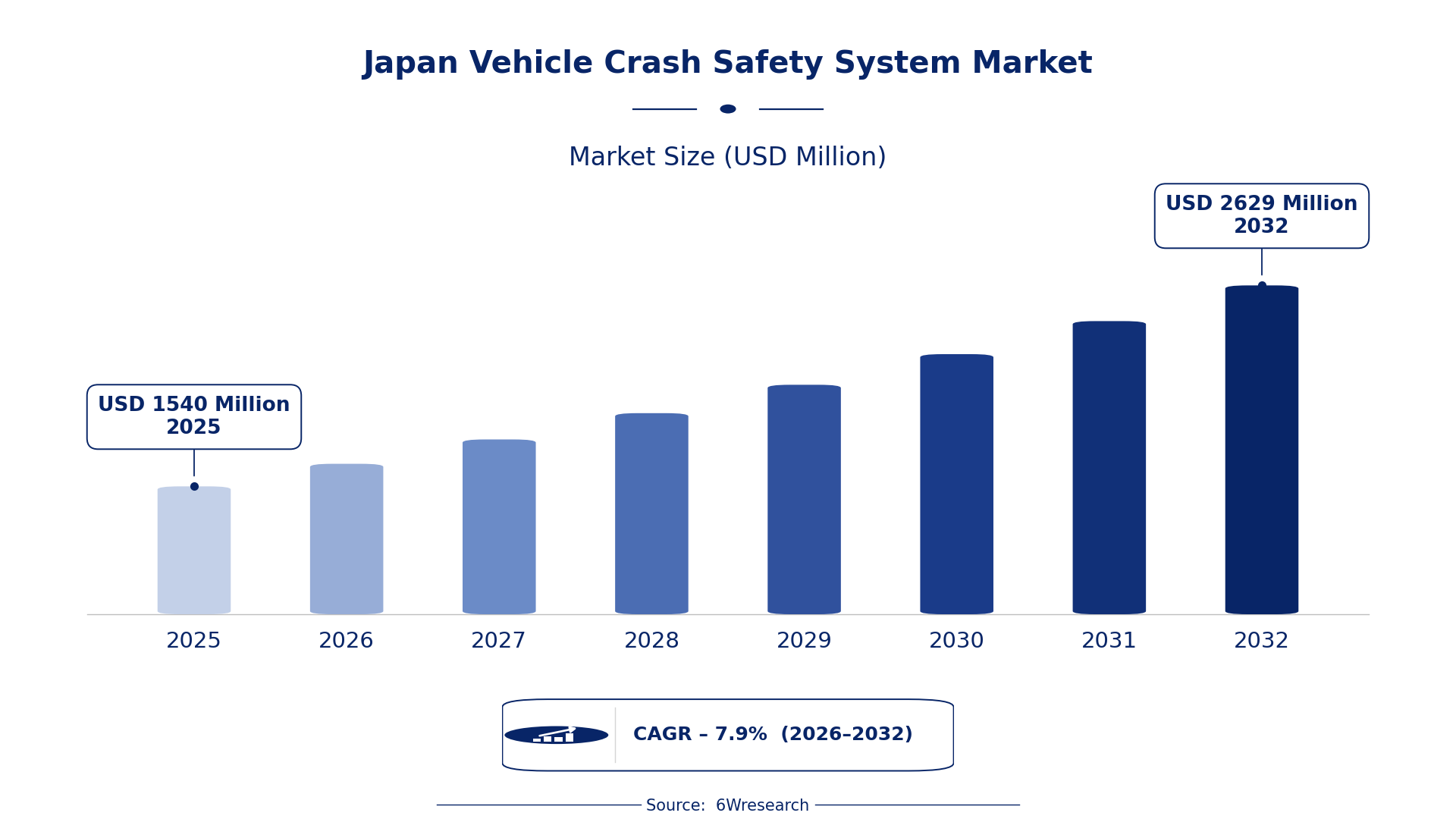
According to 6Wresearch internal database and industry insights, the Japan Vehicle Crash Safety System Market was valued at USD 1,540 Million in 2025 and is projected to reach USD 2,629 Million by 2032, growing at a CAGR of approximately 7.9% during 2026–2032.
Japan Vehicle Crash Safety System Market Highlights
| Report Metric | Details |
| Report Name | Japan Vehicle Crash Safety System Market (2026-2032) |
| Market Size 2025 | USD 1,540 Million |
| Market Size 2032 | USD 2,629 Million |
| Absolute Growth 2025–2032 | USD 1,089 Million |
| CAGR 2026–2032 | 7.9% |
| Peak Annual Growth | 8.5% in 2028 |
| Forecast Period | 2026–2032 |
| Historical Data | 2022–2025 |
| Base Year | 2025 |
| Leading System Type, 2025 | Airbag Systems (38% share) |
| Leading Activation Mechanism, 2025 | Impact Sensors (47% share) |
| Leading Vehicle Class, 2025 | Passenger Cars (42% share) |
| Leading End User, 2025 | OEMs (48% share) |
| Fastest-Growing System Type | Crash Sensors (11.1% CAGR) |
| Fastest-Growing Activation Mechanism | Radar/Camera Input (10.2% CAGR) |
| Fastest-Growing Vehicle Class | EVs (10.0% CAGR) |
| Fastest-Growing End User | ADAS Integrators (10.3% CAGR) |
| Growing Sector | automotive safety systems |
| Key End Users | OEMs, safety engineering firms, autonomous vehicle makers, ADAS integrators |
Japan Vehicle Crash Safety System Market Year-wise Growth Rate and Key Drivers (2022–2032)
This graph illustrates the annual growth rates of the market from 2022 to 2032, highlighting a steady upward trajectory and projected market expansion over the forecast period.
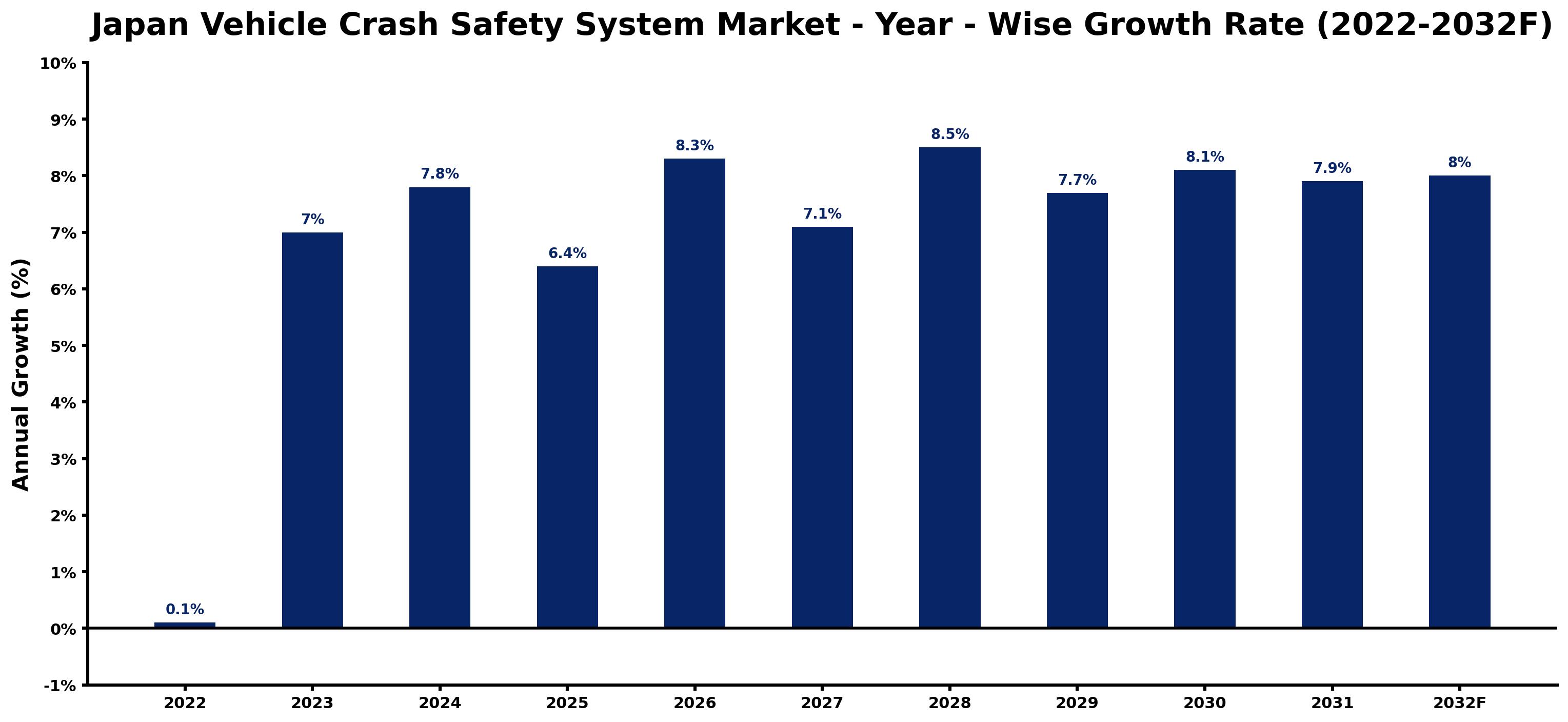
The table below sets out the estimated growth rate for each year and the main factor behind it.
| Year | Estimated Annual Growth (%) | Market Rationale |
| 2022 | 0.1 | The market showed minimal growth as manufacturers adjusted to evolving safety standards. |
| 2023 | 7.0 | Demand surged as new safety regulations prompted increased production of safety systems. |
| 2024 | 7.8 | Growth continued as automotive manufacturers focused on enhancing vehicle safety features. |
| 2025 | 6.4 | The market growth slowed as manufacturers faced challenges in meeting regulatory compliance. |
| 2026 | 8.3 | Demand rose as technological advancements in safety systems gained traction among OEMs. |
| 2027 | 7.1 | Growth decelerated as the market began to stabilise after rapid expansion. |
| 2028 | 8.5 | The market peaked as new innovations in crash safety systems drove significant demand. |
| 2029 | 7.7 | Growth slowed as the market began to normalise following peak demand. |
| 2030 | 8.1 | Demand increased again as new regulations further emphasised vehicle safety standards. |
| 2031 | 7.9 | Growth decelerated slightly as the market adjusted to new safety technologies. |
| 2032 | 8.0 | Demand remains strong as ongoing innovations continue to shape the market. |
Note: Market size estimations and growth projections presented in this report are based on 6Wresearch's proprietary forecasting methodology, utilizing the latest available industry data, government publications, and primary research inputs.
Japan Vehicle Crash Safety System Market Synopsis
Vehicle Crash Safety Systems are critical technologies that protect occupants during collisions, utilising advanced materials and integrated electronics. The market benefits from strong demand from domestic manufacturers, with Japan producing 8.3 million vehicles in 2022. An increasing emphasis on safety regulations, highlighted by the introduction of stricter crash test requirements in 2023, further propels market growth. As the automotive sector prioritises safety, the market is expected to expand, reaching USD 2,629 million by 2032.
Market Dynamics Impact Analysis (2026–2032)
| Factor | Type | Impact | Primary Segment Affected |
| Rising demand for advanced safety features | Driver | High | Airbag Systems |
| Technological advancements in crash detection | Driver | High | Crash Sensors |
| Growing focus on safety regulations | Opportunity | High | Pre-Crash Systems |
| Increase in electric vehicle production | Opportunity | Medium | EVs |
| High costs of implementing new technologies | Restraint | High | Impact Sensors |
| Challenges in meeting stringent safety standards | Restraint | Medium | Airbag Systems |
| Limited availability of skilled workforce | Challenge | High | ADAS Integrators |
| Rising material costs impacting production | Challenge | Medium | Crash Sensors |
Evaluation of Drivers in Japan Vehicle Crash Safety System Market (2026–2032)
These are the developments adding the most demand over the forecast period.
| Drivers | Primary Segment Affected | Why It Matters (Evidence) |
| Increased vehicle production | Airbag Systems | Japan produced 8.3 million vehicles in 2022, driving demand for safety systems. |
| Technological advancements in crash detection | Crash Sensors | The integration of advanced sensors into vehicles attracts manufacturers to invest in safety features. |
| Regulatory compliance requirements | Pre-Crash Systems | New crash test requirements in 2023 push manufacturers to invest in safety features. |
| Growth in electric vehicle market | EVs | With rising EV production, demand for integrated safety systems is increasing. |
| Consumer awareness of safety features | Impact Sensors | As safety ratings become important, consumers prefer vehicles with advanced safety technologies. |
Volumes grow on the back of increasing vehicle production, with Japan producing 8.3 million vehicles in 2022, leading to higher demand for safety systems. Advancements in crash detection technologies compel manufacturers to integrate sophisticated sensors into their vehicles. Compliance with new crash test standards in 2023 drives manufacturers to invest in advanced safety features. The expanding electric vehicle market further fuels demand, as manufacturers incorporate safety systems into their designs. Growing consumer awareness regarding safety ratings influences purchases of vehicles equipped with advanced safety technologies, contributing to overall market growth.
Evaluation of Restraints in Japan Vehicle Crash Safety System Market
The table below lists the restraints and the evidence behind each.
| Market Restraint | Primary Segment Affected | Why It Matters (Evidence) |
| High costs of implementing new technologies | Impact Sensors | The average cost of a vehicle crash safety system is around ¥150,000, limiting adoption. |
| Challenges in meeting stringent safety standards | Airbag Systems | Compliance with JIS standards requires substantial investment, affecting production timelines. |
| Limited availability of skilled workforce | ADAS Integrators | The automotive sector employs over 5 million people, but skilled safety engineers are scarce. |
| Rising material costs impacting production | Crash Sensors | Increased costs for raw materials strain budgets for safety system development. |
| Market saturation in established segments | Airbag Systems | With over 70 million registered vehicles, growth potential in airbag systems is constrained. |
Japan Vehicle Crash Safety System Market Challenges
In 2023, stricter crash test requirements raised compliance costs for buyers, necessitating higher investments in advanced safety features. JIS regulations impose rigorous standards that create challenges for suppliers, potentially causing delays in product launches and unmet demand in the market. Rapid advancements in technology escalate R&D expenses, particularly affecting smaller suppliers who struggle to keep pace with innovation. Intense competition among manufacturers compels suppliers to reduce costs, which can compromise the quality of crash safety systems and ultimately diminish buyer satisfaction.
Trends in the Japan Vehicle Crash Safety System Market
Four trends stand out in the Japan Vehicle Crash Safety System Market.
- Shift towards Advanced Driver Assistance Systems: ADAS adoption in Japan is projected to reach 50% by 2025, reflecting a shift in vehicle safety technology. This trend is driven by increasing consumer demand for improved safety features.
- Transition from Traditional to Integrated Safety Systems: The integration of safety systems into electric vehicles began gaining traction in 2023, with EVs expected to grow at a CAGR of 10.0% through 2032, influencing supplier strategies.
- Emergence of Stricter Safety Regulations: As Japan leads in developing autonomous vehicle safety standards, the market for safety systems is expanding, with substantial investments in technology and infrastructure.
- Growing Focus on Retrofitting Older Vehicles: With the average age of vehicles on Japanese roads at 10.5 years, there is a rising demand for retrofitting older models with updated safety systems, creating new market opportunities.
Investment Opportunities in the Japan Vehicle Crash Safety System Market
Several openings in the Japan Vehicle Crash Safety System Market merit attention from investors.
- Growing demand for safety in electric vehicles: As EV production increases, the market for integrated safety systems is projected to rise, with Japan producing 8.3 million vehicles in 2022, creating opportunities for suppliers.
- Investment in advanced crash detection technologies: With a focus on improving safety ratings, manufacturers are investing in advanced crash sensors, driven by the need for compliance with new regulations.
- Expansion of safety engineering services: Safety Engineering Firms are critical in developing new technologies, presenting opportunities for collaboration and investment in effective safety solutions.
- Rising consumer awareness of vehicle safety: As consumers become more safety-conscious, there is a growing market for vehicles equipped with advanced safety features, prompting manufacturers to innovate.
Government Initiatives in the Japan Vehicle Crash Safety System Market
The GX Promotion Act, introduced in 2023, establishes a framework for promoting green technologies, including vehicle safety systems. This law complements existing regulations by encouraging manufacturers to adopt advanced safety features that align with environmental goals, thereby improving overall vehicle safety standards. The government allocated ¥10 billion for a safety improvement program in 2023, administered by the Ministry of Land, Infrastructure, Transport and Tourism. This funding aims to support the development and implementation of new safety technologies, benefiting manufacturers and consumers alike.
The Industrial Safety and Health Act (1972) sets employer duties for hazardous substances and machinery, ensuring that safety systems meet strict operational standards. The Ministry of Health, Labour and Welfare oversees compliance with this law, which mandates regular inspections and certifications, helping to maintain high safety standards in the automotive sector.
Future Insight of the Japan Vehicle Crash Safety System Market
By 2032, a government initiative aiming to cut traffic fatalities below 2,500 will drive advancements in vehicle crash safety systems. ADAS adoption is projected to reach 50% by 2025, enhancing vehicle safety ratings and aligning with regulatory standards. The introduction of updated safety regulations will encourage suppliers to develop new technologies. As the average age of vehicles on Japanese roads is 10.5 years, demand for retrofitting older models with upgraded crash safety systems will significantly rise.
Market Segmentation Analysis
Japan Vehicle Crash Safety System Market report covers a detailed analysis of the following market segments:
By System Type – Airbag Systems Lead, Crash Sensors Expected to Grow Fastest
According to Saurav Kr Singh, Senior Research Analyst at 6Wresearch, in 2025, Airbag Systems led the system type split with a 38% share. Airbag systems are essential for occupant protection during collisions, making them a vital component of vehicle safety in Japan. Their widespread implementation in the automotive market, which produced 8.3 million vehicles in 2022, underscores their importance in reducing injuries during accidents. Over 2026–2032, Crash Sensors are expected to post the fastest growth, at a CAGR of 11.1%. The rapid uptake of crash sensors is driven by the introduction of stricter crash test requirements for new vehicles in 2023. This regulatory change is expected to broaden the application of crash sensors across various vehicle models, enhancing overall safety performance. Suppliers must focus on developing innovative crash sensor technologies to comply with evolving safety standards.
By Activation Mechanism – Impact Sensors Lead, Radar/Camera Input Expected to Grow Fastest
The largest activation mechanism category in 2025 was Impact Sensors, at 47% of revenue. Impact sensors are critical for detecting sudden deceleration, ensuring timely deployment of safety features during collisions. Their extensive use in Japan's automotive sector, particularly in passenger vehicles, solidifies their position as the leading activation mechanism. The quickest growth will come from Radar/Camera Input, forecast to expand at a CAGR of 10.2% between 2026 and 2032. Radar and camera input systems are gaining traction due to their role in enabling advanced safety features like ADAS, which are increasingly demanded by consumers. This trend reflects the automotive industry's focus on integrating state-of-the-art safety technologies. Buyers should consider incorporating radar and camera inputs to stay competitive in the rapidly advancing safety technology landscape.
By Vehicle Class – Passenger Cars Lead, EVs Expected to Grow Fastest
Passenger Cars accounted for 42% of the market by vehicle class in 2025. Passenger cars constitute the largest segment for safety systems in Japan, driven by the substantial number of vehicles in operation and a strong emphasis on occupant safety. With the average age of vehicles at 10.5 years, there is a pressing need for modernised safety systems in this category. EVs are set to record the highest CAGR in this split, 10.0% over 2026–2032. Electric vehicles are progressively incorporating advanced safety systems, reflecting the rising consumer preference for EVs and their associated technologies. This trend is likely to accelerate as the market transitions towards more sustainable vehicle options. Manufacturers should focus on developing safety systems specifically designed for electric vehicles to seize emerging market opportunities.
By End User – OEMs Lead, ADAS Integrators Expected to Grow Fastest
With 48% of end user revenue in 2025, OEMs was the largest category. OEMs are the primary users of safety systems, integrating these technologies into new vehicle models to comply with safety regulations. Their significant role in the automotive supply chain ensures a consistent demand for advanced safety features. ADAS Integrators are projected to grow fastest, at a CAGR of 10.3% during 2026–2032. ADAS integrators are experiencing rapid growth as they adopt advanced safety technologies across various vehicle platforms. This momentum is driven by rising consumer expectations for enhanced safety features in new vehicles. Suppliers should enhance partnerships with ADAS integrators to address the increasing demand for sophisticated safety solutions.
Key Attractiveness of the Report
- 10 Years of Market Numbers
- Historical Data Starting from 2022 to 2025
- Base Year 2025
- Forecast Data until 2032
- Key Performance Indicators Impacting the Market
- Major Upcoming Developments and Projects
Key Highlights of the Report:
- Japan Vehicle Crash Safety System Market Outlook
- Market Size of Japan Vehicle Crash Safety System Market, 2025
- Forecast of Japan Vehicle Crash Safety System Market, 2032
- Historical Data and Forecast of Japan Vehicle Crash Safety System Revenues & Volume for the Period 2022-2032F
- Japan Vehicle Crash Safety System Market Trend Evolution
- Japan Vehicle Crash Safety System Market Drivers and Challenges
- Japan Vehicle Crash Safety System Price Trends
- Japan Vehicle Crash Safety System Porter's Five Forces
- Japan Vehicle Crash Safety System Industry Life Cycle
- Historical Data and Forecast of Japan Vehicle Crash Safety System Market Revenues & Volume By System Type for the Period 2022-2032F
- Historical Data and Forecast of Japan Vehicle Crash Safety System Market Revenues & Volume By Airbag Systems for the Period 2022-2032F
- Historical Data and Forecast of Japan Vehicle Crash Safety System Market Revenues & Volume By Crash Sensors for the Period 2022-2032F
- Historical Data and Forecast of Japan Vehicle Crash Safety System Market Revenues & Volume By Crumple Zones for the Period 2022-2032F
- Historical Data and Forecast of Japan Vehicle Crash Safety System Market Revenues & Volume By Pre-Crash Systems for the Period 2022-2032F
- Historical Data and Forecast of Japan Vehicle Crash Safety System Market Revenues & Volume By Activation Mechanism for the Period 2022-2032F
- Historical Data and Forecast of Japan Vehicle Crash Safety System Market Revenues & Volume By Impact Sensors for the Period 2022-2032F
- Historical Data and Forecast of Japan Vehicle Crash Safety System Market Revenues & Volume By Accelerometer-Based for the Period 2022-2032F
- Historical Data and Forecast of Japan Vehicle Crash Safety System Market Revenues & Volume By Structural Design for the Period 2022-2032F
- Historical Data and Forecast of Japan Vehicle Crash Safety System Market Revenues & Volume By Radar/Camera Input for the Period 2022-2032F
- Historical Data and Forecast of Japan Vehicle Crash Safety System Market Revenues & Volume By Vehicle Class for the Period 2022-2032F
- Historical Data and Forecast of Japan Vehicle Crash Safety System Market Revenues & Volume By Passenger Cars for the Period 2022-2032F
- Historical Data and Forecast of Japan Vehicle Crash Safety System Market Revenues & Volume By EVs for the Period 2022-2032F
- Historical Data and Forecast of Japan Vehicle Crash Safety System Market Revenues & Volume By SUVs for the Period 2022-2032F
- Historical Data and Forecast of Japan Vehicle Crash Safety System Market Revenues & Volume By High-End Vehicles for the Period 2022-2032F
- Historical Data and Forecast of Japan Vehicle Crash Safety System Market Revenues & Volume By End User for the Period 2022-2032F
- Historical Data and Forecast of Japan Vehicle Crash Safety System Market Revenues & Volume By OEMs for the Period 2022-2032F
- Historical Data and Forecast of Japan Vehicle Crash Safety System Market Revenues & Volume By Autonomous Vehicle Makers for the Period 2022-2032F
- Historical Data and Forecast of Japan Vehicle Crash Safety System Market Revenues & Volume By Safety Engineering Firms for the Period 2022-2032F
- Historical Data and Forecast of Japan Vehicle Crash Safety System Market Revenues & Volume By ADAS Integrators for the Period 2022-2032F
- Japan Vehicle Crash Safety System Import Export Trade Statistics
- Market Opportunity Assessment By System Type
- Market Opportunity Assessment By Activation Mechanism
- Market Opportunity Assessment By Vehicle Class
- Market Opportunity Assessment By End User
- Japan Vehicle Crash Safety System Top Companies Market Share
- Japan Vehicle Crash Safety System Competitive Benchmarking By Technical and Operational Parameters
- Japan Vehicle Crash Safety System Company Profiles
- Japan Vehicle Crash Safety System Key Strategic Recommendations
Market Covered
This report examines the market across the segments below.
By System Type
- Airbag Systems
- Crash Sensors
- Crumple Zones
- Pre-Crash Systems
By Activation Mechanism
- Impact Sensors
- Accelerometer-Based
- Structural Design
- Radar/Camera Input
By Vehicle Class
- Passenger Cars
- EVs
- SUVs
- High-End Vehicles
By End User
- OEMs
- Autonomous Vehicle Makers
- Safety Engineering Firms
- ADAS Integrators































