Japan Vehicle Dampers Market Size & Growth Rate
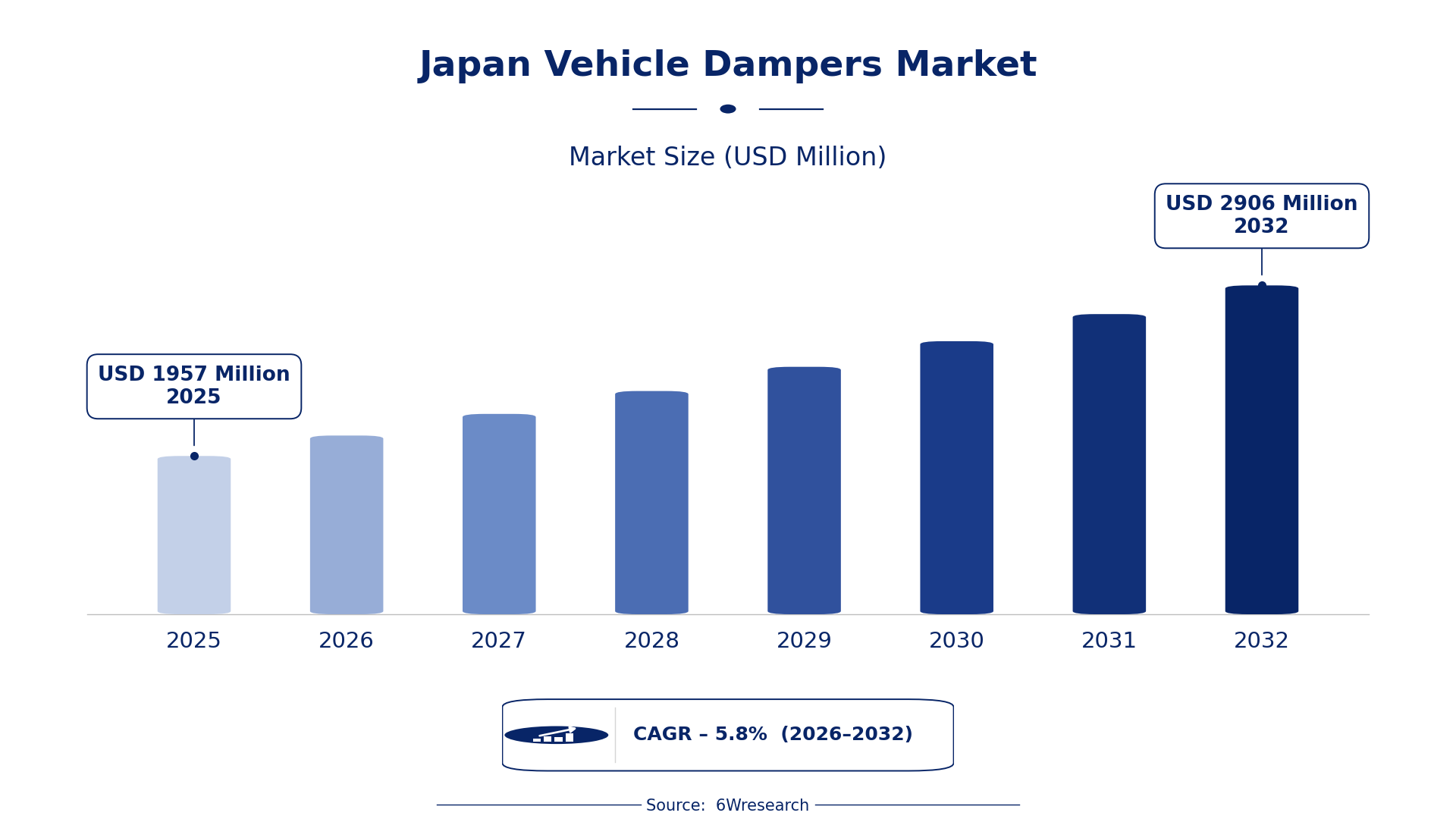
According to 6Wresearch internal database and industry insights, the Japan Vehicle Dampers Market was valued at USD 1,957 Million in 2025 and is projected to reach USD 2,906 Million by 2032, growing at a CAGR of approximately 5.8% during 2026–2032.
Japan Vehicle Dampers Market Highlights
| Report Metric | Details |
| Report Name | Japan Vehicle Dampers Market (2026-2032) |
| Market Size 2025 | USD 1,957 Million |
| Market Size 2032 | USD 2,906 Million |
| Absolute Growth 2025–2032 | USD 949 Million |
| CAGR 2026–2032 | 5.8% |
| Peak Annual Growth | 7.0% in 2032 |
| Forecast Period | 2026–2032 |
| Historical Data | 2022–2025 |
| Base Year | 2025 |
| Leading Damper Type, 2025 | Mono-Tube Dampers (40% share) |
| Leading Technology Used, 2025 | Hydraulic (46% share) |
| Leading Vehicle Type, 2025 | Compact Cars (35% share) |
| Leading End User, 2025 | Passenger Car OEMs (53% share) |
| Fastest-Growing Damper Type | Electronically Adjustable (8.1% CAGR) |
| Fastest-Growing Technology Used | Adaptive Control (8.6% CAGR) |
| Fastest-Growing Vehicle Type | SUVs and Trucks (8.2% CAGR) |
| Fastest-Growing End User | Premium Car Brands (7.8% CAGR) |
| Growing Sector | Premium Car Brands |
| Key End Users | Passenger Car OEMs, Premium Car Brands, High-Performance OEMs, Off-Road Vehicle Makers |
Japan Vehicle Dampers Market Year-wise Growth Rate and Key Drivers (2022–2032)
This graph illustrates the annual growth rates of the market from 2022 to 2032, highlighting a steady upward trajectory and projected market expansion over the forecast period.
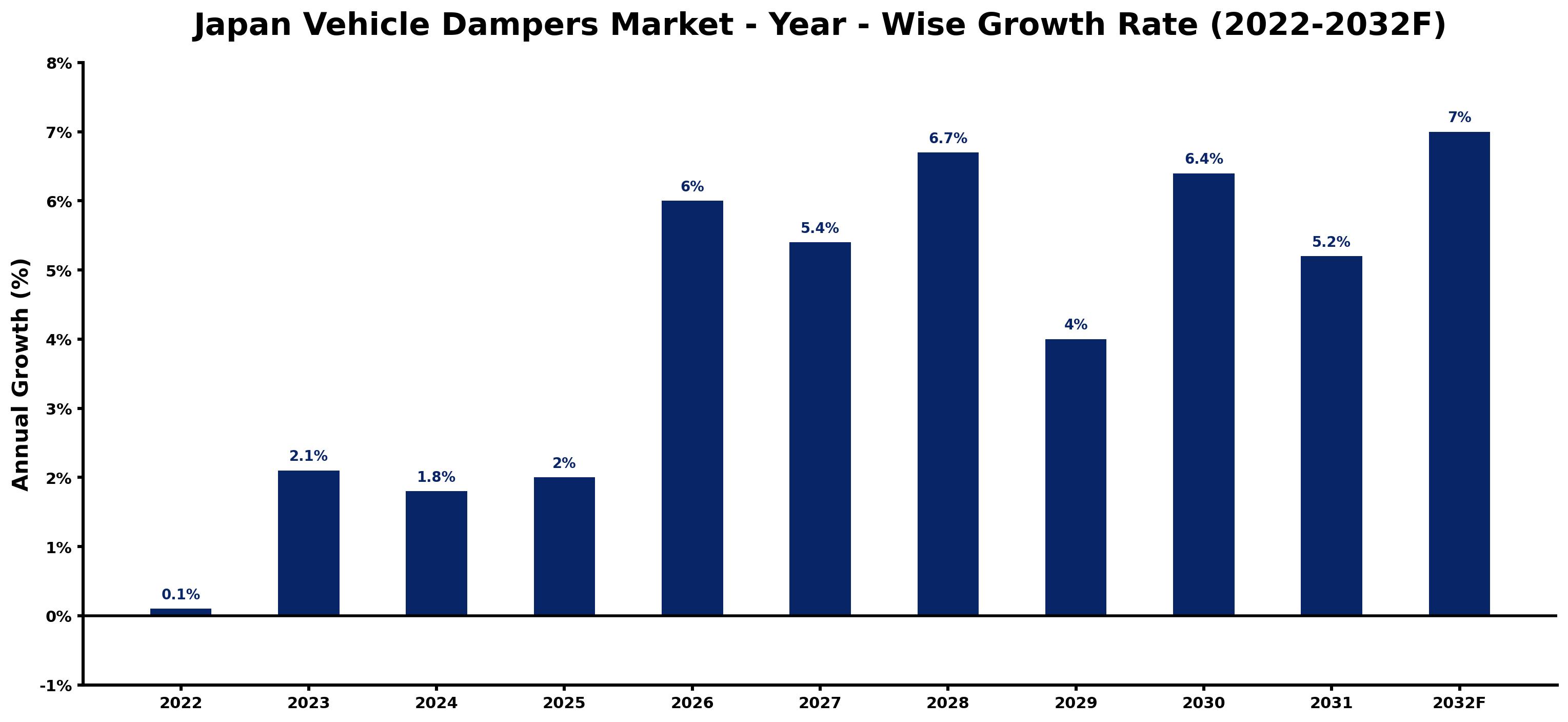
Year by year, the estimates below pair each growth rate with the development that shaped it.
| Year | Estimated Annual Growth (%) | Market Rationale |
| 2022 | 0.1 | The market showed minimal growth due to ongoing supply chain challenges. |
| 2023 | 2.1 | Demand increased as automotive production rebounded from previous disruptions. |
| 2024 | 1.8 | Growth slowed as manufacturers adjusted to rising material costs. |
| 2025 | 2.0 | Market momentum improved with a surge in vehicle production and exports. |
| 2026 | 6.0 | Investment in advanced technologies is expected to drive demand for dampers. |
| 2027 | 5.4 | Growth is projected to decelerate as production stabilises amid competitive pressures. |
| 2028 | 6.7 | Demand is expected to surge with the introduction of new vehicle models featuring advanced dampers. |
| 2029 | 4.0 | Growth will moderate as the market adjusts to supply chain realities. |
| 2030 | 6.4 | Demand is projected to accelerate with government initiatives promoting green technologies. |
| 2031 | 5.2 | Growth is expected to slow as the market approaches saturation in certain segments. |
| 2032 | 7.0 | Demand peaks as manufacturers adopt advanced technologies in vehicle dampers. |
Note: Market size estimations and growth projections presented in this report are based on 6Wresearch's proprietary forecasting methodology, utilizing the latest available industry data, government publications, and primary research inputs.
Japan Vehicle Dampers Market Synopsis
Vehicle dampers are critical components in suspension systems that absorb shock and improve ride comfort in automobiles. In 2022, Japan's automotive market produced over 8 million vehicles, driven by strong demand from domestic manufacturers and exports. The Japan Vehicle Dampers Market is expanding due to investments in advanced vehicle technologies and the growing popularity of high-performance vehicles, especially in the compact and luxury segments. This sector is set for sustained growth as manufacturers adapt to changing consumer preferences and regulatory standards, with the automotive aftermarket valued at approximately $15 billion.
Market Dynamics Impact Analysis (2026–2032)
| Factor | Type | Impact | Primary Segment Affected |
| Growing demand for high-performance vehicles drives the need for advanced dampers. | Driver | High | Mono-Tube Dampers |
| Rising investments in automotive R&D enhance product development capabilities. | Driver | High | Electronically Adjustable |
| Increasing vehicle production in the Tokyo region presents opportunities for suppliers. | Opportunity | High | Compact Cars |
| The growing automotive aftermarket in Japan creates demand for replacement dampers. | Opportunity | Medium | Hydraulic |
| Rising raw material costs may limit profitability for manufacturers. | Restraint | High | Gas-Charged |
| The average age of vehicles on the road creates a steady demand for replacements. | Restraint | Medium | Twin-Tube Dampers |
| Supply chain disruptions can delay production schedules for OEMs. | Challenge | High | Passenger Car OEMs |
| Intense competition among manufacturers may lead to price wars. | Challenge | Medium | High-Performance OEMs |
Evaluation of Drivers in Japan Vehicle Dampers Market (2026–2032)
Demand rests on the following drivers, each shown with the segment it touches most.
| Drivers | Primary Segment Affected | Why It Matters (Evidence) |
| Increased vehicle production in Japan fuels demand for dampers. | Compact Cars | Japan produced over 8 million vehicles in 2022, leading to higher purchases of dampers. |
| Investment in advanced technologies enhances the performance of dampers. | Electronically Adjustable | Approximately 40% of new vehicles are equipped with electronically adjustable dampers. |
| The automotive aftermarket is expanding, creating a need for replacement dampers. | Hydraulic | The aftermarket in Japan is valued at approximately $15 billion, driving demand. |
| Rising exports of high-performance vehicles increase demand for specialized dampers. | Mono-Tube Dampers | Japan's automotive exports reached 4.5 million units in 2022, focusing on performance. |
| Government initiatives to promote green technologies boost demand for efficient dampers. | Gas-Charged | Japan targets a 46% cut in greenhouse-gas emissions by 2030, influencing vehicle design. |
Orders keep climbing as increased vehicle production in Japan fuels demand for dampers, with over 8 million vehicles produced in 2022. Investment in advanced technologies drives improved performance, particularly in the compact car segment, where 40% of new vehicles feature electronically adjustable dampers. The automotive aftermarket, valued at approximately $15 billion, creates a strong need for replacement hydraulic dampers. Rising exports of high-performance vehicles, reaching 4.5 million units in 2022, further boost demand for specialized mono-tube dampers.
Evaluation of Restraints in Japan Vehicle Dampers Market
These restraints slow adoption and weigh on supplier margins.
| Market Restraint | Primary Segment Affected | Why It Matters (Evidence) |
| Rising raw material costs may limit profitability for manufacturers. | Gas-Charged | Increased costs can reduce margins for producers, affecting pricing strategies. |
| The average age of vehicles on the road creates a steady demand for replacements. | Twin-Tube Dampers | With vehicles averaging around 10 years old, replacement demand remains high. |
| Supply chain disruptions can delay production schedules for OEMs. | Passenger Car OEMs | Disruptions can lead to longer lead times, impacting vehicle availability. |
| Intense competition among manufacturers may lead to price wars. | High-Performance OEMs | Price competition can erode margins, affecting overall profitability. |
| Technological advancements require continuous investment to remain competitive. | Electronically Adjustable | Manufacturers must invest heavily in R&D to keep pace with innovation. |
Japan Vehicle Dampers Market Challenges
Aging vehicles pose a challenge, as the average age on the road is around 10 years, leading buyers to seek replacement dampers and straining supplier capacity. Manufacturers face fierce competition due to the need to comply with the JIS D 5515 standard, which can delay product launches for new entrants. Supply chain disruptions result from reliance on advanced materials, extending production timelines for dampers. Rising raw material costs, with average damper prices ranging from $50 to $200, pressure producers' profitability, forcing them to reassess pricing strategies.
Trends in the Japan Vehicle Dampers Market
The shifts below are changing how Japan Vehicle Dampers Market products are bought and supplied.
- Integration of Electronically Adjustable Dampers: The automotive sector is increasingly adopting electronically adjustable dampers, particularly in luxury vehicles. Approximately 40% of new vehicles in Japan incorporate this technology, enhancing ride quality and comfort.
- Growing Demand for Performance Dampers: Sports car manufacturers are prioritising performance dampers, with market demand on the rise. This segment is expected to grow substantially, driven by consumer preferences for improved handling.
- Expansion of the Automotive Aftermarket: The automotive aftermarket in Japan is flourishing, valued at approximately $15 billion. This growth is fuelled by the increasing average age of vehicles, generating demand for replacement dampers.
- Advancements in Vehicle Suspension Technology: Recent developments in vehicle suspension technology were highlighted at the Tokyo Motor Show in 2023. These advancements are anticipated to drive demand for modern dampers in the years to come.
Investment Opportunities in the Japan Vehicle Dampers Market
The following areas offer the clearest openings for investors and suppliers in the Japan Vehicle Dampers Market.
- Growth in Kansai Region Automotive Production: The Kansai region is witnessing growth in automotive production, creating demand for dampers. With the automotive sector projected to invest $10 billion in R&D by 2025, suppliers can enter through local partnerships.
- Accessing the Automotive Aftermarket: The automotive aftermarket, valued at approximately $15 billion, offers opportunities for suppliers of replacement dampers. Forming joint ventures with local distributors can facilitate market entry.
- Targeting High-Performance Vehicles: Manufacturers of high-performance vehicles are increasingly looking for advanced dampers to boost performance. Suppliers should focus on this segment, especially as exports of high-performance vehicles reached 4.5 million units in 2022.
- Investment in Green Technologies: Government initiatives promoting green technologies are creating opportunities for suppliers of efficient dampers. Collaborating with local OEMs to develop compliant products can strengthen market presence.
Government Initiatives in the Japan Vehicle Dampers Market
The GX Promotion Act of 2023 establishes the legal framework for Japan's decarbonisation strategy, affecting vehicle manufacturers by mandating compliance with new environmental standards. This act aims to mobilise approximately JPY 150 trillion in public-private investment over the next decade, influencing the design and production of vehicle dampers to meet stricter emissions targets.
The Ministry of Economy, Trade and Industry supervises the implementation of the Green Growth Strategy, which includes funding for research in automotive technologies. This strategy supports manufacturers in creating advanced dampers that align with sustainability goals, ensuring compliance with evolving regulations.
Future Insight of the Japan Vehicle Dampers Market
A policy-driven shift towards sustainable vehicle technologies will transform the market by 2032, propelled by government initiatives targeting greenhouse gas emissions. Investment in R&D is projected to reach $10 billion by 2025, concentrating on advancements that improve vehicle efficiency. Demand for electronically adjustable dampers will increase, particularly in new vehicle models, enhancing handling and comfort. Suppliers must align with evolving standards and innovations showcased at events like the Tokyo Motor Show to remain competitive.
Market Segmentation Analysis
Japan Vehicle Dampers Market report covers a detailed analysis of the following market segments:
By Damper Type – Mono-Tube Dampers Lead, Electronically Adjustable Expected to Grow Fastest
According to Saurav Kr Singh, Senior Research Analyst at 6Wresearch, Mono-Tube Dampers took 40% of damper type revenue in 2025, more than any other category. Mono-Tube Dampers dominate the market due to their preference in performance vehicles, which require effective heat dissipation. This type is particularly essential for high-performance vehicles, contributing significantly to Japan's automotive production figures. Over 2026–2032, Electronically Adjustable is expected to post the fastest growth, at a CAGR of 8.1%. The rise of Electronically Adjustable dampers is attributed to their growing integration in high-end vehicles, which offer a tailored ride experience. With around 40% of new vehicles featuring this technology, demand is expected to continue increasing. Suppliers must focus on enhancing the capabilities of electronically adjustable dampers to align with consumer preferences.
By Technology Used – Hydraulic Leads, Adaptive Control Expected to Grow Fastest
Hydraulic held 46% of the Japan Vehicle Dampers Market by technology used in 2025. Hydraulic dampers dominate the market due to their effective shock absorption capabilities, making them widely used across various vehicle types. Their reliability and performance have established them as a standard in the automotive sector. The quickest growth will come from Adaptive Control, forecast to expand at a CAGR of 8.6% between 2026 and 2032. Adaptive Control technology is experiencing rapid growth as it is increasingly adopted in luxury vehicles, improving the overall driving experience. This trend aligns with the rising consumer preference for advanced comfort features in new models. Manufacturers must invest in adaptive control technology to remain competitive in the luxury vehicle segment.
By Vehicle Type – Compact Cars Lead, SUVs and Trucks Expected to Grow Fastest
With 35% of vehicle type revenue in 2025, Compact Cars was the largest category. Compact Cars hold the largest market share as they represent a substantial segment driven by high sales volumes in Japan. Their widespread appeal ensures consistent demand for dampers specifically designed for this vehicle category. SUVs and Trucks are projected to grow fastest, at a CAGR of 8.2% during 2026–2032. The market for SUVs and Trucks is expanding rapidly, fuelled by consumer preferences for durable vehicles that necessitate advanced damping solutions. This trend mirrors broader shifts in vehicle purchasing behaviours across Japan. Suppliers should modify their product lines to address the rising demand for dampers in the SUV and Truck segments.
By End User – Passenger Car OEMs Lead, Premium Car Brands Expected to Grow Fastest
In 2025, Passenger Car OEMs led the end user split with a 53% share. Passenger Car OEMs are the leading users of dampers in mass production, solidifying their dominant role in the market. Their extensive manufacturing processes require a reliable supply of effective dampers to meet production needs. Premium Car Brands are set to record the highest CAGR in this split, 7.8% over 2026–2032. Premium Car Brands are accelerating growth as they increasingly demand high-quality dampers to enhance luxury features in their vehicles. This trend signifies a movement towards more sophisticated products within the premium market. Suppliers should prioritise the development of high-quality dampers tailored to the specific needs of premium car brands.
Key Attractiveness of the Report
- 10 Years of Market Numbers
- Historical Data Starting from 2022 to 2025
- Base Year 2025
- Forecast Data until 2032
- Key Performance Indicators Impacting the Market
- Major Upcoming Developments and Projects
Key Highlights of the Report:
- Japan Vehicle Dampers Market Outlook
- Market Size of Japan Vehicle Dampers Market, 2025
- Forecast of Japan Vehicle Dampers Market, 2032
- Historical Data and Forecast of Japan Vehicle Dampers Revenues & Volume for the Period 2022-2032F
- Japan Vehicle Dampers Market Trend Evolution
- Japan Vehicle Dampers Market Drivers and Challenges
- Japan Vehicle Dampers Price Trends
- Japan Vehicle Dampers Porter's Five Forces
- Japan Vehicle Dampers Industry Life Cycle
- Historical Data and Forecast of Japan Vehicle Dampers Market Revenues & Volume By Damper Type for the Period 2022-2032F
- Historical Data and Forecast of Japan Vehicle Dampers Market Revenues & Volume By Twin-Tube Dampers for the Period 2022-2032F
- Historical Data and Forecast of Japan Vehicle Dampers Market Revenues & Volume By Mono-Tube Dampers for the Period 2022-2032F
- Historical Data and Forecast of Japan Vehicle Dampers Market Revenues & Volume By Electronically Adjustable for the Period 2022-2032F
- Historical Data and Forecast of Japan Vehicle Dampers Market Revenues & Volume By Air Dampers for the Period 2022-2032F
- Historical Data and Forecast of Japan Vehicle Dampers Market Revenues & Volume By Technology Used for the Period 2022-2032F
- Historical Data and Forecast of Japan Vehicle Dampers Market Revenues & Volume By Hydraulic for the Period 2022-2032F
- Historical Data and Forecast of Japan Vehicle Dampers Market Revenues & Volume By Gas-Charged for the Period 2022-2032F
- Historical Data and Forecast of Japan Vehicle Dampers Market Revenues & Volume By Adaptive Control for the Period 2022-2032F
- Historical Data and Forecast of Japan Vehicle Dampers Market Revenues & Volume By Pneumatic for the Period 2022-2032F
- Historical Data and Forecast of Japan Vehicle Dampers Market Revenues & Volume By Vehicle Type for the Period 2022-2032F
- Historical Data and Forecast of Japan Vehicle Dampers Market Revenues & Volume By Compact Cars for the Period 2022-2032F
- Historical Data and Forecast of Japan Vehicle Dampers Market Revenues & Volume By Sports Cars for the Period 2022-2032F
- Historical Data and Forecast of Japan Vehicle Dampers Market Revenues & Volume By Luxury Sedans for the Period 2022-2032F
- Historical Data and Forecast of Japan Vehicle Dampers Market Revenues & Volume By SUVs and Trucks for the Period 2022-2032F
- Historical Data and Forecast of Japan Vehicle Dampers Market Revenues & Volume By End User for the Period 2022-2032F
- Historical Data and Forecast of Japan Vehicle Dampers Market Revenues & Volume By Passenger Car OEMs for the Period 2022-2032F
- Historical Data and Forecast of Japan Vehicle Dampers Market Revenues & Volume By High-Performance OEMs for the Period 2022-2032F
- Historical Data and Forecast of Japan Vehicle Dampers Market Revenues & Volume By Premium Car Brands for the Period 2022-2032F
- Historical Data and Forecast of Japan Vehicle Dampers Market Revenues & Volume By Off-Road Vehicle Makers for the Period 2022-2032F
- Japan Vehicle Dampers Import Export Trade Statistics
- Market Opportunity Assessment By Damper Type
- Market Opportunity Assessment By Technology Used
- Market Opportunity Assessment By Vehicle Type
- Market Opportunity Assessment By End User
- Japan Vehicle Dampers Top Companies Market Share
- Japan Vehicle Dampers Competitive Benchmarking By Technical and Operational Parameters
- Japan Vehicle Dampers Company Profiles
- Japan Vehicle Dampers Key Strategic Recommendations
Market Covered
The report covers the following segments.
By Damper Type
- Twin-Tube Dampers
- Mono-Tube Dampers
- Electronically Adjustable
- Air Dampers
By Technology Used
- Hydraulic
- Gas-Charged
- Adaptive Control
- Pneumatic
By Vehicle Type
- Compact Cars
- Sports Cars
- Luxury Sedans
- SUVs and Trucks
By End User
- Passenger Car OEMs
- High-Performance OEMs
- Premium Car Brands
- Off-Road Vehicle Makers































