Japan Vehicle Diagnostics Sensor Market Size & Growth Rate
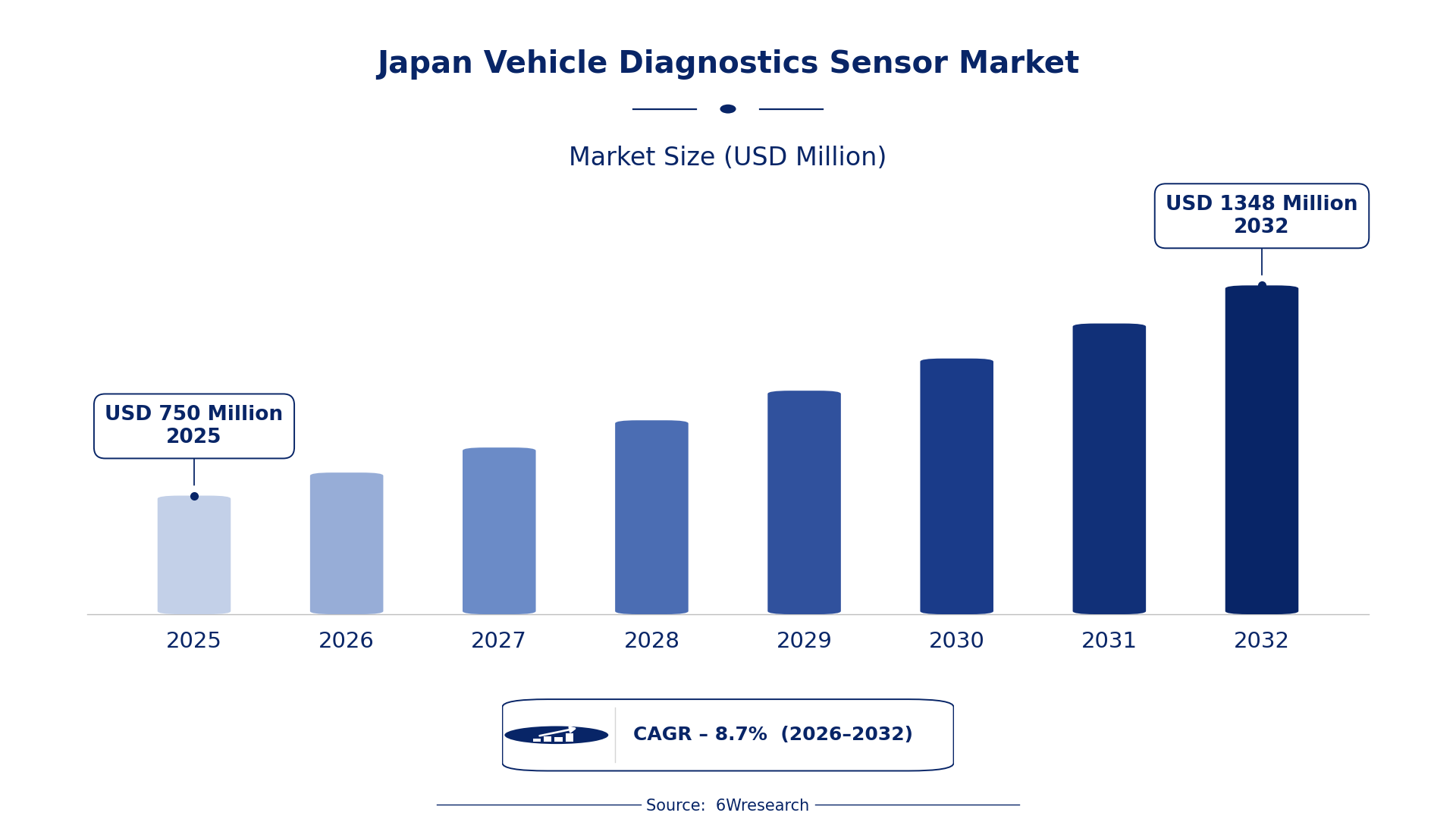
According to 6Wresearch internal database and industry insights, the Japan Vehicle Diagnostics Sensor Market was valued at USD 750 Million in 2025 and is projected to reach USD 1,348 Million by 2032, growing at a CAGR of approximately 8.7% during 2026–2032.
Japan Vehicle Diagnostics Sensor Market Highlights
| Report Metric | Details |
| Report Name | Japan Vehicle Diagnostics Sensor Market (2026-2032) |
| Market Size 2025 | USD 750 Million |
| Market Size 2032 | USD 1,348 Million |
| Absolute Growth 2025–2032 | USD 598 Million |
| CAGR 2026–2032 | 8.7% |
| Peak Annual Growth | 10.9% in 2026 |
| Forecast Period | 2026–2032 |
| Historical Data | 2022–2025 |
| Base Year | 2025 |
| Leading Sensor Type, 2025 | O2 Sensors (38% share) |
| Leading Diagnostic Parameter, 2025 | Emission Control (41% share) |
| Leading Data Output Format, 2025 | Voltage Signal (34% share) |
| Leading End User, 2025 | Engine Control Units (38% share) |
| Fastest-Growing Sensor Type | MAF Sensors (12.4% CAGR) |
| Fastest-Growing Diagnostic Parameter | Air Flow (11.3% CAGR) |
| Fastest-Growing Data Output Format | Analog/Digital (12.3% CAGR) |
| Fastest-Growing End User | Vehicle Diagnostics Tools (11.5% CAGR) |
| Growing Sector | automotive diagnostics |
| Key End Users | automotive manufacturers, service stations, EV system providers, automotive R&D facilities |
Japan Vehicle Diagnostics Sensor Market Year-wise Growth Rate and Key Drivers (2022–2032)
This graph illustrates the annual growth rates of the market from 2022 to 2032, highlighting a steady upward trajectory and projected market expansion over the forecast period.
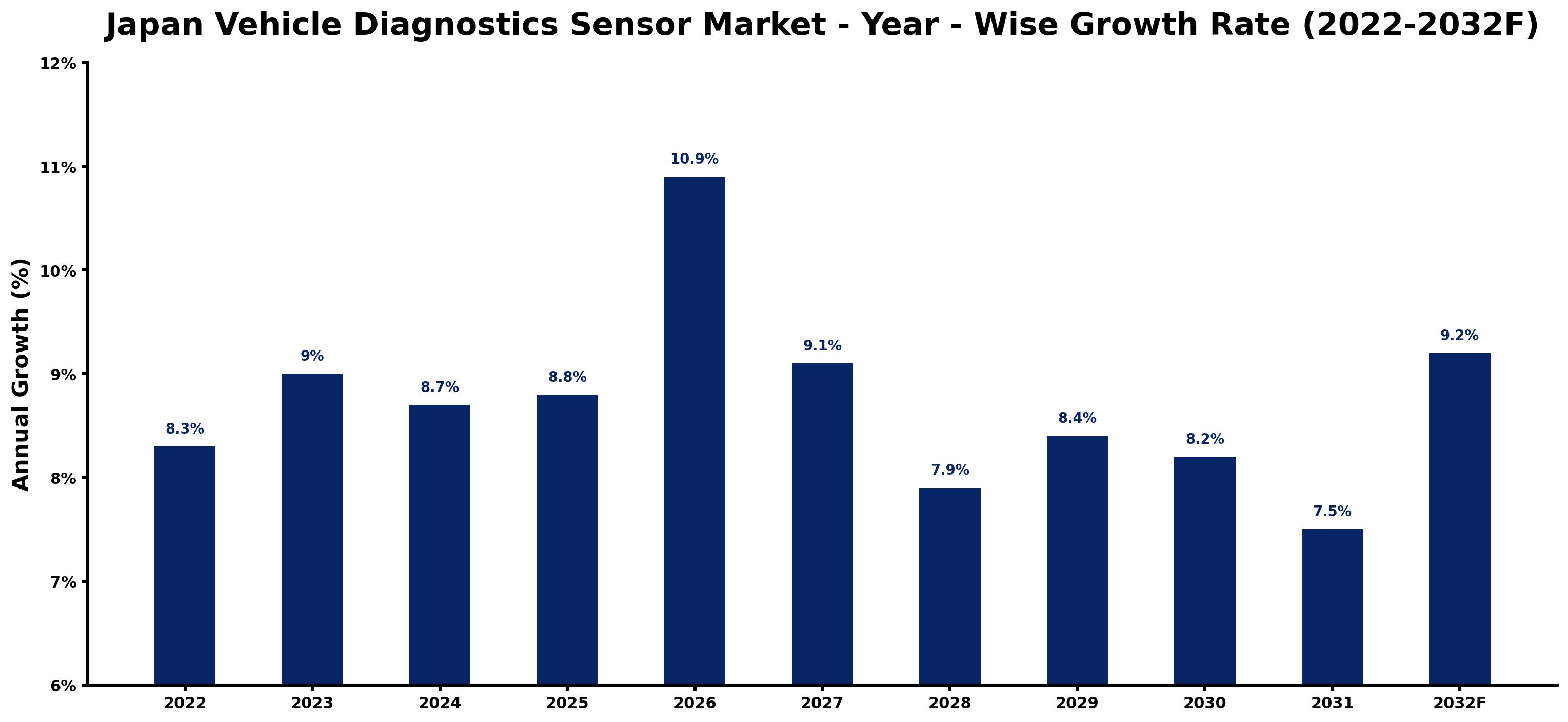
The table below sets out the estimated growth rate for each year and the main factor behind it.
| Year | Estimated Annual Growth (%) | Market Rationale |
| 2022 | 8.3 | The market exhibited stable growth, reflecting strong automotive production and demand. |
| 2023 | 9.0 | Growth accelerated due to rising vehicle registrations and increased focus on emissions compliance. |
| 2024 | 8.7 | Growth moderated as manufacturers adjusted to supply chain challenges and evolving standards. |
| 2025 | 8.8 | Demand increased with the introduction of new vehicle models and improved diagnostics technology. |
| 2026 | 10.9 | The market peaked as electric vehicle adoption surged, driving sensor demand. |
| 2027 | 9.1 | Growth slowed slightly as the market stabilised following the previous year's peak. |
| 2028 | 7.9 | Continued demand for diagnostics tools kept growth steady, despite market saturation. |
| 2029 | 8.4 | Growth picked up again due to advancements in battery monitoring technologies. |
| 2030 | 8.2 | A slight slowdown occurred as the market adjusted to new regulatory standards. |
| 2031 | 7.5 | The market continued to grow, albeit at a slower rate, as technology matured. |
| 2032 | 9.2 | Demand is expected to rise again as vehicle electrification and automation trends gain momentum. |
Note: Market size estimations and growth projections presented in this report are based on 6Wresearch's proprietary forecasting methodology, utilizing the latest available industry data, government publications, and primary research inputs.
Japan Vehicle Diagnostics Sensor Market Synopsis
Vehicle diagnostics sensors are electronic devices that monitor and analyse vehicle systems, including emissions and battery status. The Japan Vehicle Diagnostics Sensor Market is expanding due to increased vehicle registrations, stringent emissions regulations, and a shift towards electric vehicles. With over 78 million registered vehicles and a focus on compliance with standards like JIS B 0001, demand arises from both local manufacturers and imports. The market is projected to grow further as the automotive sector embraces advanced diagnostics technologies and adapts to evolving consumer needs.
Market Dynamics Impact Analysis (2026–2032)
| Factor | Type | Impact | Primary Segment Affected |
| Rising vehicle registrations drive demand for diagnostics sensors. | Driver | High | O2 Sensors |
| The shift towards electric vehicles increases the need for battery monitoring sensors. | Driver | High | Battery Monitoring Sensors |
| The increasing average age of vehicles creates a growing need for diagnostics tools. | Opportunity | High | Vehicle Diagnostics Tools |
| The Tokyo region's concentration of automotive R&D facilities supports innovation in diagnostics. | Opportunity | Medium | MAF Sensors |
| Supply chain disruptions impact the availability of critical components. | Restraint | High | Knock Sensors |
| Stringent regulatory compliance requirements can limit market entry for new players. | Restraint | Medium | Emission Control |
| High competition among manufacturers can lead to price wars affecting margins. | Challenge | High | Engine Control Units |
| Rapid technological advancements may outpace some suppliers' capabilities. | Challenge | Medium | EV System Providers |
Evaluation of Drivers in Japan Vehicle Diagnostics Sensor Market (2026–2032)
The main growth drivers and the segments they affect most are set out below.
| Drivers | Primary Segment Affected | Why It Matters (Evidence) |
| Increased vehicle registrations boost demand for O2 sensors. | O2 Sensors | With over 78 million registered vehicles, manufacturers need to ensure compliance with emissions standards. |
| The growing electric vehicle market drives battery monitoring sensor adoption. | Battery Monitoring Sensors | The number of electric vehicles reached 1.5 million in 2023, necessitating advanced battery management. |
| The average age of vehicles over 13 years raises diagnostics needs. | Vehicle Diagnostics Tools | Older vehicles require more frequent diagnostics to meet regulatory compliance. |
| Technological advancements in diagnostics improve performance monitoring. | MAF Sensors | Innovations in sensor technology improve air flow measurement, important for engine efficiency. |
| Compliance with JIS B 0001 standards increases demand for diagnostics sensors. | Emission Control | Manufacturers must adhere to stringent regulations, driving sensor integration in new models. |
Buyers are adding capacity as the number of registered vehicles in Japan exceeds 78 million, necessitating more diagnostics sensors to ensure compliance with emissions standards. The growing electric vehicle market, with 1.5 million units in 2023, increases the demand for battery monitoring sensors. The average age of vehicles in Japan is over 13 years, leading to heightened diagnostics needs for older models. Technological advancements in diagnostics tools are improving performance monitoring, particularly in air flow measurement.
Evaluation of Restraints in Japan Vehicle Diagnostics Sensor Market
The following restraints limit how fast demand can grow.
| Market Restraint | Primary Segment Affected | Why It Matters (Evidence) |
| Supply chain disruptions affect the availability of critical components. | Knock Sensors | Manufacturers face delays in sourcing semiconductor materials, impacting production timelines. |
| Stringent regulatory compliance requirements can limit market entry for new players. | Emission Control | New entrants struggle to meet established standards, hindering their ability to compete. |
| High competition among manufacturers can lead to price wars affecting margins. | Engine Control Units | Intense rivalry drives prices down, squeezing profitability for suppliers. |
| Technological advancements may outpace some suppliers' capabilities. | EV System Providers | Smaller firms may lack the resources to keep up with rapid innovation in diagnostics. |
| Market saturation in certain segments limits growth potential. | MAF Sensors | As the market matures, demand growth slows in established product categories. |
Japan Vehicle Diagnostics Sensor Market Challenges
Supply chain disruptions arise from semiconductor shortages, delaying vehicle diagnostics sensor production by six months for producers. Importers face intense competition from global markets, which constrains pricing flexibility and can erode profit margins by 15%. Distributors deal with a lack of skilled technicians in advanced diagnostics technology, leading to order fulfilment delays that affect service quality. Buyers confront escalating repair costs as the average age of vehicles exceeds 13 years, increasing the demand for diagnostics services and potentially raising expenses by 20%.
Trends in the Japan Vehicle Diagnostics Sensor Market
Below are the shifts with the largest effect on the Japan Vehicle Diagnostics Sensor Market.
- Shift from Traditional to Advanced Diagnostics: The Tokyo region is experiencing a shift towards advanced diagnostics technologies, with over 10,000 service stations adopting new tools. This change is essential for compliance with stringent emissions regulations, improving service efficiency.
- Growing Demand for Battery Monitoring: Electric vehicle system providers are increasingly prioritising battery monitoring sensors, with demand rising due to the 1.5 million electric vehicles in Japan. This trend reflects the industry's focus on optimising battery performance and longevity.
- Transition to Digital Data Output Formats: The adoption of Analog/Digital data output formats is accelerating, with a projected growth rate of 12.3% in the coming years. This shift is vital for improving data accuracy and integration with modern vehicle systems.
- Increased Focus on Emission Control: The demand for emission control sensors is growing, driven by Japan's commitment to reducing greenhouse-gas emissions by 46% by 2030. This regulatory push is prompting manufacturers to advance their sensor technologies.
Investment Opportunities in the Japan Vehicle Diagnostics Sensor Market
The opportunities below stand out in the Japan Vehicle Diagnostics Sensor Market for new entrants and existing suppliers.
- Timing for Investment in EV Infrastructure: The Japanese government allocated ¥5 billion for EV infrastructure development, creating opportunities for suppliers of battery monitoring sensors. This investment is timely as the number of electric vehicles continues to rise.
- Gap in Advanced Diagnostics Tools: With over 78 million registered vehicles, there is a notable gap in advanced diagnostics tools. Suppliers can target service stations in urban areas to meet increasing demand for vehicle diagnostics.
- Expansion of Automotive R&D Facilities: The Tokyo area, with its high concentration of automotive R&D facilities, presents opportunities for innovation in diagnostics. Suppliers can collaborate with local research institutions to develop new technologies.
- Growing Market for Hybrid Vehicles: The rise in hybrid vehicles creates demand for battery monitoring sensors, as manufacturers seek to optimise performance. Suppliers can enter this market by partnering with EV system providers.
Government Initiatives in the Japan Vehicle Diagnostics Sensor Market
The Semiconductor and Digital Industry Strategy, established by METI in June 2021, aims to secure domestic semiconductor manufacturing, impacting vehicle diagnostics sensor production. This strategy ensures that manufacturers have access to essential components for developing advanced diagnostics technologies, supporting the growth of the sector.
The Ministry of Land, Infrastructure, Transport and Tourism oversees automotive regulations and approves new vehicle models. This agency's role in enforcing compliance with standards like JIS B 0001 ensures that diagnostics sensors meet safety and performance requirements, benefiting both manufacturers and consumers.
Future Insight of the Japan Vehicle Diagnostics Sensor Market
Service stations will increasingly adopt advanced diagnostics tools by 2032, improving vehicle maintenance efficiency for buyers. The Japanese government’s allocation of ¥5 billion for EV infrastructure development will stimulate demand for sensor technologies. Standards like JIS B 0001 will evolve, ensuring enhanced performance and safety in vehicle diagnostics. As the number of electric vehicles reaches 2 million, suppliers will need to adjust their offerings to cater to the expanding market for battery monitoring solutions.
Market Segmentation Analysis
Japan Vehicle Diagnostics Sensor Market report covers a detailed analysis of the following market segments:
By Sensor Type – O2 Sensors Lead, MAF Sensors Expected to Grow Fastest
According to Saurav Kr Singh, Senior Research Analyst at 6Wresearch, the largest sensor type category in 2025 was O2 Sensors, at 38% of revenue. O2 sensors are essential for emission control, a critical requirement in Japan's automotive sector. Their widespread integration into over 78 million registered vehicles underscores their significance for both domestic manufacturers and import markets. MAF Sensors are projected to grow fastest, at a CAGR of 12.4% during 2026–2032. MAF sensors are witnessing accelerated growth due to the increasing focus on air flow measurement in contemporary vehicles, particularly following the mandated adoption of CAN bus technology. Additionally, the rising exports of vehicles equipped with advanced diagnostics, which reached approximately 1.5 million in 2022, further fuel this demand. This indicates that suppliers should focus on enhancing MAF sensor offerings to meet the evolving market needs.
By Diagnostic Parameter – Emission Control Leads, Air Flow Expected to Grow Fastest
Emission Control held 41% of the Japan Vehicle Diagnostics Sensor Market by diagnostic parameter in 2025. Emission control is vital for compliance with regulations in Japan, driving the adoption of technologies that monitor and manage vehicle emissions. This necessity is underscored by Japan's commitment to a 46% reduction in greenhouse-gas emissions by 2030. The quickest growth will come from Air Flow, forecast to expand at a CAGR of 11.3% between 2026 and 2032. The air flow parameter is experiencing rapid growth as engine efficiency becomes a priority for manufacturers, particularly with the increasing average age of vehicles over 13 years. This trend is highlighted by the advancements showcased at the Tokyo Motor Show 2023. Buyers will need to prioritise diagnostics related to air flow to ensure optimal vehicle performance.
By Data Output Format – Voltage Signal Leads, Analog/Digital Expected to Grow Fastest
Voltage Signal accounted for 34% of the market by data output format in 2025. Voltage signal is the basic output format for sensors, making it the most commonly used in vehicle diagnostics. Its fundamental role in engine control units ensures a consistent demand across the automotive sector. Analog/Digital is set to record the highest CAGR in this split, 12.3% over 2026–2032. The analog/digital format is gaining traction as it offers versatility in data representation, catering to the needs of modern diagnostics tools. This shift is driven by the increasing complexity of vehicle systems requiring more sophisticated data outputs. Suppliers must adapt to the growing preference for analog/digital formats to meet market demands.
By End User – Engine Control Units Lead, Vehicle Diagnostics Tools Expected to Grow Fastest
In 2025, Engine Control Units led the end user split with a 38% share. Engine control units represent the primary application for vehicle diagnostics sensors, as they are integral to vehicle performance management. The high volume of vehicles produced in Japan, approximately 8.3 million in 2022, further solidifies this segment's dominance. Over 2026–2032, Vehicle Diagnostics Tools are expected to post the fastest growth, at a CAGR of 11.5%. Vehicle diagnostics tools are rapidly gaining traction due to the increasing need for troubleshooting as the average vehicle age rises. This trend is reflected in the extensive use of diagnostics tools across over 10,000 service stations in Japan. Suppliers should consider expanding their product lines to include advanced diagnostics tools to meet the rising demand.
Key Attractiveness of the Report
- 10 Years of Market Numbers
- Historical Data Starting from 2022 to 2025
- Base Year 2025
- Forecast Data until 2032
- Key Performance Indicators Impacting the Market
- Major Upcoming Developments and Projects
Key Highlights of the Report:
- Japan Vehicle Diagnostics Sensor Market Outlook
- Market Size of Japan Vehicle Diagnostics Sensor Market, 2025
- Forecast of Japan Vehicle Diagnostics Sensor Market, 2032
- Historical Data and Forecast of Japan Vehicle Diagnostics Sensor Revenues & Volume for the Period 2022-2032F
- Japan Vehicle Diagnostics Sensor Market Trend Evolution
- Japan Vehicle Diagnostics Sensor Market Drivers and Challenges
- Japan Vehicle Diagnostics Sensor Price Trends
- Japan Vehicle Diagnostics Sensor Porter's Five Forces
- Japan Vehicle Diagnostics Sensor Industry Life Cycle
- Historical Data and Forecast of Japan Vehicle Diagnostics Sensor Market Revenues & Volume By Sensor Type for the Period 2022-2032F
- Historical Data and Forecast of Japan Vehicle Diagnostics Sensor Market Revenues & Volume By O2 Sensors for the Period 2022-2032F
- Historical Data and Forecast of Japan Vehicle Diagnostics Sensor Market Revenues & Volume By MAF Sensors for the Period 2022-2032F
- Historical Data and Forecast of Japan Vehicle Diagnostics Sensor Market Revenues & Volume By Knock Sensors for the Period 2022-2032F
- Historical Data and Forecast of Japan Vehicle Diagnostics Sensor Market Revenues & Volume By Battery Monitoring Sensors for the Period 2022-2032F
- Historical Data and Forecast of Japan Vehicle Diagnostics Sensor Market Revenues & Volume By Diagnostic Parameter for the Period 2022-2032F
- Historical Data and Forecast of Japan Vehicle Diagnostics Sensor Market Revenues & Volume By Emission Control for the Period 2022-2032F
- Historical Data and Forecast of Japan Vehicle Diagnostics Sensor Market Revenues & Volume By Air Flow for the Period 2022-2032F
- Historical Data and Forecast of Japan Vehicle Diagnostics Sensor Market Revenues & Volume By Combustion Monitoring for the Period 2022-2032F
- Historical Data and Forecast of Japan Vehicle Diagnostics Sensor Market Revenues & Volume By Voltage/Temp/SoC for the Period 2022-2032F
- Historical Data and Forecast of Japan Vehicle Diagnostics Sensor Market Revenues & Volume By Data Output Format for the Period 2022-2032F
- Historical Data and Forecast of Japan Vehicle Diagnostics Sensor Market Revenues & Volume By Voltage Signal for the Period 2022-2032F
- Historical Data and Forecast of Japan Vehicle Diagnostics Sensor Market Revenues & Volume By Analog/Digital for the Period 2022-2032F
- Historical Data and Forecast of Japan Vehicle Diagnostics Sensor Market Revenues & Volume By Frequency-Based for the Period 2022-2032F
- Historical Data and Forecast of Japan Vehicle Diagnostics Sensor Market Revenues & Volume By CAN Bus for the Period 2022-2032F
- Historical Data and Forecast of Japan Vehicle Diagnostics Sensor Market Revenues & Volume By End User for the Period 2022-2032F
- Historical Data and Forecast of Japan Vehicle Diagnostics Sensor Market Revenues & Volume By Engine Control Units for the Period 2022-2032F
- Historical Data and Forecast of Japan Vehicle Diagnostics Sensor Market Revenues & Volume By Vehicle Diagnostics Tools for the Period 2022-2032F
- Historical Data and Forecast of Japan Vehicle Diagnostics Sensor Market Revenues & Volume By ICE Manufacturers for the Period 2022-2032F
- Historical Data and Forecast of Japan Vehicle Diagnostics Sensor Market Revenues & Volume By EV System Providers for the Period 2022-2032F
- Japan Vehicle Diagnostics Sensor Import Export Trade Statistics
- Market Opportunity Assessment By Sensor Type
- Market Opportunity Assessment By Diagnostic Parameter
- Market Opportunity Assessment By Data Output Format
- Market Opportunity Assessment By End User
- Japan Vehicle Diagnostics Sensor Top Companies Market Share
- Japan Vehicle Diagnostics Sensor Competitive Benchmarking By Technical and Operational Parameters
- Japan Vehicle Diagnostics Sensor Company Profiles
- Japan Vehicle Diagnostics Sensor Key Strategic Recommendations
Market Covered
The following segment groups are covered in the report.
By Sensor Type
- O2 Sensors
- MAF Sensors
- Knock Sensors
- Battery Monitoring Sensors
By Diagnostic Parameter
- Emission Control
- Air Flow
- Combustion Monitoring
- Voltage/Temp/SoC
By Data Output Format
- Voltage Signal
- Analog/Digital
- Frequency-Based
- CAN Bus
By End User
- Engine Control Units
- Vehicle Diagnostics Tools
- ICE Manufacturers
- EV System Providers































