Japan Vehicle Disc Brake Pads Market Size & Growth Rate
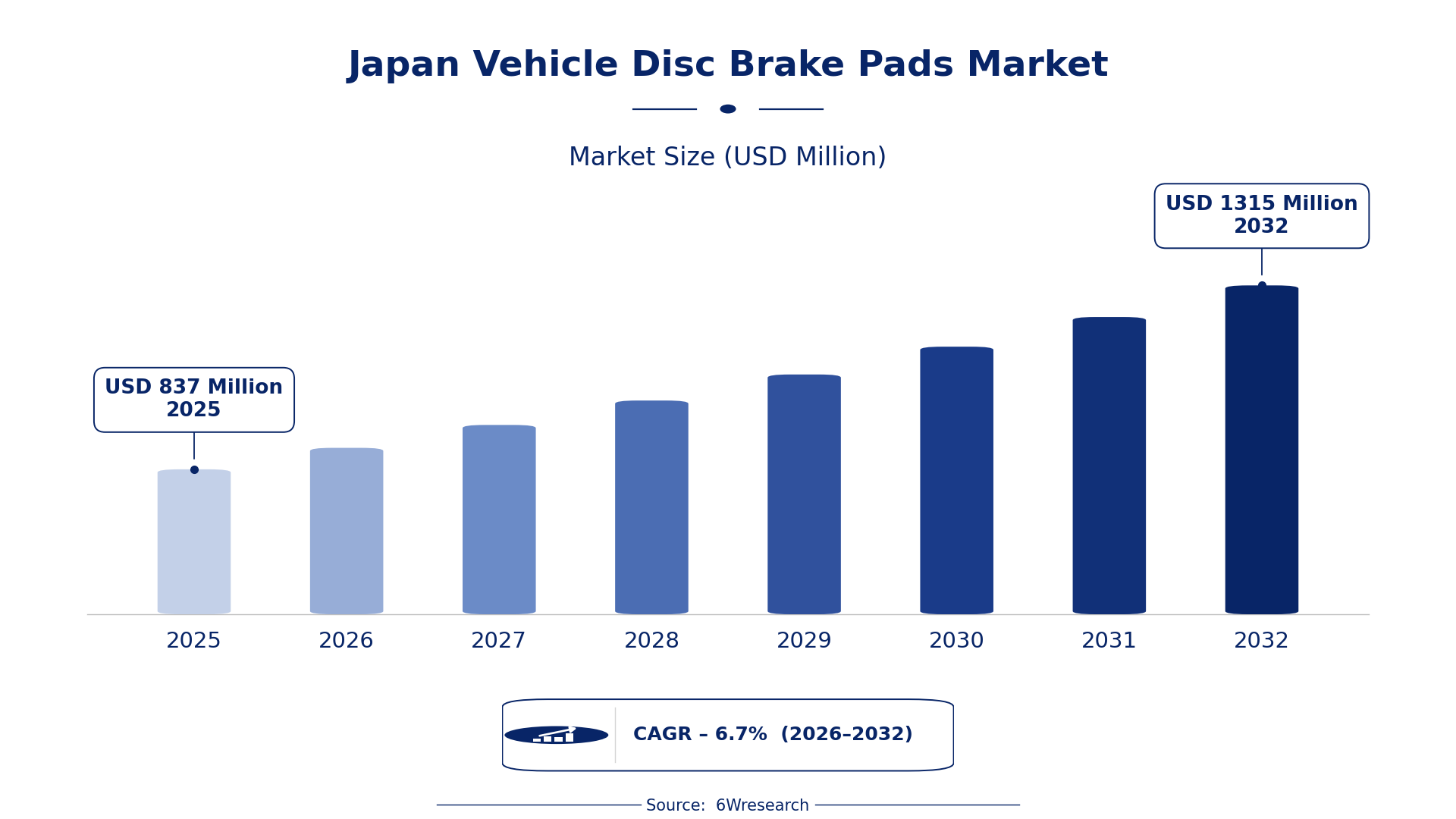
According to 6Wresearch internal database and industry insights, the Japan Vehicle Disc Brake Pads Market was valued at USD 837 Million in 2025 and is projected to reach USD 1,315 Million by 2032, growing at a CAGR of approximately 6.7% during 2026–2032.
Japan Vehicle Disc Brake Pads Market Highlights
| Report Metric | Details |
| Report Name | Japan Vehicle Disc Brake Pads Market (2026-2032) |
| Market Size 2025 | USD 837 Million |
| Market Size 2032 | USD 1,315 Million |
| Absolute Growth 2025–2032 | USD 478 Million |
| CAGR 2026–2032 | 6.7% |
| Peak Annual Growth | 8.1% in 2031 |
| Forecast Period | 2026–2032 |
| Historical Data | 2022–2025 |
| Base Year | 2025 |
| Leading Pad Type, 2025 | Ceramic Pads (49% share) |
| Leading Material Composition, 2025 | Steel/Copper Composite (37% share) |
| Leading Vehicle Type, 2025 | Passenger Cars (39% share) |
| Leading End User, 2025 | OEMs (47% share) |
| Fastest-Growing Pad Type | Semi-Metallic Pads (9.6% CAGR) |
| Fastest-Growing Material Composition | Ceramic & Kevlar (9.8% CAGR) |
| Fastest-Growing Vehicle Type | Performance Vehicles (9.3% CAGR) |
| Fastest-Growing End User | Aftermarket Retailers (8.5% CAGR) |
| Growing Sector | Aftermarket Retailers |
| Key End Users | OEMs, Aftermarket Retailers, Sports Car Brands, Budget Vehicle Makers |
Japan Vehicle Disc Brake Pads Market Year-wise Growth Rate and Key Drivers (2022–2032)
This graph illustrates the annual growth rates of the market from 2022 to 2032, highlighting a steady upward trajectory and projected market expansion over the forecast period.
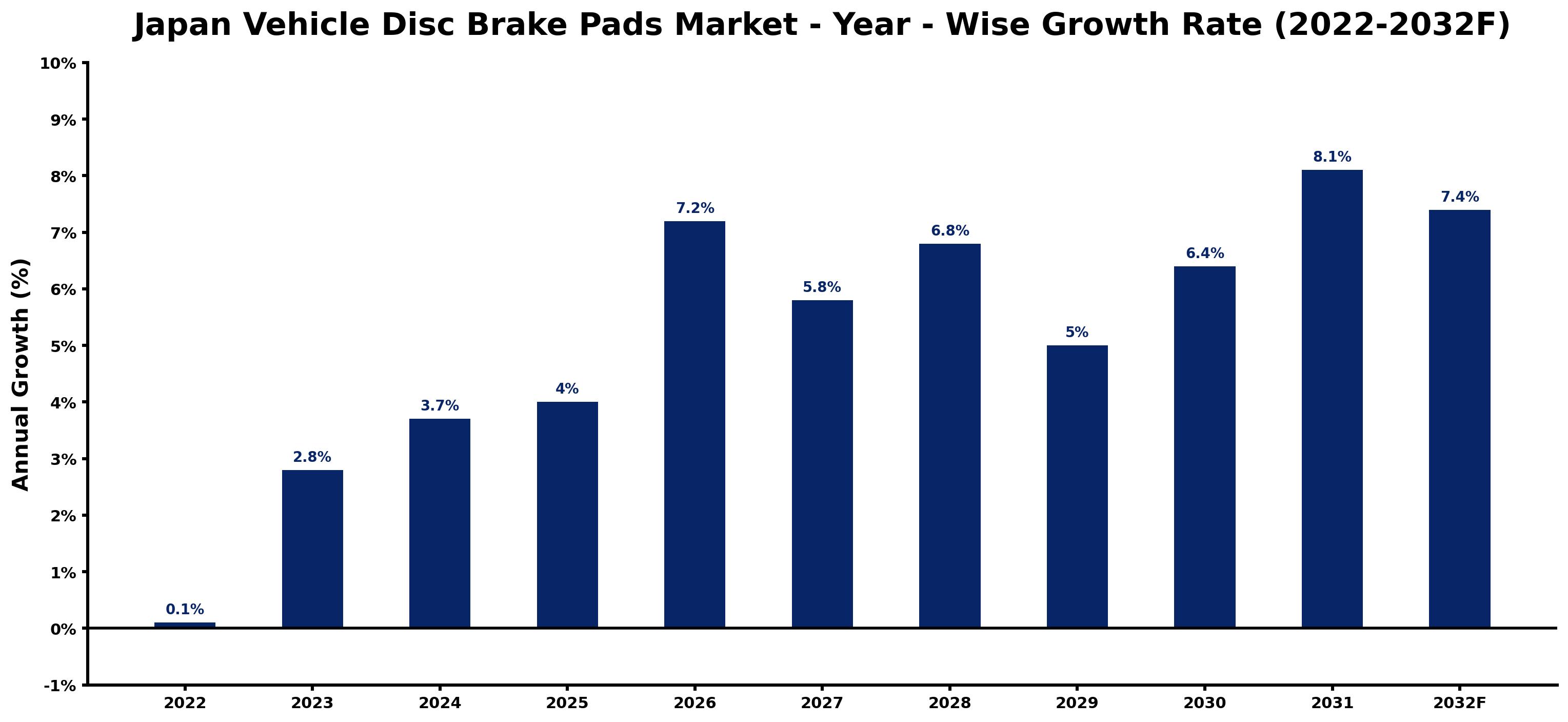
For each year, the table pairs the estimated growth rate with the leading influence on demand, showing how the drivers changed across the period.
| Year | Estimated Annual Growth (%) | Market Rationale |
| 2022 | 0.1 | The market showed minimal growth as demand stabilised after the previous year. |
| 2023 | 2.8 | Growth accelerated due to increased vehicle production and rising consumer confidence. |
| 2024 | 3.7 | Demand continued to rise with the automotive sector's recovery and expansion. |
| 2025 | 4.0 | The market peaked historically as vehicle sales surged and aftermarket demand strengthened. |
| 2026 | 7.2 | Growth is driven by heightened investments in electric vehicle technologies. |
| 2027 | 5.8 | A slowdown occurred as market adjustments followed the previous year's peak. |
| 2028 | 6.8 | Demand is expected to rebound with new vehicle launches and technological advancements. |
| 2029 | 5.0 | Growth is projected to slow as market saturation begins to affect new purchases. |
| 2030 | 6.4 | An uptick in demand is expected as electric vehicle adoption increases. |
| 2031 | 8.1 | The market will peak again as advanced braking technologies gain traction. |
| 2032 | 7.4 | Growth is projected to moderate as the market stabilises after reaching new heights. |
Note: Market size estimations and growth projections presented in this report are based on 6Wresearch's proprietary forecasting methodology, utilizing the latest available industry data, government publications, and primary research inputs.
Japan Vehicle Disc Brake Pads Market Synopsis
Vehicle disc brake pads are critical components in automotive braking systems, ensuring safety and performance. Made from various materials, they undergo mixing, shaping, and curing processes during manufacturing. The Japan Vehicle Disc Brake Pads Market is growing due to increased vehicle production, with around 4 million vehicles produced in 2022, and rising demand from both OEMs and the aftermarket. Government support for electric vehicle adoption is influencing brake pad technologies, creating new purchasing opportunities in the industry. This growth is further supported by the automotive sector's resilience and ongoing advancements in braking systems.
Market Dynamics Impact Analysis (2026–2032)
| Factor | Type | Impact | Primary Segment Affected |
| Rising vehicle production drives demand for brake pads among OEMs. | Driver | High | Semi-Metallic Pads |
| Growing aftermarket sector increases demand for replacement brake pads. | Driver | High | Ceramic Pads |
| Electric vehicle manufacturers require advanced brake pad technologies. | Opportunity | High | Steel/Copper Composite |
| The Tokyo region's automotive manufacturing hub presents investment opportunities. | Opportunity | Medium | Organic Pads |
| Competition from alternative braking technologies may limit market growth. | Restraint | High | Low-Metallic Pads |
| Strict regulations under the Automotive Safety Law increase compliance costs. | Restraint | Medium | Ceramic Pads |
| Supply chain disruptions can delay production and increase costs for manufacturers. | Challenge | High | Semi-Metallic Pads |
| Technological advancements require continuous investment from producers. | Challenge | Medium | Steel/Copper Composite |
Evaluation of Drivers in Japan Vehicle Disc Brake Pads Market (2026–2032)
Demand rests on the following drivers, each shown with the segment it touches most.
| Drivers | Primary Segment Affected | Why It Matters (Evidence) |
| Increased vehicle production drives demand for brake pads among OEMs. | Semi-Metallic Pads | Japan produced approximately 4 million vehicles in 2022, leading to higher brake pad orders. |
| The expanding aftermarket sector boosts replacement brake pad sales. | Ceramic Pads | The automotive aftermarket in Japan is valued at over 10 trillion yen, encouraging more purchases. |
| Growing electric vehicle adoption necessitates advanced brake pad technologies. | Steel/Copper Composite | Support for electric vehicles is influencing brake pad innovations, enhancing performance and safety. |
| Technological advancements in braking systems improve performance and safety. | Ceramic Pads | New braking technologies showcased at industry events are increasing demand for high-quality components. |
| Rising consumer awareness about vehicle safety drives brake pad purchases. | Organic Pads | The average lifespan of vehicle brake pads is around 30,000 to 70,000 kilometers, prompting replacements. |
Spending rises because increased vehicle production in Japan, which reached approximately 4 million units in 2022, drives demand for brake pads. The automotive aftermarket, valued at over 10 trillion yen, fuels purchases as consumers seek replacements. Support for electric vehicles encourages manufacturers to innovate brake pad technologies, improving performance and safety. Awareness of vehicle safety issues prompts consumers to invest in reliable brake pads, ensuring optimal vehicle performance. Technological advancements in braking systems are reshaping consumer expectations, resulting in higher-quality component purchases.
Evaluation of Restraints in Japan Vehicle Disc Brake Pads Market
The key brakes on demand, and where they bite hardest, are shown below.
| Market Restraint | Primary Segment Affected | Why It Matters (Evidence) |
| Competition from alternative braking technologies may limit market growth. | Low-Metallic Pads | Innovations in braking systems can divert demand away from traditional brake pads, affecting sales. |
| Strict regulations increase compliance costs for manufacturers. | Ceramic Pads | Manufacturers must invest in quality assurance to meet safety standards, affecting pricing. |
| Supply chain disruptions can delay production and increase costs for manufacturers. | Semi-Metallic Pads | Global supply chain issues have impacted the availability of raw materials, raising costs. |
| Market saturation may slow growth as consumers retain vehicles longer. | Steel/Copper Composite | The average lifespan of brake pads leads to fewer replacements in a saturated market. |
| Consumer preference for low-cost alternatives can hinder premium product sales. | Organic Pads | Price-sensitive buyers may opt for cheaper options, affecting higher-end brake pad sales. |
Japan Vehicle Disc Brake Pads Market Challenges
Producers in the Japanese vehicle disc brake pads market encounter fierce competition, resulting in price reductions that compress profit margins. Regulatory requirements from JIS standards impose strict quality checks, leading to compliance costs that can exceed 20% of production budgets, delaying product launches for manufacturers. Rapid technological advancements in braking systems demand continuous R&D investment, with costs rising to 15% of revenues, risking obsolescence for those unable to adapt. Skills shortages among automotive workers create production inefficiencies, causing lead times to extend by 20%, ultimately raising costs for buyers.
Trends in the Japan Vehicle Disc Brake Pads Market
These developments are changing demand patterns in the Japan Vehicle Disc Brake Pads Market.
- Shift from Organic to Semi-Metallic Brake Pads: The trend is shifting towards Semi-Metallic brake pads due to their durability and heat resistance. In 2023, about 60% of new vehicles adopted this technology, reflecting a change in consumer preference.
- Increased Focus on Electric Vehicle Brake Technologies: Electric vehicle manufacturers are prioritising advanced brake technologies, with 30% of new models featuring enhanced braking systems. This shift highlights the growing demand for performance and safety in electric vehicles.
- Transition from Traditional to Advanced Braking Systems: The automotive industry is increasingly embracing advanced braking systems, with 25% of vehicles showcased at the 2023 Tokyo Motor Show featuring these technologies. This change is reshaping consumer expectations for brake performance.
- Emergence of Eco-Friendly Brake Pad Materials: There is a rising trend towards eco-friendly brake pad materials, with 15% of new products launched in 2023 made from sustainable sources. This shift responds to consumer demand for environmentally responsible products.
Investment Opportunities in the Japan Vehicle Disc Brake Pads Market
Where to invest in the Japan Vehicle Disc Brake Pads Market: the main openings are set out below.
- Partner with Local Manufacturers: Local partnerships can facilitate entry into the Japanese market, particularly for high-performance brake pads. The aftermarket sector, valued at over 10 trillion yen, presents opportunities for suppliers.
- Supply Advanced Brake Technologies: There is a rising demand for advanced brake technologies, particularly in electric vehicles. Suppliers can target electric vehicle manufacturers to meet this growing need.
- Focus on Eco-Friendly Products: The demand for eco-friendly brake pad materials is increasing, driven by consumer preferences. Suppliers can invest in sustainable materials to capture this market segment.
- Invest in Research and Development: Investing in R&D for innovative braking solutions can yield high returns. The Tokyo region, a major automotive hub, is ideal for such investments.
Government Initiatives in the Japan Vehicle Disc Brake Pads Market
The GX Promotion Act (2023) establishes the legal framework for decarbonisation efforts, impacting vehicle brake pad manufacturers. This act aims for substantial public-private investment in green technologies, influencing production standards and encouraging compliance with environmental regulations. The government targets about JPY 150 trillion in investments over the next decade, promoting innovation in automotive components.
The Ministry of Land, Infrastructure, Transport and Tourism oversees compliance with safety standards for vehicle components. Their initiatives, including a recent safety campaign, require manufacturers to adhere to rigorous testing protocols, ensuring that brake pads meet quality benchmarks. This oversight benefits buyers by ensuring safer and more reliable products.
Future Insight of the Japan Vehicle Disc Brake Pads Market
Technological advancements will reshape demand for vehicle disc brake pads by 2032, driven by the rise of electric vehicles. Innovations showcased at the Tokyo Motor Show in 2023 will encourage the adoption of advanced materials that improve safety and performance. Japan's commitment to reducing greenhouse-gas emissions will prompt suppliers to develop more sustainable brake pad options. The safety initiative from the Ministry of Land, Infrastructure, Transport and Tourism will raise quality standards, ensuring buyers receive reliable products.
Market Segmentation Analysis
Japan Vehicle Disc Brake Pads Market report covers a detailed analysis of the following market segments:
By Pad Type – Ceramic Pads Lead, Semi-Metallic Pads Expected to Grow Fastest
According to Saurav Kr Singh, Senior Research Analyst at 6Wresearch, Ceramic Pads took 49% of pad type revenue in 2025, more than any other category. Ceramic pads hold the largest market share due to their preference among consumers for low noise and minimal dust production, particularly in passenger cars. The widespread adoption of these pads aligns with the production of approximately 4 million vehicles in Japan in 2022, solidifying their leading position. The quickest growth will come from Semi-Metallic Pads, forecast to expand at a CAGR of 9.6% between 2026 and 2032. Semi-metallic pads are experiencing rapid growth owing to their durability and heat resistance, which appeal to performance-focused drivers. Their increasing presence in the aftermarket, valued at over 10 trillion yen, indicates a shift towards more robust braking solutions. Suppliers should focus on enhancing the features of semi-metallic pads to capture the growing demand in the aftermarket.
By Material Composition – Steel/Copper Composite Leads, Ceramic & Kevlar Expected to Grow Fastest
In 2025, Steel/Copper Composite led the material composition split with a 37% share. Steel/copper composite pads hold the largest share because of their effective heat dissipation, making them suitable for a variety of vehicles. Their widespread application in both OEM and aftermarket segments ensures consistent demand, particularly in Japan's strong automotive industry. Over 2026–2032, Ceramic & Kevlar is expected to post the fastest growth, at a CAGR of 9.8%. Ceramic and Kevlar pads are experiencing rapid growth as they cater to high-performance applications, appealing to enthusiasts seeking advanced braking solutions. The push for electric vehicle adoption in Japan is also driving interest in these materials due to their lightweight properties. Manufacturers should invest in developing ceramic and Kevlar pads to meet the rising demand from performance-oriented consumers.
By Vehicle Type – Passenger Cars Lead, Performance Vehicles Expected to Grow Fastest
With 39% of vehicle type revenue in 2025, Passenger Cars was the largest category. Passenger cars dominate the market as they account for the highest production volume, with around 4 million units manufactured in Japan in 2022. This segment benefits from a broad consumer base, leading to consistent demand for brake pads tailored for everyday use. Performance Vehicles are projected to grow fastest, at a CAGR of 9.3% during 2026–2032. Performance vehicles are witnessing the fastest growth as consumers increasingly seek enhanced driving experiences and safety features. The emphasis on advanced braking technologies showcased at the Tokyo Motor Show in 2023 highlights the industry's commitment to this segment. Suppliers should consider expanding their product offerings to cater to the growing performance vehicle market.
By End User – OEMs Lead, Aftermarket Retailers Expected to Grow Fastest
OEMs accounted for 47% of the market by end user in 2025. OEMs represent the largest share of the market as they require reliable brake pads for new vehicle production, ensuring compliance with strict automotive safety regulations. Their established relationships with manufacturers guarantee a steady demand for high-quality components. Aftermarket Retailers are set to record the highest CAGR in this split, 8.5% over 2026–2032. Aftermarket retailers are experiencing rapid growth as vehicle owners increasingly seek replacements for worn brake pads, particularly given the average lifespan of 30,000 to 70,000 kilometers. The recent safety initiative launched by the Ministry of Land, Infrastructure, Transport and Tourism in 2023 further drives this demand for quality replacements. Suppliers should enhance distribution channels to effectively reach the growing aftermarket segment.
Key Attractiveness of the Report
- 10 Years of Market Numbers
- Historical Data Starting from 2022 to 2025
- Base Year 2025
- Forecast Data until 2032
- Key Performance Indicators Impacting the Market
- Major Upcoming Developments and Projects
Key Highlights of the Report:
- Japan Vehicle Disc Brake Pads Market Outlook
- Market Size of Japan Vehicle Disc Brake Pads Market, 2025
- Forecast of Japan Vehicle Disc Brake Pads Market, 2032
- Historical Data and Forecast of Japan Vehicle Disc Brake Pads Revenues & Volume for the Period 2022-2032F
- Japan Vehicle Disc Brake Pads Market Trend Evolution
- Japan Vehicle Disc Brake Pads Market Drivers and Challenges
- Japan Vehicle Disc Brake Pads Price Trends
- Japan Vehicle Disc Brake Pads Porter's Five Forces
- Japan Vehicle Disc Brake Pads Industry Life Cycle
- Historical Data and Forecast of Japan Vehicle Disc Brake Pads Market Revenues & Volume By Pad Type for the Period 2022-2032F
- Historical Data and Forecast of Japan Vehicle Disc Brake Pads Market Revenues & Volume By Semi-Metallic Pads for the Period 2022-2032F
- Historical Data and Forecast of Japan Vehicle Disc Brake Pads Market Revenues & Volume By Ceramic Pads for the Period 2022-2032F
- Historical Data and Forecast of Japan Vehicle Disc Brake Pads Market Revenues & Volume By Organic Pads for the Period 2022-2032F
- Historical Data and Forecast of Japan Vehicle Disc Brake Pads Market Revenues & Volume By Low-Metallic Pads for the Period 2022-2032F
- Historical Data and Forecast of Japan Vehicle Disc Brake Pads Market Revenues & Volume By Material Composition for the Period 2022-2032F
- Historical Data and Forecast of Japan Vehicle Disc Brake Pads Market Revenues & Volume By Steel/Copper Composite for the Period 2022-2032F
- Historical Data and Forecast of Japan Vehicle Disc Brake Pads Market Revenues & Volume By Ceramic & Kevlar for the Period 2022-2032F
- Historical Data and Forecast of Japan Vehicle Disc Brake Pads Market Revenues & Volume By Rubber/Resin Mix for the Period 2022-2032F
- Historical Data and Forecast of Japan Vehicle Disc Brake Pads Market Revenues & Volume By Iron/Graphite Blend for the Period 2022-2032F
- Historical Data and Forecast of Japan Vehicle Disc Brake Pads Market Revenues & Volume By Vehicle Type for the Period 2022-2032F
- Historical Data and Forecast of Japan Vehicle Disc Brake Pads Market Revenues & Volume By Passenger Cars for the Period 2022-2032F
- Historical Data and Forecast of Japan Vehicle Disc Brake Pads Market Revenues & Volume By Performance Vehicles for the Period 2022-2032F
- Historical Data and Forecast of Japan Vehicle Disc Brake Pads Market Revenues & Volume By Entry-Level Cars for the Period 2022-2032F
- Historical Data and Forecast of Japan Vehicle Disc Brake Pads Market Revenues & Volume By Trucks & SUVs for the Period 2022-2032F
- Historical Data and Forecast of Japan Vehicle Disc Brake Pads Market Revenues & Volume By End User for the Period 2022-2032F
- Historical Data and Forecast of Japan Vehicle Disc Brake Pads Market Revenues & Volume By OEMs for the Period 2022-2032F
- Historical Data and Forecast of Japan Vehicle Disc Brake Pads Market Revenues & Volume By Sports Car Brands for the Period 2022-2032F
- Historical Data and Forecast of Japan Vehicle Disc Brake Pads Market Revenues & Volume By Budget Vehicle Makers for the Period 2022-2032F
- Historical Data and Forecast of Japan Vehicle Disc Brake Pads Market Revenues & Volume By Aftermarket Retailers for the Period 2022-2032F
- Japan Vehicle Disc Brake Pads Import Export Trade Statistics
- Market Opportunity Assessment By Pad Type
- Market Opportunity Assessment By Material Composition
- Market Opportunity Assessment By Vehicle Type
- Market Opportunity Assessment By End User
- Japan Vehicle Disc Brake Pads Top Companies Market Share
- Japan Vehicle Disc Brake Pads Competitive Benchmarking By Technical and Operational Parameters
- Japan Vehicle Disc Brake Pads Company Profiles
- Japan Vehicle Disc Brake Pads Key Strategic Recommendations
Market Covered
The study includes the following segmentation.
By Pad Type
- Semi-Metallic Pads
- Ceramic Pads
- Organic Pads
- Low-Metallic Pads
By Material Composition
- Steel/Copper Composite
- Ceramic & Kevlar
- Rubber/Resin Mix
- Iron/Graphite Blend
By Vehicle Type
- Passenger Cars
- Performance Vehicles
- Entry-Level Cars
- Trucks & SUVs
By End User
- OEMs
- Sports Car Brands
- Budget Vehicle Makers
- Aftermarket Retailers































