Japan Vehicle Dismantling Market Size & Growth Rate
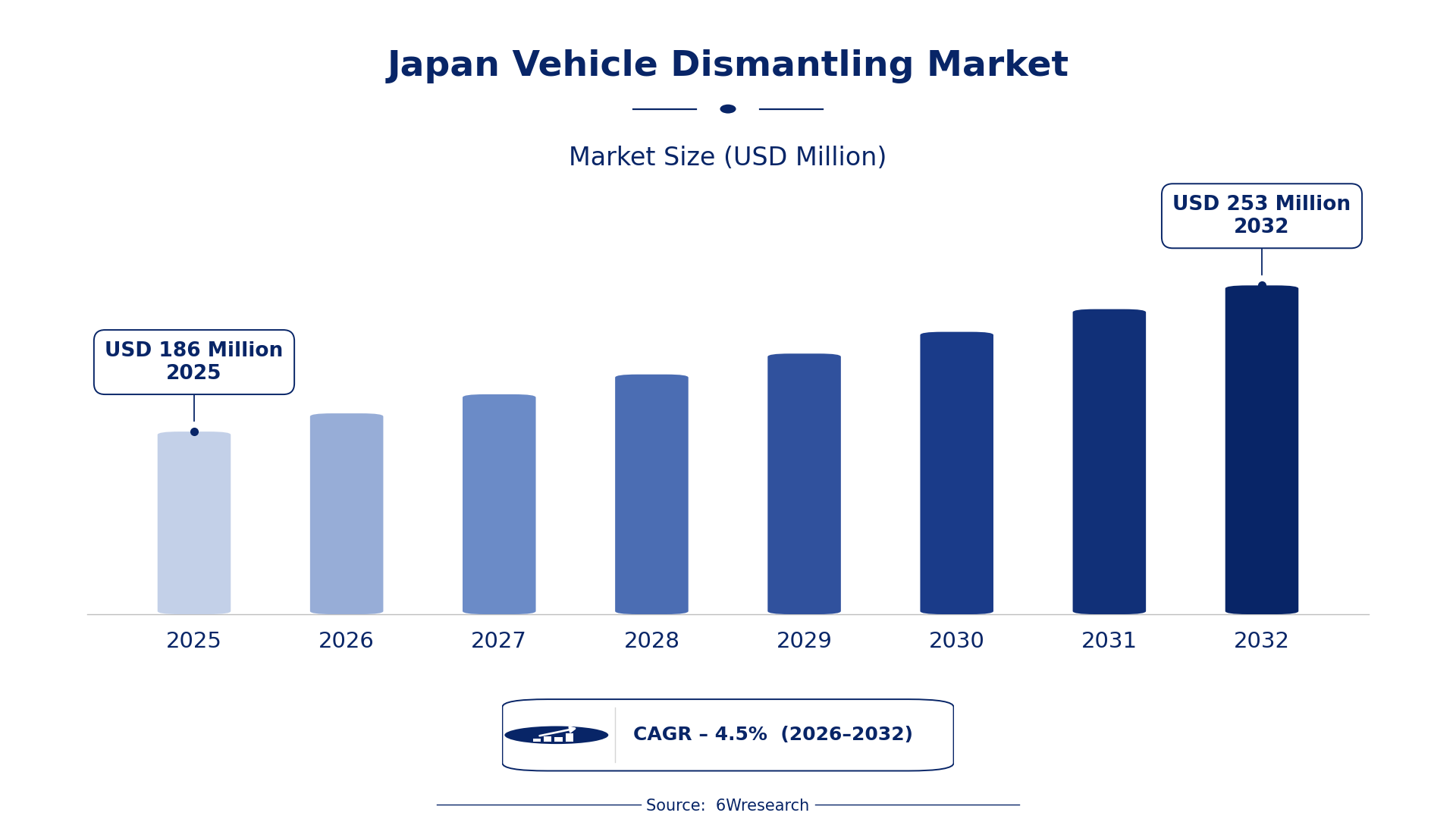
According to 6Wresearch internal database and industry insights, the Japan Vehicle Dismantling Market was valued at USD 186 Million in 2025 and is projected to reach USD 253 Million by 2032, growing at a CAGR of approximately 4.5% during 2026–2032.
Japan Vehicle Dismantling Market Highlights
| Report Metric | Details |
| Report Name | Japan Vehicle Dismantling Market (2026-2032) |
| Market Size 2025 | USD 186 Million |
| Market Size 2032 | USD 253 Million |
| Absolute Growth 2025–2032 | USD 67 Million |
| CAGR 2026–2032 | 4.5% |
| Peak Annual Growth | 5.8% in 2030 |
| Forecast Period | 2026–2032 |
| Historical Data | 2022–2025 |
| Base Year | 2025 |
| Leading Dismantling Type, 2025 | Automated Dismantling (38% share) |
| Leading Service Model, 2025 | Workshop-Based (47% share) |
| Leading Material Recovered, 2025 | Steel (47% share) |
| Leading End User, 2025 | Auto Recycling Centers (39% share) |
| Fastest-Growing Dismantling Type | Eco-Friendly Dismantling (6.6% CAGR) |
| Fastest-Growing Service Model | Robot-Assisted (6.3% CAGR) |
| Fastest-Growing Material Recovered | Electronics & Batteries (6.7% CAGR) |
| Fastest-Growing End User | Circular Economy Initiatives (6.1% CAGR) |
| Growing Sector | Auto Recycling |
| Key End Users | Auto Recycling Centers, Scrap Metal Companies, Battery Recyclers |
Japan Vehicle Dismantling Market Year-wise Growth Rate and Key Drivers (2022–2032)
This graph illustrates the annual growth rates of the market from 2022 to 2032, highlighting a steady upward trajectory and projected market expansion over the forecast period.
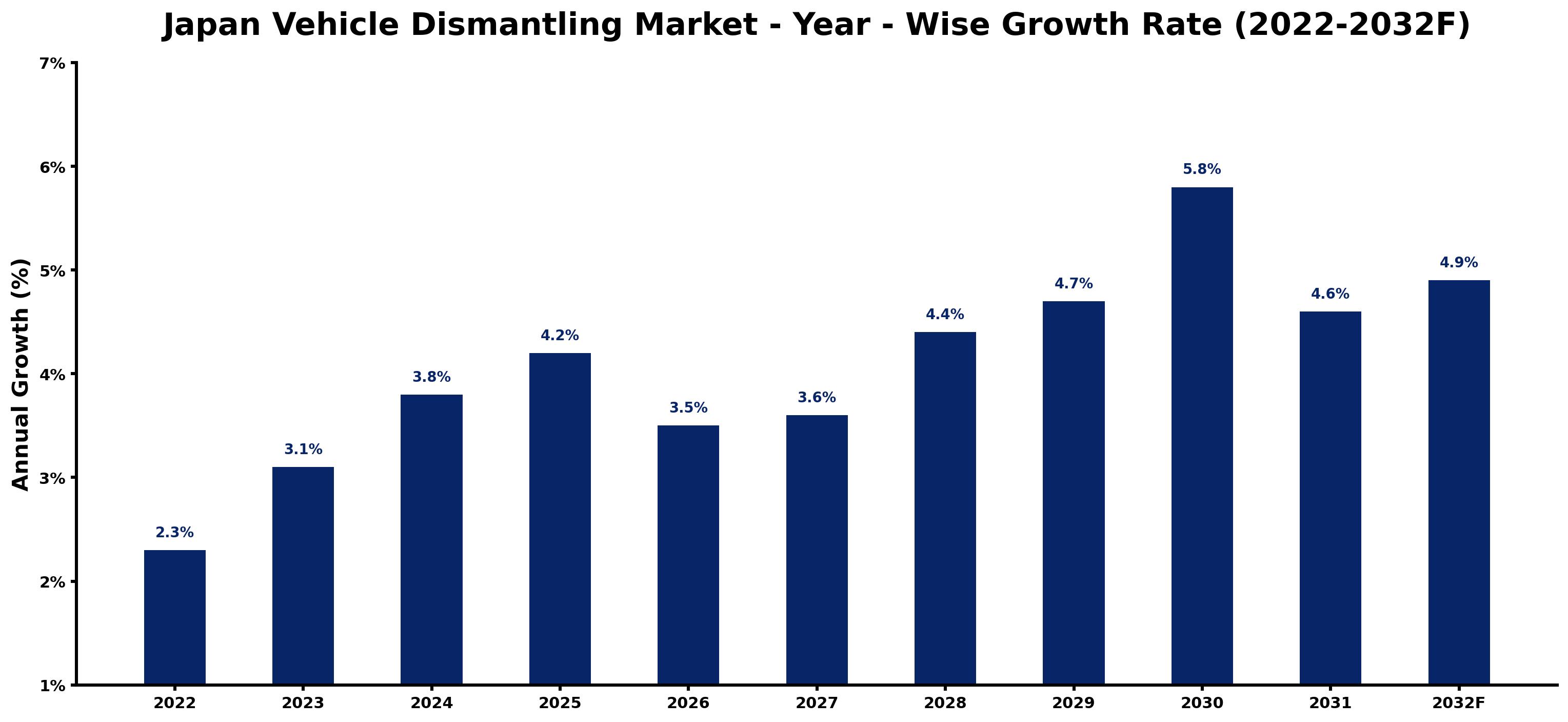
The table below sets out the estimated growth rate for each year and the main factor behind it.
| Year | Estimated Annual Growth (%) | Market Rationale |
| 2022 | 2.3 | The market experienced steady activity, driven by ongoing vehicle turnover rates. |
| 2023 | 3.1 | Growth accelerated due to increased demand for recycled materials from auto recycling centers. |
| 2024 | 3.8 | Continued investment in eco-friendly dismantling practices supported higher growth rates. |
| 2025 | 4.2 | The market reached a historical peak, influenced by rising vehicle dismantling volumes. |
| 2026 | 3.5 | Growth is expected to slow as the market adjusts to regulatory changes in waste management. |
| 2027 | 3.6 | Demand is projected to rebound with improved recycling technologies boosting dismantling efficiency. |
| 2028 | 4.4 | The market is expected to expand further as consumer awareness of sustainability increases. |
| 2029 | 4.7 | Growth will continue, driven by increasing demand for recycled aluminum in automotive applications. |
| 2030 | 5.8 | The peak annual growth is anticipated, reflecting strong environmental compliance efforts. |
| 2031 | 4.6 | Growth is projected to slow as the market stabilises following peak demand levels. |
| 2032 | 4.9 | The market will experience renewed growth, supported by ongoing circular economy initiatives. |
Note: Market size estimations and growth projections presented in this report are based on 6Wresearch's proprietary forecasting methodology, utilizing the latest available industry data, government publications, and primary research inputs.
Japan Vehicle Dismantling Market Synopsis
Vehicle dismantling involves the systematic disassembly of end-of-life vehicles to recover valuable components. This process is essential for recycling metals and ensuring safe disposal of hazardous materials. The Japan Vehicle Dismantling Market is expanding due to rising domestic demand for recycled materials, driven by auto recycling centers and compliance with strict environmental regulations. In 2022, over 5 million vehicles were dismantled, highlighting the market's contribution to sustainability efforts.
Market Dynamics Impact Analysis (2026–2032)
| Factor | Type | Impact | Primary Segment Affected |
| Increasing demand for recycled materials | Driver | High | Eco-Friendly Dismantling |
| Technological advancements in dismantling processes | Driver | High | Automated Dismantling |
| Investment in recycling technologies | Opportunity | High | Electronics & Batteries |
| Growth of circular economy initiatives | Opportunity | High | Circular Economy Initiatives |
| Compliance with strict environmental regulations | Restraint | High | Fluid Recovery Compliant |
| High operational costs for eco-friendly practices | Restraint | Medium | Eco-Friendly Dismantling |
| Limited capacity for hazardous material disposal | Challenge | High | Fluid Recovery Compliant |
| Challenges in workforce training for advanced technologies | Challenge | Medium | Automated Dismantling |
Evaluation of Drivers in Japan Vehicle Dismantling Market (2026–2032)
These are the developments adding the most demand over the forecast period.
| Drivers | Primary Segment Affected | Why It Matters (Evidence) |
| Rising demand for recycled metals | Steel | Japan's vehicle recycling rate is approximately 95%, increasing the need for steel recovery. |
| Technological advancements in dismantling processes | Automated Dismantling | In 2023, the government launched a program to improve recycling technologies, boosting efficiency. |
| Growing focus on sustainability | Eco-Friendly Dismantling | Japan targets a 46% cut in greenhouse-gas emissions by 2030, driving eco-friendly practices. |
| Increased vehicle turnover rates | Workshop-Based | The average age of vehicles being dismantled is around 13 years, leading to higher dismantling volumes. |
| Demand for lightweight materials | Aluminum | The demand for recycled aluminum is increasing due to automotive lightweighting trends. |
A wider customer base explains much of the growth, as the average age of vehicles being dismantled is around 13 years, resulting in increased dismantling volumes. The vehicle recycling rate in Japan is approximately 95%, which drives demand for recycled metals. Japan's commitment to cutting greenhouse-gas emissions by 2030 has led to a stronger focus on eco-friendly dismantling practices. The demand for lightweight materials, particularly recycled aluminum, is influenced by automotive lightweighting trends, further stimulating market growth.
Evaluation of Restraints in Japan Vehicle Dismantling Market
The following restraints limit how fast demand can grow.
| Market Restraint | Primary Segment Affected | Why It Matters (Evidence) |
| Compliance with strict environmental regulations | Fluid Recovery Compliant | Japan has strict regulations for the disposal of hazardous materials from vehicles, increasing operational complexities. |
| High operational costs for eco-friendly practices | Eco-Friendly Dismantling | Investment in eco-friendly technologies raises costs, impacting profit margins for dismantling facilities. |
| Limited capacity for hazardous material disposal | Fluid Recovery Compliant | The disposal capacity for hazardous materials is constrained, complicating compliance efforts. |
| Challenges in workforce training for advanced technologies | Automated Dismantling | Training workers on new technologies incurs costs and time, affecting operational efficiency. |
| Market saturation in urban areas | Workshop-Based | The Tokyo region has the highest concentration of auto recycling centers, limiting growth opportunities. |
Japan Vehicle Dismantling Market Challenges
High costs stem from stringent regulations on hazardous material disposal, consuming over 20% of operational expenses for dismantling facilities. Many suppliers face challenges due to outdated technology, resulting in processing delays that can extend turnaround times by 30% for producers requiring timely service. Limited access to advanced recycling technologies creates supply chain disruptions, compelling suppliers to purchase materials at inflated prices, which raises costs for clinics and other buyers. Buyers experience fluctuating demand for recycled materials, leading to price volatility that complicates budgeting for the dismantling of over 5 million vehicles annually.
Trends in the Japan Vehicle Dismantling Market
The trends below show where the Japan Vehicle Dismantling Market is heading.
- Shift towards Eco-Friendly Dismantling Practices: The Tokyo region is increasingly adopting eco-friendly dismantling practices, with over 1,000 registered auto recycling centers promoting sustainable methods. This shift aligns with Japan's target for a 46% reduction in greenhouse-gas emissions by 2030.
- Rising Demand for Recycled Aluminum: In 2022, the demand for recycled aluminum surged, influenced by automotive lightweighting trends. This increase is reflected in the growing number of projects focused on recycling aluminum components from dismantled vehicles.
- Transition from Manual to Automated Dismantling: Automated dismantling processes are gaining traction, with facilities investing in advanced machinery to improve efficiency. The government’s 2023 program to improve recycling technologies supports this transition, marking a notable industry shift.
- Emergence of Circular Economy Initiatives: Circular economy initiatives are becoming prominent, with local governments supporting projects that promote sustainability in vehicle recycling. These initiatives are expected to grow as public awareness of environmental issues increases.
Investment Opportunities in the Japan Vehicle Dismantling Market
Investors looking at the Japan Vehicle Dismantling Market should consider the following areas.
- Local Partnerships for Eco-Friendly Dismantling: Investing in eco-friendly dismantling technologies is timely, as the government advocates sustainable practices. Auto recycling centers are key partners in this initiative, providing a pathway for collaboration.
- Investment in Advanced Recycling Technologies: With the government's 2023 program improving recycling technologies, there is an opportunity to supply advanced machinery. Auto recycling centers are likely to embrace these innovations, creating demand for new suppliers.
- Expansion of Circular Economy Projects: The current focus on circular economy initiatives presents an opportunity to invest in sustainable recycling solutions. Local governments are actively supporting these projects, providing funding avenues for new entrants.
- Supply of Recycled Metals to Automotive Industry: The demand for recycled metals is increasing, particularly aluminum, due to automotive lightweighting trends. Scrap metal companies are significant buyers, creating a promising market for suppliers.
Government Initiatives in the Japan Vehicle Dismantling Market
The Green Growth Strategy Through Achieving Carbon Neutrality in 2050, adopted in December 2020 and updated in 2021, influences vehicle dismantling practices by promoting eco-friendly dismantling methods and encouraging recycling facilities to adopt sustainable practices, aligning with Japan's environmental goals.
The Ministry of the Environment oversees the implementation of eco-friendly dismantling practices and approves funding for initiatives aimed at improving recycling technologies. This agency ensures compliance with environmental regulations and supports projects that promote sustainability in the vehicle dismantling sector.
Future Insight of the Japan Vehicle Dismantling Market
A policy-driven shift will propel the adoption of advanced recycling technologies, prompting suppliers to implement ISO 14001 standards more widely. The government's commitment to net zero emissions by 2050 will stimulate innovation in dismantling practices. As demand for recycled materials rises, particularly for aluminium, suppliers will invest in new processing facilities. The Tokyo region is expected to see a rise in auto recycling centres, improving accessibility for buyers and streamlining operations.
Market Segmentation Analysis
Japan Vehicle Dismantling Market report covers a detailed analysis of the following market segments:
By Dismantling Type – Automated Dismantling Leads, Eco-Friendly Dismantling Expected to Grow Fastest
According to Saurav Kr Singh, Senior Research Analyst at 6Wresearch, Automated Dismantling held 38% of the Japan Vehicle Dismantling Market by dismantling type in 2025. Automated Dismantling holds the largest share because it significantly improves the efficiency and safety of the dismantling process. This method is particularly prevalent in the Tokyo region, where high volumes of vehicles are processed effectively. The quickest growth will come from Eco-Friendly Dismantling, forecast to expand at a CAGR of 6.6% between 2026 and 2032. Eco-Friendly Dismantling is growing rapidly as stricter environmental regulations and consumer preferences for sustainable practices gain traction. The government's recent programme to enhance recycling technologies is a major factor driving this segment's growth. Suppliers should focus on developing automated and eco-friendly dismantling solutions to meet increasing market demands.
By Service Model – Workshop-Based Leads, Robot-Assisted Expected to Grow Fastest
With 47% of service model revenue in 2025, Workshop-Based was the largest category. The Workshop-Based model dominates the market as it represents the traditional and widely adopted approach to vehicle dismantling services in Japan. With over 1,000 registered auto recycling centres using this method, it remains essential for the industry. Robot-Assisted is projected to grow fastest, at a CAGR of 6.3% during 2026–2032. Robot-Assisted services are growing quickly due to their ability to enhance operational efficiency in dismantling processes. The rising adoption of automation technologies in recycling centres plays a crucial role in this segment's rapid expansion. Buyers can improve their competitiveness by investing in advanced technologies that increase service efficiency and lower operational costs.
By Material Recovered – Steel Leads, Electronics & Batteries Expected to Grow Fastest
In 2025, Steel led the material recovered split with a 47% share. Steel is the leading material recovered in the vehicle dismantling process, primarily due to its high recycling rates and demand in various industries. The approximately 95% vehicle recycling rate in Japan underscores the significance of steel recovery. Electronics & Batteries are set to record the highest CAGR in this split, 6.7% over 2026–2032. Electronics & Batteries are seeing the fastest growth as environmental compliance becomes more stringent. The focus on responsible disposal of hazardous materials drives the need for efficient recovery of these components. Suppliers should prioritise the development of processes for recovering electronics and batteries to align with regulatory requirements.
By End User – Auto Recycling Centers Lead, Circular Economy Initiatives Expected to Grow Fastest
The largest end user category in 2025 was Auto Recycling Centers, at 39% of revenue. Auto Recycling Centers are the leading end users of dismantled vehicles, playing a crucial role in the recycling process and material recovery. Their established infrastructure and expertise in handling end-of-life vehicles reinforce their dominant market position. Over 2026–2032, Circular Economy Initiatives are expected to post the fastest growth, at a CAGR of 6.1%. Circular Economy Initiatives are expanding swiftly, driven by strong alignment with sustainability goals and support from government initiatives. The growing focus on resource recovery and waste minimisation is a key factor in this segment's rapid growth. Buyers involved in recycling should engage in circular economy initiatives to enhance sustainability and ensure compliance with regulations.
Key Attractiveness of the Report
- 10 Years of Market Numbers
- Historical Data Starting from 2022 to 2025
- Base Year 2025
- Forecast Data until 2032
- Key Performance Indicators Impacting the Market
- Major Upcoming Developments and Projects
Key Highlights of the Report:
- Japan Vehicle Dismantling Market Outlook
- Market Size of Japan Vehicle Dismantling Market, 2025
- Forecast of Japan Vehicle Dismantling Market, 2032
- Historical Data and Forecast of Japan Vehicle Dismantling Revenues & Volume for the Period 2022-2032F
- Japan Vehicle Dismantling Market Trend Evolution
- Japan Vehicle Dismantling Market Drivers and Challenges
- Japan Vehicle Dismantling Price Trends
- Japan Vehicle Dismantling Porter's Five Forces
- Japan Vehicle Dismantling Industry Life Cycle
- Historical Data and Forecast of Japan Vehicle Dismantling Market Revenues & Volume By Dismantling Type for the Period 2022-2032F
- Historical Data and Forecast of Japan Vehicle Dismantling Market Revenues & Volume By Manual Dismantling for the Period 2022-2032F
- Historical Data and Forecast of Japan Vehicle Dismantling Market Revenues & Volume By Automated Dismantling for the Period 2022-2032F
- Historical Data and Forecast of Japan Vehicle Dismantling Market Revenues & Volume By Hybrid (Semi-Auto) for the Period 2022-2032F
- Historical Data and Forecast of Japan Vehicle Dismantling Market Revenues & Volume By Eco-Friendly Dismantling for the Period 2022-2032F
- Historical Data and Forecast of Japan Vehicle Dismantling Market Revenues & Volume By Service Model for the Period 2022-2032F
- Historical Data and Forecast of Japan Vehicle Dismantling Market Revenues & Volume By Workshop-Based for the Period 2022-2032F
- Historical Data and Forecast of Japan Vehicle Dismantling Market Revenues & Volume By Robot-Assisted for the Period 2022-2032F
- Historical Data and Forecast of Japan Vehicle Dismantling Market Revenues & Volume By Tool-Assisted for the Period 2022-2032F
- Historical Data and Forecast of Japan Vehicle Dismantling Market Revenues & Volume By Fluid Recovery Compliant for the Period 2022-2032F
- Historical Data and Forecast of Japan Vehicle Dismantling Market Revenues & Volume By Material Recovered for the Period 2022-2032F
- Historical Data and Forecast of Japan Vehicle Dismantling Market Revenues & Volume By Reusable Parts for the Period 2022-2032F
- Historical Data and Forecast of Japan Vehicle Dismantling Market Revenues & Volume By Steel, Aluminum for the Period 2022-2032F
- Historical Data and Forecast of Japan Vehicle Dismantling Market Revenues & Volume By Electronics & Batteries for the Period 2022-2032F
- Historical Data and Forecast of Japan Vehicle Dismantling Market Revenues & Volume By Oils, Coolants for the Period 2022-2032F
- Historical Data and Forecast of Japan Vehicle Dismantling Market Revenues & Volume By End User for the Period 2022-2032F
- Historical Data and Forecast of Japan Vehicle Dismantling Market Revenues & Volume By Auto Recycling Centers for the Period 2022-2032F
- Historical Data and Forecast of Japan Vehicle Dismantling Market Revenues & Volume By Scrap Metal Companies for the Period 2022-2032F
- Historical Data and Forecast of Japan Vehicle Dismantling Market Revenues & Volume By Battery Recyclers for the Period 2022-2032F
- Historical Data and Forecast of Japan Vehicle Dismantling Market Revenues & Volume By Circular Economy Initiatives for the Period 2022-2032F
- Japan Vehicle Dismantling Import Export Trade Statistics
- Market Opportunity Assessment By Dismantling Type
- Market Opportunity Assessment By Service Model
- Market Opportunity Assessment By Material Recovered
- Market Opportunity Assessment By End User
- Japan Vehicle Dismantling Top Companies Market Share
- Japan Vehicle Dismantling Competitive Benchmarking By Technical and Operational Parameters
- Japan Vehicle Dismantling Company Profiles
- Japan Vehicle Dismantling Key Strategic Recommendations
Market Covered
This report examines the market across the segments below.
By Dismantling Type
- Manual Dismantling
- Automated Dismantling
- Hybrid (Semi-Auto)
- Eco-Friendly Dismantling
By Service Model
- Workshop-Based
- Robot-Assisted
- Tool-Assisted
- Fluid Recovery Compliant
By Material Recovered
- Reusable Parts
- Steel
- Aluminum
- Electronics & Batteries
- Oils
- Coolants
By End User
- Auto Recycling Centers
- Scrap Metal Companies
- Battery Recyclers
- Circular Economy Initiatives































