Japan Vehicle Mounted Anti-Tank Missile System Market Size & Growth Rate
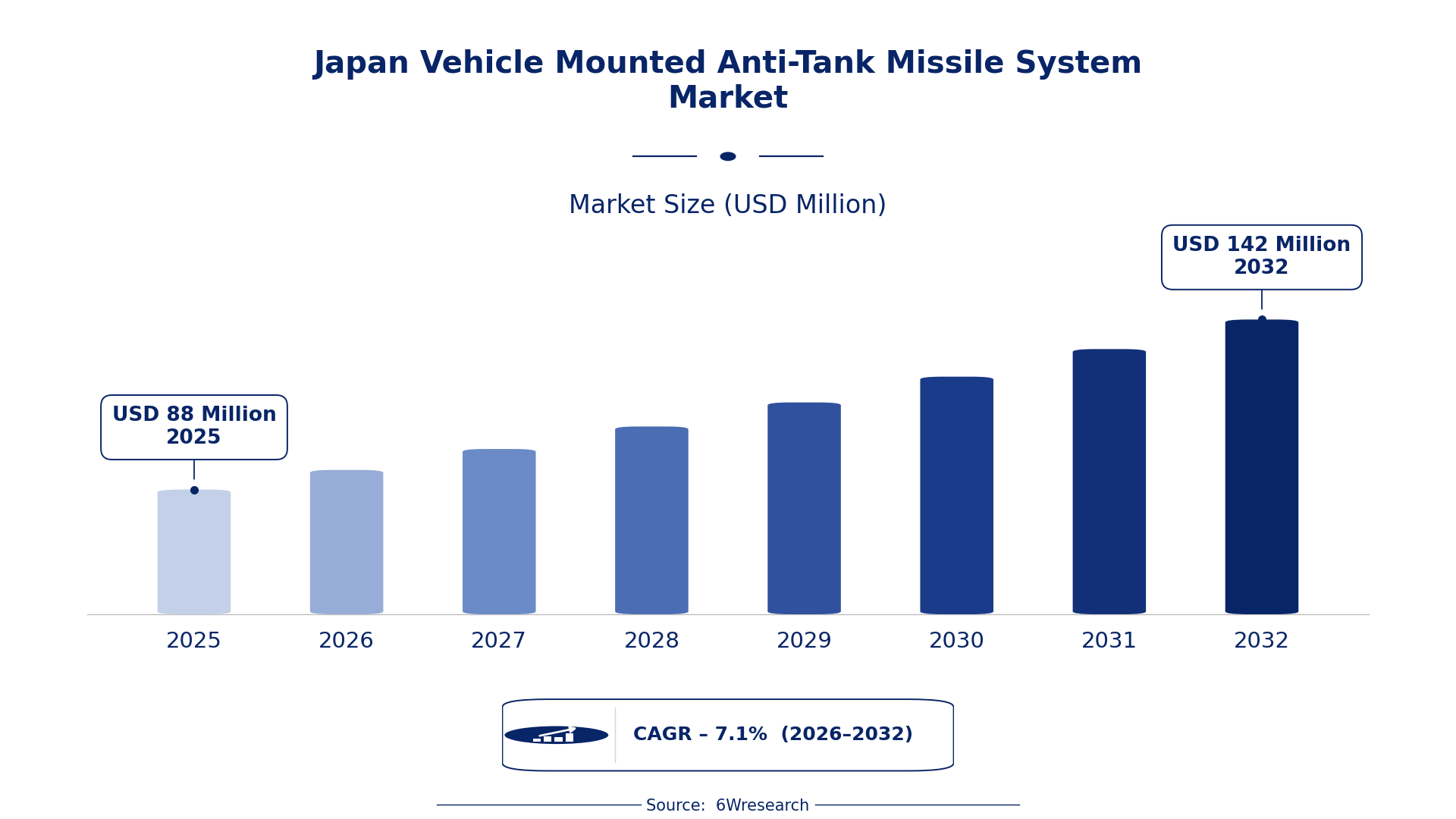
According to 6Wresearch internal database and industry insights, the Japan Vehicle Mounted Anti-Tank Missile System Market was valued at USD 88 Million in 2025 and is projected to reach USD 142 Million by 2032, growing at a CAGR of approximately 7.1% during 2026–2032.
Japan Vehicle Mounted Anti-Tank Missile System Market Highlights
| Report Metric | Details |
| Report Name | Japan Vehicle Mounted Anti-Tank Missile System Market (2026-2032) |
| Market Size 2025 | USD 88 Million |
| Market Size 2032 | USD 142 Million |
| Absolute Growth 2025–2032 | USD 54 Million |
| CAGR 2026–2032 | 7.1% |
| Peak Annual Growth | 8.2% in 2026 |
| Forecast Period | 2026–2032 |
| Historical Data | 2022–2025 |
| Base Year | 2025 |
| Leading Application, 2025 | Homeland (63% share) |
| Leading Target, 2025 | Land Target (56% share) |
| Fastest-Growing Application | Defense (9.0% CAGR) |
| Fastest-Growing Target | Aerial Target (8.7% CAGR) |
| Growing Sector | Defense |
| Key End Users | Homeland, Defense |
Japan Vehicle Mounted Anti-Tank Missile System Market Year-wise Growth Rate and Key Drivers (2022–2032)
This graph illustrates the annual growth rates of the market from 2022 to 2032, highlighting a steady upward trajectory and projected market expansion over the forecast period.
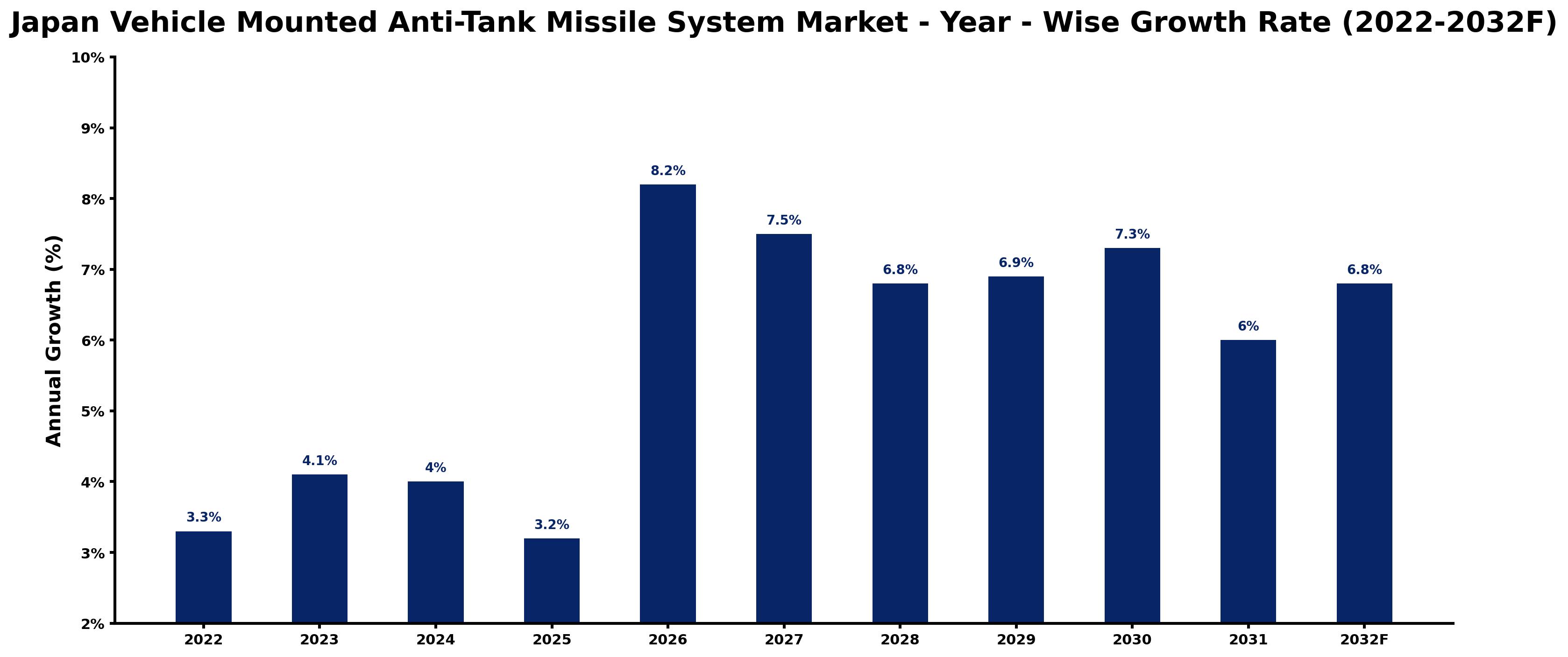
The table below sets out the estimated growth rate for each year and the main factor behind it.
| Year | Estimated Annual Growth (%) | Market Rationale |
| 2022 | 3.3 | The market experienced steady growth, driven by ongoing military exercises and modernization efforts. |
| 2023 | 4.1 | Demand increased as the Ministry of Defense allocated funding for military upgrades. |
| 2024 | 4.0 | Growth slowed slightly as budget adjustments were made in response to economic conditions. |
| 2025 | 3.2 | The market continued to grow, albeit at a reduced rate, due to ongoing military commitments. |
| 2026 | 8.2 | Demand surged as military modernization initiatives are expected to reach their peak, boosting procurement activities. |
| 2027 | 7.5 | Growth is projected to decelerate as the market stabilises after the peak investment year. |
| 2028 | 6.8 | The market is expected to maintain a steady growth rate, supported by ongoing defense collaborations. |
| 2029 | 6.9 | Demand is anticipated to increase again as military exercises with allies resume, enhancing operational readiness. |
| 2030 | 7.3 | Growth will continue as Japan's defense budget expands to support advanced weaponry. |
| 2031 | 6.0 | The market growth rate is projected to slow slightly as procurement processes become more stringent. |
| 2032 | 6.8 | Demand is expected to rise again as new technologies are integrated into existing systems. |
Note: Market size estimations and growth projections presented in this report are based on 6Wresearch's proprietary forecasting methodology, utilizing the latest available industry data, government publications, and primary research inputs.
Japan Vehicle Mounted Anti-Tank Missile System Market Synopsis
Vehicle Mounted Anti-Tank Missile Systems are designed to destroy armoured vehicles, utilising advanced materials and precision engineering for military operations. The Japan Vehicle Mounted Anti-Tank Missile System Market is growing due to substantial investments in military modernisation, with the Ministry of Defense allocating ¥200 billion in 2023. The emphasis on national defence capabilities and joint exercises with allied nations is generating new demand, creating a competitive environment for advanced military technologies.
Market Dynamics Impact Analysis (2026–2032)
| Factor | Type | Impact | Primary Segment Affected |
| Increased military spending | Driver | High | Defense |
| Growing international collaborations | Driver | High | Land Target |
| Rising demand for advanced military capabilities | Opportunity | High | Defense |
| Investment in domestic production facilities | Opportunity | High | Land Target |
| Budget constraints affecting procurement | Restraint | High | Defense |
| Slow technology transfer processes | Restraint | Medium | Land Target |
| Competition from international suppliers | Challenge | High | Defense |
| Regulatory hurdles in defense procurement | Challenge | Medium | Land Target |
Evaluation of Drivers in Japan Vehicle Mounted Anti-Tank Missile System Market (2026–2032)
The following drivers explain most of the expected growth.
| Drivers | Primary Segment Affected | Why It Matters (Evidence) |
| Increased defense budget allocations | Defense | Japan's defense budget for 2023 reached ¥6.8 trillion, allowing for procurement of advanced systems. |
| Focus on joint military exercises | Land Target | Joint exercises with allied nations increase demand for effective anti-tank systems. |
| Technological advancements in missile systems | Defense | Innovations in missile technology prompt higher purchases for modernized military capabilities. |
| Growing emphasis on national security | Defense | Japan's military strategy prioritises deterrence, leading to increased investments in anti-tank systems. |
| Rising threats from regional tensions | Land Target | Heightened security concerns in the Asia-Pacific region drive demand for effective ground defense systems. |
A wider customer base accounts for much of the growth, as increased defence budget allocations have led to a record ¥6.8 trillion in 2023, enabling the procurement of advanced military systems. The focus on joint military exercises with allied nations has further heightened demand for effective anti-tank systems. Advances in missile technology prompt higher purchases, improving operational capabilities. Japan's military strategy prioritises deterrence, driving investments in anti-tank systems due to rising threats from regional tensions.
Evaluation of Restraints in Japan Vehicle Mounted Anti-Tank Missile System Market
These are the pressures that could keep growth below its potential.
| Market Restraint | Primary Segment Affected | Why It Matters (Evidence) |
| Budget constraints affecting procurement processes | Defense | Japan's defense budget adjustments may limit the scope of new acquisitions, impacting military readiness. |
| Slow technology transfer processes | Land Target | Delays in technology transfer can hinder the timely upgrade of existing systems, affecting operational efficiency. |
| Regulatory hurdles in defense procurement | Defense | Complex regulations can slow down the procurement process, delaying the acquisition of necessary systems. |
| Competition from international suppliers | Land Target | Increased competition may pressure local manufacturers, impacting their market share and pricing strategies. |
| Limited domestic production capacity | Defense | Insufficient manufacturing capabilities can restrict the ability to meet growing demand for advanced systems. |
Japan Vehicle Mounted Anti-Tank Missile System Market Challenges
Japan's Self-Defense Forces face a shortage of skilled engineers, which delays project timelines and raises costs for military contractors by 15%. The reliance on imported materials for advanced systems leads to supply chain disruptions, causing production delays that impact the readiness of the Self-Defense Forces. Intense competition among domestic manufacturers drives down prices, which can compromise quality and reliability for military buyers, potentially resulting in failures during critical operations. Stringent regulatory requirements, including compliance with ISO 9001 standards, impose additional costs on producers, ultimately increasing the price of vehicle-mounted anti-tank missile systems by 10% for end users.
Trends in the Japan Vehicle Mounted Anti-Tank Missile System Market
The following changes are redrawing the Japan Vehicle Mounted Anti-Tank Missile System Market.
- Shift towards Advanced Missile Systems: The Ministry of Defense is increasingly focusing on advanced missile systems, with a budget allocation of ¥200 billion for upgrades.
- Increased Collaboration with Allied Forces: Joint exercises with allied nations are becoming more frequent, driving demand for effective anti-tank systems, particularly in the Tokyo region.
- Focus on Domestic Production: There is a growing emphasis on domestic production capabilities, supported by the Japan Defense Agency, which oversees procurement processes.
- Integration of New Technologies: The integration of new technologies into existing systems is gaining momentum, with the Defense Technology Agency established to improve capabilities since 2021.
Investment Opportunities in the Japan Vehicle Mounted Anti-Tank Missile System Market
The following opportunities in the Japan Vehicle Mounted Anti-Tank Missile System Market pair current demand with a clear way in.
- Military Procurement Agencies: The Japan Ground Self-Defense Force needs advanced anti-tank systems, with a projected budget of ¥6.8 trillion for 2023, creating opportunities for suppliers.
- Vehicle Mounted Systems: There is a demand for advanced vehicle-mounted anti-tank missile systems, particularly the Type 01 LMAT, which requires local partnerships for production.
- Joint Ventures in Defense Manufacturing: Now is an ideal time for joint ventures in defense manufacturing, as the government supports local production through various initiatives.
- Investment in Technology Upgrades: Investment in technology upgrades is essential, with the Defense Technology Agency focusing on improving capabilities through practical solutions.
Government Initiatives in the Japan Vehicle Mounted Anti-Tank Missile System Market
The updated National Defense Program Guidelines emphasise the need for advanced military capabilities. The Ministry of Defense allocated ¥200 billion for military modernisation in 2023, mandating compliance with ISO 9001 standards in the manufacturing of defense equipment, ensuring quality and reliability in procurement processes.
The Japan Defense Agency oversees procurement and development of military systems. It approves funding for various projects, including the enhancement of vehicle-mounted anti-tank systems, ensuring alignment with national security objectives. The agency's focus on technological advancements supports the integration of new capabilities into existing systems, fostering a competitive environment for domestic manufacturers.
Future Insight of the Japan Vehicle Mounted Anti-Tank Missile System Market
The introduction of advanced materials will transform the design and functionality of vehicle-mounted anti-tank missile systems by 2032, enhancing their operational capabilities. Japan's military modernisation programme will stimulate demand for new technologies, with procurement budgets potentially reaching ¥300 billion. The establishment of new research facilities in the Tokyo region will promote collaboration between domestic and international partners, driving innovation. As the Defense Technology Agency continues to strengthen capabilities, buyers will gain access to more reliable systems, while suppliers will encounter opportunities to expand their product lines.
Market Segmentation Analysis
Japan Vehicle Mounted Anti-Tank Missile System Market report covers a detailed analysis of the following market segments:
By Application – Homeland Leads, Defense Expected to Grow Fastest
According to Sumit Sagar, AM at 6Wresearch, Homeland took 63% of application revenue in 2025, more than any other category. The homeland application dominates the market due to its integral role in military training exercises, essential for maintaining operational readiness. For instance, Japan's Self-Defense Forces utilise advanced anti-tank systems during drills, highlighting the importance of this segment in overall military preparedness. Defense is projected to grow fastest, at a CAGR of 9.0% during 2026–2032. The defense application is experiencing rapid growth as Japan's Ministry of Defense allocated ¥200 billion for military modernization in 2023, indicating a strong commitment to enhancing national security. This investment is likely to drive increased demand for advanced military systems, further solidifying the segment's expansion. Suppliers should prioritise the defense segment to align with government initiatives and military enhancement strategies.
By Target – Land Target Leads, Aerial Target Expected to Grow Fastest
The largest target category in 2025 was Land Target, at 56% of revenue. The land target segment captures the largest share as vehicle-mounted anti-tank missile systems are specifically engineered to neutralise ground threats effectively. This is exemplified by the Japan Ground Self-Defense Force, which employs various systems designed for land-based operations. Aerial Target is set to record the highest CAGR in this split, 8.7% over 2026–2032. The aerial target segment is poised for growth as military strategies increasingly recognise the necessity for multi-threat capabilities, despite its current limited applications. As Japan's military strategy evolves, there may be a gradual shift towards enhancing technologies for aerial engagements. Buyers should anticipate advancements in aerial targeting to ensure comprehensive defence capabilities.
Key Attractiveness of the Report
- 10 Years of Market Numbers
- Historical Data Starting from 2022 to 2025
- Base Year 2025
- Forecast Data until 2032
- Key Performance Indicators Impacting the Market
- Major Upcoming Developments and Projects
Key Highlights of the Report:
- Japan Vehicle Mounted Anti-Tank Missile System Market Outlook
- Market Size of Japan Vehicle Mounted Anti-Tank Missile System Market, 2025
- Forecast of Japan Vehicle Mounted Anti-Tank Missile System Market, 2032
- Historical Data and Forecast of Japan Vehicle Mounted Anti-Tank Missile System Revenues & Volume for the Period 2022-2032
- Japan Vehicle Mounted Anti-Tank Missile System Market Trend Evolution
- Japan Vehicle Mounted Anti-Tank Missile System Market Drivers and Challenges
- Japan Vehicle Mounted Anti-Tank Missile System Price Trends
- Japan Vehicle Mounted Anti-Tank Missile System Porter's Five Forces
- Japan Vehicle Mounted Anti-Tank Missile System Industry Life Cycle
- Historical Data and Forecast of Japan Vehicle Mounted Anti-Tank Missile System Market Revenues & Volume By Application for the Period 2022-2032
- Historical Data and Forecast of Japan Vehicle Mounted Anti-Tank Missile System Market Revenues & Volume By Homeland for the Period 2022-2032
- Historical Data and Forecast of Japan Vehicle Mounted Anti-Tank Missile System Market Revenues & Volume By Defense for the Period 2022-2032
- Historical Data and Forecast of Japan Vehicle Mounted Anti-Tank Missile System Market Revenues & Volume By Target for the Period 2022-2032
- Historical Data and Forecast of Japan Vehicle Mounted Anti-Tank Missile System Market Revenues & Volume By Land Target for the Period 2022-2032
- Historical Data and Forecast of Japan Vehicle Mounted Anti-Tank Missile System Market Revenues & Volume By Aerial Target for the Period 2022-2032
- Japan Vehicle Mounted Anti-Tank Missile System Import Export Trade Statistics
- Market Opportunity Assessment By Application
- Market Opportunity Assessment By Target
- Japan Vehicle Mounted Anti-Tank Missile System Top Companies Market Share
- Japan Vehicle Mounted Anti-Tank Missile System Competitive Benchmarking By Technical and Operational Parameters
- Japan Vehicle Mounted Anti-Tank Missile System Company Profiles
- Japan Vehicle Mounted Anti-Tank Missile System Key Strategic Recommendations
Market Covered
This report examines the market across the segments below.
By Application
- Homeland
- Defense
By Target
- Land Target
- Aerial Target































