Japan Vehicle Positioning Systems Market Size & Growth Rate
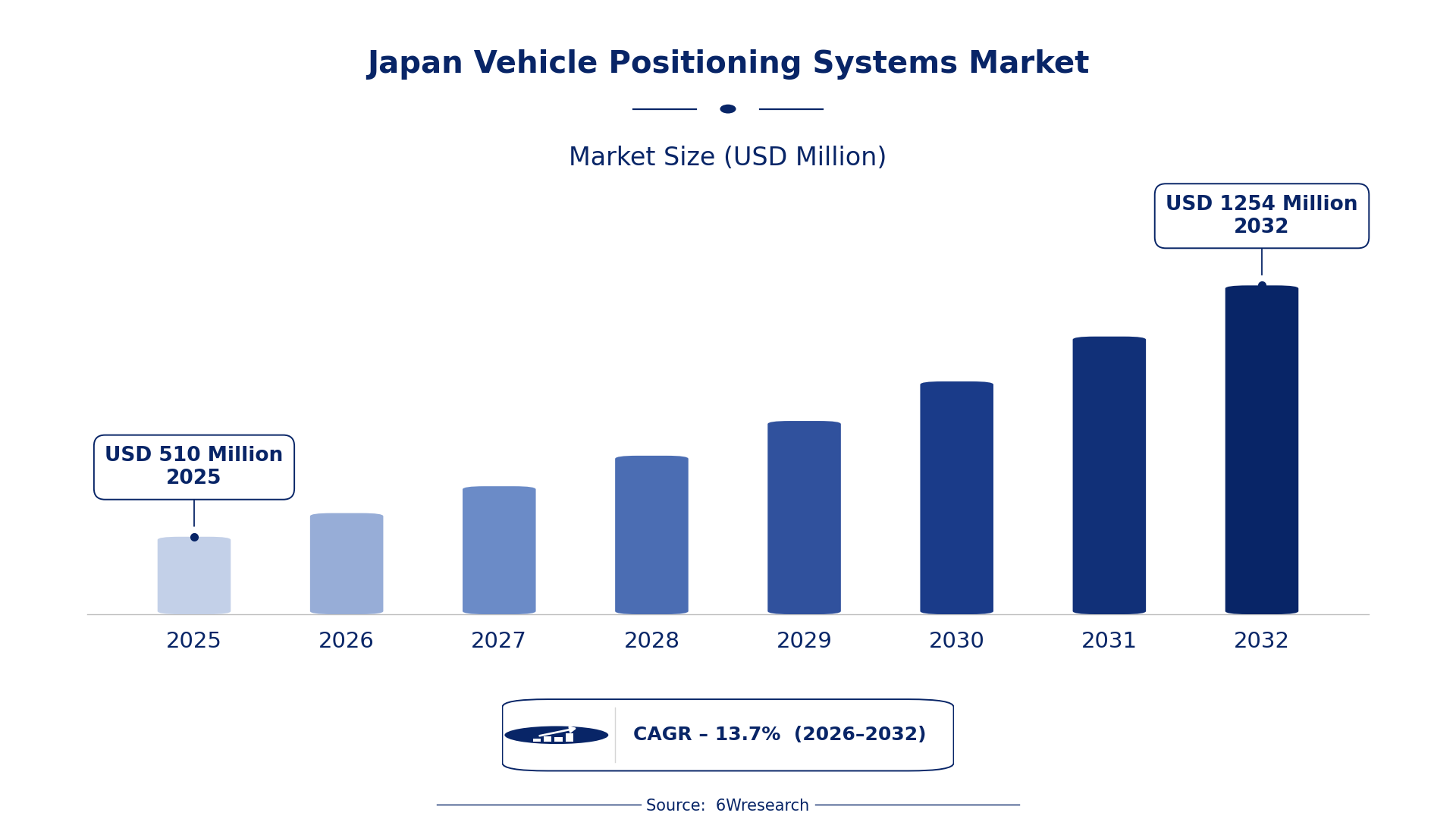
According to 6Wresearch internal database and industry insights, the Japan Vehicle Positioning Systems Market was valued at USD 510 Million in 2025 and is projected to reach USD 1,254 Million by 2032, growing at a CAGR of approximately 13.7% during 2026–2032.
Japan Vehicle Positioning Systems Market Highlights
| Report Metric | Details |
| Report Name | Japan Vehicle Positioning Systems Market (2026-2032) |
| Market Size 2025 | USD 510 Million |
| Market Size 2032 | USD 1,254 Million |
| Absolute Growth 2025–2032 | USD 744 Million |
| CAGR 2026–2032 | 13.7% |
| Peak Annual Growth | 15.0% in 2030 |
| Forecast Period | 2026–2032 |
| Historical Data | 2022–2025 |
| Base Year | 2025 |
| Leading System Type, 2025 | GPS Navigation Units (35% share) |
| Leading Technology Used, 2025 | GNSS (43% share) |
| Leading Distribution Channel, 2025 | Automotive Retailers (37% share) |
| Leading End User, 2025 | Passenger Vehicles (53% share) |
| Fastest-Growing System Type | Dead Reckoning Systems (18.8% CAGR) |
| Fastest-Growing Technology Used | Sensor Fusion (19.3% CAGR) |
| Fastest-Growing Distribution Channel | OEM Distribution (17.8% CAGR) |
| Fastest-Growing End User | Commercial Fleets (18.2% CAGR) |
| Growing Sector | Commercial Fleets |
| Key End Users | Passenger Vehicles, Commercial Fleets, Delivery Vehicles, Connected Vehicles |
Japan Vehicle Positioning Systems Market Year-wise Growth Rate and Key Drivers (2022–2032)
This graph illustrates the annual growth rates of the market from 2022 to 2032, highlighting a steady upward trajectory and projected market expansion over the forecast period.
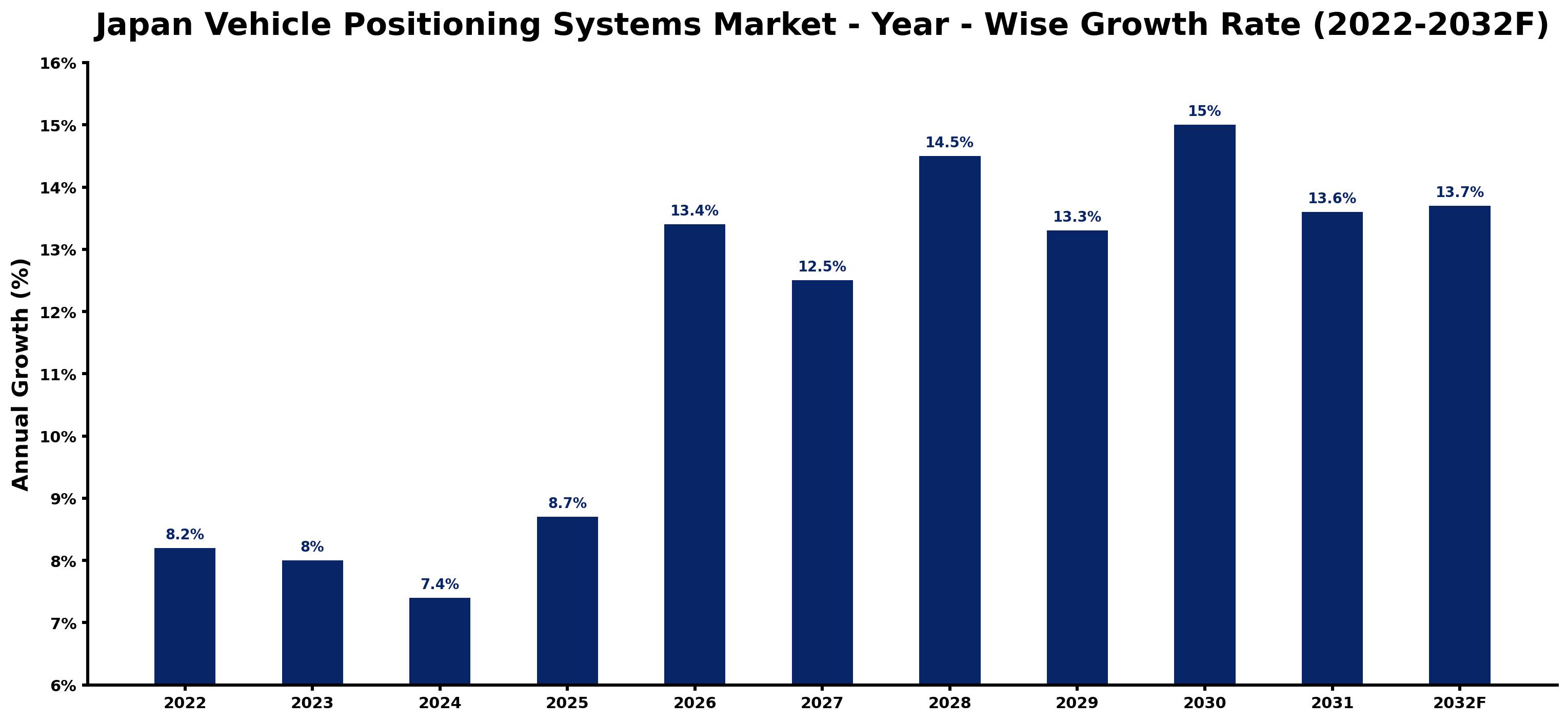
For each year, the table pairs the estimated growth rate with the leading influence on demand, showing how the drivers changed across the period.
| Year | Estimated Annual Growth (%) | Market Rationale |
| 2022 | 8.2 | The automotive market showed steady demand for vehicle positioning systems due to ongoing technological advancements. |
| 2023 | 8.0 | Growth slowed slightly as manufacturers adjusted to supply chain disruptions affecting production timelines. |
| 2024 | 7.4 | Market growth continued to decelerate as consumer preferences shifted towards more integrated mobility solutions. |
| 2025 | 8.7 | Demand surged as the automotive sector embraced advanced navigation technologies for improved connectivity. |
| 2026 | 13.4 | Growth is expected to accelerate as investments in smart mobility initiatives begin to bear fruit. |
| 2027 | 12.5 | Market growth is projected to moderate as the adoption of new technologies reaches a saturation point among early adopters. |
| 2028 | 14.5 | Demand is expected to increase again as new applications for vehicle positioning systems emerge in urban areas. |
| 2029 | 13.3 | Growth is projected to slow as competition intensifies among technology providers in the automotive sector. |
| 2030 | 15.0 | The market is expected to peak with strong demand driven by the integration of positioning systems in connected vehicles. |
| 2031 | 13.6 | Growth is projected to decelerate slightly as the market begins to stabilise after reaching peak adoption rates. |
| 2032 | 13.7 | Demand is expected to rise steadily as new innovations in vehicle connectivity continue to emerge. |
Note: Market size estimations and growth projections presented in this report are based on 6Wresearch's proprietary forecasting methodology, utilizing the latest available industry data, government publications, and primary research inputs.
Japan Vehicle Positioning Systems Market Synopsis
Vehicle Positioning Systems are advanced technologies that determine vehicle locations using satellite signals and sensors, primarily for navigation and fleet management. The Japan Vehicle Positioning Systems Market is propelled by the automotive industry, valued at approximately 4 trillion JPY, alongside the increasing number of connected vehicles, which is expected to reach 10 million by 2025. Investments in smart mobility initiatives and the growing urban population, particularly in areas like Tokyo, further stimulate demand for these systems.
Market Dynamics Impact Analysis (2026–2032)
| Factor | Type | Impact | Primary Segment Affected |
| Increasing demand for connected vehicles due to urbanisation and technological advancements | Driver | High | Connected Vehicles |
| Growing investments in smart mobility initiatives by the government and private sector | Driver | High | Passenger Vehicles |
| Expansion in the commercial fleet sector driven by e-commerce growth | Opportunity | High | Commercial Fleets |
| Rising demand for advanced navigation solutions in urban areas | Opportunity | Medium | Delivery Vehicles |
| Challenges in integrating new technologies with existing systems | Restraint | High | GPS Navigation Units |
| High costs associated with advanced positioning technology implementation | Restraint | Medium | Sensor Fusion |
| Supply chain disruptions affecting timely delivery of components | Challenge | High | OEM Distribution |
| Intense competition among technology providers leading to price wars | Challenge | Medium | Automotive Retailers |
Evaluation of Drivers in Japan Vehicle Positioning Systems Market (2026–2032)
Demand rests on the following drivers, each shown with the segment it touches most.
| Drivers | Primary Segment Affected | Why It Matters (Evidence) |
| Urbanisation driving demand for navigation systems | Connected Vehicles | The Tokyo metropolitan area, with around 14 million residents, increases the need for efficient navigation solutions. |
| Government investments in smart mobility initiatives | Passenger Vehicles | The Japanese government has allocated 1 billion JPY in 2023 to support smart transportation systems. |
| Growth of e-commerce boosting logistics requirements | Commercial Fleets | The rise in online shopping has led to increased demand for fleet management solutions. |
| Technological advancements in vehicle connectivity | Delivery Vehicles | The expected increase to 10 million connected vehicles by 2025 will improve tracking capabilities. |
| Consumer preference for integrated mobility solutions | GPS Navigation Units | The average age of vehicles in Japan is around 10 years, influencing aftermarket navigation system demand. |
Much of the new demand traces back to urbanisation in regions like Tokyo, where the population drives the need for advanced navigation systems. Investments in smart transportation projects, including 1 billion JPY in 2023, are improving infrastructure for vehicle positioning technologies. The growth of e-commerce is pushing logistics firms to adopt fleet solutions, while technological advancements are increasing the number of connected vehicles, projected to reach 10 million by 2025. Preferences for integrated mobility solutions are rising, as evidenced by the average vehicle age of around 10 years, which boosts aftermarket demand for navigation systems.
Evaluation of Restraints in Japan Vehicle Positioning Systems Market
The following restraints limit how fast demand can grow.
| Market Restraint | Primary Segment Affected | Why It Matters (Evidence) |
| Integration challenges with existing vehicle systems | GPS Navigation Units | Many vehicles require retrofitting to accommodate advanced positioning systems, complicating adoption. |
| High implementation costs for advanced technologies | Sensor Fusion | The complexity of integrating multiple data sources raises costs, limiting widespread adoption. |
| Supply chain disruptions affecting component availability | OEM Distribution | Delays in sourcing critical components can hinder timely production and delivery of vehicles. |
| Intense competition leading to price wars | Automotive Retailers | Price competition among retailers can reduce margins and impact profitability. |
| Regulatory compliance costs for safety standards | Connected Vehicles | Compliance with ISO 26262 standards increases development costs for vehicle manufacturers. |
Japan Vehicle Positioning Systems Market Challenges
Producers of vehicle positioning systems face rising raw material costs, inflating production expenses by up to 15% for manufacturers. Many systems still rely on outdated technology, leading to inefficiencies that undermine suppliers' competitiveness. Compliance with automotive safety regulations, such as ISO 26262, necessitates substantial investments, often exceeding 200 million JPY for smaller firms, which strains their financial resources. Supply chain disruptions, particularly for electronic components, can cause delivery delays of up to six months, affecting automotive buyers who depend on timely product availability.
Trends in the Japan Vehicle Positioning Systems Market
The shifts below are changing how Japan Vehicle Positioning Systems Market products are bought and supplied.
- Shift from Traditional Navigation to Integrated Systems: Japan is transitioning towards integrated vehicle positioning systems that combine multiple technologies. The Tokyo Motor Show highlighted advancements in this area, showcasing innovations that improve navigation accuracy and connectivity, with over 78 million registered vehicles driving demand.
- Transition from Standalone Units to Connected Solutions: The trend towards connected vehicles is emerging in Japan, where the number of connected vehicles is expected to reach 10 million by 2025. This shift improves vehicle-to-everything communication, creating new opportunities for technology providers.
- Emergence of Sensor Fusion Technologies: Sensor Fusion technologies are gaining traction in Japan, with a projected CAGR of 19.3% from 2026 to 2032. This growth is driven by the need for improved accuracy in vehicle positioning, particularly in urban environments.
- Prioritisation of Smart Mobility Initiatives: The Japanese government is prioritising smart mobility initiatives, as seen in the 1 billion JPY investment in 2023. This funding supports the development of advanced vehicle positioning systems, improving urban transportation efficiency.
Investment Opportunities in the Japan Vehicle Positioning Systems Market
The openings below show where demand in the Japan Vehicle Positioning Systems Market is visible and how suppliers can enter.
- Investment in Sensor Fusion Technologies: With a projected CAGR of 19.3%, investing in Sensor Fusion technologies can meet the rising demand for accurate vehicle positioning. Smart mobility firms in urban areas are seeking advanced solutions to improve connectivity.
- Supply of Advanced Navigation Systems: The increasing number of connected vehicles, expected to reach 10 million by 2025, presents an opportunity to supply advanced navigation systems. Automotive retailers are looking for innovative products to meet consumer demand.
- Development of Integrated Mobility Solutions: The growing preference for integrated mobility solutions indicates a gap in the market for comprehensive systems. Fleet operators in urban centres are eager for solutions that streamline logistics and improve efficiency.
- Provision of Retrofitting Services: The need for retrofitting existing vehicles to accommodate advanced positioning systems creates a service opportunity. Workshops in metropolitan areas can cater to the demand for modern navigation solutions.
Government Initiatives in the Japan Vehicle Positioning Systems Market
The GX Promotion Act (2023) provides a legal framework for decarbonisation efforts, impacting vehicle positioning system producers by requiring compliance with new environmental standards. This law aims to facilitate the transition to greener technologies, influencing manufacturers to invest in sustainable practices. The government targets a 46% cut in greenhouse-gas emissions from fiscal 2013 levels by fiscal 2030, which will further drive innovation in vehicle technologies.
The Ministry of Land, Infrastructure, Transport and Tourism oversees the implementation of smart mobility projects, funding initiatives that improve vehicle positioning systems. With a budget of 1 billion JPY in 2023, the agency supports innovations that enhance urban transportation efficiency.
Future Insight of the Japan Vehicle Positioning Systems Market
By 2032, buyers will see a rise in vehicle positioning systems as smart mobility initiatives gain traction. The expected increase to 10 million connected vehicles by 2025 will drive demand for advanced navigation solutions. Adoption of JIS standards will streamline manufacturing, enabling suppliers to lower costs. Enhanced data analytics will improve fleet management, offering users superior tracking capabilities and creating new opportunities for service providers.
Market Segmentation Analysis
Japan Vehicle Positioning Systems Market report covers a detailed analysis of the following market segments:
By System Type – GPS Navigation Units Lead, Dead Reckoning Systems Expected to Grow Fastest
According to Saurav Kr Singh, Senior Research Analyst at 6Wresearch, GPS Navigation Units accounted for 35% of the market by system type in 2025. GPS Navigation Units dominate the market as they are integral for route guidance in a vast number of vehicles, reflecting the high demand for effective navigation solutions. The over 78 million registered vehicles in Japan further emphasise the reliance on these systems for daily transportation needs. Dead Reckoning Systems are projected to grow fastest, at a CAGR of 18.8% during 2026–2032. Dead Reckoning Systems are experiencing rapid growth due to their ability to provide reliable tracking in urban environments, where traditional GPS may falter. The complex navigation requirements in densely populated areas like Tokyo are propelling this segment's expansion. Suppliers should focus on enhancing Dead Reckoning Systems to meet the rising urban navigation demands.
By Technology Used – GNSS Leads, Sensor Fusion Expected to Grow Fastest
GNSS held 43% of the Japan Vehicle Positioning Systems Market by technology used in 2025. GNSS serves as the cornerstone technology for vehicle positioning, delivering accurate location data essential for navigation and fleet management. Its widespread application across the automotive sector highlights the critical need for precision in vehicle positioning. Over 2026–2032, Sensor Fusion is expected to post the fastest growth, at a CAGR of 19.3%. Sensor Fusion is witnessing swift growth as it combines multiple data sources to improve accuracy in location tracking. The projected increase in connected vehicles, expected to reach 10 million by 2025, significantly contributes to this technology's momentum. Buyers should prioritise systems that incorporate Sensor Fusion to enhance operational efficiency and tracking accuracy.
By Distribution Channel – Automotive Retailers Lead, OEM Distribution Expected to Grow Fastest
Automotive Retailers took 37% of distribution channel revenue in 2025, more than any other category. Automotive Retailers are the primary distribution channel, effectively linking consumers with navigation systems through established networks. Their strong market presence ensures that vehicle owners can easily access the latest advancements in positioning technologies. OEM Distribution is set to record the highest CAGR in this split, 17.8% over 2026–2032. OEM Distribution is gaining traction as manufacturers increasingly integrate advanced positioning systems into vehicles during production. This trend reflects the automotive industry's commitment to enhancing vehicle capabilities and connectivity features. Suppliers must strengthen partnerships with OEMs to ensure their technologies are included in upcoming vehicle models.
By End User – Passenger Vehicles Lead, Commercial Fleets Expected to Grow Fastest
In 2025, Passenger Vehicles led the end user split with a 53% share. Passenger Vehicles represent the largest segment utilising vehicle positioning systems, driven by consumer demand for navigation and connectivity features. This segment's substantial size is reflected in the overall automotive market value of approximately 4 trillion JPY. The quickest growth will come from Commercial Fleets, forecast to expand at a CAGR of 18.2% between 2026 and 2032. Commercial Fleets are expanding their use of positioning systems as they are essential for optimising logistics and fleet management operations. The increasing emphasis on efficiency in transportation is propelling this segment's growth. Suppliers should tailor their solutions to meet the specific needs of commercial fleet operators to capture this growing market.
Key Attractiveness of the Report
- 10 Years of Market Numbers
- Historical Data Starting from 2022 to 2025
- Base Year 2025
- Forecast Data until 2032
- Key Performance Indicators Impacting the Market
- Major Upcoming Developments and Projects
Key Highlights of the Report:
- Japan Vehicle Positioning Systems Market Outlook
- Market Size of Japan Vehicle Positioning Systems Market, 2025
- Forecast of Japan Vehicle Positioning Systems Market, 2032
- Historical Data and Forecast of Japan Vehicle Positioning Systems Revenues & Volume for the Period 2022-2032F
- Japan Vehicle Positioning Systems Market Trend Evolution
- Japan Vehicle Positioning Systems Market Drivers and Challenges
- Japan Vehicle Positioning Systems Price Trends
- Japan Vehicle Positioning Systems Porter's Five Forces
- Japan Vehicle Positioning Systems Industry Life Cycle
- Historical Data and Forecast of Japan Vehicle Positioning Systems Market Revenues & Volume By System Type for the Period 2022-2032F
- Historical Data and Forecast of Japan Vehicle Positioning Systems Market Revenues & Volume By GPS Navigation Units for the Period 2022-2032F
- Historical Data and Forecast of Japan Vehicle Positioning Systems Market Revenues & Volume By Dead Reckoning Systems for the Period 2022-2032F
- Historical Data and Forecast of Japan Vehicle Positioning Systems Market Revenues & Volume By RTK GPS for the Period 2022-2032F
- Historical Data and Forecast of Japan Vehicle Positioning Systems Market Revenues & Volume By V2X-based Systems for the Period 2022-2032F
- Historical Data and Forecast of Japan Vehicle Positioning Systems Market Revenues & Volume By Technology Used for the Period 2022-2032F
- Historical Data and Forecast of Japan Vehicle Positioning Systems Market Revenues & Volume By GNSS for the Period 2022-2032F
- Historical Data and Forecast of Japan Vehicle Positioning Systems Market Revenues & Volume By Sensor Fusion for the Period 2022-2032F
- Historical Data and Forecast of Japan Vehicle Positioning Systems Market Revenues & Volume By Real-time Kinematic for the Period 2022-2032F
- Historical Data and Forecast of Japan Vehicle Positioning Systems Market Revenues & Volume By DSRC for the Period 2022-2032F
- Historical Data and Forecast of Japan Vehicle Positioning Systems Market Revenues & Volume By Distribution Channel for the Period 2022-2032F
- Historical Data and Forecast of Japan Vehicle Positioning Systems Market Revenues & Volume By Automotive Retailers for the Period 2022-2032F
- Historical Data and Forecast of Japan Vehicle Positioning Systems Market Revenues & Volume By OEM Distribution for the Period 2022-2032F
- Historical Data and Forecast of Japan Vehicle Positioning Systems Market Revenues & Volume By Online Platforms for the Period 2022-2032F
- Historical Data and Forecast of Japan Vehicle Positioning Systems Market Revenues & Volume By Smart Mobility Firms for the Period 2022-2032F
- Historical Data and Forecast of Japan Vehicle Positioning Systems Market Revenues & Volume By End User for the Period 2022-2032F
- Historical Data and Forecast of Japan Vehicle Positioning Systems Market Revenues & Volume By Passenger Vehicles for the Period 2022-2032F
- Historical Data and Forecast of Japan Vehicle Positioning Systems Market Revenues & Volume By Commercial Fleets for the Period 2022-2032F
- Historical Data and Forecast of Japan Vehicle Positioning Systems Market Revenues & Volume By Delivery Vehicles for the Period 2022-2032F
- Historical Data and Forecast of Japan Vehicle Positioning Systems Market Revenues & Volume By Connected Vehicles for the Period 2022-2032F
- Japan Vehicle Positioning Systems Import Export Trade Statistics
- Market Opportunity Assessment By System Type
- Market Opportunity Assessment By Technology Used
- Market Opportunity Assessment By Distribution Channel
- Market Opportunity Assessment By End User
- Japan Vehicle Positioning Systems Top Companies Market Share
- Japan Vehicle Positioning Systems Competitive Benchmarking By Technical and Operational Parameters
- Japan Vehicle Positioning Systems Company Profiles
- Japan Vehicle Positioning Systems Key Strategic Recommendations
Market Covered
Coverage by segment is as follows.
By System Type
- GPS Navigation Units
- Dead Reckoning Systems
- RTK GPS
- V2X-based Systems
By Technology Used
- GNSS
- Sensor Fusion
- Real-time Kinematic
- DSRC
By Distribution Channel
- Automotive Retailers
- OEM Distribution
- Online Platforms
- Smart Mobility Firms
By End User
- Passenger Vehicles
- Commercial Fleets
- Delivery Vehicles
- Connected Vehicles































