Japan Vehicle Rain Protection Systems Market Size & Growth Rate
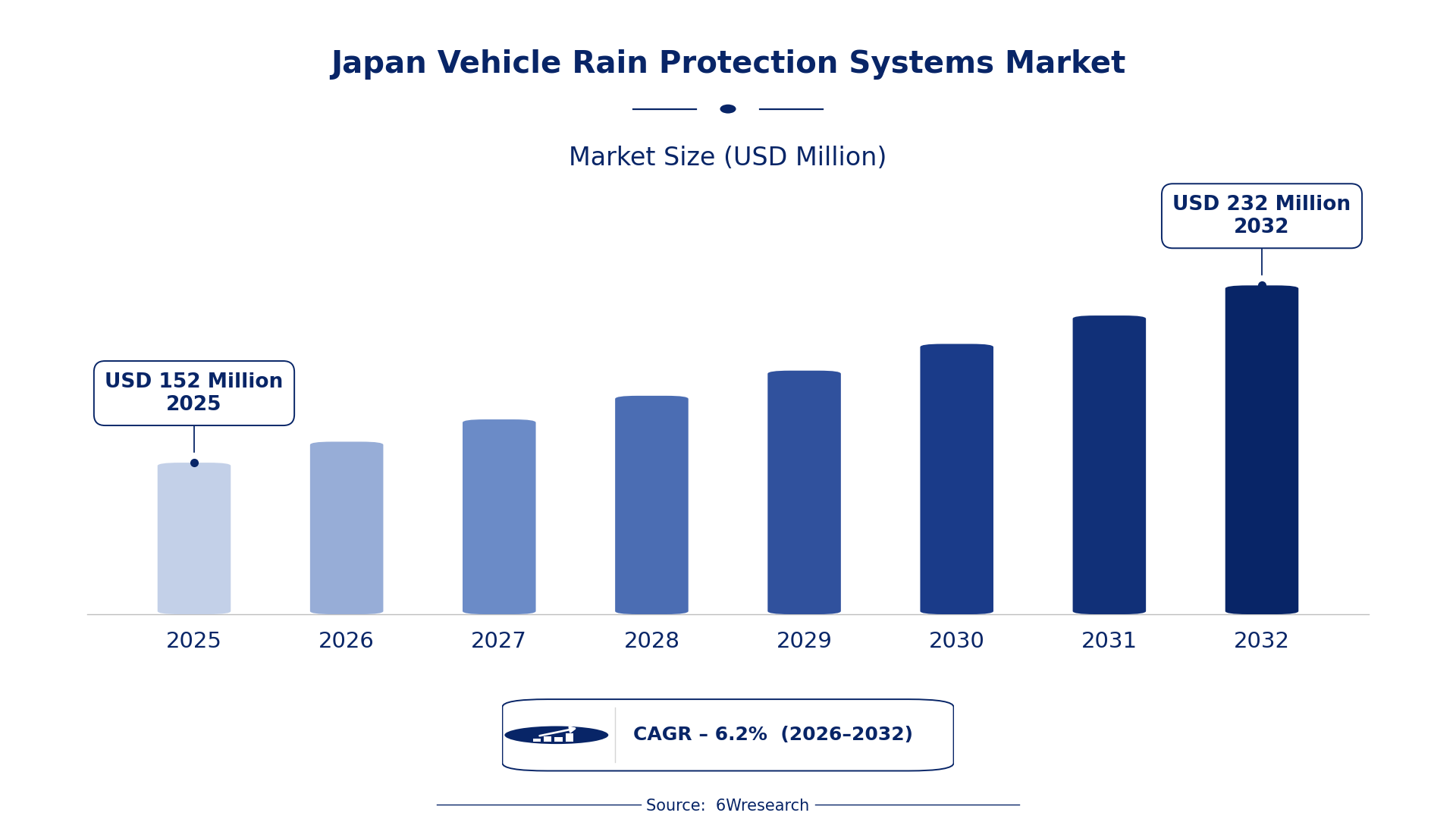
According to 6Wresearch internal database and industry insights, the Japan Vehicle Rain Protection Systems Market was valued at USD 152 Million in 2025 and is projected to reach USD 232 Million by 2032, growing at a CAGR of approximately 6.2% during 2026–2032.
Japan Vehicle Rain Protection Systems Market Highlights
| Report Metric | Details |
| Report Name | Japan Vehicle Rain Protection Systems Market (2026-2032) |
| Market Size 2025 | USD 152 Million |
| Market Size 2032 | USD 232 Million |
| Absolute Growth 2025–2032 | USD 80 Million |
| CAGR 2026–2032 | 6.2% |
| Peak Annual Growth | 7.9% in 2028 |
| Forecast Period | 2026–2032 |
| Historical Data | 2022–2025 |
| Base Year | 2025 |
| Leading Product Type, 2025 | Windshield Wipers (42% share) |
| Leading Material Used, 2025 | Rubber Blades (46% share) |
| Leading Distribution Channel, 2025 | Auto Parts Retailers (50% share) |
| Leading End User, 2025 | Daily Commuter Cars (43% share) |
| Fastest-Growing Product Type | Rain Guards (8.9% CAGR) |
| Fastest-Growing Material Used | Acrylic Plastic (9.2% CAGR) |
| Fastest-Growing Distribution Channel | Online Platforms (8.0% CAGR) |
| Fastest-Growing End User | SUVs (8.2% CAGR) |
| Growing Sector | SUVs |
| Key End Users | Daily Commuter Cars, SUVs, Commercial Vehicles, Electric Vehicles |
Japan Vehicle Rain Protection Systems Market Year-wise Growth Rate and Key Drivers (2022–2032)
This graph illustrates the annual growth rates of the market from 2022 to 2032, highlighting a steady upward trajectory and projected market expansion over the forecast period.
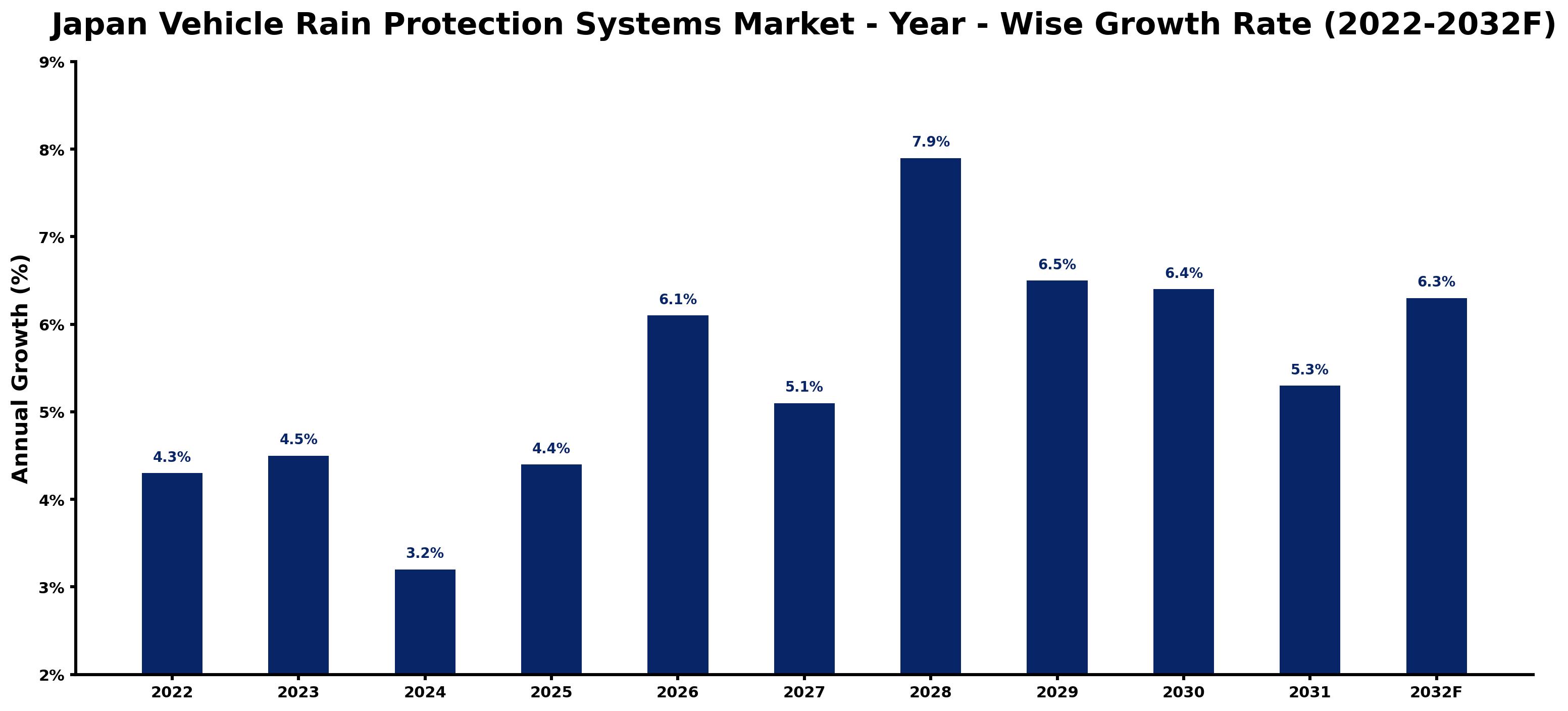
The table below sets out the estimated growth rate for each year and the main factor behind it.
| Year | Estimated Annual Growth (%) | Market Rationale |
| 2022 | 4.3 | The market experienced steady growth due to a high number of registered vehicles. |
| 2023 | 4.5 | Demand increased as vehicle production remained strong, reaching 8.3 million units. |
| 2024 | 3.2 | Growth slowed as supply chain issues affected production rates in the automotive sector. |
| 2025 | 4.4 | The market rebounded with improved supply chain stability and consumer demand. |
| 2026 | 6.1 | Demand is expected to rise as more vehicles integrate advanced rain protection systems. |
| 2027 | 5.1 | Growth is projected to slow as market saturation begins to impact new purchases of rain protection systems. |
| 2028 | 7.9 | The market is expected to peak with heightened demand for new rain protection technologies. |
| 2029 | 6.5 | Growth is projected to decelerate as competition intensifies among suppliers in the automotive sector. |
| 2030 | 6.4 | Demand will continue to slow as the market stabilises after peak growth. |
| 2031 | 5.3 | The market is expected to experience a further slowdown as consumer preferences begin to shift. |
| 2032 | 6.3 | Growth is projected to accelerate again as new vehicle models increasingly feature advanced rain protection. |
Note: Market size estimations and growth projections presented in this report are based on 6Wresearch's proprietary forecasting methodology, utilizing the latest available industry data, government publications, and primary research inputs.
Japan Vehicle Rain Protection Systems Market Synopsis
Vehicle Rain Protection Systems are critical components designed to improve visibility and safety during rain, primarily made from rubber and acrylic plastic. The Japan Vehicle Rain Protection Systems Market is expanding due to over 70 million registered vehicles, driving demand for effective systems. The integration of rain sensors into new vehicle models is boosting safety, while the rise of online platforms for purchasing auto parts is increasing consumer access. Government initiatives aimed at reducing vehicle emissions are also contributing to market growth.
Market Dynamics Impact Analysis (2026–2032)
| Factor | Type | Impact | Primary Segment Affected |
| High number of registered vehicles driving demand for windshield wipers and rain guards. | Driver | High | Windshield Wipers |
| Integration of advanced rain sensors in new vehicle models enhances safety features. | Driver | High | Rain Sensors |
| Growing online sales channel for auto parts, increasing consumer access. | Opportunity | High | Online Platforms |
| Rising demand for SUVs requiring robust rain protection systems. | Opportunity | Medium | SUVs |
| Short lifespan of rubber blades necessitating frequent replacements. | Restraint | Medium | Rubber Blades |
| Competition among suppliers leading to price wars affecting profit margins. | Restraint | High | Rain Guards |
| Supply chain disruptions affecting the availability of components. | Challenge | High | Rain Sensors |
| Rising costs of raw materials impacting production expenses. | Challenge | Medium | Windshield Wipers |
Evaluation of Drivers in Japan Vehicle Rain Protection Systems Market (2026–2032)
Demand rests on the following drivers, each shown with the segment it touches most.
| Drivers | Primary Segment Affected | Why It Matters (Evidence) |
| High number of registered vehicles | Windshield Wipers | With over 70 million registered vehicles in Japan, demand for effective windshield wipers remains strong. |
| Integration of rain sensors | Rain Sensors | The integration of rain sensors in new vehicle models is improving safety and convenience for drivers. |
| Consumer shift to online purchasing | Online Platforms | Online sales of auto parts surged by 25% in the last year, providing greater access for consumers. |
| Growth of the SUV segment | SUVs | The increasing popularity of SUVs is driving demand for more advanced rain protection systems. |
| Focus on quality assurance standards | Rubber Blades | ISO 9001 standards in manufacturing ensure high-quality rubber blades, driving consumer trust and demand. |
Much of the new demand traces back to the increasing number of registered vehicles, which exceeds 70 million, driving the need for windshield wipers. The integration of rain sensors in new vehicle models is improving safety features, prompting higher demand. Online platforms for auto parts have seen a 25% increase in sales, making it easier for consumers to purchase necessary components. The growing popularity of SUVs is prompting manufacturers to invest in more advanced rain protection systems. Quality assurance standards are influencing consumer trust in rubber blades, further boosting demand.
Evaluation of Restraints in Japan Vehicle Rain Protection Systems Market
The main factors holding the market back are set out below.
| Market Restraint | Primary Segment Affected | Why It Matters (Evidence) |
| Short lifespan of rubber blades requiring frequent replacements | Rubber Blades | The average lifespan of rubber blades is approximately 6-12 months, necessitating regular purchases. |
| Intense competition leading to price wars | Rain Guards | Competition among suppliers is driving prices down, affecting profitability and market stability. |
| Supply chain disruptions impacting component availability | Rain Sensors | Ongoing supply chain issues are making it difficult for manufacturers to source necessary components. |
| Rising raw material costs impacting production | Windshield Wipers | Increasing costs of raw materials are squeezing profit margins for manufacturers. |
| Limited awareness of advanced rain protection technologies | Rain Guards | Many consumers remain unaware of the benefits of advanced rain protection systems, which limits market growth. |
Japan Vehicle Rain Protection Systems Market Challenges
Producers are facing rising expenses due to outdated manufacturing technology for rain protection systems, resulting in a 15% increase in costs for suppliers. Compliance with regulations from the Ministry of Land, Infrastructure, Transport and Tourism complicates operations, causing delays of up to six months for manufacturers. Skills shortages hinder the adoption of modern production techniques, leading to a 20% decline in efficiency for producers. Increasing material costs, particularly for rubber, inflate prices by 10% for buyers, making products less affordable and accessible.
Trends in the Japan Vehicle Rain Protection Systems Market
Several trends are reshaping the Japan Vehicle Rain Protection Systems Market; the most important are set out below.
- Shift towards Advanced Rain Protection Systems: There is a noticeable shift towards advanced rain protection systems, particularly rain sensors, in the automotive sector. In 2023, rain sensors were integrated into 60% of new vehicle models, improving safety and convenience.
- Increase in Online Sales of Auto Parts: Online platforms are becoming increasingly popular for purchasing auto parts, with sales rising by 25% in the last year. This trend is reshaping how consumers access vehicle maintenance products.
- Growing Demand for Enhanced Systems in SUVs: The demand for SUVs is driving the need for more advanced rain protection systems. In 2022, the SUV segment accounted for 30% of new vehicle sales in Japan, indicating a shift in consumer preferences.
- Integration of Quality Standards in Manufacturing: Manufacturers are increasingly adopting ISO 9001 standards to ensure quality in production processes. This trend is important for maintaining consumer trust and improving product reliability.
Investment Opportunities in the Japan Vehicle Rain Protection Systems Market
Several openings in the Japan Vehicle Rain Protection Systems Market merit attention from investors.
- Urban Auto Parts Retailers: Urban areas are seeing a growing need for advanced rain protection systems, with sales increasing by 25% last year. Partnering with local retailers can improve market penetration.
- Daily Commuter Cars: Daily commuter vehicles represent a significant market, with over 70 million registered vehicles. Suppliers can focus on providing tailored solutions for this segment to meet rising demand.
- Joint Ventures for Local Manufacturing: Establishing joint ventures with local manufacturers can facilitate entry into the market, particularly for advanced rain protection systems. This approach can utilise local expertise and distribution networks.
- Government Initiatives Supporting Emission Reductions: Government initiatives targeting a 46% reduction in greenhouse gas emissions by 2030 create opportunities for suppliers of eco-friendly rain protection systems. Engaging with regulatory bodies can streamline compliance.
Government Initiatives in the Japan Vehicle Rain Protection Systems Market
The GX Promotion Act, adopted in 2023, strengthens existing regulations by establishing a framework for decarbonisation in the automotive sector. This law mandates upgrades to vehicle rain protection systems to meet new emissions targets, compelling producers to invest in modern technologies. Additionally, the Green Growth Strategy aims for JPY 150 trillion in public-private investment over the next decade, supporting the development of sustainable automotive components, including rain protection systems.
The Ministry of Land, Infrastructure, Transport and Tourism oversees the approval of safety standards for vehicle components. This agency funds initiatives aimed at improving vehicle safety, including the integration of advanced rain protection systems. In 2023, the ministry launched a programme to assist manufacturers in upgrading their systems, ensuring compliance with the latest regulations and enhancing consumer safety.
Future Insight of the Japan Vehicle Rain Protection Systems Market
Stricter emissions standards will drive upgrades in vehicle rain protection systems by 2032, improving safety and performance for consumers. The integration of advanced sensors will become standard in new vehicle models, significantly enhancing driver visibility. Government initiatives will promote the use of eco-friendly materials in production processes, aligning with sustainability goals. With 8.3 million vehicles produced in 2022, the demand for high-quality rain protection systems will surge, prompting suppliers to innovate and meet specific consumer needs.
Market Segmentation Analysis
Japan Vehicle Rain Protection Systems Market report covers a detailed analysis of the following market segments:
By Product Type – Windshield Wipers Lead, Rain Guards Expected to Grow Fastest
According to Saurav Kr Singh, Senior Research Analyst at 6Wresearch, the largest product type category in 2025 was Windshield Wipers, at 42% of revenue. Windshield wipers command the largest share due to their essential role in maintaining visibility during rain for over 70 million registered vehicles in Japan. Their necessity in ensuring driver safety makes them a staple in the automotive industry. Rain Guards are projected to grow fastest, at a CAGR of 8.9% during 2026–2032. Rain guards are rapidly gaining traction as they protect vehicle interiors from rain, influenced by rising consumer interest in enhanced vehicle protection. The integration of these systems into newer models is likely to further boost their adoption rates. Suppliers should consider expanding their product lines to include advanced rain protection systems to satisfy growing consumer preferences.
By Material Used – Rubber Blades Lead, Acrylic Plastic Expected to Grow Fastest
Rubber Blades took 46% of material used revenue in 2025, more than any other category. Rubber blades are the leading material in the market as they are the primary component of windshield wipers, crucial for ensuring visibility in rainy conditions. Their average lifespan of 6-12 months creates a consistent demand for replacements among vehicle owners. Over 2026–2032, Acrylic Plastic is expected to post the fastest growth, at a CAGR of 9.2%. Acrylic plastic is experiencing the fastest growth due to its durability and clarity, making it a preferred choice for rain guards. As more vehicles adopt these features, the demand for acrylic plastic is expected to rise significantly. Buyers may find value in exploring materials that enhance performance and longevity in rain protection systems.
By Distribution Channel – Auto Parts Retailers Lead, Online Platforms Expected to Grow Fastest
Auto Parts Retailers held 50% of the Japan Vehicle Rain Protection Systems Market by distribution channel in 2025. Auto parts retailers dominate the distribution landscape as they serve as the main purchasing point for consumers seeking vehicle maintenance products. Their strong presence in urban areas ensures convenient access for a wide range of customers. Online Platforms are set to record the highest CAGR in this split, 8.0% over 2026–2032. Online platforms are emerging as the fastest-growing distribution channel, with a notable 25% increase in auto parts sales over the past year. This shift reflects changing consumer preferences towards convenience and online shopping. Suppliers should enhance their online strategies to take advantage of the growing trend towards e-commerce in the automotive parts sector.
By End User – Daily Commuter Cars Lead, SUVs Expected to Grow Fastest
Daily Commuter Cars accounted for 43% of the market by end user in 2025. Daily commuter cars constitute the largest segment of vehicle users, necessitating reliable rain protection systems for safety and visibility. The size of this segment guarantees a steady demand for windshield wipers and rain guards. The quickest growth will come from SUVs, forecast to expand at a CAGR of 8.2% between 2026 and 2032. SUVs represent the fastest-growing segment, as their rising popularity necessitates robust rain protection systems. This trend indicates a shift towards larger vehicles that require enhanced safety features. Suppliers should focus on developing products tailored to meet the specific needs of SUV owners, emphasising advanced rain protection solutions.
Key Attractiveness of the Report
- 10 Years of Market Numbers
- Historical Data Starting from 2022 to 2025
- Base Year 2025
- Forecast Data until 2032
- Key Performance Indicators Impacting the Market
- Major Upcoming Developments and Projects
Key Highlights of the Report:
- Japan Vehicle Rain Protection Systems Market Outlook
- Market Size of Japan Vehicle Rain Protection Systems Market, 2025
- Forecast of Japan Vehicle Rain Protection Systems Market, 2032
- Historical Data and Forecast of Japan Vehicle Rain Protection Systems Revenues & Volume for the Period 2022-2032F
- Japan Vehicle Rain Protection Systems Market Trend Evolution
- Japan Vehicle Rain Protection Systems Market Drivers and Challenges
- Japan Vehicle Rain Protection Systems Price Trends
- Japan Vehicle Rain Protection Systems Porter's Five Forces
- Japan Vehicle Rain Protection Systems Industry Life Cycle
- Historical Data and Forecast of Japan Vehicle Rain Protection Systems Market Revenues & Volume By Product Type for the Period 2022-2032F
- Historical Data and Forecast of Japan Vehicle Rain Protection Systems Market Revenues & Volume By Windshield Wipers for the Period 2022-2032F
- Historical Data and Forecast of Japan Vehicle Rain Protection Systems Market Revenues & Volume By Rain Guards for the Period 2022-2032F
- Historical Data and Forecast of Japan Vehicle Rain Protection Systems Market Revenues & Volume By Window Deflectors for the Period 2022-2032F
- Historical Data and Forecast of Japan Vehicle Rain Protection Systems Market Revenues & Volume By Rain Sensors for the Period 2022-2032F
- Historical Data and Forecast of Japan Vehicle Rain Protection Systems Market Revenues & Volume By Material Used for the Period 2022-2032F
- Historical Data and Forecast of Japan Vehicle Rain Protection Systems Market Revenues & Volume By Rubber Blades for the Period 2022-2032F
- Historical Data and Forecast of Japan Vehicle Rain Protection Systems Market Revenues & Volume By Acrylic Plastic for the Period 2022-2032F
- Historical Data and Forecast of Japan Vehicle Rain Protection Systems Market Revenues & Volume By Polycarbonate for the Period 2022-2032F
- Historical Data and Forecast of Japan Vehicle Rain Protection Systems Market Revenues & Volume By Optical Sensors for the Period 2022-2032F
- Historical Data and Forecast of Japan Vehicle Rain Protection Systems Market Revenues & Volume By Distribution Channel for the Period 2022-2032F
- Historical Data and Forecast of Japan Vehicle Rain Protection Systems Market Revenues & Volume By Auto Parts Retailers for the Period 2022-2032F
- Historical Data and Forecast of Japan Vehicle Rain Protection Systems Market Revenues & Volume By Online Platforms for the Period 2022-2032F
- Historical Data and Forecast of Japan Vehicle Rain Protection Systems Market Revenues & Volume By Specialty Stores for the Period 2022-2032F
- Historical Data and Forecast of Japan Vehicle Rain Protection Systems Market Revenues & Volume By OEMs for the Period 2022-2032F
- Historical Data and Forecast of Japan Vehicle Rain Protection Systems Market Revenues & Volume By End User for the Period 2022-2032F
- Historical Data and Forecast of Japan Vehicle Rain Protection Systems Market Revenues & Volume By Daily Commuter Cars for the Period 2022-2032F
- Historical Data and Forecast of Japan Vehicle Rain Protection Systems Market Revenues & Volume By SUVs for the Period 2022-2032F
- Historical Data and Forecast of Japan Vehicle Rain Protection Systems Market Revenues & Volume By Commercial Vehicles for the Period 2022-2032F
- Historical Data and Forecast of Japan Vehicle Rain Protection Systems Market Revenues & Volume By Electric Vehicles for the Period 2022-2032F
- Japan Vehicle Rain Protection Systems Import Export Trade Statistics
- Market Opportunity Assessment By Product Type
- Market Opportunity Assessment By Material Used
- Market Opportunity Assessment By Distribution Channel
- Market Opportunity Assessment By End User
- Japan Vehicle Rain Protection Systems Top Companies Market Share
- Japan Vehicle Rain Protection Systems Competitive Benchmarking By Technical and Operational Parameters
- Japan Vehicle Rain Protection Systems Company Profiles
- Japan Vehicle Rain Protection Systems Key Strategic Recommendations
Market Covered
Segments analysed in this report are listed below.
By Product Type
- Windshield Wipers
- Rain Guards
- Window Deflectors
- Rain Sensors
By Material Used
- Rubber Blades
- Acrylic Plastic
- Polycarbonate
- Optical Sensors
By Distribution Channel
- Auto Parts Retailers
- Online Platforms
- Specialty Stores
- OEMs
By End User
- Daily Commuter Cars
- SUVs
- Commercial Vehicles
- Electric Vehicles































