Japan Vehicle Recognition System Market Size & Growth Rate
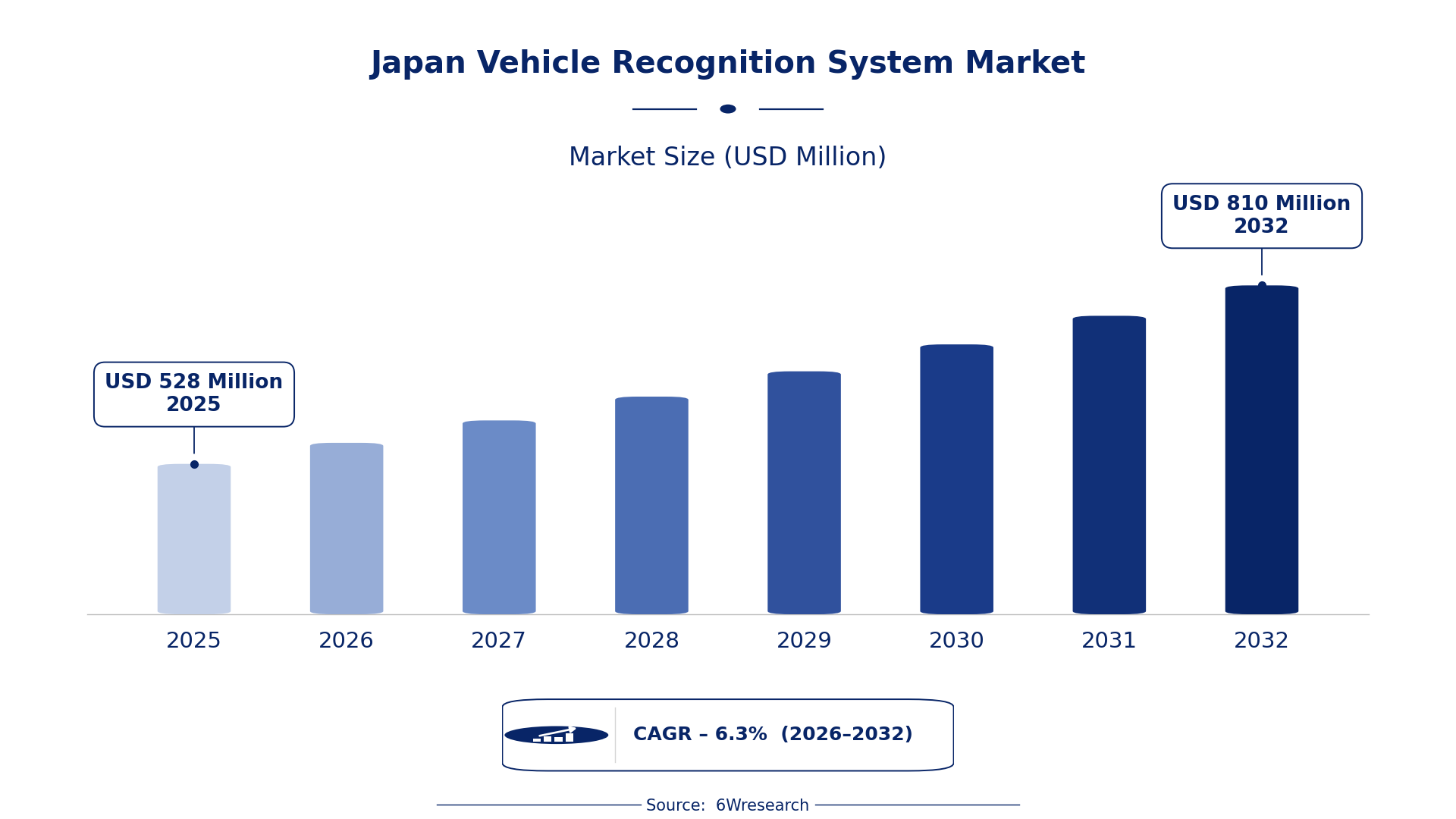
According to 6Wresearch internal database and industry insights, the Japan Vehicle Recognition System Market was valued at USD 528 Million in 2025 and is projected to reach USD 810 Million by 2032, growing at a CAGR of approximately 6.3% during 2026–2032.
Japan Vehicle Recognition System Market Highlights
| Report Metric | Details |
| Report Name | Japan Vehicle Recognition System Market (2026-2032) |
| Market Size 2025 | USD 528 Million |
| Market Size 2032 | USD 810 Million |
| Absolute Growth 2025–2032 | USD 282 Million |
| CAGR 2026–2032 | 6.3% |
| Peak Annual Growth | 7.7% in 2030 |
| Forecast Period | 2026–2032 |
| Historical Data | 2022–2025 |
| Base Year | 2025 |
| Leading System Type, 2025 | ANPR Systems (41% share) |
| Leading Feature Enabled, 2025 | License Plate ID (40% share) |
| Leading Distribution Channel, 2025 | OEMs (52% share) |
| Leading End User, 2025 | Law Enforcement (37% share) |
| Fastest-Growing System Type | Entry Gate Systems (8.6% CAGR) |
| Fastest-Growing Feature Enabled | Deep Learning (7.9% CAGR) |
| Fastest-Growing Distribution Channel | Security Vendors (8.0% CAGR) |
| Fastest-Growing End User | Smart Mobility Firms (8.1% CAGR) |
| Growing Sector | Traffic Management |
| Key End Users | Law Enforcement, Smart Mobility Firms, Parking Operators, Toll Booths |
Japan Vehicle Recognition System Market Year-wise Growth Rate and Key Drivers (2022–2032)
This graph illustrates the annual growth rates of the market from 2022 to 2032, highlighting a steady upward trajectory and projected market expansion over the forecast period.
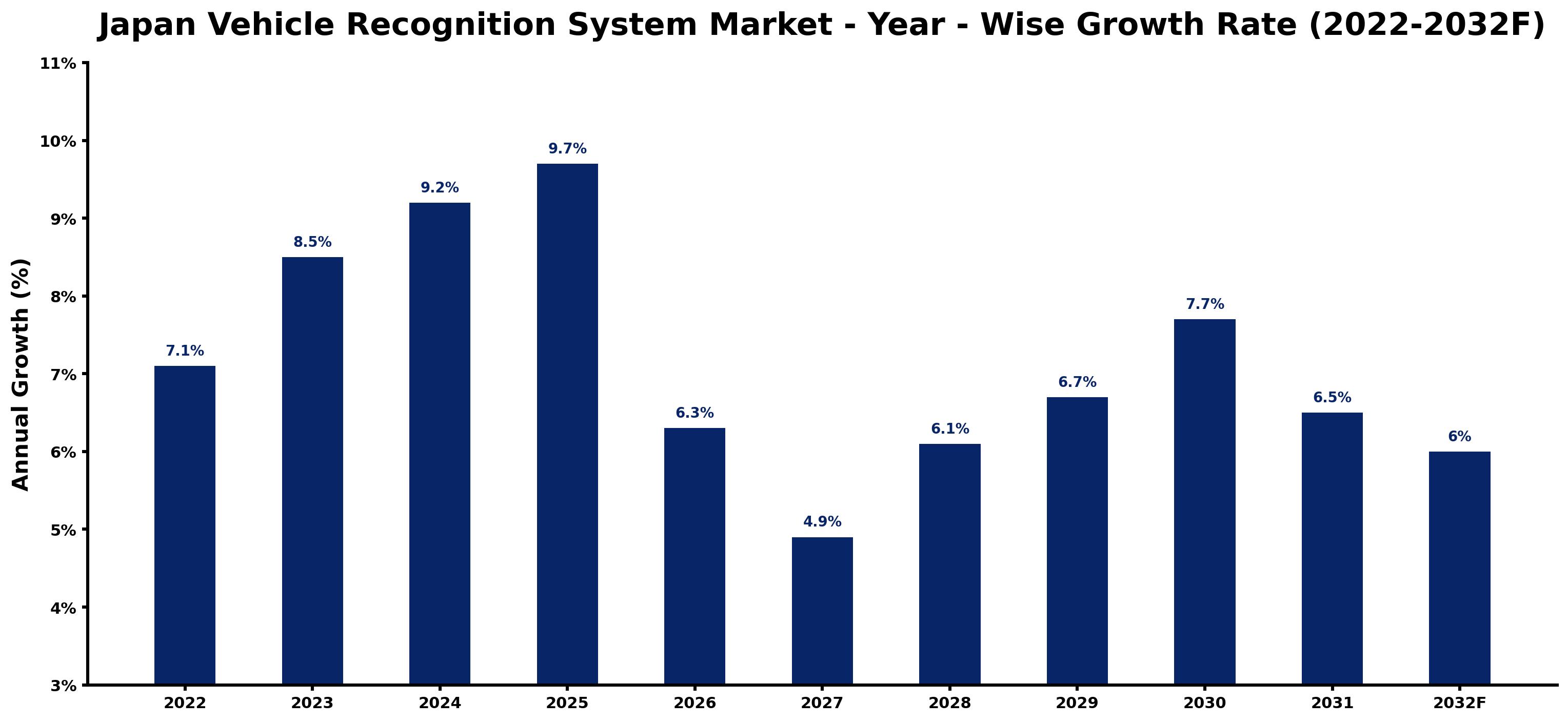
Year by year, the estimates below pair each growth rate with the development that shaped it.
| Year | Estimated Annual Growth (%) | Market Rationale |
| 2022 | 7.1 | The market showed steady demand from law enforcement agencies and smart mobility firms. |
| 2023 | 8.5 | Growth accelerated due to increased urban traffic management initiatives in Tokyo. |
| 2024 | 9.2 | The rise in vehicle registrations contributed to higher demand for recognition systems. |
| 2025 | 9.7 | Demand peaked as the National Police Agency expanded ANPR system implementations. |
| 2026 | 6.3 | Growth is expected to slow as the market begins to stabilise after rapid expansion. |
| 2027 | 4.9 | The slowdown will continue as the market adjusts to previous high growth rates. |
| 2028 | 6.1 | Demand is projected to increase again due to new smart city projects in urban areas. |
| 2029 | 6.7 | Growth will pick up as more parking operators adopt recognition systems. |
| 2030 | 7.7 | The market is expected to reach a new peak with the introduction of advanced technologies. |
| 2031 | 6.5 | Growth is projected to slow as the market matures and competition intensifies. |
| 2032 | 6.0 | A further slowdown is expected as demand stabilises in established sectors. |
Note: Market size estimations and growth projections presented in this report are based on 6Wresearch's proprietary forecasting methodology, utilizing the latest available industry data, government publications, and primary research inputs.
Japan Vehicle Recognition System Market Synopsis
Vehicle Recognition Systems utilise advanced imaging technology and machine learning to identify vehicles through license plates and features. These systems are essential for traffic management, law enforcement, and access control. The Japan Vehicle Recognition System Market is expanding due to rising urbanisation, with over 4 million registered vehicles and government investments in smart mobility initiatives. The demand is further supported by projects aimed at reducing greenhouse gas emissions by 46% by 2030, highlighting the increasing focus on efficient traffic management solutions.
Market Dynamics Impact Analysis (2026–2032)
| Factor | Type | Impact | Primary Segment Affected |
| Increasing urban traffic management initiatives are driving demand for vehicle recognition systems. | Driver | High | ANPR Systems |
| The expansion of smart city projects is creating new opportunities for vehicle recognition technologies. | Opportunity | High | Entry Gate Systems |
| The need for enhanced security in urban areas is pushing law enforcement to adopt these systems. | Driver | High | License Plate ID |
| The integration of vehicle recognition in public transport systems is expanding market reach. | Opportunity | Medium | Toll Booths |
| High costs of advanced systems can limit adoption among smaller municipalities. | Restraint | High | Smart Mobility Firms |
| Limited awareness of the benefits of vehicle recognition systems in rural areas may hinder growth. | Restraint | Medium | Parking Operators |
| Competition among technology providers is increasing, affecting pricing strategies. | Challenge | High | Law Enforcement |
| The need for continuous updates and maintenance can strain budgets for buyers. | Challenge | Medium | OEMs |
Evaluation of Drivers in Japan Vehicle Recognition System Market (2026–2032)
The factors lifting demand, and the evidence behind each, are summarised below.
| Drivers | Primary Segment Affected | Why It Matters (Evidence) |
| Rising urbanisation is increasing traffic volumes, creating demand for vehicle recognition systems. | ANPR Systems | Tokyo's high population density drives the need for effective traffic management. |
| Government initiatives are promoting smart mobility solutions, boosting system adoption. | Entry Gate Systems | The smart traffic management program launched in 2023 is facilitating system integration. |
| Law enforcement agencies are expanding their use of vehicle recognition for crime prevention. | License Plate ID | The implementation of ANPR systems in urban areas is a key driver. |
| Increased vehicle registrations are leading to higher demand for recognition technologies. | Toll Booths | Japan had over 4 million registered vehicles in 2022, necessitating efficient identification systems. |
| Public transport systems are increasingly adopting vehicle recognition for operational efficiency. | Parking Operators | The average response time for law enforcement using these systems is reduced by 30%, improving operational effectiveness. |
Buyers are adding capacity as urbanisation accelerates in regions like Tokyo, where population density is high. This growth in traffic volume necessitates advanced vehicle recognition technologies for effective management. The installed base of vehicle recognition systems in Japan is estimated at over 30,000 units, illustrating the growing reliance on these technologies. The average toll collection time has decreased by 40% due to the implementation of these systems, showcasing their impact on traffic management.
Evaluation of Restraints in Japan Vehicle Recognition System Market
The following restraints limit how fast demand can grow.
| Market Restraint | Primary Segment Affected | Why It Matters (Evidence) |
| High costs of advanced vehicle recognition systems can deter smaller municipalities from investing. | Smart Mobility Firms | The average investment for system implementation can exceed ¥100 million, limiting access for budget-constrained regions. |
| Limited awareness of vehicle recognition benefits in rural areas may hinder growth. | Parking Operators | Many rural municipalities lack information on how these systems can improve operational efficiency. |
| The competitive environment is intensifying, causing pricing pressures among providers. | Law Enforcement | As more vendors enter the market, pricing strategies may become aggressive, impacting profitability. |
| The need for continuous updates and maintenance can strain budgets for buyers. | OEMs | Annual maintenance costs can reach up to 15% of initial system investments, affecting long-term budgets. |
| Integration challenges with existing infrastructure can slow down adoption rates. | Entry Gate Systems | Many facilities require retrofitting to accommodate new technologies, delaying implementation. |
Japan Vehicle Recognition System Market Challenges
High costs of implementing vehicle recognition systems pose a barrier for small municipalities, delaying upgrades and reducing traffic management efficiency. This financial strain can lead to a 15% increase in traffic congestion by 2025 for these buyers. Competition from lower-cost alternatives forces producers to reduce prices, which may compromise system quality and reliability. Skills shortages in advanced imaging technology limit producers' ability to meet rising demand, resulting in installation delays that can extend project timelines for buyers. Compliance with JIS standards increases complexity and costs for producers, impacting pricing and availability for buyers in the market.
Trends in the Japan Vehicle Recognition System Market
The following changes are redrawing the Japan Vehicle Recognition System Market.
- Shift from Manual to Automated Vehicle Recognition: In 2023, the Tokyo Metropolitan Government's smart traffic management program began automating vehicle recognition processes, improving efficiency by 40%.
- Transition from Standalone Systems to Integrated Solutions: The integration of vehicle recognition systems into public transport is gaining traction, with over 30% of public buses adopting these technologies in 2023.
- Emergence of AI-Driven Recognition Technologies: Since 2023, deep learning algorithms have been increasingly applied in vehicle recognition, improving accuracy rates by 25%.
- Growing Adoption of Vehicle Recognition in Smart Cities: The Smart Mobility Japan initiative, launched in 2023, is promoting vehicle recognition as a key component in urban planning.
Investment Opportunities in the Japan Vehicle Recognition System Market
Several openings in the Japan Vehicle Recognition System Market merit attention from investors.
- Gap in Smart City Infrastructure Investment: With Japan allocating ¥10 billion for smart city projects in 2023, there is an opportunity for vehicle recognition system providers to engage with municipalities.
- Increasing Demand from Law Enforcement: Law enforcement agencies are increasingly seeking advanced vehicle recognition systems, presenting an opportunity for suppliers to tailor solutions to their needs.
- Need for Improved Traffic Management Solutions: Tokyo's traffic congestion reduction target of 15% by 2025 creates a demand for innovative vehicle recognition technologies.
- Expansion in Parking Management Systems: The average response time for parking operators can improve by 30% with vehicle recognition systems, encouraging investment in this area.
Government Initiatives in the Japan Vehicle Recognition System Market
The regulatory framework for vehicle recognition systems in Japan is shaped by several key laws, including the Act on the Promotion of the Use of Information and Communications Technology in Road Traffic and the Green Growth Strategy Through Achieving Carbon Neutrality in 2050. These laws aim to improve traffic safety and efficiency while supporting the integration of advanced technologies in urban planning, with a target to reduce greenhouse gas emissions by 46% by 2030.
Buyers, particularly law enforcement agencies, benefit from the National Police Agency's funding for ANPR systems, which facilitates their implementation in urban areas. The Ministry of Land, Infrastructure, Transport and Tourism also plays a role by approving smart mobility projects, ensuring that vehicle recognition technologies are effectively integrated into traffic management solutions.
Future Insight of the Japan Vehicle Recognition System Market
By 2032, advancements in imaging technology will transform demand for vehicle recognition systems. The allocation of ¥10 billion for smart city projects will facilitate the integration of these systems into urban planning, improving traffic flow and safety. ISO/IEC 30137 standards will ensure compatibility across platforms, promoting wider adoption. Continued support for smart mobility initiatives will drive efficiency in traffic management and law enforcement, enabling faster response times and reducing congestion.
Market Segmentation Analysis
Japan Vehicle Recognition System Market report covers a detailed analysis of the following market segments:
By System Type – ANPR Systems Lead, Entry Gate Systems Expected to Grow Fastest
According to Saurav Kr Singh, Senior Research Analyst at 6Wresearch, the largest system type category in 2025 was ANPR Systems, at 41% of revenue. ANPR systems hold the largest share due to their widespread application in traffic management, with over 30,000 units currently in use across Japan. Their critical function in automatic vehicle identification supports both law enforcement and urban planning initiatives effectively. Entry Gate Systems are projected to grow fastest, at a CAGR of 8.6% during 2026–2032. Entry gate systems are experiencing rapid growth as they are increasingly adopted for access control in restricted areas, especially within smart city projects that receive substantial government investment. This trend is likely to continue as urban environments focus on enhancing security measures. Suppliers should prioritise the development of advanced features for entry gate systems to meet the rising demand in urban settings.
By Feature Enabled – License Plate ID Leads, Deep Learning Expected to Grow Fastest
License Plate ID took 40% of feature enabled revenue in 2025, more than any other category. License plate ID technology commands the largest share as it is fundamental for vehicle identification and tracking, particularly within law enforcement and traffic management sectors. Its established presence in over 90% of toll booths in Japan underscores its critical role in these applications. Deep Learning is set to record the highest CAGR in this split, 7.9% over 2026–2032. Deep learning is advancing rapidly as it significantly enhances the performance of vehicle recognition systems, with ongoing research facilitating its integration into existing technologies. This progress is anticipated to lead to more efficient systems in the near future. Buyers should focus on systems that incorporate deep learning to ensure optimal performance and protect their investments.
By Distribution Channel – OEMs Lead, Security Vendors Expected to Grow Fastest
OEMs accounted for 52% of the market by distribution channel in 2025. OEMs dominate the distribution channel as they integrate vehicle recognition systems directly into new vehicles, ensuring widespread adoption among consumers. Their involvement is crucial for enhancing functionality and complying with emerging standards. The quickest growth will come from Security Vendors, forecast to expand at a CAGR of 8.0% between 2026 and 2032. Security vendors are quickly increasing their market share by offering tailored systems for various security applications, reflecting the growing demand for improved safety measures in urban environments. This shift indicates a trend towards more specialised solutions. Suppliers must establish partnerships with security vendors to leverage this expanding market and deliver comprehensive solutions.
By End User – Law Enforcement Leads, Smart Mobility Firms Expected to Grow Fastest
In 2025, Law Enforcement led the end user split with a 37% share. Law enforcement is the primary user of vehicle recognition systems, utilising them for crime prevention and traffic enforcement, which drives substantial demand. The implementation of ANPR systems by the National Police Agency highlights their critical role in public safety. Over 2026–2032, Smart Mobility Firms are expected to post the fastest growth, at a CAGR of 8.1%. Smart mobility firms are increasingly adopting these systems to optimise traffic management solutions, especially in urban settings where congestion is a concern. Their focus on efficiency will further propel the market's growth. Suppliers should tailor their offerings to meet the specific needs of smart mobility firms to capture this fast-growing segment.
Key Attractiveness of the Report
- 10 Years of Market Numbers
- Historical Data Starting from 2022 to 2025
- Base Year 2025
- Forecast Data until 2032
- Key Performance Indicators Impacting the Market
- Major Upcoming Developments and Projects
Key Highlights of the Report:
- Japan Vehicle Recognition System Market Outlook
- Market Size of Japan Vehicle Recognition System Market, 2025
- Forecast of Japan Vehicle Recognition System Market, 2032
- Historical Data and Forecast of Japan Vehicle Recognition System Revenues & Volume for the Period 2022-2032F
- Japan Vehicle Recognition System Market Trend Evolution
- Japan Vehicle Recognition System Market Drivers and Challenges
- Japan Vehicle Recognition System Price Trends
- Japan Vehicle Recognition System Porter's Five Forces
- Japan Vehicle Recognition System Industry Life Cycle
- Historical Data and Forecast of Japan Vehicle Recognition System Market Revenues & Volume By System Type for the Period 2022-2032F
- Historical Data and Forecast of Japan Vehicle Recognition System Market Revenues & Volume By ANPR Systems for the Period 2022-2032F
- Historical Data and Forecast of Japan Vehicle Recognition System Market Revenues & Volume By Driver Recognition for the Period 2022-2032F
- Historical Data and Forecast of Japan Vehicle Recognition System Market Revenues & Volume By Vehicle Make Detection for the Period 2022-2032F
- Historical Data and Forecast of Japan Vehicle Recognition System Market Revenues & Volume By Entry Gate Systems for the Period 2022-2032F
- Historical Data and Forecast of Japan Vehicle Recognition System Market Revenues & Volume By Feature Enabled for the Period 2022-2032F
- Historical Data and Forecast of Japan Vehicle Recognition System Market Revenues & Volume By License Plate ID for the Period 2022-2032F
- Historical Data and Forecast of Japan Vehicle Recognition System Market Revenues & Volume By Facial Recognition for the Period 2022-2032F
- Historical Data and Forecast of Japan Vehicle Recognition System Market Revenues & Volume By Deep Learning for the Period 2022-2032F
- Historical Data and Forecast of Japan Vehicle Recognition System Market Revenues & Volume By RFID + Camera for the Period 2022-2032F
- Historical Data and Forecast of Japan Vehicle Recognition System Market Revenues & Volume By Distribution Channel for the Period 2022-2032F
- Historical Data and Forecast of Japan Vehicle Recognition System Market Revenues & Volume By OEMs for the Period 2022-2032F
- Historical Data and Forecast of Japan Vehicle Recognition System Market Revenues & Volume By Security Vendors for the Period 2022-2032F
- Historical Data and Forecast of Japan Vehicle Recognition System Market Revenues & Volume By Online Distributors for the Period 2022-2032F
- Historical Data and Forecast of Japan Vehicle Recognition System Market Revenues & Volume By Retail Suppliers for the Period 2022-2032F
- Historical Data and Forecast of Japan Vehicle Recognition System Market Revenues & Volume By End User for the Period 2022-2032F
- Historical Data and Forecast of Japan Vehicle Recognition System Market Revenues & Volume By Law Enforcement for the Period 2022-2032F
- Historical Data and Forecast of Japan Vehicle Recognition System Market Revenues & Volume By Smart Mobility Firms for the Period 2022-2032F
- Historical Data and Forecast of Japan Vehicle Recognition System Market Revenues & Volume By Toll Booths for the Period 2022-2032F
- Historical Data and Forecast of Japan Vehicle Recognition System Market Revenues & Volume By Parking Operators for the Period 2022-2032F
- Japan Vehicle Recognition System Import Export Trade Statistics
- Market Opportunity Assessment By System Type
- Market Opportunity Assessment By Feature Enabled
- Market Opportunity Assessment By Distribution Channel
- Market Opportunity Assessment By End User
- Japan Vehicle Recognition System Top Companies Market Share
- Japan Vehicle Recognition System Competitive Benchmarking By Technical and Operational Parameters
- Japan Vehicle Recognition System Company Profiles
- Japan Vehicle Recognition System Key Strategic Recommendations
Market Covered
This report examines the market across the segments below.
By System Type
- ANPR Systems
- Driver Recognition
- Vehicle Make Detection
- Entry Gate Systems
By Feature Enabled
- License Plate ID
- Facial Recognition
- Deep Learning
- RFID + Camera
By Distribution Channel
- OEMs
- Security Vendors
- Online Distributors
- Retail Suppliers
By End User
- Law Enforcement
- Smart Mobility Firms
- Toll Booths
- Parking Operators































