Japan Venetian Blinds Market Size & Growth Rate
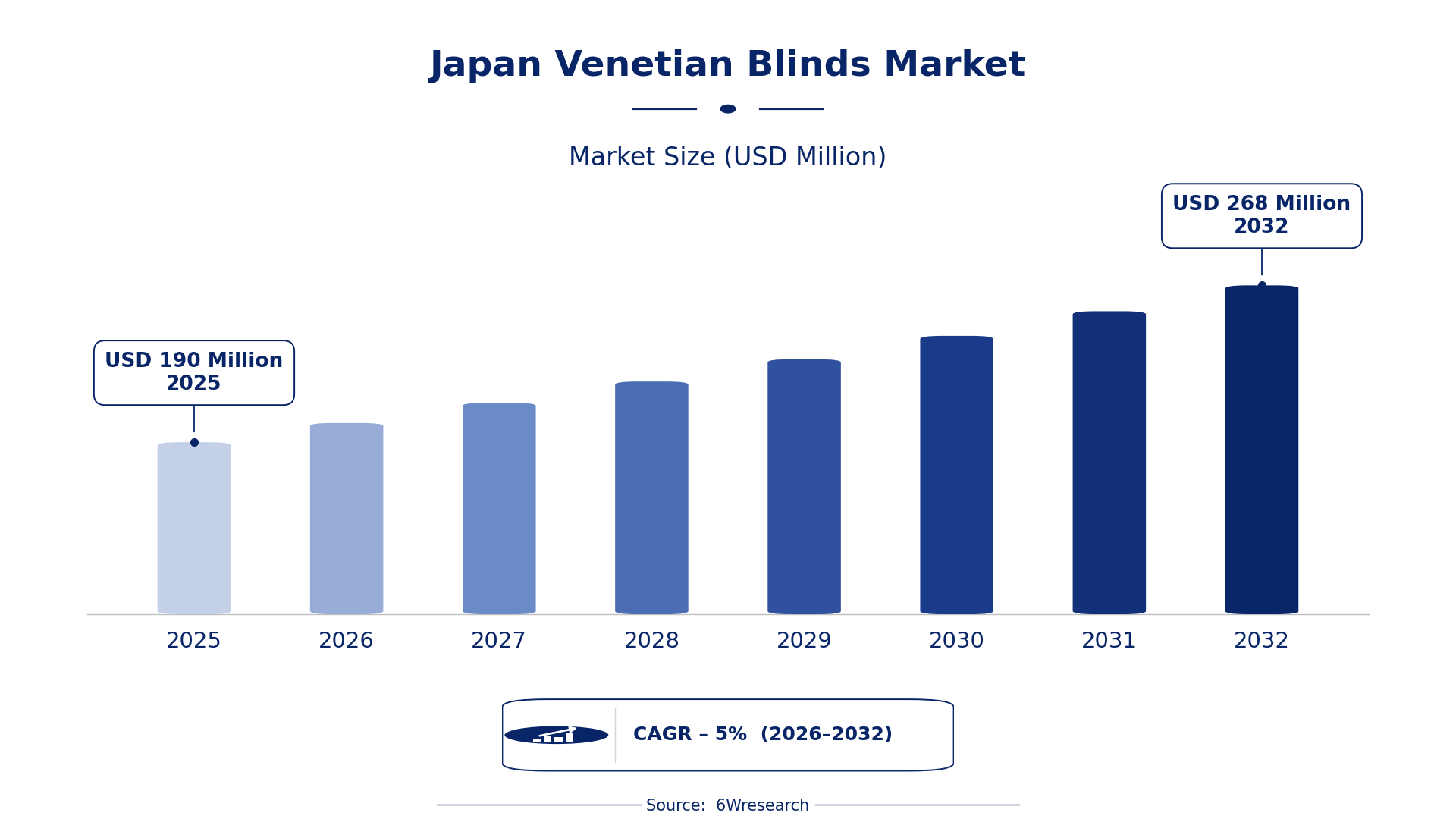
According to 6Wresearch internal database and industry insights, the Japan Venetian Blinds Market was valued at USD 190 Million in 2025 and is projected to reach USD 268 Million by 2032, growing at a CAGR of approximately 5% during 2026–2032.
Japan Venetian Blinds Market Highlights
| Report Metric | Details |
| Report Name | Japan Venetian Blinds Market (2026-2032) |
| Market Size 2025 | USD 190 Million |
| Market Size 2032 | USD 268 Million |
| Absolute Growth 2025–2032 | USD 78 Million |
| CAGR 2026–2032 | 5% |
| Peak Annual Growth | 5.9% in 2032 |
| Forecast Period | 2026–2032 |
| Historical Data | 2022–2025 |
| Base Year | 2025 |
| Leading Product Type, 2025 | Smart Motorized Blinds (40% share) |
| Leading Material Type, 2025 | PVC (48% share) |
| Leading Application Type, 2025 | Residential Windows (38% share) |
| Leading Distribution Channel, 2025 | Online Platforms (39% share) |
| Fastest-Growing Material Type | Fabric/Composite (7.1% CAGR) |
| Fastest-Growing Application Type | Smart Homes (7.0% CAGR) |
| Fastest-Growing Distribution Channel | Specialty Stores (6.5% CAGR) |
| Growing Sector | Residential Windows |
| Key End Users | Homeowners, commercial property managers, interior designers |
Japan Venetian Blinds Market Year-wise Growth Rate and Key Drivers (2022–2032)
This graph illustrates the annual growth rates of the market from 2022 to 2032, highlighting a steady upward trajectory and projected market expansion over the forecast period.
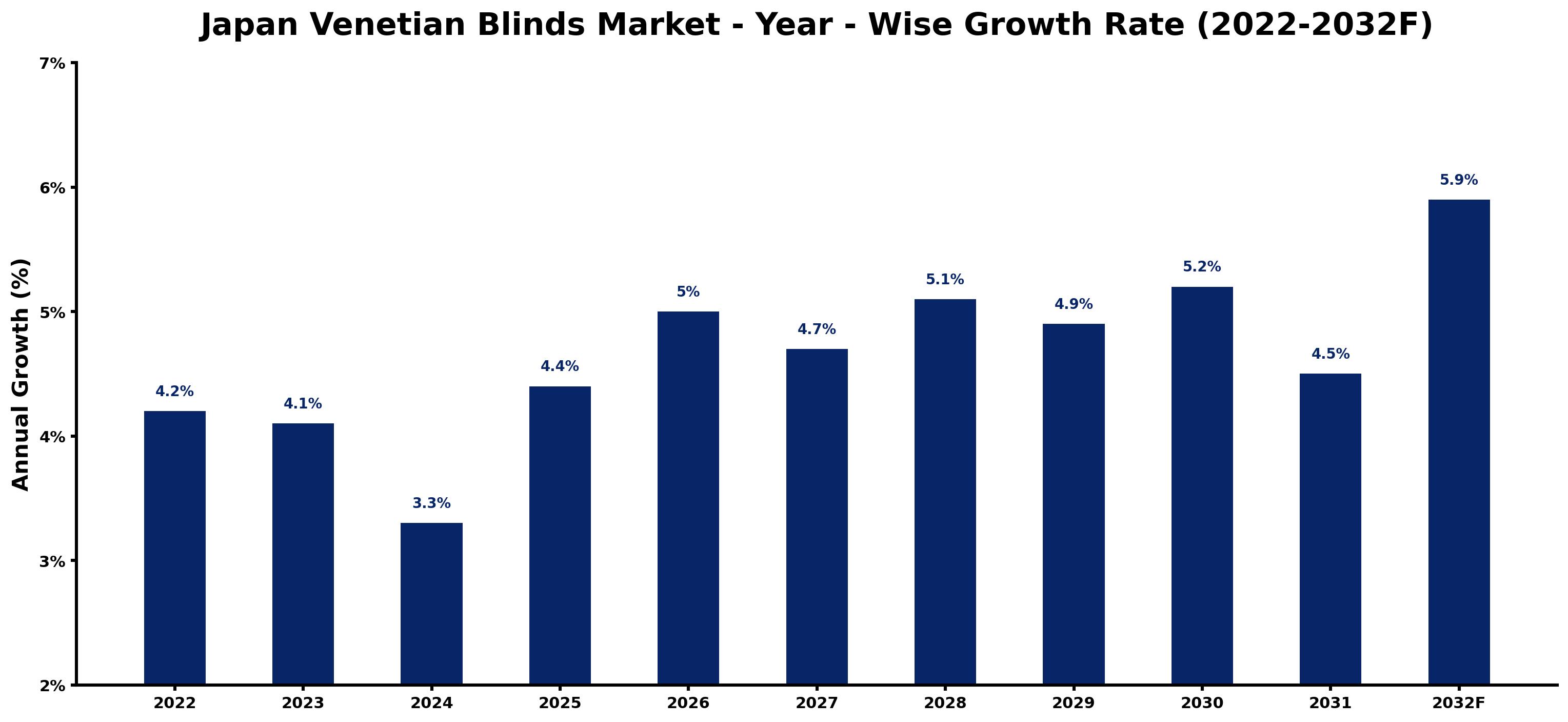
The table below sets out the estimated growth rate for each year and the main factor behind it.
| Year | Estimated Annual Growth (%) | Market Rationale |
| 2022 | 4.2 | The market showed steady growth, driven by increasing urbanisation and housing demand. |
| 2023 | 4.1 | Growth slowed as market adjustments occurred following heightened demand in the previous year. |
| 2024 | 3.3 | The market continued to grow, though at a slower pace as consumer preferences shifted. |
| 2025 | 4.4 | Demand accelerated as more consumers opted for energy-efficient window treatments. |
| 2026 | 5.0 | Growth is expected to pick up again, supported by rising interest in smart home technologies. |
| 2027 | 4.7 | A slight slowdown is projected as market saturation begins in some urban areas. |
| 2028 | 5.1 | Demand is expected to rebound with renewed interest in modernising homes and offices. |
| 2029 | 4.9 | Growth is projected to slow again as competition increases among suppliers in the market. |
| 2030 | 5.2 | The market is expected to experience a resurgence due to technological advancements in window treatments. |
| 2031 | 4.5 | Growth is projected to decelerate as economic factors influence consumer spending habits. |
| 2032 | 5.9 | Demand is expected to peak as smart motorised blinds become mainstream in urban households. |
Note: Market size estimations and growth projections presented in this report are based on 6Wresearch's proprietary forecasting methodology, utilizing the latest available industry data, government publications, and primary research inputs.
Japan Venetian Blinds Market Synopsis
Venetian blinds are versatile window coverings made from horizontal slats that allow users to control light and privacy effectively. They are primarily used in residential and commercial settings, with demand emerging from urban areas where space optimisation is vital. The Japan Venetian Blinds Market is expanding due to rising urbanisation, increasing adoption of smart technologies, and a focus on energy-efficient solutions, with the residential window segment accounting for 45% of the market in 2022 and online sales growing by 20% in 2023.
Market Dynamics Impact Analysis (2026–2032)
| Factor | Type | Impact | Primary Segment Affected |
| Urbanisation drives demand for space-efficient solutions. | Driver | High | Residential Windows |
| Smart home integration enhances user convenience. | Driver | High | Smart Motorized Blinds |
| Growing interest in energy-efficient window treatments creates opportunities. | Opportunity | High | Residential Windows |
| Increased online sales provide a wider reach for suppliers. | Opportunity | High | Online Platforms |
| Market saturation in urban areas may limit growth potential. | Restraint | Medium | Smart Motorized Blinds |
| High costs of premium materials can deter buyers. | Restraint | Medium | Wooden Venetian Blinds |
| Competition among suppliers can lead to price wars. | Challenge | High | Aluminum Blinds |
| Supply chain disruptions may affect product availability. | Challenge | High | PVC |
Evaluation of Drivers in Japan Venetian Blinds Market (2026–2032)
Below are the drivers that matter most for revenue growth, with supporting evidence.
| Drivers | Primary Segment Affected | Why It Matters (Evidence) |
| Urbanisation increases demand for Venetian blinds in residential spaces. | Residential Windows | In urban areas, the residential window segment accounted for 45% of the market. |
| Smart home technology adoption boosts demand for motorised blinds. | Smart Motorized Blinds | With a 15% adoption rate, smart blinds appeal to tech-savvy consumers. |
| Energy efficiency trends lead to higher demand for sustainable window treatments. | Residential Windows | The average lifespan of aluminum blinds is around 10 years, making them a durable choice. |
| Online sales channels expand market reach for Venetian blinds. | Online Platforms | Sales increased by 20% in 2023, reflecting a shift in consumer buying habits. |
| Durability of aluminum blinds appeals to commercial buyers. | Aluminum Blinds | Their average lifespan of 10 years makes them a cost-effective choice for businesses. |
The strongest pull on demand comes from urbanisation, with approximately 125 million people in Japan, leading to a need for space-efficient solutions. The residential window segment accounted for 45% of the Venetian blinds market in 2022, driven by the growing number of households. The average lifespan of aluminum blinds is around 10 years, making them a durable choice for consumers. Smart motorised blinds are gaining traction, with a 15% adoption rate in urban smart homes, reflecting the shift towards technology integration. The push for energy-efficient window treatments aligns with rising consumer awareness about sustainability, further stimulating market growth.
Evaluation of Restraints in Japan Venetian Blinds Market
Several factors work against faster growth; the main ones are summarised below.
| Market Restraint | Primary Segment Affected | Why It Matters (Evidence) |
| Market saturation in urban areas limits growth potential. | Smart Motorized Blinds | As urban areas become saturated, new customer acquisition becomes challenging. |
| High costs of premium materials deter some buyers. | Wooden Venetian Blinds | The average price of high-quality wooden blinds is approximately ¥30,000 per unit. |
| Supply chain issues can disrupt product availability. | PVC | Dependence on imports for materials can lead to delays in production. |
| Intense competition among suppliers may erode profit margins. | Aluminum Blinds | Price wars can significantly reduce profitability for manufacturers. |
| Changing consumer preferences may affect demand stability. | Horizontal Blinds | Shifts towards smart technologies can reduce interest in traditional options. |
Japan Venetian Blinds Market Challenges
Residential consumers face a lack of skilled installers for Venetian blinds, potentially delaying projects by up to three weeks. Suppliers struggle to source quality materials due to limited local production, resulting in a 15% cost increase for manufacturers. Compliance with JIS standards requires extensive quality checks that can extend up to two months, slowing product launches for suppliers. Technology adoption remains limited, with only 15% of homes featuring smart motorised blinds, restricting options for buyers seeking modern solutions.
Trends in the Japan Venetian Blinds Market
The trends below show where the Japan Venetian Blinds Market is heading.
- Shift towards Smart Motorised Blinds in Urban Areas: In Tokyo, the uptake of smart motorised blinds has reached 15%, mirroring the increasing demand for convenience and energy efficiency in window treatments.
- Rise of Online Sales Channels: Online sales of Venetian blinds grew by 20% in 2023, providing consumers with enhanced accessibility and convenience in their purchasing choices.
- Growing Demand for Energy-Efficient Solutions: Government programmes promoting energy-efficient window treatments are reshaping the market, encouraging more consumers to adopt these sustainable options.
- Focus on Aesthetic Appeal in Residential Applications: In Kyoto, the demand for wooden Venetian blinds is increasing, particularly in traditional homes, underscoring the significance of aesthetics in residential window treatments.
Investment Opportunities in the Japan Venetian Blinds Market
The opportunities below stand out in the Japan Venetian Blinds Market for new entrants and existing suppliers.
- Supply Smart Motorised Blinds: The market for smart motorised blinds is expanding, with a projected growth rate of 7.3%. Suppliers can target urban smart home developers to meet this demand.
- Invest in Online Sales Platforms: With online sales increasing by 20%, investing in e-commerce capabilities is essential. Retailers can reach a broader audience, particularly younger consumers in urban areas.
- Focus on Energy-Efficient Window Treatments: The government's promotion of energy-efficient solutions presents an opportunity for suppliers. Engaging with residential builders in urban areas can facilitate market entry.
- Supply High-Quality Wooden Venetian Blinds: The average price of high-quality wooden Venetian blinds is around ¥30,000. Suppliers can target traditional home builders in regions like Kyoto to meet this demand.
Government Initiatives in the Japan Venetian Blinds Market
The Economic Security Promotion Act of 2022 supports supply-chain resilience for critical products, including window coverings. This legislation mandates manufacturers to ensure material availability, promoting stability in production processes and supporting local suppliers. The Act also requires adherence to quality standards, ensuring products meet consumer expectations. This fosters a more reliable market environment for buyers seeking Venetian blinds, with an emphasis on quality and availability.
In 2023, the government initiated a programme to promote energy-efficient window treatments, overseen by the Ministry of the Environment. This initiative aims to encourage consumers to adopt sustainable products, providing funding for approved energy-efficient solutions. The programme is anticipated to benefit a broad range of consumers, strengthening the market for energy-efficient window coverings, with a focus on quality and sustainability.
Future Insight of the Japan Venetian Blinds Market
New energy-efficient window treatment programmes are expected to emerge by 2032, supported by government initiatives. The integration of smart technology will expand, improving user convenience and functionality. The shift towards sustainable materials will accelerate, backed by the Ministry of the Environment's support. By 2032, the market for wooden Venetian blinds is projected to grow substantially, reflecting a change in consumer preferences towards traditional aesthetics.
Market Segmentation Analysis
Japan Venetian Blinds Market report covers a detailed analysis of the following market segments:
By Product Type – Smart Motorized Blinds Lead and Record the Fastest Growth
According to Saurav Kr Singh, Senior Research Analyst at 6Wresearch, in 2025, Smart Motorized Blinds led the product type split with a 40% share. Smart motorized blinds command the largest share due to their compatibility with modern smart homes, appealing to consumers who prioritise convenience and automation. Their integration into daily life aligns with the increasing demand for technologically advanced window coverings in urban environments. Its lead should widen, with a projected CAGR of 7.3% during 2026–2032, the highest in this split. The growth of smart motorized blinds is propelled by the rising adoption of smart technologies in homes, currently at a 15% adoption rate. This trend will likely strengthen their market position as they become increasingly standard in new residential developments. Suppliers should invest in advancing the technology of smart motorized blinds to cater to the growing consumer demand for automation.
By Material Type – PVC Leads, Fabric/Composite Expected to Grow Fastest
The largest material type category in 2025 was PVC, at 48% of revenue. PVC holds the largest share as it is widely used in various Venetian blinds, appealing to cost-conscious buyers. Its versatility and affordability make it a preferred choice for many residential applications across Japan. Over 2026–2032, Fabric/Composite is expected to post the fastest growth, at a CAGR of 7.1%. The fabric/composite segment is growing due to a niche market demand for stylish and customisable options, although it remains minor. As consumer preferences shift towards aesthetics, this segment may see increased interest. Suppliers should consider diversifying their offerings to include fabric and composite materials to cater to changing consumer tastes.
By Application Type – Residential Windows Lead, Smart Homes Expected to Grow Fastest
Residential Windows held 38% of the Japan Venetian Blinds Market by application type in 2025. Residential windows hold the largest share as they serve as the primary application for Venetian blinds, particularly among homeowners seeking effective light management. This demand is especially pronounced in urban areas like Tokyo, where space optimisation is crucial. The quickest growth will come from Smart Homes, forecast to expand at a CAGR of 7.0% between 2026 and 2032. Smart homes are experiencing rapid growth due to increasing consumer interest in technology integration within living spaces. The adoption rate of smart motorized blinds, currently at 15%, indicates a strong potential for future demand. Suppliers should prioritise the development of smart Venetian blinds to meet the rising consumer interest in smart home technologies.
By Distribution Channel – Online Platforms Lead, Specialty Stores Expected to Grow Fastest
Online Platforms took 39% of distribution channel revenue in 2025, more than any other category. Online platforms lead the distribution channel as they provide a convenient purchasing option, particularly in urban areas where consumers seek efficiency. This channel has become vital for accessing a diverse range of Venetian blinds. Specialty Stores are set to record the highest CAGR in this split, 6.5% over 2026–2032. Specialty stores are gaining traction as they offer personalised service and expert advice, appealing to consumers who value tailored shopping experiences. This trend suggests a renewed interest in traditional retail for home improvement products. Suppliers should strengthen their online presence while also exploring partnerships with specialty stores to effectively engage different consumer segments.
Key Attractiveness of the Report
- 10 Years of Market Numbers
- Historical Data Starting from 2022 to 2025
- Base Year 2025
- Forecast Data until 2032
- Key Performance Indicators Impacting the Market
- Major Upcoming Developments and Projects
Key Highlights of the Report:
- Japan Venetian Blinds Market Outlook
- Market Size of Japan Venetian Blinds Market, 2025
- Forecast of Japan Venetian Blinds Market, 2032
- Historical Data and Forecast of Japan Venetian Blinds Revenues & Volume for the Period 2022-2032F
- Japan Venetian Blinds Market Trend Evolution
- Japan Venetian Blinds Market Drivers and Challenges
- Japan Venetian Blinds Price Trends
- Japan Venetian Blinds Porter's Five Forces
- Japan Venetian Blinds Industry Life Cycle
- Historical Data and Forecast of Japan Venetian Blinds Market Revenues & Volume By Product Type for the Period 2022-2032F
- Historical Data and Forecast of Japan Venetian Blinds Market Revenues & Volume By Horizontal Blinds for the Period 2022-2032F
- Historical Data and Forecast of Japan Venetian Blinds Market Revenues & Volume By Wooden Venetian Blinds for the Period 2022-2032F
- Historical Data and Forecast of Japan Venetian Blinds Market Revenues & Volume By Aluminum Blinds for the Period 2022-2032F
- Historical Data and Forecast of Japan Venetian Blinds Market Revenues & Volume By Smart Motorized Blinds for the Period 2022-2032F
- Historical Data and Forecast of Japan Venetian Blinds Market Revenues & Volume By Material Type for the Period 2022-2032F
- Historical Data and Forecast of Japan Venetian Blinds Market Revenues & Volume By PVC for the Period 2022-2032F
- Historical Data and Forecast of Japan Venetian Blinds Market Revenues & Volume By Hardwood for the Period 2022-2032F
- Historical Data and Forecast of Japan Venetian Blinds Market Revenues & Volume By Anodized Metal for the Period 2022-2032F
- Historical Data and Forecast of Japan Venetian Blinds Market Revenues & Volume By Fabric/Composite for the Period 2022-2032F
- Historical Data and Forecast of Japan Venetian Blinds Market Revenues & Volume By Application Type for the Period 2022-2032F
- Historical Data and Forecast of Japan Venetian Blinds Market Revenues & Volume By Residential Windows for the Period 2022-2032F
- Historical Data and Forecast of Japan Venetian Blinds Market Revenues & Volume By Office Interiors for the Period 2022-2032F
- Historical Data and Forecast of Japan Venetian Blinds Market Revenues & Volume By Commercial Buildings for the Period 2022-2032F
- Historical Data and Forecast of Japan Venetian Blinds Market Revenues & Volume By Smart Homes for the Period 2022-2032F
- Historical Data and Forecast of Japan Venetian Blinds Market Revenues & Volume By Distribution Channel for the Period 2022-2032F
- Historical Data and Forecast of Japan Venetian Blinds Market Revenues & Volume By Online Platforms for the Period 2022-2032F
- Historical Data and Forecast of Japan Venetian Blinds Market Revenues & Volume By Specialty Stores for the Period 2022-2032F
- Historical Data and Forecast of Japan Venetian Blinds Market Revenues & Volume By Direct Sales for the Period 2022-2032F
- Historical Data and Forecast of Japan Venetian Blinds Market Revenues & Volume By Industrial Suppliers for the Period 2022-2032F
- Japan Venetian Blinds Import Export Trade Statistics
- Market Opportunity Assessment By Product Type
- Market Opportunity Assessment By Material Type
- Market Opportunity Assessment By Application Type
- Market Opportunity Assessment By Distribution Channel
- Japan Venetian Blinds Top Companies Market Share
- Japan Venetian Blinds Competitive Benchmarking By Technical and Operational Parameters
- Japan Venetian Blinds Company Profiles
- Japan Venetian Blinds Key Strategic Recommendations
Market Covered
The following segment groups are covered in the report.
By Product Type
- Horizontal Blinds
- Wooden Venetian Blinds
- Aluminum Blinds
- Smart Motorized Blinds
By Material Type
- PVC
- Hardwood
- Anodized Metal
- Fabric/Composite
By Application Type
- Residential Windows
- Office Interiors
- Commercial Buildings
- Smart Homes
By Distribution Channel
- Online Platforms
- Specialty Stores
- Direct Sales
- Industrial Suppliers































