Japan Video Surveillance Systems Market Size & Growth Rate
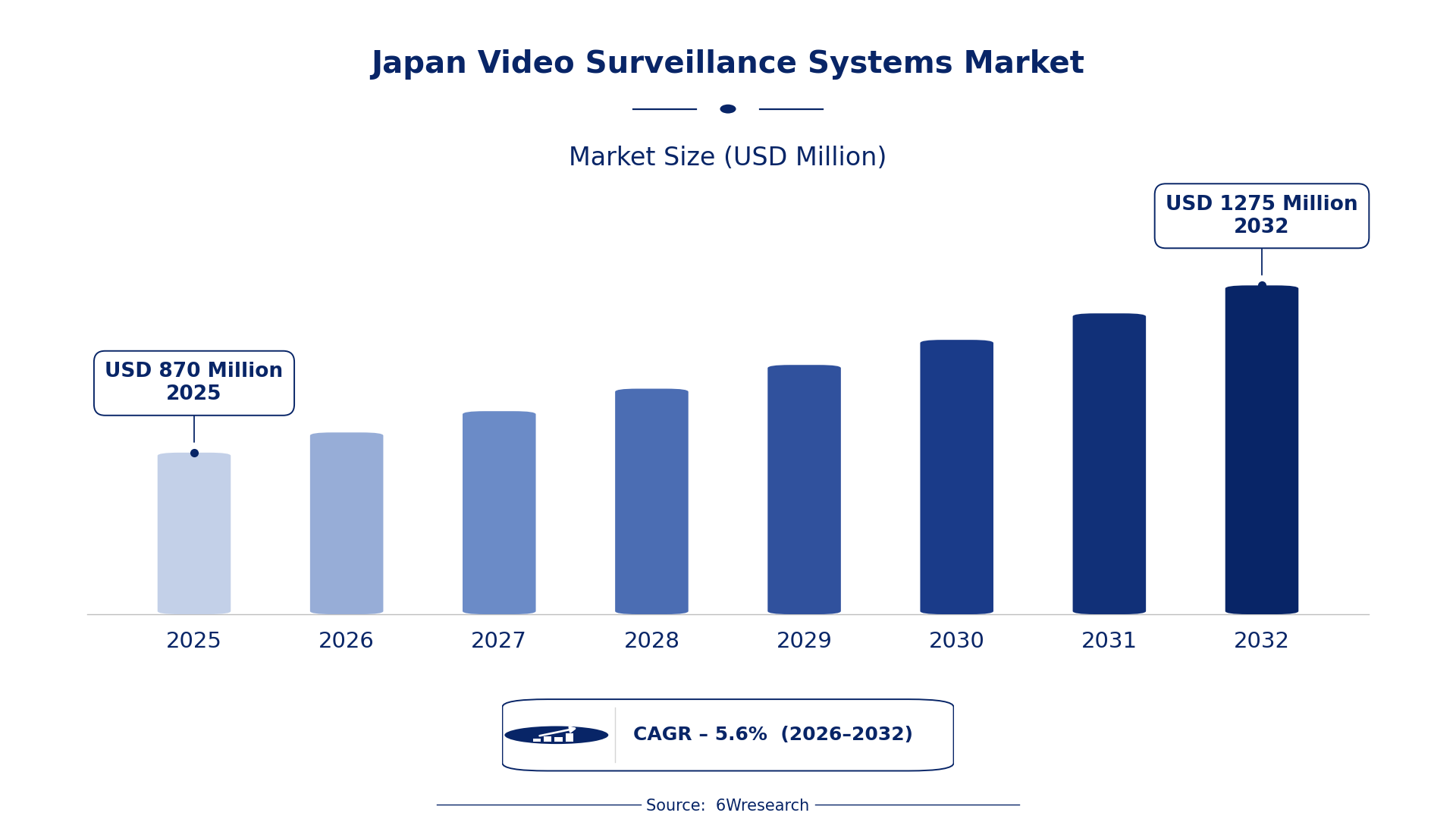
According to 6Wresearch internal database and industry insights, the Japan Video Surveillance Systems Market was valued at USD 870 Million in 2025 and is projected to reach USD 1,275 Million by 2032, growing at a CAGR of approximately 5.6% during 2026–2032.
Japan Video Surveillance Systems Market Highlights
| Report Metric | Details |
| Report Name | Japan Video Surveillance Systems Market (2026-2032) |
| Market Size 2025 | USD 870 Million |
| Market Size 2032 | USD 1,275 Million |
| Absolute Growth 2025–2032 | USD 405 Million |
| CAGR 2026–2032 | 5.6% |
| Peak Annual Growth | 6.4% in 2028 |
| Forecast Period | 2026–2032 |
| Historical Data | 2022–2025 |
| Base Year | 2025 |
| Leading Types, 2025 | Analog (62% share) |
| Leading Verticals, 2025 | Banking & Financial Institutions (32% share) |
| Leading Regions, 2025 | Hokkaido (39% share) |
| Fastest-Growing Types | IP and Video Surveillance Software (8.1% CAGR) |
| Fastest-Growing Verticals | Government & Transportation (7.7% CAGR) |
| Fastest-Growing Regions | Tohoku (7.2% CAGR) |
| Growing Sector | Residential |
| Key End Users | Banking, Retail, Government, Residential |
Japan Video Surveillance Systems Market Year-wise Growth Rate and Key Drivers (2022–2032)
This graph illustrates the annual growth rates of the market from 2022 to 2032, highlighting a steady upward trajectory and projected market expansion over the forecast period.
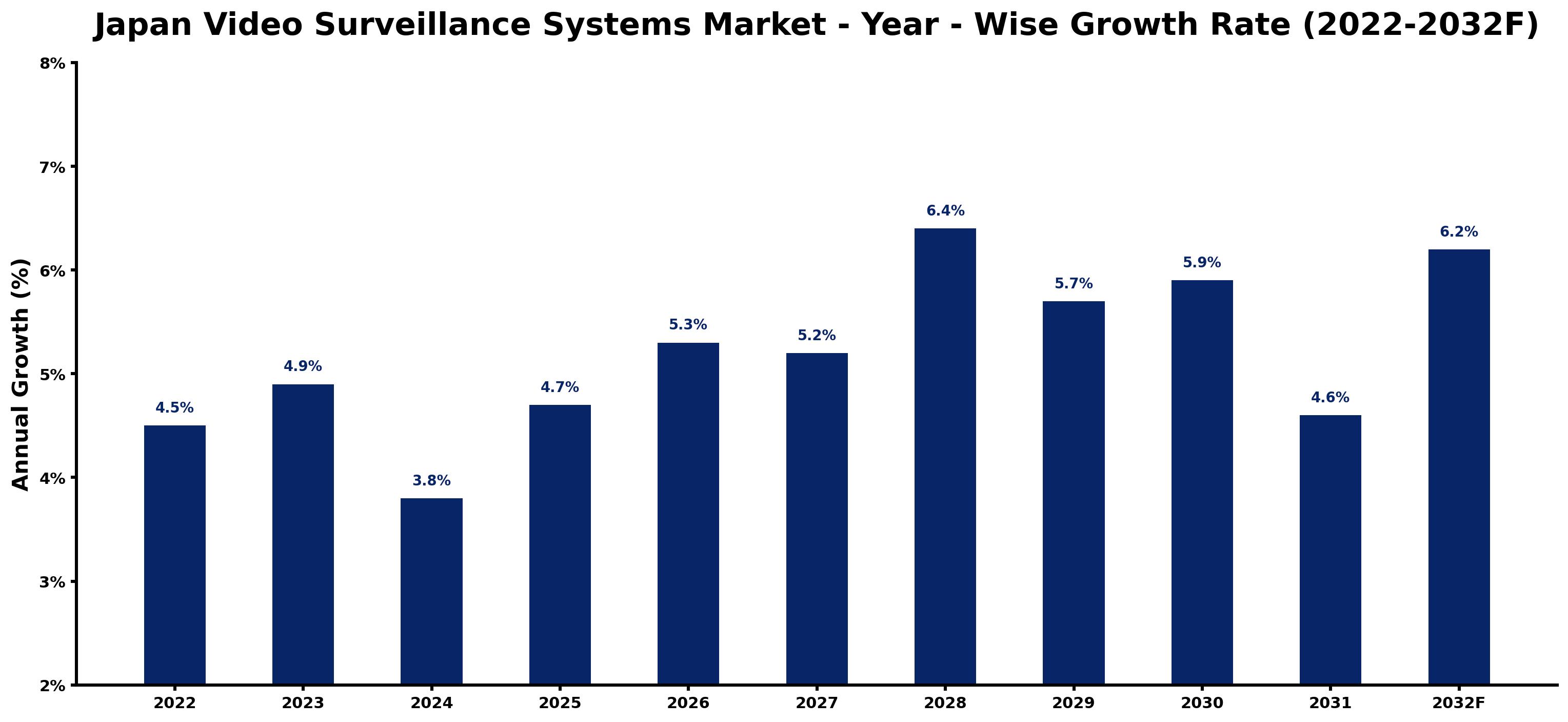
Below, each year's estimated growth is shown next to the factor that most influenced it.
| Year | Estimated Annual Growth (%) | Market Rationale |
| 2022 | 4.5 | The market recorded solid growth, driven by increased urbanisation and security needs. |
| 2023 | 4.9 | Demand rose due to heightened public safety initiatives and urban surveillance projects. |
| 2024 | 3.8 | Growth slowed as market saturation began to affect new installations and upgrades. |
| 2025 | 4.7 | A rebound occurred as investments in security systems increased across various sectors. |
| 2026 | 5.3 | Demand is expected to accelerate with the adoption of advanced technologies in video surveillance. |
| 2027 | 5.2 | Growth is projected to decelerate slightly as competition intensifies among system providers. |
| 2028 | 6.4 | The market is expected to peak, driven by infrastructure projects and urban safety enhancements. |
| 2029 | 5.7 | Growth is anticipated to moderate as the market approaches maturity and demand stabilises. |
| 2030 | 5.9 | A slight uptick in demand is projected as new technologies gain traction. |
| 2031 | 4.6 | Growth is expected to slow again as the market stabilises and competition remains fierce. |
| 2032 | 6.2 | Demand is expected to rise due to ongoing urban development and safety initiatives. |
Note: Market size estimations and growth projections presented in this report are based on 6Wresearch's proprietary forecasting methodology, utilizing the latest available industry data, government publications, and primary research inputs.
Japan Video Surveillance Systems Market Synopsis
Video surveillance systems encompass analog and IP-based technologies, integrated with software for security monitoring. The Japan Video Surveillance Systems Market is propelled by key sectors such as banking, retail, and public transportation, particularly in urban areas. Growth is supported by rising safety concerns, technological advancements, and government initiatives promoting surveillance in public spaces. For instance, the Tokyo Metropolitan Police's 2023 programme aims to improve public safety through advanced surveillance technology.
Market Dynamics Impact Analysis (2026–2032)
| Factor | Type | Impact | Primary Segment Affected |
| Increasing urbanisation and safety concerns are driving demand for video surveillance systems. | Driver | High | Banking & Financial Institutions |
| Technological advancements in IP-based systems are enhancing surveillance capabilities. | Driver | High | IP and Video Surveillance Software |
| The rising need for public safety measures presents opportunities for system providers. | Opportunity | High | Government & Transportation |
| The growing trend of smart cities creates demand for integrated surveillance solutions. | Opportunity | High | Kansai |
| Market saturation in urban areas may limit growth potential for new installations. | Restraint | Medium | Residential |
| High installation costs can deter small businesses from adopting advanced systems. | Restraint | Medium | Commercial Offices |
| Talent shortages in tech development may hinder innovation in surveillance solutions. | Challenge | High | IP and Video Surveillance Software |
| Intense competition among providers can lead to price wars and reduced margins. | Challenge | Medium | Banking & Financial Institutions |
Evaluation of Drivers in Japan Video Surveillance Systems Market (2026–2032)
Demand rests on the following drivers, each shown with the segment it touches most.
| Drivers | Primary Segment Affected | Why It Matters (Evidence) |
| Increased urbanisation leads to higher demand for surveillance systems in cities. | Banking & Financial Institutions | The Kanto region, which accounts for over 40% of demand, drives installations for security. |
| Technological advancements in IP systems improve video analytics capabilities. | IP and Video Surveillance Software | The average installed base in commercial buildings is around 150 units, boosting sales. |
| Public safety initiatives promote the adoption of surveillance technologies. | Government & Transportation | The Tokyo Metropolitan Police's 2023 programme aims to improve public safety. |
| Rising concerns over security and fraud push investments in video systems. | Retail | Retailers are investing in video analytics to enhance customer experience. |
| The growing residential market is expanding as homeowners seek security solutions. | Residential | This sector is experiencing a 20% increase in system installations in urban areas. |
What keeps demand rising is the increasing urbanisation in Japan, particularly in densely populated areas. The average installed base of surveillance cameras in commercial buildings is around 150 units, driving demand for advanced security solutions. The residential sector sees a 20% increase in installations, reflecting growing security concerns among homeowners. These factors create a vibrant market for video surveillance systems in Japan.
Evaluation of Restraints in Japan Video Surveillance Systems Market
Several factors work against faster growth; the main ones are summarised below.
| Market Restraint | Primary Segment Affected | Why It Matters (Evidence) |
| Market saturation in urban areas limits new installation opportunities. | Residential | As urban areas become saturated, the potential for new installations declines. |
| High installation costs deter small businesses from adopting advanced systems. | Commercial Offices | The average cost of installing a system is around 1 million JPY, which can be prohibitive. |
| Regulatory compliance complicates installation processes for providers. | Government & Transportation | Producers must navigate complex regulations overseen by the Ministry of Internal Affairs. |
| Limited awareness of advanced surveillance technologies affects adoption rates. | Educational Institutions | Many institutions are slow to adopt due to lack of information on benefits. |
| Dependence on technology can lead to vulnerabilities in system security. | IP and Video Surveillance Software | As systems become more connected, they may be susceptible to cyber threats. |
Japan Video Surveillance Systems Market Challenges
A slow adoption of advanced technology hampers the effectiveness of video surveillance systems, as many users still rely on outdated analog models, leading to higher maintenance costs for suppliers. Intense competition among local manufacturers drives prices down, which can squeeze profit margins for producers and result in reduced investment in innovation. Compliance with regulations from the Ministry of Internal Affairs and Communications necessitates adherence to ISO/IEC 27001, increasing costs for buyers who must implement necessary security measures. Rising demand from urban buyers results in longer installation timelines, with medium-sized businesses facing an average installation cost of 1 million JPY, straining their budgets.
Trends in the Japan Video Surveillance Systems Market
Four trends stand out in the Japan Video Surveillance Systems Market.
- Transition to IP-Based Surveillance Systems: Japan is increasingly moving from analog to IP-based surveillance systems, driven by the need for advanced analytics. The Kanto region is leading this change, with a notable rise in IP installations, reflecting a preference for remote access capabilities.
- Integration of AI in Surveillance Technology: The adoption of AI in video surveillance is gaining traction, particularly in urban areas. In 2023, the Japan Security Systems Association reported a rise in AI integration, improving the efficiency of monitoring systems across various sectors.
- Demand for Smart City Solutions: The Kansai region is prioritising smart city initiatives, integrating video surveillance for urban management. The government's smart city programme aims to increase public surveillance systems by 15% by 2025, showcasing a commitment to urban safety.
- Focus on Data Security Standards: There is a heightened emphasis on data security standards, particularly ISO/IEC 27001. This standard is becoming increasingly relevant as organisations seek to protect surveillance data, influencing purchasing decisions across sectors.
Investment Opportunities in the Japan Video Surveillance Systems Market
Where to invest in the Japan Video Surveillance Systems Market: the main openings are set out below.
- Supply of Advanced IP-Based Surveillance Systems: The shift towards IP-based systems presents an opportunity for suppliers to meet increasing demand. With the Kanto region leading in installations, suppliers can partner with local businesses to provide effective security offerings.
- Investment in Smart City Projects: The government is pushing for smart city initiatives, creating a demand for integrated surveillance solutions. With a target to increase public systems by 15% by 2025, providers can engage with municipalities to supply necessary technologies.
- Expansion of Surveillance in Retail Sector: Retailers are increasingly investing in video analytics to improve customer experience, presenting a lucrative opportunity. With a growing focus on loss prevention, suppliers can offer tailored solutions to meet this demand.
- Rising Demand for Residential Security Solutions: The residential sector is experiencing a notable increase in installations, indicating a gap in the market. Suppliers can target urban homeowners seeking effective security by offering affordable surveillance systems.
Government Initiatives in the Japan Video Surveillance Systems Market
The Act on the Rational Use of Energy, established in 1979, mandates that large energy users improve energy efficiency. This law complements existing regulations by ensuring that video surveillance systems are energy-efficient and sustainable, which is increasingly important in urban settings. The Industrial Safety and Health Act also establishes requirements for workplace safety, ensuring that video surveillance systems comply with relevant standards.
In 2023, the Tokyo Metropolitan Government allocated 500 million JPY for public safety through surveillance technology. The Ministry of Internal Affairs and Communications oversees these initiatives, ensuring compliance and effectiveness in public safety measures.
Future Insight of the Japan Video Surveillance Systems Market
The government’s smart city program will integrate video surveillance for urban management, enhancing safety measures by 2025. By 2032, advancements in AI will allow suppliers to offer more effective analytics, improving operational efficiency. The Tokyo Metropolitan Police's initiative will drive further investments in safety technologies, increasing demand for advanced systems. With a projected 15% increase in public surveillance systems, buyers will benefit from improved security and monitoring capabilities across urban areas.
Market Segmentation Analysis
Japan Video Surveillance Systems Market report covers a detailed analysis of the following market segments:
By Types – Analog Leads, IP and Video Surveillance Software Expected to Grow Fastest
According to Ravi Bhandari, Research Head at 6Wresearch, with 62% of types revenue in 2025, Analog was the largest category. Analog systems hold a substantial share in the market as they are widely used for their cost-effectiveness in traditional setups. Many users prefer these systems for basic surveillance needs without the complexities associated with modern technologies. IP and Video Surveillance Software is set to record the highest CAGR in this split, 8.1% over 2026–2032. The surge in IP and video surveillance software adoption is propelled by the increasing necessity for remote access and sophisticated analytics. This trend is highlighted by the growing installations that facilitate real-time monitoring and data processing. Suppliers should prioritise the development of IP and software solutions to cater to the rising demand for advanced surveillance capabilities.
By Verticals – Banking & Financial Institutions Lead, Government & Transportation Expected to Grow Fastest
Banking & Financial Institutions took 32% of verticals revenue in 2025, more than any other category. The banking and financial institutions sector holds the largest share due to the essential role of surveillance systems in security and fraud prevention. Facilities within this sector implement rigorous surveillance protocols to protect assets and ensure a safe environment for clients and employees. Over 2026–2032, Government & Transportation is expected to post the fastest growth, at a CAGR of 7.7%. The government and transportation sectors are witnessing rapid growth, propelled by a heightened emphasis on public safety and traffic monitoring. Recent initiatives, such as enhanced surveillance programs, are contributing to the swift adoption of these systems in urban areas. Suppliers should focus on developing tailored solutions that address the unique needs of the government and transportation sectors to capitalise on this growth.
By Regions – Hokkaido Leads, Tohoku Expected to Grow Fastest
In 2025, Hokkaido led the regions split with a 39% share. Hokkaido leads the regional market, primarily due to its established installations that cater to tourism and public safety needs. Despite its smaller demand, the existing surveillance systems maintain a consistent requirement for upgrades and maintenance. Tohoku is projected to grow fastest, at a CAGR of 7.2% during 2026–2032. Tohoku is experiencing the fastest growth, driven by increasing urbanisation and a rising demand for surveillance systems. The region's focus on improving safety measures is fostering this upward trend in installations. Suppliers should consider strategic investments in Tohoku to leverage the growing demand for surveillance systems as urbanisation continues.
Key Attractiveness of the Report
- 10 Years of Market Numbers
- Historical Data Starting from 2022 to 2025
- Base Year 2025
- Forecast Data until 2032
- Key Performance Indicators Impacting the Market
- Major Upcoming Developments and Projects
Key Highlights of the Report:
• Japan Video Surveillance Market Overview
• Japan Video Surveillance Market Outlook
• Japan Video Surveillance Market Forecast
• Japan Video Surveillance Market Size and Japan Video Surveillance Market Forecast Revenues until 2032
• Historical data of Japan Video Surveillance Market for the Period 2022-2032
• Market Size & Forecast of Japan Video Surveillance Market until 2032
• Historical data of Japan Video Surveillance Market Revenue for the Period 2022-2032
• Market Size & Forecast of Japan Video Surveillance Market revenue until 2032
• Historical data of Japan Analog Video Surveillance Market for the Period 2022-2032
• Market Size & Forecast of Japan Analog Video Surveillance Market until 2032
• Historical data of Japan IP Video Surveillance Market for the Period 2022-2032
• Market Size & Forecast of Japan IP Video Surveillance Market until 2032
• Historical data of Japan Video Surveillance Vertical Market for the Period 2022-2032
• Market Size & Forecast of Japan Video Surveillance Vertical Market until 2032
• Historical data of Japan Video Surveillance Regional Market for the Period 2022-2032
• Market Size & Forecast of Japan Video Surveillance Regional Market until 2032
• Market Drivers and Restraints
• Japan Video Surveillance Market Trends
• Industry Life Cycle and Value Chain Analysis
• Japan Video Surveillance Market share by Players
• Japan Video Surveillance Market Overview on Competitive Landscape
• Company Profiles
• Strategic Recommendations
• Key Strategic Pointers
Market Covered
Coverage by segment is as follows.
By Types
- Analog
- IP and Video Surveillance Software
By Verticals
- Banking & Financial Institutions
- Government & Transportation
- Retail
- Commercial Offices
- Industrial & Manufacturing
- Residential
- Hospitality & Healthcare
- Educational Institutions
By Regions
- Hokkaido
- Tohoku
- Kanto
- Chubu
- Kansai
- Chugoku
- Shikoku
- Kyushu & Okinawa






































