Japan Virtual Reality In Retail Market Size & Growth Rate
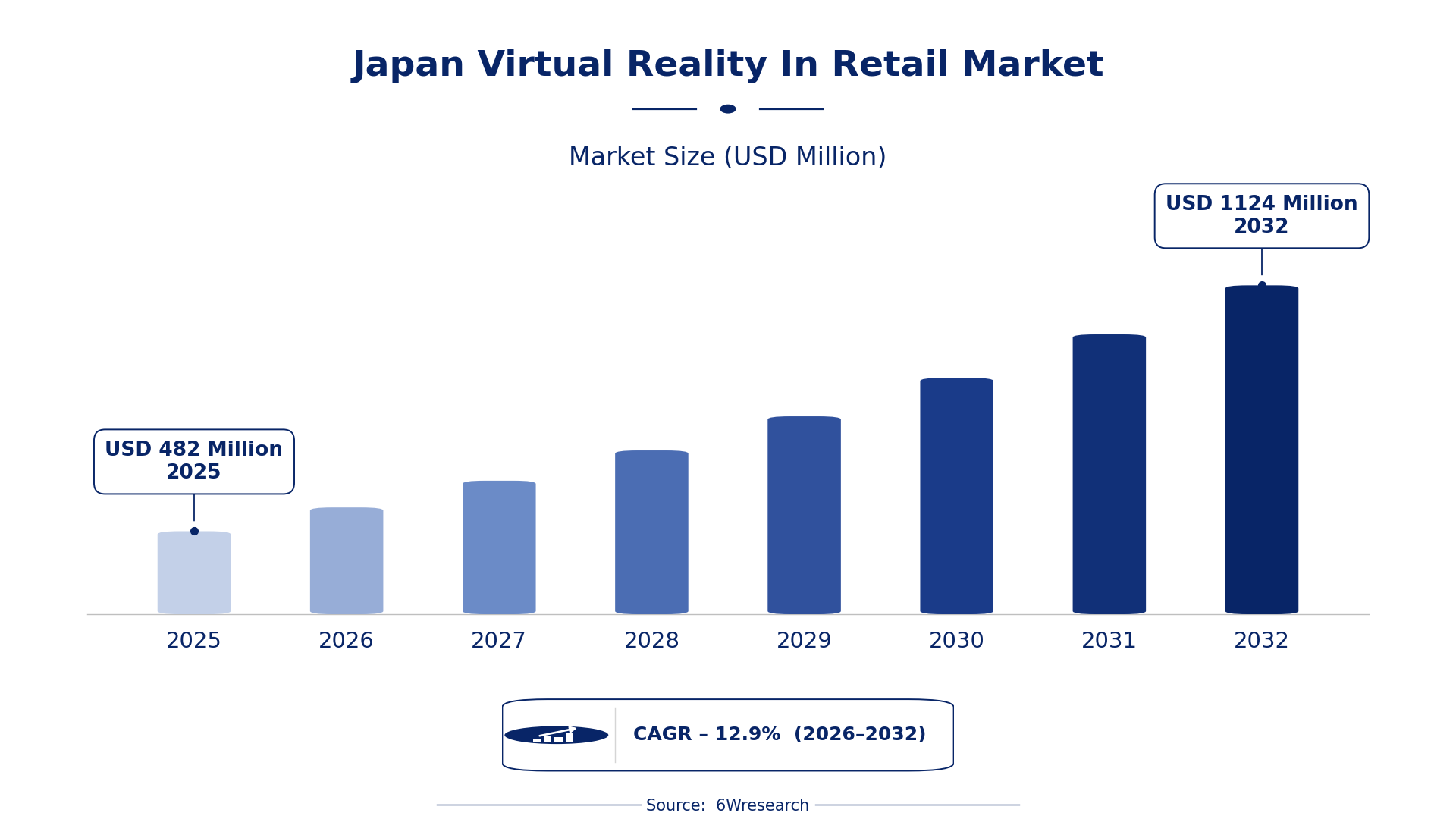
According to 6Wresearch internal database and industry insights, the Japan Virtual Reality In Retail Market was valued at USD 482 Million in 2025 and is projected to reach USD 1,124 Million by 2032, growing at a CAGR of approximately 12.9% during 2026–2032.
Japan Virtual Reality In Retail Market Highlights
| Report Metric | Details |
| Report Name | Japan Virtual Reality In Retail Market (2026-2032) |
| Market Size 2025 | USD 482 Million |
| Market Size 2032 | USD 1,124 Million |
| Absolute Growth 2025–2032 | USD 642 Million |
| CAGR 2026–2032 | 12.9% |
| Peak Annual Growth | 19.2% in 2026 |
| Forecast Period | 2026–2032 |
| Historical Data | 2022–2025 |
| Base Year | 2025 |
| Leading Component, 2025 | Hardware (48% share) |
| Leading Device, 2025 | Head Mounted Devices (44% share) |
| Leading Application, 2025 | Information Systems (53% share) |
| Leading Vertical, 2025 | Food and Beverage (46% share) |
| Fastest-Growing Component | Software (17.6% CAGR) |
| Fastest-Growing Device | Gesture Tracking Device (16.0% CAGR) |
| Fastest-Growing Application | Advertising & Marketing (17.1% CAGR) |
| Fastest-Growing Vertical | Home Products (16.1% CAGR) |
| Growing Sector | Clothing |
| Key End Users | Retail chains, clothing manufacturers, consumer electronics retailers, advertising agencies |
Japan Virtual Reality In Retail Market Year-wise Growth Rate and Key Drivers (2022–2032)
This graph illustrates the annual growth rates of the market from 2022 to 2032, highlighting a steady upward trajectory and projected market expansion over the forecast period.
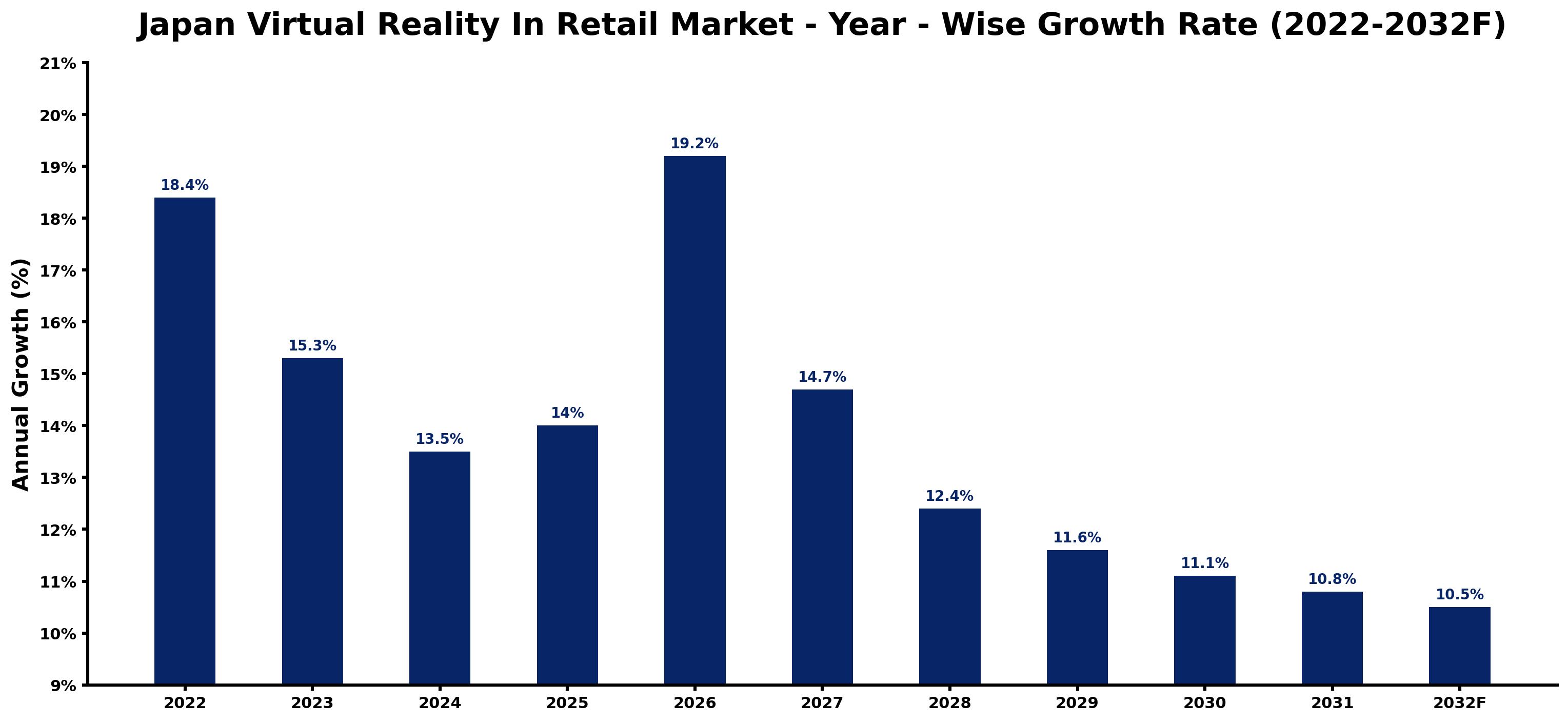
The following figures match every annual growth estimate with the main market development of that year, giving the reasoning behind each rise or slowdown.
| Year | Estimated Annual Growth (%) | Market Rationale |
| 2022 | 18.4 | The market experienced strong growth due to increased interest in immersive retail experiences. |
| 2023 | 15.3 | Growth slowed as retailers adjusted to the initial wave of VR technology adoption. |
| 2024 | 13.5 | The market continued to grow, albeit at a slower pace, as more retailers explored VR options. |
| 2025 | 14.0 | Growth accelerated again as retailers began to see tangible benefits from VR implementations. |
| 2026 | 19.2 | The market is expected to peak with investments in VR technologies and applications. |
| 2027 | 14.7 | Growth will slow as the market begins to stabilise after the peak in 2026. |
| 2028 | 12.4 | The market is projected to continue growing, but at a more moderate rate as competition intensifies. |
| 2029 | 11.6 | Growth is expected to slow further as saturation in certain segments begins to occur. |
| 2030 | 11.1 | The market will maintain steady growth as VR technology becomes more mainstream in retail. |
| 2031 | 10.8 | Growth is projected to continue slowing as the market matures and competition increases. |
| 2032 | 10.5 | The market is expected to stabilise as VR becomes a standard practice in retail. |
Note: Market size estimations and growth projections presented in this report are based on 6Wresearch's proprietary forecasting methodology, utilizing the latest available industry data, government publications, and primary research inputs.
Japan Virtual Reality In Retail Market Synopsis
Virtual Reality in retail refers to the use of immersive technology to create enhanced shopping experiences through virtual try-ons, interactive displays, and marketing campaigns. Over 50% of retailers are exploring VR solutions, indicating a shift towards innovative retail strategies, especially in Tokyo, which is leading in VR retail innovations.
Market Dynamics Impact Analysis (2026–2032)
| Factor | Type | Impact | Primary Segment Affected |
| Growing consumer engagement through immersive experiences | Driver | High | Advertising & Marketing |
| Increased investments in VR technology by retailers | Driver | High | Hardware |
| Expansion of VR training programs for retail staff | Opportunity | Medium | Services |
| Rising demand for virtual fitting solutions in clothing | Opportunity | High | Try-on Solutions |
| High initial investment costs for VR technology | Restraint | High | Hardware |
| Limited awareness of VR benefits among smaller retailers | Restraint | Medium | Services |
| Competition from alternative immersive technologies | Challenge | High | Head Mounted Devices |
| Supply chain challenges affecting VR hardware availability | Challenge | Medium | Hardware |
Evaluation of Drivers in Japan Virtual Reality In Retail Market (2026–2032)
The following drivers explain most of the expected growth.
| Drivers | Primary Segment Affected | Why It Matters (Evidence) |
| Increased consumer spending on immersive experiences | Advertising & Marketing | The average consumer spends 20% more when using VR in retail, driving demand for engaging marketing campaigns. |
| Growing investments in VR technology by major retailers | Hardware | With over 200 VR startups focusing on retail, investment in hardware is rising to enhance customer experiences. |
| Growing adoption of VR training programs for retail staff | Services | 30% of stores are implementing VR training, improving staff capabilities and service quality. |
| Rising demand for virtual fitting solutions in clothing | Try-on Solutions | The Clothing vertical accounts for 40% of VR applications, reflecting strong interest in virtual fitting. |
| Expansion of VR advertising campaigns | Advertising & Marketing | VR advertising campaigns have increased by 30% in the last year, indicating growing market potential. |
Purchasing is picking up as retailers invest heavily in VR technology to improve customer experiences. The average consumer in Japan spends 20% more when using VR in retail, driving demand for engaging marketing solutions. Over 50% of retailers are exploring VR options, particularly in Tokyo, which leads in VR retail innovations. The integration of VR technology into new retail spaces is creating more opportunities for immersive experiences.
Evaluation of Restraints in Japan Virtual Reality In Retail Market
The key brakes on demand, and where they bite hardest, are shown below.
| Market Restraint | Primary Segment Affected | Why It Matters (Evidence) |
| High initial investment costs for VR technology | Hardware | The average cost of implementing VR solutions can deter smaller retailers from adopting the technology. |
| Limited awareness of VR benefits among smaller retailers | Services | Many small retailers are unaware of the advantages of VR, resulting in slower adoption rates. |
| Supply chain challenges affecting VR hardware availability | Head Mounted Devices | Supply chain disruptions can lead to delays in hardware availability, impacting retailer implementation timelines. |
| Competition from alternative immersive technologies | Head Mounted Devices | Emerging technologies may divert attention from VR, affecting its market growth. |
| Regulatory hurdles in implementing VR solutions | Software | Compliance with standards like JIS Z 9920 can complicate the adoption of VR technologies. |
Japan Virtual Reality In Retail Market Challenges
A major obstacle is the rapid evolution of VR technology, which requires producers to invest in constant updates and training. This challenge exists due to the swift changes in consumer preferences in Japan, potentially delaying product launches for retailers. Importers struggle with sourcing compatible hardware, as over 50% of retailers are exploring VR solutions, leading to increased lead times that can raise operational costs by 15%. Buyers face high implementation costs, as the average consumer spends 20% more when using VR, which may deter adoption among price-sensitive segments. Competition grows fierce as major retail chains report a 15% increase in customer engagement through VR, pressuring smaller players to invest heavily to stay relevant.
Trends in the Japan Virtual Reality In Retail Market
Below are the shifts with the largest effect on the Japan Virtual Reality In Retail Market.
- Tokyo Game Show 2023 Showcasing VR Retail Solutions: The Tokyo Game Show 2023 prominently featured VR retail solutions, showcasing the technology's potential. This event attracted thousands of attendees, reflecting the growing interest in immersive retail experiences.
- Retailers Increasingly Implementing VR Training Programs: Retail staff training programs are increasingly adopting VR, with 30% of stores implementing these solutions. This trend improves staff capabilities and enhances customer service quality.
- Rise of Virtual Fitting Solutions in Clothing: Virtual fitting solutions are becoming more popular in the clothing sector, accounting for 40% of VR applications. This shift allows customers to try on clothes virtually, improving the shopping experience.
- Growth of VR Advertising Campaigns: VR advertising campaigns have surged by 30% in the last year, indicating a shift towards immersive marketing strategies. This trend is expected to reshape how retailers engage with consumers.
Investment Opportunities in the Japan Virtual Reality In Retail Market
The following opportunities in the Japan Virtual Reality In Retail Market pair current demand with a clear way in.
- Retailers Seeking Engaging Marketing Solutions: Retailers are increasingly looking for immersive marketing solutions, with the VR advertising market growing by 30%. Investing in VR technology can improve customer engagement.
- Collaborations with VR Startups: With over 200 VR startups in Japan, forming partnerships can facilitate access to innovative solutions. Collaborating with these startups can help retailers effectively integrate VR technology.
- Gap in VR Training Solutions for Retail Staff: The increasing implementation of VR training programs indicates a gap in the market. Investing in training solutions can cater to the 30% of stores adopting VR for staff development.
- Expansion of VR in New Retail Spaces: The integration of VR technology in 25% of new retail spaces presents opportunities for suppliers. Focusing on this segment can lead to significant market penetration.
Government Initiatives in the Japan Virtual Reality In Retail Market
The Food Sanitation Act amendment requires food businesses to comply with a positive list system for synthetic resins used in food utensils, containers, and packaging, which impacts producers in the retail sector. Compliance with this regulation is essential for businesses to ensure product safety and quality, affecting their operational processes. The amendment was fully applied in June 2021, ensuring that food safety standards are met.
In 2023, the Ministry of Economy, Trade and Industry (METI) allocated USD 5 million for VR technology research. This funding supports the development of VR solutions in retail, promoting innovation and improving the competitive edge of Japanese retailers.
Future Insight of the Japan Virtual Reality In Retail Market
Investment in VR technology will increase, driven by the Japanese government's allocation of 5 million USD for research in 2023. This funding will create a surge in demand for VR solutions, contributing to the market's projected growth towards 1.5 billion USD by 2025. As VR training programs for retail staff expand, suppliers must adjust their offerings to meet evolving retailer needs. The integration of VR technology into 25% of new retail spaces will redefine shopping experiences, establishing immersive technology as a standard expectation for consumers.
Market Segmentation Analysis
Japan Virtual Reality In Retail Market report covers a detailed analysis of the following market segments:
By Component – Hardware Leads, Software Expected to Grow Fastest
According to Summon Dutta, Assistant Manager at 6Wresearch, Hardware accounted for 48% of the market by component in 2025. Hardware dominates the market as it is vital for creating immersive VR experiences in retail. The increasing sales of VR headsets, which reached 1 million units in 2022, demonstrate the strong demand for this essential component. The quickest growth will come from Software, forecast to expand at a CAGR of 17.6% between 2026 and 2032. Software is rapidly growing as it is critical for developing immersive environments that elevate customer engagement. The 30% rise in VR advertising campaigns over the last year underscores the escalating need for sophisticated software solutions. Suppliers should focus on enhancing software capabilities to capitalise on the growing demand in the market.
By Device – Head Mounted Devices Lead, Gesture Tracking Device Expected to Grow Fastest
Head Mounted Devices took 44% of device revenue in 2025, more than any other category. Head Mounted Devices lead the sector as they are the primary instruments for delivering immersive experiences in retail. Their widespread adoption among major retailers has significantly boosted customer engagement, solidifying their market position. Gesture Tracking Device is projected to grow fastest, at a CAGR of 16.0% during 2026–2032. Gesture Tracking Devices are experiencing swift growth due to their application in interactive displays that enhance customer interaction. The increasing focus on innovative retail strategies is likely to further accelerate their adoption. Buyers should explore diverse device options to enrich customer engagement and enhance the shopping experience.
By Application – Information Systems Lead, Advertising & Marketing Expected to Grow Fastest
Information Systems held 53% of the Japan Virtual Reality In Retail Market by application in 2025. Information Systems lead the market as they play a supportive role in data management, essential for retailers implementing VR solutions. Their integration into over 50% of retailers exploring VR solutions highlights their importance in the retail sector. Over 2026–2032, Advertising & Marketing is expected to post the fastest growth, at a CAGR of 17.1%. Advertising & Marketing is growing quickly as it serves as a key application for engaging customers through immersive campaigns. The notable rise in VR advertising campaigns by 30% indicates a strong shift towards experiential marketing strategies. Suppliers must prioritise advertising and marketing applications to meet the increasing demand for immersive customer engagement.
By Vertical – Food and Beverage Leads, Home Products Expected to Grow Fastest
The largest vertical category in 2025 was Food and Beverage, at 46% of revenue. Food and Beverage holds the largest share in VR retail applications, even with limited use, as it represents a substantial segment of the market. The integration of VR technology in this vertical, although modest, indicates its potential to enhance customer experiences. Home Products are set to record the highest CAGR in this split, 16.1% over 2026–2032. Home Products are quickly gaining popularity due to their occasional use for product showcasing in an engaging manner. The shift towards experiential marketing across various retail sectors is expected to drive further growth in this vertical. Retailers should evaluate VR applications in home products to unlock new marketing avenues and improve customer interaction.
Key Attractiveness of the Report
- 10 Years of Market Numbers
- Historical Data Starting from 2022 to 2025
- Base Year 2025
- Forecast Data until 2032
- Key Performance Indicators Impacting the Market
- Major Upcoming Developments and Projects
Key Highlights of the Report:
- Japan Virtual Reality In Retail Market Outlook
- Market Size of Japan Virtual Reality In Retail Market, 2025
- Forecast of Japan Virtual Reality In Retail Market, 2032
- Historical Data and Forecast of Japan Virtual Reality In Retail Revenues & Volume for the Period 2022-2032
- Japan Virtual Reality In Retail Market Trend Evolution
- Japan Virtual Reality In Retail Market Drivers and Challenges
- Japan Virtual Reality In Retail Price Trends
- Japan Virtual Reality In Retail Porter's Five Forces
- Japan Virtual Reality In Retail Industry Life Cycle
- Historical Data and Forecast of Japan Virtual Reality In Retail Market Revenues & Volume By Component for the Period 2022-2032
- Historical Data and Forecast of Japan Virtual Reality In Retail Market Revenues & Volume By Hardware for the Period 2022-2032
- Historical Data and Forecast of Japan Virtual Reality In Retail Market Revenues & Volume By Software for the Period 2022-2032
- Historical Data and Forecast of Japan Virtual Reality In Retail Market Revenues & Volume By Services for the Period 2022-2032
- Historical Data and Forecast of Japan Virtual Reality In Retail Market Revenues & Volume By Device for the Period 2022-2032
- Historical Data and Forecast of Japan Virtual Reality In Retail Market Revenues & Volume By Head Mounted Devices for the Period 2022-2032
- Historical Data and Forecast of Japan Virtual Reality In Retail Market Revenues & Volume By Gesture Tracking Device for the Period 2022-2032
- Historical Data and Forecast of Japan Virtual Reality In Retail Market Revenues & Volume By Projectors & Display Wall for the Period 2022-2032
- Historical Data and Forecast of Japan Virtual Reality In Retail Market Revenues & Volume By Application for the Period 2022-2032
- Historical Data and Forecast of Japan Virtual Reality In Retail Market Revenues & Volume By Information Systems for the Period 2022-2032
- Historical Data and Forecast of Japan Virtual Reality In Retail Market Revenues & Volume By Advertising & Marketing for the Period 2022-2032
- Historical Data and Forecast of Japan Virtual Reality In Retail Market Revenues & Volume By Try-on Solutions for the Period 2022-2032
- Historical Data and Forecast of Japan Virtual Reality In Retail Market Revenues & Volume By Planning & Designing for the Period 2022-2032
- Historical Data and Forecast of Japan Virtual Reality In Retail Market Revenues & Volume By Vertical for the Period 2022-2032
- Historical Data and Forecast of Japan Virtual Reality In Retail Market Revenues & Volume By Food and Beverage for the Period 2022-2032
- Historical Data and Forecast of Japan Virtual Reality In Retail Market Revenues & Volume By Home Products for the Period 2022-2032
- Historical Data and Forecast of Japan Virtual Reality In Retail Market Revenues & Volume By Clothing for the Period 2022-2032
- Historical Data and Forecast of Japan Virtual Reality In Retail Market Revenues & Volume By Consumer Electronics for the Period 2022-2032
- Japan Virtual Reality In Retail Import Export Trade Statistics
- Market Opportunity Assessment By Component
- Market Opportunity Assessment By Device
- Market Opportunity Assessment By Application
- Market Opportunity Assessment By Vertical
- Japan Virtual Reality In Retail Top Companies Market Share
- Japan Virtual Reality In Retail Competitive Benchmarking By Technical and Operational Parameters
- Japan Virtual Reality In Retail Company Profiles
- Japan Virtual Reality In Retail Key Strategic Recommendations
Market Covered
The report covers the following segments.
By Component
- Hardware
- Software
- Services
By Device
- Head Mounted Devices
- Gesture Tracking Device
- Projectors & Display Wall
By Application
- Information Systems
- Advertising & Marketing
- Try-on Solutions
- Planning & Designing
By Vertical
- Food and Beverage
- Home Products
- Clothing
- Consumer Electronics































