Japan Virtual Reality (VR) in Education Market Size & Growth Rate
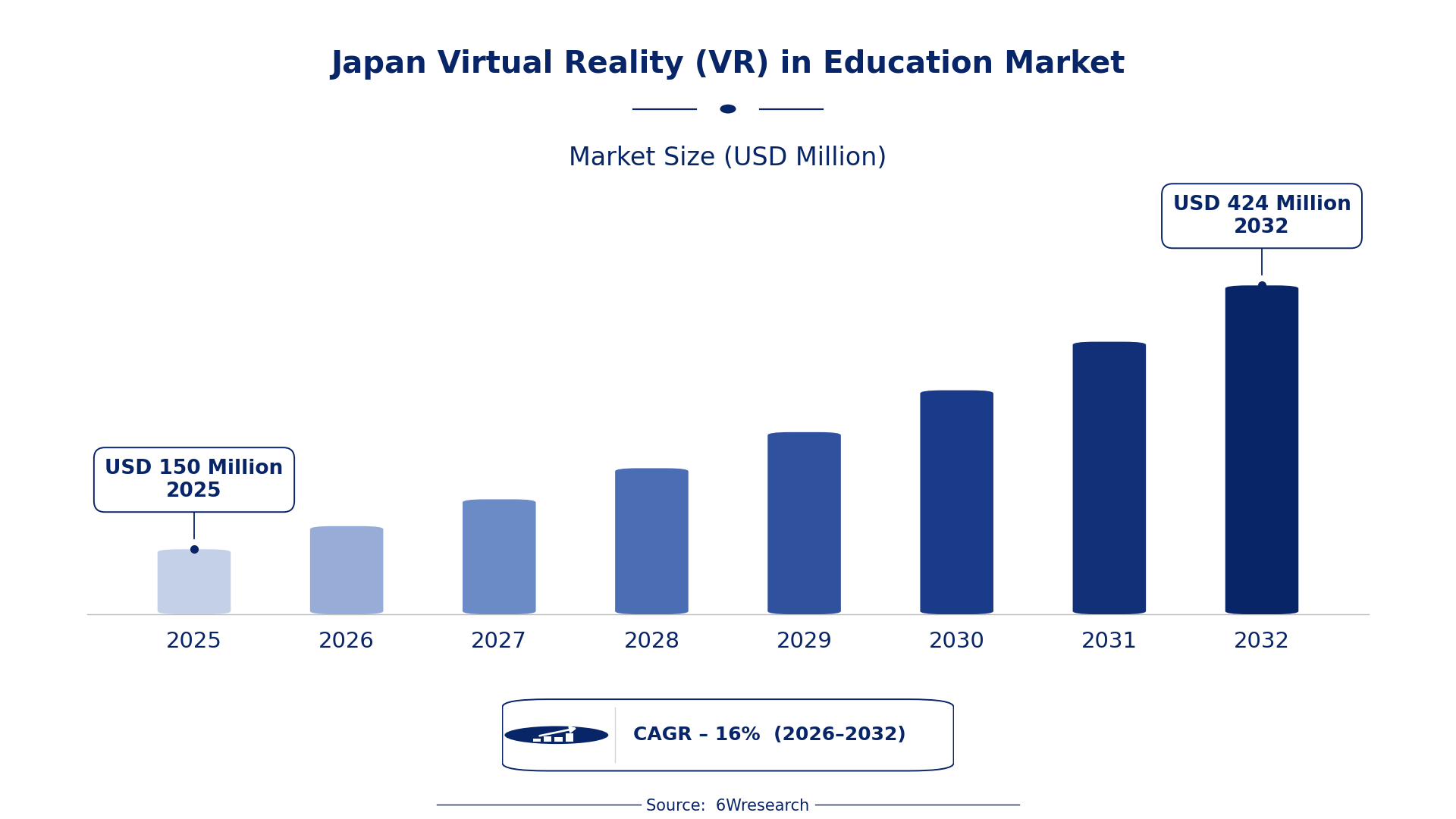
According to 6Wresearch internal database and industry insights, the Japan Virtual Reality (VR) in Education Market was valued at USD 150 Million in 2025 and is projected to reach USD 424 Million by 2032, growing at a CAGR of approximately 16% during 2026–2032.
Japan Virtual Reality (VR) in Education Market Highlights
| Report Metric | Details |
| Report Name | Japan Virtual Reality (VR) in Education Market (2026-2032) |
| Market Size 2025 | USD 150 Million |
| Market Size 2032 | USD 424 Million |
| Absolute Growth 2025–2032 | USD 274 Million |
| CAGR 2026–2032 | 16% |
| Peak Annual Growth | 21.5% in 2026 |
| Forecast Period | 2026–2032 |
| Historical Data | 2022–2025 |
| Base Year | 2025 |
| Leading Device, 2025 | Smartboard (40% share) |
| Leading Application, 2025 | Schools (44% share) |
| Leading Virtual Reality, 2025 | Window on World (47% share) |
| Fastest-Growing Device | Projector (21.0% CAGR) |
| Fastest-Growing Application | Institutes (20.2% CAGR) |
| Fastest-Growing Virtual Reality | Immersive System (19.8% CAGR) |
| Growing Sector | Education |
| Key End Users | Schools, Institutes, Educational organizations, Training centres |
Japan Virtual Reality (VR) in Education Market Year-wise Growth Rate and Key Drivers (2022–2032)
This graph illustrates the annual growth rates of the market from 2022 to 2032, highlighting a steady upward trajectory and projected market expansion over the forecast period.
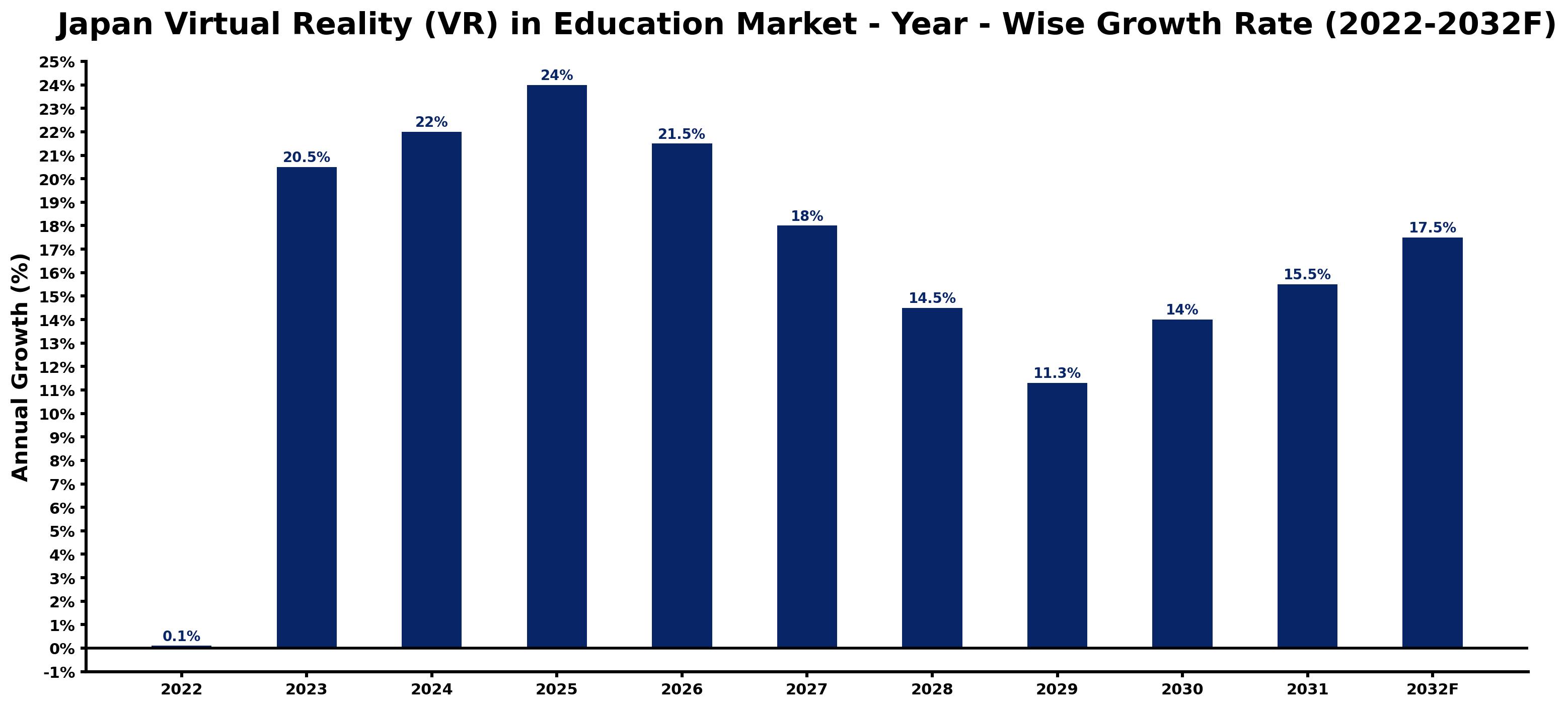
The table below sets out the estimated growth rate for each year and the main factor behind it.
| Year | Estimated Annual Growth (%) | Market Rationale |
| 2022 | 0.1 | The market experienced initial adoption of VR technologies, with limited integration in classrooms. |
| 2023 | 20.5 | Growth accelerated due to heightened awareness and acceptance of VR among educational institutions. |
| 2024 | 22.0 | Demand rose as more schools incorporated VR into their teaching methods and training. |
| 2025 | 24.0 | The peak growth year saw widespread implementation of VR in classrooms across Japan. |
| 2026 | 21.5 | Growth is expected to slow slightly as the market stabilises after rapid expansion. |
| 2027 | 18.0 | A further slowdown is projected as the initial surge in adoption begins to normalise. |
| 2028 | 14.5 | The market will continue to grow, albeit at a reduced pace, as saturation approaches. |
| 2029 | 11.3 | Growth is expected to slow further as many institutions have already adopted VR solutions. |
| 2030 | 14.0 | An uptick in demand is projected as new applications and technologies emerge. |
| 2031 | 15.5 | The market will see a steady rise as educational institutions upgrade their VR systems. |
| 2032 | 17.5 | Continued investment in VR technology is expected to drive further growth. |
Note: Market size estimations and growth projections presented in this report are based on 6Wresearch's proprietary forecasting methodology, utilizing the latest available industry data, government publications, and primary research inputs.
Japan Virtual Reality (VR) in Education Market Synopsis
Virtual Reality (VR) in Education encompasses immersive technologies that enhance learning experiences through simulations and interactive environments. In Japan, more than 1,000 schools have embraced VR technology, spurred by initiatives from the Ministry of Education, Culture, Sports, Science and Technology. The market is growing due to rising investments in educational technology, with 50% of institutions reporting the use of VR tools and a substantial installed base of VR headsets. The commitment to incorporating VR in classrooms is underscored by government funding and support for the development of customised VR content.
Market Dynamics Impact Analysis (2026–2032)
| Factor | Type | Impact | Primary Segment Affected |
| Increased investment in educational technology | Driver | High | Schools |
| Growing demand for immersive learning experiences | Driver | High | Institutes |
| Rising need for advanced training methods | Opportunity | High | Institutes |
| Expansion of VR programs in urban areas | Opportunity | High | Schools |
| High initial costs of VR equipment | Restraint | Medium | Schools |
| Limited content availability for specific subjects | Restraint | Medium | Institutes |
| Resistance to change from traditional teaching methods | Challenge | High | Schools |
| Shortage of trained personnel to implement VR effectively | Challenge | High | Institutes |
Evaluation of Drivers in Japan Virtual Reality (VR) in Education Market (2026–2032)
The following drivers explain most of the expected growth.
| Drivers | Primary Segment Affected | Why It Matters (Evidence) |
| Investment in VR technology by educational institutions | Schools | In 2023, over 1,000 schools adopted VR, improving interactive learning experiences. |
| Increased focus on remote learning solutions | Institutes | The population of approximately 3 million higher education students drives demand for VR training. |
| Local government initiatives promoting VR in education | Schools | The Tokyo Metropolitan Government launched a VR education program in 2023, boosting adoption. |
| Growing awareness of VR benefits among educators | Institutes | 50% of educational institutions reported using VR tools, indicating rising acceptance. |
| Development of VR content tailored for educational purposes | Schools | The government allocated ¥1 billion for VR educational content development in 2023. |
The strongest pull on demand comes from significant investments in VR technology by educational institutions, with over 1,000 schools adopting VR in 2023. The growing focus on remote learning solutions is evident, as approximately 3 million higher education students drive demand for advanced training methods. Awareness of VR benefits has increased, with 50% of educational institutions reporting usage of VR tools.
Evaluation of Restraints in Japan Virtual Reality (VR) in Education Market
Below are the constraints most often cited by buyers and suppliers, with the segment each affects.
| Market Restraint | Primary Segment Affected | Why It Matters (Evidence) |
| High initial costs of VR equipment | Schools | Financial barriers limit schools' ability to invest in VR technology. |
| Limited content availability for specific subjects | Institutes | Institutes struggle to find suitable VR content for niche educational areas. |
| Resistance to change from traditional teaching methods | Schools | Some educators prefer conventional methods, hindering VR adoption in classrooms. |
| Shortage of trained personnel to implement VR effectively | Institutes | Institutes lack staff with the expertise to integrate VR into their programs. |
| Concerns over the effectiveness of VR in learning outcomes | Schools | Some educators question whether VR truly improves educational experiences. |
Japan Virtual Reality (VR) in Education Market Challenges
Adoption of VR technology in education faces a major obstacle due to inadequate technological infrastructure in many institutions. This issue arises because many schools lack the necessary hardware and software, delaying the integration process for educators. Suppliers encounter inconsistent supply chains for VR headsets and software, which can lead to shortages and disrupt educational programs. Buyers, particularly educational institutions, face high costs for VR content development; the ¥1 billion allocated by the government in 2023 does not meet the needs of all schools, limiting their ability to implement effective learning solutions.
Trends in the Japan Virtual Reality (VR) in Education Market
Several trends are reshaping the Japan Virtual Reality (VR) in Education Market; the most important are set out below.
- Launch of the Tokyo Metropolitan Government's VR Education Initiative: In 2023, the Tokyo Metropolitan Government launched a VR education initiative, resulting in a 50% usage rate of VR tools in schools, highlighting the increasing integration of immersive technology.
- Shift from Traditional to Interactive Learning: Educational institutions are transitioning towards interactive learning experiences through VR technologies. More than 1,000 schools in Japan have adopted VR, indicating a shift in teaching methodologies and engagement strategies.
- Emergence of Tailored VR Educational Content: The creation of customised VR content is gaining momentum, with the government allocating ¥1 billion for this purpose in 2023. This investment aims to enhance the quality and availability of VR resources for educators.
- Increased Focus on Remote Learning Solutions: As remote learning becomes more widespread, educational institutions are increasingly embracing VR technologies. The population of around 3 million higher education students is driving this trend, underscoring the need for advanced learning solutions.
Investment Opportunities in the Japan Virtual Reality (VR) in Education Market
The openings below show where demand in the Japan Virtual Reality (VR) in Education Market is visible and how suppliers can enter.
- Educational Institutions Seeking Advanced Training Methods: With 50% of institutions reporting the use of VR tools, there is a clear demand for advanced training solutions. Investing in customised VR content can effectively address this need.
- Urban Schools Adopting VR Programs: In urban areas like Tokyo and Osaka, schools are progressively adopting VR programmes. This trend presents an opportunity for suppliers to provide VR equipment and content tailored to urban educational requirements.
- Growing Demand for High-Quality VR Equipment: The installed base of 200,000 VR headsets in educational institutions indicates a burgeoning market. Suppliers can concentrate on delivering high-quality VR hardware to satisfy this demand.
- Development of Interactive Learning Platforms: With the rising interest in immersive learning, there is a gap for interactive platforms. Suppliers can invest in creating engaging VR applications for educational purposes.
Government Initiatives in the Japan Virtual Reality (VR) in Education Market
The Act against Unjustifiable Premiums and Misleading Representations ensures that educational VR products are accurately represented, safeguarding buyers by mandating transparency in product claims and marketing strategies. This law helps maintain trust in the educational technology market, ensuring that institutions receive quality products.
The Industrial Standardization Act governs the standards for VR technology in education, ensuring quality and safety. The National Institute of Multimedia Education supports these initiatives, promoting effective use of VR in learning environments and ensuring compliance with established standards.
Future Insight of the Japan Virtual Reality (VR) in Education Market
Investment in VR educational content is set to increase, with government initiatives and private funding creating new opportunities. By 2032, the number of educational institutions using VR tools is expected to reach over 1,500, expanding the market for suppliers. The introduction of new standards like JIS X 0129 will facilitate smoother integration of VR in classrooms. With the installed base of VR headsets in education reaching 200,000 units in 2023, demand for immersive learning experiences will continue to rise, benefiting both buyers and suppliers.
Market Segmentation Analysis
Japan Virtual Reality (VR) in Education Market report covers a detailed analysis of the following market segments:
By Device – Smartboard Leads, Projector Expected to Grow Fastest
According to Summon Dutta, Assistant Manager at 6Wresearch, the largest device category in 2025 was Smartboard, at 40% of revenue. Smartboards command the largest share as they are widely implemented for interactive lessons across numerous educational institutions in Japan. Their integration with VR technology enhances classroom engagement, making them a preferred option for educators. Projector is projected to grow fastest, at a CAGR of 21.0% during 2026–2032. Projectors are rapidly gaining popularity as they enable effective VR presentations, which are increasingly sought after in educational settings. The recent launch of a VR education programme by local authorities has further propelled their adoption. Suppliers should prioritise advancements in projector technology to cater to the growing demand in educational environments.
By Application – Schools Lead, Institutes Expected to Grow Fastest
Schools held 44% of the Japan Virtual Reality (VR) in Education Market by application in 2025. Schools lead the market as they represent the primary users of VR for educational purposes, with half of the institutions reporting VR tool utilisation. The backing from the Ministry of Education, Culture, Sports, Science and Technology plays a crucial role in this trend. Over 2026–2032, Institutes are expected to post the fastest growth, at a CAGR of 20.2%. Institutes are experiencing swift growth due to their focus on advanced training methodologies that incorporate VR technology. The government's substantial funding for VR educational content development is expected to further boost this sector. Buyers should explore VR solutions specifically designed for advanced training to take advantage of this upward trend.
By Virtual Reality – Window on World Leads, Immersive System Expected to Grow Fastest
Window on World took 47% of virtual reality revenue in 2025, more than any other category. Window on World is the leading application, providing virtual field trips that are highly appreciated in educational settings. This offering aligns perfectly with the immersive learning goals of many institutions, making it a sought-after choice. The quickest growth will come from Immersive System, forecast to expand at a CAGR of 19.8% between 2026 and 2032. Immersive Systems are growing at the fastest rate as they significantly enhance experiential learning, an essential component of contemporary education. The increasing integration of VR in classrooms is likely to strengthen the position of Window on World. Suppliers need to focus on developing immersive technologies to maintain a competitive edge in this expanding market.
Key Attractiveness of the Report
- 10 Years of Market Numbers
- Historical Data Starting from 2022 to 2025
- Base Year 2025
- Forecast Data until 2032
- Key Performance Indicators Impacting the Market
- Major Upcoming Developments and Projects
Key Highlights of the Report:
- Japan Virtual Reality (VR) in Education Market Outlook
- Market Size of Japan Virtual Reality (VR) in Education Market, 2025
- Forecast of Japan Virtual Reality (VR) in Education Market, 2032
- Historical Data and Forecast of Japan Virtual Reality (VR) in Education Revenues & Volume for the Period 2022-2032
- Japan Virtual Reality (VR) in Education Market Trend Evolution
- Japan Virtual Reality (VR) in Education Market Drivers and Challenges
- Japan Virtual Reality (VR) in Education Price Trends
- Japan Virtual Reality (VR) in Education Porter's Five Forces
- Japan Virtual Reality (VR) in Education Industry Life Cycle
- Historical Data and Forecast of Japan Virtual Reality (VR) in Education Market Revenues & Volume By Device for the Period 2022-2032
- Historical Data and Forecast of Japan Virtual Reality (VR) in Education Market Revenues & Volume By Smartboard for the Period 2022-2032
- Historical Data and Forecast of Japan Virtual Reality (VR) in Education Market Revenues & Volume By Projector for the Period 2022-2032
- Historical Data and Forecast of Japan Virtual Reality (VR) in Education Market Revenues & Volume By Laptop for the Period 2022-2032
- Historical Data and Forecast of Japan Virtual Reality (VR) in Education Market Revenues & Volume By Mobile Phones for the Period 2022-2032
- Historical Data and Forecast of Japan Virtual Reality (VR) in Education Market Revenues & Volume By Application for the Period 2022-2032
- Historical Data and Forecast of Japan Virtual Reality (VR) in Education Market Revenues & Volume By Schools for the Period 2022-2032
- Historical Data and Forecast of Japan Virtual Reality (VR) in Education Market Revenues & Volume By Institutes for the Period 2022-2032
- Historical Data and Forecast of Japan Virtual Reality (VR) in Education Market Revenues & Volume By Business organizations for the Period 2022-2032
- Historical Data and Forecast of Japan Virtual Reality (VR) in Education Market Revenues & Volume By Others for the Period 2022-2032
- Historical Data and Forecast of Japan Virtual Reality (VR) in Education Market Revenues & Volume By Virtual Reality for the Period 2022-2032
- Historical Data and Forecast of Japan Virtual Reality (VR) in Education Market Revenues & Volume By Window on World for the Period 2022-2032
- Historical Data and Forecast of Japan Virtual Reality (VR) in Education Market Revenues & Volume By Immersive System for the Period 2022-2032
- Historical Data and Forecast of Japan Virtual Reality (VR) in Education Market Revenues & Volume By Telepresence for the Period 2022-2032
- Historical Data and Forecast of Japan Virtual Reality (VR) in Education Market Revenues & Volume By Mixed Reality for the Period 2022-2032
- Japan Virtual Reality (VR) in Education Import Export Trade Statistics
- Market Opportunity Assessment By Device
- Market Opportunity Assessment By Application
- Market Opportunity Assessment By Virtual Reality
- Japan Virtual Reality (VR) in Education Top Companies Market Share
- Japan Virtual Reality (VR) in Education Competitive Benchmarking By Technical and Operational Parameters
- Japan Virtual Reality (VR) in Education Company Profiles
- Japan Virtual Reality (VR) in Education Key Strategic Recommendations
Market Covered
This report examines the market across the segments below.
By Device
- Smartboard
- Projector
- Laptop
- Mobile Phones
By Application
- Schools
- Institutes
- Business organizations
- Others
By Virtual Reality
- Window on World
- Immersive System
- Telepresence
- Mixed Reality































