Japan Warehouse Conveying Equipment Market Size & Growth Rate
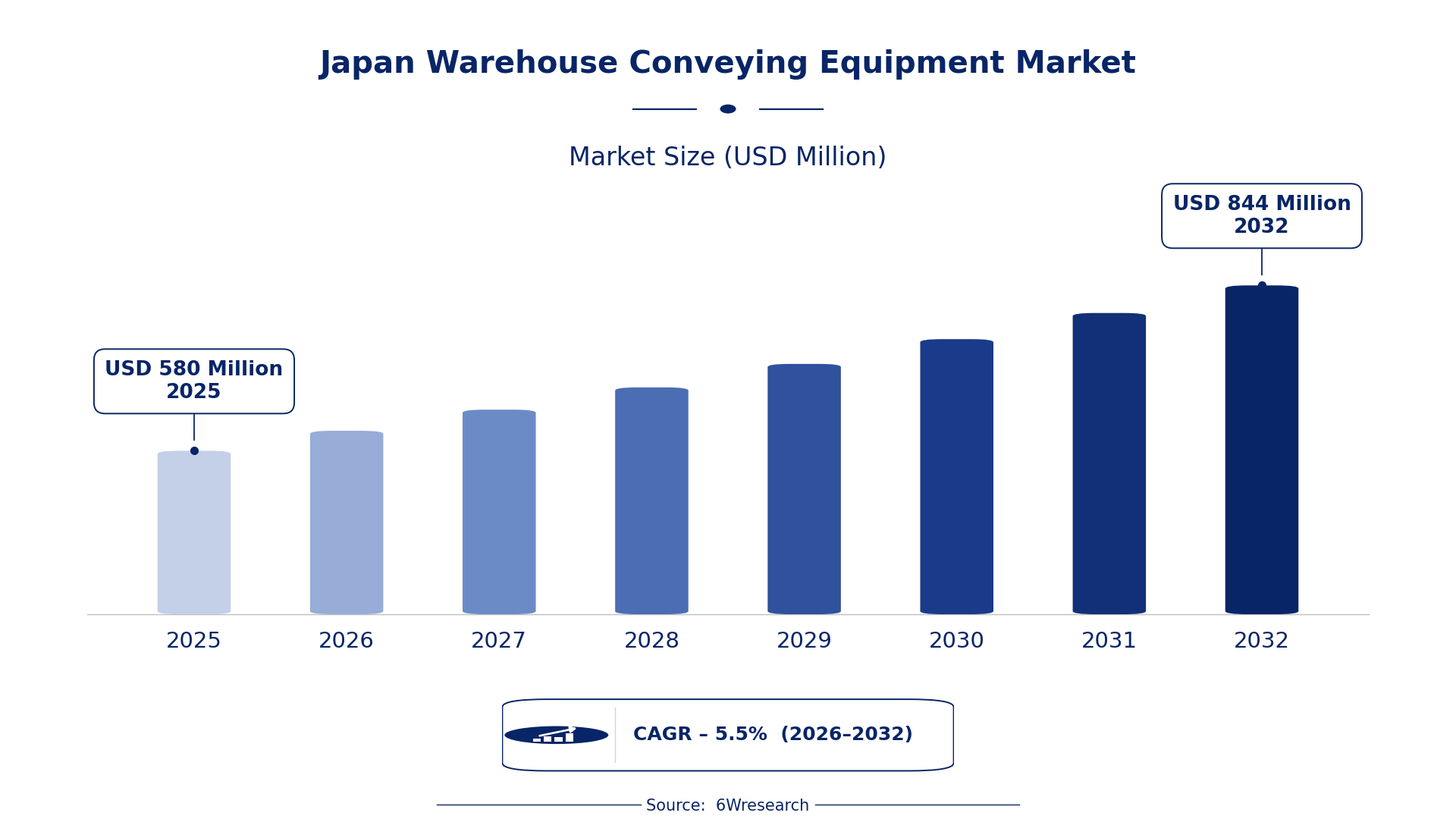
According to 6Wresearch internal database and industry insights, the Japan Warehouse Conveying Equipment Market was valued at USD 580 Million in 2025 and is projected to reach USD 844 Million by 2032, growing at a CAGR of approximately 5.5% during 2026–2032.
Japan Warehouse Conveying Equipment Market Highlights
| Report Metric | Details |
| Report Name | Japan Warehouse Conveying Equipment Market (2026-2032) |
| Market Size 2025 | USD 580 Million |
| Market Size 2032 | USD 844 Million |
| Absolute Growth 2025–2032 | USD 264 Million |
| CAGR 2026–2032 | 5.5% |
| Peak Annual Growth | 6.4% in 2028 |
| Forecast Period | 2026–2032 |
| Historical Data | 2022–2025 |
| Base Year | 2025 |
| Leading Type, 2025 | Belt Conveyors (37% share) |
| Leading Technology Used, 2025 | Automated (37% share) |
| Leading Application, 2025 | Material Handling (48% share) |
| Leading End User, 2025 | Warehousing & Distribution (35% share) |
| Leading End Use, 2025 | Professional Tattooing (60% share) |
| Fastest-Growing Type | Roller Conveyors (7.6% CAGR) |
| Fastest-Growing Technology Used | Manual (7.9% CAGR) |
| Fastest-Growing Application | Sorting (7.3% CAGR) |
| Fastest-Growing End User | Manufacturing (7.4% CAGR) |
| Fastest-Growing End Use | Tattoo Studios (6.7% CAGR) |
| Growing Sector | Warehousing & Distribution |
| Key End Users | Logistics operators, e-commerce businesses, warehouse managers, manufacturers |
Japan Warehouse Conveying Equipment Market Year-wise Growth Rate and Key Drivers (2022–2032)
This graph illustrates the annual growth rates of the market from 2022 to 2032, highlighting a steady upward trajectory and projected market expansion over the forecast period.
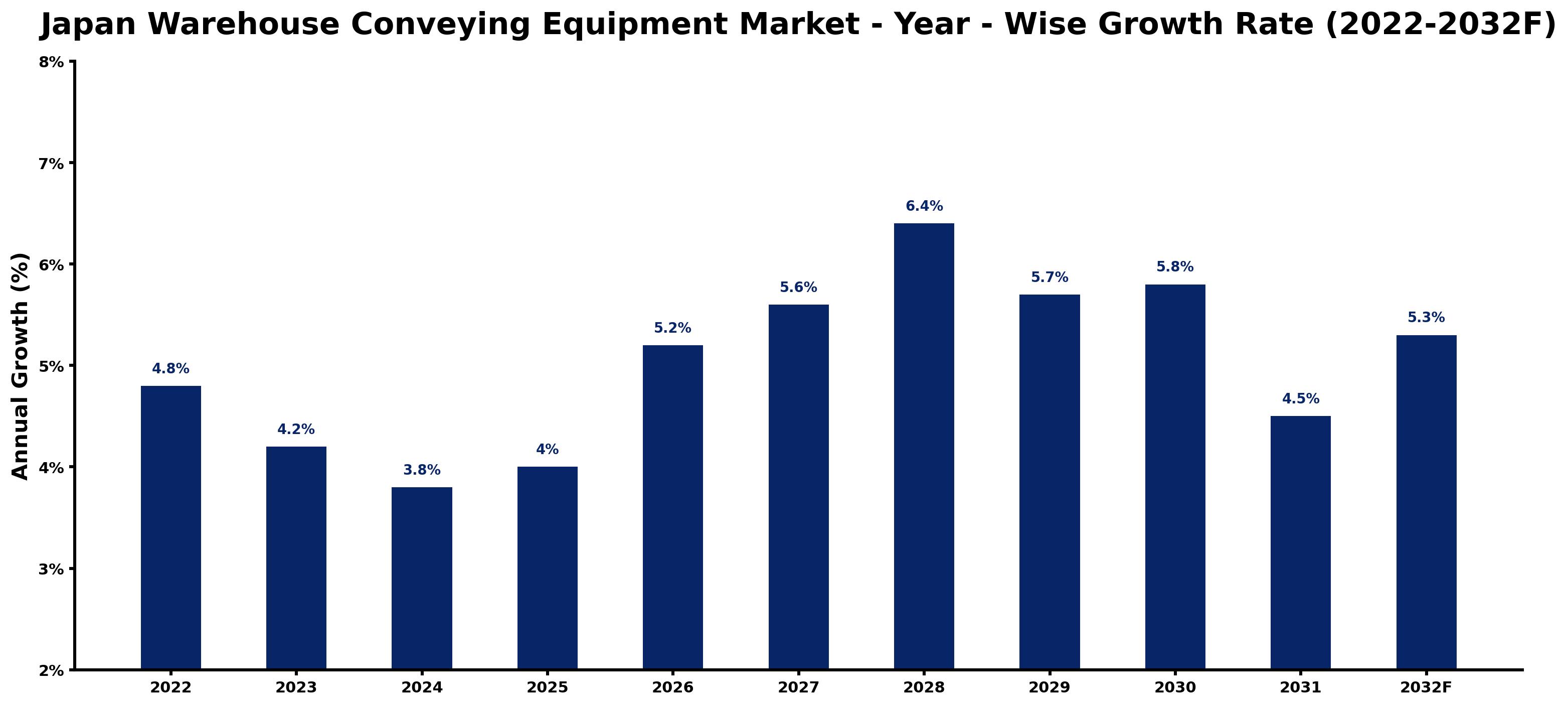
For each year, the table pairs the estimated growth rate with the leading influence on demand, showing how the drivers changed across the period.
| Year | Estimated Annual Growth (%) | Market Rationale |
| 2022 | 4.8 | The market experienced strong demand due to a growing logistics sector. |
| 2023 | 4.2 | Growth slowed as the market adjusted to increased automation investments. |
| 2024 | 3.8 | Continued investments in technology led to a further slowdown in growth. |
| 2025 | 4.0 | Demand increased as warehousing operations expanded in urban areas. |
| 2026 | 5.2 | Growth accelerated with rising automation adoption in logistics. |
| 2027 | 5.6 | Continued investment in technology further boosted growth rates. |
| 2028 | 6.4 | The market peaked as e-commerce demand surged significantly. |
| 2029 | 5.7 | Growth slowed as the market stabilised after the peak. |
| 2030 | 5.8 | Demand rose again with new technological advancements in logistics. |
| 2031 | 4.5 | Growth slowed as market conditions normalised after rapid expansion. |
| 2032 | 5.3 | Demand is expected to rise with ongoing automation in warehousing. |
Note: Market size estimations and growth projections presented in this report are based on 6Wresearch's proprietary forecasting methodology, utilizing the latest available industry data, government publications, and primary research inputs.
Japan Warehouse Conveying Equipment Market Synopsis
Warehouse conveying equipment encompasses systems such as conveyors that facilitate material transport within facilities. Growth in this market is propelled by the surge in e-commerce demand and heightened investments in automation technologies. Japan's logistics sector is set to grow steadily, especially in urban regions, as domestic users pursue efficient material handling solutions. With over 10,000 registered warehouses and a workforce of more than 1.5 million, the market is well-positioned for ongoing development through 2032.
Market Dynamics Impact Analysis (2026–2032)
| Factor | Type | Impact | Primary Segment Affected |
| Rising e-commerce demand | Driver | High | Material Handling |
| Investment in automation technologies | Driver | High | Automated |
| Increasing demand for efficient logistics solutions | Opportunity | High | Warehousing & Distribution |
| Urbanisation driving logistics expansion | Opportunity | High | E-commerce |
| High operational costs in logistics | Restraint | Medium | Pallet Conveyors |
| Aging workforce in warehousing | Restraint | Medium | Roller Conveyors |
| Limited adoption of advanced technologies | Challenge | High | AI-Driven |
| Competition from alternative material handling solutions | Challenge | High | Overhead Conveyors |
Evaluation of Drivers in Japan Warehouse Conveying Equipment Market (2026–2032)
Demand rests on the following drivers, each shown with the segment it touches most.
| Drivers | Primary Segment Affected | Why It Matters (Evidence) |
| Growing e-commerce sector | Material Handling | The e-commerce sector in Japan is expected to surpass ¥20 trillion by 2025, driving demand for efficient material handling solutions. |
| Investment in automation technologies | Automated | Investment in automation technologies in logistics reached ¥100 billion in 2022, leading to increased adoption of automated systems. |
| Expansion of urban logistics | Warehousing & Distribution | Urban areas are projected to see steady growth in logistics, necessitating improved warehousing solutions. |
| Increased workforce efficiency | Pallet Conveyors | The average age of warehouse workers in Japan is over 40 years, prompting investment in equipment that enhances operational efficiency. |
| Regulatory support for logistics innovation | Roller Conveyors | Support from local authorities encourages upgrades in handling equipment, further boosting demand. |
Buyers are expanding capacity as Japan's e-commerce sector is projected to exceed ¥20 trillion by 2025, creating a strong demand for effective material handling solutions. In 2022, investments in automation technologies reached ¥100 billion, encouraging logistics operators to implement automated systems for greater efficiency. The urban logistics sector is anticipated to grow steadily, necessitating enhanced warehousing solutions. The average age of warehouse workers is over 40 years, prompting investments in equipment that improves operational efficiency.
Evaluation of Restraints in Japan Warehouse Conveying Equipment Market
These restraints slow adoption and weigh on supplier margins.
| Market Restraint | Primary Segment Affected | Why It Matters (Evidence) |
| High operational costs in logistics | Pallet Conveyors | Operational costs are rising, impacting profitability for logistics operators who rely on pallet conveyors. |
| Aging workforce in warehousing | Roller Conveyors | An aging workforce leads to challenges in recruitment and retention, affecting operations reliant on roller conveyors. |
| Limited adoption of advanced technologies | AI-Driven | The limited application of AI-driven technologies in logistics restricts efficiency improvements and market growth. |
| Competition from alternative material handling solutions | Overhead Conveyors | Increased competition from alternative solutions can limit the market share of overhead conveyors. |
| Regulatory compliance costs | Automated | Compliance with evolving regulations increases costs for automated systems, affecting investment decisions. |
Japan Warehouse Conveying Equipment Market Challenges
Regulatory challenges in logistics lead to delays for warehouse operators, as stringent guidelines from the Ministry of Land, Infrastructure, Transport and Tourism can extend compliance timelines by up to three weeks. Buyers in urban areas are grappling with rising operational costs due to minimum wage increases, which have reached JPY 1,055 per hour, potentially squeezing profit margins by 15%. Cost pressures stem from the need for advanced automation, with investments in these technologies hitting ¥100 billion in 2022, forcing smaller warehouses to delay upgrades. Supply chain disruptions arise as the average age of warehouse workers surpasses 40 years, resulting in a workforce gap that can impede logistics efficiency for producers.
Trends in the Japan Warehouse Conveying Equipment Market
Below are the shifts with the largest effect on the Japan Warehouse Conveying Equipment Market.
- Shift from Manual to Automated Systems: In 2022, numerous logistics facilities began the transition from manual to automated systems, reflecting a growing need for efficiency. This trend is particularly evident in Tokyo, where the adoption of automation has risen.
- Emergence of IoT-Enabled Solutions: Since 2023, IoT-enabled solutions have gained traction in warehousing, enhancing monitoring and management capabilities. This trend is bolstered by initiatives from the Tokyo Metropolitan Government.
- Growing Demand for Sorting Systems: Since 2026, sorting systems have experienced increased demand, especially in e-commerce warehouses. This shift is driven by the necessity for efficient order fulfillment processes.
- Focus on Sustainability in Logistics: Since 2025, sustainability has become a priority, with many warehouses adopting eco-friendly practices. The Japan Warehousing Association promotes best practices aimed at reducing environmental impact.
Investment Opportunities in the Japan Warehouse Conveying Equipment Market
Several openings in the Japan Warehouse Conveying Equipment Market merit attention from investors.
- Investment in Automation Technologies: With ¥100 billion invested in automation technologies in 2022, opportunities exist for suppliers to provide advanced solutions to logistics operators in urban areas like Tokyo.
- Expansion of E-commerce Warehousing: As the e-commerce sector is set to surpass ¥20 trillion by 2025, there are opportunities for investment in new warehousing facilities to meet rising demand.
- Urban Logistics Development: Urban areas are experiencing logistics expansion, creating opportunities for suppliers to provide efficient material handling solutions in key regions like Osaka.
- Partnerships for Innovation: Now is the time for local partnerships to improve logistics capabilities, particularly in automated systems, as companies seek to boost efficiency.
Government Initiatives in the Japan Warehouse Conveying Equipment Market
The Industrial Safety and Health Act, established in 1972, outlines employer responsibilities regarding hazardous substances and machinery, ensuring safe working conditions for warehouse employees. This law is crucial for producers of warehouse conveying equipment, as compliance is necessary for market entry and operation. Additionally, the Act on the Rational Use of Energy, enacted in 1979, mandates large energy users to enhance energy efficiency and report energy consumption, influencing operational practices in the logistics sector.
The Ministry of Land, Infrastructure, Transport and Tourism oversees initiatives that advocate for automation in logistics, including funding for various projects. The Japan Warehousing Association plays a pivotal role in assisting buyers in adopting new technologies and improving operational performance.
Future Insight of the Japan Warehouse Conveying Equipment Market
Technological advancements will reshape demand as the Logistics Efficiency Program aims to reduce costs by 10% by 2025. By 2032, the e-commerce sector is expected to exceed ¥20 trillion, driving the need for improved warehouse systems. The adoption of ISO 9001 and JIS Z 8801 standards will enhance operational reliability for suppliers. Government initiatives, including support for logistics innovation from local authorities, will streamline processes and improve service delivery for buyers.
Market Segmentation Analysis
Japan Warehouse Conveying Equipment Market report covers a detailed analysis of the following market segments:
By Type – Belt Conveyors Lead, Roller Conveyors Expected to Grow Fastest
According to Bhawna Singh, Assistant Manager at 6Wresearch, with 37% of type revenue in 2025, Belt Conveyors was the largest category. Belt conveyors dominate the market due to their widespread use for continuous material transport in warehouses. Their importance is particularly highlighted in urban areas like Tokyo and Osaka, where logistics efficiency is critical. Over 2026–2032, Roller Conveyors are expected to post the fastest growth, at a CAGR of 7.6%. Roller conveyors are witnessing rapid growth as they are essential for sorting and transporting goods, particularly with the 15% rise in e-commerce businesses since 2020. This trend indicates that the demand for efficient material handling solutions will continue to increase. Suppliers should prioritise roller conveyor systems to meet the rising logistical demands in the market.
By Technology Used – Automated Leads, Manual Expected to Grow Fastest
Automated accounted for 37% of the market by technology used in 2025. Automated systems are leading the market as they are increasingly adopted for their efficiency in operations, particularly in large-scale warehouses. The investment in automation technologies reached ¥100 billion in 2022, reflecting a strong shift towards automated solutions. The quickest growth will come from Manual, forecast to expand at a CAGR of 7.9% between 2026 and 2032. Manual systems are growing quickly as smaller operations that cannot afford automation still rely on them for basic functions. This segment remains critical as the logistics sector continues to expand and diversify. Buyers in smaller operations may benefit from affordable manual solutions while larger facilities should invest in automation for improved efficiency.
By Application – Material Handling Leads, Sorting Expected to Grow Fastest
Material Handling held 48% of the Japan Warehouse Conveying Equipment Market by application in 2025. Material handling is the primary application for conveying equipment, serving as the core function in warehouses. The logistics sector, which contributes approximately 7% to Japan's GDP, heavily relies on efficient material handling processes. Sorting is set to record the highest CAGR in this split, 7.3% over 2026–2032. Sorting is rapidly gaining traction as it is integral for organising products in warehouses, especially with the increase in e-commerce activities. The need for efficient sorting mechanisms is becoming more pronounced as logistics demands grow. Suppliers should develop advanced sorting solutions to cater to the evolving needs of the logistics and warehousing sectors.
By End User – Warehousing & Distribution Leads, Manufacturing Expected to Grow Fastest
In 2025, Warehousing & Distribution led the end user split with a 35% share. The warehousing and distribution sector leads as the primary end-user of conveying equipment, relying on these systems for operational efficiency. With over 10,000 registered warehouses in Japan, this segment represents a significant portion of the market. Manufacturing is projected to grow fastest, at a CAGR of 7.4% during 2026–2032. Manufacturing is growing quickly as it increasingly adopts conveying systems for assembly lines, reflecting the need for streamlined production. The ongoing growth in the logistics industry further supports this trend. Suppliers should engage with manufacturing firms to capitalise on the expanding opportunities in this sector.
By End Use – Professional Tattooing Leads, Tattoo Studios Expected to Grow Fastest
The largest end use category in 2025 was Professional Tattooing, at 60% of revenue. Professional tattooing represents a niche application for conveying equipment, primarily due to the limited need for such systems in this field. The focus on precision and artistry in tattooing does not typically align with the use of conveying systems. Over 2026–2032, Tattoo Studios are expected to post the fastest growth, at a CAGR of 6.7%. Tattoo studios are seeing a slight increase in demand for equipment, but the overall use of conveying systems remains minimal. This segment's growth is constrained by the specific needs of the tattooing industry. Suppliers may find limited opportunities in this segment and should focus on more substantial markets for growth.
Key Attractiveness of the Report
- 10 Years of Market Numbers
- Historical Data Starting from 2022 to 2025
- Base Year 2025
- Forecast Data until 2032
- Key Performance Indicators Impacting the Market
- Major Upcoming Developments and Projects
Key Highlights of the Report:
- Japan Warehouse Conveying Equipment Market Outlook
- Market Size of Japan Warehouse Conveying Equipment Market,2025
- Forecast of Japan Warehouse Conveying Equipment Market, 2032
- Historical Data and Forecast of Japan Warehouse Conveying Equipment Revenues & Volume for the Period 2022-2032
- Japan Warehouse Conveying Equipment Market Trend Evolution
- Japan Warehouse Conveying Equipment Market Drivers and Challenges
- Japan Warehouse Conveying Equipment Price Trends
- Japan Warehouse Conveying Equipment Porter's Five Forces
- Japan Warehouse Conveying Equipment Industry Life Cycle
- Historical Data and Forecast of Japan Warehouse Conveying Equipment Market Revenues & Volume By Type for the Period 2022-2032
- Historical Data and Forecast of Japan Warehouse Conveying Equipment Market Revenues & Volume By Belt Conveyors for the Period 2022-2032
- Historical Data and Forecast of Japan Warehouse Conveying Equipment Market Revenues & Volume By Roller Conveyors for the Period 2022-2032
- Historical Data and Forecast of Japan Warehouse Conveying Equipment Market Revenues & Volume By Overhead Conveyors for the Period 2022-2032
- Historical Data and Forecast of Japan Warehouse Conveying Equipment Market Revenues & Volume By Pallet Conveyors for the Period 2022-2032
- Historical Data and Forecast of Japan Warehouse Conveying Equipment Market Revenues & Volume By Others for the Period 2022-2032
- Historical Data and Forecast of Japan Warehouse Conveying Equipment Market Revenues & Volume By Technology Used for the Period 2022-2032
- Historical Data and Forecast of Japan Warehouse Conveying Equipment Market Revenues & Volume By Automated for the Period 2022-2032
- Historical Data and Forecast of Japan Warehouse Conveying Equipment Market Revenues & Volume By Manual for the Period 2022-2032
- Historical Data and Forecast of Japan Warehouse Conveying Equipment Market Revenues & Volume By AI-Driven for the Period 2022-2032
- Historical Data and Forecast of Japan Warehouse Conveying Equipment Market Revenues & Volume By IoT-Enabled for the Period 2022-2032
- Historical Data and Forecast of Japan Warehouse Conveying Equipment Market Revenues & Volume By Application for the Period 2022-2032
- Historical Data and Forecast of Japan Warehouse Conveying Equipment Market Revenues & Volume By Material Handling for the Period 2022-2032
- Historical Data and Forecast of Japan Warehouse Conveying Equipment Market Revenues & Volume By Sorting for the Period 2022-2032
- Historical Data and Forecast of Japan Warehouse Conveying Equipment Market Revenues & Volume By Packaging for the Period 2022-2032
- Historical Data and Forecast of Japan Warehouse Conveying Equipment Market Revenues & Volume By Loading & Unloading for the Period 2022-2032
- Historical Data and Forecast of Japan Warehouse Conveying Equipment Market Revenues & Volume By End User for the Period 2022-2032
- Historical Data and Forecast of Japan Warehouse Conveying Equipment Market Revenues & Volume By Warehousing & Distribution for the Period 2022-2032
- Historical Data and Forecast of Japan Warehouse Conveying Equipment Market Revenues & Volume By Manufacturing for the Period 2022-2032
- Historical Data and Forecast of Japan Warehouse Conveying Equipment Market Revenues & Volume By E-commerce for the Period 2022-2032
- Historical Data and Forecast of Japan Warehouse Conveying Equipment Market Revenues & Volume By Retail Industry for the Period 2022-2032
- Historical Data and Forecast of Japan Warehouse Conveying Equipment Market Revenues & Volume By End Use for the Period 2022-2032
- Historical Data and Forecast of Japan Warehouse Conveying Equipment Market Revenues & Volume By Professional Tattooing for the Period 2022-2032
- Historical Data and Forecast of Japan Warehouse Conveying Equipment Market Revenues & Volume By Tattoo Studios for the Period 2022-2032
- Japan Warehouse Conveying Equipment Import Export Trade Statistics
- Market Opportunity Assessment By Type
- Market Opportunity Assessment By Technology Used
- Market Opportunity Assessment By Application
- Market Opportunity Assessment By End User
- Market Opportunity Assessment By End Use
- Japan Warehouse Conveying Equipment Top Companies Market Share
- Japan Warehouse Conveying Equipment Competitive Benchmarking By Technical and Operational Parameters
- Japan Warehouse Conveying Equipment Company Profiles
- Japan Warehouse Conveying Equipment Key Strategic Recommendations
Market Covered
This report examines the market across the segments below.
By Type
- Belt Conveyors
- Roller Conveyors
- Overhead Conveyors
- Pallet Conveyors
- Others
By Technology Used
- Automated
- Manual
- AI-Driven
- IoT-Enabled
By Application
- Material Handling
- Sorting
- Packaging
- Loading & Unloading
By End User
- Warehousing & Distribution
- Manufacturing
- E-commerce
- Retail Industry
By End Use
- Professional Tattooing
- Tattoo Studios































