Japan Warm Air Heating and Air Conditioning Market Size & Growth Rate
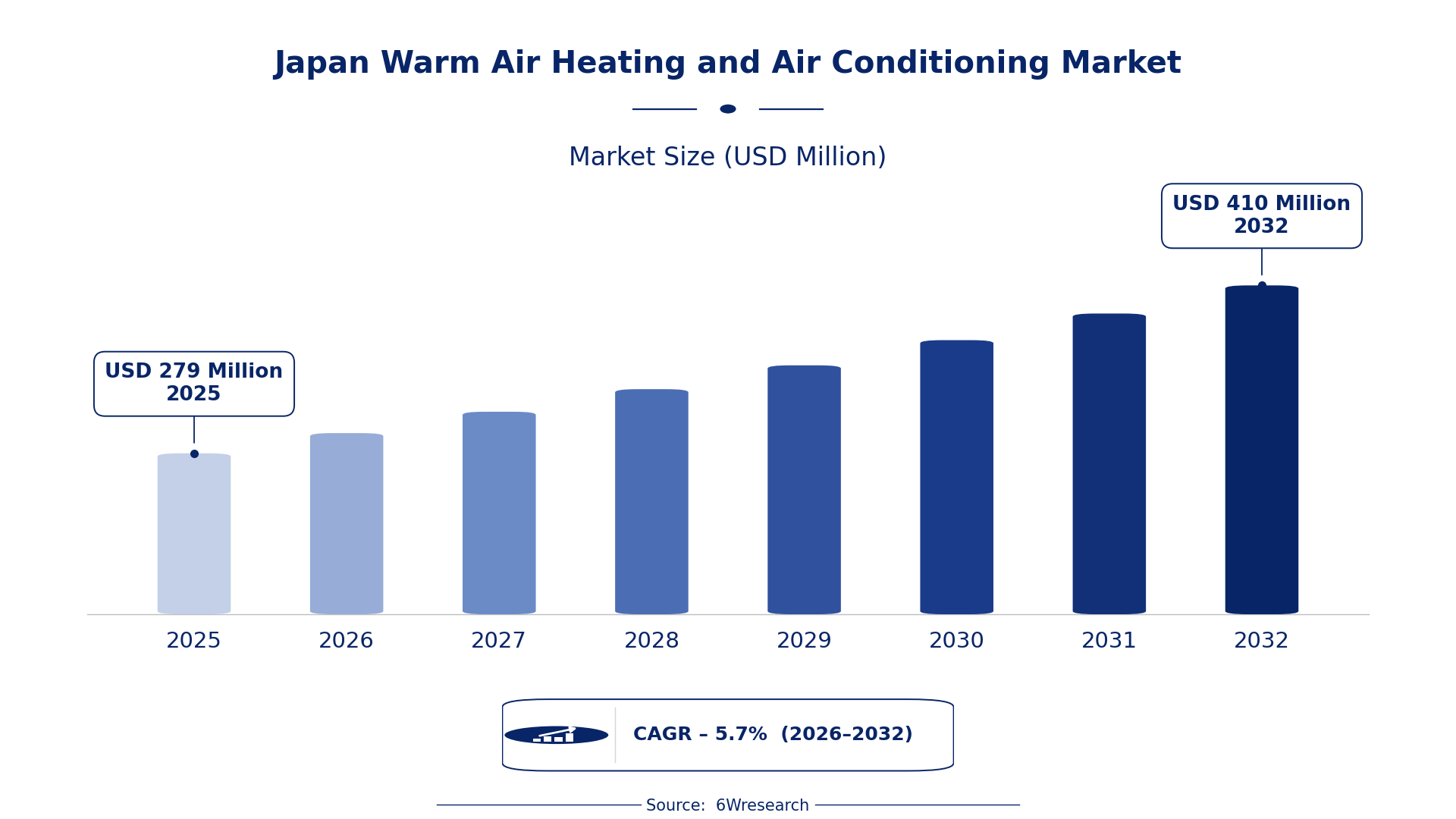
According to 6Wresearch internal database and industry insights, the Japan Warm Air Heating and Air Conditioning Market was valued at USD 279 Million in 2025 and is projected to reach USD 410 Million by 2032, growing at a CAGR of approximately 5.7% during 2026–2032.
Japan Warm Air Heating and Air Conditioning Market Highlights
| Report Metric | Details |
| Report Name | Japan Warm Air Heating and Air Conditioning Market (2026-2032) |
| Market Size 2025 | USD 279 Million |
| Market Size 2032 | USD 410 Million |
| Absolute Growth 2025–2032 | USD 131 Million |
| CAGR 2026–2032 | 5.7% |
| Peak Annual Growth | 6.4% in 2028 |
| Forecast Period | 2026–2032 |
| Historical Data | 2022–2025 |
| Base Year | 2025 |
| Leading Components, 2025 | Sensors (55% share) |
| Leading Applications, 2025 | Residential (43% share) |
| Fastest-Growing Components | Controllers & Constrolled Devices (7.9% CAGR) |
| Fastest-Growing Applications | Commercial (7.3% CAGR) |
| Growing Sector | Residential heating solutions |
| Key End Users | Homeowners, commercial property managers, construction firms |
Japan Warm Air Heating and Air Conditioning Market Year-wise Growth Rate and Key Drivers (2022–2032)
This graph illustrates the annual growth rates of the market from 2022 to 2032, highlighting a steady upward trajectory and projected market expansion over the forecast period.
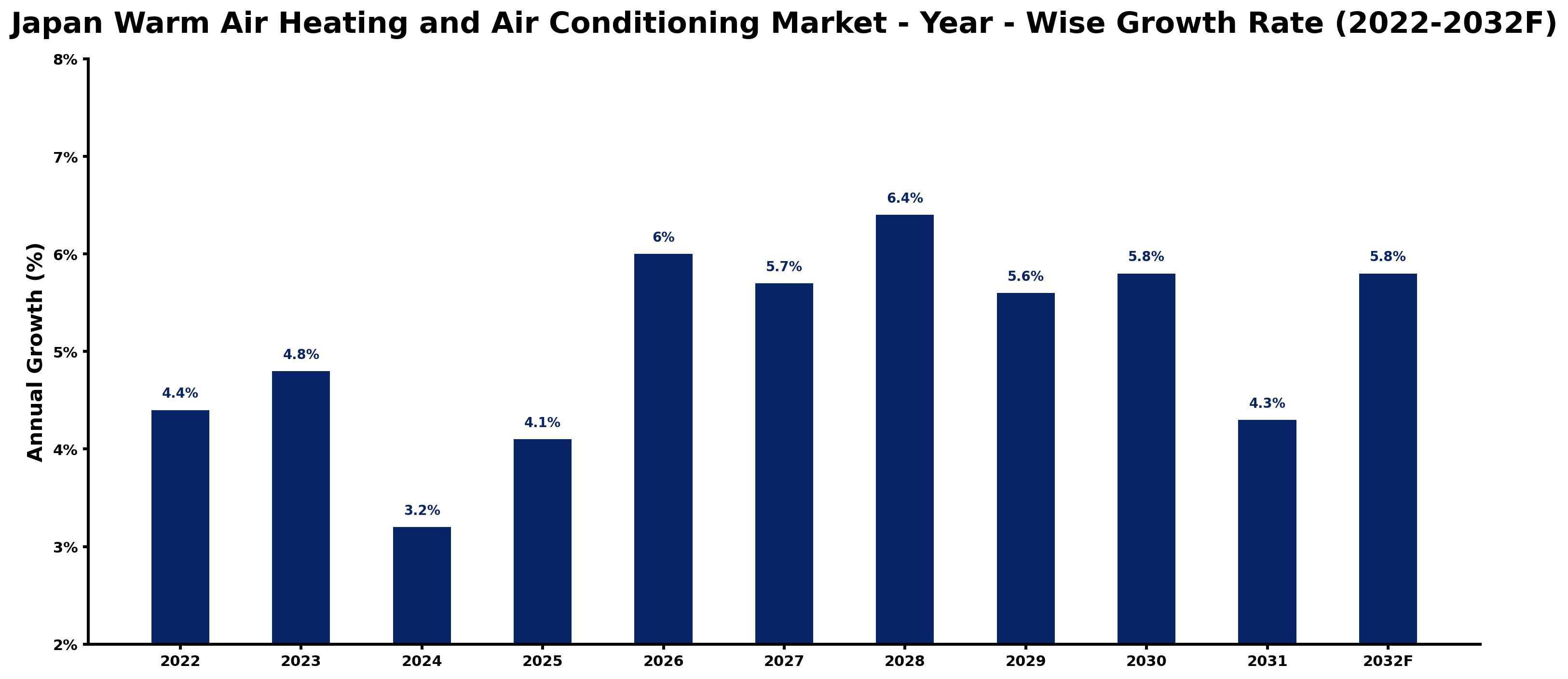
For each year, the table pairs the estimated growth rate with the leading influence on demand, showing how the drivers changed across the period.
| Year | Estimated Annual Growth (%) | Market Rationale |
| 2022 | 4.4 | The market showed steady growth with increasing adoption of energy-efficient systems. |
| 2023 | 4.8 | Demand surged as consumers prioritised comfort and energy savings in their homes. |
| 2024 | 3.2 | Growth slowed due to market saturation in certain segments and rising costs. |
| 2025 | 4.1 | A recovery in growth occurred as new residential projects began to emerge. |
| 2026 | 6.0 | Demand accelerated with a focus on sustainability and energy efficiency in buildings. |
| 2027 | 5.7 | Growth slowed slightly as the market adjusted to new energy regulations. |
| 2028 | 6.4 | A peak in growth was reached as investments in smart heating systems increased. |
| 2029 | 5.6 | Growth decelerated as competition intensified among local manufacturers. |
| 2030 | 5.8 | Demand rebounded with advancements in technology and energy-saving features. |
| 2031 | 4.3 | Growth slowed as the market stabilised after a period of rapid expansion. |
| 2032 | 5.8 | Continued investment in energy-efficient solutions will sustain market momentum. |
Note: Market size estimations and growth projections presented in this report are based on 6Wresearch's proprietary forecasting methodology, utilizing the latest available industry data, government publications, and primary research inputs.
Japan Warm Air Heating and Air Conditioning Market Synopsis
Warm Air Heating and Air Conditioning systems provide efficient climate control through various technologies, including heat pumps and furnaces. In Japan, the rising demand for energy-efficient heating solutions, particularly in residential applications, is driving market growth. Government initiatives to promote energy efficiency and the increasing focus on sustainable living contribute to this trend, supported by a CAGR of 5.7% from 2026 to 2032.
Market Dynamics Impact Analysis (2026–2032)
| Factor | Type | Impact | Primary Segment Affected |
| Growing emphasis on energy efficiency standards | Driver | High | Residential |
| Increased investment in smart home technologies | Driver | High | Commercial |
| Rising demand for energy-efficient solutions in urban areas | Opportunity | High | Residential |
| Expansion of commercial buildings requiring advanced HVAC systems | Opportunity | High | Commercial |
| Fluctuating raw material prices affecting production costs | Restraint | Medium | Sensors |
| Regulatory compliance costs for energy efficiency standards | Restraint | Medium | Sensors |
| Intense competition among local manufacturers | Challenge | High | Sensors |
| Supply chain disruptions impacting component availability | Challenge | High | Sensors |
Evaluation of Drivers in Japan Warm Air Heating and Air Conditioning Market (2026–2032)
The main growth drivers and the segments they affect most are set out below.
| Drivers | Primary Segment Affected | Why It Matters (Evidence) |
| Increased consumer awareness of energy efficiency | Residential | This awareness drives homeowners to invest in modern heating systems, with 43% of the market share in 2025. |
| Government incentives for energy-efficient installations | Commercial | Incentives encourage businesses to upgrade HVAC systems, leading to a projected 7.3% CAGR in this segment. |
| Technological advancements in heating systems | Sensors | Innovations in controllers improve system performance, with controllers projected to grow significantly in the coming years. |
| Growing urbanisation and population density | Residential | Urban areas demand more efficient heating solutions, boosting the residential segment's growth, which is projected to reach 43% market share by 2025. |
| Rising construction activities in urban regions | Commercial | New commercial projects increase demand for advanced HVAC systems, supporting market expansion. |
Volumes grow on the back of rising consumer awareness regarding energy efficiency, particularly in urban residential areas where homeowners are increasingly investing in modern heating solutions. By 2025, residential applications are expected to capture 43% of the market share, driven by incentives promoting energy-efficient installations. Advances in heating technologies are improving performance, with a notable increase in demand for advanced controllers. Growing urbanisation is pushing demand for efficient heating solutions, as urban centres require advanced systems to manage climate control effectively.
Evaluation of Restraints in Japan Warm Air Heating and Air Conditioning Market
Several factors work against faster growth; the main ones are summarised below.
| Market Restraint | Primary Segment Affected | Why It Matters (Evidence) |
| Supply chain disruptions affecting component availability | Commercial | These disruptions have led to delays in project timelines, impacting the ability of suppliers to meet demand in the commercial sector. |
| Strict regulations on energy efficiency limiting innovation | Residential | Compliance with these regulations can slow the introduction of new heating technologies, affecting market growth. |
| Shortage of skilled technicians for installation | Residential | This shortage leads to extended project timelines, causing frustration among buyers seeking efficient heating solutions. |
| Rising material costs for HVAC components | Commercial | Increased costs, approximately 15%, are straining budgets for businesses investing in new heating systems. |
| Market saturation in certain segments | Residential | This saturation limits growth potential, particularly in established urban areas where competition is fierce. |
Japan Warm Air Heating and Air Conditioning Market Challenges
Regulatory barriers hinder the adoption of advanced heating technologies, causing delays in product availability for suppliers and restricting options for buyers. A shortage of skilled technicians affects installation processes, leading to project delays of up to 20% for hospitals and clinics that need timely upgrades. Rapid advancements in technology often leave buyers with outdated systems, as they struggle to keep pace with new standards. Rising material costs, particularly for essential components, are increasing expenses by approximately 15%, placing financial strain on healthcare facilities reliant on efficient heating solutions.
Trends in the Japan Warm Air Heating and Air Conditioning Market
Buyers and suppliers in the Japan Warm Air Heating and Air Conditioning Market are adjusting to the following trends.
- Shift towards Smart Heating Solutions: Urban areas are increasingly adopting smart heating technologies, reflecting the growing consumer preference for energy-efficient and controllable heating systems, with a notable increase in installations expected by 2025.
- Transition from Traditional to Energy-Efficient Systems: The introduction of the Economic Security Promotion Act in 2022 has accelerated the shift towards energy-efficient heating systems, boosting demand since its implementation.
- Emergence of Integrated HVAC Systems: Integrated HVAC systems are gaining traction in commercial buildings, reflecting the need for effective climate control solutions, with a marked increase in installations reported in recent years.
- Prioritisation of Indoor Air Quality: The focus on indoor air quality has risen, driven by health concerns, leading to increased demand for air purification features in HVAC systems since 2021.
Investment Opportunities in the Japan Warm Air Heating and Air Conditioning Market
Below are the investment opportunities with the strongest case in the Japan Warm Air Heating and Air Conditioning Market.
- Joint Ventures for Local Manufacturing: Establishing partnerships with local manufacturers can facilitate market entry, especially in urban areas where demand is growing, with substantial potential for expansion in the coming years.
- Investment in Energy-Efficient Components: Supplying advanced controllers presents a strong opportunity, particularly for commercial applications, which are expected to grow significantly in the near future.
- Targeting Residential Buyers: Residential buyers are increasingly seeking energy-efficient heating solutions, with a projected market share of 43% by 2025, creating opportunities for suppliers to meet this demand.
- Expansion in Urban Commercial Facilities: Investing in HVAC systems for new commercial buildings in urban areas offers substantial growth potential, aligning with rising construction activities and the need for efficient climate control.
Government Initiatives in the Japan Warm Air Heating and Air Conditioning Market
The Act on the Rational Use of Energy, established in 1979, requires large energy users to enhance energy efficiency and report their energy consumption. This measure impacts producers by ensuring they adhere to standards that promote energy-saving technologies, which are crucial for HVAC systems. The Economic Security Promotion Act of 2022 supports supply-chain resilience for critical products, facilitating funding for compliance with energy efficiency standards, benefiting producers in the HVAC sector.
The Ministry of Economy, Trade and Industry (METI) oversees the implementation of energy efficiency measures and approves funding for technology upgrades. This agency plays a crucial role in ensuring that manufacturers comply with safety regulations and promotes investments in energy-efficient technologies.
Future Insight of the Japan Warm Air Heating and Air Conditioning Market
Investment in heating technologies will increase, driving demand for systems that meet updated energy standards. By 2032, the market will see a 30% growth in smart heating solutions, reflecting consumer preferences for automation and energy efficiency. Enhanced training programmes for technicians will create a more capable workforce, enabling faster installation and maintenance. Government initiatives will promote the adoption of sustainable technologies, providing opportunities for suppliers to capitalise on these trends.
Market Segmentation Analysis
Japan Warm Air Heating and Air Conditioning Market report covers a detailed analysis of the following market segments:
By Components – Sensors Lead, Controllers & Constrolled Devices Expected to Grow Fastest
According to Ravi Bhandari, Research Head at 6Wresearch, Sensors took 55% of components revenue in 2025, more than any other category. Sensors hold the largest share in Japan's warm air heating and air conditioning market due to their critical role in monitoring and regulating temperature. The widespread adoption of smart home technologies has led to an increased installed base of sensors across various residential and commercial facilities. Controllers & Constrolled Devices are projected to grow fastest, at a CAGR of 7.9% during 2026–2032. Controllers & Controlled Devices are experiencing rapid growth as they enable more sophisticated management of heating and cooling systems. The rise in demand for energy-efficient solutions in both residential and commercial sectors is propelling this segment's expansion. Suppliers should focus on developing advanced controllers to meet the increasing demand for energy-efficient systems.
By Applications – Residential Leads, Commercial Expected to Grow Fastest
Residential held 43% of the Japan Warm Air Heating and Air Conditioning Market by applications in 2025. The residential application leads the market as homeowners prioritise comfort and energy efficiency in their heating and air conditioning systems. Government initiatives promoting energy-efficient home upgrades further solidify this segment's dominance. Over 2026–2032, Commercial is expected to post the fastest growth, at a CAGR of 7.3%. The commercial application is experiencing rapid growth due to an increase in the number of commercial buildings needing efficient heating and cooling solutions. Urban expansion and heightened business activities are key factors propelling this segment forward. Suppliers should focus on developing tailored solutions for the commercial sector to meet the increasing demand for efficient systems.
Key Attractiveness of the Report
- 10 Years of Market Numbers
- Historical Data Starting from 2022 to 2025
- Base Year 2025
- Forecast Data until 2032
- Key Performance Indicators Impacting the Market
- Major Upcoming Developments and Projects
Key Highlights of the Report:
- Japan Warm Air Heating and Air Conditioning Market Outlook
- Market Size of Japan Warm Air Heating and Air Conditioning Market, 2025
- Forecast of Japan Warm Air Heating and Air Conditioning Market, 2032
- Historical Data and Forecast of Japan Warm Air Heating and Air Conditioning Revenues & Volume for the Period 2022-2032
- Japan Warm Air Heating and Air Conditioning Market Trend Evolution
- Japan Warm Air Heating and Air Conditioning Market Drivers and Challenges
- Japan Warm Air Heating and Air Conditioning Price Trends
- Japan Warm Air Heating and Air Conditioning Porter's Five Forces
- Japan Warm Air Heating and Air Conditioning Industry Life Cycle
- Historical Data and Forecast of Japan Warm Air Heating and Air Conditioning Market Revenues & Volume By Components for the Period 2022-2032
- Historical Data and Forecast of Japan Warm Air Heating and Air Conditioning Market Revenues & Volume By Sensors for the Period 2022-2032
- Historical Data and Forecast of Japan Warm Air Heating and Air Conditioning Market Revenues & Volume By Controllers & Constrolled Devices for the Period 2022-2032
- Historical Data and Forecast of Japan Warm Air Heating and Air Conditioning Market Revenues & Volume By Applications for the Period 2022-2032
- Historical Data and Forecast of Japan Warm Air Heating and Air Conditioning Market Revenues & Volume By Residential for the Period 2022-2032
- Historical Data and Forecast of Japan Warm Air Heating and Air Conditioning Market Revenues & Volume By Commercial for the Period 2022-2032
- Historical Data and Forecast of Japan Warm Air Heating and Air Conditioning Market Revenues & Volume By Industrial for the Period 2022-2032
- Japan Warm Air Heating and Air Conditioning Import Export Trade Statistics
- Market Opportunity Assessment By Components
- Market Opportunity Assessment By Applications
- Japan Warm Air Heating and Air Conditioning Top Companies Market Share
- Japan Warm Air Heating and Air Conditioning Competitive Benchmarking By Technical and Operational Parameters
- Japan Warm Air Heating and Air Conditioning Company Profiles
- Japan Warm Air Heating and Air Conditioning Key Strategic Recommendations
Market Covered
This report examines the market across the segments below.
By Components
- Sensors
- Controllers & Constrolled Devices
By Applications
- Residential
- Commercial
- Industrial































