Japan Wearable Devices in Sports Market Size & Growth Rate
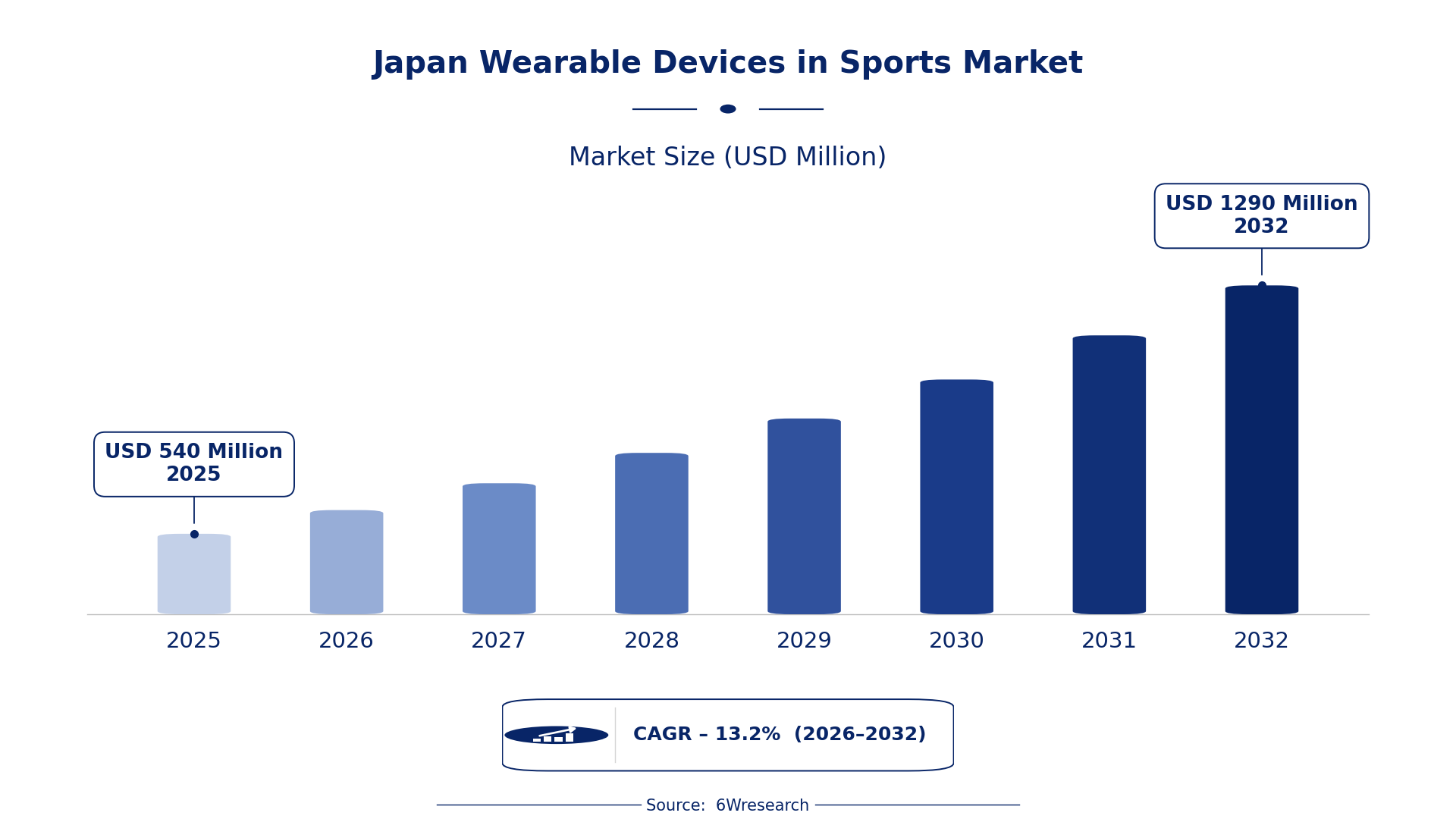
According to 6Wresearch internal database and industry insights, the Japan Wearable Devices in Sports Market was valued at USD 540 Million in 2025 and is projected to reach USD 1,290 Million by 2032, growing at a CAGR of approximately 13.2% during 2026–2032.
Japan Wearable Devices in Sports Market Highlights
| Report Metric | Details |
| Report Name | Japan Wearable Devices in Sports Market (2026-2032) |
| Market Size 2025 | USD 540 Million |
| Market Size 2032 | USD 1,290 Million |
| Absolute Growth 2025–2032 | USD 750 Million |
| CAGR 2026–2032 | 13.2% |
| Peak Annual Growth | 15.6% in 2026 |
| Forecast Period | 2026–2032 |
| Historical Data | 2022–2025 |
| Base Year | 2025 |
| Leading Type, 2025 | Activity Monitors (33% share) |
| Leading Application, 2025 | Specialty Stores (64% share) |
| Fastest-Growing Type | Smart Fabrics (18.5% CAGR) |
| Fastest-Growing Application | Online Stores (17.2% CAGR) |
| Growing Sector | fitness technology |
| Key End Users | fitness enthusiasts, sports teams, health-conscious consumers, gyms |
Japan Wearable Devices in Sports Market Year-wise Growth Rate and Key Drivers (2022–2032)
This graph illustrates the annual growth rates of the market from 2022 to 2032, highlighting a steady upward trajectory and projected market expansion over the forecast period.
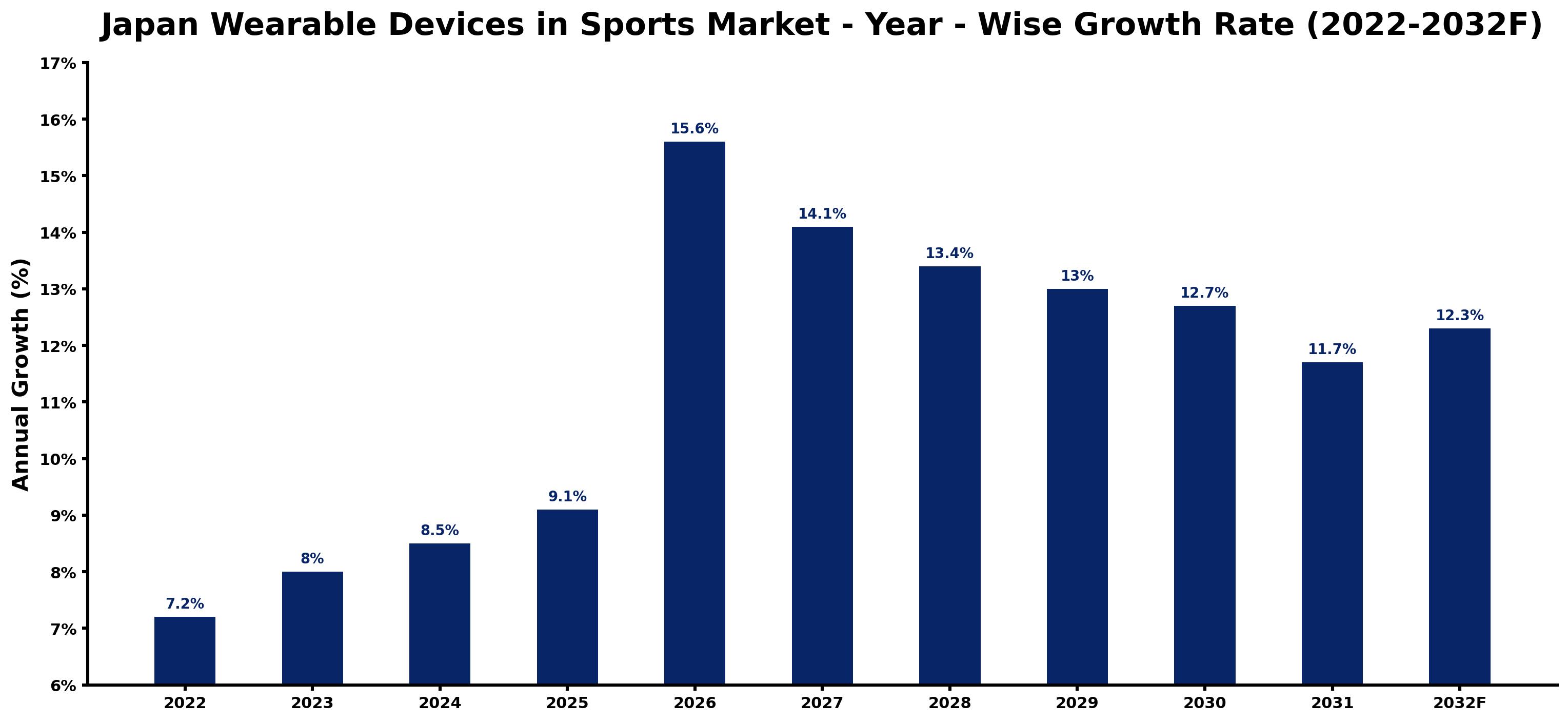
The following figures match every annual growth estimate with the main market development of that year, giving the reasoning behind each rise or slowdown.
| Year | Estimated Annual Growth (%) | Market Rationale |
| 2022 | 7.2 | The market showed steady growth as interest in fitness technology increased. |
| 2023 | 8.0 | Demand accelerated due to heightened consumer awareness of health and fitness. |
| 2024 | 8.5 | Growth continued as more users adopted wearable technology for performance tracking. |
| 2025 | 9.1 | The Tokyo 2020 Olympics spurred interest in sports technology innovations. |
| 2026 | 15.6 | A surge in technology adoption and fitness awareness will drive rapid growth. |
| 2027 | 14.1 | Growth is expected to slow slightly as the market begins to stabilise after a peak. |
| 2028 | 13.4 | Demand will continue to rise, although at a slower pace than previous years. |
| 2029 | 13.0 | The market is projected to maintain growth, supported by ongoing consumer interest in fitness. |
| 2030 | 12.7 | Growth will slow further, reflecting a maturing market and consumer base. |
| 2031 | 11.7 | The market will continue to grow, albeit at a reduced rate compared to previous years. |
| 2032 | 12.3 | Demand is expected to rise again as new technologies emerge and attract buyers. |
Note: Market size estimations and growth projections presented in this report are based on 6Wresearch's proprietary forecasting methodology, utilizing the latest available industry data, government publications, and primary research inputs.
Japan Wearable Devices in Sports Market Synopsis
Wearable devices in sports are electronic gadgets designed to monitor and enhance athletic performance. These devices, including fitness and heart rate monitors, are gaining traction among fitness enthusiasts in Japan. The Japan Wearable Devices in Sports Market is expanding due to increased health consciousness, technological advancements, and a surge in online sales, which rose by 25% in 2023. Tokyo serves as a key hub for sports technology innovation, driving demand from urban populations.
Market Dynamics Impact Analysis (2026–2032)
| Factor | Type | Impact | Primary Segment Affected |
| Rising health consciousness among consumers | Driver | High | Fitness & Heart Rate Monitors |
| Technological advancements in wearable devices | Driver | High | Sports & Running Computers |
| Growing online retail channels for sports technology | Opportunity | High | Online Stores |
| Increasing interest in fitness among urban populations | Opportunity | High | Activity Monitors |
| Limited adoption of smart fabrics in mainstream sports | Restraint | Medium | Smart Fabrics |
| Regulatory hurdles for new wearable technologies | Restraint | Medium | Fitness & Heart Rate Monitors |
| Competition from alternative fitness tracking solutions | Challenge | High | Sports & Running Computers |
| Consumer reluctance to invest in new technologies | Challenge | Medium | Activity Monitors |
Evaluation of Drivers in Japan Wearable Devices in Sports Market (2026–2032)
The table below links each growth driver to the segment it affects and the evidence for it.
| Drivers | Primary Segment Affected | Why It Matters (Evidence) |
| Increased health awareness | Fitness & Heart Rate Monitors | Over 30% of the market share is driven by users seeking to monitor their health during workouts. |
| Advancements in sensor technology | Sports & Running Computers | Integration with mobile apps attracts more users to these devices. |
| Growth of e-commerce platforms | Online Stores | Online sales of wearable devices increased by 25% in 2023, expanding market reach. |
| Urban fitness trends | Activity Monitors | These devices are popular among urban populations aged 20-40, driving consistent demand. |
| Support from sports initiatives | Specialty Stores | The Japan Sports Agency promotes technology adoption, benefiting retail channels. |
Purchasing is picking up as health awareness rises among consumers, with over 30% of the market share attributed to Fitness & Heart Rate Monitors. Technological advancements in sensor technology are improving Sports & Running Computers, integrating with mobile apps to attract users. The growth of e-commerce platforms has led to a 25% increase in online sales in 2023, expanding market reach. Urban fitness trends are boosting demand for Activity Monitors, especially among individuals aged 20-40.
Evaluation of Restraints in Japan Wearable Devices in Sports Market
Below are the constraints most often cited by buyers and suppliers, with the segment each affects.
| Market Restraint | Primary Segment Affected | Why It Matters (Evidence) |
| Limited adoption of smart fabrics | Smart Fabrics | Smart Fabrics are being tested in professional sports teams but have not gained widespread acceptance. |
| Regulatory hurdles for new technologies | Fitness & Heart Rate Monitors | Approval processes can delay market entry for new wearable devices. |
| Consumer reluctance to invest in new technologies | Activity Monitors | Some consumers hesitate to purchase new devices due to perceived costs and benefits. |
| Competition from alternative fitness tracking solutions | Sports & Running Computers | Wearable devices face competition from smartphone apps that offer similar tracking features. |
| Market saturation in urban areas | Specialty Stores | High competition among retailers can limit growth opportunities in densely populated regions. |
Japan Wearable Devices in Sports Market Challenges
Producers face high costs due to outdated manufacturing technology, which can inflate prices, with some devices exceeding JPY 30,000. Buyers in rural areas struggle with limited access to advanced wearable technology, leading to missed opportunities for improved athletic performance. Compliance with JIS standards can prolong product approval timelines, causing suppliers to miss critical market windows and lose competitiveness. Traditional retail channels restrict the distribution of new products, resulting in lower sales for suppliers in urban markets where demand is high.
Trends in the Japan Wearable Devices in Sports Market
These developments are changing demand patterns in the Japan Wearable Devices in Sports Market.
- Shift from Traditional to Smart Wearables: Since 2022, there has been a noticeable shift towards smart wearables among athletes, driven by the Tokyo 2020 Olympics. This trend reflects a growing preference for devices that offer advanced tracking and analytics.
- Increase in Online Sales Channels: In 2023, online sales of wearable devices surged by 25%, highlighting a shift in consumer purchasing behaviour. This trend indicates that buyers prefer the convenience of e-commerce for fitness technology.
- Integration of Wearables with Mobile Apps: The integration of Sports & Running Computers with mobile applications has changed how athletes track performance. This development improves user experience and encourages more purchases among tech-savvy consumers.
- Focus on Health Monitoring Features: Since 2022, there has been a growing emphasis on health monitoring features in wearable devices. This shift is clear as Fitness & Heart Rate Monitors gain popularity among health-conscious consumers.
Investment Opportunities in the Japan Wearable Devices in Sports Market
Below are the investment opportunities with the strongest case in the Japan Wearable Devices in Sports Market.
- Increasing Demand for Fitness Technology: With the fitness market expanding, there is a gap for new wearable devices. The Tokyo metropolitan area is a prime location for investment, as it hosts numerous fitness enthusiasts.
- Growth in Online Retailing: The rise of e-commerce presents a strong opportunity for suppliers to reach consumers. Investing in online platforms can cater to the growing demand for wearable devices.
- Emerging Interest in Smart Fabrics: With an 18.5% CAGR projected for Smart Fabrics, there is a unique opportunity to develop these technologies. Collaborating with professional sports teams can facilitate market entry.
- Expansion of Fitness Centers: As the total number of fitness centers in Japan is estimated at around 30,000, there is a strong demand for wearable devices. Suppliers can partner with gyms to promote their products.
Government Initiatives in the Japan Wearable Devices in Sports Market
The PMD Act regulates the approval and quality of wearable devices, ensuring safety and efficacy for consumers. This law enhances previous regulations to improve compliance and consumer trust in the market. The Act against Unjustifiable Premiums and Misleading Representations prohibits misleading labelling and advertising of wearable devices, protecting buyers and ensuring accurate information.
In 2023, the Japan Agency for Medical Research and Development (AMED) allocated JPY 10 billion to support medical research, including studies on wearable technologies. This funding aims to advance the development of health monitoring devices, benefiting producers and buyers in the wearable devices market.
Future Insight of the Japan Wearable Devices in Sports Market
By 2032, advancements in sensor technology will transform the functionality of wearable devices, allowing for superior health monitoring. Government programmes will drive the adoption of sports technology, encouraging buyers to utilise these devices more frequently. Integration with mobile applications will simplify user experiences, making products more appealing to fitness enthusiasts. Online sales of wearable devices are projected to rise by 40%, reflecting a shift towards digital purchasing channels and increased consumer engagement.
Market Segmentation Analysis
Japan Wearable Devices in Sports Market report covers a detailed analysis of the following market segments:
By Type – Activity Monitors Lead, Smart Fabrics Expected to Grow Fastest
According to Sumit Sagar, AM at 6Wresearch, Activity Monitors held 33% of the Japan Wearable Devices in Sports Market by type in 2025. Activity Monitors hold the largest share due to their widespread use among fitness enthusiasts, particularly in urban settings where health awareness is increasing. They are essential for tracking daily activities and fitness levels, especially among individuals aged 20-40 who regularly visit gyms and fitness centres. Smart Fabrics are set to record the highest CAGR in this split, 18.5% over 2026–2032. Smart Fabrics are experiencing rapid growth as they are currently being tested in professional sports teams, indicating a trend towards the integration of technology in athletic apparel. This growth is further supported by government initiatives aimed at enhancing sports participation through technology, expanding their market potential. This indicates that suppliers must focus on developing advanced wearable technologies to cater to the increasing demand in the sports market.
By Application – Specialty Stores Lead, Online Stores Expected to Grow Fastest
The largest application category in 2025 was Specialty Stores, at 64% of revenue. Specialty Stores lead the market as they are the primary retail channels for wearable devices, providing a focused selection of products tailored to serious athletes. Their expert advice and personalised service attract fitness enthusiasts who seek the latest advancements in wearable technology. Online Stores are projected to grow fastest, at a CAGR of 17.2% during 2026–2032. Online Stores are experiencing the fastest growth, with a 25% increase in sales in 2023, reflecting the convenience of e-commerce and a shift towards online shopping. This trend highlights changing consumer preferences, with more buyers opting for digital platforms to purchase wearable devices. Buyers can expect a broader selection and competitive pricing as the online market for wearable devices continues to expand.
Key Attractiveness of the Report
- 10 Years of Market Numbers
- Historical Data Starting from 2022 to 2025
- Base Year 2025
- Forecast Data until 2032
- Key Performance Indicators Impacting the Market
- Major Upcoming Developments and Projects
Key Highlights of the Report:
- Japan Wearable Devices in Sports Market Outlook
- Market Size of Japan Wearable Devices in Sports Market, 2025
- Forecast of Japan Wearable Devices in Sports Market, 2032
- Historical Data and Forecast of Japan Wearable Devices in Sports Revenues & Volume for the Period 2022-2032
- Japan Wearable Devices in Sports Market Trend Evolution
- Japan Wearable Devices in Sports Market Drivers and Challenges
- Japan Wearable Devices in Sports Price Trends
- Japan Wearable Devices in Sports Porter's Five Forces
- Japan Wearable Devices in Sports Industry Life Cycle
- Historical Data and Forecast of Japan Wearable Devices in Sports Market Revenues & Volume By Type for the Period 2022-2032
- Historical Data and Forecast of Japan Wearable Devices in Sports Market Revenues & Volume By Activity Monitors for the Period 2022-2032
- Historical Data and Forecast of Japan Wearable Devices in Sports Market Revenues & Volume By Smart Fabrics for the Period 2022-2032
- Historical Data and Forecast of Japan Wearable Devices in Sports Market Revenues & Volume By Sports & Running Computers for the Period 2022-2032
- Historical Data and Forecast of Japan Wearable Devices in Sports Market Revenues & Volume By Fitness & Heart Rate Monitors for the Period 2022-2032
- Historical Data and Forecast of Japan Wearable Devices in Sports Market Revenues & Volume By Others for the Period 2022-2032
- Historical Data and Forecast of Japan Wearable Devices in Sports Market Revenues & Volume By Application for the Period 2022-2032
- Historical Data and Forecast of Japan Wearable Devices in Sports Market Revenues & Volume By Specialty Stores for the Period 2022-2032
- Historical Data and Forecast of Japan Wearable Devices in Sports Market Revenues & Volume By Online Stores for the Period 2022-2032
- Japan Wearable Devices in Sports Import Export Trade Statistics
- Market Opportunity Assessment By Type
- Market Opportunity Assessment By Application
- Japan Wearable Devices in Sports Top Companies Market Share
- Japan Wearable Devices in Sports Competitive Benchmarking By Technical and Operational Parameters
- Japan Wearable Devices in Sports Company Profiles
- Japan Wearable Devices in Sports Key Strategic Recommendations
Market Covered
The study includes the following segmentation.
By Type
- Activity Monitors
- Smart Fabrics
- Sports & Running Computers
- Fitness & Heart Rate Monitors
- Others
By Application
- Specialty Stores
- Online Stores































