Japan Weather Forecasting Services Market Size & Growth Rate
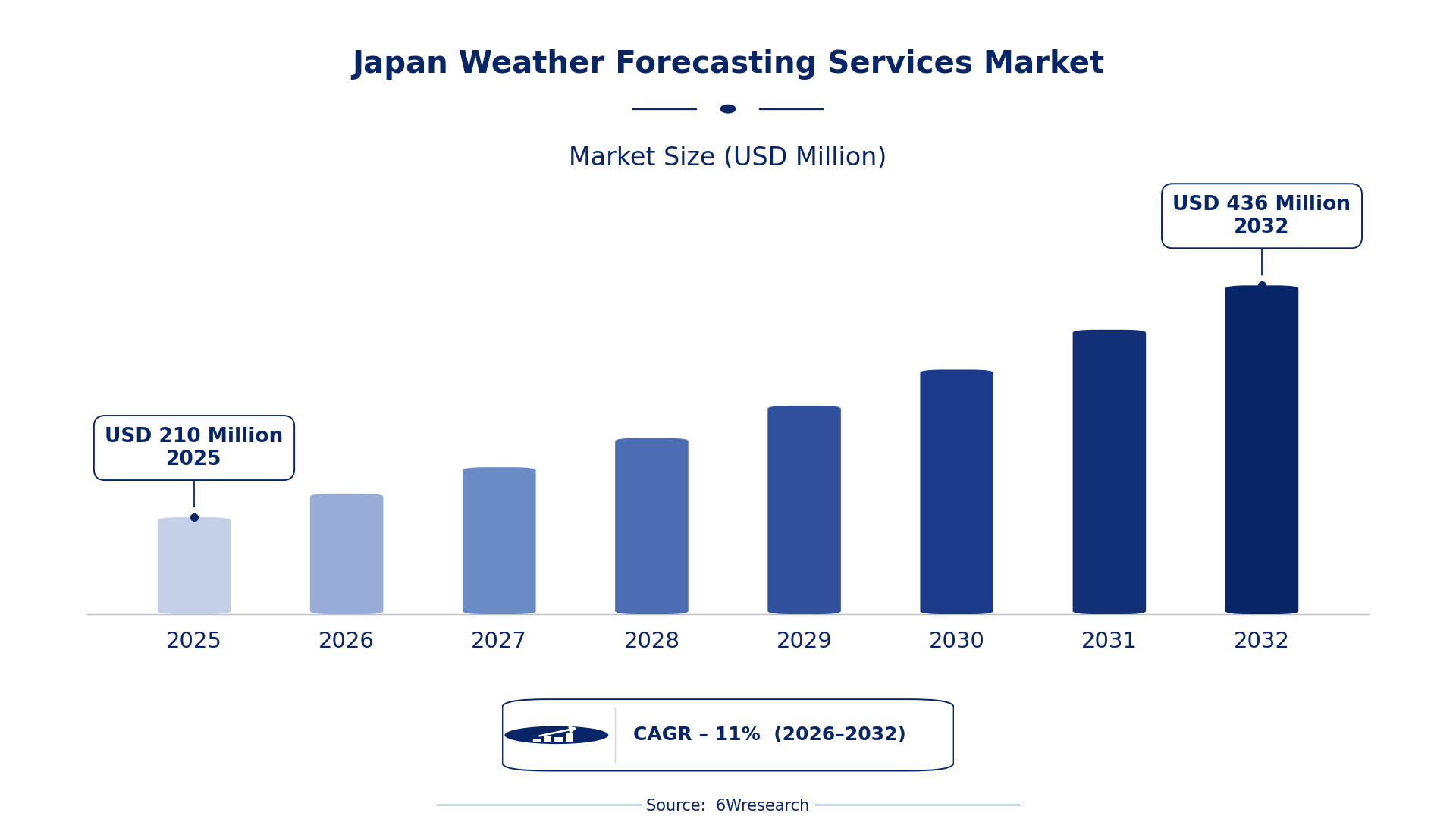
According to 6Wresearch internal database and industry insights, the Japan Weather Forecasting Services Market was valued at USD 210 Million in 2025 and is projected to reach USD 436 Million by 2032, growing at a CAGR of approximately 11% during 2026–2032.
Japan Weather Forecasting Services Market Highlights
| Report Metric | Details |
| Report Name | Japan Weather Forecasting Services Market (2026-2032) |
| Market Size 2025 | USD 210 Million |
| Market Size 2032 | USD 436 Million |
| Absolute Growth 2025–2032 | USD 226 Million |
| CAGR 2026–2032 | 11% |
| Peak Annual Growth | 12.5% in 2027 |
| Forecast Period | 2026–2032 |
| Historical Data | 2022–2025 |
| Base Year | 2025 |
| Leading Industry, 2025 | Aviation (30% share) |
| Leading Purpose, 2025 | Operational Efficiency (51% share) |
| Leading Forecast Type, 2025 | Nowcast (39% share) |
| Leading Organization Size, 2025 | Large Enterprises (65% share) |
| Fastest-Growing Industry | Energy & Utilities (14.6% CAGR) |
| Fastest-Growing Forecast Type | Short-Range (15.1% CAGR) |
| Fastest-Growing Organization Size | Small & Medium-Sized Enterprises (13.5% CAGR) |
| Growing Sector | Aviation |
| Key End Users | Aviation, Agriculture, Energy & Utilities, Marine |
Japan Weather Forecasting Services Market Year-wise Growth Rate and Key Drivers (2022–2032)
This graph illustrates the annual growth rates of the market from 2022 to 2032, highlighting a steady upward trajectory and projected market expansion over the forecast period.
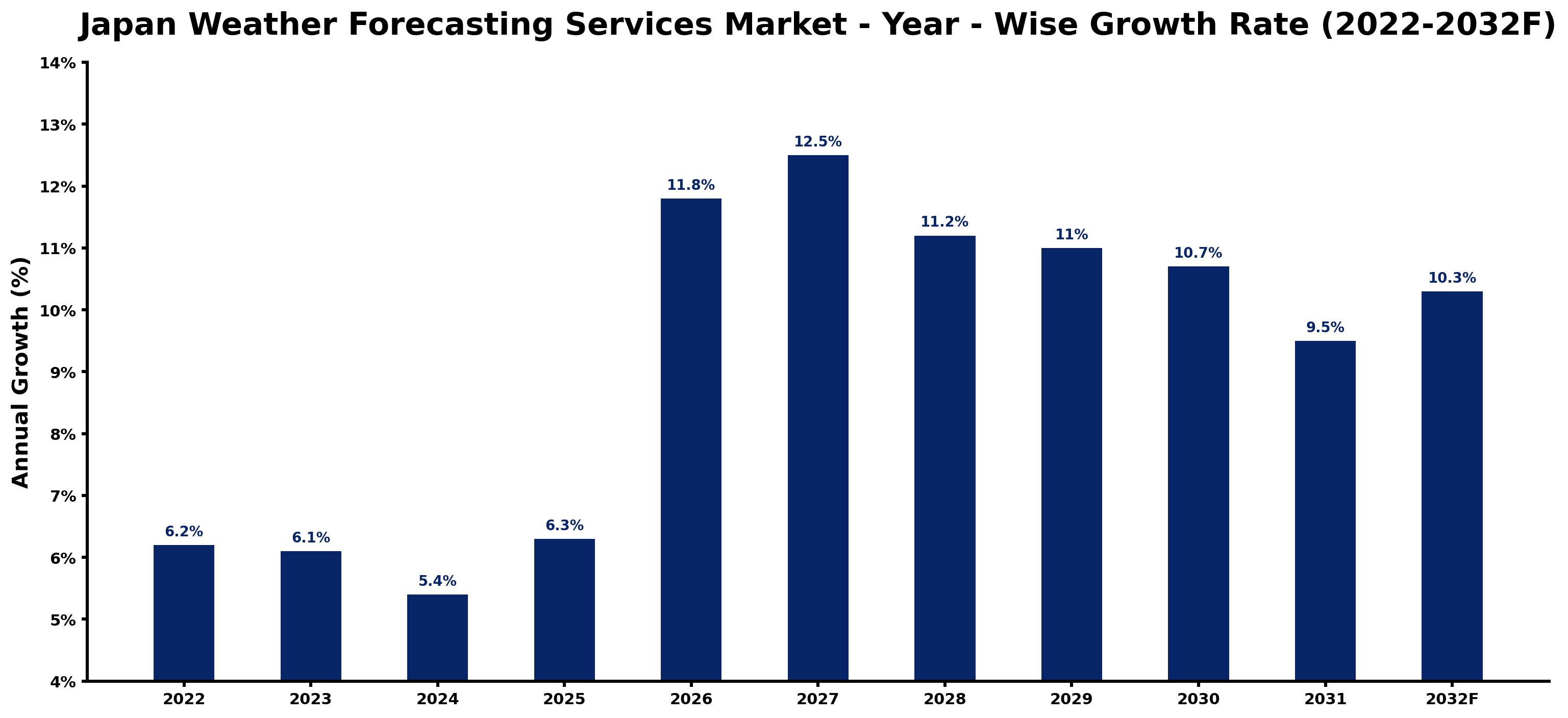
Each row of the following table gives one year's estimated growth and the event or demand shift that explains it.
| Year | Estimated Annual Growth (%) | Market Rationale |
| 2022 | 6.2 | The market experienced steady growth as urban demand for weather services increased. |
| 2023 | 6.1 | Growth slowed slightly as the aviation sector faced operational adjustments. |
| 2024 | 5.4 | The market continued to grow, driven by agricultural needs for accurate weather data. |
| 2025 | 6.3 | Growth accelerated as the aviation industry expanded, necessitating improved forecasting services. |
| 2026 | 11.8 | Demand surged as energy companies increasingly relied on weather forecasts for operational efficiency. |
| 2027 | 12.5 | The market peaked due to rising investments in advanced meteorological technologies. |
| 2028 | 11.2 | Growth slowed as market saturation began to affect new service adoption. |
| 2029 | 11.0 | Demand stabilised as established users continued to rely on existing forecasting services. |
| 2030 | 10.7 | Growth is expected to decelerate as the market matures and competition intensifies. |
| 2031 | 9.5 | The market is projected to show slower growth as buyers focus on cost efficiency in services. |
| 2032 | 10.3 | Growth is expected to pick up again due to renewed investments in climate adaptation technologies. |
Note: Market size estimations and growth projections presented in this report are based on 6Wresearch's proprietary forecasting methodology, utilizing the latest available industry data, government publications, and primary research inputs.
Japan Weather Forecasting Services Market Synopsis
Weather forecasting services utilise advanced meteorological technology and data analytics to predict weather patterns, essential for sectors such as aviation, agriculture, and energy management. In Japan, with a population of approximately 125 million, demand for these services is particularly high in urban areas like Tokyo and Osaka. The aviation industry operates over 1,000 flights daily, creating a need for precise weather data. The agricultural sector, contributing around 1% to GDP, relies heavily on forecasts for crop management, driving investment in these services. The increasing focus on disaster preparedness further amplifies the need for accurate weather forecasting, ensuring safety and operational efficiency across various sectors.
Market Dynamics Impact Analysis (2026–2032)
| Factor | Type | Impact | Primary Segment Affected |
| Increasing reliance on accurate weather data for aviation safety and scheduling | Driver | High | Aviation |
| Growing agricultural demands for precise weather forecasting to optimise crop yields | Driver | High | Agriculture |
| Expansion of renewable energy projects requiring weather data for operational efficiency | Opportunity | High | Energy & Utilities |
| Rising urbanisation leading to increased demand for real-time weather updates | Opportunity | Medium | Operational Efficiency |
| Market saturation limiting growth potential for new service providers | Restraint | High | Aviation |
| High operational costs associated with advanced forecasting technologies | Restraint | Medium | Energy & Utilities |
| Intense competition among service providers driving down prices | Challenge | High | Aviation |
| Technological advancements requiring continuous investment to remain competitive | Challenge | Medium | Energy & Utilities |
Evaluation of Drivers in Japan Weather Forecasting Services Market (2026–2032)
The factors lifting demand, and the evidence behind each, are summarised below.
| Drivers | Primary Segment Affected | Why It Matters (Evidence) |
| Increased flight operations requiring reliable weather forecasts for safety | Aviation | The aviation industry operates over 1,000 flights daily, necessitating accurate weather data for scheduling. |
| High dependency on weather forecasts for effective crop management | Agriculture | The agricultural sector contributes around 1% to GDP, heavily relying on weather forecasts for planning. |
| Demand for weather data in renewable energy management | Energy & Utilities | The energy sector utilises weather forecasts to optimise operations and energy demand forecasting, improving efficiency. |
| Urban population growth leading to higher demand for weather services | Operational Efficiency | Japan's population of approximately 125 million drives demand for accurate weather services in urban areas. |
| Integration of advanced technology in forecasting services | Marine | The Marine sector includes over 1,500 registered vessels, all requiring timely weather updates for navigation. |
Volumes grow on the back of increased flight operations, with the aviation industry operating over 1,000 flights daily, necessitating reliable weather forecasts for safety. The agricultural sector, contributing around 1% to GDP, heavily relies on accurate weather data for effective crop management. The energy sector increasingly utilises weather forecasts to optimise operations, driven by the demand for renewable energy solutions. Urban population growth further fuels the need for accurate weather services in urban areas. The Marine sector, comprising over 1,500 registered vessels, also requires timely weather updates to ensure safe navigation.
Evaluation of Restraints in Japan Weather Forecasting Services Market
Several factors work against faster growth; the main ones are summarised below.
| Market Restraint | Primary Segment Affected | Why It Matters (Evidence) |
| Market saturation limiting growth opportunities for new entrants | Aviation | Increased competition has led to a saturated market, making it difficult for new providers to gain traction. |
| High operational costs of advanced forecasting technologies | Energy & Utilities | Investments in sophisticated technology for accurate forecasting can be prohibitively expensive for some providers. |
| Regulatory compliance costs impacting service pricing | Agriculture | Compliance with quality management standards like ISO 9001 adds to operational costs for weather service providers. |
| Limited adoption of long-range forecasts due to accuracy concerns | Long-Range | Users prefer short-range forecasts as long-range predictions are often seen as less reliable. |
| Dependence on government funding for meteorological research | Marine | Research funding fluctuations can affect the development and availability of advanced forecasting services. |
Japan Weather Forecasting Services Market Challenges
Buyers of weather forecasting services encounter difficulties stemming from reliance on outdated technology, which delays the delivery of accurate weather data. This inefficiency can result in considerable crop losses for farmers, costing them approximately 1% of GDP. Competition from the Japan Meteorological Agency, which provides free forecasts, undermines the market share of private firms, limiting profitability for service providers. Technology gaps in data analytics impede precise forecasting capabilities, leading to operational disruptions for energy managers who depend on accurate weather information for effective energy management.
Trends in the Japan Weather Forecasting Services Market
The following changes are redrawing the Japan Weather Forecasting Services Market.
- Shift from Long-Range to Short-Range Forecasting: Since 2022, there has been a notable shift towards short-range forecasting, as users prefer immediate updates for day-to-day planning. This trend is particularly evident in urban centres like Tokyo, where timely information is critical.
- Emergence of Smart Agriculture Practices: The integration of technology in farming practices has increased significantly. This initiative has led to a 20% increase in technology adoption among farmers, enhancing crop management efficiency.
- Transition to Renewable Energy Forecasting: As Japan invests in renewable energy, the demand for weather forecasting services has increased significantly. The energy sector's reliance on accurate weather data for operational efficiency has risen, with forecasts becoming essential for managing renewable resources.
- Growing Importance of Disaster Preparedness: The Disaster Prevention and Mitigation Act has heightened the focus on weather forecasting for disaster management. This shift is reflected in increased funding for meteorological research, with the government investing over $10 million annually.
Investment Opportunities in the Japan Weather Forecasting Services Market
The opportunities below stand out in the Japan Weather Forecasting Services Market for new entrants and existing suppliers.
- Weather Forecasting Services for Aviation: The aviation sector requires precise weather forecasting services, especially in urban areas like Tokyo. With over 1,000 flights daily, there is a pressing need for reliable data to ensure safety and efficient scheduling.
- Forecasting Services for Agriculture: The agricultural sector is increasingly adopting weather forecasting services to optimise crop yields. With Japan's agricultural policies supporting technology use, farmers are seeking reliable data to improve planning and management.
- Marine Weather Forecasting Services: The Marine sector, comprising over 1,500 registered vessels, needs accurate weather updates for navigation. This presents an opportunity for providers to improve their service offerings tailored to maritime safety.
- Energy Sector Forecasting Services: The growing demand for renewable energy solutions has created a need for weather forecasting services in the energy sector. With investments in clean energy rising, accurate weather data is essential for operational efficiency.
Government Initiatives in the Japan Weather Forecasting Services Market
The Waste Management and Public Cleansing Act of 1970 regulates the treatment of industrial waste, impacting weather forecasting services by ensuring that meteorological data used in environmental assessments is reliable. The Disaster Prevention and Mitigation Act emphasises the importance of accurate weather forecasting in disaster preparedness, mandating regular updates and alerts from forecasting agencies.
The government allocates over $10 million annually through the Meteorological Research Institute to support meteorological research and forecasting capabilities. The Japan Meteorological Agency oversees these initiatives, ensuring compliance with national standards and facilitating the integration of advanced forecasting technologies.
Future Insight of the Japan Weather Forecasting Services Market
By 2032, a shift in government policy will drive advancements in weather forecasting services, with the National Resilience Program enhancing forecasting capabilities. Improved satellite data and radar technology will increase forecast accuracy, benefiting buyers in sectors like energy and agriculture. Suppliers will respond by adopting these technologies, enabling them to provide more reliable predictions. The insurance industry will leverage enhanced data for better risk assessments, while the marine sector will see improved safety measures for over 1,500 registered vessels.
Market Segmentation Analysis
Japan Weather Forecasting Services Market report covers a detailed analysis of the following market segments:
By Industry – Aviation Leads, Energy & Utilities Expected to Grow Fastest
According to Summon Dutta, Assistant Manager at 6Wresearch, Aviation accounted for 30% of the market by industry in 2025. The aviation sector commands the largest share due to its critical reliance on accurate weather data for the safety and scheduling of over 1,000 daily flights. This demand is underscored by the rigorous standards set by the Japan Meteorological Agency to support flight operations. Energy & Utilities are set to record the highest CAGR in this split, 14.6% over 2026–2032. The energy and utilities segment is experiencing rapid growth as this industry increasingly utilises weather forecasts for operational efficiency, especially in the context of renewable energy. The government's Green Growth Strategy, which includes provisions for climate adaptation, is a significant factor propelling this expansion. Suppliers should focus on developing tailored services for the energy sector to capitalise on its growing demand.
By Purpose – Operational Efficiency Leads and Records the Fastest Growth
Operational Efficiency held 51% of the Japan Weather Forecasting Services Market by purpose in 2025. Operational efficiency is the leading purpose for weather forecasting services as it significantly enhances productivity across sectors such as aviation and energy management, where precise data is essential. This focus on efficiency is bolstered by government initiatives that advocate for technological integration in various industries. Its lead should widen, with a projected CAGR of 13.7% during 2026–2032, the highest in this split. The operational efficiency segment is also the fastest-growing, as businesses increasingly recognise the value of real-time weather data for optimising their operations. This trend is expected to persist as advancements in forecasting technology are showcased at industry conferences and adopted widely. Buyers must invest in advanced forecasting services to maintain competitive advantages in their operations.
By Forecast Type – Nowcast Leads, Short-Range Expected to Grow Fastest
With 39% of forecast type revenue in 2025, Nowcast was the largest category. Nowcast services dominate the market as they provide immediate weather updates that are crucial for sectors like aviation, where timely information is vital for decision-making. The high density of weather stations in urban areas like Tokyo further enhances the reliability of these services. Over 2026–2032, Short-Range is expected to post the fastest growth, at a CAGR of 15.1%. Short-range forecasting is the fastest-growing type, driven by its significance in daily planning across various industries. The increasing demand for precise and timely information to guide operational decisions supports this growth trajectory. Suppliers should prioritise the enhancement of short-range forecasting capabilities to meet the rising market needs.
By Organization Size – Large Enterprises Lead, Small & Medium-Sized Enterprises Expected to Grow Fastest
The largest organization size category in 2025 was Large Enterprises, at 65% of revenue. Large enterprises hold the largest market share as they are substantial users of forecasting services, employing them for extensive operational planning and risk management. Their scale allows for a more comprehensive integration of weather data into strategic decision-making processes. Small & Medium-Sized Enterprises are projected to grow fastest, at a CAGR of 13.5% during 2026–2032. Small and medium-sized enterprises represent the fastest-growing segment as they increasingly acknowledge the benefits of weather forecasts for their operational planning, albeit on a smaller scale. This trend is likely to accelerate as more cost-effective forecasting solutions become available. Suppliers should customise their offerings to meet the specific requirements of small and medium-sized enterprises to tap into this emerging market.
Key Attractiveness of the Report
- 10 Years of Market Numbers
- Historical Data Starting from 2022 to 2025
- Base Year 2025
- Forecast Data until 2032
- Key Performance Indicators Impacting the Market
- Major Upcoming Developments and Projects
Key Highlights of the Report:
- Japan Weather Forecasting Services Market Outlook
- Market Size of Japan Weather Forecasting Services Market, 2025
- Forecast of Japan Weather Forecasting Services Market, 2032
- Historical Data and Forecast of Japan Weather Forecasting Services Revenues & Volume for the Period 2022-2032
- Japan Weather Forecasting Services Market Trend Evolution
- Japan Weather Forecasting Services Market Drivers and Challenges
- Japan Weather Forecasting Services Price Trends
- Japan Weather Forecasting Services Porter's Five Forces
- Japan Weather Forecasting Services Industry Life Cycle
- Historical Data and Forecast of Japan Weather Forecasting Services Market Revenues & Volume By Industry for the Period 2022-2032
- Historical Data and Forecast of Japan Weather Forecasting Services Market Revenues & Volume By Aviation for the Period 2022-2032
- Historical Data and Forecast of Japan Weather Forecasting Services Market Revenues & Volume By Agriculture for the Period 2022-2032
- Historical Data and Forecast of Japan Weather Forecasting Services Market Revenues & Volume By Marine for the Period 2022-2032
- Historical Data and Forecast of Japan Weather Forecasting Services Market Revenues & Volume By Oil & Gas for the Period 2022-2032
- Historical Data and Forecast of Japan Weather Forecasting Services Market Revenues & Volume By Energy & Utilities for the Period 2022-2032
- Historical Data and Forecast of Japan Weather Forecasting Services Market Revenues & Volume By Insurance for the Period 2022-2032
- Historical Data and Forecast of Japan Weather Forecasting Services Market Revenues & Volume By Retail for the Period 2022-2032
- Historical Data and Forecast of Japan Aviation Weather Forecasting Services Market Revenues & Volume By Media for the Period 2022-2032
- Historical Data and Forecast of Japan Weather Forecasting Services Market Revenues & Volume By Purpose for the Period 2022-2032
- Historical Data and Forecast of Japan Weather Forecasting Services Market Revenues & Volume By Operational Efficiency for the Period 2022-2032
- Historical Data and Forecast of Japan Weather Forecasting Services Market Revenues & Volume By Safety for the Period 2022-2032
- Historical Data and Forecast of Japan Weather Forecasting Services Market Revenues & Volume By Others for the Period 2022-2032
- Historical Data and Forecast of Japan Weather Forecasting Services Market Revenues & Volume By Forecast Type for the Period 2022-2032
- Historical Data and Forecast of Japan Weather Forecasting Services Market Revenues & Volume By Nowcast for the Period 2022-2032
- Historical Data and Forecast of Japan Weather Forecasting Services Market Revenues & Volume By Short-Range for the Period 2022-2032
- Historical Data and Forecast of Japan Weather Forecasting Services Market Revenues & Volume By Medium-Range for the Period 2022-2032
- Historical Data and Forecast of Japan Weather Forecasting Services Market Revenues & Volume By Extended-Range for the Period 2022-2032
- Historical Data and Forecast of Japan Weather Forecasting Services Market Revenues & Volume By Long-Range for the Period 2022-2032
- Historical Data and Forecast of Japan Weather Forecasting Services Market Revenues & Volume By Organization Size for the Period 2022-2032
- Historical Data and Forecast of Japan Weather Forecasting Services Market Revenues & Volume By Large Enterprises for the Period 2022-2032
- Historical Data and Forecast of Japan Weather Forecasting Services Market Revenues & Volume By Small & Medium-Sized Enterprises for the Period 2022-2032
- Japan Weather Forecasting Services Import Export Trade Statistics
- Market Opportunity Assessment By Industry
- Market Opportunity Assessment By Purpose
- Market Opportunity Assessment By Forecast Type
- Market Opportunity Assessment By Organization Size
- Japan Weather Forecasting Services Top Companies Market Share
- Japan Weather Forecasting Services Competitive Benchmarking By Technical and Operational Parameters
- Japan Weather Forecasting Services Company Profiles
- Japan Weather Forecasting Services Key Strategic Recommendations
Market Covered
The report covers the following segments.
By Industry
- Aviation
- Agriculture
- Marine
- Oil & Gas
- Energy & Utilities
- Insurance
- Retail
- Media
By Purpose
- Operational Efficiency
- Safety
- Others
By Forecast Type
- Nowcast
- Short-Range
- Medium-Range
- Extended-Range
- Long-Range
By Organization Size
- Large Enterprises
- Small & Medium-Sized Enterprises































