Japan Welding Market Size & Growth Rate
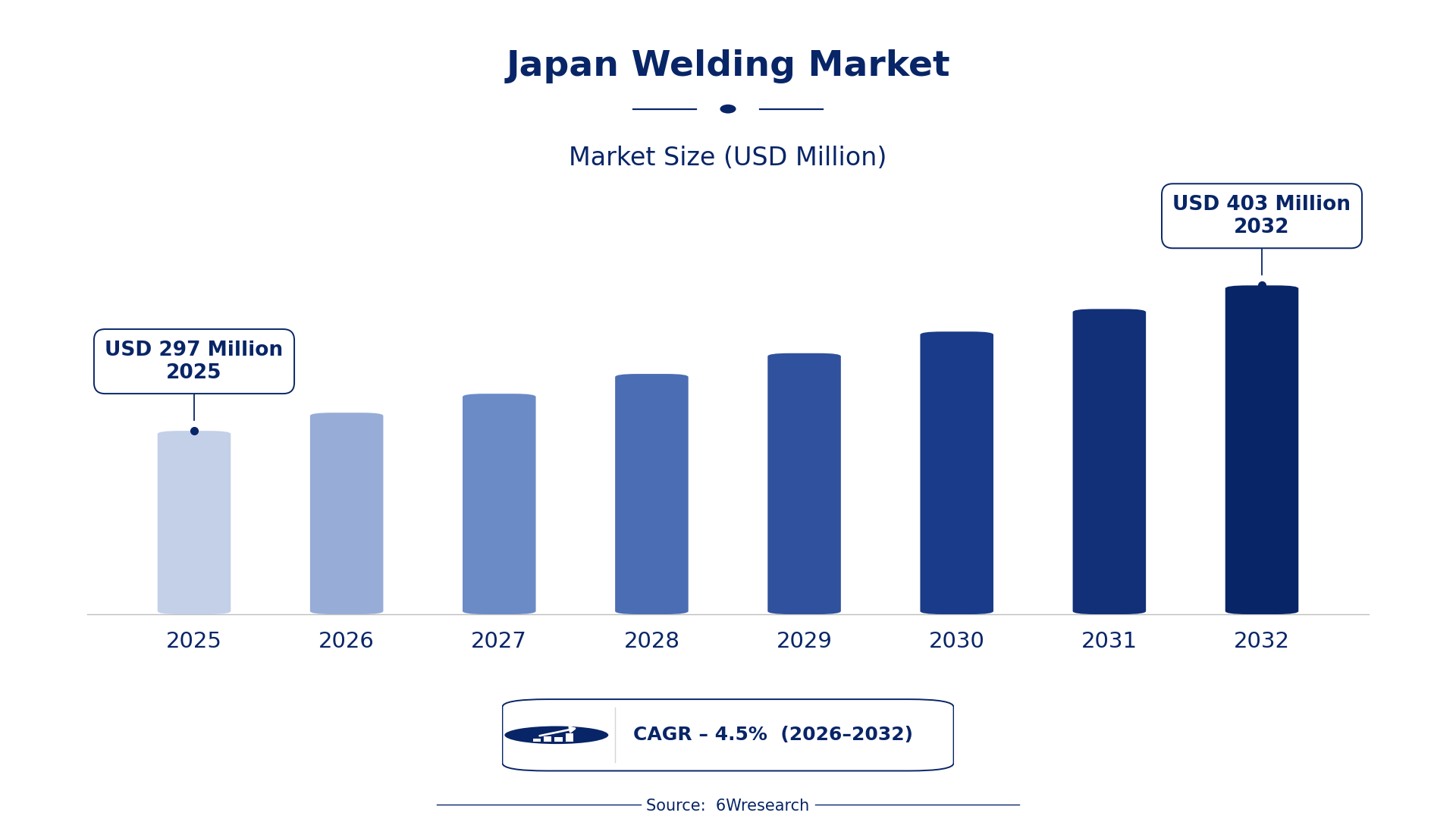
According to 6Wresearch internal database and industry insights, the Japan Welding Market was valued at USD 297 Million in 2025 and is projected to reach USD 403 Million by 2032, growing at a CAGR of approximately 4.5% during 2026–2032.
Japan Welding Market Highlights
| Report Metric | Details |
| Report Name | Japan Welding Market (2026-2032) |
| Market Size 2025 | USD 297 Million |
| Market Size 2032 | USD 403 Million |
| Absolute Growth 2025–2032 | USD 106 Million |
| CAGR 2026–2032 | 4.5% |
| Peak Annual Growth | 5.0% in 2032 |
| Forecast Period | 2026–2032 |
| Historical Data | 2022–2025 |
| Base Year | 2025 |
| Leading Welding Type, 2025 | Arc Welding (MMA) (43% share) |
| Leading Power Source, 2025 | Portable (32% share) |
| Leading Application Area, 2025 | Construction & Repair (47% share) |
| Leading End User, 2025 | Field Welders (49% share) |
| Fastest-Growing Welding Type | MIG / MAG Welding (6.5% CAGR) |
| Fastest-Growing Power Source | Grid-Source (7.0% CAGR) |
| Fastest-Growing Application Area | Automotive (6.0% CAGR) |
| Fastest-Growing End User | Workshops (6.1% CAGR) |
| Growing Sector | Construction |
| Key End Users | Field Welders, Specialized Manufacturers, Automotive Sector, Aerospace Sector |
Japan Welding Market Year-wise Growth Rate and Key Drivers (2022–2032)
This graph illustrates the annual growth rates of the market from 2022 to 2032, highlighting a steady upward trajectory and projected market expansion over the forecast period.
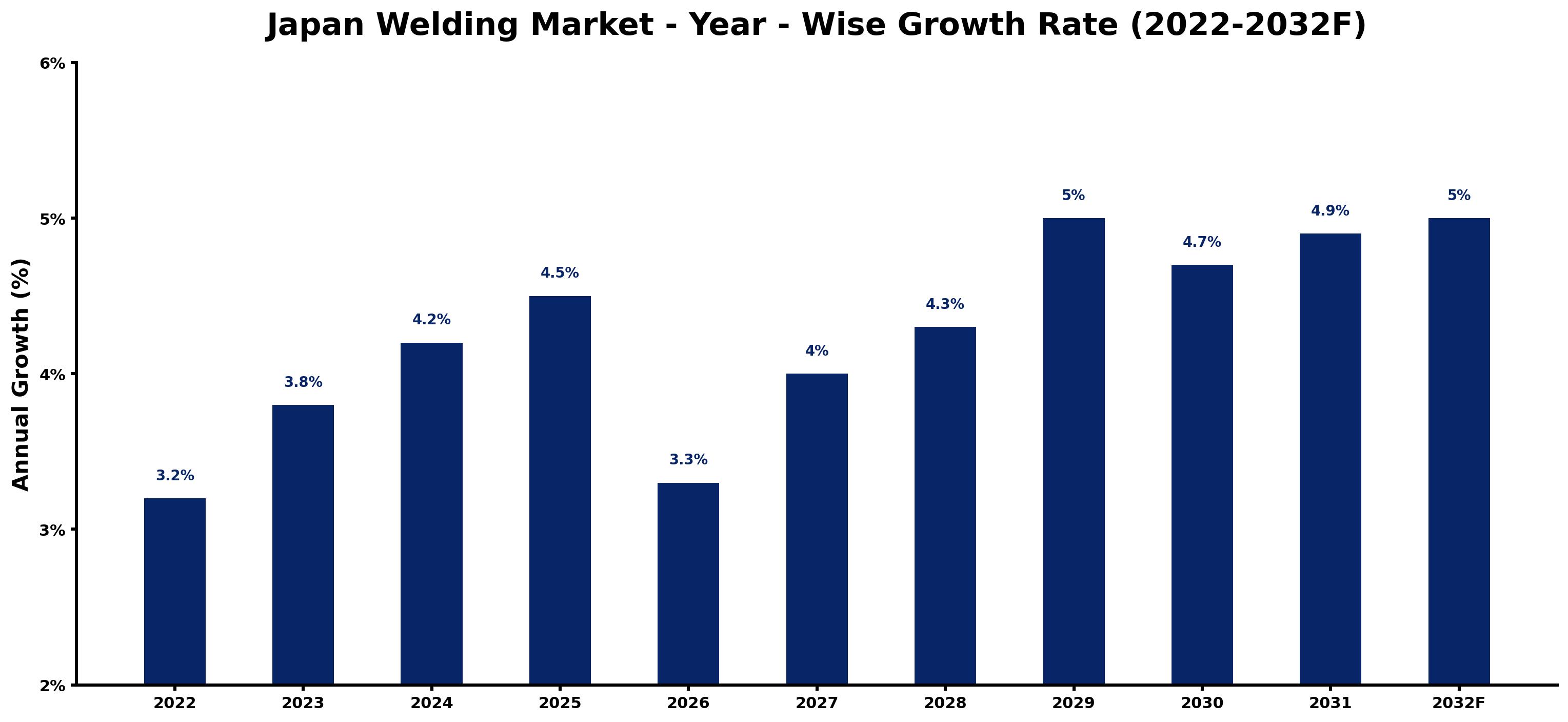
The following figures match every annual growth estimate with the main market development of that year, giving the reasoning behind each rise or slowdown.
| Year | Estimated Annual Growth (%) | Market Rationale |
| 2022 | 3.2 | The market experienced steady demand from construction and automotive sectors. |
| 2023 | 3.8 | Growth accelerated as infrastructure projects gained traction in urban areas. |
| 2024 | 4.2 | Increased automotive production further boosted welding requirements across facilities. |
| 2025 | 4.5 | The peak growth year saw investments in advanced welding technologies. |
| 2026 | 3.3 | Growth slowed as the market adjusted to the previous peak in demand. |
| 2027 | 4.0 | Demand rose again due to increasing automotive and aerospace production levels. |
| 2028 | 4.3 | The construction sector's expansion continued to drive welding needs. |
| 2029 | 5.0 | Growth peaked again as the aerospace industry expanded its production capacity. |
| 2030 | 4.7 | A slight slowdown occurred as the market stabilised post-peak growth. |
| 2031 | 4.9 | Demand increased again, supported by ongoing infrastructure projects. |
| 2032 | 5.0 | The market is projected to peak again due to rising technology adoption. |
Note: Market size estimations and growth projections presented in this report are based on 6Wresearch's proprietary forecasting methodology, utilizing the latest available industry data, government publications, and primary research inputs.
Japan Welding Market Synopsis
Welding is a critical process for joining materials, primarily metals, using techniques such as arc, MIG, and TIG welding. The Japan Welding Market is valued at approximately 500 billion yen annually, driven by strong demand from the automotive sector, which produced over 8 million vehicles in 2022. Factors such as projected growth in aerospace and construction sectors, alongside advancements in welding technology, are contributing to this positive market outlook.
Market Dynamics Impact Analysis (2026–2032)
| Factor | Type | Impact | Primary Segment Affected |
| Increased infrastructure projects drive demand for welding services. | Driver | High | Construction & Repair |
| The automotive sector's growth fuels the need for advanced welding techniques. | Driver | High | Automotive |
| The growing aerospace industry presents new opportunities for welding applications. | Opportunity | High | Aerospace |
| Rising demand for medical devices creates a need for precision welding. | Opportunity | Medium | Medical Devices |
| A shortage of skilled welders limits the industry's growth potential. | Restraint | High | Field Welders |
| High costs of advanced welding equipment may deter investment. | Restraint | Medium | Arc Welding (MMA) |
| The need for compliance with stringent quality standards increases operational costs. | Challenge | High | Arc Welding (MMA) |
| Technological advancements require constant upskilling of the workforce. | Challenge | Medium | Arc Welding (MMA) |
Evaluation of Drivers in Japan Welding Market (2026–2032)
The following drivers explain most of the expected growth.
| Drivers | Primary Segment Affected | Why It Matters (Evidence) |
| Rising construction projects increase demand for welding services. | Construction & Repair | The construction sector is projected to require 20% more welders by 2025 due to infrastructure projects. |
| Automotive production growth drives the need for welding. | Automotive | The automotive sector produced over 8 million vehicles in 2022, boosting welding demands. |
| Aerospace industry expansion increases welding requirements. | Aerospace | The aerospace industry in Japan is projected to grow, increasing welding demand. |
| Technological advancements in welding equipment attract investments. | Arc Welding (MMA) | Welding equipment imports reached 30 billion yen in 2022, indicating high technology demand. |
| Increasing production of medical devices requires high-precision welding. | Medical Devices | Welding is essential in the fabrication of medical devices, with strict regulatory standards. |
What keeps demand rising is the ongoing expansion of the construction sector, which will require 20% more welders by 2025 due to various infrastructure projects. In 2022, the automotive sector produced over 8 million vehicles, boosting the need for welding services. The aerospace industry is set to grow, leading to increased welding requirements for structural integrity. In 2022, welding equipment imports reached 30 billion yen, reflecting the industry's technological advancements and investment opportunities.
Evaluation of Restraints in Japan Welding Market
The main factors holding the market back are set out below.
| Market Restraint | Primary Segment Affected | Why It Matters (Evidence) |
| A shortage of skilled welders limits growth potential. | Field Welders | With over 120,000 registered welders as of 2023, the industry faces a talent gap. |
| High costs of advanced welding equipment may deter investment. | Arc Welding (MMA) | Investment in advanced welding technologies can be prohibitive for smaller manufacturers. |
| Compliance with stringent quality standards increases operational costs. | Arc Welding (MMA) | ISO 3834 is a key standard that requires rigorous quality assurance processes. |
| Technological advancements require constant upskilling of the workforce. | Arc Welding (MMA) | Training programs in over 200 vocational schools highlight the skills gap. |
| Market fluctuations affect long-term planning for welding services. | Construction & Repair | Economic uncertainties can lead to unpredictable demand in the construction sector. |
Japan Welding Market Challenges
Producers face rising costs due to compliance with ISO 3834, which enforces stringent quality standards, increasing operational expenses by up to 15% for construction firms. Importers struggle with supply chain disruptions as welding equipment imports reached 30 billion yen in 2022, leading to project delays for automotive manufacturers. Technology gaps exist as domestic welding practices lag behind global advancements, causing inefficiencies that can extend production times by 10% for medical device fabricators. Buyers encounter intensified competition as the construction sector projects a 20% increase in welder demand by 2025, driving up labour costs for firms.
Trends in the Japan Welding Market
Four trends stand out in the Japan Welding Market.
- Shift from Traditional to Advanced Welding Techniques: The Tokyo region is adopting advanced welding technologies, focusing on automation and precision. In 2022, welding equipment imports reached 25 billion yen, indicating a strong shift towards modern methods.
- Growing Demand for Precision Welding in Medical Devices: The medical device sector is increasingly adopting high-precision welding techniques. This shift is driven by the need for stringent quality standards, with the industry projected to expand by 10% in the coming years.
- Expansion of Welding Training Programs Nationwide: Welding training programs are implemented in over 200 vocational schools across Japan. This initiative aims to address the skills gap and support the increasing demand for qualified welders, with an expected 15% increase in enrolment.
- Increased Focus on Sustainable Welding Practices: The construction sector is prioritising sustainable welding practices to reduce environmental impact. This trend aligns with Japan's broader commitment to sustainability and will shape future welding standards.
Investment Opportunities in the Japan Welding Market
The opportunities below stand out in the Japan Welding Market for new entrants and existing suppliers.
- Construction Sector Seeking Skilled Welders: Field welders are in high demand as the construction sector anticipates a 20% increase in requirements by 2025. Collaborating with local vocational schools can help bridge the skills gap.
- Aerospace Industry Expansion Creates Welding Demand: The aerospace sector is projected to grow, necessitating advanced welding solutions. Suppliers can enter this market by partnering with specialized manufacturers in the Tokyo region.
- Rising Medical Device Production Needs Precision Welding: Medical device manufacturers are increasingly seeking high-precision welding services. Establishing joint ventures with local firms can facilitate entry into this evolving market.
- Investment in Advanced Welding Technologies: The growing demand for advanced welding equipment presents opportunities for suppliers. Engaging with specialized manufacturers can help capture market share in this sector.
Government Initiatives in the Japan Welding Market
Policy measures impact welding producers and buyers in Japan. The Semiconductor and Digital Industry Strategy, initiated by METI in June 2021, aims to secure domestic semiconductor manufacturing, indirectly benefiting welding technology through increased demand for precision applications. Additionally, the PMDA oversees the approval and quality of medical devices, ensuring that welding standards meet regulatory requirements.
In 2022, the Ministry of Economy, Trade and Industry funded various welding technology development programs. These initiatives support advancements in welding practices, with the Japan Welding Engineering Society promoting innovation in the sector. The funding aims to improve the capabilities of over 120,000 registered welders, ensuring compliance with international standards.
Future Insight of the Japan Welding Market
By 2032, government initiatives will drive advancements in welding technology, prompting suppliers to adopt new standards. Automation will enhance efficiency in welding processes, benefiting producers across various sectors. The construction sector will require a more skilled workforce, leading to the establishment of new training programs in vocational schools. With the automotive sector producing over 8 million vehicles annually, the demand for skilled welders will increase, necessitating a focus on workforce development.
Market Segmentation Analysis
Japan Welding Market report covers a detailed analysis of the following market segments:
By Welding Type – Arc Welding (MMA) Leads, MIG / MAG Welding Expected to Grow Fastest
According to Vasu Joshi, Associate Consultant at 6Wresearch, Arc Welding (MMA) held 43% of the Japan Welding Market by welding type in 2025. Arc welding maintains the largest share in Japan due to its extensive use in construction and repair applications. This technique is vital for infrastructure projects, ensuring robust joints that meet safety and durability standards. Over 2026–2032, MIG / MAG Welding is expected to post the fastest growth, at a CAGR of 6.5%. MIG/MAG welding is experiencing rapid growth as it becomes the preferred choice in the automotive sector, which produced over 8 million vehicles in 2022. Its speed and efficiency cater to the high-volume production needs of this industry, driving its expansion. This trend suggests that suppliers must focus on enhancing MIG/MAG capabilities to meet the automotive sector's rising requirements.
By Power Source – Portable Leads, Grid-Source Expected to Grow Fastest
The largest power source category in 2025 was Portable, at 32% of revenue. Portable power sources dominate the market as they are essential for field welding applications, allowing welders to perform tasks in various locations. Their convenience and adaptability make them the preferred choice for many professionals. Grid-Source is set to record the highest CAGR in this split, 7.0% over 2026–2032. Grid-source power is gaining traction as industries seek reliable solutions for stationary applications, although it remains less common than portable options. The need for consistent power in workshops is driving this growth. Buyers may benefit from exploring grid-source options to improve efficiency in fixed operations.
By Application Area – Construction & Repair Leads, Automotive Expected to Grow Fastest
Construction & Repair took 47% of application area revenue in 2025, more than any other category. The construction and repair sector leads the market as it is the primary application area for welding, driven by ongoing infrastructure projects across Japan. The demand for skilled welders in this field continues to rise, reflecting the sector's importance. The quickest growth will come from Automotive, forecast to expand at a CAGR of 6.0% between 2026 and 2032. The automotive industry is rapidly expanding its use of welding, particularly with the production of over 8 million vehicles in 2022. This surge in automotive manufacturing is propelling the demand for advanced welding techniques. Suppliers should align their strategies to cater to the automotive sector's increasing requirements for welding solutions.
By End User – Field Welders Lead, Workshops Expected to Grow Fastest
With 49% of end user revenue in 2025, Field Welders was the largest category. Field welders constitute the largest user group as they depend on portable welding equipment for on-site applications. Their extensive presence across various sectors highlights the critical role of portable solutions in meeting diverse welding needs. Workshops are projected to grow fastest, at a CAGR of 6.1% during 2026–2032. Workshops are the fastest-growing user segment as they adapt to a variety of welding tasks, indicating a shift towards more complex projects. This trend suggests an increasing demand for adaptable welding equipment in these environments. Suppliers should tailor their products to cater to the specific requirements of workshop settings.
Key Attractiveness of the Report
- 10 Years of Market Numbers
- Historical Data Starting from 2022 to 2025
- Base Year 2025
- Forecast Data until 2032
- Key Performance Indicators Impacting the Market
- Major Upcoming Developments and Projects
Key Highlights of the Report:
- Japan Welding Market Outlook
- Market Size of Japan Welding Market, 2025
- Forecast of Japan Welding Market, 2032
- Historical Data and Forecast of Japan Welding Revenues & Volume for the Period 2022-2032F
- Japan Welding Market Trend Evolution
- Japan Welding Market Drivers and Challenges
- Japan Welding Price Trends
- Japan Welding Porter's Five Forces
- Japan Welding Industry Life Cycle
- Historical Data and Forecast of Japan Welding Market Revenues & Volume By Welding Type for the Period 2022-2032F
- Historical Data and Forecast of Japan Welding Market Revenues & Volume By Arc Welding (MMA) for the Period 2022-2032F
- Historical Data and Forecast of Japan Welding Market Revenues & Volume By MIG / MAG Welding for the Period 2022-2032F
- Historical Data and Forecast of Japan Welding Market Revenues & Volume By TIG Welding for the Period 2022-2032F
- Historical Data and Forecast of Japan Welding Market Revenues & Volume By Laser Welding for the Period 2022-2032F
- Historical Data and Forecast of Japan Welding Market Revenues & Volume By Power Source for the Period 2022-2032F
- Historical Data and Forecast of Japan Welding Market Revenues & Volume By Portable, Grid-Source for the Period 2022-2032F
- Historical Data and Forecast of Japan Welding Market Revenues & Volume By Electric, Gas Shielded for the Period 2022-2032F
- Historical Data and Forecast of Japan Welding Market Revenues & Volume By DC/AC Power for the Period 2022-2032F
- Historical Data and Forecast of Japan Welding Market Revenues & Volume By High-Precision Laser for the Period 2022-2032F
- Historical Data and Forecast of Japan Welding Market Revenues & Volume By Application Area for the Period 2022-2032F
- Historical Data and Forecast of Japan Welding Market Revenues & Volume By Construction & Repair for the Period 2022-2032F
- Historical Data and Forecast of Japan Welding Market Revenues & Volume By Automotive, Fabrication for the Period 2022-2032F
- Historical Data and Forecast of Japan Welding Market Revenues & Volume By Aerospace, Precision Work for the Period 2022-2032F
- Historical Data and Forecast of Japan Welding Market Revenues & Volume By Electronics, Medical Devices for the Period 2022-2032F
- Historical Data and Forecast of Japan Welding Market Revenues & Volume By End User for the Period 2022-2032F
- Historical Data and Forecast of Japan Welding Market Revenues & Volume By Field Welders, Workshops for the Period 2022-2032F
- Historical Data and Forecast of Japan Welding Market Revenues & Volume By Auto Shops, Fab Shops for the Period 2022-2032F
- Historical Data and Forecast of Japan Welding Market Revenues & Volume By Specialized Manufacturers for the Period 2022-2032F
- Historical Data and Forecast of Japan Welding Market Revenues & Volume By Tech Industry for the Period 2022-2032F
- Japan Welding Import Export Trade Statistics
- Market Opportunity Assessment By Welding Type
- Market Opportunity Assessment By Power Source
- Market Opportunity Assessment By Application Area
- Market Opportunity Assessment By End User
- Japan Welding Top Companies Market Share
- Japan Welding Competitive Benchmarking By Technical and Operational Parameters
- Japan Welding Company Profiles
- Japan Welding Key Strategic Recommendations
Market Covered
Segments analysed in this report are listed below.
By Welding Type
- Arc Welding (MMA)
- MIG / MAG Welding
- TIG Welding
- Laser Welding
By Power Source
- Portable
- Grid-Source
- Electric
- Gas Shielded
- DC/AC Power
- High-Precision Laser
By Application Area
- Construction & Repair
- Automotive
- Fabrication
- Aerospace
- Precision Work
- Electronics
- Medical Devices
By End User
- Field Welders
- Workshops
- Auto Shops
- Fab Shops
- Specialized Manufacturers
- Tech Industry































