Japan Wheelchair Market Size & Growth Rate
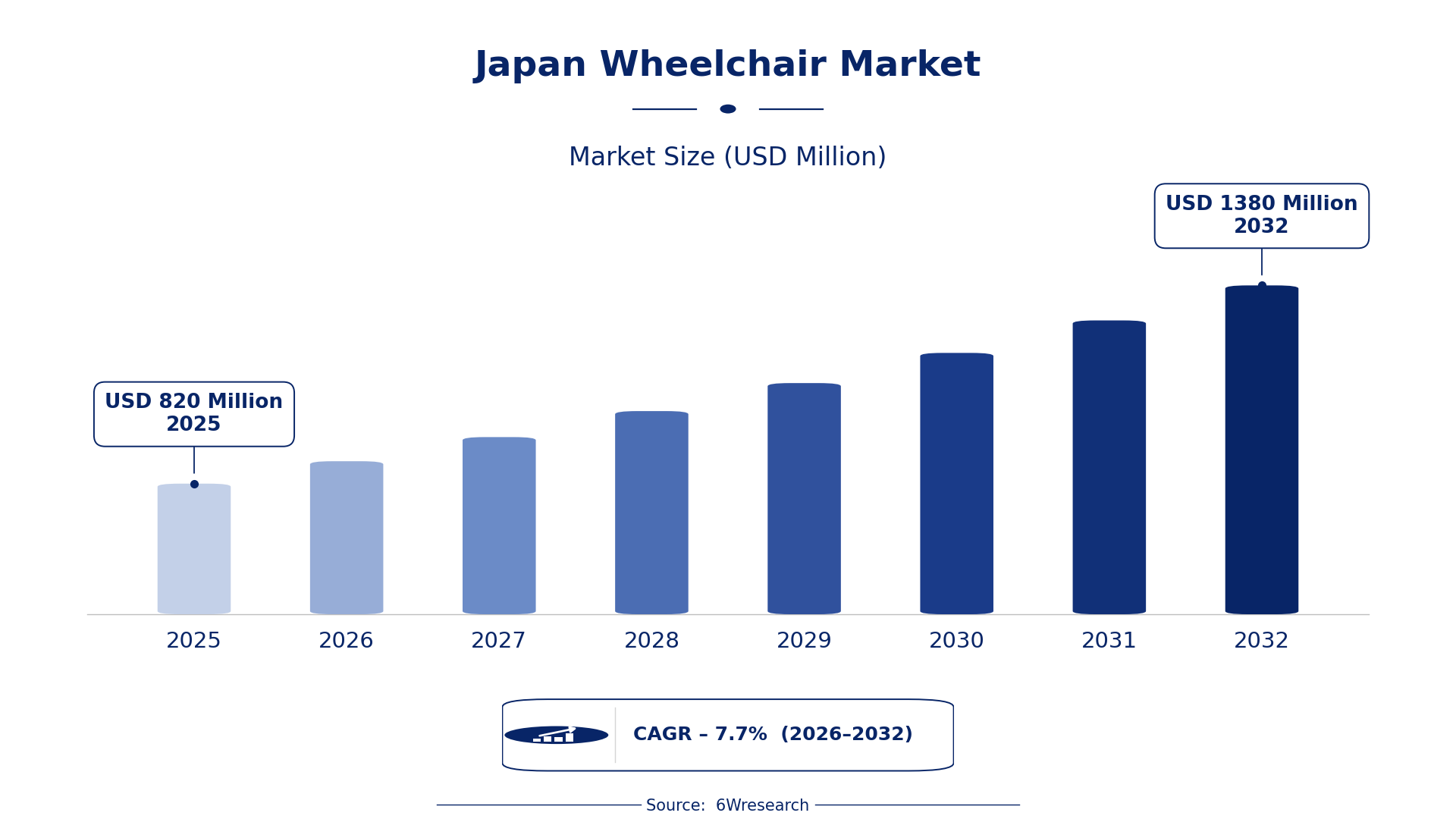
According to 6Wresearch internal database and industry insights, the Japan Wheelchair Market was valued at USD 820 Million in 2025 and is projected to reach USD 1,380 Million by 2032, growing at a CAGR of approximately 7.7% during 2026–2032.
Japan Wheelchair Market Highlights
| Report Metric | Details |
| Report Name | Japan Wheelchair Market (2026-2032) |
| Market Size 2025 | USD 820 Million |
| Market Size 2032 | USD 1,380 Million |
| Absolute Growth 2025–2032 | USD 560 Million |
| CAGR 2026–2032 | 7.7% |
| Peak Annual Growth | 9.4% in 2032 |
| Forecast Period | 2026–2032 |
| Historical Data | 2022–2025 |
| Base Year | 2025 |
| Leading Type, 2025 | Manual (69% share) |
| Leading Applications, 2025 | Standard Wheelchair (47% share) |
| Fastest-Growing Type | Powered (10.5% CAGR) |
| Fastest-Growing Applications | Bariatrich Wheelchair (10.3% CAGR) |
| Growing Sector | Bariatrich Wheelchair |
| Key End Users | Standard Wheelchair, Bariatrich Wheelchair, Sports Wheelchair |
Japan Wheelchair Market Year-wise Growth Rate and Key Drivers (2022–2032)
This graph illustrates the annual growth rates of the market from 2022 to 2032, highlighting a steady upward trajectory and projected market expansion over the forecast period.
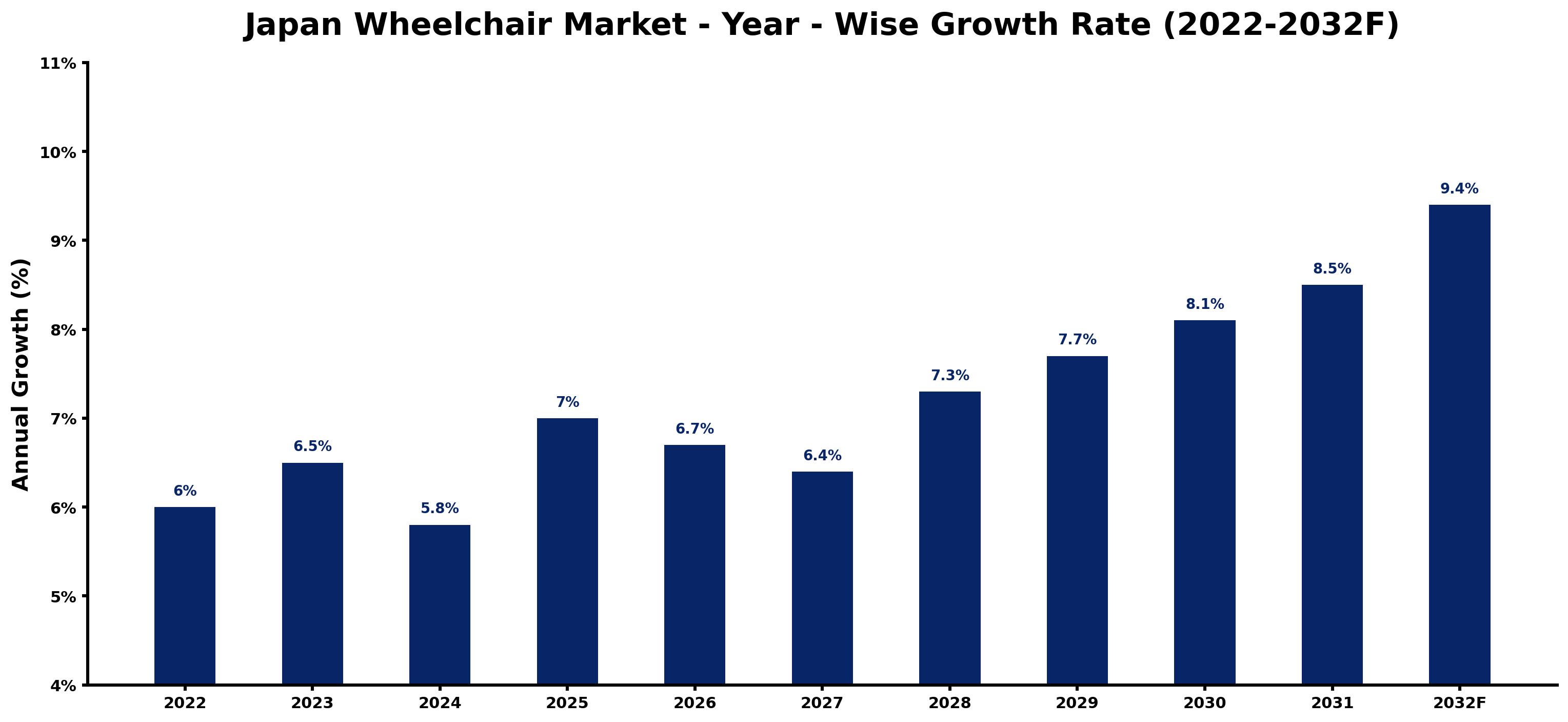
Annual growth estimates for each year appear below with the principal reason behind them, explaining the shifts that set the pace of the market.
| Year | Estimated Annual Growth (%) | Market Rationale |
| 2022 | 6.0 | The market experienced steady growth due to increasing awareness of mobility solutions. |
| 2023 | 6.5 | Demand rose as more healthcare facilities adopted modern wheelchair options. |
| 2024 | 5.8 | Growth slowed slightly as the market adjusted to previous high demand levels. |
| 2025 | 7.0 | The introduction of new wheelchair designs boosted market performance. |
| 2026 | 6.7 | A slight slowdown occurred as competition intensified among manufacturers. |
| 2027 | 6.4 | The market continued to grow, driven by rising elderly populations needing mobility aids. |
| 2028 | 7.3 | Growth accelerated as new technologies improved wheelchair functionality. |
| 2029 | 7.7 | Increased investments in healthcare infrastructure supported higher wheelchair demand. |
| 2030 | 8.1 | Demand rose further due to the introduction of advanced powered wheelchair models. |
| 2031 | 8.5 | The market maintained strong growth as consumer preferences shifted towards powered options. |
| 2032 | 9.4 | A peak in growth is projected, driven by technological advancements and increased accessibility. |
Note: Market size estimations and growth projections presented in this report are based on 6Wresearch's proprietary forecasting methodology, utilizing the latest available industry data, government publications, and primary research inputs.
Japan Wheelchair Market Synopsis
The Japan Wheelchair Market is expanding due to a rising elderly population, increased healthcare investments, and technological advancements in wheelchair design. Demand is particularly strong from healthcare facilities and individuals seeking improved mobility solutions, reflecting a commitment to accessibility and independence for users.
Market Dynamics Impact Analysis (2026–2032)
| Factor | Type | Impact | Primary Segment Affected |
| Rising elderly population | Driver | High | Manual |
| Advancements in wheelchair technology | Driver | High | Powered |
| Growing demand for bariatric wheelchairs | Opportunity | High | Bariatrich Wheelchair |
| Increased healthcare spending | Opportunity | High | Standard Wheelchair |
| High production costs for advanced models | Restraint | Medium | Powered |
| Limited availability of specialised wheelchairs | Restraint | Medium | Bariatrich Wheelchair |
| Intense competition among manufacturers | Challenge | High | Manual |
| Regulatory compliance costs | Challenge | Medium | Powered |
Evaluation of Drivers in Japan Wheelchair Market (2026–2032)
Below are the drivers that matter most for revenue growth, with supporting evidence.
| Drivers | Primary Segment Affected | Why It Matters (Evidence) |
| Increasing elderly population | Manual | The elderly population in Japan is projected to reach 36% by 2040, driving demand for mobility solutions. |
| Technological advancements in wheelchair design | Powered | Innovative designs are attracting more buyers, leading to increased sales of powered options. |
| Rising health awareness among consumers | Standard Wheelchair | Health campaigns are encouraging individuals to invest in mobility aids, boosting market growth. |
| Government initiatives promoting accessibility | Bariatrich Wheelchair | Policies aimed at improving accessibility for disabled individuals are increasing demand for specialised wheelchairs. |
| Expansion of healthcare facilities | Powered | The growth of healthcare infrastructure is creating a higher demand for advanced mobility solutions. |
What keeps demand rising is the increasing elderly population in Japan, projected to reach 36% by 2040, which drives the need for mobility solutions. New designs in wheelchair technology are attracting more buyers, particularly in healthcare facilities where advanced powered options are sought. Health campaigns are encouraging individuals to invest in mobility aids, further expanding the market.
Evaluation of Restraints in Japan Wheelchair Market
The following restraints limit how fast demand can grow.
| Market Restraint | Primary Segment Affected | Why It Matters (Evidence) |
| High production costs for advanced wheelchair models | Powered | Manufacturers face increased costs due to advanced materials and technologies, limiting affordability. |
| Limited availability of specialised wheelchairs | Bariatrich Wheelchair | The niche market for bariatric wheelchairs restricts supply, affecting accessibility for users. |
| Regulatory compliance costs | Powered | Manufacturers must invest in compliance with safety standards, increasing operational costs. |
| Slow adoption of new technologies by consumers | Standard Wheelchair | Some consumers remain hesitant to invest in new models, affecting market penetration. |
| Intense competition among manufacturers | Manual | Competition drives prices down, impacting profit margins for manufacturers. |
Japan Wheelchair Market Challenges
Producers face rising raw material costs, which have increased by 15% over the past year, squeezing profit margins and compelling them to raise prices. Importers struggle with stringent customs regulations, leading to potential delays of up to four weeks, disrupting timely deliveries to clinics. A shortage of skilled workers limits production capabilities, causing a 20% drop in output for manufacturers, intensifying supply challenges. Buyers encounter higher prices due to these issues, with average wheelchair costs climbing by 10%, making mobility aids less accessible for those in need.
Trends in the Japan Wheelchair Market
Buyers and suppliers in the Japan Wheelchair Market are adjusting to the following trends.
- Healthcare Facilities Adopting Powered Wheelchairs: Healthcare facilities are increasingly adopting powered wheelchairs due to their advanced features, improving user mobility. In 2023, powered wheelchair sales rose by 15%, reflecting a shift in preferences among users.
- Transition from Manual to Smart Wheelchairs: Consumers are moving from traditional manual wheelchairs to smart models equipped with navigation technology. The introduction of smart wheelchairs in 2024 is projected to attract tech-savvy buyers, changing market dynamics.
- Bariatric Wheelchairs Gaining Popularity: The demand for bariatric wheelchairs is increasing as awareness of obesity-related mobility issues grows. Sales of bariatric models are projected to rise by 20% in 2025, reflecting changing consumer needs.
- Focus on Accessibility Standards: Healthcare providers are prioritising compliance with accessibility standards, driving wheelchair adoption. The implementation of new accessibility regulations in 2023 is expected to boost demand for compliant wheelchair models.
Investment Opportunities in the Japan Wheelchair Market
Investors looking at the Japan Wheelchair Market should consider the following areas.
- Healthcare Facilities Seeking Advanced Solutions: Healthcare facilities are currently looking for advanced wheelchair solutions to improve patient care. With a projected growth of 15% in healthcare spending by 2025, suppliers can partner with hospitals to meet this demand.
- Growing Demand for Bariatric Wheelchairs: The increasing prevalence of obesity creates a demand for bariatric wheelchairs. With the market for these products expected to grow by 10% in 2026, suppliers can enter by collaborating with healthcare providers.
- Investment in Smart Wheelchair Technology: The rise in demand for smart wheelchairs presents an opportunity for investment in technology. By 2025, the market for smart wheelchairs is projected to expand significantly, encouraging partnerships with tech firms.
- Expansion of Home Care Services: The growing home care services sector is driving demand for mobility aids. With a 12% increase in home care spending anticipated by 2026, suppliers can tap into this market by offering tailored wheelchair solutions.
Government Initiatives in the Japan Wheelchair Market
The Act on the Rational Use of Energy, established in 1979, mandates large energy users to enhance energy efficiency and report usage. This law has prompted wheelchair manufacturers to adopt more energy-efficient production methods, reducing costs and environmental impact. The GX Promotion Act, enacted in 2023, serves as the legal basis for Japan's GX strategy, promoting sustainable practices across industries, including wheelchair production.
Healthcare facilities benefit from the GX Basic Policy adopted in 2023, which aims for about JPY 150 trillion of public-private decarbonisation investment over ten years. This policy encourages healthcare facilities to invest in energy-efficient equipment, including wheelchairs, improving accessibility for users.
Future Insight of the Japan Wheelchair Market
Advancements in automated navigation technology will significantly influence wheelchair demand by 2032, enhancing user experience. A government initiative aimed at improving accessibility will drive the adoption of innovative designs in healthcare facilities. Stricter manufacturing standards will elevate product quality, benefiting both buyers and suppliers. By 2032, the use of 3D printing could reduce production times by 30%, enabling manufacturers to quickly adapt to changing consumer preferences.
Market Segmentation Analysis
Japan Wheelchair Market report covers a detailed analysis of the following market segments:
By Type – Manual Leads, Powered Expected to Grow Fastest
According to Ravi Bhandari, Research Head at 6Wresearch, Manual accounted for 69% of the market by type in 2025. The manual wheelchair segment holds the largest share as it is the preferred choice for users prioritising cost-effectiveness and basic functionality. Many healthcare facilities in Japan select manual wheelchairs for their ease of use and lower maintenance expenses. Powered is projected to grow fastest, at a CAGR of 10.5% during 2026–2032. The powered wheelchair segment is experiencing rapid growth, largely due to advancements in technology that improve accessibility for those with severe mobility challenges. The introduction of more compact and user-friendly models has resulted in increased adoption among the elderly population, propelling this segment forward. This suggests that suppliers should focus on enhancing their powered wheelchair offerings to capture the growing market interest.
By Applications – Standard Wheelchair Leads, Bariatrich Wheelchair Expected to Grow Fastest
The largest applications category in 2025 was Standard Wheelchair, at 47% of revenue. The standard wheelchair segment dominates the market as it caters to a broad demographic, including those with temporary mobility impairments. Hospitals and outpatient facilities predominantly utilise standard wheelchairs for their versatility and cost-effectiveness. Over 2026–2032, Bariatrich Wheelchair is expected to post the fastest growth, at a CAGR of 10.3%. The bariatric wheelchair segment is growing quickly due to the rising prevalence of obesity in Japan, necessitating specialised mobility solutions for larger individuals. This trend is reflected in healthcare policies that increasingly prioritise inclusive equipment for all body types. Buyers will benefit from a wider range of options as manufacturers respond to the increasing demand for bariatric wheelchairs.
Key Attractiveness of the Report
- 10 Years of Market Numbers
- Historical Data Starting from 2022 to 2025
- Base Year 2025
- Forecast Data until 2032
- Key Performance Indicators Impacting the Market
- Major Upcoming Developments and Projects
Key Highlights of the Report:
- Japan Wheelchair Market Outlook
- Market Size of Japan Wheelchair Market, 2025
- Forecast of Japan Wheelchair Market, 2032
- Historical Data and Forecast of Japan Wheelchair Revenues & Volume for the Period 2022-2032
- Japan Wheelchair Market Trend Evolution
- Japan Wheelchair Market Drivers and Challenges
- Japan Wheelchair Price Trends
- Japan Wheelchair Porter's Five Forces
- Japan Wheelchair Industry Life Cycle
- Historical Data and Forecast of Japan Wheelchair Market Revenues & Volume By Type for the Period 2022-2032
- Historical Data and Forecast of Japan Wheelchair Market Revenues & Volume By Manual for the Period 2022-2032
- Historical Data and Forecast of Japan Wheelchair Market Revenues & Volume By Powered for the Period 2022-2032
- Historical Data and Forecast of Japan Wheelchair Market Revenues & Volume By Applications for the Period 2022-2032
- Historical Data and Forecast of Japan Wheelchair Market Revenues & Volume By Standard Wheelchair for the Period 2022-2032
- Historical Data and Forecast of Japan Wheelchair Market Revenues & Volume By Bariatrich Wheelchair for the Period 2022-2032
- Historical Data and Forecast of Japan Wheelchair Market Revenues & Volume By Sports Wheelchair for the Period 2022-2032
- Historical Data and Forecast of Japan Wheelchair Market Revenues & Volume By Others for the Period 2022-2032
- Historical Data and Forecast of Japan Wheelchair Market Revenues & Volume By End-Users for the Period 2022-2032
- Japan Wheelchair Import Export Trade Statistics
- Market Opportunity Assessment By Type
- Market Opportunity Assessment By Applications
- Market Opportunity Assessment By End-Users
- Japan Wheelchair Top Companies Market Share
- Japan Wheelchair Competitive Benchmarking By Technical and Operational Parameters
- Japan Wheelchair Company Profiles
- Japan Wheelchair Key Strategic Recommendations
Market Covered
This report examines the market across the segments below.
By Type
- Manual
- Powered
By Applications
- Standard Wheelchair
- Bariatrich Wheelchair
- Sports Wheelchair
- Others































