Japan Wi-Fi Hotspot Market Size & Growth Rate
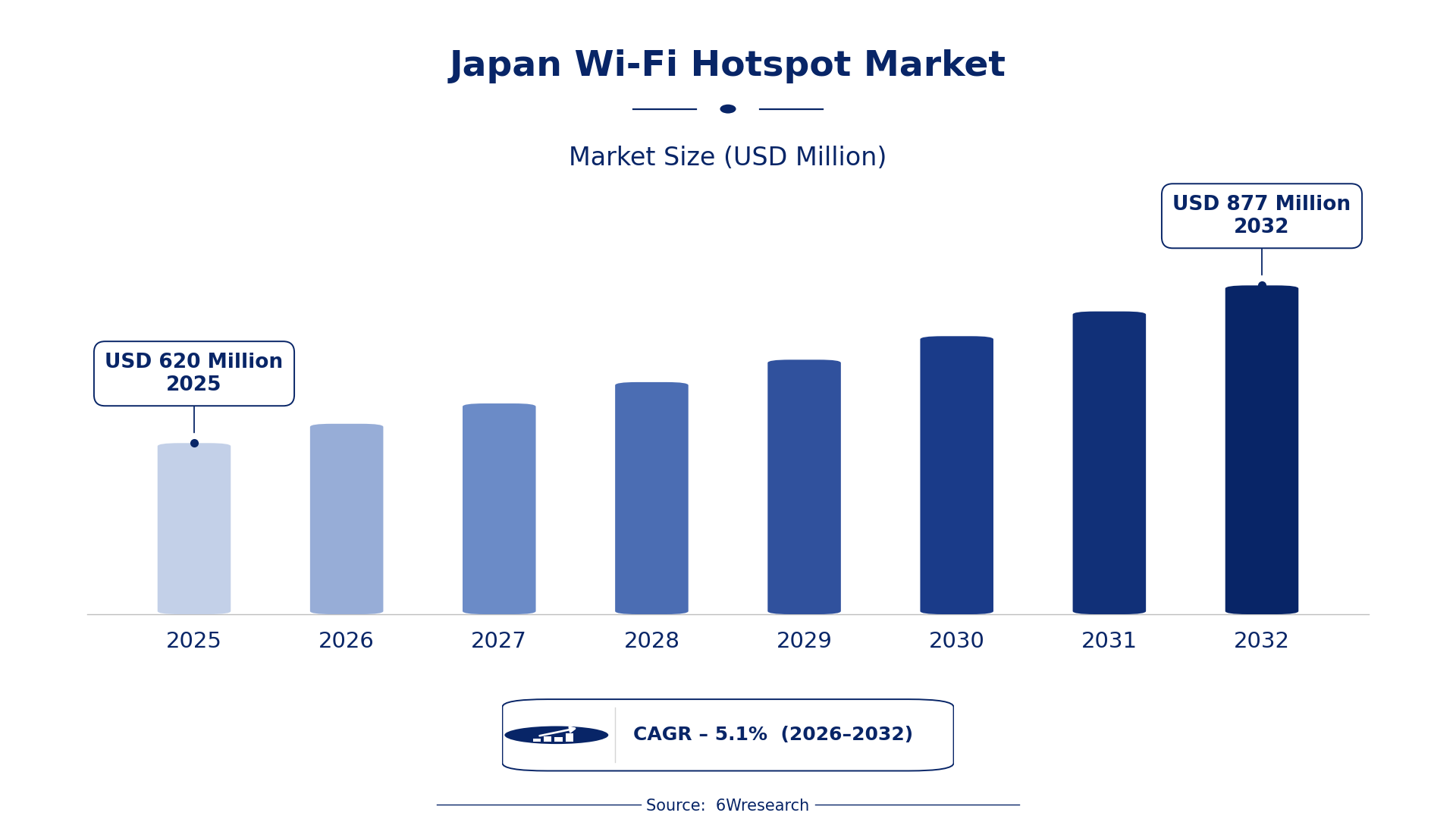
According to 6Wresearch internal database and industry insights, the Japan Wi-Fi Hotspot Market was valued at USD 620 Million in 2025 and is projected to reach USD 877 Million by 2032, growing at a CAGR of approximately 5.1% during 2026–2032.
Japan Wi-Fi Hotspot Market Highlights
| Report Metric | Details |
| Report Name | Japan Wi-Fi Hotspot Market (2026-2032) |
| Market Size 2025 | USD 620 Million |
| Market Size 2032 | USD 877 Million |
| Absolute Growth 2025–2032 | USD 257 Million |
| CAGR 2026–2032 | 5.1% |
| Peak Annual Growth | 6.3% in 2027 |
| Forecast Period | 2026–2032 |
| Historical Data | 2022–2025 |
| Base Year | 2025 |
| Leading Components, 2025 | Wireless Hotspot Gateways (52% share) |
| Leading Software, 2025 | Centralized hotspot management (45% share) |
| Leading Services, 2025 | Professional service (47% share) |
| Leading End Users, 2025 | Communication service providers & network operators (45% share) |
| Leading Verticals, 2025 | Telecom and IT (29% share) |
| Fastest-Growing Components | Wireless Hotspot Controllers (7.3% CAGR) |
| Fastest-Growing Software | Wi-Fi security software (6.9% CAGR) |
| Fastest-Growing Services | Installation and integration services (6.8% CAGR) |
| Fastest-Growing End Users | Enterprises (6.5% CAGR) |
| Fastest-Growing Verticals | Financial services (7.0% CAGR) |
| Growing Sector | Telecommunications |
| Key End Users | Communication service providers, Enterprises, Government, Education |
Japan Wi-Fi Hotspot Market Year-wise Growth Rate and Key Drivers (2022–2032)
This graph illustrates the annual growth rates of the market from 2022 to 2032, highlighting a steady upward trajectory and projected market expansion over the forecast period.
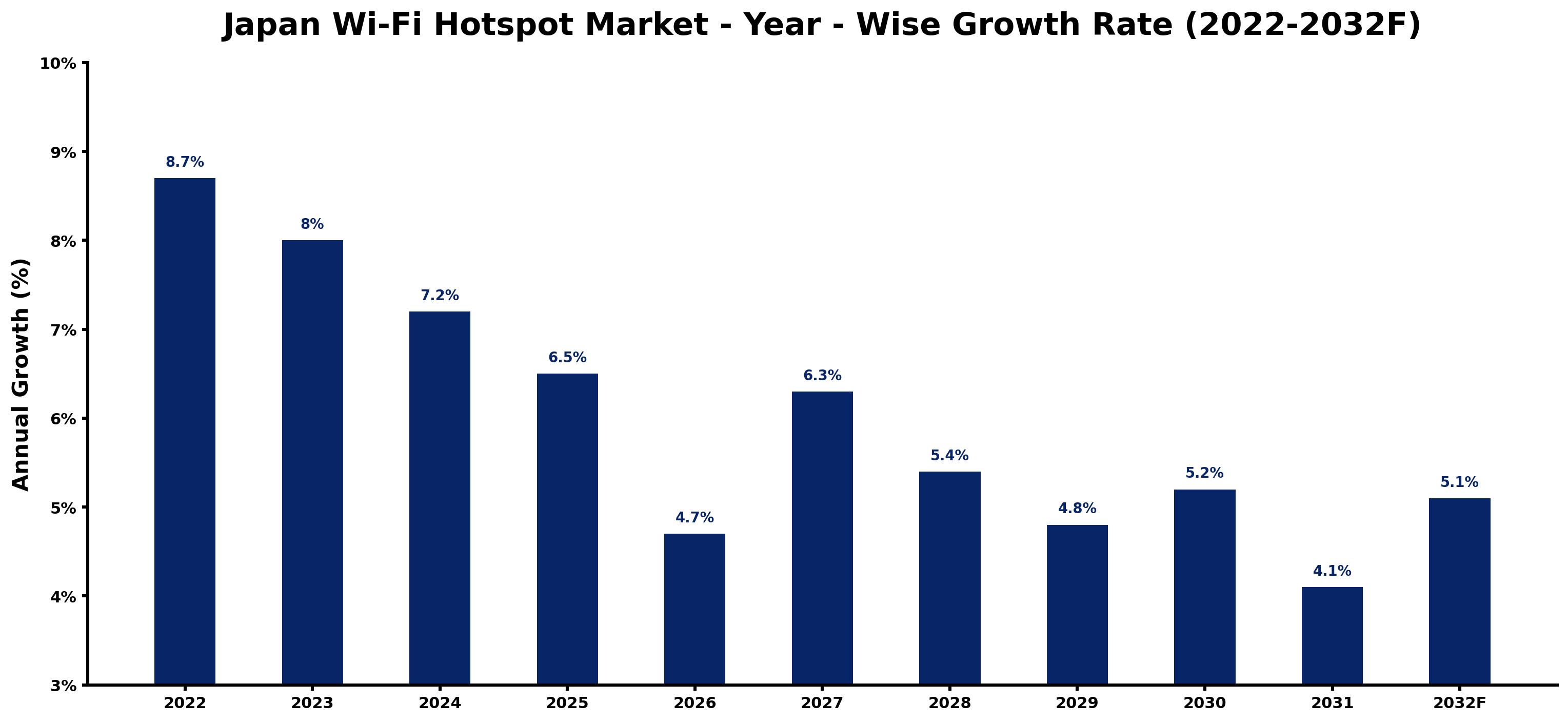
The following figures match every annual growth estimate with the main market development of that year, giving the reasoning behind each rise or slowdown.
| Year | Estimated Annual Growth (%) | Market Rationale |
| 2022 | 8.7 | The market experienced strong demand due to increased internet usage and public Wi-Fi initiatives. |
| 2023 | 8.0 | Growth slowed as the market adjusted to previous high demand levels and competition intensified. |
| 2024 | 7.2 | A continued slowdown occurred as saturation in urban areas began to impact new installations. |
| 2025 | 6.5 | Demand stabilised as public and private sectors focused on upgrading existing infrastructure. |
| 2026 | 4.7 | Growth is expected to slow further as market maturity leads to fewer new entrants and installations. |
| 2027 | 6.3 | A resurgence in demand is expected as new projects and expansions in rural areas are initiated. |
| 2028 | 5.4 | Growth is projected to slow again as market saturation continues to limit new opportunities. |
| 2029 | 4.8 | Demand is expected to remain steady as enterprises invest in upgrading existing Wi-Fi infrastructure. |
| 2030 | 5.2 | An increase in demand is anticipated as new technological advancements are adopted. |
| 2031 | 4.1 | Growth is expected to slow as the market approaches saturation in urban settings. |
| 2032 | 5.1 | Demand is projected to rise again as new public initiatives expand Wi-Fi access. |
Note: Market size estimations and growth projections presented in this report are based on 6Wresearch's proprietary forecasting methodology, utilizing the latest available industry data, government publications, and primary research inputs.
Japan Wi-Fi Hotspot Market Synopsis
Wi-Fi hotspots provide wireless internet access through radio waves, utilising hardware and software for management. In Japan, the Japan Wi-Fi Hotspot Market is essential in public spaces, businesses, and events, with Tokyo being a major deployment hub. The market is expanding due to over 120 million internet users and government initiatives to improve broadband access, such as the recent programme aimed at increasing public Wi-Fi availability. The telecommunications industry is driving demand as both domestic and imported solutions are integrated into various sectors.
Market Dynamics Impact Analysis (2026–2032)
| Factor | Type | Impact | Primary Segment Affected |
| Rising internet penetration and user base | Driver | High | Wireless Hotspot Gateways |
| Increased investment in public Wi-Fi initiatives | Driver | High | Cloud based hotspot management |
| Growing demand for secure connections in the financial sector | Opportunity | Medium | Wi-Fi security software |
| Expansion of hotspots in rural areas to improve connectivity | Opportunity | Medium | Mobile Hotspot Devices |
| Market saturation in urban areas limiting new installations | Restraint | High | Wireless Hotspot Controllers |
| Competition leading to price wars among service providers | Restraint | Medium | Centralized hotspot management |
| High costs of infrastructure upgrades for enterprises | Challenge | High | Installation and integration services |
| Compliance with evolving security standards increasing operational costs | Challenge | Medium | Wi-Fi security software |
Evaluation of Drivers in Japan Wi-Fi Hotspot Market (2026–2032)
The table below links each growth driver to the segment it affects and the evidence for it.
| Drivers | Primary Segment Affected | Why It Matters (Evidence) |
| Increased internet usage driving demand for public access points | Wireless Hotspot Gateways | Over 120 million internet users in Japan are creating a need for more hotspots. |
| Government initiatives promoting broadband access in urban and rural areas | Cloud based hotspot management | The recent programme aims to expand public Wi-Fi access by 30%. |
| Growing adoption of Wi-Fi in education for student connectivity | Mobile Hotspot Devices | The education sector has seen a 30% increase in hotspot installations since 2020. |
| Rising demand for secure transactions in the financial services sector | Wi-Fi security software | The financial sector is increasingly adopting Wi-Fi solutions for secure transactions. |
| Expansion of the hospitality sector requiring reliable internet for guests | Centralized hotspot management | The hospitality sector accounts for 25% of hotspot usage in urban areas. |
Purchasing is picking up as the telecommunications industry expands its infrastructure, with millions of internet users driving demand for Wi-Fi hotspots. The education sector has seen a marked increase in installations since 2020, highlighting the need for connectivity. The hospitality sector accounts for a significant portion of hotspot usage, necessitating reliable internet services for guests. The financial sector's shift towards secure Wi-Fi solutions also contributes to rising purchases.
Evaluation of Restraints in Japan Wi-Fi Hotspot Market
The key brakes on demand, and where they bite hardest, are shown below.
| Market Restraint | Primary Segment Affected | Why It Matters (Evidence) |
| Market saturation limiting new installations in urban areas | Wireless Hotspot Controllers | The increasing number of existing hotspots makes new installations less viable. |
| Intense competition leading to price reductions among providers | Centralized hotspot management | Price wars are affecting profitability and service quality in the market. |
| High costs associated with upgrading existing infrastructure | Installation and integration services | Enterprises face considerable expenses when modernising their Wi-Fi systems. |
| Compliance with stringent security standards increasing operational costs | Wi-Fi security software | Meeting standards like ISO/IEC 27001 requires investment in security measures. |
| Limited availability of skilled technicians for installation and maintenance | Professional service | A shortage of qualified personnel can delay project timelines and increase costs. |
Japan Wi-Fi Hotspot Market Challenges
Public venues face high operational costs due to inadequate Wi-Fi infrastructure, with expenses reaching up to 30% of their budgets. Regulatory hurdles from Wi-Fi security standards, like ISO/IEC 27001, can delay deployment for healthcare facilities by several months. Intense competition among service providers forces suppliers to reduce prices, eroding profit margins by up to 15%. A shortage of skilled technicians in managing advanced Wi-Fi systems hampers retail businesses, resulting in a 20% increase in service downtime that negatively impacts customer engagement strategies.
Trends in the Japan Wi-Fi Hotspot Market
The shifts below are changing how Japan Wi-Fi Hotspot Market products are bought and supplied.
- Shift from Traditional to Cloud-Based Management: Since 2023, there has been a noticeable shift towards cloud-based management solutions for Wi-Fi hotspots. This change is occurring in urban areas like Tokyo, where service providers are adopting these technologies to streamline operations, with a reported increase in adoption.
- Transition to Enhanced Security Standards: The focus on security has intensified, especially in the financial sector, where compliance with ISO/IEC 27001 is now a priority. This trend is reshaping how hotspots are managed, with a significant increase in the adoption of security software since 2021.
- Emergence of Rural Hotspot Initiatives: In 2023, initiatives aimed at expanding Wi-Fi access in rural areas have gained momentum. For example, the government has allocated funds to develop hotspots in underserved regions, targeting an increase in connectivity by 2025.
- Growing Demand for Managed Wi-Fi Services: Managed services for Wi-Fi are increasingly popular among enterprises, particularly in the hospitality sector. This trend is reflected in a rise in demand for these services since 2022, as businesses seek to improve customer experiences.
Investment Opportunities in the Japan Wi-Fi Hotspot Market
Investors looking at the Japan Wi-Fi Hotspot Market should consider the following areas.
- Partnerships for Rural Connectivity Projects: Entering into joint ventures with local governments can facilitate the expansion of Wi-Fi in rural areas, where demand is growing. The government aims to improve connectivity in underserved regions, targeting an increase by 2025.
- Investment in Cloud-Based Solutions: With the shift towards cloud-based management, supplying cloud solutions for hotspot management is timely. Communication service providers are seeking efficient systems to manage multiple hotspots, creating a strong market opportunity.
- Focus on Security Software Development: The increasing need for secure Wi-Fi connections presents an opportunity for investment in security software. Financial services are particularly focused on improving security, driving demand for advanced solutions.
- Expansion of Hotspot Services in Hospitality: Now is the time to invest in managed Wi-Fi services for the hospitality sector, which accounts for a significant portion of hotspot usage. Partnering with hotels and restaurants can help meet their growing connectivity needs.
Government Initiatives in the Japan Wi-Fi Hotspot Market
The regulatory framework for Wi-Fi hotspots in Japan is shaped by several key laws, including the JIS X 5070 standard, which governs Wi-Fi technology. The Ministry of Internal Affairs and Communications has been instrumental in promoting broadband access, launching initiatives to expand public Wi-Fi availability across urban and rural areas. The government aims for 100% broadband coverage by 2025, impacting hotspot deployment.
The Ministry of Internal Affairs and Communications oversees the approval of broadband initiatives and funding for public Wi-Fi projects. This agency has allocated resources to improve connectivity, with a target of increasing public Wi-Fi access by 30% by 2025. Such measures ensure that both urban and rural populations benefit from improved internet access.
Future Insight of the Japan Wi-Fi Hotspot Market
The launch of regional hotspot projects will improve connectivity in rural areas, enabling broader access for consumers and businesses. By 2032, the integration of cloud-based management solutions will streamline operations for service providers, increasing efficiency. The hospitality sector will see a rise in hotspot installations, ensuring better service for guests. Increased government initiatives will promote public Wi-Fi access, supporting urban development and enhancing user experience.
Market Segmentation Analysis
Japan Wi-Fi Hotspot Market report covers a detailed analysis of the following market segments:
By Components – Wireless Hotspot Gateways Lead, Wireless Hotspot Controllers Expected to Grow Fastest
According to Ravi Bhandari, Research Head at 6Wresearch, in 2025, Wireless Hotspot Gateways led the components split with a 52% share. Wireless Hotspot Gateways hold the largest share due to their critical role in managing numerous connections in high-traffic areas like Tokyo. Their functionality is essential for ensuring reliable internet access in public spaces, catering to a vast number of users. Wireless Hotspot Controllers are projected to grow fastest, at a CAGR of 7.3% during 2026–2032. The rapid growth of Wireless Hotspot Controllers is fuelled by the increasing need for efficient traffic management in crowded venues. Events with large audiences are quickly adopting these controllers to enhance connectivity and user experience. Suppliers should focus on developing advanced management solutions to meet the rising demand in urban hotspots.
By Software – Centralized hotspot management Leads, Wi-Fi security software Expected to Grow Fastest
The largest software category in 2025 was Centralized hotspot management, at 45% of revenue. Centralized hotspot management leads the software segment as it allows operators to oversee multiple hotspots from a single platform, which is vital for large-scale deployments in urban areas like Tokyo. This capability ensures consistent service quality across various locations. Over 2026–2032, Wi-Fi security software is expected to post the fastest growth, at a CAGR of 6.9%. Wi-Fi security software is experiencing rapid growth due to escalating concerns about data protection in public hotspots. The rise in cyber threats has prompted many enterprises to invest in robust security measures to safeguard their networks. Buyers must prioritise implementing security solutions to protect user data and maintain trust in public Wi-Fi services.
By Services – Professional service Leads, Installation and integration services Expected to Grow Fastest
With 47% of services revenue in 2025, Professional service was the largest category. Professional service is the leading segment as it offers essential support for the deployment of Wi-Fi hotspots, particularly in complex environments. This service is crucial for ensuring successful implementation in busy urban areas where connectivity is paramount. The quickest growth will come from Installation and integration services, forecast to expand at a CAGR of 6.8% between 2026 and 2032. Installation and integration services are growing quickly due to the surge in new hotspot setups across various sectors, including education and healthcare. The demand for efficient installation processes is critical as more facilities seek to improve connectivity. Providers should enhance their service offerings to include comprehensive installation solutions to meet the increasing market demand.
By End Users – Communication service providers & network operators Lead, Enterprises Expected to Grow Fastest
Communication service providers & network operators took 45% of end users revenue in 2025, more than any other category. Communication service providers & network operators are the primary end-users as they deliver Wi-Fi services to consumers. Their extensive infrastructure and established customer base in Japan solidify their dominant position in the market. Enterprises are set to record the highest CAGR in this split, 6.5% over 2026–2032. Enterprises are rapidly adopting Wi-Fi hotspots for employee and customer connectivity, reflecting a shift towards digital engagement in business operations. This trend highlights the need for improved service offerings through enhanced connectivity solutions. Suppliers must tailor their solutions to meet the specific needs of enterprises, focusing on reliability and performance.
By Verticals – Telecom and IT Leads, Financial services Expected to Grow Fastest
Telecom and IT accounted for 29% of the market by verticals in 2025. Telecom and IT is the leading vertical as it extensively utilises Wi-Fi technology to provide connectivity solutions throughout Japan. This sector's robust infrastructure and continuous advancements contribute significantly to its market share. Financial services are projected to grow fastest, at a CAGR of 7.0% during 2026–2032. Financial services are experiencing the fastest growth as they increasingly rely on secure hotspots for customer transactions. The heightened need for secure connections in banking has accelerated the adoption of Wi-Fi technology in this sector. Vendors should focus on developing tailored solutions for the financial sector to capitalise on this growing demand.
Key Attractiveness of the Report
- 10 Years of Market Numbers
- Historical Data Starting from 2022 to 2025
- Base Year 2025
- Forecast Data until 2032
- Key Performance Indicators Impacting the Market
- Major Upcoming Developments and Projects
Key Highlights of the Report:
- Japan Wi-Fi Hotspot Market Outlook
- Market Size of Japan Wi-Fi Hotspot Market, 2025
- Forecast of Japan Wi-Fi Hotspot Market, 2032
- Historical Data and Forecast of Japan Wi-Fi Hotspot Revenues & Volume for the Period 2022-2032
- Japan Wi-Fi Hotspot Market Trend Evolution
- Japan Wi-Fi Hotspot Market Drivers and Challenges
- Japan Wi-Fi Hotspot Price Trends
- Japan Wi-Fi Hotspot Porter's Five Forces
- Japan Wi-Fi Hotspot Industry Life Cycle
- Historical Data and Forecast of Japan Wi-Fi Hotspot Market Revenues & Volume By Components for the Period 2022-2032
- Historical Data and Forecast of Japan Wi-Fi Hotspot Market Revenues & Volume By Wireless Hotspot Gateways for the Period 2022-2032
- Historical Data and Forecast of Japan Wi-Fi Hotspot Market Revenues & Volume By Wireless Hotspot Controllers for the Period 2022-2032
- Historical Data and Forecast of Japan Wi-Fi Hotspot Market Revenues & Volume By Mobile Hotspot Devices for the Period 2022-2032
- Historical Data and Forecast of Japan Wi-Fi Hotspot Market Revenues & Volume By Software for the Period 2022-2032
- Historical Data and Forecast of Japan Wi-Fi Hotspot Market Revenues & Volume By Centralized hotspot management for the Period 2022-2032
- Historical Data and Forecast of Japan Wi-Fi Hotspot Market Revenues & Volume By Wi-Fi security software for the Period 2022-2032
- Historical Data and Forecast of Japan Wi-Fi Hotspot Market Revenues & Volume By Wi-Fi hotspot billing software for the Period 2022-2032
- Historical Data and Forecast of Japan Wi-Fi Hotspot Market Revenues & Volume By Cloud based hotspot management for the Period 2022-2032
- Historical Data and Forecast of Japan Wi-Fi Hotspot Market Revenues & Volume By Services for the Period 2022-2032
- Historical Data and Forecast of Japan Wi-Fi Hotspot Market Revenues & Volume By Professional service for the Period 2022-2032
- Historical Data and Forecast of Japan Wi-Fi Hotspot Market Revenues & Volume By Installation and integration services for the Period 2022-2032
- Historical Data and Forecast of Japan Wi-Fi Hotspot Market Revenues & Volume By Consulting services for the Period 2022-2032
- Historical Data and Forecast of Japan Wi-Fi Hotspot Market Revenues & Volume By Managed services for the Period 2022-2032
- Historical Data and Forecast of Japan Wi-Fi Hotspot Market Revenues & Volume By End Users for the Period 2022-2032
- Historical Data and Forecast of Japan Wi-Fi Hotspot Market Revenues & Volume By Communication service providers & network operators for the Period 2022-2032
- Historical Data and Forecast of Japan Wi-Fi Hotspot Market Revenues & Volume By Enterprises for the Period 2022-2032
- Historical Data and Forecast of Japan Wi-Fi Hotspot Market Revenues & Volume By Government for the Period 2022-2032
- Historical Data and Forecast of Japan Wi-Fi Hotspot Market Revenues & Volume By Verticals for the Period 2022-2032
- Historical Data and Forecast of Japan Wi-Fi Hotspot Market Revenues & Volume By Telecom and IT for the Period 2022-2032
- Historical Data and Forecast of Japan Wi-Fi Hotspot Market Revenues & Volume By Financial services for the Period 2022-2032
- Historical Data and Forecast of Japan Wi-Fi Hotspot Market Revenues & Volume By Education for the Period 2022-2032
- Historical Data and Forecast of Japan Wi-Fi Hotspot Market Revenues & Volume By Healthcare for the Period 2022-2032
- Historical Data and Forecast of Japan Wi-Fi Hotspot Market Revenues & Volume By Hospitality for the Period 2022-2032
- Historical Data and Forecast of Japan Wi-Fi Hotspot Market Revenues & Volume By Transportation for the Period 2022-2032
- Historical Data and Forecast of Japan Wi-Fi Hotspot Market Revenues & Volume By Retail for the Period 2022-2032
- Historical Data and Forecast of Japan Wi-Fi Hotspot Market Revenues & Volume By Others for the Period 2022-2032
- Japan Wi-Fi Hotspot Import Export Trade Statistics
- Market Opportunity Assessment By Components
- Market Opportunity Assessment By Software
- Market Opportunity Assessment By Services
- Market Opportunity Assessment By End Users
- Market Opportunity Assessment By Verticals
- Japan Wi-Fi Hotspot Top Companies Market Share
- Japan Wi-Fi Hotspot Competitive Benchmarking By Technical and Operational Parameters
- Japan Wi-Fi Hotspot Company Profiles
- Japan Wi-Fi Hotspot Key Strategic Recommendations
Market Covered
Segments analysed in this report are listed below.
By Components
- Wireless Hotspot Gateways
- Wireless Hotspot Controllers
- Mobile Hotspot Devices
By Software
- Centralized hotspot management
- Wi-Fi security software
- Wi-Fi hotspot billing software
- Cloud based hotspot management
By Services
- Professional service
- Installation and integration services
- Consulting services
- Managed services
By End Users
- Communication service providers & network operators
- Enterprises
- Government
By Verticals
- Telecom and IT
- Financial services
- Education
- Healthcare
- Hospitality
- Transportation
- Retail
- Others































