Japan Wi-Fi Range Extender Market Size & Growth Rate
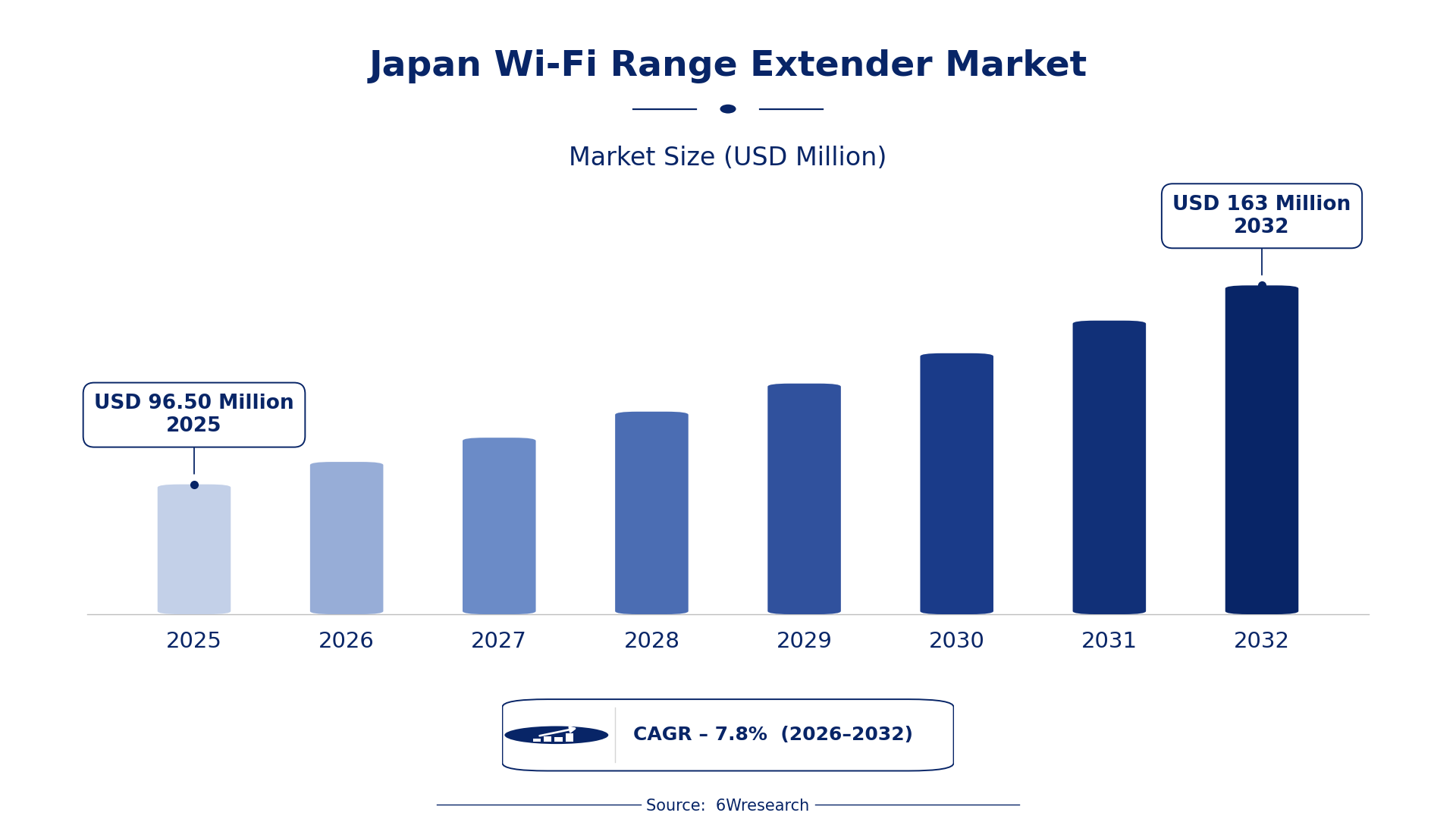
According to 6Wresearch internal database and industry insights, the Japan Wi-Fi Range Extender Market was valued at USD 96.50 Million in 2025 and is projected to reach USD 163 Million by 2032, growing at a CAGR of approximately 7.8% during 2026–2032.
Japan Wi-Fi Range Extender Market Highlights
| Report Metric | Details |
| Report Name | Japan Wi-Fi Range Extender Market (2026-2032) |
| Market Size 2025 | USD 96.50 Million |
| Market Size 2032 | USD 163 Million |
| Absolute Growth 2025–2032 | USD 66.50 Million |
| CAGR 2026–2032 | 7.8% |
| Peak Annual Growth | 8.3% in 2027 |
| Forecast Period | 2026–2032 |
| Historical Data | 2022–2025 |
| Base Year | 2025 |
| Leading Type, 2025 | Wi-Fi Range Extender (63% share) |
| Leading Application, 2025 | Household (57% share) |
| Fastest-Growing Type | Wireless AP Router (10.8% CAGR) |
| Fastest-Growing Application | Commercial Use (9.8% CAGR) |
| Growing Sector | Commercial Use |
| Key End Users | Household, Commercial Use |
Japan Wi-Fi Range Extender Market Year-wise Growth Rate and Key Drivers (2022–2032)
This graph illustrates the annual growth rates of the market from 2022 to 2032, highlighting a steady upward trajectory and projected market expansion over the forecast period.
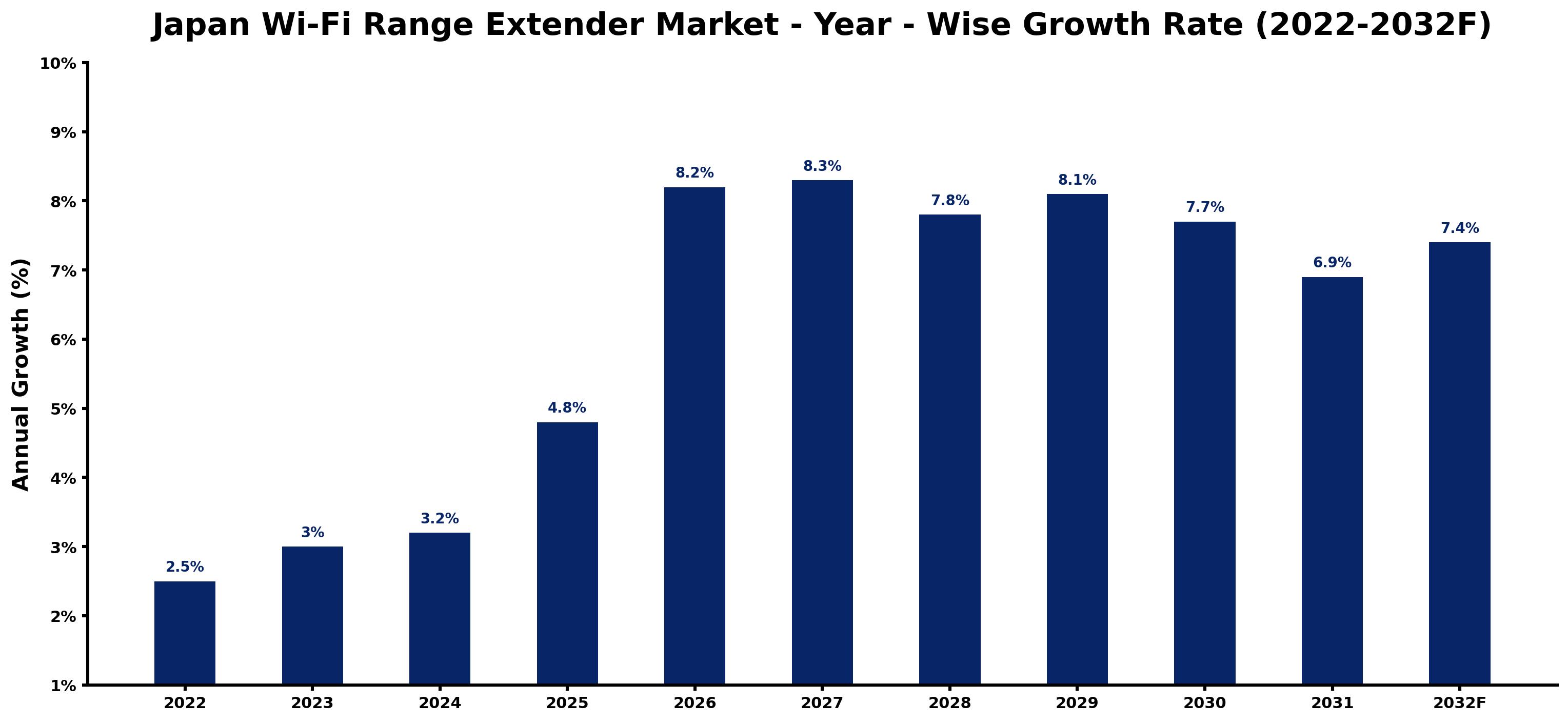
The following figures match every annual growth estimate with the main market development of that year, giving the reasoning behind each rise or slowdown.
| Year | Estimated Annual Growth (%) | Market Rationale |
| 2022 | 2.5 | The market experienced steady demand due to existing internet infrastructure. |
| 2023 | 3.0 | Growth accelerated as more households adopted smart devices for connectivity. |
| 2024 | 3.2 | Increased internet usage further boosted the need for reliable Wi-Fi coverage. |
| 2025 | 4.8 | The introduction of new residential projects expanded the market significantly. |
| 2026 | 8.2 | Investment in broadband infrastructure led to heightened demand for range extenders. |
| 2027 | 8.3 | The peak growth year saw a surge in smart home adoption across urban areas. |
| 2028 | 7.8 | Growth slowed slightly as the market began to stabilise after rapid expansion. |
| 2029 | 8.1 | Demand increased again as more businesses sought improved connectivity solutions. |
| 2030 | 7.7 | The market continued to grow, driven by ongoing digital transformation efforts. |
| 2031 | 6.9 | Growth slowed as saturation in urban areas began to impact new sales. |
| 2032 | 7.4 | The market experienced renewed interest as technology advancements improved performance. |
Note: Market size estimations and growth projections presented in this report are based on 6Wresearch's proprietary forecasting methodology, utilizing the latest available industry data, government publications, and primary research inputs.
Japan Wi-Fi Range Extender Market Synopsis
The Japan Wi-Fi Range Extender Market is growing due to over 100 million internet users and the increasing number of smart devices, with households averaging 10 connected devices. The government’s goal of 100% broadband coverage by 2025 and the rise of smart homes are driving further demand for these devices, particularly in urban centres like Tokyo and Osaka.
Market Dynamics Impact Analysis (2026–2032)
| Factor | Type | Impact | Primary Segment Affected |
| Increasing number of smart devices in households | Driver | High | Household |
| Government initiatives for broadband access | Driver | High | Commercial Use |
| Rising demand for connectivity in smart homes | Opportunity | High | Household |
| Need for reliable internet in commercial buildings | Opportunity | Medium | Commercial Use |
| Regulatory compliance for safety standards | Restraint | High | Wi-Fi Range Extender |
| Market saturation in urban areas | Restraint | Medium | Wi-Fi Range Extender |
| High costs of advanced technology integration | Challenge | High | Wireless AP Router |
| Limited infrastructure in rural areas | Challenge | Medium | Commercial Use |
Evaluation of Drivers in Japan Wi-Fi Range Extender Market (2026–2032)
The table below links each growth driver to the segment it affects and the evidence for it.
| Drivers | Primary Segment Affected | Why It Matters (Evidence) |
| Increase in smart home installations | Household | With 5 million smart homes in Japan, demand for range extenders rises to ensure connectivity. |
| Government broadband initiatives | Commercial Use | The aim for 100% broadband coverage by 2025 drives demand for range extenders in businesses. |
| Growth in e-commerce | Household | E-commerce sales reached 20 trillion yen in 2022, necessitating better connectivity for online transactions. |
| Rising average household devices | Household | The average household has 10 connected devices, increasing the need for Wi-Fi range extenders. |
| Expansion of commercial spaces | Commercial Use | Wireless AP routers are essential in buildings over 1,000 square meters, driving demand for range extenders. |
What keeps demand rising is the rapid increase in smart home installations, with 5 million smart homes in Japan driving the need for Wi-Fi range extenders to maintain connectivity. E-commerce sales, reaching 20 trillion yen in 2022, necessitate improved connectivity for seamless transactions. Additionally, the average household now has 10 connected devices, which increases the requirement for effective Wi-Fi solutions, while the expansion of commercial spaces over 1,000 square meters necessitates the use of wireless AP routers, boosting the demand for range extenders.
Evaluation of Restraints in Japan Wi-Fi Range Extender Market
The table below lists the restraints and the evidence behind each.
| Market Restraint | Primary Segment Affected | Why It Matters (Evidence) |
| Compliance with safety standards | Wi-Fi Range Extender | The Electrical Appliance and Material Safety Act mandates strict testing, increasing costs for producers. |
| Saturation in urban markets | Wi-Fi Range Extender | As urban areas reach high penetration, new sales opportunities diminish. |
| High integration costs of advanced technology | Wireless AP Router | Advanced features raise production costs, impacting affordability for buyers. |
| Limited infrastructure in rural areas | Commercial Use | Inadequate broadband access restricts market growth in less populated regions. |
| Consumer awareness of product benefits | Household | Lack of understanding about range extenders limits the potential customer base. |
Japan Wi-Fi Range Extender Market Challenges
Producers in residential areas face rising costs for Wi-Fi range extenders, which can increase by 15% due to heightened raw material prices. Buyers experience delays in device availability, impacting connectivity for homes with an average of 10 connected devices. As competition intensifies, new entrants lower prices, which constrains margins for existing producers and limits their capacity to invest in quality improvements. Supply chain disruptions, especially in component procurement, result in longer wait times for buyers, making it difficult for them to achieve reliable internet access in larger spaces.
Trends in the Japan Wi-Fi Range Extender Market
Below are the shifts with the largest effect on the Japan Wi-Fi Range Extender Market.
- Increase in Smart Home Adoption: Japan reached 5 million smart homes in 2023, increasing demand for Wi-Fi range extenders to ensure connectivity across devices.
- Shift Towards High-Speed Internet: The average internet speed in Japan is now 100 Mbps, prompting households to invest in range extenders for optimal performance in larger spaces.
- Growth of E-commerce: E-commerce sales in Japan hit 20 trillion yen in 2022, driving the need for reliable internet connectivity in homes and businesses.
- Expansion of Commercial Spaces: Commercial buildings exceeding 1,000 square meters increasingly rely on wireless AP routers, raising the demand for range extenders in these environments.
Investment Opportunities in the Japan Wi-Fi Range Extender Market
Investors looking at the Japan Wi-Fi Range Extender Market should consider the following areas.
- Partnerships with Local Distributors: Forming joint ventures with local distributors can facilitate market entry, particularly in urban areas where demand is high, as seen in Tokyo's growing smart home sector.
- Targeting Commercial Buildings: With the rise of commercial spaces over 1,000 square meters, suppliers should focus on providing connectivity solutions to businesses, particularly in Osaka.
- Investing in Marketing Campaigns: Now is the time to invest in marketing campaigns targeting households, as the average home has 10 connected devices, creating a need for effective Wi-Fi solutions.
- Certification for Quality Standards: Obtaining JIS certification will improve product credibility, appealing to consumers seeking reliable Wi-Fi solutions in their homes.
Government Initiatives in the Japan Wi-Fi Range Extender Market
The Electrical Appliance and Material Safety Act, enacted in 1961, regulates the safety of electrical appliances, including Wi-Fi range extenders, ensuring that producers comply with strict testing standards. The Industrial Standardization Act, amended in 2019, governs JIS product and test standards, further ensuring quality and safety in the market.
The Ministry of Internal Affairs and Communications oversees the implementation of broadband initiatives, funding projects aimed at achieving 100% broadband coverage by 2025. The Japan Internet Providers Association supports infrastructure improvements, facilitating better connectivity across urban and rural areas.
Future Insight of the Japan Wi-Fi Range Extender Market
Investment in broadband infrastructure will expand significantly, driven by government initiatives aimed at achieving 100% broadband coverage by 2025. This growth will create heightened demand for Wi-Fi range extenders as households increasingly rely on connectivity for multiple devices. The implementation of JIS X 5071 standards will improve product quality, benefiting both buyers and suppliers. The number of smart homes is expected to reach 10 million, increasing the need for range extenders to ensure reliable internet access.
Market Segmentation Analysis
Japan Wi-Fi Range Extender Market report covers a detailed analysis of the following market segments:
By Type – Wi-Fi Range Extender Leads, Wireless AP Router Expected to Grow Fastest
According to Sumit Sagar, AM at 6Wresearch, with 63% of type revenue in 2025, Wi-Fi Range Extender was the largest category. The Wi-Fi range extender segment holds the largest share as it is crucial for improving connectivity in both residential and commercial environments. For instance, the average household in Japan has 10 connected devices, creating a strong need for reliable internet coverage. Wireless AP Router is set to record the highest CAGR in this split, 10.8% over 2026–2032. The wireless AP router segment is growing rapidly as commercial spaces increasingly require robust network solutions for larger areas. This trend is supported by the government's goal of achieving 100% broadband coverage by 2025, prompting businesses to enhance their infrastructure. This indicates that suppliers should focus on developing products that cater to both residential and commercial connectivity needs.
By Application – Household Leads, Commercial Use Expected to Grow Fastest
Household took 57% of application revenue in 2025, more than any other category. The household application leads the market as it meets the connectivity requirements of millions of families throughout Japan. With around 50 million households and an increasing number of smart devices, the demand for range extenders in homes is substantial. Over 2026–2032, Commercial Use is expected to post the fastest growth, at a CAGR of 9.8%. The commercial use segment is expanding quickly due to the rising need for stable internet connections in business settings. As e-commerce sales reached 20 trillion yen in 2022, companies are investing in enhanced connectivity solutions to support their operations. This suggests that suppliers should create tailored strategies for the commercial sector to take advantage of the growing demand for connectivity solutions.
Key Attractiveness of the Report
- 10 Years of Market Numbers
- Historical Data Starting from 2022 to 2025
- Base Year 2025
- Forecast Data until 2032
- Key Performance Indicators Impacting the Market
- Major Upcoming Developments and Projects
Key Highlights of the Report:
- Japan Wi-Fi Range Extender Market Outlook
- Market Size of Japan Wi-Fi Range Extender Market, 2025
- Forecast of Japan Wi-Fi Range Extender Market, 2032
- Historical Data and Forecast of Japan Wi-Fi Range Extender Revenues & Volume for the Period 2022-2032
- Japan Wi-Fi Range Extender Market Trend Evolution
- Japan Wi-Fi Range Extender Market Drivers and Challenges
- Japan Wi-Fi Range Extender Price Trends
- Japan Wi-Fi Range Extender Porter's Five Forces
- Japan Wi-Fi Range Extender Industry Life Cycle
- Historical Data and Forecast of Japan Wi-Fi Range Extender Market Revenues & Volume By Type for the Period 2022-2032
- Historical Data and Forecast of Japan Wi-Fi Range Extender Market Revenues & Volume By Wi-Fi Range Extender for the Period 2022-2032
- Historical Data and Forecast of Japan Wi-Fi Range Extender Market Revenues & Volume By Wireless AP Router for the Period 2022-2032
- Historical Data and Forecast of Japan Wi-Fi Range Extender Market Revenues & Volume By Application for the Period 2022-2032
- Historical Data and Forecast of Japan Wi-Fi Range Extender Market Revenues & Volume By Household for the Period 2022-2032
- Historical Data and Forecast of Japan Wi-Fi Range Extender Market Revenues & Volume By Commercial Use for the Period 2022-2032
- Japan Wi-Fi Range Extender Import Export Trade Statistics
- Market Opportunity Assessment By Type
- Market Opportunity Assessment By Application
- Japan Wi-Fi Range Extender Top Companies Market Share
- Japan Wi-Fi Range Extender Competitive Benchmarking By Technical and Operational Parameters
- Japan Wi-Fi Range Extender Company Profiles
- Japan Wi-Fi Range Extender Key Strategic Recommendations
Market Covered
Segments analysed in this report are listed below.
By Type
- Wi-Fi Range Extender
- Wireless AP Router
By Application
- Household
- Commercial Use































