Japan Wind Turbine Blade Recycling Market Size & Growth Rate
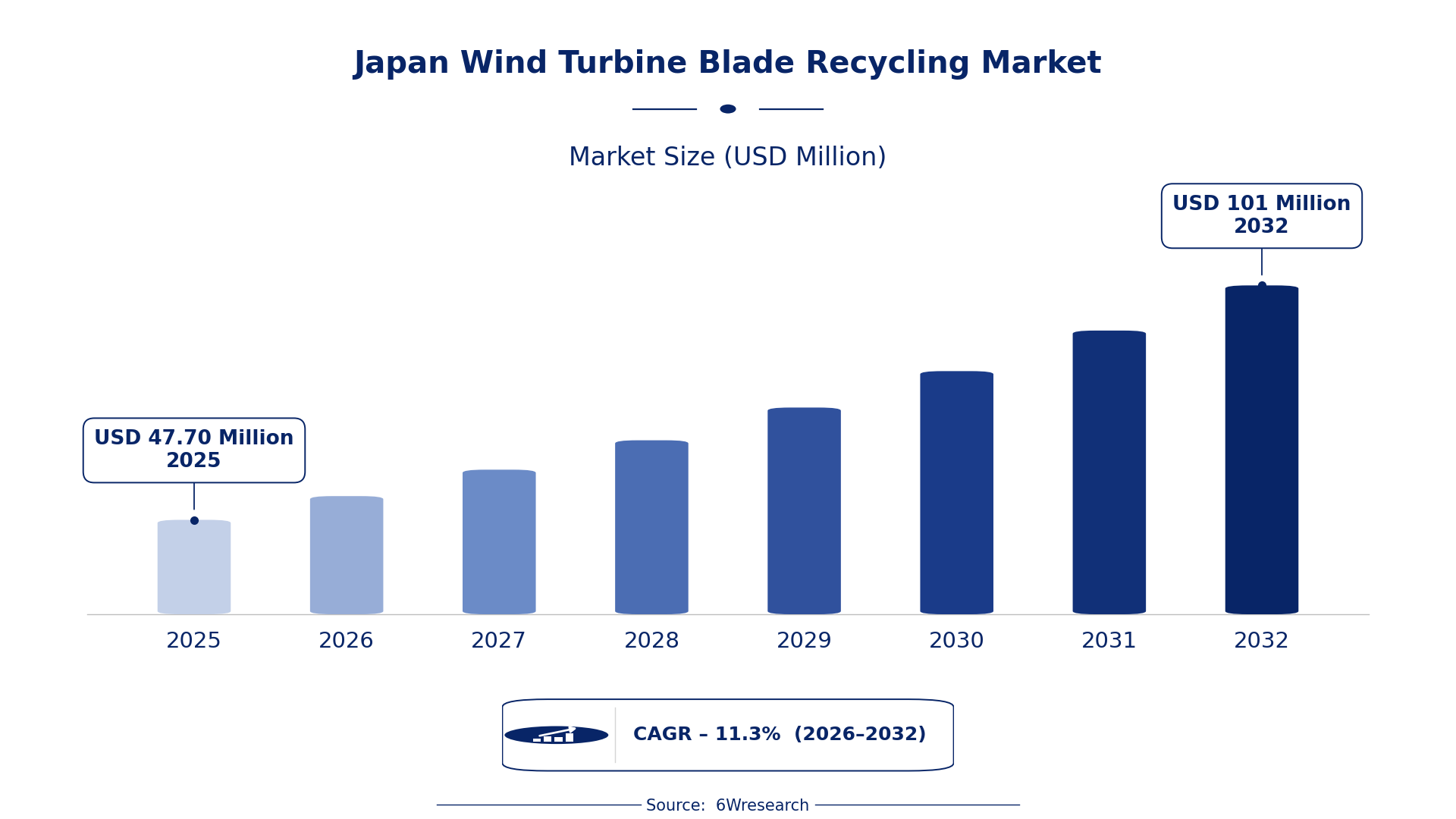
According to 6Wresearch internal database and industry insights, the Japan Wind Turbine Blade Recycling Market was valued at USD 47.70 Million in 2025 and is projected to reach USD 101 Million by 2032, growing at a CAGR of approximately 11.3% during 2026–2032.
Japan Wind Turbine Blade Recycling Market Highlights
| Report Metric | Details |
| Report Name | Japan Wind Turbine Blade Recycling Market (2026-2032) |
| Market Size 2025 | USD 47.70 Million |
| Market Size 2032 | USD 101 Million |
| Absolute Growth 2025–2032 | USD 53.30 Million |
| CAGR 2026–2032 | 11.3% |
| Peak Annual Growth | 12.0% in 2028 |
| Forecast Period | 2026–2032 |
| Historical Data | 2022–2025 |
| Base Year | 2025 |
| Leading Type, 2025 | Physical Recycling (66% share) |
| Leading Application, 2025 | Material Recycling (62% share) |
| Fastest-Growing Type | Chemical Recycling (15.8% CAGR) |
| Fastest-Growing Application | Blade Reuse (14.8% CAGR) |
| Growing Sector | renewable energy |
| Key End Users | local governments, construction companies, renewable energy developers |
Japan Wind Turbine Blade Recycling Market Year-wise Growth Rate and Key Drivers (2022–2032)
This graph illustrates the annual growth rates of the market from 2022 to 2032, highlighting a steady upward trajectory and projected market expansion over the forecast period.
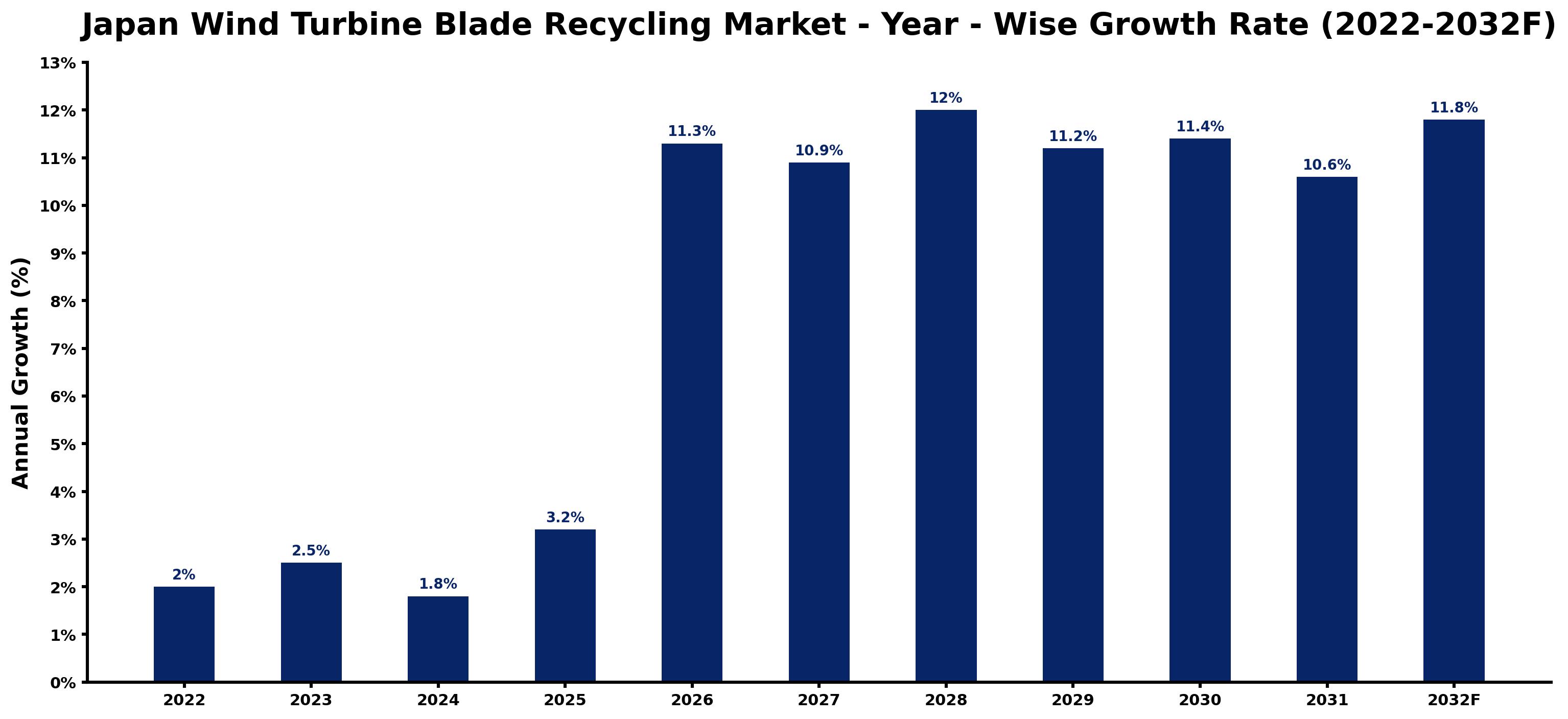
The yearly estimates that follow link every growth rate to its principal driver, so readers can see why the pace changed in each period.
| Year | Estimated Annual Growth (%) | Market Rationale |
| 2022 | 2.0 | The market experienced steady growth due to initial recycling initiatives gaining traction. |
| 2023 | 2.5 | Demand increased as awareness of recycling benefits spread among industry stakeholders. |
| 2024 | 1.8 | Growth slowed as the market adjusted to new recycling technologies and practices. |
| 2025 | 3.2 | Interest surged with the implementation of new recycling standards and initiatives. |
| 2026 | 11.3 | The market is expected to expand rapidly due to heightened investment in recycling technologies. |
| 2027 | 10.9 | Growth will slow slightly as the market stabilises after rapid expansion in previous years. |
| 2028 | 12.0 | Demand is projected to peak as recycling initiatives gain widespread acceptance and implementation. |
| 2029 | 11.2 | A slight slowdown is anticipated as the market matures and competition increases. |
| 2030 | 11.4 | Growth is expected to rise again as more decommissioned blades enter the recycling stream. |
| 2031 | 10.6 | The market will experience a slowdown as it approaches maturity and stabilises. |
| 2032 | 11.8 | Demand is expected to rise as new applications for recycled materials are developed. |
Note: Market size estimations and growth projections presented in this report are based on 6Wresearch's proprietary forecasting methodology, utilizing the latest available industry data, government publications, and primary research inputs.
Japan Wind Turbine Blade Recycling Market Synopsis
Wind turbine blade recycling involves reclaiming materials from decommissioned blades, primarily made of composite materials like fiberglass. The recycling process includes mechanical grinding and chemical treatments to recover valuable components for construction and insulation. The Japan Wind Turbine Blade Recycling Market is expanding due to the increasing number of decommissioned blades, driven by a target of 10 GW of installed wind capacity by 2025 and a new recycling initiative launched in 2023.
Market Dynamics Impact Analysis (2026–2032)
| Factor | Type | Impact | Primary Segment Affected |
| Growing number of decommissioned wind turbines drives demand for recycling solutions. | Driver | High | Material Recycling |
| Increasing investment in renewable energy projects creates a need for recycling services. | Driver | High | Physical Recycling |
| Emerging technologies in recycling processes present new business opportunities. | Opportunity | High | Chemical Recycling |
| The push for sustainable practices encourages local governments to adopt recycling initiatives. | Opportunity | Medium | Material Recycling |
| Limited awareness among stakeholders about recycling benefits restrains market growth. | Restraint | Medium | Physical Recycling |
| High initial costs of recycling technologies can deter investment in new facilities. | Restraint | High | Chemical Recycling |
| Competition from alternative waste management methods poses challenges to recycling adoption. | Challenge | High | Material Recycling |
| Regulatory compliance can complicate the recycling process and increase operational costs. | Challenge | Medium | Physical Recycling |
Evaluation of Drivers in Japan Wind Turbine Blade Recycling Market (2026–2032)
The following drivers explain most of the expected growth.
| Drivers | Primary Segment Affected | Why It Matters (Evidence) |
| Increasing decommissioned wind turbines create a steady supply of materials for recycling. | Material Recycling | Over 200,000 wind turbines are expected to be decommissioned globally by 2030, leading to higher demand for recycling solutions. |
| Government support for renewable energy projects boosts investment in recycling technologies. | Physical Recycling | The Ministry of the Environment promotes recycling, encouraging investments in new facilities. |
| Technological advancements in recycling processes improve efficiency and material recovery rates. | Chemical Recycling | The introduction of new chemical treatments improves the recovery of valuable materials from blades. |
| Growing environmental awareness among consumers drives demand for sustainable practices. | Material Recycling | Local governments are increasingly promoting recycling initiatives, influencing industry practices. |
| Partnerships between industry stakeholders facilitate knowledge sharing and technology transfer. | Physical Recycling | Collaborations with research associations improve recycling methods and broaden market access. |
What keeps demand rising is the increasing number of decommissioned wind turbines, with over 200,000 expected by 2030. Advancements in recycling processes are improving material recovery rates, further driving demand. The growing environmental awareness among consumers encourages industries to adopt sustainable practices, creating a favourable market environment.
Evaluation of Restraints in Japan Wind Turbine Blade Recycling Market
These are the pressures that could keep growth below its potential.
| Market Restraint | Primary Segment Affected | Why It Matters (Evidence) |
| Limited awareness about the benefits of recycling among industry stakeholders hampers growth. | Physical Recycling | Many stakeholders are unaware of the potential cost savings and environmental benefits of recycling wind turbine blades. |
| High initial costs associated with setting up recycling facilities deter investment. | Chemical Recycling | Investors are hesitant to commit to recycling technologies due to the upfront costs involved. |
| Competition from alternative waste management methods affects recycling adoption rates. | Material Recycling | Some companies prefer cheaper disposal methods over investing in recycling solutions. |
| Regulatory compliance requirements can complicate the recycling process. | Physical Recycling | Navigating complex regulations can increase operational costs and delay project timelines. |
| Limited infrastructure for recycling facilities restricts market growth potential. | Chemical Recycling | The lack of established recycling centres makes it challenging to process decommissioned blades efficiently. |
Japan Wind Turbine Blade Recycling Market Challenges
Producers face regulatory challenges due to the JIS Q 10000 standard, complicating compliance and potentially delaying recycling processes, which can cost them up to 15% of project budgets. Buyers encounter rising disposal costs for decommissioned blades, as landfill fees can reach 30,000 yen per blade, impacting their overall project expenses. Skills shortages in the recycling sector hinder efficient processing, resulting in delays that can extend timelines by six months for producers. Competition from alternative waste management solutions threatens to divert investment away from wind turbine blade recycling, potentially leading to a 20% reduction in market growth by 2032.
Trends in the Japan Wind Turbine Blade Recycling Market
The shifts below are changing how Japan Wind Turbine Blade Recycling Market products are bought and supplied.
- Shift in Recycling Practices in Tokyo: Tokyo is experiencing a shift towards more advanced recycling practices, supported by the Japan Wind Power Association. In 2023, new initiatives were launched to promote recycling, resulting in increased participation from local governments.
- Increased Focus on Material Recycling: Material Recycling is gaining traction among stakeholders as a sustainable solution. The Japan Composite Materials Association is actively promoting recycling research, which has increased awareness and participation in recycling initiatives.
- Emergence of Chemical Recycling Techniques: Chemical Recycling techniques are becoming more prominent, particularly for specialized applications. This sub-segment is attracting attention for its potential to recover valuable materials from blades with a CAGR of 15.8%.
- Growing Adoption of JIS Q 10000 Standard: The adoption of the JIS Q 10000 standard is becoming more widespread, ensuring consistent recycling processes. This standard, applicable since 2023, strengthens the credibility of recycling efforts across Japan.
Investment Opportunities in the Japan Wind Turbine Blade Recycling Market
Below are the investment opportunities with the strongest case in the Japan Wind Turbine Blade Recycling Market.
- Local Governments Seeking Recycling Solutions: Local governments are increasingly looking for effective recycling solutions, with 1 billion yen allocated for renewable energy projects in 2023. Collaborating with local partners can facilitate entry into this growing market.
- Investment in Advanced Recycling Technologies: There is a notable opportunity for investment in advanced recycling technologies. Engaging with research associations can provide insights into emerging trends and technologies.
- Gap in Recycling Infrastructure: The current recycling infrastructure is limited, presenting a gap for new facilities. Establishing partnerships with local governments can help address this need and enhance recycling capabilities.
- Timing for Sustainable Practices: As environmental concerns rise, the timing is right for investing in recycling solutions. The push for sustainable practices among consumers creates demand for innovative recycling methods.
Government Initiatives in the Japan Wind Turbine Blade Recycling Market
The new recycling initiative launched in 2023 complements existing regulations like the Waste Management and Public Cleansing Act of 1970. This initiative encourages the development of recycling facilities and promotes sustainable practices in the wind energy sector, strengthening the overall recycling framework.
The Ministry of the Environment oversees the approval of projects related to renewable energy recycling. In 2023, the agency allocated 1 billion yen to support recycling initiatives, aiming to improve infrastructure and promote efficient recycling practices across Japan.
Future Insight of the Japan Wind Turbine Blade Recycling Market
By 2032, buyers will experience higher material recovery rates from advanced recycling technologies, allowing for the reuse of up to 200,000 tonnes of blade materials. The government's investment in renewable energy recycling projects will stimulate innovation and attract new suppliers to the market. Local governments will implement more effective recycling practices, fostering a supportive environment for the industry. New recycling initiatives will drive demand for sustainable solutions in the wind energy sector.
Market Segmentation Analysis
Japan Wind Turbine Blade Recycling Market report covers a detailed analysis of the following market segments:
By Type – Physical Recycling Leads, Chemical Recycling Expected to Grow Fastest
According to Sumit Sagar, AM at 6Wresearch, Physical Recycling held 66% of the Japan Wind Turbine Blade Recycling Market by type in 2025. Physical recycling holds the largest share as it is directly applicable for recovering materials from decommissioned blades. This method is widely adopted in facilities across regions like the Tokyo metropolitan area, which is a hub for wind energy development. The quickest growth will come from Chemical Recycling, forecast to expand at a CAGR of 15.8% between 2026 and 2032. Chemical recycling is experiencing rapid growth due to its ability to reclaim valuable materials for specialised applications. The new recycling initiative launched under the Green Growth Strategy in 2023 is expected to significantly boost this sub-segment's prospects. Suppliers should focus on enhancing chemical recycling capabilities to meet the rising demand.
By Application – Material Recycling Leads, Blade Reuse Expected to Grow Fastest
With 62% of application revenue in 2025, Material Recycling was the largest category. Material recycling dominates the market as it centres on repurposing blade materials into new products. The increasing number of decommissioned blades, projected to exceed 200,000 globally by 2030, drives this trend. Over 2026–2032, Blade Reuse is expected to post the fastest growth, at a CAGR of 14.8%. Blade reuse is growing quickly, though its application is restricted by concerns regarding structural integrity. Local government encouragement for recycling practices is likely to inspire more innovative approaches in this area. Buyers should explore material recycling options to support sustainable practices within the wind energy sector.
Key Attractiveness of the Report
- 10 Years of Market Numbers
- Historical Data Starting from 2022 to 2025
- Base Year 2025
- Forecast Data until 2032
- Key Performance Indicators Impacting the Market
- Major Upcoming Developments and Projects
Key Highlights of the Report:
- Japan Wind Turbine Blade Recycling Market Outlook
- Market Size of Japan Wind Turbine Blade Recycling Market, 2025
- Forecast of Japan Wind Turbine Blade Recycling Market, 2032
- Historical Data and Forecast of Japan Wind Turbine Blade Recycling Revenues & Volume for the Period 2022-2032
- Japan Wind Turbine Blade Recycling Market Trend Evolution
- Japan Wind Turbine Blade Recycling Market Drivers and Challenges
- Japan Wind Turbine Blade Recycling Price Trends
- Japan Wind Turbine Blade Recycling Porter's Five Forces
- Japan Wind Turbine Blade Recycling Industry Life Cycle
- Historical Data and Forecast of Japan Wind Turbine Blade Recycling Market Revenues & Volume By Type for the Period 2022-2032
- Historical Data and Forecast of Japan Wind Turbine Blade Recycling Market Revenues & Volume By Physical Recycling for the Period 2022-2032
- Historical Data and Forecast of Japan Wind Turbine Blade Recycling Market Revenues & Volume By Chemical Recycling for the Period 2022-2032
- Historical Data and Forecast of Japan Wind Turbine Blade Recycling Market Revenues & Volume By Application for the Period 2022-2032
- Historical Data and Forecast of Japan Wind Turbine Blade Recycling Market Revenues & Volume By Material Recycling for the Period 2022-2032
- Historical Data and Forecast of Japan Wind Turbine Blade Recycling Market Revenues & Volume By Blade Reuse for the Period 2022-2032
- Japan Wind Turbine Blade Recycling Import Export Trade Statistics
- Market Opportunity Assessment By Type
- Market Opportunity Assessment By Application
- Japan Wind Turbine Blade Recycling Top Companies Market Share
- Japan Wind Turbine Blade Recycling Competitive Benchmarking By Technical and Operational Parameters
- Japan Wind Turbine Blade Recycling Company Profiles
- Japan Wind Turbine Blade Recycling Key Strategic Recommendations
Market Covered
The study includes the following segmentation.
By Type
- Physical Recycling
- Chemical Recycling
By Application
- Material Recycling
- Blade Reuse































