Japan Wireless Gas Detection Market Size & Growth Rate
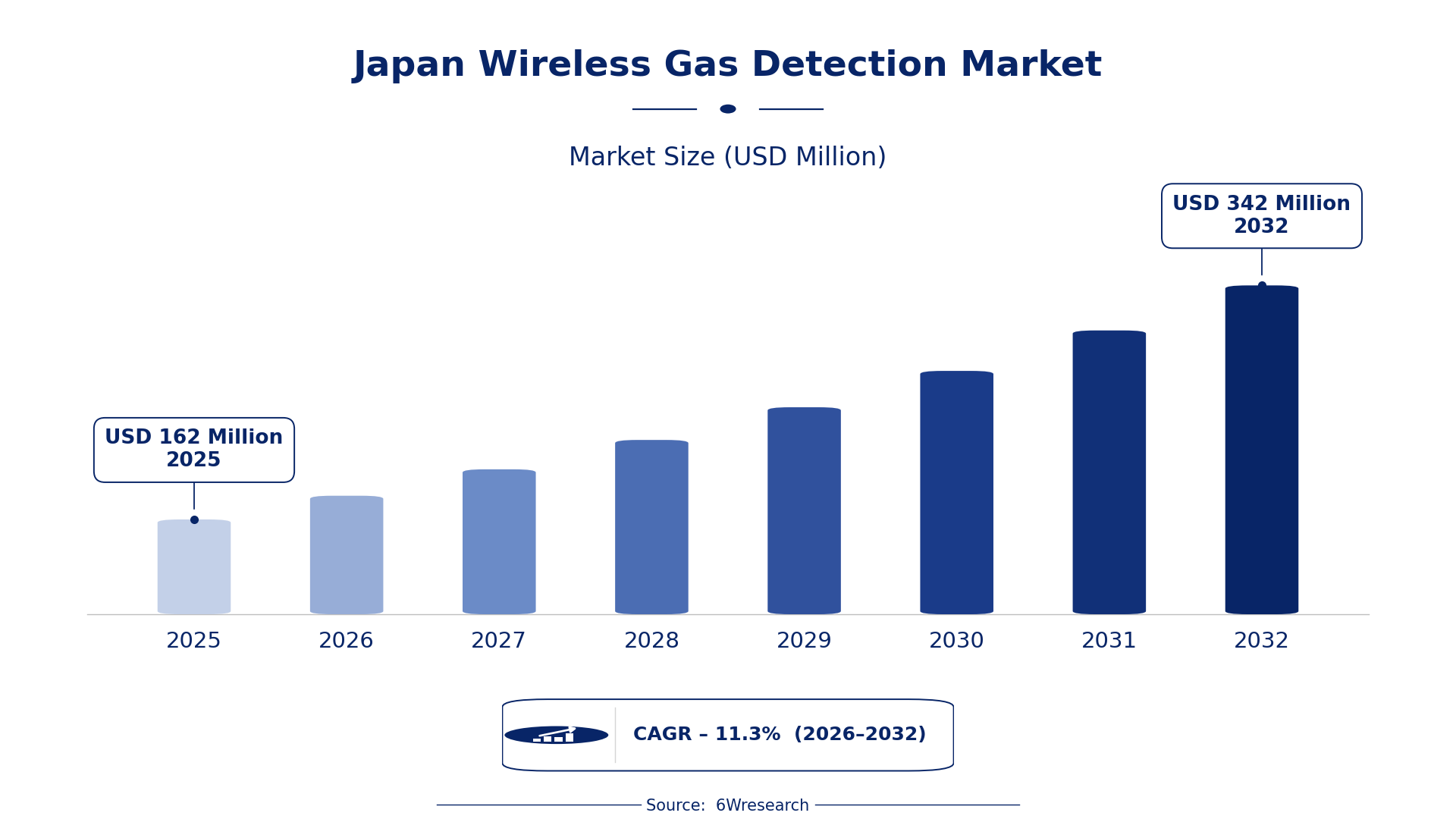
According to 6Wresearch internal database and industry insights, the Japan Wireless Gas Detection Market was valued at USD 162 Million in 2025 and is projected to reach USD 342 Million by 2032, growing at a CAGR of approximately 11.3% during 2026–2032.
Japan Wireless Gas Detection Market Highlights
| Report Metric | Details |
| Report Name | Japan Wireless Gas Detection Market (2026-2032) |
| Market Size 2025 | USD 162 Million |
| Market Size 2032 | USD 342 Million |
| Absolute Growth 2025–2032 | USD 180 Million |
| CAGR 2026–2032 | 11.3% |
| Peak Annual Growth | 12.1% in 2028 |
| Forecast Period | 2026–2032 |
| Historical Data | 2022–2025 |
| Base Year | 2025 |
| Leading Technology, 2025 | Wi-Fi (38% share) |
| Leading Offering, 2025 | Hardware Detectors/ Sensors (39% share) |
| Leading End-user industry, 2025 | Oil & Gas (29% share) |
| Leading Application, 2025 | Industrial Safety (46% share) |
| Fastest-Growing Technology | Bluetooth (15.7% CAGR) |
| Fastest-Growing Offering | Gateways (16.3% CAGR) |
| Fastest-Growing End-user industry | Chemicals and Petrochemicals (15.8% CAGR) |
| Fastest-Growing Application | National Safety and Military Security (15.0% CAGR) |
| Growing Sector | Industrial Safety |
| Key End Users | Oil and Gas, Chemicals and Petrochemicals, Utilities and Power Generation, Government and Military |
Japan Wireless Gas Detection Market Year-wise Growth Rate and Key Drivers (2022–2032)
This graph illustrates the annual growth rates of the market from 2022 to 2032, highlighting a steady upward trajectory and projected market expansion over the forecast period.
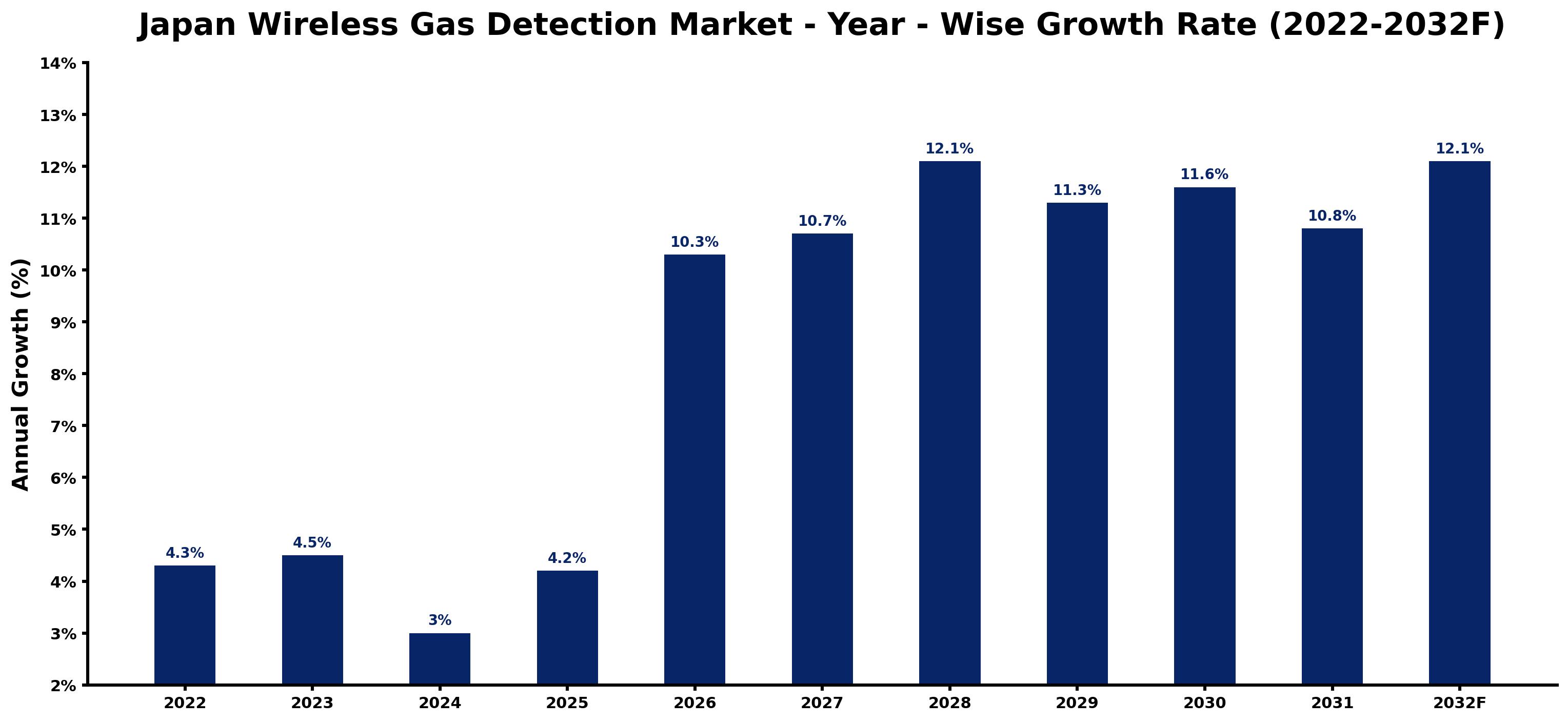
Below, each year's estimated growth is shown next to the factor that most influenced it.
| Year | Estimated Annual Growth (%) | Market Rationale |
| 2022 | 4.3 | The market showed steady growth due to increasing safety awareness among industries. |
| 2023 | 4.5 | Demand for wireless gas detection systems rose as companies sought to enhance workplace safety. |
| 2024 | 3.0 | Growth slowed as some sectors faced budget constraints amid economic uncertainties. |
| 2025 | 4.2 | Increased investment in industrial safety technologies drove faster growth compared to the previous year. |
| 2026 | 10.3 | The market is projected to accelerate as more industries adopt advanced wireless technologies. |
| 2027 | 10.7 | Continued expansion of the oil and gas sector is expected to boost demand further. |
| 2028 | 12.1 | Peak growth is anticipated as regulatory pressures for compliance increase. |
| 2029 | 11.3 | A slowdown is expected as market saturation begins in certain applications. |
| 2030 | 11.6 | Growth is projected to rise again as environmental regulations become stricter. |
| 2031 | 10.8 | The market will continue to grow, backed by ongoing investments in safety technologies. |
| 2032 | 12.1 | Demand is expected to peak again as industries modernise their safety systems. |
Note: Market size estimations and growth projections presented in this report are based on 6Wresearch's proprietary forecasting methodology, utilizing the latest available industry data, government publications, and primary research inputs.
Japan Wireless Gas Detection Market Synopsis
Wireless gas detection technology utilises advanced sensors to monitor gas levels and transmit data wirelessly for safety and environmental monitoring. The Japan Wireless Gas Detection Market is growing due to stringent safety standards and the demand for real-time monitoring across various sectors, particularly in industrial safety and the oil and gas industry. With over 300,000 industrial facilities in Japan, the demand for these systems is expected to increase, supported by government initiatives and technological advancements.
Market Dynamics Impact Analysis (2026–2032)
| Factor | Type | Impact | Primary Segment Affected |
| Increasing safety regulations in industrial sectors | Driver | High | Industrial Safety |
| Growing adoption of wireless technology in monitoring systems | Driver | High | Hardware Detectors/ Sensors |
| Expansion of the oil and gas sector in Japan | Opportunity | High | Oil & Gas |
| Rising demand for environmental monitoring solutions | Opportunity | Medium | Environmental Safety |
| High initial investment costs for advanced systems | Restraint | High | Hardware Detectors/ Sensors |
| Limited awareness of wireless systems among smaller firms | Restraint | Medium | Industrial Safety |
| Competition from established wired systems | Challenge | High | Hardware Detectors/ Sensors |
| Technological integration challenges in existing infrastructures | Challenge | Medium | Environmental Safety |
Evaluation of Drivers in Japan Wireless Gas Detection Market (2026–2032)
These are the developments adding the most demand over the forecast period.
| Drivers | Primary Segment Affected | Why It Matters (Evidence) |
| Increased focus on workplace safety regulations | Industrial Safety | This focus has led to a growing demand for wireless gas detection systems, with compliance required across numerous facilities. |
| Technological advancements in wireless communication | Hardware Detectors/ Sensors | These advancements enable real-time monitoring, driving purchases among industries like oil and gas, which employ over 200,000 people. |
| Rising environmental regulations | Environmental Safety | Regulations mandate gas monitoring in wastewater treatment plants, increasing demand for reliable detection systems. |
| Government initiatives promoting safety standards | Oil & Gas | Safety standards set by relevant associations encourage investment in gas detection technologies across the sector. |
| Growing urbanisation in metropolitan areas | Commercial Buildings and Public Facilities | Urbanisation in regions like Tokyo increases the need for safety technologies in numerous commercial buildings. |
Purchasing is picking up as industries prioritise compliance with safety regulations, particularly in the oil and gas sector, which employs over 200,000 people. The focus on environmental regulations is also increasing, with mandates for gas monitoring in wastewater treatment plants across 47 prefectures. Advancements in wireless communication are enabling real-time monitoring, driving demand for systems in numerous industrial facilities. Government initiatives are promoting safety standards, further encouraging investment in detection technologies.
Evaluation of Restraints in Japan Wireless Gas Detection Market
Several factors work against faster growth; the main ones are summarised below.
| Market Restraint | Primary Segment Affected | Why It Matters (Evidence) |
| High initial costs for wireless gas detection systems | Hardware Detectors/ Sensors | The initial investment can deter smaller firms from adopting advanced technologies, limiting market growth. |
| Limited awareness of wireless technology benefits | Industrial Safety | Many smaller companies lack knowledge about wireless systems, hindering their adoption and market expansion. |
| Competition from established wired detection systems | Hardware Detectors/ Sensors | Familiarity with wired systems often leads to preference, affecting the transition to wireless technologies. |
| Integration challenges with existing infrastructures | Environmental Safety | Many facilities face difficulties in incorporating new wireless systems with their current setups, slowing adoption. |
| Regulatory compliance complexities | Oil & Gas | Navigating regulatory requirements can be challenging for companies, impacting their investment decisions. |
Japan Wireless Gas Detection Market Challenges
Buyers face increased costs due to fierce competition, with price hikes of up to 15% for gas detection systems impacting operational budgets. Suppliers struggle with outdated technology, leading to delays of six months in product development, which hampers buyers' ability to ensure safety compliance. Supply chain disruptions can create shortages of critical components, forcing industrial facilities to temporarily halt operations. Stricter environmental regulations impose additional compliance costs, estimated at 10% of operational budgets for facilities, further straining financial resources for buyers and suppliers alike.
Trends in the Japan Wireless Gas Detection Market
Below are the shifts with the largest effect on the Japan Wireless Gas Detection Market.
- Shift from Wired to Wireless Detection Systems: The trend towards wireless gas detection systems is gaining traction as industries seek flexibility and real-time data. In 2022, over 1,000 commercial buildings in Tokyo adopted wireless technologies, improving monitoring capabilities.
- Increasing Focus on Environmental Safety: Environmental safety is becoming more prominent, with regulations mandating gas monitoring in wastewater treatment plants. This shift began in 2023, driving demand for advanced detection technologies.
- Rise of Advanced Monitoring Technologies: Since 2024, there has been a notable increase in the adoption of advanced monitoring technologies in industrial settings. This trend is supported by initiatives promoting safety standards.
- Growing Demand in Military Applications: Military facilities are increasingly integrating wireless gas detection systems, with over 500 installations reported. This trend, which started in 2025, highlights the need for improved national security.
Investment Opportunities in the Japan Wireless Gas Detection Market
Several openings in the Japan Wireless Gas Detection Market merit attention from investors.
- Collaborations with Local Manufacturers: Partnering with local manufacturers can facilitate market entry, particularly in the oil and gas sector, which employs over 200,000 people. This approach can improve market penetration.
- Supply of Advanced Monitoring Solutions: There is a rising need for advanced monitoring solutions in environmental safety, especially in wastewater treatment plants. Companies can target this sector to meet regulatory demands.
- Investment in Industrial Safety Technologies: Investment opportunities exist in industrial safety technologies, with numerous facilities requiring compliance. Engaging with local safety associations can assist market entry.
- Focus on Urban Commercial Buildings: The demand for wireless gas detection systems in urban commercial buildings is increasing, particularly in Tokyo. Suppliers should consider partnerships with local construction firms to access this market.
Government Initiatives in the Japan Wireless Gas Detection Market
The Electrical Appliance and Material Safety Act (1961; METI) regulates the safety of electrical appliances, ensuring that wireless gas detection systems meet stringent safety standards. Compliance with this act is essential for producers, as it requires rigorous testing and certification of devices before they can be marketed. Additionally, the GX Basic Policy, adopted in 2023, aims for approximately JPY 150 trillion in public-private decarbonisation investment over the next decade, promoting advancements in gas detection technologies and enhancing safety protocols across industries.
In 2023, the government allocated funds for the modernization of industrial safety equipment, with a focus on wireless gas detection systems. The Ministry of Economy, Trade and Industry oversees this funding, supporting initiatives that enhance safety in industrial facilities. This financial backing encourages manufacturers to innovate and improve their product offerings, ensuring compliance with evolving safety standards and regulations.
Future Insight of the Japan Wireless Gas Detection Market
By 2032, industrial facilities will adopt advanced wireless gas detection systems, driven by government safety initiatives and funding for equipment upgrades. The integration of real-time data analytics will improve monitoring capabilities, allowing suppliers to respond promptly to gas leaks. Environmental monitoring programs will expand, necessitating adherence to more stringent regulations, thus increasing the need for sophisticated detection technologies. The average installed base of gas detection systems is projected to grow, ensuring safer environments across various sectors.
Market Segmentation Analysis
Japan Wireless Gas Detection Market report covers a detailed analysis of the following market segments:
By Technology – Wi-Fi Leads, Bluetooth Expected to Grow Fastest
According to Sachin Kumar Rai, Senior Research Analyst at 6Wresearch, Wi-Fi accounted for 38% of the market by technology in 2025. Wi-Fi technology holds the largest share due to its capability for real-time data transmission across Japan's vast network of industrial facilities. Its reliability is essential for maintaining safety standards, especially in critical sectors such as oil and gas, where timely information is paramount. Bluetooth is set to record the highest CAGR in this split, 15.7% over 2026–2032. Bluetooth technology is experiencing rapid growth as it becomes increasingly popular for short-range applications in over 1,000 commercial buildings in Tokyo. This trend is likely to continue as businesses seek efficient and cost-effective monitoring solutions. Suppliers should focus on expanding their Bluetooth offerings to meet the growing demand in commercial settings.
By Offering – Hardware Detectors/ Sensors Lead, Gateways Expected to Grow Fastest
With 39% of offering revenue in 2025, Hardware Detectors/ Sensors was the largest category. Hardware detectors and sensors dominate the market as they are crucial for detecting hazardous gases in various industrial environments. Their importance is underscored by strict safety regulations that require reliable detection systems to protect workers and facilities. Gateways are projected to grow fastest, at a CAGR of 16.3% during 2026–2032. Gateways are seeing the fastest growth as they are vital for connecting sensors to networks, facilitating real-time monitoring capabilities. The increasing integration of wireless technology into safety protocols is driving this demand. Buyers should prioritise suppliers that offer advanced gateway solutions to improve their gas detection systems.
By End-user industry – Oil & Gas Lead, Chemicals and Petrochemicals Expected to Grow Fastest
Oil & Gas held 29% of the Japan Wireless Gas Detection Market by end-user industry in 2025. The oil and gas sector is the leading end-user of gas detection systems, employing these technologies to ensure the safety of over 200,000 workers. The industry's extensive operations necessitate robust gas monitoring solutions to effectively manage safety risks. The quickest growth will come from Chemicals and Petrochemicals, forecast to expand at a CAGR of 15.8% between 2026 and 2032. The chemicals and petrochemicals sector is experiencing rapid growth as it requires effective monitoring of toxic gas emissions to comply with environmental regulations. This compliance necessity is propelling the adoption of advanced detection technologies. Suppliers should tailor their products to meet the specific safety requirements of the chemicals and petrochemicals sector.
By Application – Industrial Safety Leads, National Safety and Military Security Expected to Grow Fastest
Industrial Safety took 46% of application revenue in 2025, more than any other category. Industrial safety is the leading application for gas detection systems, as it is fundamental for ensuring workplace safety across various sectors. The emphasis on safety in over 300,000 industrial facilities highlights the critical need for effective monitoring solutions. Over 2026–2032, National Safety and Military Security is expected to post the fastest growth, at a CAGR of 15.0%. The national safety and military security application is experiencing the fastest growth due to increased focus on protecting national interests in over 500 military facilities. This heightened awareness is driving investments in advanced gas detection technologies. Buyers in the military sector should seek suppliers that specialise in high-security gas detection systems.
Key Attractiveness of the Report
- 10 Years of Market Numbers
- Historical Data Starting from 2022 to 2025
- Base Year 2025
- Forecast Data until 2032
- Key Performance Indicators Impacting the Market
- Major Upcoming Developments and Projects
Key Highlights of the Report:
- Japan Wireless Gas Detection Market Outlook
- Market Size of Japan Wireless Gas Detection Market, 2025
- Forecast of Japan Wireless Gas Detection Market, 2032
- Historical Data and Forecast of Japan Wireless Gas Detection Revenues & Volume for the Period 2022-2032
- Japan Wireless Gas Detection Market Trend Evolution
- Japan Wireless Gas Detection Market Drivers and Challenges
- Japan Wireless Gas Detection Price Trends
- Japan Wireless Gas Detection Porter's Five Forces
- Japan Wireless Gas Detection Industry Life Cycle
- Historical Data and Forecast of Japan Wireless Gas Detection Market Revenues & Volume By Technology for the Period 2022-2032
- Historical Data and Forecast of Japan Wireless Gas Detection Market Revenues & Volume By Wi-Fi for the Period 2022-2032
- Historical Data and Forecast of Japan Wireless Gas Detection Market Revenues & Volume By Bluetooth for the Period 2022-2032
- Historical Data and Forecast of Japan Wireless Gas Detection Market Revenues & Volume By Cellular for the Period 2022-2032
- Historical Data and Forecast of Japan Wireless Gas Detection Market Revenues & Volume By License-Free Ism B for the Period 2022-2032
- Historical Data and Forecast of Japan Wireless Gas Detection Market Revenues & Volume By Offering for the Period 2022-2032
- Historical Data and Forecast of Japan Wireless Gas Detection Market Revenues & Volume By Hardware Detectors/ Sensors for the Period 2022-2032
- Historical Data and Forecast of Japan Wireless Gas Detection Market Revenues & Volume By Gateways for the Period 2022-2032
- Historical Data and Forecast of Japan Wireless Gas Detection Market Revenues & Volume By Monitors for the Period 2022-2032
- Historical Data and Forecast of Japan Wireless Gas Detection Market Revenues & Volume By Controllers for the Period 2022-2032
- Historical Data and Forecast of Japan Wireless Gas Detection Market Revenues & Volume By End-user industry for the Period 2022-2032
- Historical Data and Forecast of Japan Wireless Gas Detection Market Revenues & Volume By Oil & Gas for the Period 2022-2032
- Historical Data and Forecast of Japan Wireless Gas Detection Market Revenues & Volume By Chemicals and Petrochemicals for the Period 2022-2032
- Historical Data and Forecast of Japan Wireless Gas Detection Market Revenues & Volume By Utilities and Power Generation for the Period 2022-2032
- Historical Data and Forecast of Japan Wireless Gas Detection Market Revenues & Volume By Mining and Metals for the Period 2022-2032
- Historical Data and Forecast of Japan Wireless Gas Detection Market Revenues & Volume By Water and Wastewater Treatment Plants for the Period 2022-2032
- Historical Data and Forecast of Japan Wireless Gas Detection Market Revenues & Volume By Commercial Buildings and Public Facilities for the Period 2022-2032
- Historical Data and Forecast of Japan Wireless Gas Detection Market Revenues & Volume By Government and Military for the Period 2022-2032
- Historical Data and Forecast of Japan Wireless Gas Detection Market Revenues & Volume By Discrete Manufacturing Industries for the Period 2022-2032
- Historical Data and Forecast of Japan Wireless Gas Detection Market Revenues & Volume By Application for the Period 2022-2032
- Historical Data and Forecast of Japan Wireless Gas Detection Market Revenues & Volume By Industrial Safety for the Period 2022-2032
- Historical Data and Forecast of Japan Wireless Gas Detection Market Revenues & Volume By National Safety and Military Security for the Period 2022-2032
- Historical Data and Forecast of Japan Wireless Gas Detection Market Revenues & Volume By Environmental Safety for the Period 2022-2032
- Japan Wireless Gas Detection Import Export Trade Statistics
- Market Opportunity Assessment By Technology
- Market Opportunity Assessment By Offering
- Market Opportunity Assessment By End-user industry
- Market Opportunity Assessment By Application
- Japan Wireless Gas Detection Top Companies Market Share
- Japan Wireless Gas Detection Competitive Benchmarking By Technical and Operational Parameters
- Japan Wireless Gas Detection Company Profiles
- Japan Wireless Gas Detection Key Strategic Recommendations
Market Covered
Coverage by segment is as follows.
By Technology
- Wi-Fi
- Bluetooth
- Cellular
- License-Free Ism B
By Offering
- Hardware Detectors/ Sensors
- Gateways
- Monitors
- Controllers
By End-user industry
- Oil & Gas
- Chemicals and Petrochemicals
- Utilities and Power Generation
- Mining and Metals
- Water and Wastewater Treatment Plants
- Commercial Buildings and Public Facilities
- Government and Military
- Discrete Manufacturing Industries
By Application
- Industrial Safety
- National Safety and Military Security
- Environmental Safety































