Japan Wireless Infrastructure Monitoring Market Size & Growth Rate
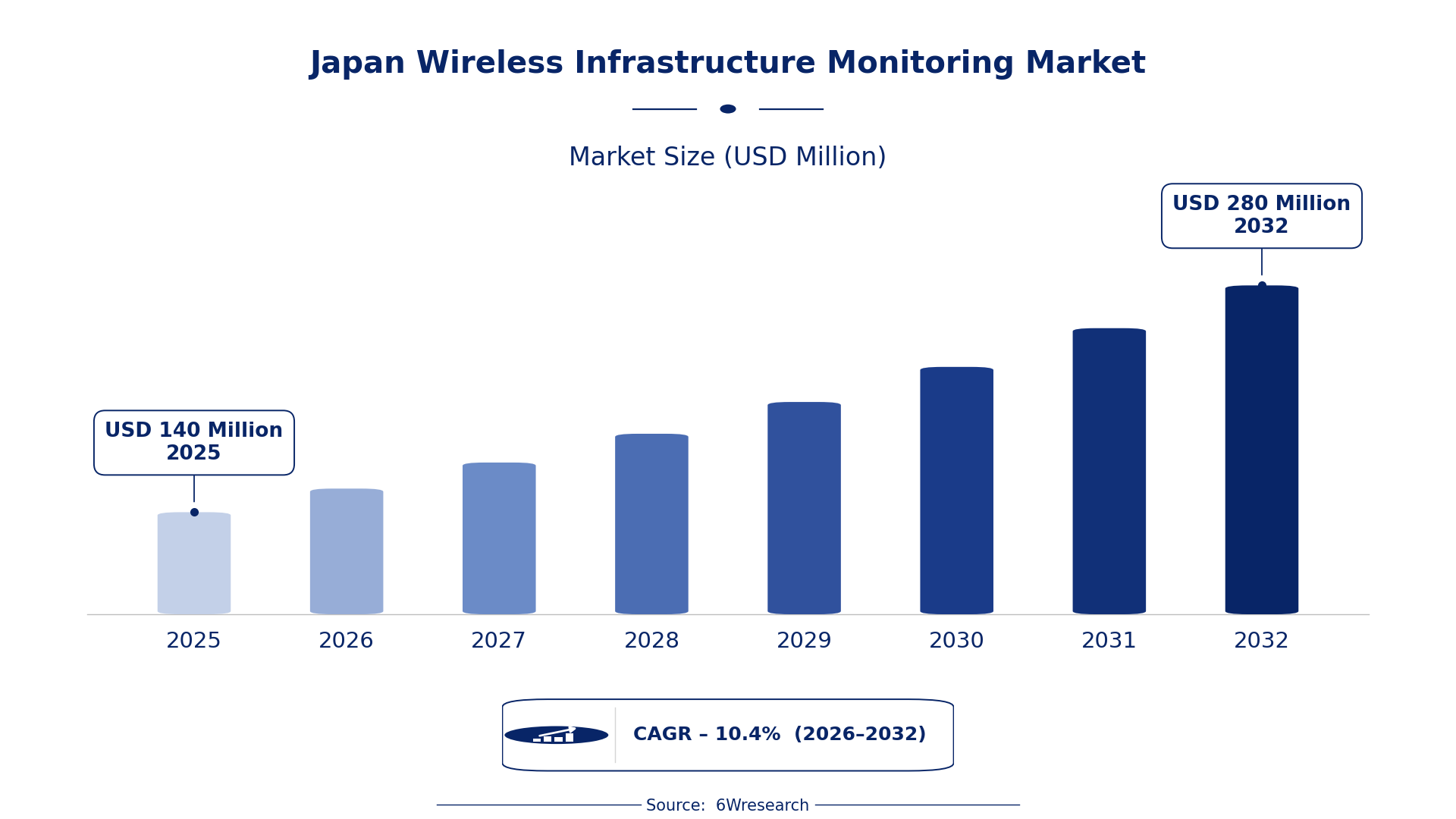
According to 6Wresearch internal database and industry insights, the Japan Wireless Infrastructure Monitoring Market was valued at USD 140 Million in 2025 and is projected to reach USD 280 Million by 2032, growing at a CAGR of approximately 10.4% during 2026–2032.
Japan Wireless Infrastructure Monitoring Market Highlights
| Report Metric | Details |
| Report Name | Japan Wireless Infrastructure Monitoring Market (2026-2032) |
| Market Size 2025 | USD 140 Million |
| Market Size 2032 | USD 280 Million |
| Absolute Growth 2025–2032 | USD 140 Million |
| CAGR 2026–2032 | 10.4% |
| Peak Annual Growth | 11.2% in 2031 |
| Forecast Period | 2026–2032 |
| Historical Data | 2022–2025 |
| Base Year | 2025 |
| Leading Type, 2025 | Hardware (57% share) |
| Leading Application, 2025 | Civil Infrastructure (42% share) |
| Fastest-Growing Type | Software & Services (12.0% CAGR) |
| Fastest-Growing Application | Energy (14.0% CAGR) |
| Growing Sector | telecommunications |
| Key End Users | telecommunications providers, energy companies, civil infrastructure planners, disaster response agencies |
Japan Wireless Infrastructure Monitoring Market Year-wise Growth Rate and Key Drivers (2022–2032)
This graph illustrates the annual growth rates of the market from 2022 to 2032, highlighting a steady upward trajectory and projected market expansion over the forecast period.
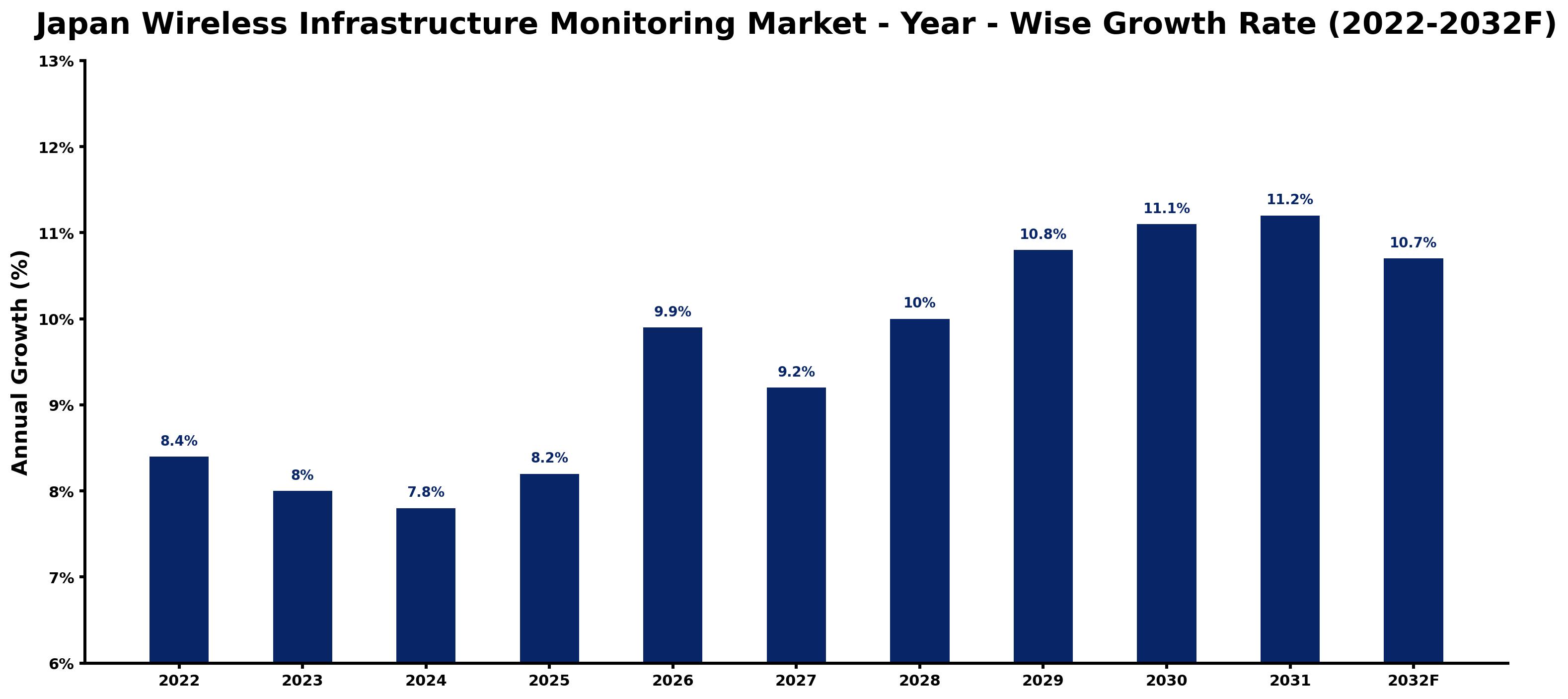
Below, each year's estimated growth is shown next to the factor that most influenced it.
| Year | Estimated Annual Growth (%) | Market Rationale |
| 2022 | 8.4 | The telecommunications sector showed strong performance, supporting market growth. |
| 2023 | 8.0 | Growth slowed slightly due to saturation in urban areas. |
| 2024 | 7.8 | Demand continued to grow, although at a reduced rate compared to previous years. |
| 2025 | 8.2 | Increased investment in smart technologies boosted market activity. |
| 2026 | 9.9 | The introduction of new monitoring technologies is expected to accelerate growth. |
| 2027 | 9.2 | Growth is projected to slow as market maturity begins to set in. |
| 2028 | 10.0 | Demand will rise again as urban planning initiatives expand. |
| 2029 | 10.8 | Investment in monitoring systems by the energy sector will drive growth. |
| 2030 | 11.1 | Market growth is expected to accelerate with new infrastructure projects. |
| 2031 | 11.2 | Peak growth will be achieved as demand surges in urban areas. |
| 2032 | 10.7 | Growth is projected to slow as the market stabilises after rapid expansion. |
Note: Market size estimations and growth projections presented in this report are based on 6Wresearch's proprietary forecasting methodology, utilizing the latest available industry data, government publications, and primary research inputs.
Japan Wireless Infrastructure Monitoring Market Synopsis
Wireless Infrastructure Monitoring employs advanced technologies to oversee the condition and performance of wireless communication systems, combining hardware sensors and software analytics for real-time data collection. The Japan Wireless Infrastructure Monitoring Market is growing due to a robust telecommunications sector that serves a population of approximately 125 million. Substantial investments in smart grid technologies and urban planning initiatives are driving new demand, ensuring network reliability and improving operational efficiency across various sectors.
Market Dynamics Impact Analysis (2026–2032)
| Factor | Type | Impact | Primary Segment Affected |
| Growing demand for reliable communication networks | Driver | High | Hardware |
| Increased investment in smart grid technologies | Driver | High | Software & Services |
| Expansion of urban planning initiatives | Opportunity | High | Civil Infrastructure |
| Rising focus on disaster response capabilities | Opportunity | High | Energy |
| Market saturation in urban areas | Restraint | Medium | Hardware |
| High costs of advanced monitoring systems | Restraint | Medium | Software & Services |
| Supply chain disruptions affecting hardware availability | Challenge | High | Hardware |
| Technological integration challenges in existing systems | Challenge | Medium | Software & Services |
Evaluation of Drivers in Japan Wireless Infrastructure Monitoring Market (2026–2032)
These are the developments adding the most demand over the forecast period.
| Drivers | Primary Segment Affected | Why It Matters (Evidence) |
| High demand for reliable communication networks | Hardware | Japan's extensive wireless infrastructure of over 120,000 km requires constant monitoring to ensure reliability. |
| Investment in smart grid technologies | Software & Services | The energy sector's ¥1 trillion investment in smart grid technologies increases the need for effective monitoring solutions. |
| Urban planning initiatives promoting smart technologies | Civil Infrastructure | The Digital Agency's efforts encourage the adoption of wireless monitoring systems in urban development. |
| Focus on disaster response capabilities | Energy | Wireless monitoring is vital for disaster preparedness in earthquake-prone regions, improving safety measures. |
| Integration of advanced technologies in aerospace | Aerospace & Defense | The Japan Aerospace Exploration Agency employs wireless monitoring for satellite communications, increasing demand. |
Several shifts outside the market lift sales. The telecommunications sector's extensive infrastructure, spanning over 120,000 km, creates a high demand for reliable monitoring solutions. In 2023, Japan's energy sector invested ¥1 trillion in smart grid technologies, increasing the need for effective monitoring systems. These factors are driving a growing market for wireless infrastructure monitoring solutions.
Evaluation of Restraints in Japan Wireless Infrastructure Monitoring Market
These restraints slow adoption and weigh on supplier margins.
| Market Restraint | Primary Segment Affected | Why It Matters (Evidence) |
| Market saturation in urban areas | Hardware | As urban areas become saturated, growth potential for new installations diminishes, limiting hardware sales. |
| High costs of advanced monitoring systems | Software & Services | The initial investment required for advanced monitoring systems can deter potential buyers, slowing adoption. |
| Supply chain disruptions affecting hardware availability | Hardware | Global supply chain issues have led to delays in hardware availability, impacting project timelines. |
| Technological integration challenges in existing systems | Software & Services | Many existing systems struggle to integrate new technologies, hindering the adoption of advanced solutions. |
| Limited awareness of wireless monitoring benefits | Civil Infrastructure | Some stakeholders remain unaware of the advantages of wireless monitoring, affecting market growth. |
Japan Wireless Infrastructure Monitoring Market Challenges
Strict telecommunications regulations slow down the deployment of new wireless monitoring technologies, delaying updates for producers. Intense competition among importers leads to price wars, forcing them to cut costs, which can compromise the quality of monitoring systems and result in unreliable data for buyers. Compliance with standards like ISO/IEC 27001 raises operational expenses by up to 15%, ultimately increasing prices for buyers. Rapid technological advancements require continuous investment, making it challenging for smaller producers to keep pace and limiting their ability to compete effectively.
Trends in the Japan Wireless Infrastructure Monitoring Market
Four trends stand out in the Japan Wireless Infrastructure Monitoring Market.
- Shift towards Smart City Initiatives: In 2023, urban development focuses on wireless monitoring technologies, promoting efficiency and resilience across Japan's cities, particularly in the Tokyo metropolitan area.
- Increasing Adoption of Smart Grid Technologies: Japan's energy sector is investing ¥1 trillion in smart grid technologies, leading to greater reliance on wireless monitoring for energy distribution and management.
- Growing Demand for Disaster Response Solutions: As Japan is prone to earthquakes, the need for effective wireless monitoring systems for disaster response is rising, improving safety measures in vulnerable regions.
- Focus on Energy Sector Monitoring: The energy sector prioritises wireless monitoring to optimise transmission networks, driven by substantial investments and technological advancements.
Investment Opportunities in the Japan Wireless Infrastructure Monitoring Market
The opportunities below stand out in the Japan Wireless Infrastructure Monitoring Market for new entrants and existing suppliers.
- Supply advanced monitoring hardware: With a growing need for reliable communication, suppliers can focus on hardware solutions for urban infrastructure, targeting the Tokyo metropolitan area, which has over 12 million residents.
- Provide software analytics services: The market gap for data analysis services is notable, with a projected increase in demand for software solutions by 12% by 2032, particularly in the energy sector.
- Establish partnerships for smart grid technologies: Energy companies are seeking local partners to improve monitoring capabilities, presenting opportunities for joint ventures in the smart grid sector.
- Support disaster response initiatives: With increasing focus on disaster preparedness, suppliers can provide monitoring solutions to government agencies responsible for emergency management.
Government Initiatives in the Japan Wireless Infrastructure Monitoring Market
The Electrical Appliance and Material Safety Act of 1961 regulates safety standards for electrical appliances, impacting wireless monitoring equipment. This law ensures that all monitoring devices meet safety requirements, promoting consumer confidence in the technology. The AI Promotion Act, established in 2025, sets a national framework for AI development, influencing the integration of AI in wireless monitoring systems, improving their functionality and efficiency.
The Digital Agency, established in September 2021, leads the government's digital transformation efforts. This agency oversees the implementation of common system standards, facilitating the adoption of wireless monitoring technologies across various sectors. The Ministry of Internal Affairs and Communications also supports these efforts by approving standards that ensure the reliability and performance of monitoring systems.
Future Insight of the Japan Wireless Infrastructure Monitoring Market
Telecommunications buyers will experience transformative changes in wireless monitoring technologies by 2032, driven by the Smart City Strategy 2023 that promotes advanced monitoring systems. The Ministry of Internal Affairs and Communications is expected to implement updated standards that improve monitoring reliability. Investment in smart grid technologies, amounting to ¥1 trillion in 2023, will further advance data collection methods. Suppliers will respond by offering solutions that enhance operational efficiency and strengthen disaster response capabilities in earthquake-prone regions.
Market Segmentation Analysis
Japan Wireless Infrastructure Monitoring Market report covers a detailed analysis of the following market segments:
By Type – Hardware Leads, Software & Services Expected to Grow Fastest
According to Sumit Sagar, AM at 6Wresearch, Hardware accounted for 57% of the market by type in 2025. Hardware holds the largest share because it is fundamental for real-time data collection and monitoring across Japan's extensive wireless communication infrastructure. The critical role of hardware is underscored by the need for reliable performance in a country with over 120,000 km of such infrastructure. Software & Services are set to record the highest CAGR in this split, 12.0% over 2026–2032. Software & Services is growing rapidly as organisations increasingly recognise the necessity of data analysis and system management for optimising wireless infrastructure performance. The substantial investments in smart grid technologies, totalling ¥1 trillion in 2023, illustrate this trend. Suppliers should prioritise the development of advanced software solutions to cater to the rising demand for data analytics in wireless monitoring.
By Application – Civil Infrastructure Leads, Energy Expected to Grow Fastest
Civil Infrastructure took 42% of application revenue in 2025, more than any other category. Civil Infrastructure holds the largest share due to its essential role in monitoring structural health and safety across Japan's extensive urban landscape, particularly in earthquake-prone areas like Tokyo. The reliance on this application ensures the integrity and longevity of critical infrastructure, which is paramount for public safety. Over 2026–2032, Energy is expected to post the fastest growth, at a CAGR of 14.0%. Energy is experiencing the fastest growth, fuelled by the pressing demand for effective monitoring solutions in energy transmission and distribution networks, especially with the recent emphasis on smart grid technologies. This sector's substantial investments highlight its importance in advancing energy management and sustainability. Suppliers should prioritise the development of tailored solutions for the energy sector to meet the increasing demand for efficient monitoring technologies.
Key Attractiveness of the Report
- 10 Years of Market Numbers
- Historical Data Starting from 2022 to 2025
- Base Year 2025
- Forecast Data until 2032
- Key Performance Indicators Impacting the Market
- Major Upcoming Developments and Projects
Key Highlights of the Report:
- Japan Wireless Infrastructure Monitoring Market Outlook
- Market Size of Japan Wireless Infrastructure Monitoring Market, 2025
- Forecast of Japan Wireless Infrastructure Monitoring Market, 2032
- Historical Data and Forecast of Japan Wireless Infrastructure Monitoring Revenues & Volume for the Period 2022-2032
- Japan Wireless Infrastructure Monitoring Market Trend Evolution
- Japan Wireless Infrastructure Monitoring Market Drivers and Challenges
- Japan Wireless Infrastructure Monitoring Price Trends
- Japan Wireless Infrastructure Monitoring Porter's Five Forces
- Japan Wireless Infrastructure Monitoring Industry Life Cycle
- Historical Data and Forecast of Japan Wireless Infrastructure Monitoring Market Revenues & Volume By Type for the Period 2022-2032
- Historical Data and Forecast of Japan Wireless Infrastructure Monitoring Market Revenues & Volume By Hardware for the Period 2022-2032
- Historical Data and Forecast of Japan Wireless Infrastructure Monitoring Market Revenues & Volume By Software & Services for the Period 2022-2032
- Historical Data and Forecast of Japan Wireless Infrastructure Monitoring Market Revenues & Volume By Application for the Period 2022-2032
- Historical Data and Forecast of Japan Wireless Infrastructure Monitoring Market Revenues & Volume By Civil Infrastructure for the Period 2022-2032
- Historical Data and Forecast of Japan Wireless Infrastructure Monitoring Market Revenues & Volume By Aerospace & Defense for the Period 2022-2032
- Historical Data and Forecast of Japan Wireless Infrastructure Monitoring Market Revenues & Volume By Energy for the Period 2022-2032
- Historical Data and Forecast of Japan Wireless Infrastructure Monitoring Market Revenues & Volume By Mining for the Period 2022-2032
- Japan Wireless Infrastructure Monitoring Import Export Trade Statistics
- Market Opportunity Assessment By Type
- Market Opportunity Assessment By Application
- Japan Wireless Infrastructure Monitoring Top Companies Market Share
- Japan Wireless Infrastructure Monitoring Competitive Benchmarking By Technical and Operational Parameters
- Japan Wireless Infrastructure Monitoring Company Profiles
- Japan Wireless Infrastructure Monitoring Key Strategic Recommendations
Market Covered
Coverage by segment is as follows.
By Type
- Hardware
- Software & Services
By Application
- Civil Infrastructure
- Aerospace & Defense
- Energy
- Mining































