Japan Wireless Mesh Networking Market Size & Growth Rate
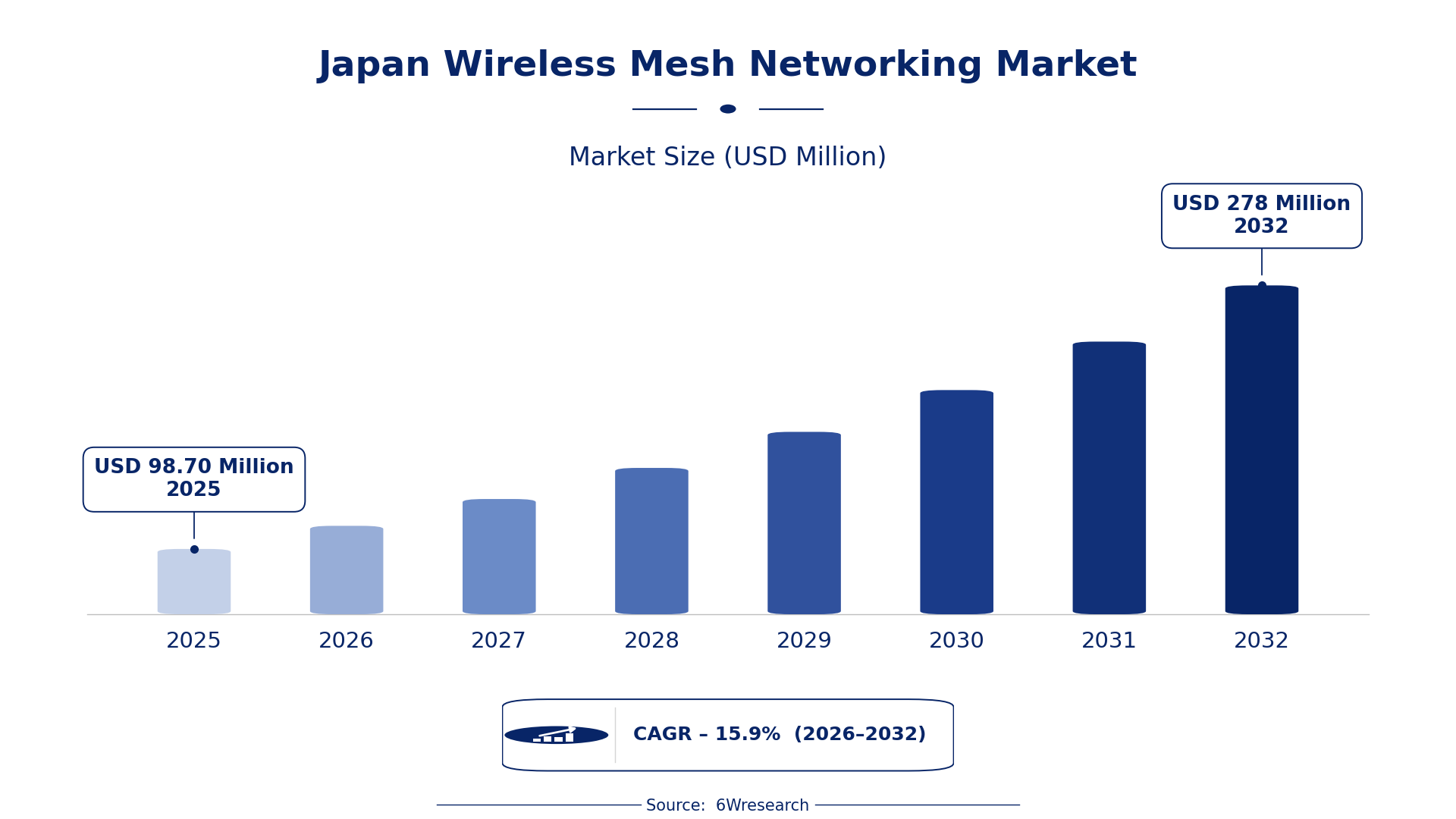
According to 6Wresearch internal database and industry insights, the Japan Wireless Mesh Networking Market was valued at USD 98.70 Million in 2025 and is projected to reach USD 278 Million by 2032, growing at a CAGR of approximately 15.9% during 2026–2032.
Japan Wireless Mesh Networking Market Highlights
| Report Metric | Details |
| Report Name | Japan Wireless Mesh Networking Market (2026-2032) |
| Market Size 2025 | USD 98.70 Million |
| Market Size 2032 | USD 278 Million |
| Absolute Growth 2025–2032 | USD 179.30 Million |
| CAGR 2026–2032 | 15.9% |
| Peak Annual Growth | 16.5% in 2032 |
| Forecast Period | 2026–2032 |
| Historical Data | 2022–2025 |
| Base Year | 2025 |
| Leading Radio Frequency, 2025 | Sub 1 GHz Band (39% share) |
| Leading Application, 2025 | Home Networking (39% share) |
| Leading End-User, 2025 | Education (35% share) |
| Fastest-Growing Radio Frequency | 2.4 GHz Band (20.4% CAGR) |
| Fastest-Growing Application | Video Surveillance (21.7% CAGR) |
| Fastest-Growing End-User | Government (22.8% CAGR) |
| Growing Sector | Smart Cities |
| Key End Users | Healthcare, Government, Education, Transportation & Logistics |
Japan Wireless Mesh Networking Market Year-wise Growth Rate and Key Drivers (2022–2032)
This graph illustrates the annual growth rates of the market from 2022 to 2032, highlighting a steady upward trajectory and projected market expansion over the forecast period.
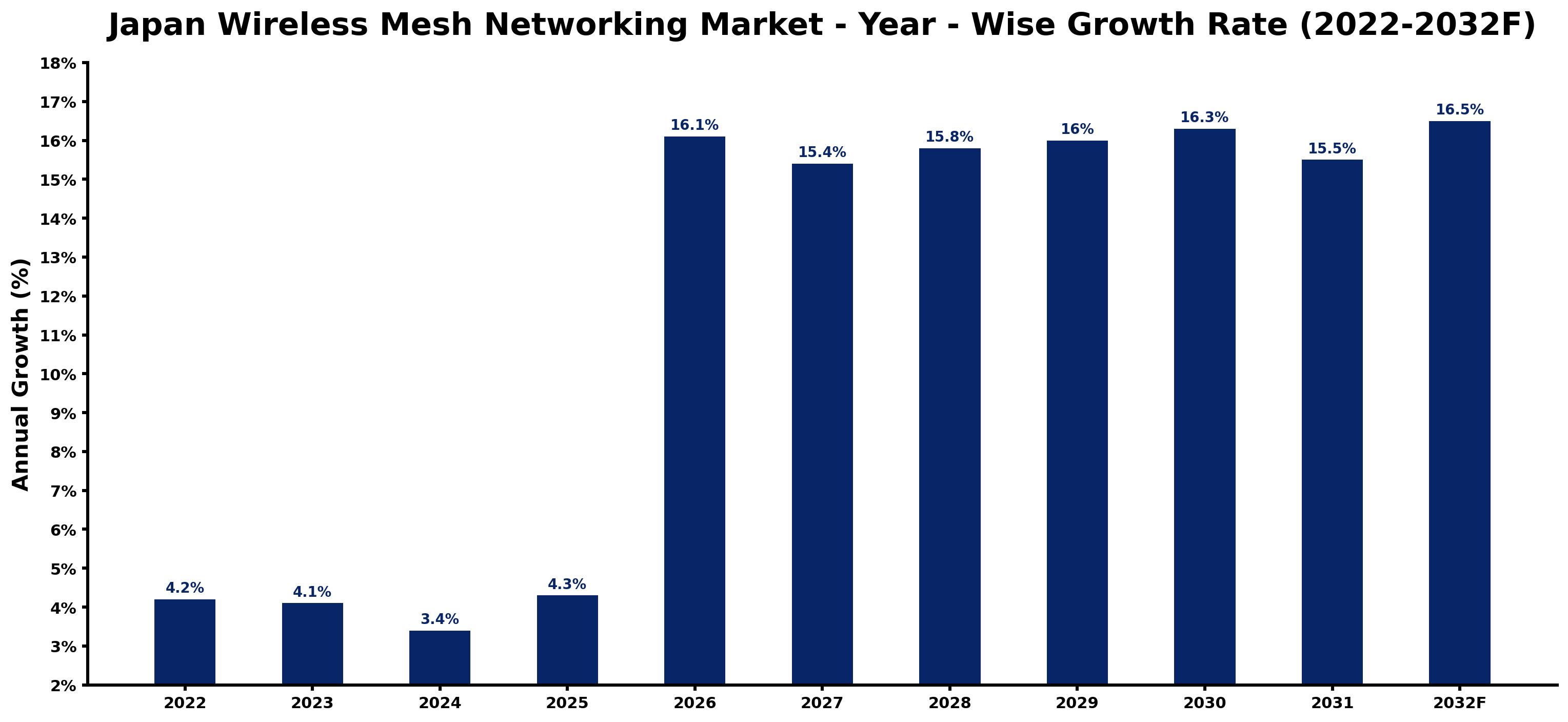
Below, each year's estimated growth is shown next to the factor that most influenced it.
| Year | Estimated Annual Growth (%) | Market Rationale |
| 2022 | 4.2 | Demand for wireless connectivity was strong, reflecting ongoing urbanisation trends. |
| 2023 | 4.1 | Market growth slowed slightly due to supply chain adjustments in technology sectors. |
| 2024 | 3.4 | Continued investment in smart city projects contributed to a further slowdown in growth. |
| 2025 | 4.3 | Increased adoption of home networking solutions drove a faster growth rate than before. |
| 2026 | 16.1 | Rising demand for high-speed connectivity in urban areas is expected to accelerate growth. |
| 2027 | 15.4 | Growth is projected to slow as market saturation begins to affect new installations. |
| 2028 | 15.8 | Demand for video surveillance technology is expected to boost growth as urban security needs increase. |
| 2029 | 16.0 | Continued expansion of smart city initiatives is projected to sustain growth. |
| 2030 | 16.3 | High-density environments will further increase demand for advanced wireless mesh solutions. |
| 2031 | 15.5 | Market growth is expected to slow slightly as competition intensifies among technology providers. |
| 2032 | 16.5 | The introduction of new smart city technologies will spur the highest growth rate. |
Note: Market size estimations and growth projections presented in this report are based on 6Wresearch's proprietary forecasting methodology, utilizing the latest available industry data, government publications, and primary research inputs.
Japan Wireless Mesh Networking Market Synopsis
Wireless Mesh Networking is a technology that enables devices to communicate over a decentralized network, integrating multiple wireless nodes for connectivity. The Japan Wireless Mesh Networking Market is primarily driven by domestic users, particularly in healthcare and smart city applications. With over 100 smart cities implementing these solutions and a government allocation of ¥5 billion for technology development, the market is projected to grow substantially by 2032.
Market Dynamics Impact Analysis (2026–2032)
| Factor | Type | Impact | Primary Segment Affected |
| Growing adoption of smart city solutions | Driver | High | Smart Cities & Smart Warehouses |
| Increased demand for healthcare connectivity | Driver | High | Healthcare |
| Emerging opportunities in urban infrastructure | Opportunity | High | Traffic Management |
| Rising need for advanced video surveillance systems | Opportunity | High | Video Surveillance |
| Challenges in integrating new technologies | Restraint | Medium | Home Networking |
| Limited awareness among smaller enterprises | Restraint | Medium | Disaster Management & Rescue Operations |
| Competition from alternative networking solutions | Challenge | High | Medical Device Connectivity |
| High costs associated with deployment in urban areas | Challenge | Medium | Transportation & Logistics |
Evaluation of Drivers in Japan Wireless Mesh Networking Market (2026–2032)
The main growth drivers and the segments they affect most are set out below.
| Drivers | Primary Segment Affected | Why It Matters (Evidence) |
| Investment in smart city initiatives | Smart Cities & Smart Warehouses | Over 100 smart cities in Japan are implementing wireless mesh solutions, increasing demand for connectivity. |
| Healthcare sector expansion | Healthcare | With over 300 hospitals adopting wireless mesh technology, healthcare facilities are investing heavily in reliable connectivity. |
| Urbanisation trends | Traffic Management | Japan's population of 126 million drives the need for advanced traffic management systems, increasing connectivity requirements. |
| Rising security concerns | Video Surveillance | Urban areas with over 1 million cameras are adopting wireless mesh networks for improved surveillance. |
| Government funding for technology development | Home Networking | In 2023, the government allocated ¥5 billion to improve urban connectivity, boosting demand. |
The healthcare sector, with over 300 hospitals adopting this technology, is driving demand for reliable connectivity. Urbanisation trends are increasing the need for advanced traffic management systems, while security concerns have led to the adoption of mesh networks in urban areas with over 1 million surveillance cameras.
Evaluation of Restraints in Japan Wireless Mesh Networking Market
The following restraints limit how fast demand can grow.
| Market Restraint | Primary Segment Affected | Why It Matters (Evidence) |
| Integration challenges with existing technologies | Home Networking | Many users face difficulties integrating new wireless mesh systems with legacy devices, limiting adoption. |
| Low awareness among small enterprises | Disaster Management & Rescue Operations | Smaller organisations often lack knowledge about the benefits of wireless mesh networking, hindering growth. |
| Competition from alternative solutions | Medical Device Connectivity | Emerging technologies may offer cheaper alternatives, impacting the demand for wireless mesh networks. |
| High deployment costs in urban areas | Transportation & Logistics | The expense of installing mesh networks in densely populated regions can deter potential buyers. |
| Limited scalability of current solutions | Traffic Management | Existing systems may not easily scale to meet the growing demands of urban environments. |
Japan Wireless Mesh Networking Market Challenges
Over 70% of home networking setups rely on the 2.4 GHz band, leading to congestion and slower speeds for urban users. This reliance on a crowded spectrum arises from the growing number of connected devices, resulting in delays for households and businesses needing reliable internet access. The Ministry of Internal Affairs and Communications imposes regulatory hurdles that can slow the integration of new technologies, affecting the efficiency of over 10,000 medical devices in the healthcare sector. Complex compliance requirements can delay the rollout of wireless solutions, hindering progress for suppliers trying to meet market demands.
Trends in the Japan Wireless Mesh Networking Market
Several trends are reshaping the Japan Wireless Mesh Networking Market; the most important are set out below.
- Shift from Traditional to Smart City Infrastructure: Since 2023, Tokyo has been leading the shift towards smart city infrastructure, with over 100 cities adopting wireless mesh networking solutions, improving urban connectivity.
- Increase in Video Surveillance Adoption: In 2023, urban areas in Japan deployed over 1 million cameras, driving demand for wireless mesh networks to support real-time data sharing and security.
- Growth of Healthcare Connectivity: The healthcare sector has seen a rise in connected medical devices, with over 300 hospitals using wireless mesh technology to improve patient monitoring and care.
- Expansion of Home Networking Solutions: In 2023, over 70% of home networking setups utilised the 2.4 GHz band, indicating a strong trend towards wireless mesh networking for residential connectivity.
Investment Opportunities in the Japan Wireless Mesh Networking Market
Several openings in the Japan Wireless Mesh Networking Market merit attention from investors.
- Gap in Smart City Technology: With the government allocating ¥5 billion for smart city development, there is an opportunity to supply advanced wireless mesh solutions in urban areas.
- Demand for Advanced Traffic Management: Tokyo's ongoing smart city initiatives present an opportunity to invest in traffic management systems that utilise wireless mesh technology for improved connectivity.
- Growth in Video Surveillance Systems: The increasing need for urban security solutions creates an opportunity to supply wireless mesh networks for video surveillance in cities with high crime rates.
- Expansion in Healthcare Facilities: With over 300 hospitals adopting wireless mesh technology, there is a chance to partner with healthcare providers to enhance medical device connectivity.
Government Initiatives in the Japan Wireless Mesh Networking Market
In 2023, a new strategy was launched to improve urban connectivity, building on the Electrical Appliance and Material Safety Act (1961). This measure aims to ensure that wireless technologies meet safety standards while promoting innovation in smart city applications.
The Ministry of Internal Affairs and Communications oversees the implementation of these regulations, allocating ¥5 billion for smart city technology development in 2023. This funding supports projects that improve connectivity and infrastructure across urban areas.
Future Insight of the Japan Wireless Mesh Networking Market
Investment in smart city technology will create substantial demand for advanced connectivity solutions by 2032. Wireless mesh networking will enhance patient monitoring systems in over 300 hospitals, improving healthcare outcomes. The rise of connected classrooms will transform educational experiences, while new strategies will prioritise urban connectivity enhancements. Increased adoption of wireless mesh technology in smart warehouses will drive logistics efficiency, allowing suppliers to expand their offerings and meet evolving market needs.
Market Segmentation Analysis
Japan Wireless Mesh Networking Market report covers a detailed analysis of the following market segments:
By Radio Frequency – Sub 1 GHz Band Leads, 2.4 GHz Band Expected to Grow Fastest
According to Sumit Sagar, AM at 6Wresearch, Sub 1 GHz Band accounted for 39% of the market by radio frequency in 2025. The Sub 1 GHz Band is essential for long-range communication, particularly in smart city applications where extensive coverage is necessary. Its widespread use in urban areas like Tokyo highlights its critical role in enabling connectivity across various sectors. The quickest growth will come from 2.4 GHz Band, forecast to expand at a CAGR of 20.4% between 2026 and 2032. The 2.4 GHz Band is experiencing rapid growth due to its common application in home networking and IoT devices, which are increasingly prevalent in Japanese households. With over 70% of home networking setups utilising this band, demand is expected to keep rising. Suppliers should focus on developing products compatible with the 2.4 GHz Band to meet the growing home networking demands.
By Application – Home Networking Leads, Video Surveillance Expected to Grow Fastest
Home Networking held 39% of the Japan Wireless Mesh Networking Market by application in 2025. Home Networking leads the market as it is extensively utilised for residential internet connectivity, crucial for Japan's technology-oriented population. Its presence in over 70% of homes underscores its importance in fulfilling daily connectivity needs. Video Surveillance is set to record the highest CAGR in this split, 21.7% over 2026–2032. Video Surveillance is the fastest-growing application, propelled by the increasing demand for security in urban settings, where over 1 million cameras are operational. This rise in surveillance systems necessitates reliable wireless mesh networking solutions for efficient data transmission. Buyers in the security sector should consider investing in advanced wireless mesh networking solutions to strengthen their surveillance capabilities.
By End-User – Education Leads, Government Expected to Grow Fastest
The largest end-user category in 2025 was Education, at 35% of revenue. The Education sector is at the forefront due to its growing reliance on connectivity to enhance learning experiences in classrooms across Japan. This trend is illustrated by the integration of wireless mesh technology in numerous educational institutions. Government is projected to grow fastest, at a CAGR of 22.8% during 2026–2032. Government applications are rapidly expanding as public safety and infrastructure projects increasingly adopt wireless mesh networking technology. This growth is evident in initiatives aimed at improving communication networks for disaster prevention and management. Suppliers should target government contracts to capitalise on the rising demand for advanced connectivity solutions in public safety.
Key Attractiveness of the Report
- 10 Years of Market Numbers
- Historical Data Starting from 2022 to 2025
- Base Year 2025
- Forecast Data until 2032
- Key Performance Indicators Impacting the Market
- Major Upcoming Developments and Projects
Key Highlights of the Report:
- Japan Wireless Mesh Networking Market Outlook
- Market Size of Japan Wireless Mesh Networking Market, 2025
- Forecast of Japan Wireless Mesh Networking Market, 2032
- Historical Data and Forecast of Japan Wireless Mesh Networking Revenues & Volume for the Period 2022-2032
- Japan Wireless Mesh Networking Market Trend Evolution
- Japan Wireless Mesh Networking Market Drivers and Challenges
- Japan Wireless Mesh Networking Price Trends
- Japan Wireless Mesh Networking Porter's Five Forces
- Japan Wireless Mesh Networking Industry Life Cycle
- Historical Data and Forecast of Japan Wireless Mesh Networking Market Revenues & Volume By Radio Frequency for the Period 2022-2032
- Historical Data and Forecast of Japan Wireless Mesh Networking Market Revenues & Volume By Sub 1 GHz Band for the Period 2022-2032
- Historical Data and Forecast of Japan Wireless Mesh Networking Market Revenues & Volume By 2.4 GHz Band for the Period 2022-2032
- Historical Data and Forecast of Japan Wireless Mesh Networking Market Revenues & Volume By 4.9 GHz Band for the Period 2022-2032
- Historical Data and Forecast of Japan Wireless Mesh Networking Market Revenues & Volume By 5 GHz Band for the Period 2022-2032
- Historical Data and Forecast of Japan Wireless Mesh Networking Market Revenues & Volume By Application for the Period 2022-2032
- Historical Data and Forecast of Japan Wireless Mesh Networking Market Revenues & Volume By Home Networking for the Period 2022-2032
- Historical Data and Forecast of Japan Wireless Mesh Networking Market Revenues & Volume By Video Surveillance for the Period 2022-2032
- Historical Data and Forecast of Japan Wireless Mesh Networking Market Revenues & Volume By Disaster Management & Rescue Operations for the Period 2022-2032
- Historical Data and Forecast of Japan Wireless Mesh Networking Market Revenues & Volume By Medical Device Connectivity for the Period 2022-2032
- Historical Data and Forecast of Japan Wireless Mesh Networking Market Revenues & Volume By Traffic Management for the Period 2022-2032
- Historical Data and Forecast of Japan Wireless Mesh Networking Market Revenues & Volume By End-User for the Period 2022-2032
- Historical Data and Forecast of Japan Wireless Mesh Networking Market Revenues & Volume By Education for the Period 2022-2032
- Historical Data and Forecast of Japan Wireless Mesh Networking Market Revenues & Volume By Government for the Period 2022-2032
- Historical Data and Forecast of Japan Wireless Mesh Networking Market Revenues & Volume By Healthcare for the Period 2022-2032
- Historical Data and Forecast of Japan Wireless Mesh Networking Market Revenues & Volume By Hospitality for the Period 2022-2032
- Historical Data and Forecast of Japan Wireless Mesh Networking Market Revenues & Volume By Mining for the Period 2022-2032
- Historical Data and Forecast of Japan Wireless Mesh Networking Market Revenues & Volume By Oil & Gas for the Period 2022-2032
- Historical Data and Forecast of Japan Wireless Mesh Networking Market Revenues & Volume By Transportation & Logistics for the Period 2022-2032
- Historical Data and Forecast of Japan Wireless Mesh Networking Market Revenues & Volume By Smart Cities & Smart Warehouses for the Period 2022-2032
- Japan Wireless Mesh Networking Import Export Trade Statistics
- Market Opportunity Assessment By Radio Frequency
- Market Opportunity Assessment By Application
- Market Opportunity Assessment By End-User
- Japan Wireless Mesh Networking Top Companies Market Share
- Japan Wireless Mesh Networking Competitive Benchmarking By Technical and Operational Parameters
- Japan Wireless Mesh Networking Company Profiles
- Japan Wireless Mesh Networking Key Strategic Recommendations
Market Covered
The following segment groups are covered in the report.
By Radio Frequency
- Sub 1 GHz Band
- 2.4 GHz Band
- 4.9 GHz Band
- 5 GHz Band
By Application
- Home Networking
- Video Surveillance
- Disaster Management & Rescue Operations
- Medical Device Connectivity
- Traffic Management
By End-User
- Education
- Government
- Healthcare
- Hospitality
- Mining
- Oil & Gas
- Transportation & Logistics
- Smart Cities & Smart Warehouses































