Japan Wireless Power Transmission Market Size & Growth Rate
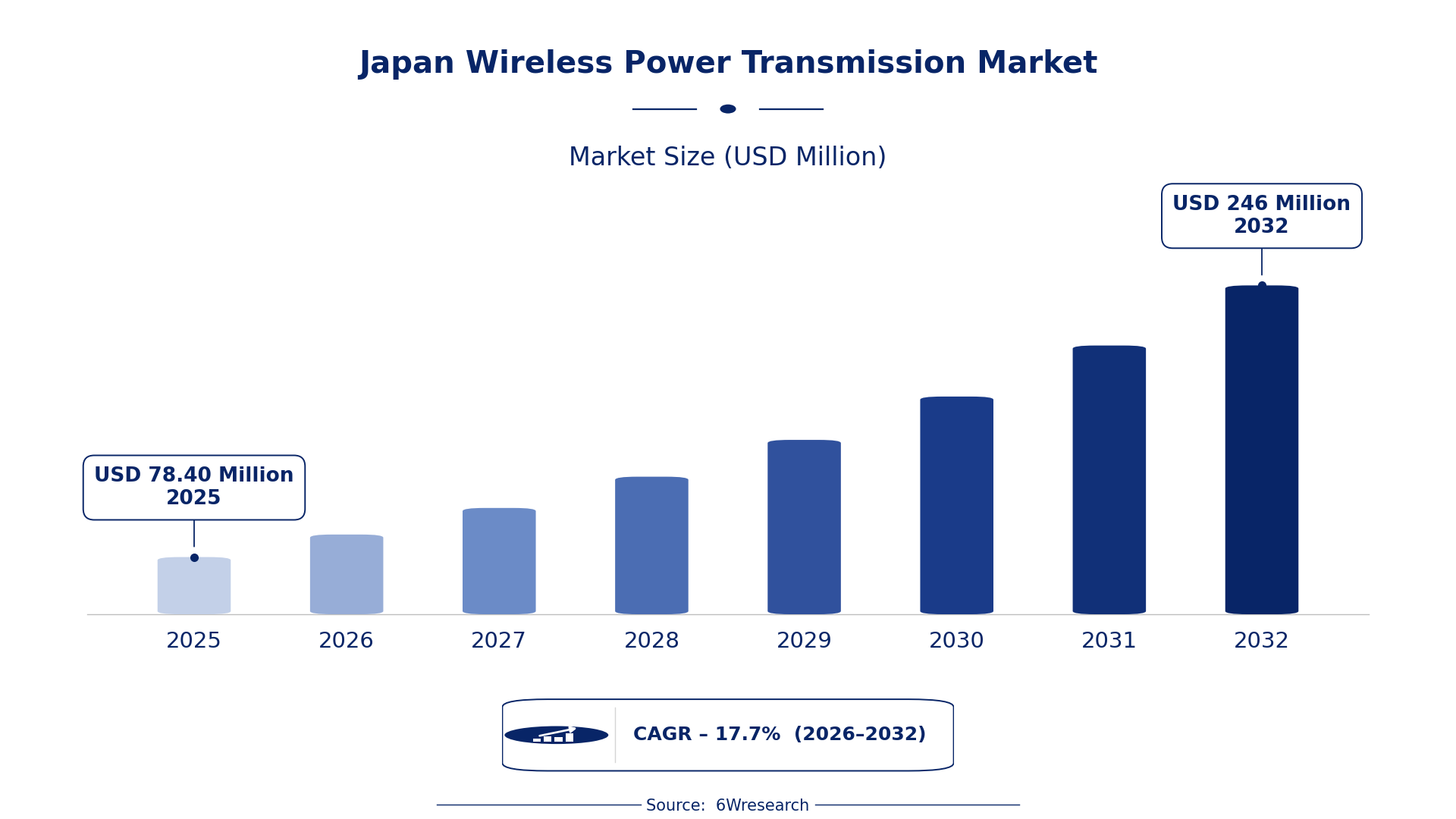
According to 6Wresearch internal database and industry insights, the Japan Wireless Power Transmission Market was valued at USD 78.40 Million in 2025 and is projected to reach USD 246 Million by 2032, growing at a CAGR of approximately 17.7% during 2026–2032.
Japan Wireless Power Transmission Market Highlights
| Report Metric | Details |
| Report Name | Japan Wireless Power Transmission Market (2026-2032) |
| Market Size 2025 | USD 78.40 Million |
| Market Size 2032 | USD 246 Million |
| Absolute Growth 2025–2032 | USD 167.60 Million |
| CAGR 2026–2032 | 17.7% |
| Peak Annual Growth | 22.4% in 2026 |
| Forecast Period | 2026–2032 |
| Historical Data | 2022–2025 |
| Base Year | 2025 |
| Leading Technology, 2025 | Near-Field Technology (55% share) |
| Leading Implementation, 2025 | Integrated (59% share) |
| Leading Receiver Application, 2025 | Smartphones (42% share) |
| Leading Transmitter Application, 2025 | Standalone Chargers (39% share) |
| Fastest-Growing Implementation | Aftermarket (21.1% CAGR) |
| Fastest-Growing Receiver Application | Electric Vehicle Charging (24.8% CAGR) |
| Fastest-Growing Transmitter Application | Automotive (In Vehicle) (23.7% CAGR) |
| Growing Sector | Electric Vehicle Charging |
| Key End Users | Electronics manufacturers, automotive industry, urban planners, energy providers |
Japan Wireless Power Transmission Market Year-wise Growth Rate and Key Drivers (2022–2032)
This graph illustrates the annual growth rates of the market from 2022 to 2032, highlighting a steady upward trajectory and projected market expansion over the forecast period.
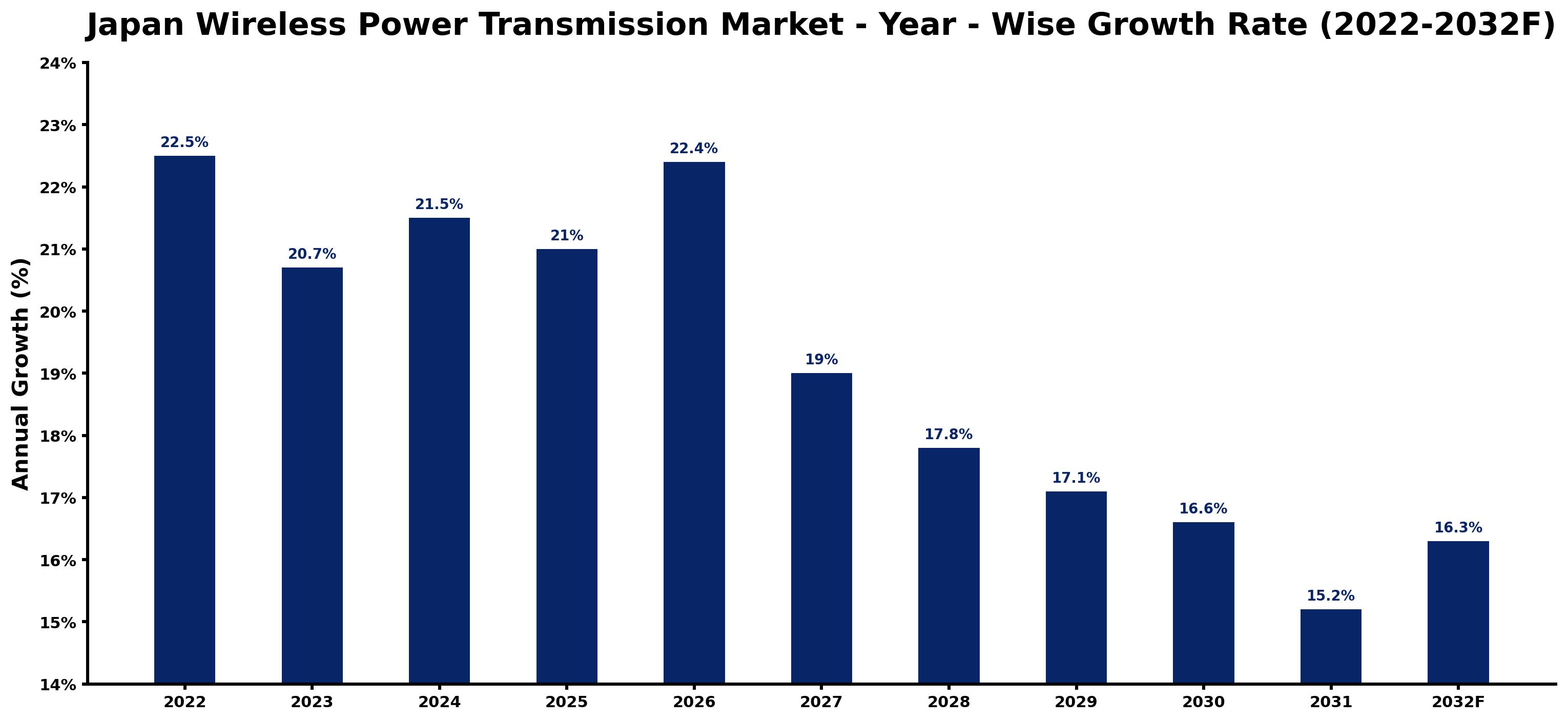
Below, each year's estimated growth is shown next to the factor that most influenced it.
| Year | Estimated Annual Growth (%) | Market Rationale |
| 2022 | 22.5 | The market experienced strong demand from the electronics sector, particularly smartphones and consumer electronics. |
| 2023 | 20.7 | Growth slowed slightly due to supply chain disruptions affecting the automotive sector's production capabilities. |
| 2024 | 21.5 | Increased investment in electric vehicle infrastructure boosted market expansion and consumer interest. |
| 2025 | 21.0 | Demand remained steady, driven by the adoption of new consumer electronics and product innovations. |
| 2026 | 22.4 | A resurgence in growth is anticipated as electric vehicle sales and charging infrastructure expand significantly. |
| 2027 | 19.0 | Growth is projected to slow as market saturation begins to impact new device sales in consumer electronics. |
| 2028 | 17.8 | The adoption of wireless charging in vehicles is expected to continue growing, sustaining market interest and investment. |
| 2029 | 17.1 | Market growth is likely to decelerate as competition intensifies among charging technology providers and alternatives. |
| 2030 | 16.6 | The market will face challenges from alternative charging methods gaining traction among consumers and businesses. |
| 2031 | 15.2 | Growth is anticipated to slow as the market matures, leading to a focus on efficiency and standardisation. |
| 2032 | 16.3 | An increase in integrated solutions for consumer electronics is expected to boost demand significantly. |
Note: Market size estimations and growth projections presented in this report are based on 6Wresearch's proprietary forecasting methodology, utilizing the latest available industry data, government publications, and primary research inputs.
Japan Wireless Power Transmission Market Synopsis
Wireless power transmission enables the transfer of electrical energy without physical connectors, primarily through electromagnetic fields. The Japan Wireless Power Transmission Market is projected to reach 1.5 billion USD by 2025, driven by strong demand from the electronics and automotive sectors. The integration of wireless charging in over 50% of new smartphones and the rapid expansion of electric vehicle infrastructure are propelling this market forward in Japan, underscoring the technology's growing relevance.
Market Dynamics Impact Analysis (2026–2032)
| Factor | Type | Impact | Primary Segment Affected |
| Growing adoption of wireless charging in consumer electronics | Driver | High | Near-Field Technology |
| Increased investment in electric vehicle charging infrastructure | Driver | High | Electric Vehicle Charging |
| Expansion of smart city initiatives promoting wireless solutions | Opportunity | High | Integrated |
| Rising consumer demand for convenient charging solutions | Opportunity | High | Smartphones |
| Competition from alternative charging technologies | Restraint | Medium | Far-Field Technology |
| Supply chain disruptions affecting component availability | Restraint | High | Aftermarket |
| Technological advancements outpacing current infrastructure | Challenge | Medium | Near-Field Technology |
| Regulatory hurdles in standardisation of wireless technologies | Challenge | High | Near-Field Technology |
Evaluation of Drivers in Japan Wireless Power Transmission Market (2026–2032)
Below are the drivers that matter most for revenue growth, with supporting evidence.
| Drivers | Primary Segment Affected | Why It Matters (Evidence) |
| Growing adoption of electric vehicles | Electric Vehicle Charging | The total number of electric vehicles in Japan reached 1 million in 2023, increasing demand for charging infrastructure. |
| Integration of wireless charging in consumer electronics | Smartphones | Over 50% of new smartphones sold in Japan feature wireless charging, driving consumer demand for compatible devices. |
| Investment in research and development | Integrated | Japan has invested over 200 million USD in wireless power technology research since 2020, fostering innovation in this sector. |
| Development of safety standards | Consumer Electronics | JIS standards for wireless power transmission are being developed to ensure safety and efficiency, encouraging broader adoption. |
| Smart city initiatives | Near-Field Technology | The Tokyo Metropolitan Government promotes smart city initiatives that include wireless power solutions, enhancing urban energy efficiency. |
Behind the steady rise in orders sits the integration of wireless charging in smartphones, with over 50% of new devices featuring this technology. Investment in electric vehicle infrastructure has surged, with 1 million electric vehicles on the roads, creating substantial demand for charging solutions. Funding allocated for research into wireless technologies has spurred innovation, with over 200 million USD invested since 2020. The development of standards for wireless power improves safety and efficiency, encouraging broader adoption across various consumer electronics.
Evaluation of Restraints in Japan Wireless Power Transmission Market
The table below lists the restraints and the evidence behind each.
| Market Restraint | Primary Segment Affected | Why It Matters (Evidence) |
| High compliance costs due to new standards | Integrated | The introduction of new JIS standards requires significant investments in safety and efficiency, delaying product launches. |
| Lack of skilled workforce | Electric Vehicle Charging | A shortage of skilled workers in Japan restricts the development of wireless technologies, increasing project costs by approximately 20%. |
| Rising production costs from specialised materials | Consumer Electronics | The necessity of using specialised materials impacts buyers, resulting in an estimated 15% increase in end-user prices. |
| Intense competition among local firms | Smartphones | Competition pressures profit margins, making it difficult for suppliers to sustain operations while funding essential R&D. |
| Limited market awareness | Aftermarket | Consumer awareness of wireless power technology remains low, hindering adoption rates in retrofitting existing devices. |
Japan Wireless Power Transmission Market Challenges
Producers in Japan's wireless power transmission market face high compliance costs due to the introduction of new JIS standards, which require substantial investments in safety and efficiency, delaying product launches by up to six months. A shortage of skilled workers restricts the development of wireless technologies, forcing companies to hire foreign expertise and increasing project costs by approximately 20%. Rising production costs from the necessity of specialised materials impact buyers, resulting in an estimated 15% increase in end-user prices. Intense competition among local firms pressures profit margins, making it challenging for suppliers to sustain operations while funding essential R&D.
Trends in the Japan Wireless Power Transmission Market
These developments are changing demand patterns in the Japan Wireless Power Transmission Market.
- Shift from Wired to Wireless Charging in Consumer Electronics: Consumers are increasingly opting for wireless charging solutions, particularly in smartphones, which accounted for 42% of the receiver application segment in 2025. This trend reflects a growing preference for convenience in charging devices.
- Transition to Integrated Wireless Solutions in Vehicles: The automotive sector is moving towards integrated wireless charging solutions, with a projected CAGR of 23.7% for in-vehicle applications. This shift is evident as manufacturers seek to improve user experience in electric vehicles.
- Emergence of Smart City Initiatives in Tokyo: Tokyo's smart city initiatives, which promote wireless power solutions, have seen a 20% increase in wireless charging stations in urban areas over the past year. This trend supports the city's broader sustainability goals.
- Growing Demand for Electric Vehicle Charging Infrastructure: The number of electric vehicles in Japan reached 1 million in 2023, driving demand for charging solutions. This growth highlights the need for infrastructure to support the expanding EV market.
Investment Opportunities in the Japan Wireless Power Transmission Market
The following opportunities in the Japan Wireless Power Transmission Market pair current demand with a clear way in.
- Investment in Electric Vehicle Charging Stations: With a 20% increase in charging stations last year, there is a clear gap in infrastructure. Investing in EV charging solutions is crucial for urban planners and energy providers to meet rising demand.
- Supply of Integrated Wireless Charging Solutions: As the automotive sector shifts towards integrated solutions, there is a growing need for suppliers to provide these technologies. Collaborating with automotive manufacturers will be key to entering this market.
- Development of JIS-Compliant Wireless Technologies: The ongoing updates to JIS standards present an opportunity for companies to develop compliant products. Engaging with local manufacturers to ensure adherence will improve market entry prospects.
- Expansion of Wireless Charging in Consumer Electronics: The adoption rate of wireless charging in consumer electronics is around 30%, indicating a substantial opportunity. Suppliers should focus on developing solutions to cater to this growing market.
Government Initiatives in the Japan Wireless Power Transmission Market
The GX Promotion Act (2023) establishes a framework for promoting decarbonisation in Japan, building on the Electrical Appliance and Material Safety Act (1961). This act encourages investments in wireless power technologies, supporting the transition to cleaner energy sources and benefiting producers and consumers alike.
The GX strategy's implementation is overseen by METI, which funds various projects aimed at improving energy efficiency. The agency's initiatives include promoting wireless power solutions, benefiting both producers and consumers by ensuring compliance with safety standards.
Future Insight of the Japan Wireless Power Transmission Market
Clinics and hospitals will experience improved wireless power solutions by 2032, as Japan's government aims to boost the number of charging stations by 20% each year. The ongoing decarbonisation programme is expected to drive investments in wireless power technology, contributing to a market value projected at 1.5 billion USD by 2025. Adoption rates for wireless charging in consumer electronics are anticipated to surpass 30%, supported by advancements in technology. Continued support from the Ministry of Economy, Trade and Industry will encourage innovation, positioning Japanese suppliers as frontrunners in the global market.
Market Segmentation Analysis
Japan Wireless Power Transmission Market report covers a detailed analysis of the following market segments:
By Technology – Near-Field Technology Leads and Records the Fastest Growth
According to Shubham Deep, Research Manager at 6Wresearch, Near-Field Technology held 55% of the Japan Wireless Power Transmission Market by technology in 2025. Near-field technology holds the largest share due to its prevalent use in charging small devices like smartphones and wearables. This segment is further supported by the integration of wireless charging in over 50% of new smartphones sold in Japan. Its lead should widen, with a projected CAGR of 19.6% during 2026–2032, the highest in this split. The growth of near-field technology is fuelled by its increasing adoption in consumer electronics, with a notable 30% adoption rate in Japan. This segment's lead will likely widen as more devices continue to incorporate this technology. Suppliers should focus on advancing near-field technology offerings to align with consumer preferences and device integration trends.
By Implementation – Integrated Leads, Aftermarket Expected to Grow Fastest
Integrated accounted for 59% of the market by implementation in 2025. The integrated implementation segment holds the largest share as it is directly embedded into consumer electronics and automotive systems, providing a seamless user experience. This is particularly evident in the automotive sector, where manufacturers are increasingly adopting wireless solutions to enhance vehicle functionality. Aftermarket is projected to grow fastest, at a CAGR of 21.1% during 2026–2032. The aftermarket segment is experiencing rapid growth as consumers look for retrofitting options for existing devices, spurred by the rising demand for wireless charging capabilities. This trend indicates a significant shift towards upgrading older devices to meet modern charging standards. Suppliers should consider expanding their offerings to include aftermarket solutions, catering to consumers seeking to enhance their existing devices.
By Receiver Application – Smartphones Lead, Electric Vehicle Charging Expected to Grow Fastest
Smartphones took 42% of receiver application revenue in 2025, more than any other category. Smartphones lead the receiver application segment due to their widespread adoption and the convenience of wireless charging solutions. The technology's integration in over 50% of new smartphones sold illustrates its essential role in the market. Over 2026–2032, Electric Vehicle Charging is expected to post the fastest growth, at a CAGR of 24.8%. Electric vehicle charging is the fastest-growing application, reflecting the increasing emphasis on sustainable transportation solutions and the rise in electric vehicle numbers, which reached 1 million in 2023. This growth highlights a significant shift towards greener energy solutions in the automotive sector. Suppliers should focus on developing wireless charging solutions specifically for electric vehicles to take advantage of this rapidly expanding market.
By Transmitter Application – Standalone Chargers Lead, Automotive (In Vehicle) Expected to Grow Fastest
With 39% of transmitter application revenue in 2025, Standalone Chargers was the largest category. Standalone chargers dominate the transmitter application segment as they are commonly used for personal devices, offering a convenient charging solution for consumers. Their widespread availability and user-friendly design contribute to their leading position in the market. Automotive (In Vehicle) is set to record the highest CAGR in this split, 23.7% over 2026–2032. The automotive (in vehicle) segment is growing quickly, driven by the integration of wireless charging solutions in modern vehicles. This trend is expected to accelerate as more manufacturers adopt this technology to improve user convenience. Suppliers should invest in automotive wireless charging solutions to meet the increasing demand from vehicle manufacturers and enhance the overall user experience.
Key Attractiveness of the Report
- 10 Years of Market Numbers
- Historical Data Starting from 2022 to 2025
- Base Year 2025
- Forecast Data until 2032
- Key Performance Indicators Impacting the Market
- Major Upcoming Developments and Projects
Key Highlights of the Report:
- Japan Wireless Power Transmission Market Outlook
- Market Size of Japan Wireless Power Transmission Market, 2025
- Forecast of Japan Wireless Power Transmission Market, 2032
- Historical Data and Forecast of Japan Wireless Power Transmission Revenues & Volume for the Period 2022-2032
- Japan Wireless Power Transmission Market Trend Evolution
- Japan Wireless Power Transmission Market Drivers and Challenges
- Japan Wireless Power Transmission Price Trends
- Japan Wireless Power Transmission Porter's Five Forces
- Japan Wireless Power Transmission Industry Life Cycle
- Historical Data and Forecast of Japan Wireless Power Transmission Market Revenues & Volume By Technology for the Period 2022-2032
- Historical Data and Forecast of Japan Wireless Power Transmission Market Revenues & Volume By Near-Field Technology for the Period 2022-2032
- Historical Data and Forecast of Japan Wireless Power Transmission Market Revenues & Volume By Far-Field Technology for the Period 2022-2032
- Historical Data and Forecast of Japan Wireless Power Transmission Market Revenues & Volume By Implementation for the Period 2022-2032
- Historical Data and Forecast of Japan Wireless Power Transmission Market Revenues & Volume By Integrated for the Period 2022-2032
- Historical Data and Forecast of Japan Wireless Power Transmission Market Revenues & Volume By Aftermarket for the Period 2022-2032
- Historical Data and Forecast of Japan Wireless Power Transmission Market Revenues & Volume By Receiver Application for the Period 2022-2032
- Historical Data and Forecast of Japan Wireless Power Transmission Market Revenues & Volume By Smartphones for the Period 2022-2032
- Historical Data and Forecast of Japan Wireless Power Transmission Market Revenues & Volume By Tablets for the Period 2022-2032
- Historical Data and Forecast of Japan Wireless Power Transmission Market Revenues & Volume By Wearable Electronics for the Period 2022-2032
- Historical Data and Forecast of Japan Wireless Power Transmission Market Revenues & Volume By Notebooks for the Period 2022-2032
- Historical Data and Forecast of Japan Wireless Power Transmission Market Revenues & Volume By Consumer Electronics for the Period 2022-2032
- Historical Data and Forecast of Japan Wireless Power Transmission Market Revenues & Volume By Electric Vehicle Charging for the Period 2022-2032
- Historical Data and Forecast of Japan Wireless Power Transmission Market Revenues & Volume By Industrial for the Period 2022-2032
- Historical Data and Forecast of Japan Wireless Power Transmission Market Revenues & Volume By Transmitter Application for the Period 2022-2032
- Historical Data and Forecast of Japan Wireless Power Transmission Market Revenues & Volume By Standalone Chargers for the Period 2022-2032
- Historical Data and Forecast of Japan Wireless Power Transmission Market Revenues & Volume By Automotive (In Vehicle) for the Period 2022-2032
- Historical Data and Forecast of Japan Wireless Power Transmission Market Revenues & Volume By Electric Vehicle Charging for the Period 2022-2032
- Historical Data and Forecast of Japan Wireless Power Transmission Market Revenues & Volume By Furniture for the Period 2022-2032
- Historical Data and Forecast of Japan Wireless Power Transmission Market Revenues & Volume By Industrial for the Period 2022-2032
- Japan Wireless Power Transmission Import Export Trade Statistics
- Market Opportunity Assessment By Technology
- Market Opportunity Assessment By Implementation
- Market Opportunity Assessment By Receiver Application
- Market Opportunity Assessment By Transmitter Application
- Japan Wireless Power Transmission Top Companies Market Share
- Japan Wireless Power Transmission Competitive Benchmarking By Technical and Operational Parameters
- Japan Wireless Power Transmission Company Profiles
- Japan Wireless Power Transmission Key Strategic Recommendations
Market Covered
Segments analysed in this report are listed below.
By Technology
- Near-Field Technology
- Far-Field Technology
By Implementation
- Integrated
- Aftermarket
By Receiver Application
- Smartphones
- Tablets
- Wearable Electronics
- Notebooks
- Consumer Electronics
- Electric Vehicle Charging
- Industrial
By Transmitter Application
- Standalone Chargers
- Automotive (In Vehicle)
- Electric Vehicle Charging
- Furniture
- Industrial































