Japan Wireless Router Market Size & Growth Rate
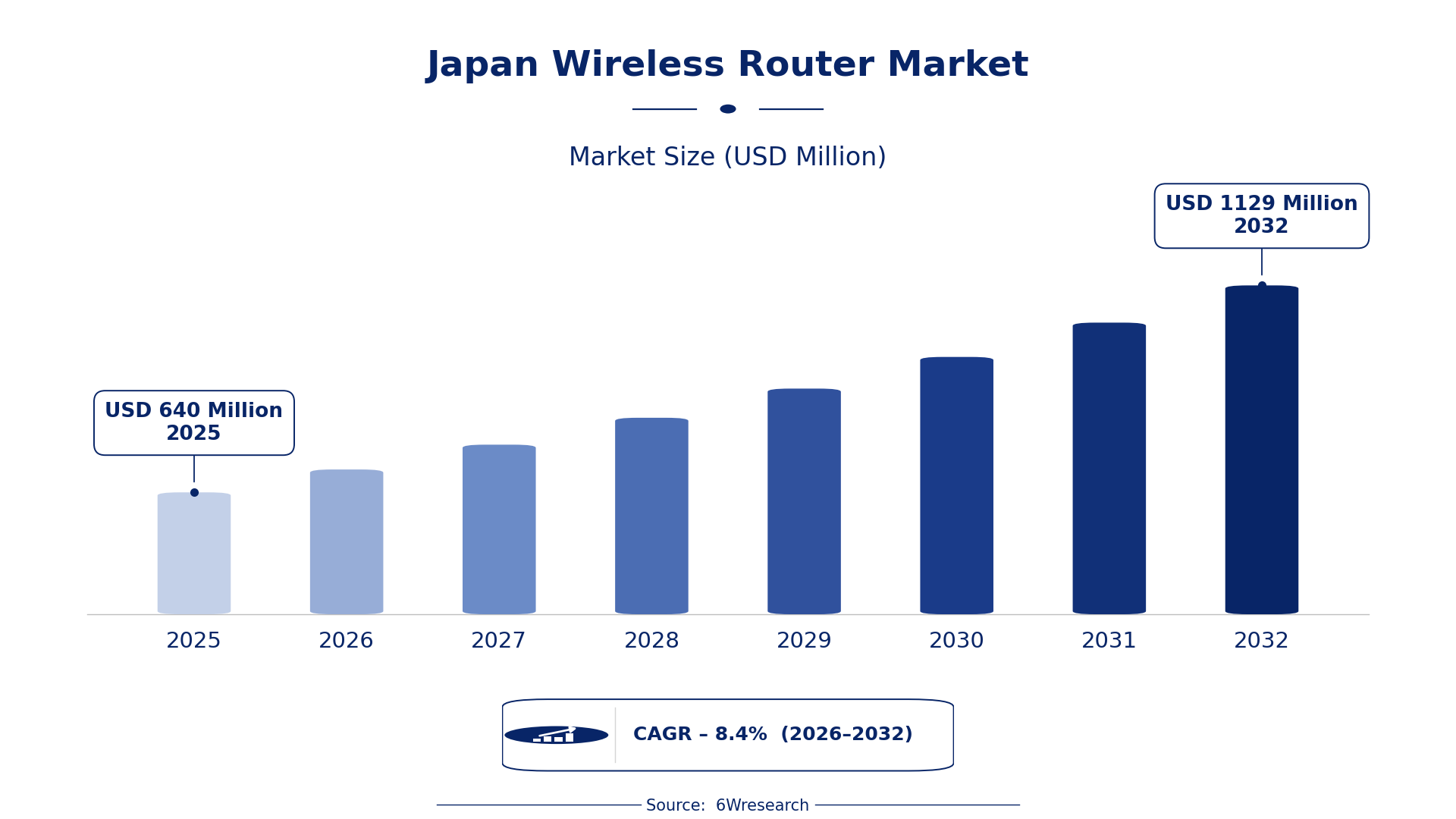
According to 6Wresearch internal database and industry insights, the Japan Wireless Router Market was valued at USD 640 Million in 2025 and is projected to reach USD 1,129 Million by 2032, growing at a CAGR of approximately 8.4% during 2026–2032.
Japan Wireless Router Market Highlights
| Report Metric | Details |
| Report Name | Japan Wireless Router Market (2026-2032) |
| Market Size 2025 | USD 640 Million |
| Market Size 2032 | USD 1,129 Million |
| Absolute Growth 2025–2032 | USD 489 Million |
| CAGR 2026–2032 | 8.4% |
| Peak Annual Growth | 9.6% in 2030 |
| Forecast Period | 2026–2032 |
| Historical Data | 2022–2025 |
| Base Year | 2025 |
| Leading Component Type, 2025 | Single Band (50% share) |
| Leading End-user Industry, 2025 | BFSI (38% share) |
| Fastest-Growing Component Type | Double Band (11.2% CAGR) |
| Fastest-Growing End-user Industry | Education (10.7% CAGR) |
| Growing Sector | Education |
| Key End Users | BFSI, Education, Healthcare, Media and Entertainment |
Japan Wireless Router Market Year-wise Growth Rate and Key Drivers (2022–2032)
This graph illustrates the annual growth rates of the market from 2022 to 2032, highlighting a steady upward trajectory and projected market expansion over the forecast period.
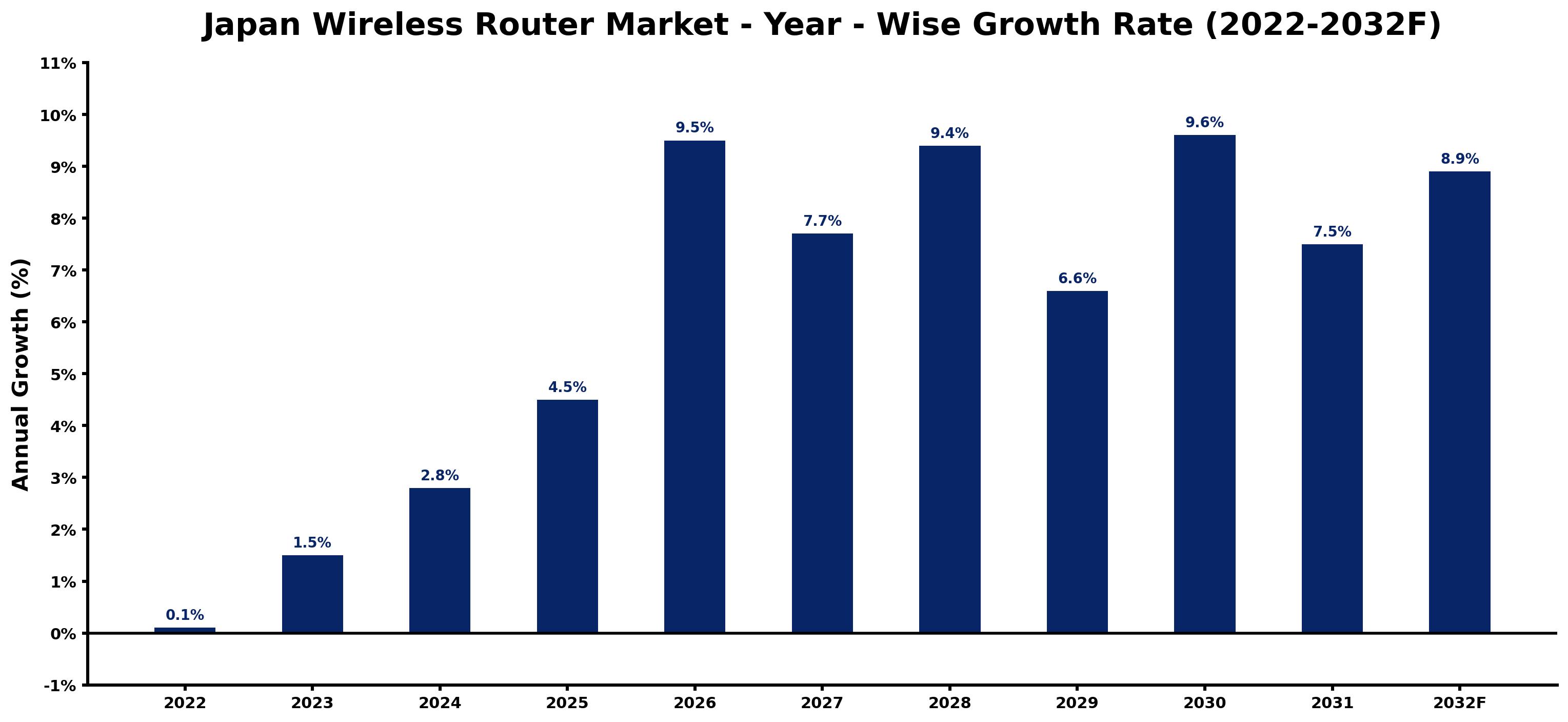
The table below sets out the estimated growth rate for each year and the main factor behind it.
| Year | Estimated Annual Growth (%) | Market Rationale |
| 2022 | 0.1 | The market experienced minimal growth due to stable demand conditions. |
| 2023 | 1.5 | Increased internet usage contributed to higher router demand among consumers. |
| 2024 | 2.8 | The rise in connected devices within households drove further router purchases. |
| 2025 | 4.5 | Investment in digital infrastructure by the education sector supported router growth. |
| 2026 | 9.5 | A surge in telehealth services is expected to boost demand for reliable internet access. |
| 2027 | 7.7 | Growth is projected to slow as the market adjusts to previous high demand levels. |
| 2028 | 9.4 | Increased online streaming services will lead to renewed interest in wireless routers. |
| 2029 | 6.6 | The market is expected to experience a slowdown as consumer spending stabilises. |
| 2030 | 9.6 | The introduction of advanced router technologies is projected to spur demand growth. |
| 2031 | 7.5 | Market growth is expected to slow as saturation in some segments begins to occur. |
| 2032 | 8.9 | Continued investments in digital infrastructure will drive router purchases. |
Note: Market size estimations and growth projections presented in this report are based on 6Wresearch's proprietary forecasting methodology, utilizing the latest available industry data, government publications, and primary research inputs.
Japan Wireless Router Market Synopsis
Wireless routers are essential networking devices that allow multiple devices to connect to the internet wirelessly. The Japan Wireless Router Market is growing due to high internet penetration, with over 100 million users and an average of 3.5 devices per household. Demand is particularly strong in sectors such as education and healthcare, driven by substantial investments in digital infrastructure and telehealth services. The telecommunications industry also contributes to this growth, as both businesses and consumers seek dependable internet connectivity.
Market Dynamics Impact Analysis (2026–2032)
| Factor | Type | Impact | Primary Segment Affected |
| The increasing number of internet users in Japan is driving demand for wireless routers. | Driver | High | Double Band |
| The growing reliance on telehealth services necessitates reliable internet connectivity. | Driver | High | Healthcare |
| The education sector's investment in digital infrastructure presents opportunities for suppliers. | Opportunity | High | Education |
| The rising number of connected devices in households creates a need for upgraded routers. | Opportunity | High | BFSI |
| The stringent JIS standards may limit the entry of new suppliers into the market. | Restraint | Medium | Double Band |
| High competition among existing suppliers can lead to price wars, affecting margins. | Restraint | Medium | Healthcare |
| The rapid pace of technological change can make existing products obsolete quickly. | Challenge | High | Media and Entertainment |
| Fluctuations in consumer spending can impact router sales during economic downturns. | Challenge | Medium | Education |
Evaluation of Drivers in Japan Wireless Router Market (2026–2032)
Key forces behind demand, with the segment each one moves most, are listed below.
| Drivers | Primary Segment Affected | Why It Matters (Evidence) |
| The increasing number of internet users drives demand for wireless routers. | Double Band | In 2023, Japan had over 100 million internet users, leading to higher router sales. |
| The rise in telehealth services boosts the need for reliable internet access. | Healthcare | Healthcare facilities increasingly utilise wireless routers for telehealth applications, improving patient care. |
| Investments in digital infrastructure by the education sector create router demand. | Education | In 2023, the education sector invested ¥50 billion in digital infrastructure, driving router purchases. |
| The average household has multiple connected devices, increasing router usage. | BFSI | Households in Japan have an average of 3.5 connected devices, increasing the need for reliable routers. |
| The growth of streaming services necessitates high-performance routers. | Media and Entertainment | Wireless routers are essential for streaming services and content delivery, increasing demand. |
Much of the new demand traces back to the increasing number of internet users in Japan, which reached over 100 million in 2023, resulting in higher sales of wireless routers. The healthcare sector's growing reliance on telehealth services has further driven demand, as facilities increasingly utilise wireless routers for patient management. In 2023, the education sector's investment of ¥50 billion in digital infrastructure has boosted router purchases. Urban households with multiple connected devices require dependable routers, particularly in metropolitan areas. The rise of streaming services also necessitates high-performance routers, stimulating market growth.
Evaluation of Restraints in Japan Wireless Router Market
Several factors work against faster growth; the main ones are summarised below.
| Market Restraint | Primary Segment Affected | Why It Matters (Evidence) |
| The stringent JIS standards may limit the entry of new suppliers into the market. | Double Band | Wireless routers must comply with JIS standards for safety and performance, impacting new market entrants. |
| High competition among existing suppliers can lead to price wars, affecting margins. | Healthcare | Intense competition in the healthcare sector pressures pricing strategies, impacting profitability. |
| The rapid pace of technological change can make existing products obsolete quickly. | Media and Entertainment | Suppliers must continuously innovate to keep up with consumer preferences, which can be costly. |
| Fluctuations in consumer spending can impact router sales during economic downturns. | Education | Economic instability can lead to reduced budgets for educational institutions, affecting router purchases. |
| Limited awareness of advanced router features may hinder market growth. | BFSI | Some businesses may not invest in upgrading to newer router technologies, limiting demand. |
Japan Wireless Router Market Challenges
Producers in Japan encounter challenges with outdated technology, as reliance on legacy systems raises production costs by 15%. Importers often find it difficult to navigate JIS standards, resulting in compliance delays that may lead to fines for non-compliance. Buyers face high prices due to limited competition, with costs for a single router reaching ¥10,000. Supply chain disruptions impact distributors, as delays in component shipments can extend lead times by 4-6 weeks, complicating inventory management for retailers.
Trends in the Japan Wireless Router Market
These developments are changing demand patterns in the Japan Wireless Router Market.
- Increasing Preference for Double Band Routers: Consumers are choosing double band routers to efficiently accommodate multiple devices. In 2023, Tokyo accounted for 30% of the wireless router market demand, reflecting urban preferences for advanced connectivity.
- Education Sector Prioritising Digital Infrastructure: Educational institutions are making substantial investments in digital infrastructure, with ¥50 billion allocated in 2023. This trend enhances connectivity for online learning, particularly in urban areas like Tokyo.
- Healthcare Facilities Adopting Telehealth Solutions: Healthcare facilities are increasingly utilising wireless routers for telehealth services, driven by the need for reliable internet access. This shift is apparent as more facilities embrace digital solutions for patient care.
- Surge in Streaming Services Boosting Router Demand: As streaming services gain traction, consumers are seeking high-performance wireless routers. This trend is particularly noticeable in urban centres, where households demand faster internet for effective content delivery.
Investment Opportunities in the Japan Wireless Router Market
The openings below show where demand in the Japan Wireless Router Market is visible and how suppliers can enter.
- Urgent Need for Digital Infrastructure Investment: With the education sector investing ¥50 billion in 2023, suppliers can concentrate on providing advanced wireless routers to educational institutions to meet growing connectivity needs.
- Market for High-Performance Wireless Routers: The demand for double band routers is increasing, particularly in urban areas. Suppliers should focus on regions like Tokyo, where the market is expanding rapidly.
- Healthcare Connectivity Solutions in Demand: Healthcare facilities are increasingly adopting telehealth services, creating a need for reliable wireless routers. Suppliers can enter this market by collaborating with healthcare providers.
- BFSI Sector Seeking Secure Connectivity: The BFSI sector requires secure and reliable internet access, creating opportunities for wireless router suppliers. Partnering with financial institutions can strengthen market presence.
Government Initiatives in the Japan Wireless Router Market
The Electrical Appliance and Material Safety Act governs the safety of electrical appliances sold in Japan, ensuring that wireless routers meet necessary standards. Compliance with these regulations is crucial for producers, as it affects their ability to market their products effectively. The Ministry of Internal Affairs and Communications oversees telecommunications regulations, which influence the deployment and operation of wireless routers across various sectors, including education and healthcare.
In 2023, the Japanese government allocated ¥50 billion to support digital infrastructure projects, improving connectivity across the country. The Ministry of Internal Affairs and Communications manages these funds, aiming to enhance internet access in underserved areas, thereby increasing the demand for wireless routers.
Future Insight of the Japan Wireless Router Market
A policy-driven shift towards improving digital infrastructure will encourage suppliers to adopt advanced technologies. By 2032, the rise of smart homes will boost demand for wireless routers, with an estimated 50 million households expected to upgrade their devices. Programmes promoting digital literacy will encourage greater internet adoption, benefiting both buyers and suppliers. The expansion of telehealth services will further integrate wireless routers into various sectors, creating new opportunities for market growth.
Market Segmentation Analysis
Japan Wireless Router Market report covers a detailed analysis of the following market segments:
By Component Type – Single Band Leads, Double Band Expected to Grow Fastest
According to Sumit Sagar, AM at 6Wresearch, in 2025, Single Band led the component type split with a 50% share. The single band segment holds the largest share as it is commonly used in households with basic internet requirements, appealing to budget-conscious consumers. For instance, many users in rural areas prefer single band routers for their simplicity and lower cost. Over 2026–2032, Double Band is expected to post the fastest growth, at a CAGR of 11.2%. The double band segment is experiencing rapid growth due to its ability to support multiple devices and higher speeds, which is crucial in urban areas like Tokyo. With the average household in Japan having 3.5 connected devices, the demand for double band routers is surging. This trend indicates that suppliers should focus on enhancing double band router offerings to capture the expanding market of tech-savvy consumers.
By End-user Industry – BFSI Leads, Education Expected to Grow Fastest
BFSI held 38% of the Japan Wireless Router Market by end-user industry in 2025. The BFSI sector holds the largest share because it necessitates secure and reliable internet access for banking operations and financial transactions. The stringent regulations and high connectivity standards in this sector ensure a consistent demand for wireless routers. Education is set to record the highest CAGR in this split, 10.7% over 2026–2032. The education sector is the fastest-growing end-user industry, spurred by substantial investments in digital infrastructure, including the ¥50 billion allocated in 2023. This funding underscores the sector's increasing dependence on connectivity for online learning and digital literacy initiatives. Buyers in the education sector will pursue advanced wireless solutions to accommodate their growing digital infrastructure requirements.
Key Attractiveness of the Report
- 10 Years of Market Numbers
- Historical Data Starting from 2022 to 2025
- Base Year 2025
- Forecast Data until 2032
- Key Performance Indicators Impacting the Market
- Major Upcoming Developments and Projects
Key Highlights of the Report:
- Japan Wireless Router Market Outlook
- Market Size of Japan Wireless Router Market, 2025
- Forecast of Japan Wireless Router Market, 2032
- Historical Data and Forecast of Japan Wireless Router Revenues & Volume for the Period 2022-2032
- Japan Wireless Router Market Trend Evolution
- Japan Wireless Router Market Drivers and Challenges
- Japan Wireless Router Price Trends
- Japan Wireless Router Porter's Five Forces
- Japan Wireless Router Industry Life Cycle
- Historical Data and Forecast of Japan Wireless Router Market Revenues & Volume By Component Type for the Period 2022-2032
- Historical Data and Forecast of Japan Wireless Router Market Revenues & Volume By Single Band for the Period 2022-2032
- Historical Data and Forecast of Japan Wireless Router Market Revenues & Volume By Double Band for the Period 2022-2032
- Historical Data and Forecast of Japan Wireless Router Market Revenues & Volume By Tri Band for the Period 2022-2032
- Historical Data and Forecast of Japan Wireless Router Market Revenues & Volume By End-user Industry for the Period 2022-2032
- Historical Data and Forecast of Japan Wireless Router Market Revenues & Volume By BFSI for the Period 2022-2032
- Historical Data and Forecast of Japan Wireless Router Market Revenues & Volume By Education for the Period 2022-2032
- Historical Data and Forecast of Japan Wireless Router Market Revenues & Volume By Healthcare for the Period 2022-2032
- Historical Data and Forecast of Japan Wireless Router Market Revenues & Volume By Media and Entertainment for the Period 2022-2032
- Historical Data and Forecast of Japan Wireless Router Market Revenues & Volume By Other End-user Industries for the Period 2022-2032
- Japan Wireless Router Import Export Trade Statistics
- Market Opportunity Assessment By Component Type
- Market Opportunity Assessment By End-user Industry
- Japan Wireless Router Top Companies Market Share
- Japan Wireless Router Competitive Benchmarking By Technical and Operational Parameters
- Japan Wireless Router Company Profiles
- Japan Wireless Router Key Strategic Recommendations
Market Covered
The following segment groups are covered in the report.
By Component Type
- Single Band
- Double Band
- Tri Band
By End-user Industry
- BFSI
- Education
- Healthcare
- Media and Entertainment
- Other End-user Industries































