Japan Wood Chips Market Size & Growth Rate
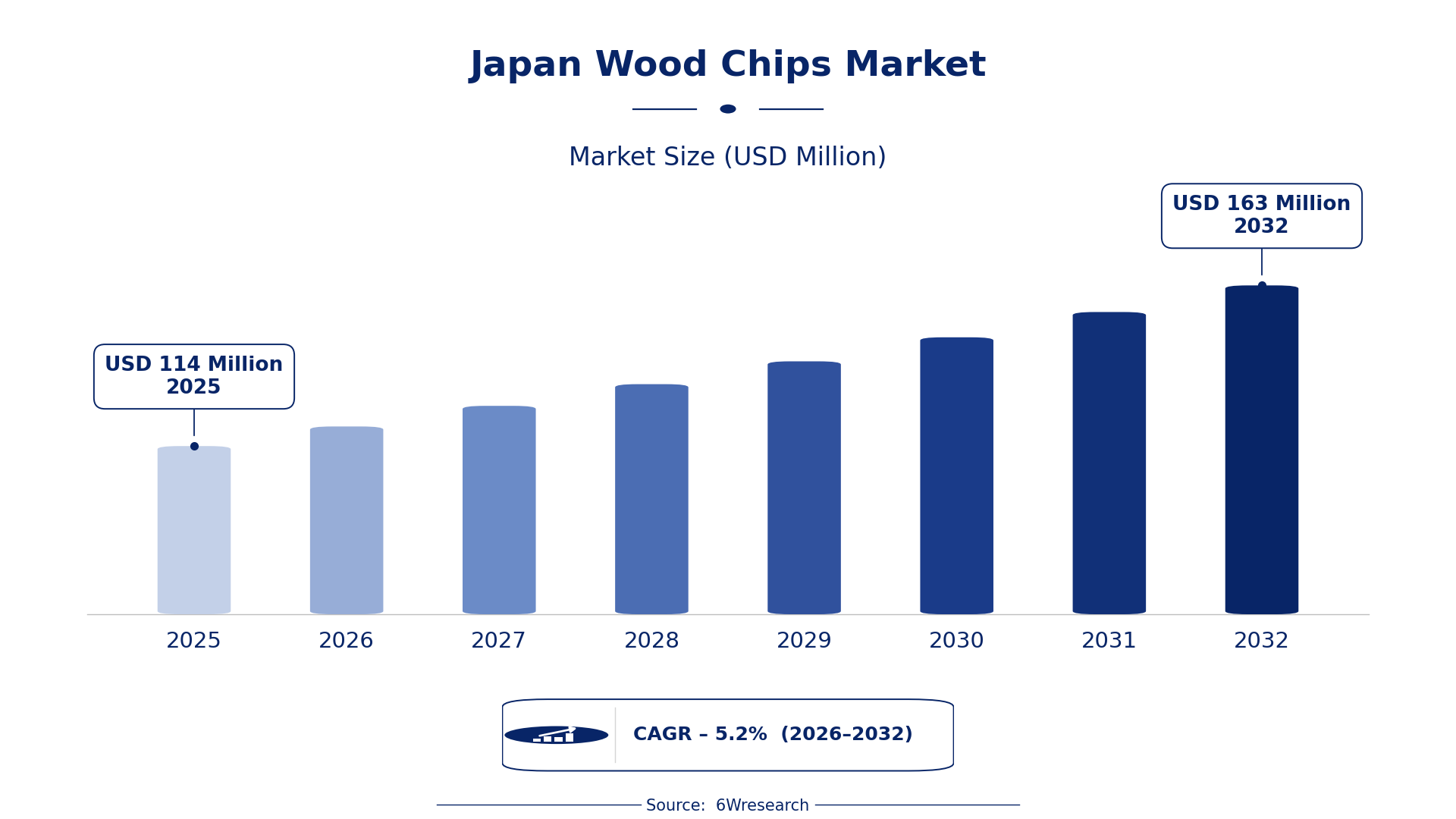
According to 6Wresearch internal database and industry insights, the Japan Wood Chips Market was valued at USD 114 Million in 2025 and is projected to reach USD 163 Million by 2032, growing at a CAGR of approximately 5.2% during 2026–2032.
Japan Wood Chips Market Highlights
| Report Metric | Details |
| Report Name | Japan Wood Chips Market (2026-2032) |
| Market Size 2025 | USD 114 Million |
| Market Size 2032 | USD 163 Million |
| Absolute Growth 2025–2032 | USD 49 Million |
| CAGR 2026–2032 | 5.2% |
| Peak Annual Growth | 6.1% in 2031 |
| Forecast Period | 2026–2032 |
| Historical Data | 2022–2025 |
| Base Year | 2025 |
| Leading Product Type, 2025 | Softwood (55% share) |
| Leading Variety Type, 2025 | Forest Chips (49% share) |
| Leading Raw Material, 2025 | Pulp Wood (63% share) |
| Leading Application, 2025 | Combined Heat and Power (43% share) |
| Fastest-Growing Product Type | Hardwood (7.1% CAGR) |
| Fastest-Growing Variety Type | Recycled Chips (7.5% CAGR) |
| Fastest-Growing Raw Material | Residue Wood (7.6% CAGR) |
| Fastest-Growing Application | Residential Heating (7.8% CAGR) |
| Growing Sector | biomass energy production |
| Key End Users | pulp and paper industry, energy producers, landscaping companies |
Japan Wood Chips Market Year-wise Growth Rate and Key Drivers (2022–2032)
This graph illustrates the annual growth rates of the market from 2022 to 2032, highlighting a steady upward trajectory and projected market expansion over the forecast period.
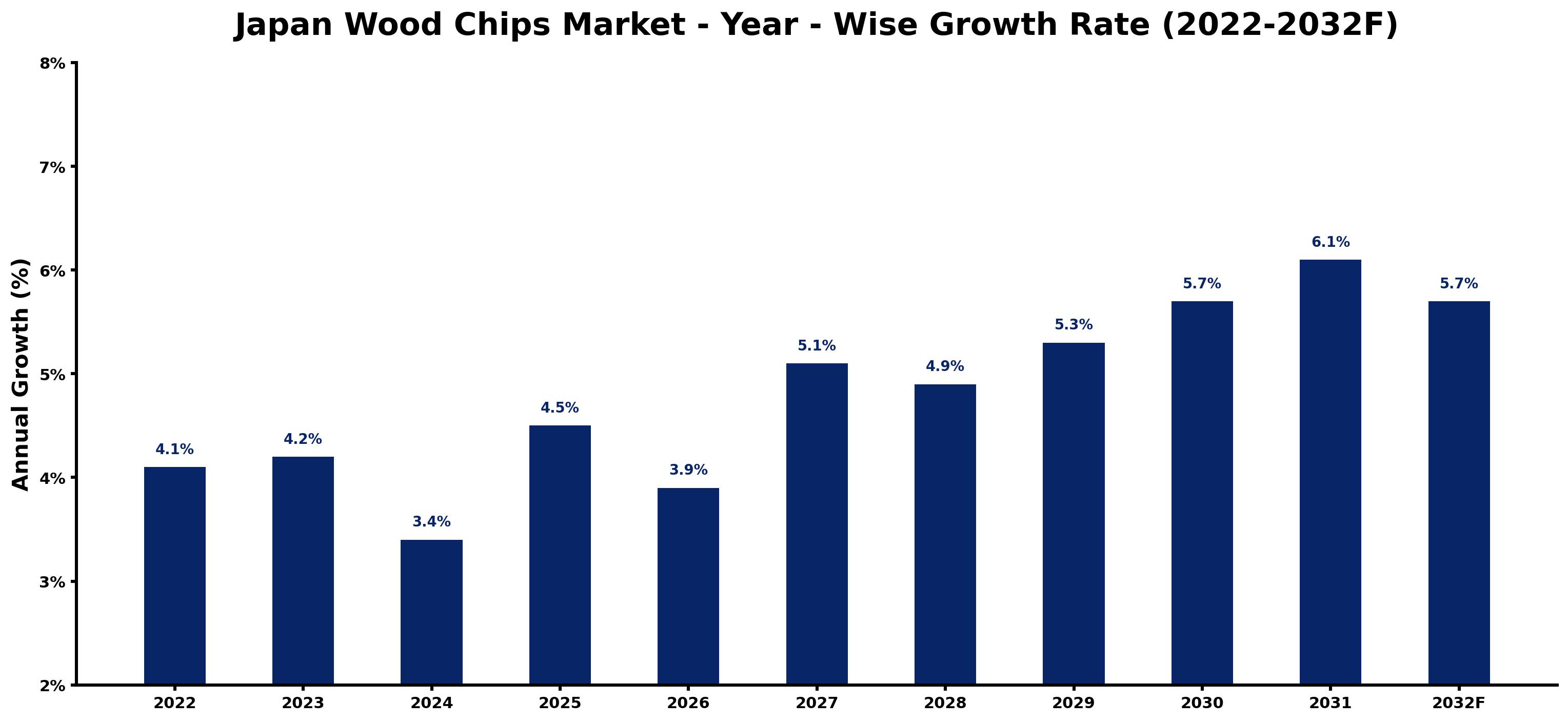
For each year, the table pairs the estimated growth rate with the leading influence on demand, showing how the drivers changed across the period.
| Year | Estimated Annual Growth (%) | Market Rationale |
| 2022 | 4.1 | The market showed steady demand from the pulp and paper sector. |
| 2023 | 4.2 | Growth was supported by increased interest in biomass energy production. |
| 2024 | 3.4 | Demand growth slowed as the market adjusted to previous highs. |
| 2025 | 4.5 | The pulp and paper industry drove faster growth in wood chip consumption. |
| 2026 | 3.9 | A slight slowdown is expected as market conditions stabilise. |
| 2027 | 5.1 | Demand is projected to increase as biomass energy projects gain traction. |
| 2028 | 4.9 | Growth is expected to moderate as supply chains adapt to new requirements. |
| 2029 | 5.3 | Renewable energy initiatives will spur further demand for wood chips. |
| 2030 | 5.7 | Increased residential heating applications will contribute to market growth. |
| 2031 | 6.1 | The market is expected to peak as biomass energy projects reach full capacity. |
| 2032 | 5.7 | Demand will remain strong, supported by ongoing energy transition efforts. |
Note: Market size estimations and growth projections presented in this report are based on 6Wresearch's proprietary forecasting methodology, utilizing the latest available industry data, government publications, and primary research inputs.
Japan Wood Chips Market Synopsis
Wood chips are small pieces of wood produced from debarked logs, primarily used in the pulp and paper industry, biomass energy production, and landscaping. The Japan Wood Chips Market is projected to grow, with approximately 1.2 million tons produced in 2022, driven by the increasing demand from the biomass energy sector. The allocation of ¥30 billion for biomass energy projects in 2023 highlights the government's commitment to this sector, further stimulating market growth. This growth is supported by rising interest in renewable energy and sustainable forestry practices.
Market Dynamics Impact Analysis (2026–2032)
| Factor | Type | Impact | Primary Segment Affected |
| Increasing demand for biomass energy production | Driver | High | WoodResidue Chips |
| Rising interest in sustainable forestry practices | Driver | High | Forest Chips |
| Growing need for renewable energy sources | Opportunity | High | Residential Heating |
| Urban landscaping initiatives driving demand for recycled materials | Opportunity | Medium | Recycled Chips |
| Competition from alternative energy sources | Restraint | High | WoodResidue Chips |
| Supply chain disruptions affecting availability | Restraint | Medium | Forest Chips |
| High production costs impacting profitability | Challenge | High | Pulp Wood |
| Limited domestic production capacity for specific applications | Challenge | Medium | Hardwood |
Evaluation of Drivers in Japan Wood Chips Market (2026–2032)
The factors lifting demand, and the evidence behind each, are summarised below.
| Drivers | Primary Segment Affected | Why It Matters (Evidence) |
| Growing biomass energy market | WoodResidue Chips | The biomass energy market is expanding, with wood chips as a key fuel source, projected to grow significantly. |
| Sustainable forestry practices | Forest Chips | Promoting sustainable forestry increases demand for responsibly sourced wood chips, aligning with environmental standards. |
| Rising interest in renewable energy | Residential Heating | Interest in renewable energy for heating is driving demand for wood chips, particularly in residential applications. |
| Urban landscaping trends | Recycled Chips | Recycled wood chips are gaining traction in urban areas for landscaping due to new safety regulations. |
| Growing pulp and paper production | Pulp Wood | Japan produced approximately 1.2 million tons of wood chips in 2022, primarily for the pulp and paper industry. |
In 2022, approximately 1.2 million tons of wood chips were produced, mainly for pulp and paper applications. The rising interest in renewable energy for residential heating applications is driving demand for wood chips, particularly in urban areas.
Evaluation of Restraints in Japan Wood Chips Market
The following restraints limit how fast demand can grow.
| Market Restraint | Primary Segment Affected | Why It Matters (Evidence) |
| Competition from alternative energy sources | WoodResidue Chips | The growth of alternative energy sources limits the market share of wood chips in biomass energy, impacting overall demand. |
| Supply chain disruptions | Forest Chips | Supply chain issues have affected the availability of forest-sourced wood chips, impacting production and delivery timelines. |
| High production costs | Pulp Wood | Rising production costs have made it challenging for producers to maintain profitability, affecting pricing strategies. |
| Limited domestic production capacity | Hardwood | Domestic production capacity for hardwood is limited, affecting availability for specialty applications and increasing reliance on imports. |
| Regulatory compliance costs | Recycled Chips | Meeting safety and environmental regulations increases costs for recycled wood chip producers, impacting their competitiveness. |
Japan Wood Chips Market Challenges
Producers in the wood chip market face stiff competition from imports, particularly from the United States and Canada, which can pressure local prices and reduce profit margins. Buyers in the pulp and paper sector encounter fluctuating quality standards, as inconsistent supply can lead to production delays costing them up to ¥1 billion annually. Many producers still use outdated chipping technology, resulting in inefficiencies that can inflate production costs by 15%. Skills shortages in the forestry sector hinder innovation, making it challenging for producers to adopt sustainable practices and affecting the industry's long-term viability.
Trends in the Japan Wood Chips Market
Four trends stand out in the Japan Wood Chips Market.
- Shift towards Sustainable Forestry Practices: The Ministry of Agriculture, Forestry and Fisheries has been promoting sustainable forestry practices, leading to a notable increase in responsibly sourced wood chips since 2022. This trend benefits producers focused on eco-friendly sourcing.
- Increased Demand for Biomass Energy: The Japanese biomass energy sector is expanding rapidly, with wood chips projected to be a key fuel source. The sector is anticipated to grow by 20% by 2025, reflecting energy transition efforts.
- Urban Landscaping Initiatives Gaining Momentum: Urban areas are increasingly adopting recycled wood chips for landscaping applications, with a reported rise in usage since 2022 due to new safety regulations. This trend supports sustainable practices in urban planning.
- Growing Interest in Residential Heating: In 2023, local government subsidies for residential heating using wood chips led to a significant increase in demand. This shift reflects a broader trend towards renewable energy sources in households.
Investment Opportunities in the Japan Wood Chips Market
The opportunities below stand out in the Japan Wood Chips Market for new entrants and existing suppliers.
- Timing for Investment in Biomass Projects: With the Japanese biomass energy market projected to grow, now is an ideal time to invest in biomass energy facilities. Local governments are actively seeking partnerships to boost energy production.
- Urban Landscaping Projects Driving Demand: Urban landscaping initiatives in cities like Tokyo are creating a demand for recycled wood chips, with a notable increase in usage expected. Suppliers can enter this market by collaborating with local governments.
- Expansion of Residential Heating Applications: The growing interest in residential heating applications presents an opportunity for suppliers of wood chips. Local governments are offering subsidies to encourage adoption, making it a promising market.
- Investment in Sustainable Forestry: Investing in sustainable forestry practices is timely, as responsible sourcing is being promoted. Collaborating with local forestry groups can open new avenues for suppliers.
Government Initiatives in the Japan Wood Chips Market
The Industrial Standardization Act governs the standards for wood chips in Japan, ensuring quality and safety for producers and buyers. Compliance with JIS A 5908 is essential for market access, as it sets the requirements for wood chip specifications and testing. The Act also mandates regular inspections to maintain standards, benefiting both producers and consumers by ensuring product reliability.
In 2023, the government allocated ¥30 billion for biomass energy projects, administered by the Ministry of Agriculture, Forestry and Fisheries. This funding supports the development of sustainable energy solutions and encourages local producers to participate in biomass initiatives. The Ministry also facilitates training programs for producers to enhance their capabilities in sustainable practices.
Future Insight of the Japan Wood Chips Market
Advancements in chipping technology will reshape demand for higher quality wood chips, enabling producers to better meet industry standards. By 2032, the biomass energy market will grow, supported by ¥30 billion in government funding for renewable projects, solidifying wood chips as a primary fuel source. Increased urban landscaping initiatives will drive the use of recycled wood chips, aligning with safety regulations for various applications. The rising population's interest in renewable energy will further stimulate the market, creating new opportunities for suppliers.
Market Segmentation Analysis
Japan Wood Chips Market report covers a detailed analysis of the following market segments:
By Product Type – Softwood Leads, Hardwood Expected to Grow Fastest
According to Sachin Kumar Rai, Senior Research Analyst at 6Wresearch, in 2025, Softwood led the product type split with a 55% share. Softwood chips dominate Japan's wood chips market as they are primarily utilised in the pulp and paper industry, which is essential for the nation's economy. This segment's stronghold is reflected in its substantial contribution to the overall production, particularly from regions like Hokkaido and Tohoku. The quickest growth will come from Hardwood, forecast to expand at a CAGR of 7.1% between 2026 and 2032. The hardwood segment is experiencing rapid growth due to its increasing use in specialty paper and furniture manufacturing. This surge is fuelled by a rising consumer preference for high-quality products that capitalise on the distinct properties of hardwood. This suggests that suppliers should focus on enhancing their offerings to meet the rising demand for hardwood in niche applications.
By Variety Type – Forest Chips Lead, Recycled Chips Expected to Grow Fastest
Forest Chips held 49% of the Japan Wood Chips Market by variety type in 2025. Forest chips hold the largest share as they are primarily sourced from sustainable forest management practices, which are supported by government initiatives. This aligns with the increasing focus on biomass energy, making forest chips essential for energy production. Recycled Chips are set to record the highest CAGR in this split, 7.5% over 2026–2032. Recycled chips are gaining momentum due to their role in sustainable practices and waste reduction, reflecting a broader trend towards environmental responsibility. The growing interest in eco-friendly materials is propelling this segment's growth. Buyers may benefit from sourcing recycled chips to align with sustainability goals and reduce environmental impact.
By Raw Material – Pulp Wood Leads, Residue Wood Expected to Grow Fastest
Pulp Wood took 63% of raw material revenue in 2025, more than any other category. Pulp wood is the leading raw material as it serves as the primary input for the paper and pulp production processes, which are vital to Japan's economy. The established infrastructure for pulp wood sourcing ensures a steady supply for manufacturers. Over 2026–2032, Residue Wood is expected to post the fastest growth, at a CAGR of 7.6%. Residue wood is rapidly gaining traction as it is increasingly used in biomass energy and various products, reflecting the shift towards utilising all available resources efficiently. The government's support for biomass projects is further accelerating this trend. Suppliers should consider diversifying their raw material sources to include residue wood to capitalise on its growing demand.
By Application – Combined Heat and Power Leads, Residential Heating Expected to Grow Fastest
Combined Heat and Power accounted for 43% of the market by application in 2025. Combined heat and power applications lead the market, as they effectively utilise wood chips for energy generation from biomass, which is a critical component of Japan's energy strategy. This method maximises the utility of wood chips, ensuring a consistent demand. Residential Heating is projected to grow fastest, at a CAGR of 7.8% during 2026–2032. Residential heating is the fastest-growing application, driven by local government subsidies that promote wood chips as a renewable energy source for heating. This trend reflects the increasing interest in sustainable energy solutions among homeowners. Suppliers should explore partnerships with residential heating initiatives to tap into this expanding market.
Key Attractiveness of the Report
- 10 Years of Market Numbers
- Historical Data Starting from 2022 to 2025
- Base Year 2025
- Forecast Data until 2032
- Key Performance Indicators Impacting the Market
- Major Upcoming Developments and Projects
Key Highlights of the Report:
- Japan Wood Chips Market Outlook
- Market Size of Japan Wood Chips Market, 2025
- Forecast of Japan Wood Chips Market, 2032
- Historical Data and Forecast of Japan Wood Chips Revenues & Volume for the Period 2022-2032
- Japan Wood Chips Market Trend Evolution
- Japan Wood Chips Market Drivers and Challenges
- Japan Wood Chips Price Trends
- Japan Wood Chips Porter's Five Forces
- Japan Wood Chips Industry Life Cycle
- Historical Data and Forecast of Japan Wood Chips Market Revenues & Volume By Product Type for the Period 2022-2032
- Historical Data and Forecast of Japan Wood Chips Market Revenues & Volume By Softwood for the Period 2022-2032
- Historical Data and Forecast of Japan Wood Chips Market Revenues & Volume By Hardwood for the Period 2022-2032
- Historical Data and Forecast of Japan Wood Chips Market Revenues & Volume By Manual for the Period 2022-2032
- Historical Data and Forecast of Japan Wood Chips Market Revenues & Volume By Variety Type for the Period 2022-2032
- Historical Data and Forecast of Japan Wood Chips Market Revenues & Volume By Forest Chips for the Period 2022-2032
- Historical Data and Forecast of Japan Wood Chips Market Revenues & Volume By Recycled Chips for the Period 2022-2032
- Historical Data and Forecast of Japan Wood Chips Market Revenues & Volume By WoodResidue Chips for the Period 2022-2032
- Historical Data and Forecast of Japan Wood Chips Market Revenues & Volume By Sawing ResidueChips for the Period 2022-2032
- Historical Data and Forecast of Japan Wood Chips Market Revenues & Volume By Raw Material for the Period 2022-2032
- Historical Data and Forecast of Japan Wood Chips Market Revenues & Volume By Pulp Wood for the Period 2022-2032
- Historical Data and Forecast of Japan Wood Chips Market Revenues & Volume By Residue Wood for the Period 2022-2032
- Historical Data and Forecast of Japan Wood Chips Market Revenues & Volume By Application for the Period 2022-2032
- Historical Data and Forecast of Japan Wood Chips Market Revenues & Volume By Combined Heat and Power for the Period 2022-2032
- Historical Data and Forecast of Japan Wood Chips Market Revenues & Volume By Household Furnishing for the Period 2022-2032
- Historical Data and Forecast of Japan Wood Chips Market Revenues & Volume By Residential Heating for the Period 2022-2032
- Historical Data and Forecast of Japan Wood Chips Market Revenues & Volume By Playground Surfacing for the Period 2022-2032
- Historical Data and Forecast of Japan Wood Chips Market Revenues & Volume By Barbecue for the Period 2022-2032
- Historical Data and Forecast of Japan Wood Chips Market Revenues & Volume By Mulch for the Period 2022-2032
- Historical Data and Forecast of Japan Wood Chips Market Revenues & Volume By Bio Reactors for the Period 2022-2032
- Historical Data and Forecast of Japan Wood Chips Market Revenues & Volume By Fuel for the Period 2022-2032
- Japan Wood Chips Import Export Trade Statistics
- Market Opportunity Assessment By Product Type
- Market Opportunity Assessment By Variety Type
- Market Opportunity Assessment By Raw Material
- Market Opportunity Assessment By Application
- Japan Wood Chips Top Companies Market Share
- Japan Wood Chips Competitive Benchmarking By Technical and Operational Parameters
- Japan Wood Chips Company Profiles
- Japan Wood Chips Key Strategic Recommendations
Market Covered
This report examines the market across the segments below.
By Product Type
- Softwood
- Hardwood
- Manual
By Variety Type
- Forest Chips
- Recycled Chips
- WoodResidue Chips
- Sawing ResidueChips
By Raw Material
- Pulp Wood
- Residue Wood
By Application
- Combined Heat and Power
- Household Furnishing
- Residential Heating
- Playground Surfacing
- Barbecue
- Mulch
- Bio Reactors
- Fuel































