Japan Wood Utility Poles Market Size & Growth Rate
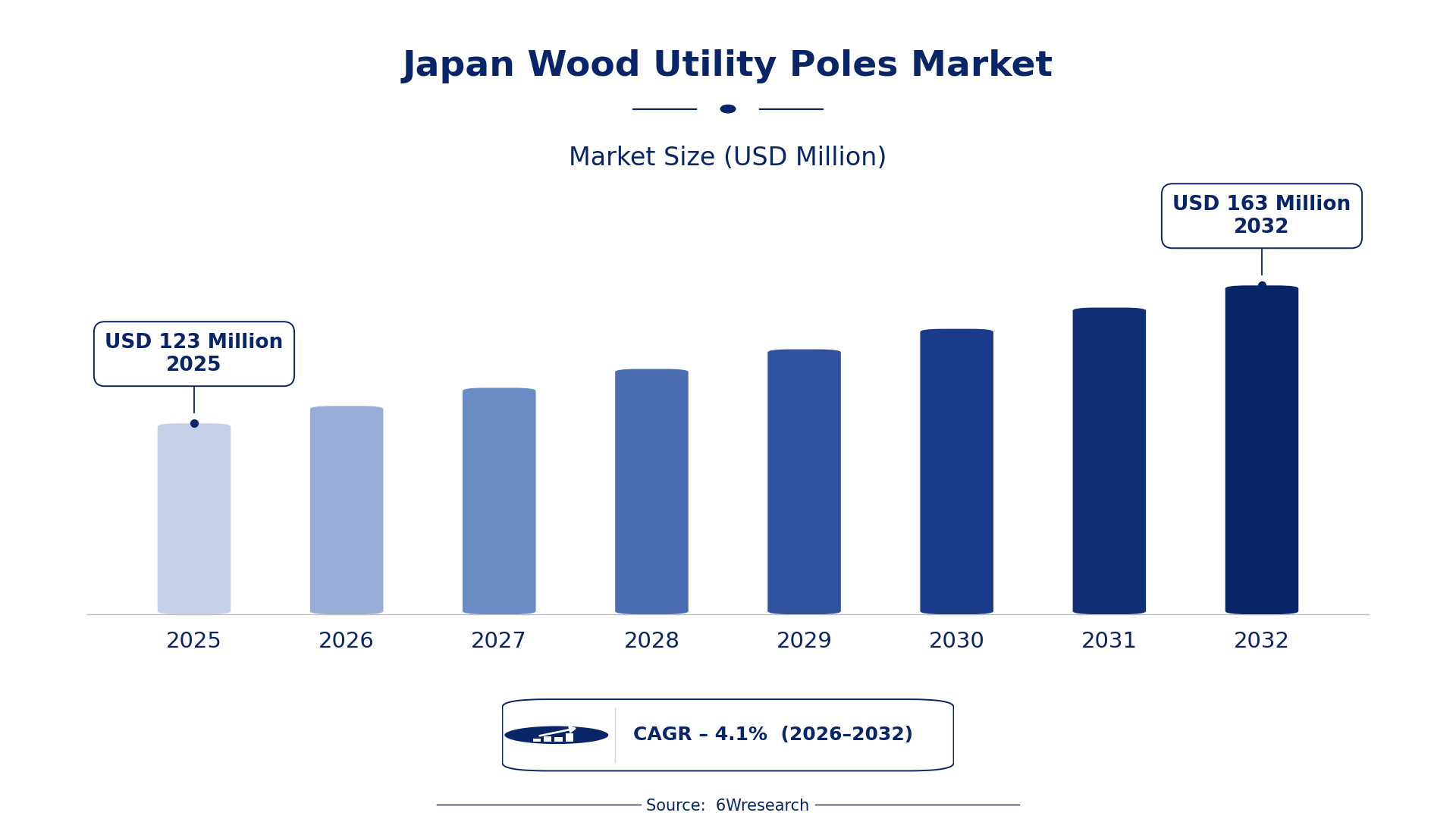
According to 6Wresearch internal database and industry insights, the Japan Wood Utility Poles Market was valued at USD 123 Million in 2025 and is projected to reach USD 163 Million by 2032, growing at a CAGR of approximately 4.1% during 2026–2032.
Japan Wood Utility Poles Market Highlights
| Report Metric | Details |
| Report Name | Japan Wood Utility Poles Market (2026-2032) |
| Market Size 2025 | USD 123 Million |
| Market Size 2032 | USD 163 Million |
| Absolute Growth 2025–2032 | USD 40 Million |
| CAGR 2026–2032 | 4.1% |
| Peak Annual Growth | 5.0% in 2032 |
| Forecast Period | 2026–2032 |
| Historical Data | 2022–2025 |
| Base Year | 2025 |
| Leading Type, 2025 | Transmission Poles (54% share) |
| Leading Material, 2025 | Wood (50% share) |
| Leading Pole Size, 2025 | Between 40 & 70ft (58% share) |
| Leading Application, 2025 | Energy transmission & distribution (47% share) |
| Fastest-Growing Type | Distribution Poles (5.6% CAGR) |
| Fastest-Growing Material | Composites (5.8% CAGR) |
| Fastest-Growing Application | Telecommunication (6.3% CAGR) |
| Growing Sector | Energy transmission & distribution |
| Key End Users | Utility companies, local governments, telecommunication providers |
Japan Wood Utility Poles Market Year-wise Growth Rate and Key Drivers (2022–2032)
This graph illustrates the annual growth rates of the market from 2022 to 2032, highlighting a steady upward trajectory and projected market expansion over the forecast period.
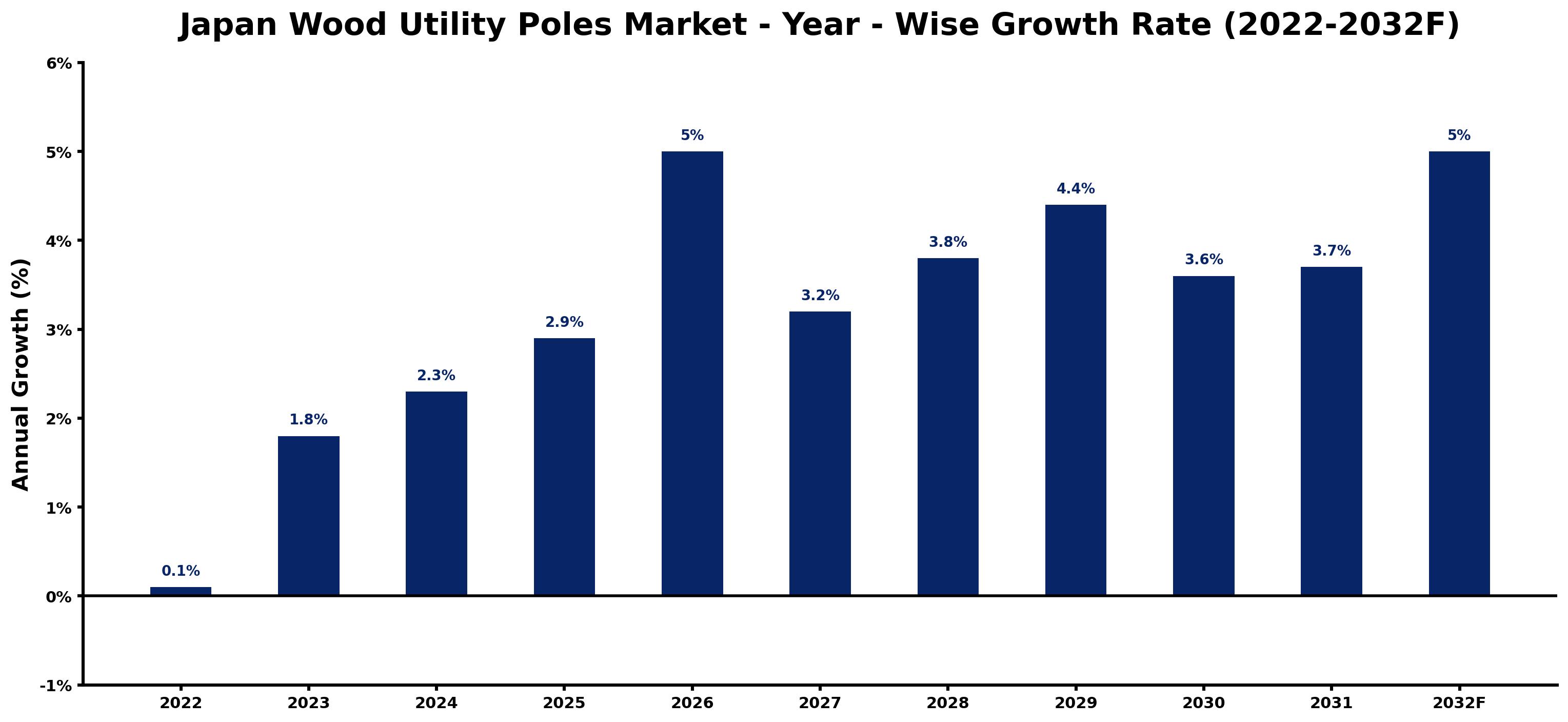
The yearly estimates that follow link every growth rate to its principal driver, so readers can see why the pace changed in each period.
| Year | Estimated Annual Growth (%) | Market Rationale |
| 2022 | 0.1 | The market showed minimal growth due to stable demand from utility companies. |
| 2023 | 1.8 | Increased electricity consumption led to higher demand for utility poles. |
| 2024 | 2.3 | The market continued to grow as utility companies expanded infrastructure projects. |
| 2025 | 2.9 | Demand peaked as utility investments surged ahead of new standards. |
| 2026 | 5.0 | The forecast peak year sees a rise in orders from energy sectors. |
| 2027 | 3.2 | Growth is expected to slow as market adjusts to peak demand levels. |
| 2028 | 3.8 | A slight recovery is projected as utility projects resume after initial adjustments. |
| 2029 | 4.4 | Demand is expected to rise again as infrastructure upgrades are prioritised. |
| 2030 | 3.6 | Growth is projected to slow as the market stabilises after previous peaks. |
| 2031 | 3.7 | A slight increase is expected as utility companies plan further expansions. |
| 2032 | 5.0 | The market is projected to reach its forecast peak due to ongoing infrastructure investments. |
Note: Market size estimations and growth projections presented in this report are based on 6Wresearch's proprietary forecasting methodology, utilizing the latest available industry data, government publications, and primary research inputs.
Japan Wood Utility Poles Market Synopsis
Wood utility poles, primarily made from treated timber, support overhead power lines and telecommunication cables. The Japan Wood Utility Poles Market is growing due to Japan's electricity demand, estimated at approximately 1,000 TWh annually. The government's 2023 initiative promoting sustainable forestry practices for utility pole production encourages investment in this sector, while utility companies and local governments remain the main buyers. This increasing need stems from the demand for reliable energy and communication infrastructure across the country.
Market Dynamics Impact Analysis (2026–2032)
| Factor | Type | Impact | Primary Segment Affected |
| Growing electricity demand from urban areas | Driver | High | Energy transmission & distribution |
| Increased investments in renewable energy infrastructure | Driver | High | Energy transmission & distribution |
| Rising need for modernised utility infrastructure | Opportunity | High | Energy transmission & distribution |
| Expansion of telecommunication networks requiring more poles | Opportunity | High | Telecommunication |
| Environmental regulations affecting timber sourcing | Restraint | Medium | Wood |
| Competition from alternative materials like composites | Restraint | Medium | Wood |
| Rising costs of treated timber due to supply chain issues | Challenge | High | Wood |
| Delays in infrastructure projects due to regulatory approvals | Challenge | Medium | Energy transmission & distribution |
Evaluation of Drivers in Japan Wood Utility Poles Market (2026–2032)
Demand rests on the following drivers, each shown with the segment it touches most.
| Drivers | Primary Segment Affected | Why It Matters (Evidence) |
| Increased electricity consumption | Energy transmission & distribution | Japan's electricity demand, approximately 1,000 TWh annually, drives utility pole requirements. |
| Government investment in renewable energy | Energy transmission & distribution | In 2023, ¥5 billion was allocated for renewable energy infrastructure, boosting utility pole demand. |
| Telecommunication expansion | Telecommunication | Telecommunication companies utilise wood utility poles for about 30% of their infrastructure, increasing purchases. |
| Sustainable forestry practices | Wood | The 2023 program promotes sustainable practices, encouraging more utility pole production. |
| Urbanisation trends | Energy transmission & distribution | The Tokyo metropolitan area, with its high population density, increases the need for utility poles. |
Spending rises because electricity consumption in Japan is high, with demand reaching approximately 1,000 TWh annually. This demand drives utility companies to invest in infrastructure, leading to increased orders for wood utility poles. In 2023, ¥5 billion was allocated for renewable energy infrastructure, further boosting purchases. The expansion of urban areas creates additional need for utility poles to support energy distribution and communication networks. As utility projects resume, the requirement for reliable infrastructure continues to grow, prompting further investments.
Evaluation of Restraints in Japan Wood Utility Poles Market
The following restraints limit how fast demand can grow.
| Market Restraint | Primary Segment Affected | Why It Matters (Evidence) |
| Environmental regulations on timber sourcing | Wood | Regulations require compliance with sustainable practices, complicating sourcing and increasing costs. |
| Competition from alternative materials | Wood | Composites are gaining traction due to their durability, impacting wood pole demand. |
| Supply chain disruptions affecting treated timber availability | Wood | Rising costs and delays in treated timber supply can hinder production timelines. |
| Regulatory approval delays for infrastructure projects | Energy transmission & distribution | Long approval processes can postpone essential utility pole installations. |
| Market fluctuations in timber prices | Wood | Volatility in timber prices can affect budgeting and investment decisions for utility companies. |
Japan Wood Utility Poles Market Challenges
In 2023, Japan's utility companies require approximately 1.5 million wood utility poles annually, but sourcing challenges from local forests can delay production for producers. Quality regulations impose checks that can extend lead times, impacting timely deliveries to buyers. Skills shortages in forestry and treatment processes hinder producers' ability to meet demand, resulting in potential project delays for local governments. Rising costs associated with sustainable practices, driven by the government's ¥5 billion allocation for renewable energy, can strain budgets for utility firms and municipalities.
Trends in the Japan Wood Utility Poles Market
The trends below show where the Japan Wood Utility Poles Market is heading.
- Shift towards Sustainable Forestry Practices: In 2023, a new program was launched to promote sustainable forestry for utility pole production. This initiative aims to improve environmental responsibility in timber sourcing, aligning with global sustainability goals.
- Increasing Demand for Telecommunication Infrastructure: Telecommunication networks are expanding rapidly, with wood utility poles supporting about 30% of infrastructure. This growth reflects the need for improved connectivity in urban areas, driving further investments.
- Growth in Renewable Energy Projects: The allocation of ¥5 billion for renewable energy infrastructure in 2023 indicates a shift towards greener energy solutions. This funding will likely increase the demand for utility poles in energy transmission.
- Heightened Urbanisation Impacting Utility Pole Demand: As urban populations grow, particularly in the Tokyo metropolitan area, the need for utility poles rises. This trend is illustrated by the increasing infrastructure projects aimed at supporting energy distribution.
Investment Opportunities in the Japan Wood Utility Poles Market
Several openings in the Japan Wood Utility Poles Market merit attention from investors.
- Gap in Sustainable Utility Pole Supply: With the government's ¥5 billion investment in renewable energy infrastructure, there is an opportunity for suppliers to provide sustainable wood utility poles to utility companies.
- Telecommunication Sector Expansion: Telecommunication companies in urban areas are rapidly expanding their networks, creating a demand for more utility poles. Suppliers can enter this market by partnering with local telecommunications providers.
- Investment in Urban Infrastructure: The Tokyo metropolitan area requires more utility poles to support its growing population. Suppliers can target this area by establishing local partnerships and ensuring compliance with JIS standards.
- Renewable Energy Infrastructure Needs: The recent government funding for renewable energy infrastructure highlights a need for utility poles. Suppliers can invest in producing poles that meet the new sustainable standards.
Government Initiatives in the Japan Wood Utility Poles Market
The Hydrogen Society Promotion Act, enacted in 2024, provides price-gap support for low-carbon hydrogen supply chains. This measure encourages utility pole producers to adopt environmentally friendly practices, aligning with national energy goals. The government allocated ¥5 billion to support renewable energy infrastructure, promoting the production of treated wood utility poles.
The Ministry of the Environment oversees the implementation of various environmental initiatives, including the promotion of sustainable forestry practices. This agency funds projects that support the production of treated wood utility poles, ensuring compliance with quality standards. In 2023, the ministry approved multiple projects aimed at enhancing the sustainability of timber sourcing.
Future Insight of the Japan Wood Utility Poles Market
A policy-driven shift towards sustainable forestry will reshape production methods by 2032, prompting suppliers to implement advanced treatment technologies. Utility companies will enhance infrastructure to ensure reliable service delivery. With the average lifespan of treated wood utility poles at 30 years, buyers will benefit from greater durability and less frequent replacements. As electricity demand approaches 1,000 TWh annually, updated installation guidelines from the Japan Electric Power Information Center will facilitate more efficient operations for producers.
Market Segmentation Analysis
Japan Wood Utility Poles Market report covers a detailed analysis of the following market segments:
By Type – Transmission Poles Lead, Distribution Poles Expected to Grow Fastest
According to Shubham Padhi, Research Analyst at 6Wresearch, Transmission Poles held 54% of the Japan Wood Utility Poles Market by type in 2025. Transmission poles are essential for supporting high voltage power lines, meeting Japan's substantial electricity demand of approximately 1,000 TWh annually. The established infrastructure in regions like Hokkaido and Tohoku ensures a reliable supply of these critical poles. Distribution Poles are projected to grow fastest, at a CAGR of 5.6% during 2026–2032. Distribution poles are witnessing rapid growth due to the rising need for efficient electricity distribution in densely populated areas, particularly in Tokyo. As urbanisation continues, the demand for these poles is expected to expand further, solidifying their market position. Suppliers must enhance production capabilities for distribution poles to meet the increasing urban demand effectively.
By Material – Wood Leads, Composites Expected to Grow Fastest
The largest material category in 2025 was Wood, at 50% of revenue. Wood remains the primary material for utility poles due to its availability from local forests and compliance with Japanese Industrial Standards. This material is favoured by utility companies and local governments for its durability and cost-effectiveness in utility pole production. Composites are set to record the highest CAGR in this split, 5.8% over 2026–2032. The composites segment is experiencing growth as they are being explored for niche applications, particularly where weight and resistance to environmental factors are critical. The increasing emphasis on sustainable practices is also prompting interest in alternative materials like composites. Buyers may consider diversifying their material sources to include composites, especially for specific applications where traditional wood may not suffice.
By Pole Size – Between 40 & 70ft Leads and Records the Fastest Growth
With 58% of pole size revenue in 2025, Between 40 & 70ft was the largest category. Poles between 40 and 70 feet are the most commonly used size, aligning with the average height requirements for both transmission and distribution applications. This size is optimal for supporting overhead power lines and telecommunication cables, making it a preferred choice among utility companies. Between 40 & 70ft is also forecast to expand faster than any other category, at a CAGR of 5.4% over 2026–2032. The continued dominance of poles between 40 and 70 feet in both transmission and distribution applications ensures that their market share will likely expand as demand grows. As urban infrastructure develops, this size will remain critical for effective service delivery. Suppliers should maintain a steady inventory of poles within this size range to accommodate ongoing demand from utility companies.
By Application – Energy transmission & distribution Leads, Telecommunication Expected to Grow Fastest
In 2025, Energy transmission & distribution led the application split with a 47% share. Energy transmission and distribution serves as the primary application for utility poles, driven by Japan's significant electricity consumption and the need for dependable infrastructure. Government initiatives focused on improving energy efficiency and sustainability underscore the importance of this segment. Over 2026–2032, Telecommunication is expected to post the fastest growth, at a CAGR of 6.3%. The telecommunication application is growing quickly as the demand for robust communication lines increases, especially in urban regions. The reliance on wood utility poles for approximately 30% of telecommunication infrastructure suggests strong growth potential for this segment. Suppliers should explore partnerships with telecommunication companies to capitalise on the rising demand for utility poles in this area.
Key Attractiveness of the Report
- 10 Years of Market Numbers
- Historical Data Starting from 2022 to 2025
- Base Year 2025
- Forecast Data until 2032
- Key Performance Indicators Impacting the Market
- Major Upcoming Developments and Projects
Key Highlights of the Report:
- Japan Wood Utility Poles Market Outlook
- Market Size of Japan Wood Utility Poles Market, 2025
- Forecast of Japan Wood Utility Poles Market, 2032
- Historical Data and Forecast of Japan Wood Utility Poles Revenues & Volume for the Period 2022-2032
- Japan Wood Utility Poles Market Trend Evolution
- Japan Wood Utility Poles Market Drivers and Challenges
- Japan Wood Utility Poles Price Trends
- Japan Wood Utility Poles Porter's Five Forces
- Japan Wood Utility Poles Industry Life Cycle
- Historical Data and Forecast of Japan Wood Utility Poles Market Revenues & Volume By Type for the Period 2022-2032
- Historical Data and Forecast of Japan Wood Utility Poles Market Revenues & Volume By Transmission Poles for the Period 2022-2032
- Historical Data and Forecast of Japan Wood Utility Poles Market Revenues & Volume By Distribution Poles for the Period 2022-2032
- Historical Data and Forecast of Japan Wood Utility Poles Market Revenues & Volume By Material for the Period 2022-2032
- Historical Data and Forecast of Japan Wood Utility Poles Market Revenues & Volume By Concrete for the Period 2022-2032
- Historical Data and Forecast of Japan Wood Utility Poles Market Revenues & Volume By Wood for the Period 2022-2032
- Historical Data and Forecast of Japan Wood Utility Poles Market Revenues & Volume By Steel for the Period 2022-2032
- Historical Data and Forecast of Japan Wood Utility Poles Market Revenues & Volume By Composites for the Period 2022-2032
- Historical Data and Forecast of Japan Wood Utility Poles Market Revenues & Volume By Pole Size for the Period 2022-2032
- Historical Data and Forecast of Japan Wood Utility Poles Market Revenues & Volume By Below 40ft for the Period 2022-2032
- Historical Data and Forecast of Japan Wood Utility Poles Market Revenues & Volume By Between 40 & 70ft for the Period 2022-2032
- Historical Data and Forecast of Japan Wood Utility Poles Market Revenues & Volume By Above 70ft for the Period 2022-2032
- Historical Data and Forecast of Japan Wood Utility Poles Market Revenues & Volume By Application for the Period 2022-2032
- Historical Data and Forecast of Japan Wood Utility Poles Market Revenues & Volume By Energy transmission & distribution for the Period 2022-2032
- Historical Data and Forecast of Japan Wood Utility Poles Market Revenues & Volume By Telecommunication for the Period 2022-2032
- Historical Data and Forecast of Japan Wood Utility Poles Market Revenues & Volume By Street lighting for the Period 2022-2032
- Historical Data and Forecast of Japan Wood Utility Poles Market Revenues & Volume By Heavy power lines for the Period 2022-2032
- Historical Data and Forecast of Japan Wood Utility Poles Market Revenues & Volume By Subtransmission lines for the Period 2022-2032
- Historical Data and Forecast of Japan Wood Utility Poles Market Revenues & Volume By Others for the Period 2022-2032
- Japan Wood Utility Poles Import Export Trade Statistics
- Market Opportunity Assessment By Type
- Market Opportunity Assessment By Material
- Market Opportunity Assessment By Pole Size
- Market Opportunity Assessment By Application
- Japan Wood Utility Poles Top Companies Market Share
- Japan Wood Utility Poles Competitive Benchmarking By Technical and Operational Parameters
- Japan Wood Utility Poles Company Profiles
- Japan Wood Utility Poles Key Strategic Recommendations
Market Covered
The following segment groups are covered in the report.
By Type
- Transmission Poles
- Distribution Poles
By Material
- Concrete
- Wood
- Steel
- Composites
By Pole Size
- Below 40ft
- Between 40 & 70ft
- Above 70ft
By Application
- Energy transmission & distribution
- Telecommunication
- Street lighting
- Heavy power lines
- Subtransmission lines
- Others































