Japan Wood Varnishes Market Size & Growth Rate
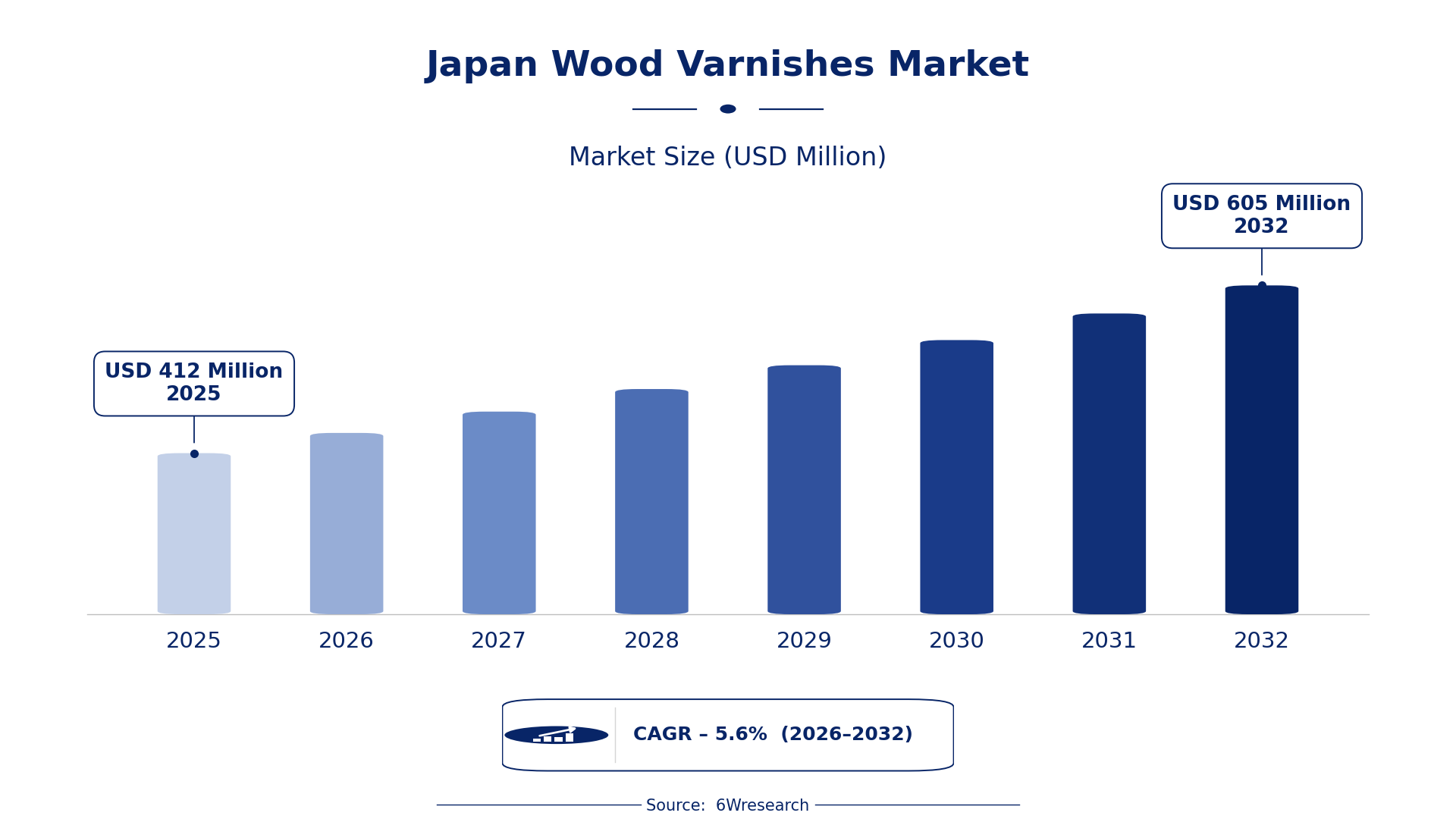
According to 6Wresearch internal database and industry insights, the Japan Wood Varnishes Market was valued at USD 412 Million in 2025 and is projected to reach USD 605 Million by 2032, growing at a CAGR of approximately 5.6% during 2026–2032.
Japan Wood Varnishes Market Highlights
| Report Metric | Details |
| Report Name | Japan Wood Varnishes Market (2026-2032) |
| Market Size 2025 | USD 412 Million |
| Market Size 2032 | USD 605 Million |
| Absolute Growth 2025–2032 | USD 193 Million |
| CAGR 2026–2032 | 5.6% |
| Peak Annual Growth | 6.3% in 2028 |
| Forecast Period | 2026–2032 |
| Historical Data | 2022–2025 |
| Base Year | 2025 |
| Leading Product, 2025 | Water Based (44% share) |
| Leading Application, 2025 | Interior (43% share) |
| Leading End Users, 2025 | Residential (45% share) |
| Fastest-Growing Product | Oil Based (7.8% CAGR) |
| Fastest-Growing Application | Exterior (7.4% CAGR) |
| Fastest-Growing End Users | Commercial (7.1% CAGR) |
| Growing Sector | Residential |
| Key End Users | Homeowners, contractors, furniture makers, commercial builders |
Japan Wood Varnishes Market Year-wise Growth Rate and Key Drivers (2022–2032)
This graph illustrates the annual growth rates of the market from 2022 to 2032, highlighting a steady upward trajectory and projected market expansion over the forecast period.
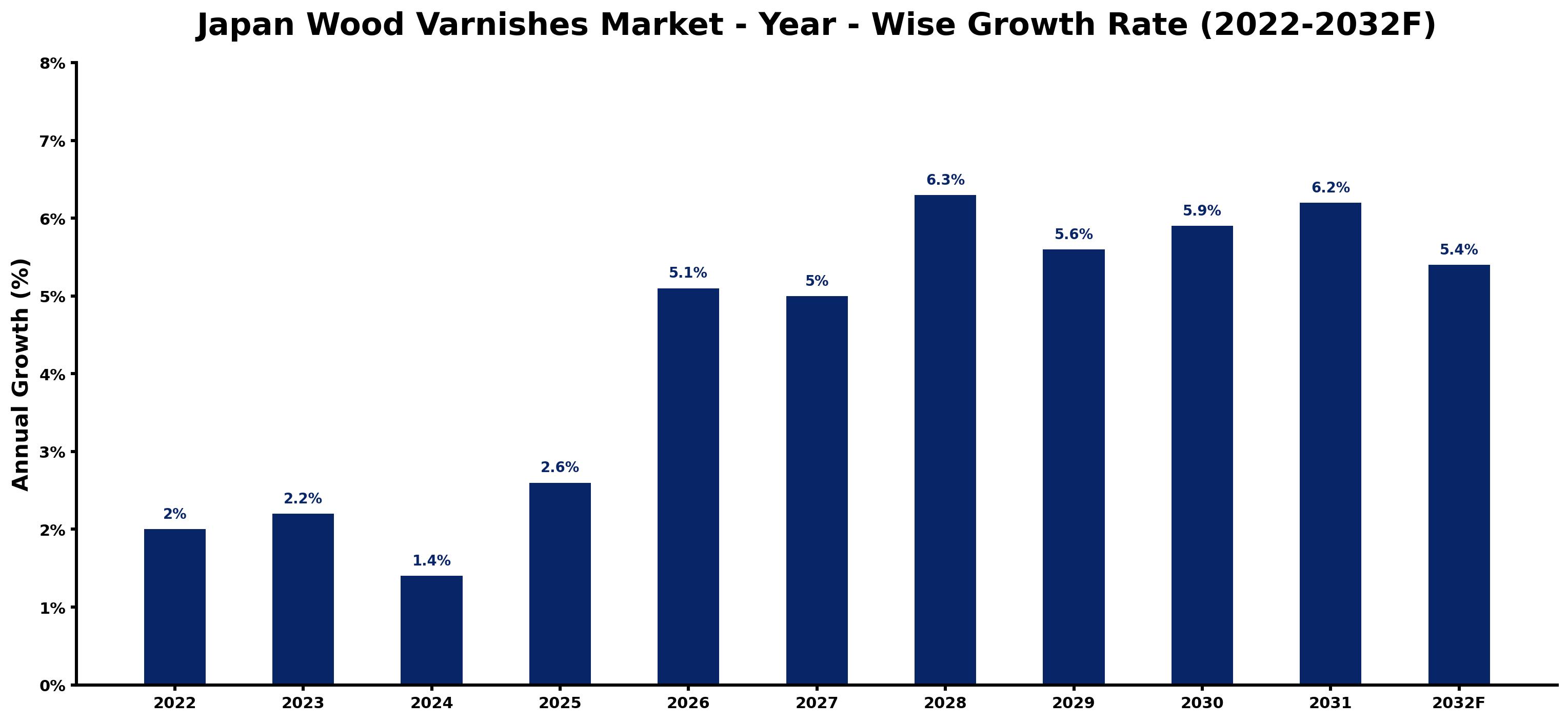
The yearly estimates that follow link every growth rate to its principal driver, so readers can see why the pace changed in each period.
| Year | Estimated Annual Growth (%) | Market Rationale |
| 2022 | 2.0 | The market experienced steady growth due to increased residential demand. |
| 2023 | 2.2 | Growth accelerated as urban areas expanded, boosting varnish consumption. |
| 2024 | 1.4 | A slowdown occurred as market conditions stabilised after rapid growth. |
| 2025 | 2.6 | Demand surged with a rise in commercial construction activities. |
| 2026 | 5.1 | Growth will continue as eco-friendly varnishes gain traction among consumers. |
| 2027 | 5.0 | A slight slowdown is projected as market saturation begins to set in. |
| 2028 | 6.3 | Peak growth will arise from heightened demand for outdoor applications. |
| 2029 | 5.6 | Growth is anticipated to decelerate slightly as competition intensifies in the market. |
| 2030 | 5.9 | Demand is expected to rebound as new eco-friendly products enter the market. |
| 2031 | 6.2 | Growth will accelerate again due to rising awareness of sustainable practices. |
| 2032 | 5.4 | A slowdown is projected as the market reaches maturity. |
Note: Market size estimations and growth projections presented in this report are based on 6Wresearch's proprietary forecasting methodology, utilizing the latest available industry data, government publications, and primary research inputs.
Japan Wood Varnishes Market Synopsis
Wood varnishes are protective coatings applied to wood surfaces, improving durability and aesthetics. The Japan Wood Varnishes Market is expanding, primarily driven by the residential sector, which accounts for around 50% of demand. Urbanisation in regions like Tokyo is fuelling this trend, alongside a growing preference for eco-friendly products, as shown by the government's promotion of sustainable coatings. With the furniture industry valued at over 1 trillion JPY, varnish consumption is expected to rise considerably, supported by both residential and commercial applications.
Market Dynamics Impact Analysis (2026–2032)
| Factor | Type | Impact | Primary Segment Affected |
| Rising urbanisation in the Tokyo region | Driver | High | Interior |
| Increased demand for eco-friendly products | Driver | High | Water Based |
| Growing residential construction projects | Opportunity | High | Residential |
| Expansion of the commercial sector | Opportunity | High | Commercial |
| Environmental regulations limiting solvent-based varnishes | Restraint | High | Solvent Based |
| Market saturation in certain segments | Restraint | Medium | Oil Based |
| High costs associated with eco-friendly certification | Challenge | High | Water Based |
| Intense competition among manufacturers | Challenge | Medium | Interior |
Evaluation of Drivers in Japan Wood Varnishes Market (2026–2032)
The table below links each growth driver to the segment it affects and the evidence for it.
| Drivers | Primary Segment Affected | Why It Matters (Evidence) |
| Urbanisation in the Tokyo region | Interior | Urban expansion in the Tokyo region is driving more purchases of wood varnishes for residential and commercial applications. |
| Popularity of eco-friendly products | Water Based | Water-based varnishes, accounting for approximately 40% of the market, are preferred for their low VOC emissions, prompting increased purchases. |
| Growth in the furniture industry | Residential | Japan's furniture industry, valued at over 1 trillion JPY, boosts varnish consumption as homeowners seek quality finishes. |
| Rising commercial construction | Commercial | Commercial construction is projected to require 30% more varnishes by 2025, increasing demand from office and retail sectors. |
| JIS K 5600 standard compliance | Oil Based | Manufacturers are investing in compliance with this standard, improving product quality and driving sales in the oil-based segment. |
Most of the extra volume comes from urbanisation in the Tokyo region, which has led to a notable increase in demand for wood varnishes, particularly in residential and commercial applications. Approximately 50% of wood varnish demand originates from the residential sector, backed by a thriving furniture industry valued at over 1 trillion JPY. The popularity of eco-friendly products is clear, as water-based varnishes account for around 40% of the market share, appealing to consumers seeking low VOC options. Commercial construction will require 30% more varnishes by 2025, further boosting demand in this sector.
Evaluation of Restraints in Japan Wood Varnishes Market
The table below lists the restraints and the evidence behind each.
| Market Restraint | Primary Segment Affected | Why It Matters (Evidence) |
| Environmental regulations limiting solvent-based varnishes | Solvent Based | Strict regulations on VOC emissions restrict the use of solvent-based varnishes, leading to reduced demand in this segment. |
| Market saturation in certain segments | Oil Based | The oil-based varnish segment is facing saturation, limiting growth opportunities as competition intensifies. |
| High costs associated with eco-friendly certification | Water Based | Obtaining eco-friendly certifications can be costly, deterring some manufacturers from producing water-based varnishes. |
| Limited awareness of specialty varnishes | Others | Niche applications for specialty varnishes are underutilised due to a lack of awareness among potential buyers. |
| Competition from alternative coatings | Marine | The marine varnish segment faces competition from alternative coatings, reducing market share and growth potential. |
Japan Wood Varnishes Market Challenges
Buyers face increased costs due to the JIS K 5600 standard, which raises production expenses by 15%, impacting profit margins for producers. Many manufacturers rely on outdated technology, leading to delivery delays of up to three weeks for buyers. Rising prices of eco-friendly additives can inflate costs by 20%, forcing buyers to reconsider their purchasing strategies. The commercial construction sector, projected to require 30% more varnishes by 2025, may struggle to meet demand without price adjustments, affecting project timelines and budgets.
Trends in the Japan Wood Varnishes Market
These developments are changing demand patterns in the Japan Wood Varnishes Market.
- Shift towards Eco-Friendly Products: In 2023, the Ministry of the Environment launched a program promoting eco-friendly coatings, resulting in a notable increase in demand for water-based varnishes.
- Increase in Residential Construction: Since 2022, the residential construction sector has expanded significantly, leading to a projected increase in varnish consumption in urban areas.
- Growing Preference for Oil-Based Varnishes: From 2026, oil-based varnishes are expected to see a growth rate of 7.8%, due to their durability for outdoor applications.
- Rising Awareness of Quality Standards: The introduction of the JIS K 5600 standard in varnish production has improved product quality, resulting in increased consumer trust.
Investment Opportunities in the Japan Wood Varnishes Market
Several openings in the Japan Wood Varnishes Market merit attention from investors.
- Residential Sector Demand: Homeowners are increasingly seeking high-quality wood finishes, creating opportunities for suppliers of water-based varnishes, particularly in urban areas where demand is high.
- Commercial Construction Growth: With commercial construction projected to require 30% more varnishes by 2025, suppliers should consider forming joint ventures with local contractors to meet this demand.
- Investment in Eco-Friendly Products: As the market shifts towards sustainability, manufacturers should invest in developing new eco-friendly varnishes to capture the growing environmentally conscious consumer base.
- Expansion into Specialty Varnishes: There is a rising interest in specialty varnishes for niche applications, providing an opportunity for suppliers to introduce new products in this segment.
Government Initiatives in the Japan Wood Varnishes Market
The Waste Management and Public Cleansing Act (1970) regulates waste treatment and disposal, impacting wood varnish producers by enforcing compliance standards for waste management. This law ensures that manufacturers must invest in proper waste disposal methods, which can increase operational costs but also improve sustainability practices.
The PRTR Law (1999) requires businesses to report on chemical substances, affecting varnish producers by mandating transparency in their chemical usage. This regulation encourages manufacturers to adopt safer practices and can improve their marketability among environmentally conscious buyers.
Future Insight of the Japan Wood Varnishes Market
By 2032, a shift towards eco-friendly coatings will transform the market, driven by government initiatives and consumer demand. The Ministry of the Environment's programme will boost the availability of sustainable varnishes, increasing eco-friendly product options by 25%. Urban areas will experience heightened demand as commercial construction projects expand. ISO 14001 certification will become essential for suppliers, ensuring product safety and credibility, which will benefit buyers seeking reliable options.
Market Segmentation Analysis
Japan Wood Varnishes Market report covers a detailed analysis of the following market segments:
By Product – Water Based Leads, Oil Based Expected to Grow Fastest
According to Ravi Bhandari, Research Head at 6Wresearch, Water Based accounted for 44% of the market by product in 2025. Water-based varnishes hold the largest share as they are commonly used for interior applications, appealing to consumers who prioritise low VOC emissions. This preference aligns with Japan's stringent regulations, making them suitable for both residential and commercial projects. Oil Based is set to record the highest CAGR in this split, 7.8% over 2026–2032. Oil-based varnishes are experiencing rapid growth due to their increasing preference for durability in exterior applications, particularly in urban areas like Tokyo. The anticipated 30% increase in commercial construction by 2025 will further drive demand for these robust outdoor finishes. Suppliers should enhance their oil-based product lines to meet the rising demand for durable exterior applications.
By Application – Interior Leads, Exterior Expected to Grow Fastest
Interior took 43% of application revenue in 2025, more than any other category. The interior application segment leads the market as it addresses the aesthetic requirements of residential and commercial spaces, where wood finishes are vital for visual appeal. This is particularly significant in Japan's flourishing furniture industry, valued at over 1 trillion JPY. The quickest growth will come from Exterior, forecast to expand at a CAGR of 7.4% between 2026 and 2032. Exterior applications are witnessing rapid growth due to the rising need for protective coatings against environmental elements, especially for outdoor structures. The government's initiative to promote eco-friendly coatings will also facilitate this segment's expansion. Buyers should focus on acquiring high-quality exterior varnishes to ensure durability and protection against weather conditions.
By End Users – Residential Leads, Commercial Expected to Grow Fastest
With 45% of end users revenue in 2025, Residential was the largest category. The residential sector dominates the market, driven by homeowners' demand for wood finishes in furniture and flooring projects. This strong consumer interest is evident in the overall consumption of wood varnishes across Japan. Over 2026–2032, Commercial is expected to post the fastest growth, at a CAGR of 7.1%. Commercial end users are significantly increasing their wood varnish consumption, particularly in offices and retail spaces where aesthetic appeal is essential. The projected growth in commercial construction will further accelerate this trend. Suppliers must adapt their offerings to cater to the specific needs of commercial clients, emphasising both aesthetics and durability.
Key Attractiveness of the Report
- 10 Years of Market Numbers
- Historical Data Starting from 2022 to 2025
- Base Year 2025
- Forecast Data until 2032
- Key Performance Indicators Impacting the Market
- Major Upcoming Developments and Projects
Key Highlights of the Report:
- Japan Wood Varnishes Market Outlook
- Market Size of Japan Wood Varnishes Market, 2025
- Forecast of Japan Wood Varnishes Market, 2032
- Historical Data and Forecast of Japan Wood Varnishes Revenues & Volume for the Period 2022-2032
- Japan Wood Varnishes Market Trend Evolution
- Japan Wood Varnishes Market Drivers and Challenges
- Japan Wood Varnishes Price Trends
- Japan Wood Varnishes Porter's Five Forces
- Japan Wood Varnishes Industry Life Cycle
- Historical Data and Forecast of Japan Wood Varnishes Market Revenues & Volume By Product for the Period 2022-2032
- Historical Data and Forecast of Japan Wood Varnishes Market Revenues & Volume By Water Based for the Period 2022-2032
- Historical Data and Forecast of Japan Wood Varnishes Market Revenues & Volume By Oil Based for the Period 2022-2032
- Historical Data and Forecast of Japan Wood Varnishes Market Revenues & Volume By Solvent Based for the Period 2022-2032
- Historical Data and Forecast of Japan Wood Varnishes Market Revenues & Volume By Others for the Period 2022-2032
- Historical Data and Forecast of Japan Wood Varnishes Market Revenues & Volume By Application for the Period 2022-2032
- Historical Data and Forecast of Japan Wood Varnishes Market Revenues & Volume By Interior for the Period 2022-2032
- Historical Data and Forecast of Japan Wood Varnishes Market Revenues & Volume By Exterior for the Period 2022-2032
- Historical Data and Forecast of Japan Wood Varnishes Market Revenues & Volume By Marine for the Period 2022-2032
- Historical Data and Forecast of Japan Wood Varnishes Market Revenues & Volume By End Users for the Period 2022-2032
- Historical Data and Forecast of Japan Wood Varnishes Market Revenues & Volume By Residential for the Period 2022-2032
- Historical Data and Forecast of Japan Wood Varnishes Market Revenues & Volume By Commercial for the Period 2022-2032
- Historical Data and Forecast of Japan Wood Varnishes Market Revenues & Volume By Industrial for the Period 2022-2032
- Japan Wood Varnishes Import Export Trade Statistics
- Market Opportunity Assessment By Product
- Market Opportunity Assessment By Application
- Market Opportunity Assessment By End Users
- Japan Wood Varnishes Top Companies Market Share
- Japan Wood Varnishes Competitive Benchmarking By Technical and Operational Parameters
- Japan Wood Varnishes Company Profiles
- Japan Wood Varnishes Key Strategic Recommendations
Market Covered
The study includes the following segmentation.
By Product
- Water Based
- Oil Based
- Solvent Based
- Others
By Application
- Interior
- Exterior
- Marine
By End Users
- Residential
- Commercial
- Industrial































