Japan Woodworking Tools Market Size & Growth Rate
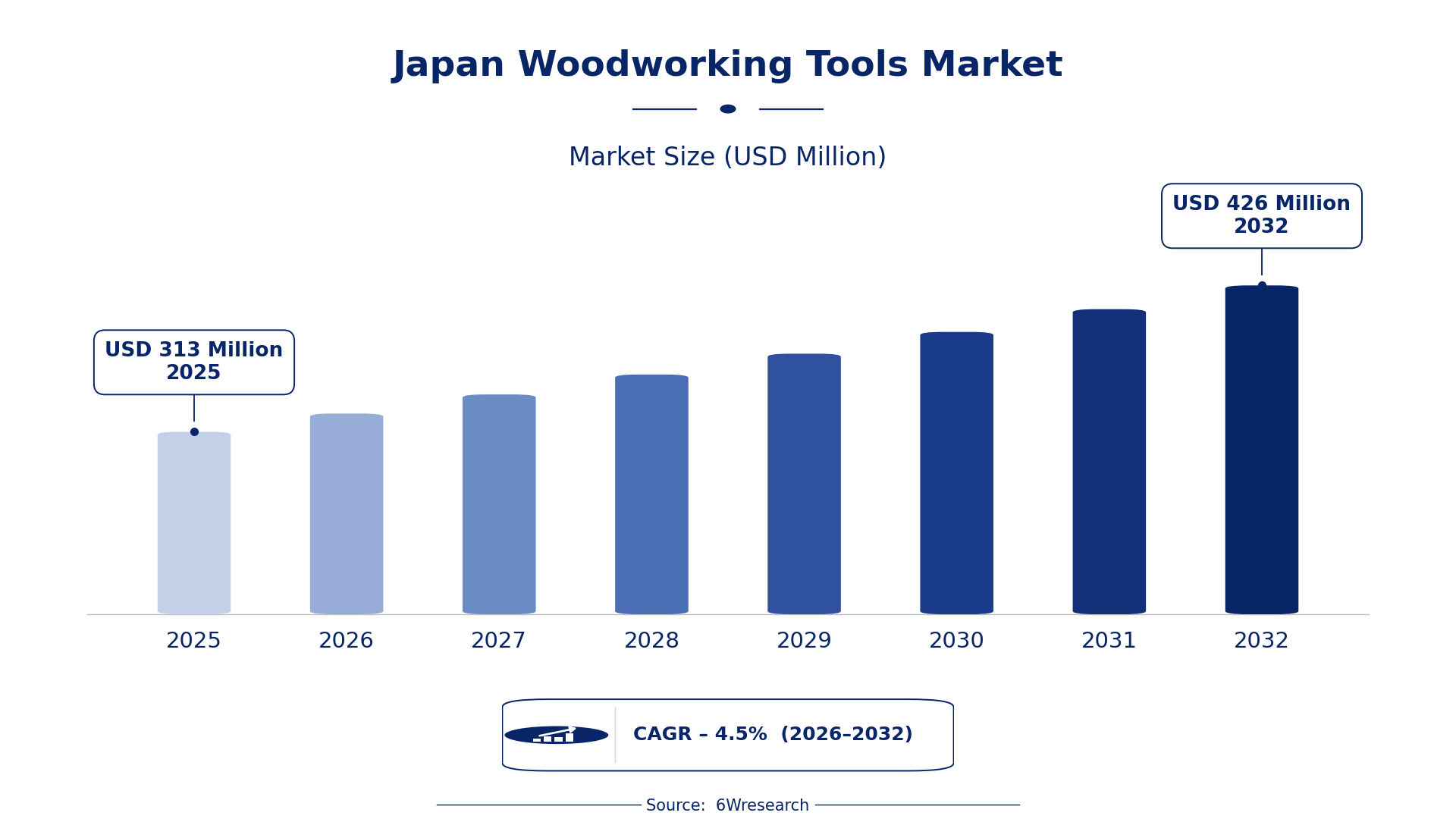
According to 6Wresearch internal database and industry insights, the Japan Woodworking Tools Market was valued at USD 313 Million in 2025 and is projected to reach USD 426 Million by 2032, growing at a CAGR of approximately 4.5% during 2026–2032.
Japan Woodworking Tools Market Highlights
| Report Metric | Details |
| Report Name | Japan Woodworking Tools Market (2026-2032) |
| Market Size 2025 | USD 313 Million |
| Market Size 2032 | USD 426 Million |
| Absolute Growth 2025–2032 | USD 113 Million |
| CAGR 2026–2032 | 4.5% |
| Peak Annual Growth | 6.3% in 2032 |
| Forecast Period | 2026–2032 |
| Historical Data | 2022–2025 |
| Base Year | 2025 |
| Leading Operations, 2025 | Power Tools (39% share) |
| Leading Product Type, 2025 | Bandsaw (36% share) |
| Leading End-Users, 2025 | Manufacturing/Industrial (33% share) |
| Leading Sales Channel, 2025 | Online (35% share) |
| Fastest-Growing Operations | Electric (6.2% CAGR) |
| Fastest-Growing Product Type | Routers (6.7% CAGR) |
| Fastest-Growing End-Users | DIY (6.0% CAGR) |
| Growing Sector | DIY |
| Key End Users | Manufacturers, Professionals, DIY Enthusiasts |
Japan Woodworking Tools Market Year-wise Growth Rate and Key Drivers (2022–2032)
This graph illustrates the annual growth rates of the market from 2022 to 2032, highlighting a steady upward trajectory and projected market expansion over the forecast period.
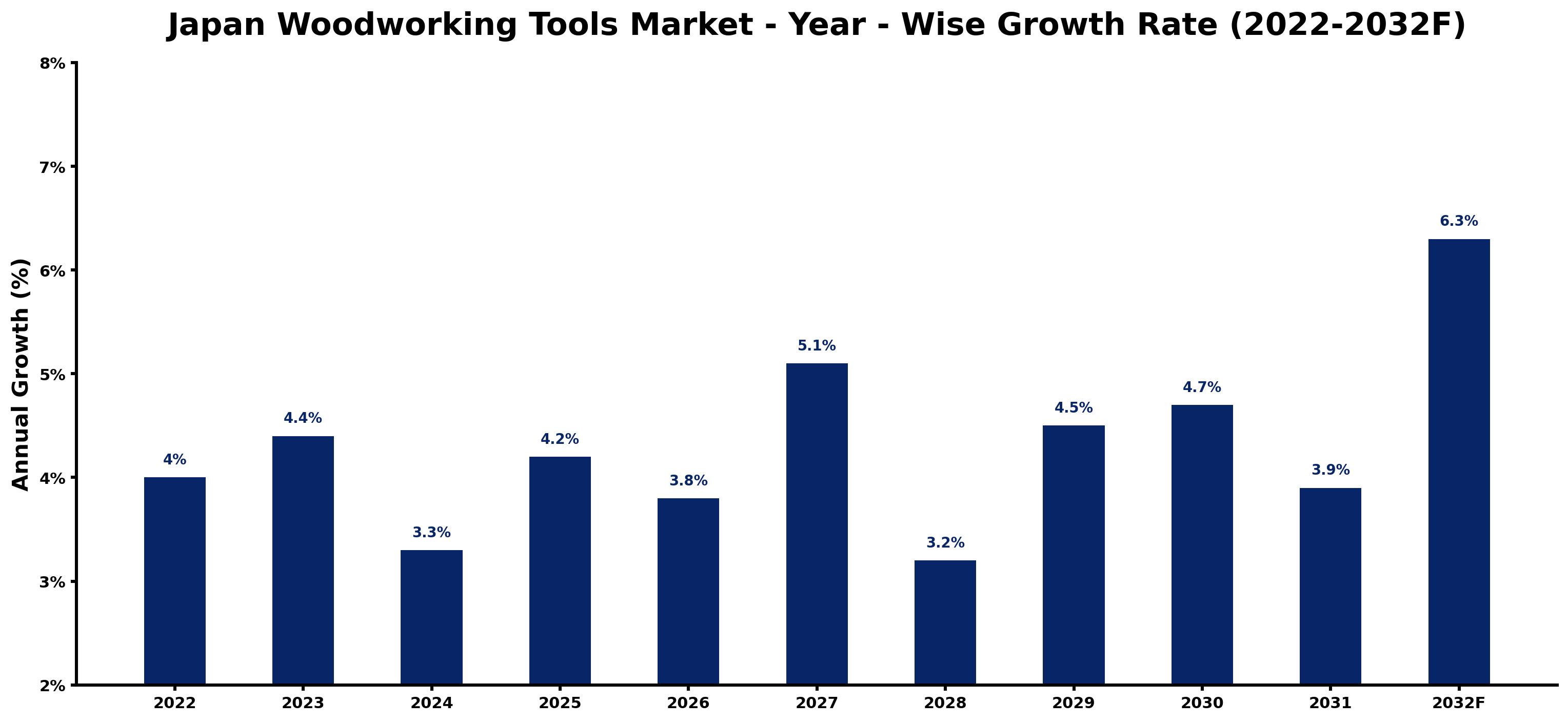
Below, each year's estimated growth is shown next to the factor that most influenced it.
| Year | Estimated Annual Growth (%) | Market Rationale |
| 2022 | 4.0 | The market experienced steady demand from domestic users and the DIY sector. |
| 2023 | 4.4 | Growth was driven by increased participation in the DIY market and tool innovations. |
| 2024 | 3.3 | A slowdown occurred as demand stabilised following the previous year's surge. |
| 2025 | 4.2 | Demand rose again, supported by a growing interest in woodworking craftsmanship. |
| 2026 | 3.8 | A slight slowdown is expected as competition intensifies among suppliers. |
| 2027 | 5.1 | Growth will accelerate due to rising orders from the manufacturing sector. |
| 2028 | 3.2 | A slowdown is projected as the market adjusts to previous highs in demand. |
| 2029 | 4.5 | Demand will increase as more households engage in DIY projects and renovations. |
| 2030 | 4.7 | Growth is expected to continue, supported by the popularity of electric tools among professionals. |
| 2031 | 3.9 | A slowdown will occur as market saturation begins to affect growth rates. |
| 2032 | 6.3 | Demand is projected to surge again, driven by new sustainable practices in woodworking. |
Note: Market size estimations and growth projections presented in this report are based on 6Wresearch's proprietary forecasting methodology, utilizing the latest available industry data, government publications, and primary research inputs.
Japan Woodworking Tools Market Synopsis
Woodworking tools are essential instruments for shaping, cutting, and assembling wood, commonly used in furniture making and construction. The Japan Woodworking Tools Market is expanding due to rising DIY participation and a strong manufacturing sector. Electric tools account for about 40% of sales, while the government promotes sustainable practices through recent initiatives. The Tokyo region remains a key manufacturing hub, supporting local supply and innovation, which further drives market growth.
Market Dynamics Impact Analysis (2026–2032)
| Factor | Type | Impact | Primary Segment Affected |
| Increasing DIY participation drives demand for woodworking tools among households. | Driver | High | Handheld |
| The rise in electric tool sales enhances efficiency for professional woodworkers. | Driver | High | Electric |
| The growing interest in sustainable woodworking practices presents opportunities for new product development. | Opportunity | High | Power Tools |
| The Tokyo International Woodworking Fair attracts buyers looking for innovative tools. | Opportunity | Medium | Bandsaw |
| Market saturation limits growth potential for certain tool types. | Restraint | High | Chisels |
| The average age of professional woodworkers indicates a potential skills gap in the industry. | Restraint | Medium | Hammers |
| Supply chain disruptions can delay tool availability for manufacturers. | Challenge | High | Power Tools |
| Technological advancements require constant investment to keep up with market trends. | Challenge | Medium | Electric |
Evaluation of Drivers in Japan Woodworking Tools Market (2026–2032)
Below are the drivers that matter most for revenue growth, with supporting evidence.
| Drivers | Primary Segment Affected | Why It Matters (Evidence) |
| Rising DIY participation boosts demand for woodworking tools among households. | Handheld | The DIY market in Japan has seen a steady increase, leading to more purchases of handheld tools. |
| Electric tools drive efficiency for professional woodworkers, increasing sales. | Electric | Electric tools represent about 40% of total woodworking tool sales, appealing to professionals. |
| The manufacturing sector's growth increases demand for woodworking tools. | Power Tools | The woodworking industry employs approximately 300,000 people, driving tool purchases for production. |
| Chisels and hammers remain top-selling tools, reflecting consistent demand. | Chisels | Chisels are fundamental for detailed carving, making them essential for woodworkers. |
| The Tokyo region's manufacturing hub supports local tool production and innovation. | Bandsaw | The Tokyo region is a major hub for woodworking tool manufacturing, enhancing supply. |
Behind the steady rise in orders sits a growing interest in woodworking among households, with the DIY market seeing increased participation. The average household in Japan spends around ¥10,000 on DIY tools annually, prompting more purchases. Electric tools, which account for about 40% of total sales, are particularly appealing to professionals for their efficiency. Additionally, the woodworking industry employs approximately 300,000 people, driving demand for various tools. This combination of factors is expected to sustain growth in the market.
Evaluation of Restraints in Japan Woodworking Tools Market
These are the pressures that could keep growth below its potential.
| Market Restraint | Primary Segment Affected | Why It Matters (Evidence) |
| Market saturation limits growth potential for certain tool types. | Chisels | As the market matures, demand for basic tools like chisels may plateau. |
| The average age of professional woodworkers indicates a potential skills gap. | Hammers | With an average age of 45, the workforce may face challenges in attracting younger talent. |
| Supply chain disruptions can delay tool availability for manufacturers. | Power Tools | Global supply chain issues may hinder timely access to essential components. |
| Technological advancements require constant investment to keep up with trends. | Electric | Manufacturers must invest in new technologies to remain competitive in the market. |
| Competition among suppliers can lead to price wars, affecting profitability. | Bandsaw | Intense competition may force suppliers to lower prices, impacting margins. |
Japan Woodworking Tools Market Challenges
Producers incur rising costs due to fierce competition from imported woodworking tools, which forces them to lower prices and reduces profit margins. This competition stems from Japan's vibrant DIY culture, where consumers increasingly opt for affordable alternatives, threatening local manufacturers' market share. Regulatory compliance with the JIS standard adds approximately ¥1,500 per tool for producers, delaying product launches and hindering innovation. Supply chain disruptions, particularly from natural disasters, can result in delays of up to three months for essential tools, impacting project timelines for buyers.
Trends in the Japan Woodworking Tools Market
Several trends are reshaping the Japan Woodworking Tools Market; the most important are set out below.
- Shift towards Electric Tools: A noticeable shift towards electric tools is occurring in woodworking, driven by their efficiency. In 2023, electric tools accounted for approximately 40% of total sales, appealing to both professionals and DIY enthusiasts.
- Increase in DIY Projects: The DIY market in Japan has seen a steady increase, with participation rising significantly. The average household spends around ¥10,000 on DIY tools annually, indicating a growing trend among consumers.
- Focus on Sustainable Practices: In 2023, the government launched a program to promote sustainable woodworking practices. This initiative is expected to encourage manufacturers to adopt eco-friendly techniques and materials, aligning with market trends.
- Growth of Online Sales Channels: Online sales of woodworking tools increased by 15% in the last year, reflecting changing consumer preferences. This trend is particularly strong in urban areas where convenience is paramount.
Investment Opportunities in the Japan Woodworking Tools Market
Below are the investment opportunities with the strongest case in the Japan Woodworking Tools Market.
- Investing in the Growing DIY Market: Now presents an ideal opportunity to invest in products aimed at the DIY market, which has seen increased participation. The average household spends around ¥10,000 annually on DIY tools, offering a substantial opportunity for suppliers.
- Sustainable Woodworking Practices: With the government's 2023 programme promoting sustainability, there is a burgeoning demand for eco-friendly tools. Manufacturers can leverage this trend by developing products that comply with these new standards and regulations.
- Expansion of Electric Tool Offerings: The increasing popularity of electric tools creates a demand for diverse product offerings. Suppliers can target professional woodworkers who depend on these tools for efficiency and precision, strengthening their market presence.
- Online Sales Growth: The rise in online sales channels offers suppliers opportunities to connect with a broader audience. Engaging with e-commerce platforms can help capture the expanding market of online shoppers, broadening their customer base.
Government Initiatives in the Japan Woodworking Tools Market
In 2023, the government initiated a programme to promote sustainable woodworking practices, building on existing regulations such as the Electrical Appliance and Material Safety Act. This initiative encourages manufacturers to adopt eco-friendly techniques and materials, ensuring compliance with safety standards and promoting innovation in the industry.
The Digital Agency, established in September 2021, spearheads government digital transformation efforts. It approves funding for training programmes aimed at developing woodworking craftsmanship, supporting the creation of skilled professionals in the industry.
Future Insight of the Japan Woodworking Tools Market
Households will increasingly embrace electric tools, projected to constitute 40% of total sales by 2032, driven by advancements in technology and battery efficiency. Government-funded training programmes will nurture skilled craftsmen, ensuring a workforce capable of meeting industry standards. Sustainable woodworking practices, supported by recent government initiatives, will transform production methods, boosting demand for eco-friendly tools. The Tokyo International Woodworking Fair in 2024 will showcase new innovations, promoting collaboration between suppliers and buyers to align with consumer preferences.
Market Segmentation Analysis
Japan Woodworking Tools Market report covers a detailed analysis of the following market segments:
By Operations – Power Tools Lead, Electric Expected to Grow Fastest
According to Ravi Bhandari, Research Head at 6Wresearch, Power Tools held 39% of the Japan Woodworking Tools Market by operations in 2025. Power tools dominate the market because they significantly enhance efficiency in woodworking tasks, making them essential for various applications. Their prevalent use in manufacturing settings, especially in the Tokyo region, reinforces their leading position. Over 2026–2032, Electric is expected to post the fastest growth, at a CAGR of 6.2%. Electric tools are experiencing rapid growth due to their widespread application for precision and speed in woodworking tasks. This trend is supported by a rising demand for efficient and high-quality tools among both professionals and hobbyists. Suppliers should focus on expanding their electric tool offerings to meet growing consumer demand.
By Product Type – Bandsaw Leads, Routers Expected to Grow Fastest
The largest product type category in 2025 was Bandsaw, at 36% of revenue. Bandsaws lead the market as they are essential for cutting large pieces of wood, making them indispensable for various woodworking projects. Their critical role in manufacturing and industrial applications reinforces their leading position in the sector. The quickest growth will come from Routers, forecast to expand at a CAGR of 6.7% between 2026 and 2032. Routers are the fastest-growing segment due to their significance in hollowing out areas in wood, catering to the rising trend of intricate woodworking designs. This growth is propelled by an increase in DIY projects that require precision tools. Buyers should consider investing in routers to take advantage of emerging woodworking trends.
By End-Users – Manufacturing/Industrial Leads, DIY Expected to Grow Fastest
With 33% of end-users revenue in 2025, Manufacturing/Industrial was the largest category. The manufacturing and industrial sector leads the market as it heavily relies on woodworking tools for production processes. With approximately 300,000 people employed in this sector, its dependence on these tools is clearly significant. DIY is projected to grow fastest, at a CAGR of 6.0% during 2026–2032. The DIY segment is growing quickly as more enthusiasts engage in personal projects, indicating a cultural shift towards home improvement. The steady increase in participation in the DIY market reflects this trend. Suppliers should tailor their marketing strategies to attract the expanding DIY customer base.
By Sales Channel – Online Leads and Records the Fastest Growth
Online took 35% of sales channel revenue in 2025, more than any other category. Online sales channels are at the forefront of the market as they are increasingly preferred for purchasing woodworking tools, offering convenience and a wider selection. This shift aligns with changing consumer behaviours, particularly in urban areas. Online is also forecast to expand faster than any other category, at a CAGR of 6.4% over 2026–2032. Online sales also represent the fastest-growing channel, propelled by the convenience and accessibility they offer to consumers. The surge in online shopping trends, especially in recent years, has solidified this growth trajectory. Suppliers must enhance their online presence to capture the growing e-commerce market.
Key Attractiveness of the Report
- 10 Years of Market Numbers
- Historical Data Starting from 2022 to 2025
- Base Year 2025
- Forecast Data until 2032
- Key Performance Indicators Impacting the Market
- Major Upcoming Developments and Projects
Key Highlights of the Report:
- Japan Woodworking Tools Market Outlook
- Market Size of Japan Woodworking Tools Market, 2025
- Forecast of Japan Woodworking Tools Market, 2032
- Historical Data and Forecast of Japan Woodworking Tools Revenues & Volume for the Period 2022-2032
- Japan Woodworking Tools Market Trend Evolution
- Japan Woodworking Tools Market Drivers and Challenges
- Japan Woodworking Tools Price Trends
- Japan Woodworking Tools Porter's Five Forces
- Japan Woodworking Tools Industry Life Cycle
- Historical Data and Forecast of Japan Woodworking Tools Market Revenues & Volume By Operations for the Period 2022-2032
- Historical Data and Forecast of Japan Woodworking Tools Market Revenues & Volume By Handheld for the Period 2022-2032
- Historical Data and Forecast of Japan Woodworking Tools Market Revenues & Volume By Power Tools for the Period 2022-2032
- Historical Data and Forecast of Japan Woodworking Tools Market Revenues & Volume By Electric for the Period 2022-2032
- Historical Data and Forecast of Japan Woodworking Tools Market Revenues & Volume By Pneumatic for the Period 2022-2032
- Historical Data and Forecast of Japan Woodworking Tools Market Revenues & Volume By Product Type for the Period 2022-2032
- Historical Data and Forecast of Japan Woodworking Tools Market Revenues & Volume By Bandsaw for the Period 2022-2032
- Historical Data and Forecast of Japan Woodworking Tools Market Revenues & Volume By Chisels for the Period 2022-2032
- Historical Data and Forecast of Japan Woodworking Tools Market Revenues & Volume By Hammers for the Period 2022-2032
- Historical Data and Forecast of Japan Woodworking Tools Market Revenues & Volume By Planes for the Period 2022-2032
- Historical Data and Forecast of Japan Woodworking Tools Market Revenues & Volume By Workbench for the Period 2022-2032
- Historical Data and Forecast of Japan Woodworking Tools Market Revenues & Volume By Sanders for the Period 2022-2032
- Historical Data and Forecast of Japan Woodworking Tools Market Revenues & Volume By Routers for the Period 2022-2032
- Historical Data and Forecast of Japan Woodworking Tools Market Revenues & Volume By Others for the Period 2022-2032
- Historical Data and Forecast of Japan Woodworking Tools Market Revenues & Volume By End-Users for the Period 2022-2032
- Historical Data and Forecast of Japan Woodworking Tools Market Revenues & Volume By Manufacturing/Industrial for the Period 2022-2032
- Historical Data and Forecast of Japan Woodworking Tools Market Revenues & Volume By Professional for the Period 2022-2032
- Historical Data and Forecast of Japan Woodworking Tools Market Revenues & Volume By DIY for the Period 2022-2032
- Historical Data and Forecast of Japan Woodworking Tools Market Revenues & Volume By Residential for the Period 2022-2032
- Historical Data and Forecast of Japan Woodworking Tools Market Revenues & Volume By Sales Channel for the Period 2022-2032
- Historical Data and Forecast of Japan Woodworking Tools Market Revenues & Volume By Offline for the Period 2022-2032
- Historical Data and Forecast of Japan Woodworking Tools Market Revenues & Volume By Authorized Distributor/Dealer for the Period 2022-2032
- Historical Data and Forecast of Japan Woodworking Tools Market Revenues & Volume By Mom and Pop Stores for the Period 2022-2032
- Historical Data and Forecast of Japan Woodworking Tools Market Revenues & Volume By Supermarkets/Hypermarkets for the Period 2022-2032
- Historical Data and Forecast of Japan Woodworking Tools Market Revenues & Volume By Online for the Period 2022-2032
- Japan Woodworking Tools Import Export Trade Statistics
- Market Opportunity Assessment By Operations
- Market Opportunity Assessment By Product Type
- Market Opportunity Assessment By End-Users
- Market Opportunity Assessment By Sales Channel
- Japan Woodworking Tools Top Companies Market Share
- Japan Woodworking Tools Competitive Benchmarking By Technical and Operational Parameters
- Japan Woodworking Tools Company Profiles
- Japan Woodworking Tools Key Strategic Recommendations
Market Covered
The study includes the following segmentation.
By Operations
- Handheld
- Power Tools
- Electric
- Pneumatic
By Product Type
- Bandsaw
- Chisels
- Hammers
- Planes
- Workbench
- Sanders
- Routers
- Others
By End-Users
- Manufacturing/Industrial
- Professional
- DIY
- Residential
By Sales Channel
- Offline
- Authorized Distributor/Dealer
- Mom and Pop Stores
- Supermarkets/Hypermarkets
- Online































