Japan Workspace as a Service (WaaS) Market Size & Growth Rate
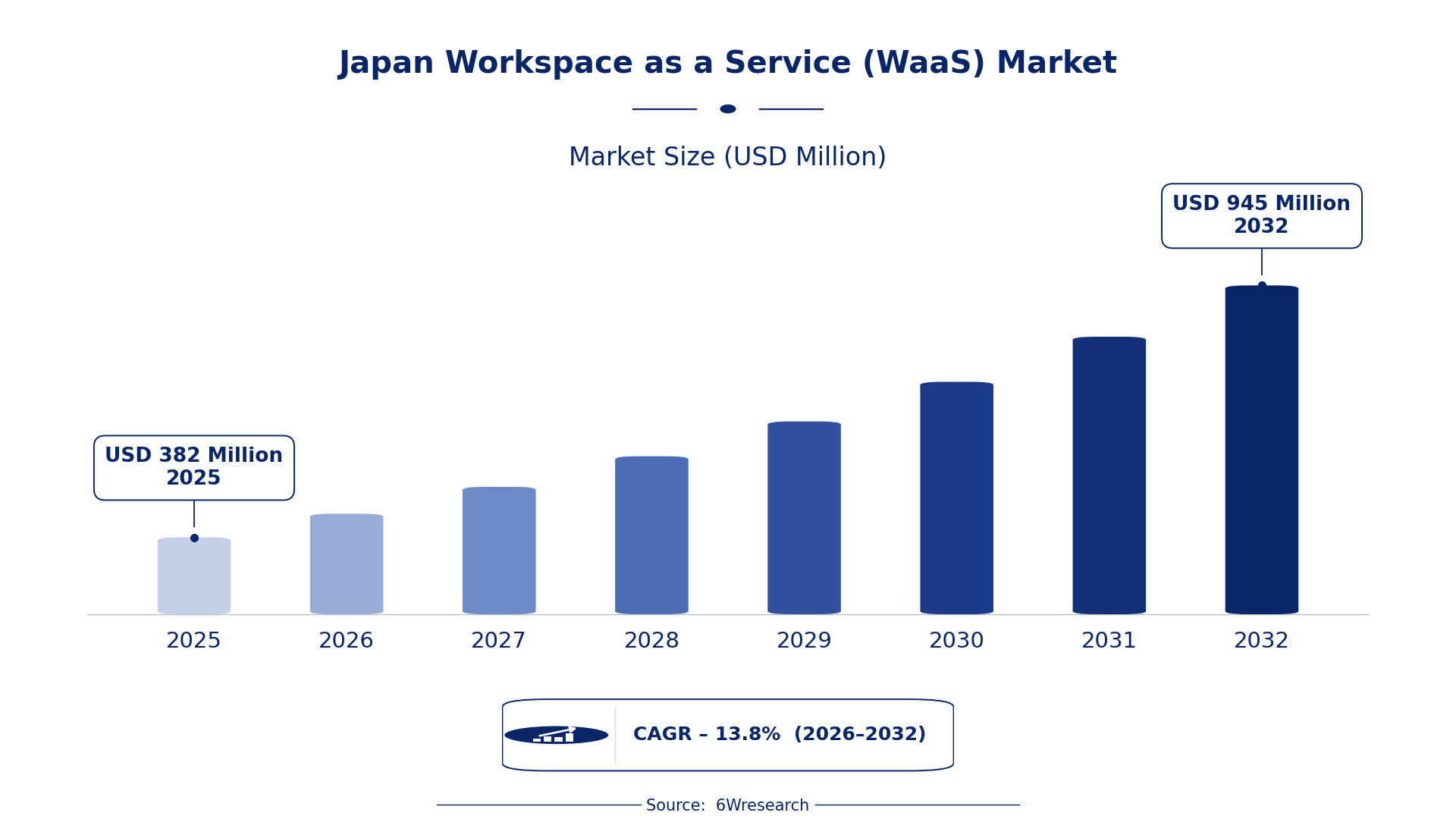
According to 6Wresearch internal database and industry insights, the Japan Workspace as a Service (WaaS) Market was valued at USD 382 Million in 2025 and is projected to reach USD 945 Million by 2032, growing at a CAGR of approximately 13.8% during 2026–2032.
Japan Workspace as a Service (WaaS) Market Highlights
| Report Metric | Details |
| Report Name | Japan Workspace as a Service (WaaS) Market (2026-2032) |
| Market Size 2025 | USD 382 Million |
| Market Size 2032 | USD 945 Million |
| Absolute Growth 2025–2032 | USD 563 Million |
| CAGR 2026–2032 | 13.8% |
| Peak Annual Growth | 16.9% in 2028 |
| Forecast Period | 2026–2032 |
| Historical Data | 2022–2025 |
| Base Year | 2025 |
| Leading Deployment, 2025 | Public (52% share) |
| Leading Solution and Service, 2025 | Desktop as a Service (DaaS) (55% share) |
| Leading End User, 2025 | Small and Medium Enterprises (65% share) |
| Fastest-Growing Deployment | Private (20.2% CAGR) |
| Fastest-Growing Solution and Service | Applicationas a Service (AaaS) (16.4% CAGR) |
| Fastest-Growing End User | Large Enterprises (17.7% CAGR) |
| Growing Sector | IT Services |
| Key End Users | Small and Medium Enterprises, Large Enterprises, Healthcare Providers |
Japan Workspace as a Service (WaaS) Market Year-wise Growth Rate and Key Drivers (2022–2032)
This graph illustrates the annual growth rates of the market from 2022 to 2032, highlighting a steady upward trajectory and projected market expansion over the forecast period.
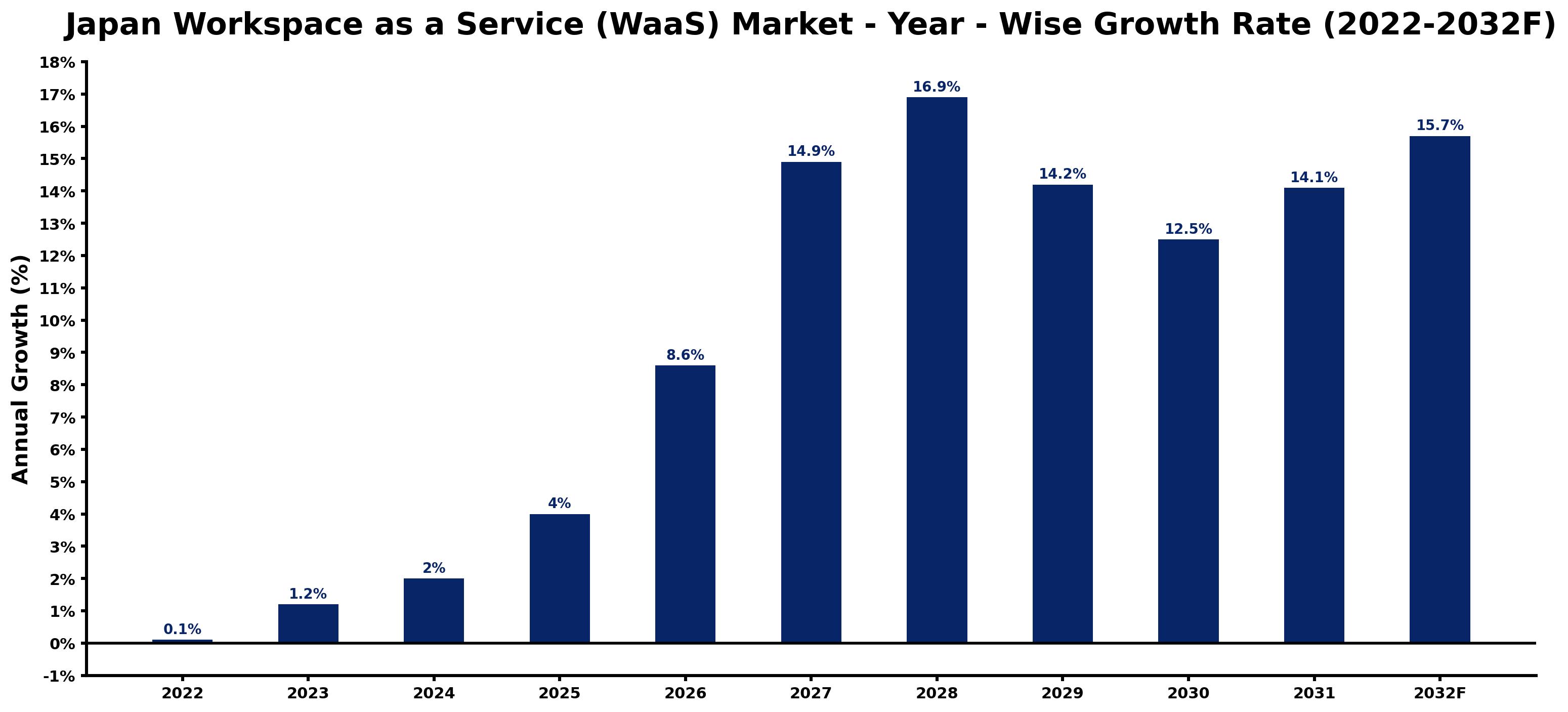
Annual growth estimates for each year appear below with the principal reason behind them, explaining the shifts that set the pace of the market.
| Year | Estimated Annual Growth (%) | Market Rationale |
| 2022 | 0.1 | The remote work population was approximately 30%, indicating a growing acceptance of telecommuting. |
| 2023 | 1.2 | Adoption of WaaS solutions increased as businesses sought to improve remote work capabilities. |
| 2024 | 2.0 | Demand continued to rise as more companies recognised the advantages of virtual workspaces. |
| 2025 | 4.0 | The market peaked historically as telecommuting initiatives gained traction across various sectors. |
| 2026 | 8.6 | Increasing investments in digital infrastructure will drive WaaS adoption further. |
| 2027 | 14.9 | The trend towards hybrid work models is anticipated to fuel demand for WaaS solutions. |
| 2028 | 16.9 | The market is projected to peak in growth as major urban centres expand digital services. |
| 2029 | 14.2 | Growth is expected to slow slightly as the market matures and competition intensifies. |
| 2030 | 12.5 | A steady demand for WaaS will persist as businesses adapt to ongoing digital transformation. |
| 2031 | 14.1 | The market is likely to see renewed interest as new technologies emerge to support remote work. |
| 2032 | 15.7 | Continued investment in digital infrastructure will sustain growth in WaaS solutions. |
Note: Market size estimations and growth projections presented in this report are based on 6Wresearch's proprietary forecasting methodology, utilizing the latest available industry data, government publications, and primary research inputs.
Japan Workspace as a Service (WaaS) Market Synopsis
Workspace as a Service (WaaS) is a cloud computing model providing virtualised workspaces via remote servers, facilitating remote work, collaboration, and cost reduction. In Japan, the Japan Workspace as a Service (WaaS) Market is expanding due to a 30% remote work population and a government initiative aiming for a 50% increase in telecommuting by 2025. The Tokyo Metropolitan Government's digital innovation strategy further supports WaaS adoption, driving demand from private enterprises and small to medium-sized businesses seeking efficient IT solutions.
Market Dynamics Impact Analysis (2026–2032)
| Factor | Type | Impact | Primary Segment Affected |
| Growing remote work population | Driver | High | Desktop as a Service (DaaS) |
| Government initiatives promoting digital transformation | Driver | High | Public |
| Increasing adoption of WaaS in healthcare | Opportunity | Medium | Public |
| Rising demand from small and medium enterprises | Opportunity | High | Small and Medium Enterprises |
| Limited adoption in the public sector due to budget constraints | Restraint | High | Public |
| Concerns over data security and compliance regulations | Restraint | Medium | Private |
| Competition from traditional IT infrastructure providers | Challenge | High | Public |
| Need for skilled personnel to manage WaaS solutions | Challenge | Medium | Public |
Evaluation of Drivers in Japan Workspace as a Service (WaaS) Market (2026–2032)
Below are the drivers that matter most for revenue growth, with supporting evidence.
| Drivers | Primary Segment Affected | Why It Matters (Evidence) |
| Increasing remote work adoption | Desktop as a Service (DaaS) | Approximately 30% of the workforce is now remote, leading to higher demand for virtual desktops. |
| Government digital transformation initiatives | Small and Medium Enterprises | The number of SMEs adopting WaaS solutions increased by 25% last year, driving demand. |
| Healthcare sector's need for remote patient management | Public | WaaS solutions are increasingly used in healthcare, improving remote patient management capabilities. |
| Growth of tech startups in urban areas | Desktop as a Service (DaaS) | The number of tech startups in Tokyo is driving WaaS adoption, encouraging innovation. |
| Rising demand for flexible work solutions | Hybrid | The shift towards hybrid work models is increasing the need for adaptable WaaS offerings. |
Demand is primarily driven by the growing adoption of remote work, with around 30% of the workforce now telecommuting, resulting in increased interest in virtual workspace solutions. The healthcare sector is increasingly utilising WaaS for remote patient management, reflecting a notable trend in this area. The number of small and medium enterprises adopting WaaS solutions surged by 25% last year, indicating a strong market shift towards cost-effective IT options. The rise of tech startups in Tokyo is stimulating innovation and demand for WaaS, particularly in urban environments.
Evaluation of Restraints in Japan Workspace as a Service (WaaS) Market
Below are the constraints most often cited by buyers and suppliers, with the segment each affects.
| Market Restraint | Primary Segment Affected | Why It Matters (Evidence) |
| Limited adoption in the public sector due to budget constraints | Public | Budget limitations restrict public sector investment in WaaS, hindering overall growth. |
| Concerns over data security and compliance regulations | Private | Data security issues deter some private enterprises from fully embracing WaaS solutions. |
| High competition from traditional IT infrastructure providers | Public | Competition from established IT providers limits WaaS market penetration in certain sectors. |
| Need for skilled personnel to manage WaaS solutions | Public | A shortage of skilled professionals can delay WaaS implementation and adoption. |
| Resistance to change from traditional work practices | Public | Some organisations are hesitant to shift from conventional IT setups to WaaS models. |
Japan Workspace as a Service (WaaS) Market Challenges
Limited technology infrastructure hampers WaaS adoption in Japan. Many rural areas lack reliable high-speed internet, delaying remote work implementation for producers and affecting 30% of potential users. Regulatory hurdles complicate WaaS deployment; stringent data protection laws can slow down service rollout for buyers, leading to a 15% increase in time to market. Compliance with standards like ISO/IEC 27001 raises operational expenses for providers, resulting in a 20% cost increase for end-users. Growing demand for WaaS solutions has outpaced supply, causing delays in service availability for businesses seeking to transition to remote work environments.
Trends in the Japan Workspace as a Service (WaaS) Market
The shifts below are changing how Japan Workspace as a Service (WaaS) Market products are bought and supplied.
- Shift in Adoption from Large Enterprises to SMEs: Small and medium enterprises are increasingly adopting WaaS solutions, driven by the need for cost-effective IT infrastructure. In 2023, the number of SMEs using WaaS increased by 25%, highlighting this trend's significance.
- Transition from On-Premise to Cloud Solutions: The move from on-premise IT solutions to cloud-based WaaS is gaining traction, particularly in urban areas. The Tokyo Metropolitan Government's digital innovation strategy for 2023-2025 supports this shift, promoting cloud adoption.
- Healthcare Sector Prioritising Remote Management: The healthcare sector is prioritising WaaS solutions for remote patient management, reflecting a growing trend. In 2023, WaaS solutions were increasingly utilised in healthcare, demonstrating their importance in this field.
- Emergence of Hybrid Work Models: The rise of hybrid work models is reshaping WaaS adoption, as companies seek flexible solutions. The Japanese government's aim to increase telecommuting by 50% by 2025 supports this emerging trend.
Investment Opportunities in the Japan Workspace as a Service (WaaS) Market
The following opportunities in the Japan Workspace as a Service (WaaS) Market pair current demand with a clear way in.
- Small and Medium Enterprises Seeking Cost-Effective Solutions: With a 25% increase in SMEs adopting WaaS, there is a clear opportunity to provide tailored solutions. Collaborating with industry associations can facilitate market entry and improve offerings.
- Urban Areas Driving Demand for Digital Infrastructure: Tokyo's tech environment presents a significant opportunity for WaaS providers, with a projected growth in demand. Investing in partnerships with local startups can strengthen market presence.
- Healthcare Sector Expanding Remote Services: The healthcare sector's growing need for remote management solutions presents a lucrative opportunity. Suppliers can enter by offering specialised WaaS solutions tailored for healthcare providers.
- Government Investment in Digital Infrastructure: The Japanese government allocated 10 billion yen for digital infrastructure improvements in 2023. This funding creates opportunities for WaaS providers to engage with public sector projects.
Government Initiatives in the Japan Workspace as a Service (WaaS) Market
The Industrial Standardization Act, amended in 2019, governs product standards, influencing WaaS providers to comply with JIS standards. The Act against Unjustifiable Premiums and Misleading Representations ensures transparency in advertising, affecting how WaaS solutions are marketed to consumers.
Various digital transformation initiatives overseen by the Ministry of Internal Affairs and Communications aim to improve telecommuting and digital infrastructure. These initiatives provide funding and support for WaaS adoption in both public and private sectors.
Future Insight of the Japan Workspace as a Service (WaaS) Market
The launch of digital innovation strategies by local governments will reshape workspace environments by 2032. The Japanese government plans to invest 10 billion yen in digital infrastructure, improving connectivity for remote workers. Telecommuting initiatives will support a 50% rise in remote work participation by 2025. As SMEs increasingly adopt WaaS solutions, the market will shift towards customised offerings that cater to specific industry needs, particularly in healthcare and technology sectors.
Market Segmentation Analysis
Japan Workspace as a Service (WaaS) Market report covers a detailed analysis of the following market segments:
By Deployment – Public Leads, Private Expected to Grow Fastest
According to Sumit Sagar, AM at 6Wresearch, Public accounted for 52% of the market by deployment in 2025. The public sector in Japan shows limited adoption of WaaS due to budget constraints, which hampers investment in cloud services. In contrast, private enterprises dominate the market, utilising WaaS for enhanced security and control, particularly in sectors such as finance and technology. Private is set to record the highest CAGR in this split, 20.2% over 2026–2032. The private deployment segment is witnessing rapid growth as companies increasingly seek secure environments for their operations. This trend is amplified by the rise in telecommuting, leading to a notable increase in the number of SMEs adopting WaaS solutions. Suppliers should focus on developing security features to meet the needs of private enterprises.
By Solution and Service – Desktop as a Service (DaaS) Leads, Applicationas a Service (AaaS) Expected to Grow Fastest
With 55% of solution and service revenue in 2025, Desktop as a Service (DaaS) was the largest category. Desktop as a Service (DaaS) holds the largest share as it provides users with virtual desktops, which are widely adopted for remote work. This model allows organisations to efficiently manage their IT resources while supporting a growing remote workforce. Over 2026–2032, Applicationas a Service (AaaS) is expected to post the fastest growth, at a CAGR of 16.4%. Application as a Service (AaaS) is growing quickly as businesses seek to streamline application delivery and improve collaboration among remote teams. The increasing demand for flexible and scalable application solutions is propelling this segment forward. Providers must prioritise the development of AaaS offerings to meet the rising demand for application flexibility.
By End User – Small and Medium Enterprises Lead, Large Enterprises Expected to Grow Fastest
In 2025, Small and Medium Enterprises led the end user split with a 65% share. Small and Medium Enterprises are the leading users of WaaS, leveraging it for cost-effective IT solutions that enable competitiveness. The increase in SMEs adopting WaaS underscores the demand for accessible technology that meets their specific operational needs. Large Enterprises are projected to grow fastest, at a CAGR of 17.7% during 2026–2032. Large Enterprises are experiencing rapid growth in WaaS adoption to benefit from its scalability and efficiency, which optimises their operations. This trend is driven by the necessity for robust IT infrastructure to support extensive remote work initiatives. Vendors should tailor their WaaS offerings to address the specific requirements of large enterprises.
Key Attractiveness of the Report
- 10 Years of Market Numbers
- Historical Data Starting from 2022 to 2025
- Base Year 2025
- Forecast Data until 2032
- Key Performance Indicators Impacting the Market
- Major Upcoming Developments and Projects
Key Highlights of the Report:
- Japan Workspace as a Service (WaaS) Market Outlook
- Market Size of Japan Workspace as a Service (WaaS) Market, 2025
- Forecast of Japan Workspace as a Service (WaaS) Market, 2032
- Historical Data and Forecast of Japan Workspace as a Service (WaaS) Revenues & Volume for the Period 2022-2032
- Japan Workspace as a Service (WaaS) Market Trend Evolution
- Japan Workspace as a Service (WaaS) Market Drivers and Challenges
- Japan Workspace as a Service (WaaS) Price Trends
- Japan Workspace as a Service (WaaS) Porter's Five Forces
- Japan Workspace as a Service (WaaS) Industry Life Cycle
- Historical Data and Forecast of Japan Workspace as a Service (WaaS) Market Revenues & Volume By Deployment for the Period 2022-2032
- Historical Data and Forecast of Japan Workspace as a Service (WaaS) Market Revenues & Volume By Public for the Period 2022-2032
- Historical Data and Forecast of Japan Workspace as a Service (WaaS) Market Revenues & Volume By Private for the Period 2022-2032
- Historical Data and Forecast of Japan Workspace as a Service (WaaS) Market Revenues & Volume By Hybrid for the Period 2022-2032
- Historical Data and Forecast of Japan Workspace as a Service (WaaS) Market Revenues & Volume By Solution and Service for the Period 2022-2032
- Historical Data and Forecast of Japan Workspace as a Service (WaaS) Market Revenues & Volume By Desktop as a Service (DaaS) for the Period 2022-2032
- Historical Data and Forecast of Japan Workspace as a Service (WaaS) Market Revenues & Volume By Applicationas a Service (AaaS) for the Period 2022-2032
- Historical Data and Forecast of Japan Workspace as a Service (WaaS) Market Revenues & Volume By End User for the Period 2022-2032
- Historical Data and Forecast of Japan Workspace as a Service (WaaS) Market Revenues & Volume By Small and Medium Enterprises for the Period 2022-2032
- Historical Data and Forecast of Japan Workspace as a Service (WaaS) Market Revenues & Volume By Large Enterprises for the Period 2022-2032
- Historical Data and Forecast of Japan Workspace as a Service (WaaS) Market Revenues & Volume By End User for the Period 2022-2032
- Historical Data and Forecast of Japan Workspace as a Service (WaaS) Market Revenues & Volume By BFSI for the Period 2022-2032
- Historical Data and Forecast of Japan Workspace as a Service (WaaS) Market Revenues & Volume By Government for the Period 2022-2032
- Historical Data and Forecast of Japan Workspace as a Service (WaaS) Market Revenues & Volume By Healthcare for the Period 2022-2032
- Historical Data and Forecast of Japan Workspace as a Service (WaaS) Market Revenues & Volume By IT & Telecom for the Period 2022-2032
- Historical Data and Forecast of Japan Workspace as a Service (WaaS) Market Revenues & Volume By Other End-users for the Period 2022-2032
- Japan Workspace as a Service (WaaS) Import Export Trade Statistics
- Market Opportunity Assessment By Deployment
- Market Opportunity Assessment By Solution and Service
- Market Opportunity Assessment By End User
- Market Opportunity Assessment By End User
- Japan Workspace as a Service (WaaS) Top Companies Market Share
- Japan Workspace as a Service (WaaS) Competitive Benchmarking By Technical and Operational Parameters
- Japan Workspace as a Service (WaaS) Company Profiles
- Japan Workspace as a Service (WaaS) Key Strategic Recommendations
Market Covered
The following segment groups are covered in the report.
By Deployment
- Public
- Private
- Hybrid
By Solution and Service
- Desktop as a Service (DaaS)
- Applicationas a Service (AaaS)
By End User
- Small and Medium Enterprises
- Large Enterprises































