Japan Zinc Oxide Market Size & Growth Rate
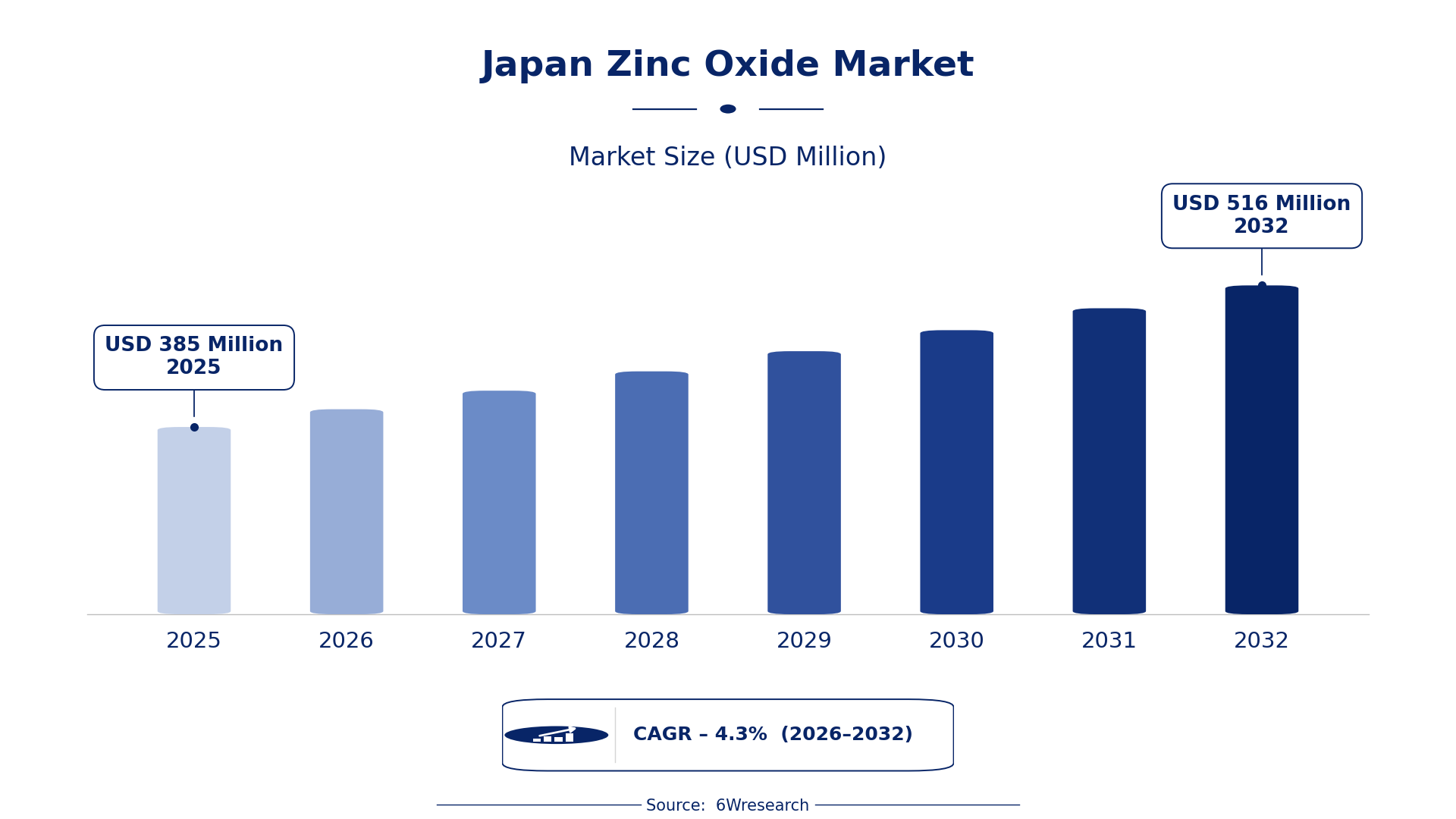
According to 6Wresearch internal database and industry insights, the Japan Zinc Oxide Market was valued at USD 385 Million in 2025 and is projected to reach USD 516 Million by 2032, growing at a CAGR of approximately 4.3% during 2026–2032.
Japan Zinc Oxide Market Highlights
| Report Metric | Details |
| Report Name | Japan Zinc Oxide Market (2026-2032) |
| Market Size 2025 | USD 385 Million |
| Market Size 2032 | USD 516 Million |
| Absolute Growth 2025–2032 | USD 131 Million |
| CAGR 2026–2032 | 4.3% |
| Peak Annual Growth | 5.3% in 2032 |
| Forecast Period | 2026–2032 |
| Historical Data | 2022–2025 |
| Base Year | 2025 |
| Leading Process, 2025 | Indirect Process (French Process) (49% share) |
| Leading Application, 2025 | Rubber & Tyres (42% share) |
| Fastest-Growing Process | Direct Process (American Process) (6.0% CAGR) |
| Fastest-Growing Application | Ceramics & Glass (6.1% CAGR) |
| Growing Sector | Rubber Manufacturing |
| Key End Users | Rubber manufacturers, cosmetic producers, pharmaceutical companies, ceramics manufacturers |
Japan Zinc Oxide Market Year-wise Growth Rate and Key Drivers (2022–2032)
This graph illustrates the annual growth rates of the market from 2022 to 2032, highlighting a steady upward trajectory and projected market expansion over the forecast period.
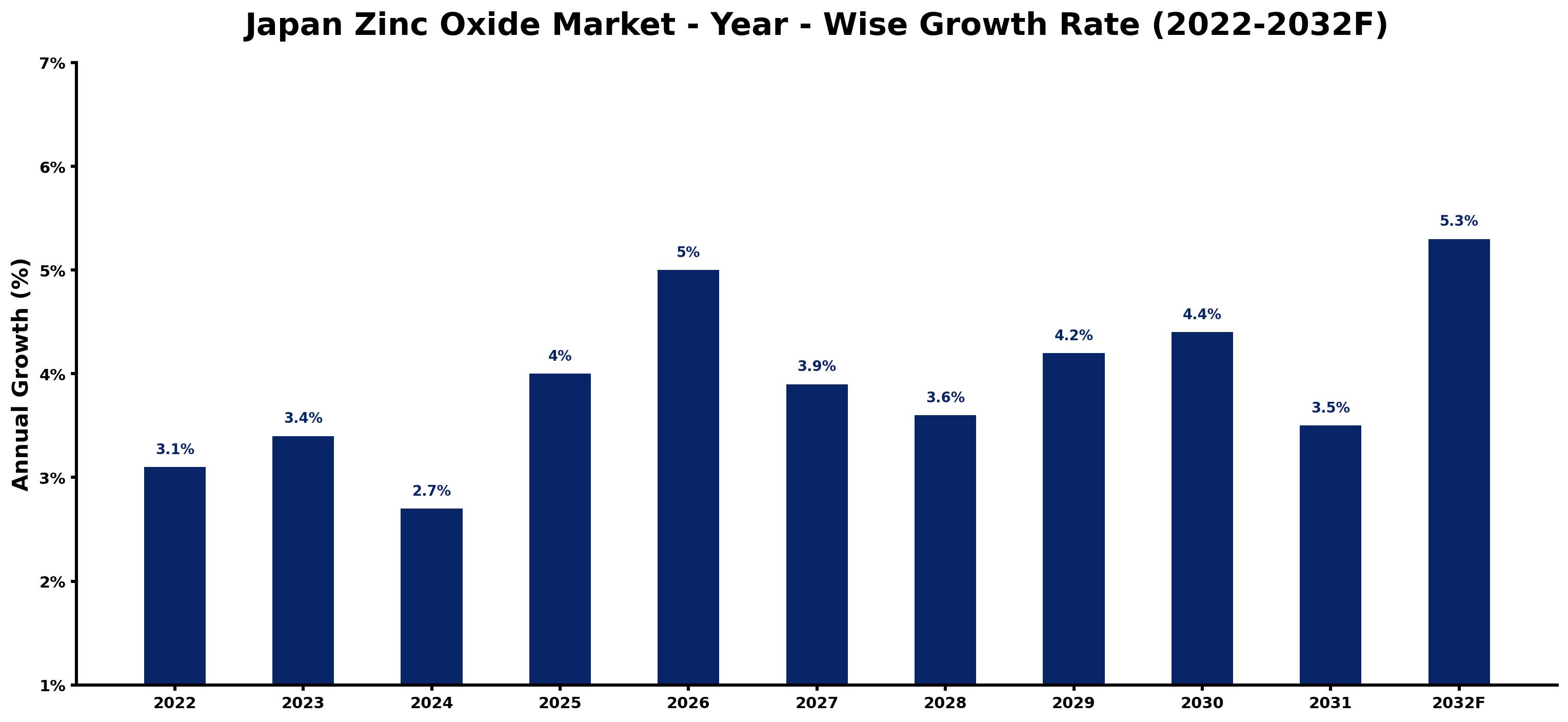
The yearly estimates that follow link every growth rate to its principal driver, so readers can see why the pace changed in each period.
| Year | Estimated Annual Growth (%) | Market Rationale |
| 2022 | 3.1 | The market showed steady growth as demand from the rubber sector increased. |
| 2023 | 3.4 | Growth accelerated due to rising production in the rubber and coatings industries. |
| 2024 | 2.7 | Growth slowed as the market adjusted to previous high demand levels. |
| 2025 | 4.0 | Demand surged as the rubber industry expanded, reaching new heights. |
| 2026 | 5.0 | The market is expected to continue growing rapidly, driven by increased production capacity. |
| 2027 | 3.9 | Growth is projected to slow as the market stabilises after a period of rapid expansion. |
| 2028 | 3.6 | Demand will continue to moderate as the market adjusts to earlier peaks. |
| 2029 | 4.2 | Growth is expected to pick up again as the rubber sector experiences renewed demand. |
| 2030 | 4.4 | The market will maintain momentum with steady demand from the ceramics industry. |
| 2031 | 3.5 | Growth is projected to slow as the market begins to normalise after previous peaks. |
| 2032 | 5.3 | Demand will surge again as the rubber industry reaches new operational standards. |
Note: Market size estimations and growth projections presented in this report are based on 6Wresearch's proprietary forecasting methodology, utilizing the latest available industry data, government publications, and primary research inputs.
Japan Zinc Oxide Market Synopsis
Zinc oxide is an inorganic compound widely used as a white pigment and in various industrial applications, including rubber manufacturing, ceramics, and cosmetics. The Japan Zinc Oxide Market is expanding due to increased demand from the rubber industry, valued at approximately 1 trillion yen and relying on zinc oxide for over 70% of its products. The cosmetics market, projected to reach 4 trillion yen by 2025, further drives demand for zinc oxide as a key ingredient in sunscreens and ointments.
Market Dynamics Impact Analysis (2026–2032)
| Factor | Type | Impact | Primary Segment Affected |
| Increased production in the rubber sector | Driver | High | Rubber & Tyres |
| Growing demand for cosmetics and pharmaceuticals | Driver | High | Pharmaceutical & Cosmetics |
| Expansion of the ceramics industry in Aichi Prefecture | Opportunity | Medium | Ceramics & Glass |
| Rising investment in sustainable agriculture practices | Opportunity | Medium | Agriculture |
| Fluctuations in raw material prices | Restraint | High | Indirect Process (French Process) |
| Regulatory compliance costs for manufacturers | Restraint | Medium | Indirect Process (French Process) |
| Technological advancements in alternative materials | Challenge | High | Indirect Process (French Process) |
| Competition from imported zinc oxide products | Challenge | Medium | Indirect Process (French Process) |
Evaluation of Drivers in Japan Zinc Oxide Market (2026–2032)
Demand rests on the following drivers, each shown with the segment it touches most.
| Drivers | Primary Segment Affected | Why It Matters (Evidence) |
| Increased production capacity in the rubber industry | Rubber & Tyres | The rubber industry in Japan is valued at approximately 1 trillion yen, driving demand for zinc oxide. |
| Rising demand for sunscreens and ointments | Pharmaceutical & Cosmetics | Zinc oxide is used in over 50% of sunscreen products in Japan, boosting its market presence. |
| Expansion of ceramics production in Aichi Prefecture | Ceramics & Glass | The ceramics industry relies on zinc oxide for glazes, increasing its demand significantly. |
| Growing agricultural sector supported by micronutrient use | Agriculture | Government programs promote the use of zinc oxide in fertilizers, increasing its adoption in farming. |
| Demand for corrosion-resistant paints and coatings | Paints & Coatings | Zinc oxide is a key component in automotive coatings, driving its market growth and applications. |
Behind the steady rise in orders sits the growth of the rubber industry, valued at approximately 1 trillion yen, which relies on zinc oxide for over 70% of its products. The pharmaceutical sector, with a market size of 9 trillion yen, increasingly incorporates zinc oxide in sunscreens, accounting for over 50% of products. In Aichi Prefecture, the ceramics industry utilises zinc oxide for glazes, further increasing demand. The need for corrosion-resistant paints in automotive applications also contributes to growth in the zinc oxide market.
Evaluation of Restraints in Japan Zinc Oxide Market
The main factors holding the market back are set out below.
| Market Restraint | Primary Segment Affected | Why It Matters (Evidence) |
| Fluctuations in the prices of raw materials | Indirect Process (French Process) | Variability in raw material costs can impact production budgets and pricing strategies for manufacturers. |
| High compliance costs due to regulations | Indirect Process (French Process) | Manufacturers face expenses to meet quality standards like ISO 9001 and JIS, increasing operational costs. |
| Limited production methods for high-purity zinc oxide | Indirect Process (French Process) | The indirect process is costly and time-consuming, limiting production capacity and affecting supply. |
| Competition from lower-cost imported zinc oxide | Indirect Process (French Process) | Imported products can undermine local manufacturers' pricing strategies and market share, impacting sales. |
| Dependence on a few key end-use sectors | Rubber & Tyres | A downturn in the rubber industry could affect zinc oxide demand, leading to reduced sales. |
Japan Zinc Oxide Market Challenges
Producers in Japan encounter challenges with outdated production technology, which raises operational costs and limits output efficiency, particularly affecting the rubber industry that relies heavily on zinc oxide. Skills shortages hinder the workforce's ability to adopt modern production techniques, causing delays in product availability for pharmaceutical companies that depend on timely supplies. Regulatory compliance with ISO 9001 and JIS standards complicates manufacturing processes, increasing costs for producers and ultimately raising prices for buyers in the cosmetics sector. Buyers in the rubber market face unpredictable demand fluctuations, leading to excess inventory and cash flow issues, especially as the industry is valued at approximately 1 trillion yen.
Trends in the Japan Zinc Oxide Market
The following changes are redrawing the Japan Zinc Oxide Market.
- Shift towards Sustainable Agriculture Practices: The Japanese government has initiated programs to promote sustainable agriculture using micronutrients, including zinc oxide. This shift is expected to increase the adoption of zinc oxide in fertilizers, boosting its market presence.
- Growing Use of Zinc Oxide in Sunscreens: Over 50% of sunscreen products in Japan contain zinc oxide, reflecting a trend towards skin protection. The cosmetics market is anticipated to reach 4 trillion yen by 2025, further driving demand.
- Increased Demand for Ceramics and Glass Products: The ceramics industry in Aichi Prefecture is experiencing a surge in demand for zinc oxide as a glaze and opacifier. This trend is likely to grow as the ceramics market expands.
- Rising Adoption of JIS Standards: The implementation of JIS standards for zinc oxide quality is becoming more prevalent, ensuring higher quality products. This trend supports manufacturers in meeting consumer expectations and regulatory requirements.
Investment Opportunities in the Japan Zinc Oxide Market
Where to invest in the Japan Zinc Oxide Market: the main openings are set out below.
- Gap in High-Purity Zinc Oxide Production: With Japan producing 100,000 tons of zinc oxide in 2022, there exists a gap for high-purity production. Investing in advanced production technologies can cater to the pharmaceutical sector's needs.
- Growing Demand from the Rubber Industry: The rubber industry, valued at approximately 1 trillion yen, presents a strong opportunity for suppliers of zinc oxide. Collaborating with local manufacturers can facilitate market entry and growth.
- Expansion of Ceramics Production Facilities: Aichi Prefecture's ceramics industry is expanding, creating demand for zinc oxide as a glaze. Suppliers can target this region to meet the growing needs of manufacturers.
- Investment in Sustainable Agricultural Practices: The government's push for sustainable agriculture creates opportunities for zinc oxide suppliers in fertilizers. Engaging with agricultural cooperatives can enhance market penetration.
Government Initiatives in the Japan Zinc Oxide Market
The Chemical Substances Control Law, enacted in 1973, mandates the evaluation and regulation of chemical substances. This law ensures that manufacturers of zinc oxide comply with safety and environmental standards, improving product quality and safety. The law has led to the evaluation of over 1,000 chemical substances, ensuring compliance and enhancing safety measures for producers.
The Ministry of Health, Labour and Welfare (MHLW) oversees the implementation of the Standards for Cosmetics, established in 2000. This agency ensures that zinc oxide used in cosmetics meets strict quality standards, protecting consumer health. The MHLW has approved over 500 cosmetic products containing zinc oxide, ensuring compliance with safety regulations.
Future Insight of the Japan Zinc Oxide Market
Automation and advanced production methods will reshape zinc oxide demand by 2032, enabling suppliers to meet the growing needs of the cosmetics market, projected to reach 4 trillion yen by 2025. Enhanced quality standards will improve product consistency, benefiting buyers in the pharmaceutical sector. Government initiatives promoting sustainable practices will encourage greater use of micronutrients, creating new opportunities for suppliers. The integration of advanced applications in automotive coatings will further expand market potential.
Market Segmentation Analysis
Japan Zinc Oxide Market report covers a detailed analysis of the following market segments:
By Process – Indirect Process (French Process) Leads, Direct Process (American Process) Expected to Grow Fastest
According to Sumit Sagar, AM at 6Wresearch, Indirect Process (French Process) held 49% of the Japan Zinc Oxide Market by process in 2025. The indirect process is favoured for producing high-purity zinc oxide, essential for applications in sectors like pharmaceuticals and cosmetics. Its widespread adoption among manufacturers ensures a consistent supply to meet the demands of these critical industries. Direct Process (American Process) is set to record the highest CAGR in this split, 6.0% over 2026–2032. The direct process is experiencing rapid growth due to its efficiency in bulk production, which aligns with the increasing demand from the rubber and coatings sectors. As these industries expand, the direct process will likely capture a larger market share. Suppliers must adapt to the rising preference for the direct process to remain competitive in a growing industrial market.
By Application – Rubber & Tyres Lead, Ceramics & Glass Expected to Grow Fastest
With 42% of application revenue in 2025, Rubber & Tyres was the largest category. The rubber and tyres segment commands the largest share as zinc oxide is vital for vulcanization in over 70% of rubber products. The rubber industry's substantial value of approximately 1 trillion yen underscores the importance of this application. Over 2026–2032, Ceramics & Glass is expected to post the fastest growth, at a CAGR of 6.1%. The ceramics and glass segment is experiencing rapid growth, driven by its use as a glaze and opacifier in various products. With the ceramics industry concentrated in Aichi Prefecture, demand is expected to surge as local production ramps up. Buyers in the ceramics sector should prepare for increased availability and potential cost changes as demand grows.
Key Attractiveness of the Report
- 10 Years of Market Numbers
- Historical Data Starting from 2022 to 2025
- Base Year 2025
- Forecast Data until 2032
- Key Performance Indicators Impacting the Market
- Major Upcoming Developments and Projects
Key Highlights of the Report:
- Japan Zinc Oxide Market Outlook
- Market Size of Japan Zinc Oxide Market, 2025
- Forecast of Japan Zinc Oxide Market, 2032
- Historical Data and Forecast of Japan Zinc Oxide Revenues & Volume for the Period 2022-2032
- Japan Zinc Oxide Market Trend Evolution
- Japan Zinc Oxide Market Drivers and Challenges
- Japan Zinc Oxide Price Trends
- Japan Zinc Oxide Porter's Five Forces
- Japan Zinc Oxide Industry Life Cycle
- Historical Data and Forecast of Japan Zinc Oxide Market Revenues & Volume By Process for the Period 2022-2032
- Historical Data and Forecast of Japan Zinc Oxide Market Revenues & Volume By Indirect Process (French Process) for the Period 2022-2032
- Historical Data and Forecast of Japan Zinc Oxide Market Revenues & Volume By Direct Process (American Process) for the Period 2022-2032
- Historical Data and Forecast of Japan Zinc Oxide Market Revenues & Volume By Wet Process for the Period 2022-2032
- Historical Data and Forecast of Japan Zinc Oxide Market Revenues & Volume By Application for the Period 2022-2032
- Historical Data and Forecast of Japan Zinc Oxide Market Revenues & Volume By Rubber & Tyres for the Period 2022-2032
- Historical Data and Forecast of Japan Zinc Oxide Market Revenues & Volume By Ceramics & Glass for the Period 2022-2032
- Historical Data and Forecast of Japan Zinc Oxide Market Revenues & Volume By Pharmaceutical & Cosmetics for the Period 2022-2032
- Historical Data and Forecast of Japan Zinc Oxide Market Revenues & Volume By Agriculture for the Period 2022-2032
- Historical Data and Forecast of Japan Zinc Oxide Market Revenues & Volume By Paints & Coatings for the Period 2022-2032
- Historical Data and Forecast of Japan Zinc Oxide Market Revenues & Volume By Others for the Period 2022-2032
- Japan Zinc Oxide Import Export Trade Statistics
- Market Opportunity Assessment By Process
- Market Opportunity Assessment By Application
- Japan Zinc Oxide Top Companies Market Share
- Japan Zinc Oxide Competitive Benchmarking By Technical and Operational Parameters
- Japan Zinc Oxide Company Profiles
- Japan Zinc Oxide Key Strategic Recommendations
Market Covered
The report covers the following segments.
By Process
- Indirect Process (French Process)
- Direct Process (American Process)
- Wet Process
By Application
- Rubber & Tyres
- Ceramics & Glass
- Pharmaceutical & Cosmetics
- Agriculture
- Paints & Coatings
- Others































