Japan Zinc Sulfate Market Size & Growth Rate
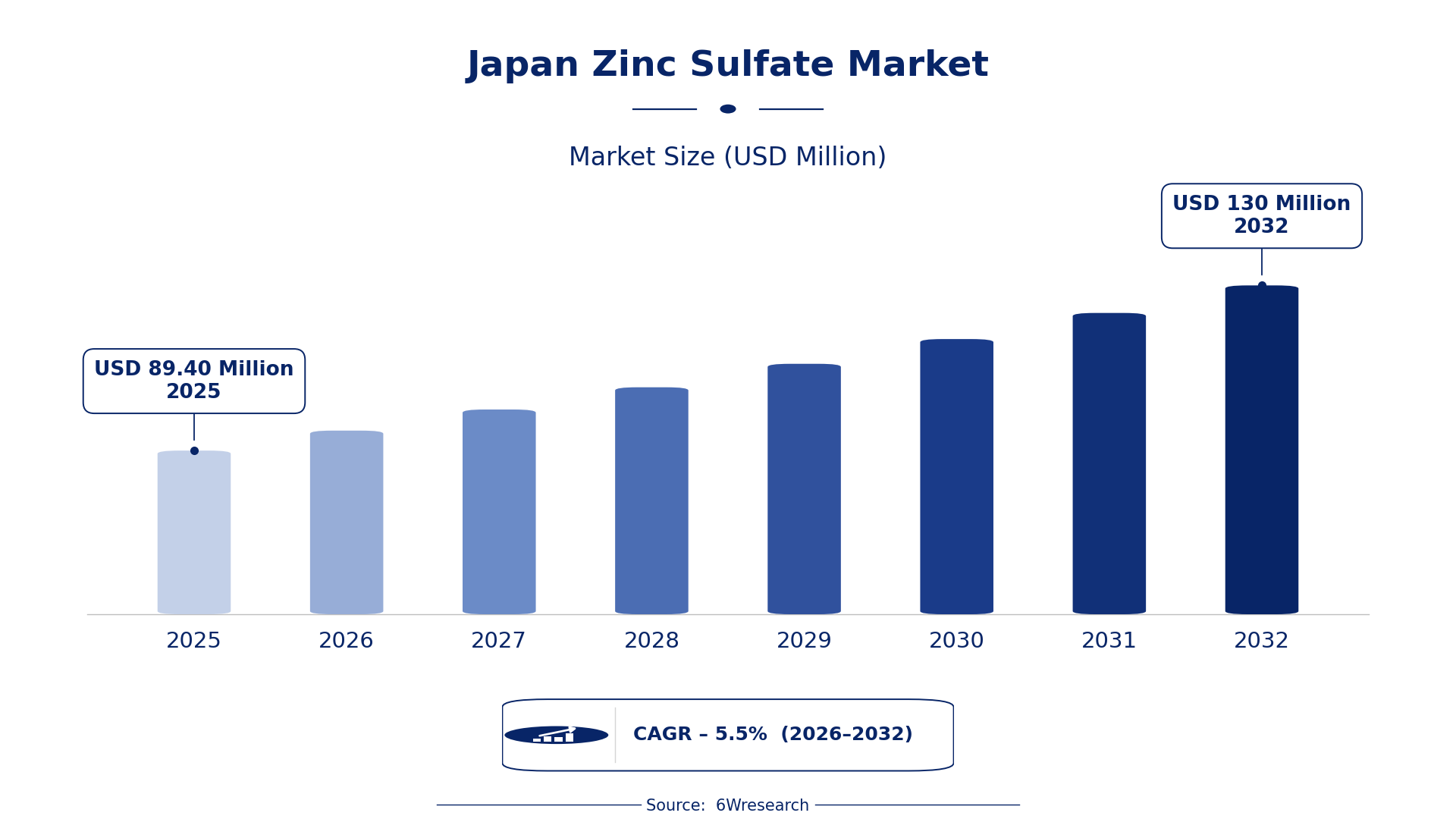
According to 6Wresearch internal database and industry insights, the Japan Zinc Sulfate Market was valued at USD 89.40 Million in 2025 and is projected to reach USD 130 Million by 2032, growing at a CAGR of approximately 5.5% during 2026–2032.
Japan Zinc Sulfate Market Highlights
| Report Metric | Details |
| Report Name | Japan Zinc Sulfate Market (2026-2032) |
| Market Size 2025 | USD 89.40 Million |
| Market Size 2032 | USD 130 Million |
| Absolute Growth 2025–2032 | USD 40.60 Million |
| CAGR 2026–2032 | 5.5% |
| Peak Annual Growth | 6.2% in 2028 |
| Forecast Period | 2026–2032 |
| Historical Data | 2022–2025 |
| Base Year | 2025 |
| Leading Type, 2025 | Zinc Sulfate Monohydrate (42% share) |
| Leading Application, 2025 | Agrochemical (47% share) |
| Leading End-Use Industry, 2025 | Agriculture (48% share) |
| Fastest-Growing Application | Medicine (7.3% CAGR) |
| Fastest-Growing End-Use Industry | Healthcare (7.0% CAGR) |
| Growing Sector | Agriculture |
| Key End Users | Farmers, agricultural cooperatives, healthcare providers |
Japan Zinc Sulfate Market Year-wise Growth Rate and Key Drivers (2022–2032)
This graph illustrates the annual growth rates of the market from 2022 to 2032, highlighting a steady upward trajectory and projected market expansion over the forecast period.
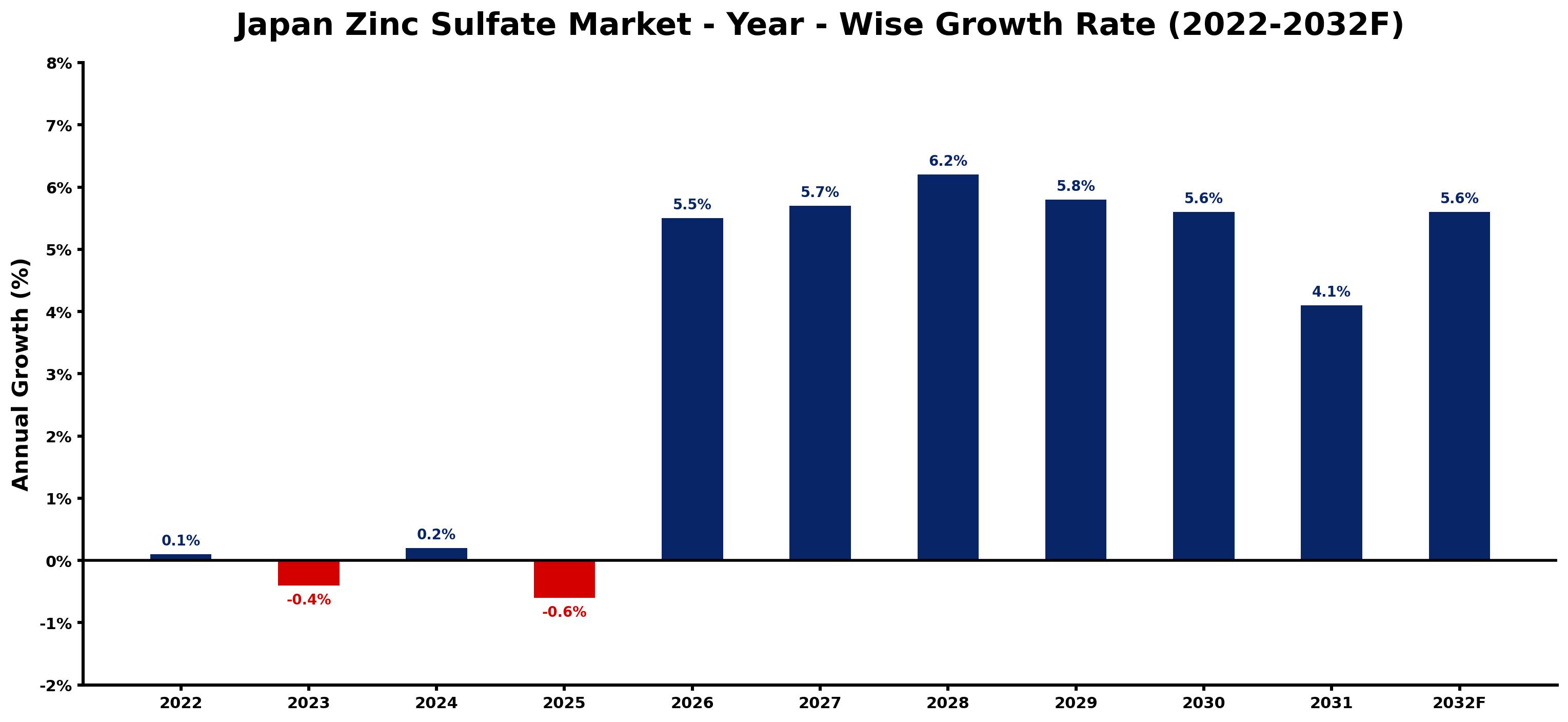
Each row of the following table gives one year's estimated growth and the event or demand shift that explains it.
| Year | Estimated Annual Growth (%) | Market Rationale |
| 2022 | 0.1 | The market showed slight growth, reflecting stable demand in agriculture sectors. |
| 2023 | -0.4 | Market declines due to reduced agricultural activities and lower demand for fertilizers. |
| 2024 | 0.2 | Growth faster than the previous year as agricultural production begins to recover. |
| 2025 | -0.6 | Market declines again, influenced by adverse weather conditions affecting crop yields. |
| 2026 | 5.5 | Growth resumes as investments in agrochemicals increase to support agricultural recovery. |
| 2027 | 5.7 | Growth continues, driven by rising agricultural output and demand for fertilizers. |
| 2028 | 6.2 | Growth peaks as investments in sustainable agriculture technologies gain traction. |
| 2029 | 5.8 | Growth slows slightly, reflecting a market adjustment after the peak demand year. |
| 2030 | 5.6 | Growth slows further, as the market stabilises after rapid expansion. |
| 2031 | 4.1 | Growth continues to slow, indicating a maturing market with steady demand. |
| 2032 | 5.6 | Growth picks up again as new agricultural technologies are adopted widely. |
Note: Market size estimations and growth projections presented in this report are based on 6Wresearch's proprietary forecasting methodology, utilizing the latest available industry data, government publications, and primary research inputs.
Japan Zinc Sulfate Market Synopsis
Zinc Sulfate serves as a micronutrient in agriculture, promoting crop health and productivity. Adoption of advanced agricultural techniques will further boost demand for Zinc Sulfate, as farmers seek effective solutions to improve soil health and crop yields.
Market Dynamics Impact Analysis (2026–2032)
| Factor | Type | Impact | Primary Segment Affected |
| Growing agricultural sector | Driver | High | Agrochemical |
| Increased focus on sustainable farming | Driver | High | Agrochemical |
| Rising demand for micronutrients in agriculture | Opportunity | High | Agrochemical |
| Expansion of the healthcare sector | Opportunity | Medium | Medicine |
| Weather variability affecting crop yields | Restraint | High | Agrochemical |
| Regulatory challenges in chemical approvals | Restraint | Medium | Agrochemical |
| High production costs for manufacturers | Challenge | High | Zinc Sulfate Anhydrous |
| Limited domestic supply sources | Challenge | Medium | Zinc Sulfate Monohydrate |
Evaluation of Drivers in Japan Zinc Sulfate Market (2026–2032)
These are the developments adding the most demand over the forecast period.
| Drivers | Primary Segment Affected | Why It Matters (Evidence) |
| Increased investment in agricultural technology | Agrochemical | This drives demand for Zinc Sulfate as farmers seek effective micronutrient solutions, with the agricultural sector projected to grow by 5.5% annually. |
| Rising awareness of soil health | Agrochemical | Farmers are investing in soil amendments, leading to higher purchases of Zinc Sulfate, as soil health initiatives gain traction in regions like Tohoku. |
| Growing demand for organic farming products | Agrochemical | The shift towards organic farming practices boosts the need for Zinc Sulfate, with organic farming expected to grow by 7% annually in Japan. |
| Increased crop yields due to advanced farming techniques | Agrochemical | Higher yields necessitate more micronutrients, including Zinc Sulfate, as farmers in regions like Tohoku adopt precision agriculture. |
| Expansion of the healthcare sector | Medicine | The healthcare industry’s growth drives demand for Zinc Sulfate in pharmaceuticals, with the sector projected to reach USD 100 Billion by 2025. |
Spending rises because of increased investment in agricultural technology, which drives demand for Zinc Sulfate as farmers seek effective micronutrient solutions. The agricultural sector is expected to grow by 5.5% annually, prompting higher purchases of Zinc Sulfate. Awareness of soil health drives farmers to invest in soil amendments, particularly in regions like Tohoku. The shift towards organic farming practices boosts the need for Zinc Sulfate, as organic farming is anticipated to expand by 7% annually. Advanced farming techniques that increase crop yields necessitate more micronutrients, further driving demand.
Evaluation of Restraints in Japan Zinc Sulfate Market
The key brakes on demand, and where they bite hardest, are shown below.
| Market Restraint | Primary Segment Affected | Why It Matters (Evidence) |
| Weather variability affecting crop yields | Agrochemical | Adverse weather conditions can lead to reduced crop yields, decreasing the demand for Zinc Sulfate, which is critical for crop health. |
| Regulatory challenges in chemical approvals | Agrochemical | Stringent regulations can delay the introduction of new Zinc Sulfate products, impacting supply and market growth. |
| High production costs for manufacturers | Zinc Sulfate Anhydrous | Rising raw material costs can limit production capacity, affecting availability for buyers in the agriculture sector. |
| Limited domestic supply sources | Zinc Sulfate Monohydrate | Dependence on imports can create supply chain vulnerabilities, impacting pricing and availability for local buyers. |
| Competition from alternative fertilizers | Agrochemical | Emerging alternative micronutrient sources may divert demand away from Zinc Sulfate, affecting market share. |
Japan Zinc Sulfate Market Challenges
Regulatory hurdles in Japan complicate the approval process for zinc sulfate production, leading to delays that can extend timelines by up to six months for producers. Limited domestic supply sources create disruptions, forcing buyers to maintain higher inventory levels, which raises their holding costs by 15%. A lack of skilled workers reduces production efficiency, causing a 10% drop in output for manufacturers. Outdated technology limits the adoption of efficient processes, which could otherwise reduce costs and impact pricing strategies for buyers.
Trends in the Japan Zinc Sulfate Market
Below are the shifts with the largest effect on the Japan Zinc Sulfate Market.
- Shift towards Organic Farming: The trend towards organic farming is gaining traction, with organic farming expected to grow by 7% annually in Japan. This shift increases the demand for Zinc Sulfate as a natural micronutrient.
- Increased Use of Precision Agriculture: Precision agriculture techniques are being adopted widely, improving crop yields and necessitating more micronutrients like Zinc Sulfate. This trend is evident in regions like Tohoku, where technology adoption is rising.
- Growing Demand for Sustainable Practices: Sustainable farming practices are increasingly prioritised, resulting in a higher demand for Zinc Sulfate. The Green Growth Strategy, updated in 2021, highlights the need for sustainable agricultural inputs.
- Expansion of Healthcare Applications: The healthcare sector is expanding, driving demand for Zinc Sulfate in pharmaceuticals. The market for healthcare products is projected to reach USD 100 Billion by 2025, increasing Zinc Sulfate's relevance.
Investment Opportunities in the Japan Zinc Sulfate Market
Where to invest in the Japan Zinc Sulfate Market: the main openings are set out below.
- Agrochemical Sector Growth: The agrochemical sector is experiencing growth, with a projected market size of USD 50 Billion by 2025. Suppliers can focus on providing Zinc Sulfate to meet rising demand from farmers.
- Healthcare Sector Expansion: The healthcare sector's growth presents an opportunity to supply Zinc Sulfate for pharmaceuticals. With healthcare projected to reach USD 100 Billion by 2025, there is a significant gap to fill.
- Investment in Sustainable Agriculture: Investments in sustainable agriculture are rising, with farmers seeking effective micronutrient solutions. This trend creates opportunities for suppliers of Zinc Sulfate in regions prioritising sustainability.
- Technological Advancements in Agriculture: Technological advancements are transforming agriculture, leading to increased demand for Zinc Sulfate. Suppliers can enter this market by collaborating with local agricultural technology firms.
Government Initiatives in the Japan Zinc Sulfate Market
The PRTR Law mandates businesses to disclose information regarding the release and transfer of designated chemical substances, including Zinc Sulfate. This law promotes transparency and accountability in chemical management, influencing producers and buyers in the market. Compliance with this regulation ensures that Zinc Sulfate is managed safely and responsibly, impacting its production and distribution.
The Chemical Substances Control Law requires the evaluation and management of new and existing chemical substances in manufacturing and import. The Ministry of Economy, Trade and Industry oversees compliance, ensuring that Zinc Sulfate products meet safety standards. This regulation is vital for maintaining product quality and safety in the market.
Future Insight of the Japan Zinc Sulfate Market
The investment pipeline for local production will expand significantly by 2032, driven by government initiatives that will create demand for modern manufacturing processes. Training programmes will cultivate a skilled workforce, ensuring that suppliers can meet evolving industry requirements. New production efficiency standards will push suppliers to implement advanced technologies, enhancing operational capabilities. The establishment of state-of-the-art facilities will increase output capacity, enabling buyers to secure more reliable supplies and potentially lower prices.
Market Segmentation Analysis
Japan Zinc Sulfate Market report covers a detailed analysis of the following market segments:
By Type – Zinc Sulfate Monohydrate Leads and Records the Fastest Growth
According to Ravi Bhandari, Research Head at 6Wresearch, Zinc Sulfate Monohydrate took 42% of type revenue in 2025, more than any other category. Zinc Sulfate Monohydrate holds the largest share due to its widespread use in agriculture as a fertiliser, with a strong existing user base among farmers. Its application in various agricultural practices across Japan ensures sustained market dominance. The same category is also set to grow fastest, at a CAGR of 7.6% during 2026–2032. Zinc Sulfate Monohydrate is also the fastest growing sub-segment, as the rising demand for effective fertilisers that enhance crop yields continues to increase. The ongoing trend towards sustainable farming practices will further strengthen its growth. Suppliers should focus on Zinc Sulfate Monohydrate to capitalise on its leading market position.
By Application – Agrochemical Leads, Medicine Expected to Grow Fastest
Agrochemical held 47% of the Japan Zinc Sulfate Market by application in 2025. The agrochemical application leads the market, as it extensively uses Zinc Sulfate to improve soil quality and safeguard crops, reflecting Japan's robust agricultural sector. This strong demand from farmers solidifies the agrochemical segment's market presence. Over 2026–2032, Medicine is expected to post the fastest growth, at a CAGR of 7.3%. The medicine application is the fastest growing segment, driven by increased awareness of Zinc Sulfate's health advantages in dietary supplements and pharmaceuticals. The rising consumer emphasis on health and wellness significantly contributes to this growth. Buyers in the healthcare sector should collaborate with suppliers to secure high-quality Zinc Sulfate for their products.
By End-Use Industry – Agriculture Leads, Healthcare Expected to Grow Fastest
Agriculture accounted for 48% of the market by end-use industry in 2025. Agriculture is the leading end-use industry, with a large quantity of Zinc Sulfate used for fertilisation and improving soil health in farming operations. The essential role of agriculture in Japan's economy reinforces its dominant position in the market. Healthcare is set to record the highest CAGR in this split, 7.0% over 2026–2032. The healthcare sector is the fastest expanding end-use industry, spurred by increasing demand for nutritional supplements and therapeutic applications of Zinc Sulfate. The growing focus on preventive healthcare is a key factor in this rapid growth. Suppliers should consider expanding their product offerings to meet the rising needs of the healthcare sector.
Key Attractiveness of the Report
- 10 Years of Market Numbers
- Historical Data Starting from 2022 to 2025
- Base Year 2025
- Forecast Data until 2032
- Key Performance Indicators Impacting the Market
- Major Upcoming Developments and Projects
Key Highlights of the Report:
- Japan Zinc Sulfate Market Outlook
- Market Size of Japan Zinc Sulfate Market, 2025
- Forecast of Japan Zinc Sulfate Market, 2032
- Historical Data and Forecast of Japan Zinc Sulfate Revenues & Volume for the Period 2022-2032
- Japan Zinc Sulfate Market Trend Evolution
- Japan Zinc Sulfate Market Drivers and Challenges
- Japan Zinc Sulfate Price Trends
- Japan Zinc Sulfate Porter's Five Forces
- Japan Zinc Sulfate Industry Life Cycle
- Historical Data and Forecast of Japan Zinc Sulfate Market Revenues & Volume By Type for the Period 2022-2032
- Historical Data and Forecast of Japan Zinc Sulfate Market Revenues & Volume By Zinc Sulfate Anhydrous for the Period 2022-2032
- Historical Data and Forecast of Japan Zinc Sulfate Market Revenues & Volume By Zinc Sulfate Monohydrate for the Period 2022-2032
- Historical Data and Forecast of Japan Zinc Sulfate Market Revenues & Volume By Zinc Sulfate Hexahydrate for the Period 2022-2032
- Historical Data and Forecast of Japan Zinc Sulfate Market Revenues & Volume By Zinc Sulfate Heptahydrate for the Period 2022-2032
- Historical Data and Forecast of Japan Zinc Sulfate Market Revenues & Volume By Application for the Period 2022-2032
- Historical Data and Forecast of Japan Zinc Sulfate Market Revenues & Volume By Medicine for the Period 2022-2032
- Historical Data and Forecast of Japan Zinc Sulfate Market Revenues & Volume By Agrochemical for the Period 2022-2032
- Historical Data and Forecast of Japan Zinc Sulfate Market Revenues & Volume By Chemical for the Period 2022-2032
- Historical Data and Forecast of Japan Zinc Sulfate Market Revenues & Volume By Water Treatment for the Period 2022-2032
- Historical Data and Forecast of Japan Zinc Sulfate Market Revenues & Volume By End-Use Industry for the Period 2022-2032
- Historical Data and Forecast of Japan Zinc Sulfate Market Revenues & Volume By Healthcare for the Period 2022-2032
- Historical Data and Forecast of Japan Zinc Sulfate Market Revenues & Volume By Agriculture for the Period 2022-2032
- Historical Data and Forecast of Japan Zinc Sulfate Market Revenues & Volume By Chemical for the Period 2022-2032
- Historical Data and Forecast of Japan Zinc Sulfate Market Revenues & Volume By Textile for the Period 2022-2032
- Japan Zinc Sulfate Import Export Trade Statistics
- Market Opportunity Assessment By Type
- Market Opportunity Assessment By Application
- Market Opportunity Assessment By End-Use Industry
- Japan Zinc Sulfate Top Companies Market Share
- Japan Zinc Sulfate Competitive Benchmarking By Technical and Operational Parameters
- Japan Zinc Sulfate Company Profiles
- Japan Zinc Sulfate Key Strategic Recommendations
Market Covered
The following segment groups are covered in the report.
By Type
- Zinc Sulfate Anhydrous
- Zinc Sulfate Monohydrate
- Zinc Sulfate Hexahydrate
- Zinc Sulfate Heptahydrate
By Application
- Medicine
- Agrochemical
- Chemical
- Water Treatment
By End-Use Industry
- Healthcare
- Agriculture
- Chemical
- Textile































