Jordan Radioactive Waste Management Market Size, Share & Growth Rate
The Jordan Radioactive Waste Management Market was estimated at USD 243 Million in 2025 and is projected to reach USD 338 Million by 2032, growing at a CAGR of 4.8% from 2026 to 2032. This positive trajectory is primarily driven by the expansion of the country's nuclear energy program, alongside increasing industrial activities involving radioactive materials. The stringent regulatory environment further emphasizes the need for safe, effective waste management solutions, as both public health and environmental considerations take precedence.
Jordan Radioactive Waste Management Market Year-wise Growth Rate and Key Drivers
This graph highlights how the Jordan Radioactive Waste Management Market has steadily grown over the years, supported by major growth factors.
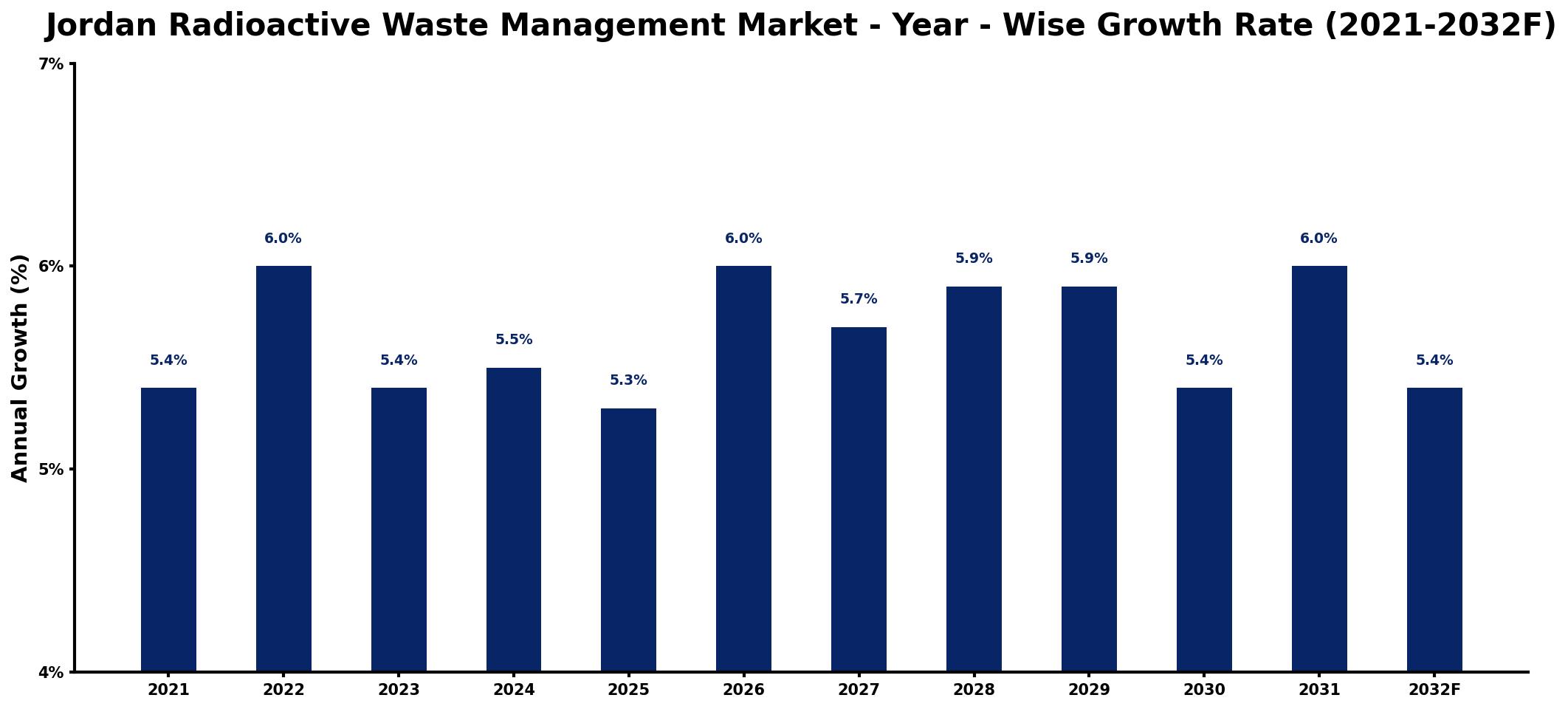
The table below presents the year‑wise growth rates along with the key drivers influencing the market
| Year | Growth Rate | Major Drivers |
| 2021 | 5.4% | Increased government infrastructure investments |
| 2022 | 6.0% | Growing public safety regulations |
| 2023 | 5.4% | Rising energy sector demands |
| 2024 | 5.5% | Expansion of treatment facilities |
| 2025 | 5.3% | Advancements in disposal technologies |
| 2026 | 6.0% | Increased international collaboration efforts |
| 2027 | 5.7% | Heightened environmental awareness campaigns |
| 2028 | 5.9% | Emerging renewable energy projects |
| 2029 | 5.9% | Strengthened regulatory compliance requirements |
| 2030 | 5.4% | Growing private sector involvement |
| 2031 | 6.0% | Innovative recycling initiatives launched |
| 2032 | 5.4% | Enhanced community engagement programs |
Note: Market size estimations and growth projections presented in this report are based on 6Wresearch's proprietary forecasting methodology, utilizing the latest available industry data, government publications, and primary research inputs.
Jordan Radioactive Waste Management Market Synopsis
As Jordan continues to develop its nuclear energy capabilities, the management of radioactive waste has emerged as a critical focal point for policymakers and industry stakeholders. Recent investments in waste management infrastructure reflect a commitment to adhering to international safety standards while addressing the complex challenges that accompany radioactive material handling.
The medical and industrial sectors also contribute significantly to the radioactive waste generated in Jordan. As these industries expand, so too does the urgency for innovative waste management practices that mitigate risks and ensure compliance with environmental regulations. This evolving landscape positions the Jordan Radioactive Waste Management Market as both a challenge and an opportunity for growth.
Jordan Radioactive Waste Management Market Key Takeaways
- The market is experiencing significant growth driven by nuclear energy expansion and increased industrial applications.
- Stringent regulations enforce compliance with international standards for safe waste management practices.
- Challenges related to technology and investment remain as key factors influencing market dynamics.
- Government policies actively support the development of specialized waste management infrastructure.
- Ongoing trends indicate a shift toward more sustainable and innovative waste management solutions.
Evaluation of Restraints in Jordan Radioactive Waste Management Market
Despite the promising growth outlook, the Jordan Radioactive Waste Management Market faces several restraints that could hinder progress. The regulatory landscape is complex, requiring stakeholders to navigate a myriad of compliance requirements. In addition, the technological demands for effective waste management necessitate substantial investments in advanced solutions. The interplay between regulation and technology often complicates the implementation of efficient practices, posing challenges to both new entrants and established players in the market.
Jordan Radioactive Waste Management Market Trends
A notable trend in the Jordan Radioactive Waste Management Market is the increasing adoption of innovative waste treatment technologies that enhance safety and efficiency. Technologies such as advanced incineration and secure storage solutions are gaining traction, driven by the need for sustainable practices. Additionally, there is a growing emphasis on public awareness and education regarding radioactive waste management, as stakeholders seek to foster greater community engagement and understanding.
Jordan Radioactive Waste Management Market Opportunities
Investment opportunities abound within the Jordan Radioactive Waste Management Market, particularly in the development of modern waste management facilities and technologies. Collaborations between public and private sectors can accelerate the establishment of state-of-the-art infrastructure. Furthermore, there is potential for growth in consulting services focused on regulatory compliance and risk assessment, catering to businesses involved in the handling of radioactive materials.
Government Initiatives in the Jordan Radioactive Waste Management Market
The Jordanian government plays a pivotal role in shaping the radioactive waste management landscape through policy initiatives and public investment. Efforts are underway to align national regulations with international standards, ensuring that waste management practices are both safe and environmentally responsible. Public spending on infrastructure development and training programs is also essential to equip the workforce with the necessary skills to manage radioactive waste effectively.
Future Insights of the Jordan Radioactive Waste Management Market
Looking ahead to the period from 2026 to 2032, the Jordan Radioactive Waste Management Market is poised for continued growth and evolution. The ongoing advancements in nuclear technology and the increasing reliance on radioactive materials in various industries suggest a robust demand for effective waste management solutions. Moreover, the commitment to sustainability and adherence to international best practices will drive innovation and investment in this critical sector, positioning Jordan as a regional leader in responsible waste management.
Jordan Radioactive Waste Management Market Latest Developments (2025 - 2026)
Recent developments in the Jordan Radioactive Waste Management Market indicate a concerted effort to enhance waste management infrastructure. New initiatives focus on improving compliance with international safety standards, while research into advanced waste processing technologies is on the rise. Additionally, collaborative efforts between various government agencies and industry stakeholders are expected to yield significant advancements in the effectiveness and efficiency of waste management practices.
Jordan Radioactive Waste Management Market - Key Attractiveness of the Report
- 10 Years of Market Numbers
- Historical Data Starting from 2022 to 2025
- Base Year: 2025
- Forecast Data until 2032
- Key Performance Indicators Impacting the Market
- Major Upcoming Developments and Projects
Key Highlights of the Report:
- Jordan Radioactive Waste Management Market Outlook
- Market Size of Jordan Radioactive Waste Management Market, 2025
- Forecast of Jordan Radioactive Waste Management Market, 2032
- Historical Data and Forecast of Jordan Radioactive Waste Management Revenues & Volume for the Period 2022-2032F
- Jordan Radioactive Waste Management Market Trend Evolution
- Jordan Radioactive Waste Management Market Drivers and Challenges
- Jordan Radioactive Waste Management Price Trends
- Jordan Radioactive Waste Management Porter's Five Forces
- Jordan Radioactive Waste Management Industry Life Cycle
- Historical Data and Forecast of Jordan Radioactive Waste Management Market Revenues & Volume By Type for the Period 2022-2032F
- Historical Data and Forecast of Jordan Radioactive Waste Management Market Revenues & Volume By Exempt Waste and Very Low-Level Waste(VLLW) for the Period 2022-2032F
- Historical Data and Forecast of Jordan Radioactive Waste Management Market Revenues & Volume By Low-Level Waste(LLW) for the Period 2022-2032F
- Historical Data and Forecast of Jordan Radioactive Waste Management Market Revenues & Volume By Intermediate-Level Waste(ILW) for the Period 2022-2032F
- Historical Data and Forecast of Jordan Radioactive Waste Management Market Revenues & Volume By High-Level Waste(HLW) for the Period 2022-2032F
- Historical Data and Forecast of Jordan Radioactive Waste Management Market Revenues & Volume By Application for the Period 2022-2032F
- Historical Data and Forecast of Jordan Radioactive Waste Management Market Revenues & Volume By Industrial for the Period 2022-2032F
- Historical Data and Forecast of Jordan Radioactive Waste Management Market Revenues & Volume By Utility for the Period 2022-2032F
- Jordan Radioactive Waste Management Import Export Trade Statistics
- Market Opportunity Assessment By Type
- Market Opportunity Assessment By Application
- Jordan Radioactive Waste Management Top Companies Market Share
- Jordan Radioactive Waste Management Competitive Benchmarking By Technical and Operational Parameters
- Jordan Radioactive Waste Management Company Profiles
- Jordan Radioactive Waste Management Key Strategic Recommendations






































