Kazakhstan Business Intelligence and Analytics Software Market Size & Growth Rate (2026-2032)
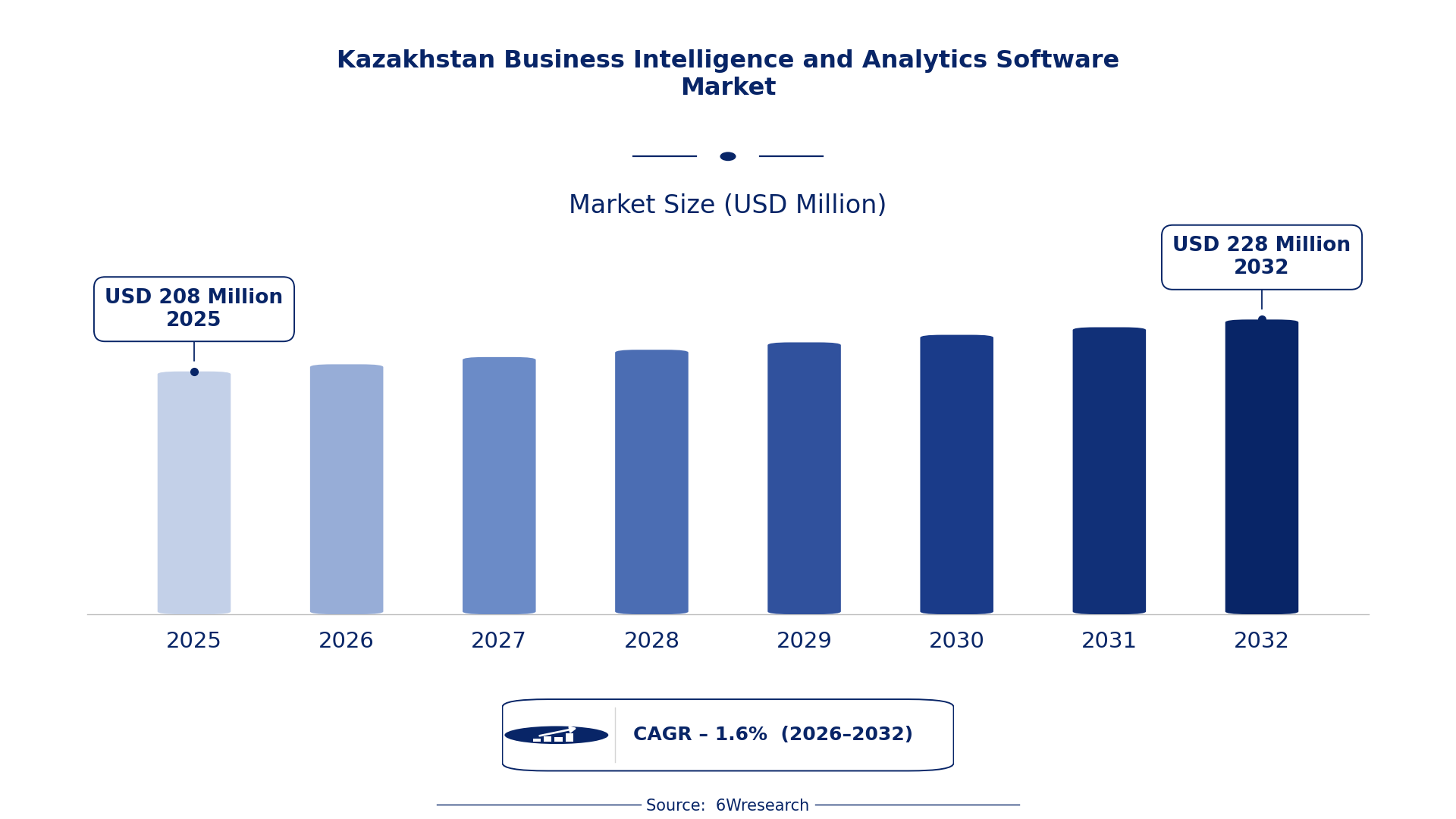
The Kazakhstan Business Intelligence and Analytics Software Market was estimated at USD 208 Million in 2025 and is projected to reach USD 228 Million by 2032, growing at a CAGR of 1.6% from 2026 to 2032.
Kazakhstan Business Intelligence and Analytics Software Market Synopsis
The demand for business intelligence (BI) and analytics software in Kazakhstan is driven by organizations striving for data-driven decision-making capabilities. As businesses increasingly recognize the value of actionable insights, there’s a notable shift towards adopting sophisticated analytics tools that can process large data volumes.
The market is further supported by the growing trend of cloud computing, allowing businesses to access powerful analytics tools without substantial upfront investment. Real-time data analysis has become essential for companies aiming to maintain a competitive edge, highlighting the urgency of adopting these software solutions.
Kazakhstan Business Intelligence and Analytics Software Market Year-wise Growth Rate and Key Drivers
This graph illustrates the annual growth rates of the Kazakhstan Business Intelligence and Analytics Software Market from 2021 to 2032, highlighting a steady upward trajectory and projected expansion over the forecast period.
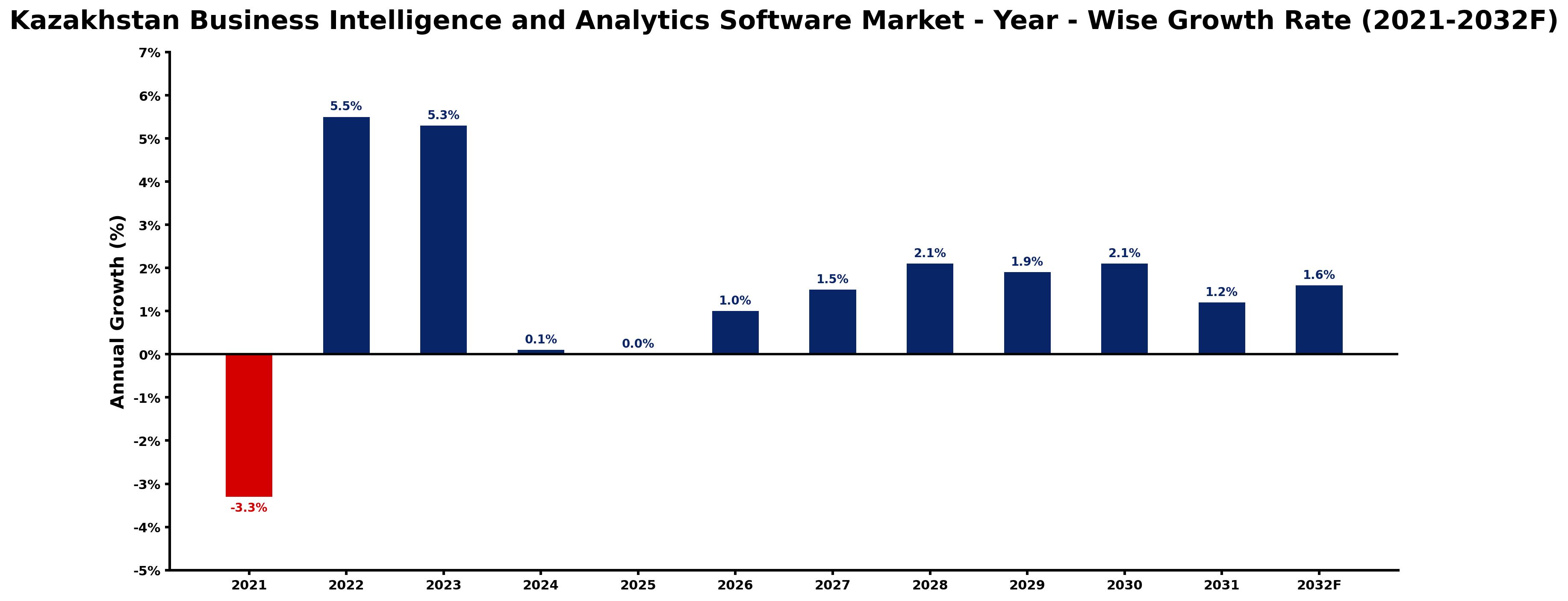
The table below presents the year‑wise growth rates along with the key drivers influencing the market
| Year | Growth Rate | Major Drivers |
| 2021 | -3.3% | Kazakhstan's economy contracted due to oil price decline. |
| 2022 | 5.5% | Increased demand for data-driven decision-making among businesses. |
| 2023 | 5.3% | Investment in digital transformation by Kazakhstani companies. |
| 2024 | 0.1% | Government push for smart agriculture initiatives leveraging analytics. |
| 2025 | 0.0% | Expansion of commercial construction activities |
| 2026 | 1.0% | Rise of fintech solutions driving data analytics integration. |
| 2027 | 1.5% | Local startups adopting BI tools to enhance operations. |
| 2028 | 2.1% | Implementation of Kazakhstan's Digital Kazakhstan program facilitating growth. |
| 2029 | 1.9% | Emergence of e-commerce platforms requiring advanced analytics software. |
| 2030 | 2.1% | Adoption of AI technologies boosting analytics demand in enterprises. |
| 2031 | 1.2% | Growing regulatory focus on data privacy and analytics compliance. |
| 2032 | 1.6% | Rise in analytics training programs enhancing workforce capabilities. |
Note: Market size estimations and growth projections presented in this report are based on 6Wresearch's proprietary forecasting methodology, utilizing the latest available industry data, government publications, and primary research inputs.
Kazakhstan Business Intelligence and Analytics Software Market Key Takeaways
Below are some of the specific key takeaways from the market, including:
- The market is expected to experience steady growth, driven by increased data usage across industries.
- Cloud-based solutions are becoming more popular due to their flexibility and cost-effectiveness.
- Organizations face challenges in customizing BI solutions to meet diverse industry needs.
- Government initiatives are fostering an environment conducive to technology adoption.
- Data security concerns remain a significant focus for businesses implementing BI solutions.
Evaluation of Restraints in Kazakhstan Business Intelligence and Analytics Software Market
Customization and scalability pose real challenges for companies looking to implement business intelligence and analytics software. Each industry has unique requirements, which means a one-size-fits-all approach rarely suffices. This can lead to frustrations for organizations that need tailored solutions. Additionally, as technological advancements progress rapidly, software developers must continuously adapt their offerings to meet evolving data integration and usability demands. Failure to keep pace can limit a company’s effectiveness and hinder market growth.
Kazakhstan Business Intelligence and Analytics Software Market Trends
Organizations are increasingly prioritizing real-time analytics to respond swiftly to market changes. This trend is leading to the integration of advanced technologies, such as artificial intelligence and machine learning, into BI software. The focus is not just on data collection, but on deriving meaningful insights that can drive strategic decisions. on top of that, the rise of data visualization tools is making analytics more accessible for non-technical users, democratizing data-driven decision-making across organizations.
Kazakhstan Business Intelligence and Analytics Software Market Opportunities
The growth of the Kazakhstan Business Intelligence and Analytics Software Market presents several opportunities, particularly in sectors like finance, healthcare, and retail. Companies that invest in advanced analytics can gain a significant competitive advantage by uncovering insights that inform product development, customer engagement, and operational efficiency. Additionally, as businesses increasingly adopt cloud solutions, there’s room for innovative companies to develop tailored offerings that cater specifically to local industry needs.
Government Initiatives in the Kazakhstan Business Intelligence and Analytics Software Market
Government policies play a crucial role in shaping the direction of the Kazakhstan Business Intelligence and Analytics Software Market. The focus on modernizing public administration and enhancing private sector capabilities through technology is driving market growth. Regulatory frameworks aimed at ensuring data security and privacy foster an environment conducive to the adoption of analytics solutions.
- A recently completed initiative involved the launch of the "Digital Kazakhstan" program, which emphasizes the importance of IT education and digital literacy.
- Currently underway is the development of a national digital infrastructure upgrade program, enhancing connectivity and access to analytics tools across the country.
- A planned public-private partnership is expected to promote the creation of local software solutions tailored to the unique needs of Kazakh businesses by 2028.
- The government has also introduced regulatory frameworks focused on data privacy, encouraging organizations to adopt BI solutions with greater confidence.
- An ongoing initiative aims to provide financial incentives for businesses that invest in digital transformation, including BI software adoption.
Future Insights of the Kazakhstan Business Intelligence and Analytics Software Market
Looking ahead to 2026-2032, the Kazakhstan Business Intelligence and Analytics Software Market is set to evolve significantly. As businesses continue to recognize the importance of data in strategic decision-making, the demand for advanced analytics solutions will likely surge. Enhanced focus on data-driven culture within organizations will drive the adoption of innovative tools. The integration of emerging technologies, coupled with supportive government policies, is expected to foster a more dynamic market environment, enabling companies to harness the full potential of their data.
Kazakhstan Business Intelligence and Analytics Software Market Latest Developments
Recent developments in the Kazakhstan Business Intelligence and Analytics Software Market reflect a trend towards increased investment in technology solutions. Companies are actively pursuing innovative strategies to enhance their analytics capabilities. This activity showcases a commitment to leveraging data for improved decision-making and operational efficiency.
- A major technology vendor launched a new analytics platform in early 2025, designed specifically for small and medium-sized enterprises.
- An initiative that began in mid-2025 focuses on creating partnerships between local universities and businesses to foster talent in data analytics.
- A rollout expected to begin in the second half of 2026 aims to expand access to BI tools for public sector organizations across Kazakhstan.
- Ongoing upgrades to existing software solutions are being implemented to enhance user experience and integration capabilities, with updates expected by late 2025.
- Another initiative involves a pilot program to assess the impact of advanced analytics in government decision-making processes, currently in the testing phase.
Kazakhstan Business Intelligence and Analytics Software Market - Key Attractiveness of the Report
- 10 Years of Market Numbers
- Historical Data Starting from 2022 to 2025
- Base Year: 2025
- Forecast Data until 2032
- Key Performance Indicators Impacting the Market
- Major Upcoming Developments and Projects
Key Highlights of the Report:
- Kazakhstan Business Intelligence and Analytics Software Market Outlook
- Market Size of Kazakhstan Business Intelligence and Analytics Software Market, 2025
- Forecast of Kazakhstan Business Intelligence and Analytics Software Market, 2032
- Historical Data and Forecast of Kazakhstan Business Intelligence and Analytics Software Revenues & Volume for the Period 2022-2032F
- Kazakhstan Business Intelligence and Analytics Software Market Trend Evolution
- Kazakhstan Business Intelligence and Analytics Software Market Drivers and Challenges
- Kazakhstan Business Intelligence and Analytics Software Price Trends
- Kazakhstan Business Intelligence and Analytics Software Porter's Five Forces
- Kazakhstan Business Intelligence and Analytics Software Industry Life Cycle
- Historical Data and Forecast of Kazakhstan Business Intelligence and Analytics Software Market Revenues & Volume By Segment for the Period 2022-2032F
- Historical Data and Forecast of Kazakhstan Business Intelligence and Analytics Software Market Revenues & Volume By Business Intelligence (BI) Platforms for the Period 2022-2032F
- Historical Data and Forecast of Kazakhstan Business Intelligence and Analytics Software Market Revenues & Volume By Corporate Performance Management (CPM) Suite for the Period 2022-2032F
- Historical Data and Forecast of Kazakhstan Business Intelligence and Analytics Software Market Revenues & Volume By Advanced and Predictive Analytics for the Period 2022-2032F
- Historical Data and Forecast of Kazakhstan Business Intelligence and Analytics Software Market Revenues & Volume By Content Analytics for the Period 2022-2032F
- Historical Data and Forecast of Kazakhstan Business Intelligence and Analytics Software Market Revenues & Volume By Analytics Application for the Period 2022-2032F
- Historical Data and Forecast of Kazakhstan Business Intelligence and Analytics Software Market Revenues & Volume By Deployment Modes for the Period 2022-2032F
- Historical Data and Forecast of Kazakhstan Business Intelligence and Analytics Software Market Revenues & Volume By On-premise for the Period 2022-2032F
- Historical Data and Forecast of Kazakhstan Business Intelligence and Analytics Software Market Revenues & Volume By Cloud for the Period 2022-2032F
- Historical Data and Forecast of Kazakhstan Business Intelligence and Analytics Software Market Revenues & Volume By Organization Size for the Period 2022-2032F
- Historical Data and Forecast of Kazakhstan Business Intelligence and Analytics Software Market Revenues & Volume By Small Medium Business (SMB??s) for the Period 2022-2032F
- Historical Data and Forecast of Kazakhstan Business Intelligence and Analytics Software Market Revenues & Volume By Large enterprises for the Period 2022-2032F
- Historical Data and Forecast of Kazakhstan Business Intelligence and Analytics Software Market Revenues & Volume By Deployment Mode for the Period 2022-2032F
- Historical Data and Forecast of Kazakhstan Business Intelligence and Analytics Software Market Revenues & Volume By On-premise for the Period 2022-2032F
- Historical Data and Forecast of Kazakhstan Business Intelligence and Analytics Software Market Revenues & Volume By Cloud for the Period 2022-2032F
- Historical Data and Forecast of Kazakhstan Business Intelligence and Analytics Software Market Revenues & Volume By Verticals for the Period 2022-2032F
- Historical Data and Forecast of Kazakhstan Business Intelligence and Analytics Software Market Revenues & Volume By Banking, Financial Services, and Insurance (BFSI) for the Period 2022-2032F
- Historical Data and Forecast of Kazakhstan Business Intelligence and Analytics Software Market Revenues & Volume By Healthcare for the Period 2022-2032F
- Historical Data and Forecast of Kazakhstan Business Intelligence and Analytics Software Market Revenues & Volume By IT & Telecom for the Period 2022-2032F
- Historical Data and Forecast of Kazakhstan Business Intelligence and Analytics Software Market Revenues & Volume By Retail for the Period 2022-2032F
- Historical Data and Forecast of Kazakhstan Business Intelligence and Analytics Software Market Revenues & Volume By Manufacturing for the Period 2022-2032F
- Historical Data and Forecast of Kazakhstan Business Intelligence and Analytics Software Market Revenues & Volume By Education for the Period 2022-2032F
- Historical Data and Forecast of Kazakhstan Business Intelligence and Analytics Software Market Revenues & Volume By Government for the Period 2022-2032F
- Historical Data and Forecast of Kazakhstan Business Intelligence and Analytics Software Market Revenues & Volume By Energy and Power for the Period 2022-2032F
- Kazakhstan Business Intelligence and Analytics Software Import Export Trade Statistics
- Market Opportunity Assessment By Segment
- Market Opportunity Assessment By Deployment Modes
- Market Opportunity Assessment By Organization Size
- Market Opportunity Assessment By Deployment Mode
- Market Opportunity Assessment By Verticals
- Kazakhstan Business Intelligence and Analytics Software Top Companies Market Share
- Kazakhstan Business Intelligence and Analytics Software Competitive Benchmarking By Technical and Operational Parameters
- Kazakhstan Business Intelligence and Analytics Software Company Profiles
- Kazakhstan Business Intelligence and Analytics Software Key Strategic Recommendations






































