Kazakhstan Moisturizing Cream Market Outlook | Analysis, Growth, COVID-19 IMPACT, Companies, Value, Forecast, Industry, Share, Revenue, Trends & Size
Market Forecast By Type (Emollients, Ceramides, Occlusive, Humectants, Others), By Category (Premium, Mass), By Consumer Group (Adult, Children), By Distribution Channel (Store Based, Non Store Based) And Competitive Landscape
| Product Code: ETC333898 | Publication Date: Aug 2022 | Updated Date: Feb 2026 | Product Type: Market Research Report | |
| Publisher: 6Wresearch | Author: Shubham Deep | No. of Pages: 75 | No. of Figures: 35 | No. of Tables: 20 |
Kazakhstan Moisturizing Cream Market: Import Trend Analysis
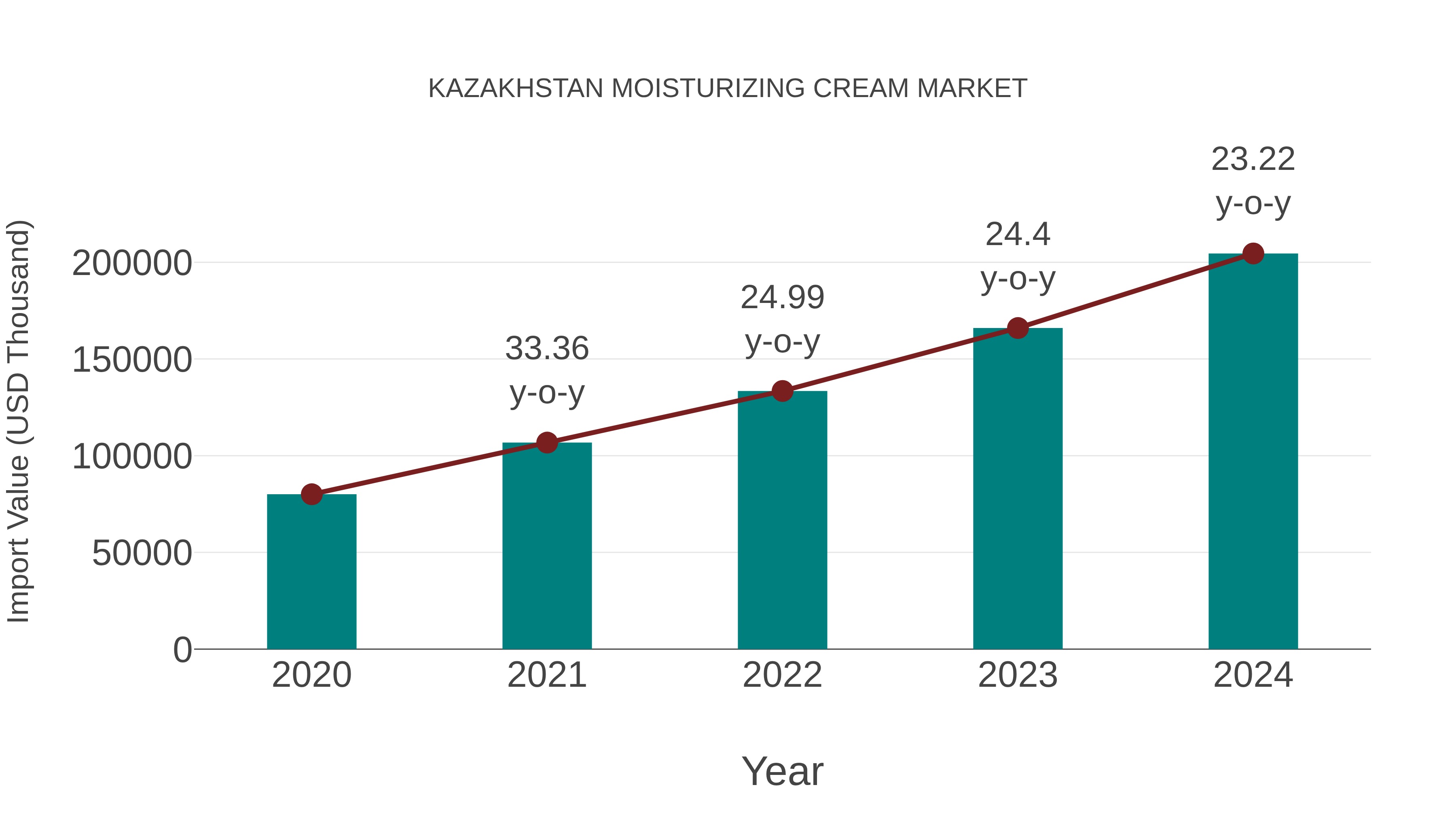
In the Kazakhstan moisturizing cream market, the import trend showed a notable growth rate of 23.22% from 2023 to 2024, with a compound annual growth rate (CAGR) of 26.43% for the period 2020-2024. This uptrend in imports could be attributed to increased consumer demand for skincare products or shifts in trade policies that favored international trade.
Moisturizing Cream Market: Kazakhstan vs Top 5 Major Economies in 2027 (Asia)
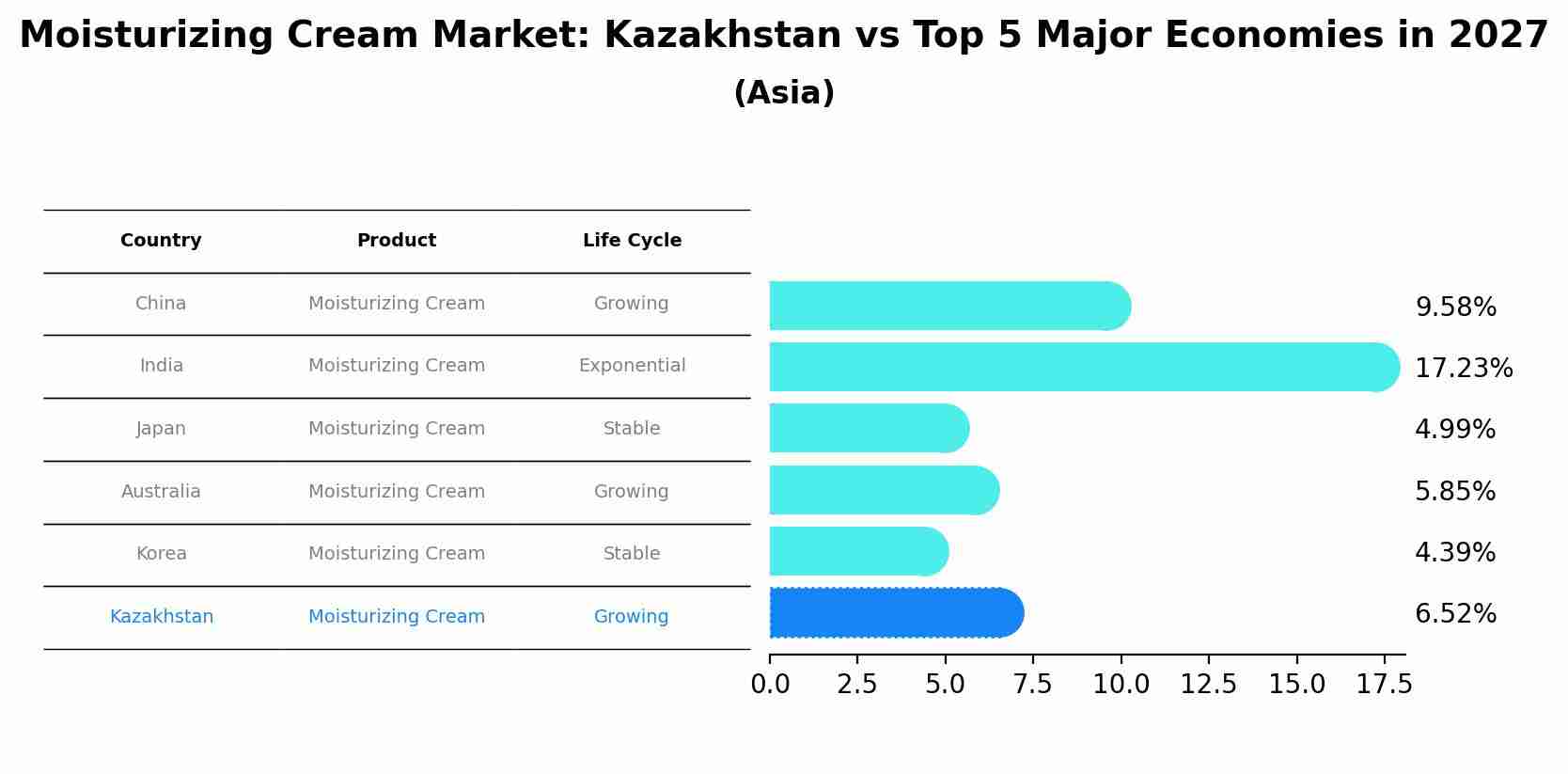
The Moisturizing Cream market in Kazakhstan is projected to grow at a growing growth rate of 6.52% by 2027, within the Asia region led by China, along with other countries like India, Japan, Australia and South Korea, collectively shaping a dynamic and evolving market environment driven by innovation and increasing adoption of emerging technologies.
Kazakhstan Moisturizing Cream Market Synopsis
The Kazakhstan Moisturizing Cream Market is experiencing steady growth driven by increasing consumer awareness of skincare products and a rising demand for quality skincare solutions. Key players in the market are focusing on product innovation, incorporating natural ingredients, and offering targeted solutions for various skin types. The market is characterized by the presence of both international and local brands, with competition leading to a diverse range of products available to consumers. Factors such as changing lifestyles, climate conditions, and a growing middle-class population are further fueling the market growth. Additionally, the rising trend of self-care and beauty routines among consumers is expected to drive further expansion of the moisturizing cream market in Kazakhstan.
Kazakhstan Moisturizing Cream Market Trends
In the Kazakhstan moisturizing cream market, there is a growing trend towards products that offer not only hydration but also additional benefits such as anti-aging properties, sun protection, and natural ingredients. Consumers are becoming more conscious about the ingredients in their skincare products, leading to a demand for products that are free from harmful chemicals and artificial fragrances. There is also an increasing preference for lightweight and fast-absorbing formulas that cater to different skin types, including sensitive and oily skin. With a focus on achieving healthy and glowing skin, consumers are looking for moisturizing creams that provide long-lasting hydration without feeling heavy or greasy. Brands are responding to these trends by introducing innovative formulations, sustainable packaging, and marketing strategies that emphasize the benefits of their products in meeting the evolving skincare needs of consumers in Kazakhstan.
Kazakhstan Moisturizing Cream Market Challenges
In the Kazakhstan moisturizing cream market, some key challenges include stiff competition from both domestic and international brands, pricing pressure due to varying consumer purchasing power, and the need for effective marketing strategies to stand out in a crowded market. Additionally, fluctuations in raw material costs and regulatory hurdles can impact product development and pricing. Consumer preferences and trends also play a significant role, requiring companies to continuously innovate and adapt to changing demands. Distribution challenges, such as reaching rural areas and ensuring product availability, can also hinder market penetration. Overall, navigating these challenges requires companies to have a deep understanding of the market dynamics and a proactive approach to product development, marketing, and distribution strategies.
Kazakhstan Moisturizing Cream Market Investment Opportunities
The Kazakhstan moisturizing cream market presents several investment opportunities for potential investors. With a growing awareness of skincare and beauty products among consumers in Kazakhstan, there is a rising demand for high-quality moisturizing creams. Investing in innovative product formulations that cater to specific skin concerns such as dryness, aging, or sensitivity could be a lucrative opportunity. Additionally, incorporating natural and organic ingredients in moisturizing creams to align with the increasing trend towards clean beauty products can appeal to environmentally conscious consumers. Leveraging digital marketing strategies to reach a wider audience and establishing partnerships with local retailers or online platforms can further drive growth in this market. Overall, investing in the Kazakhstan moisturizing cream market offers the potential for significant returns due to the expanding consumer base and evolving preferences in skincare products.
Jordan Agar Market Government Policies
The Kazakhstan government has implemented various policies related to the Moisturizing Cream Market to ensure consumer safety and product quality. The Ministry of Health regulates the market by setting product standards and requirements for labeling, packaging, and advertising. Additionally, the government enforces strict regulations on the use of certain ingredients to prevent harmful substances from being included in moisturizing creams. The authorities also conduct regular inspections of manufacturing facilities to monitor compliance with these regulations. Overall, the government`s policies aim to protect consumers from potential health risks and promote the growth of a safe and reliable Moisturizing Cream Market in Kazakhstan.
Kazakhstan Moisturizing Cream Market Future Outlook
The future outlook for the Kazakhstan Moisturizing Cream Market appears promising, driven by factors such as increasing consumer awareness about skincare, rising disposable incomes, and a growing preference for premium beauty products. The market is expected to witness steady growth as consumers seek products that offer hydration, anti-aging benefits, and protection against environmental stressors. Key trends shaping the market include a rising demand for natural and organic ingredients, innovative product formulations, and personalized skincare solutions. Market players are likely to focus on product diversification, marketing strategies targeting specific consumer segments, and expanding distribution channels to capitalize on the growing demand for moisturizing creams in Kazakhstan. Overall, the market is poised for expansion and innovation in the coming years.
Key Highlights of the Report:
- Kazakhstan Moisturizing Cream Market Outlook
- Market Size of Kazakhstan Moisturizing Cream Market, 2021
- Forecast of Kazakhstan Moisturizing Cream Market, 2031
- Historical Data and Forecast of Kazakhstan Moisturizing Cream Revenues & Volume for the Period 2018 - 2031
- Kazakhstan Moisturizing Cream Market Trend Evolution
- Kazakhstan Moisturizing Cream Market Drivers and Challenges
- Kazakhstan Moisturizing Cream Price Trends
- Kazakhstan Moisturizing Cream Porter's Five Forces
- Kazakhstan Moisturizing Cream Industry Life Cycle
- Historical Data and Forecast of Kazakhstan Moisturizing Cream Market Revenues & Volume By Type for the Period 2018 - 2031
- Historical Data and Forecast of Kazakhstan Moisturizing Cream Market Revenues & Volume By Emollients for the Period 2018 - 2031
- Historical Data and Forecast of Kazakhstan Moisturizing Cream Market Revenues & Volume By Ceramides for the Period 2018 - 2031
- Historical Data and Forecast of Kazakhstan Moisturizing Cream Market Revenues & Volume By Occlusive for the Period 2018 - 2031
- Historical Data and Forecast of Kazakhstan Moisturizing Cream Market Revenues & Volume By Humectants for the Period 2018 - 2031
- Historical Data and Forecast of Kazakhstan Moisturizing Cream Market Revenues & Volume By Others for the Period 2018 - 2031
- Historical Data and Forecast of Kazakhstan Moisturizing Cream Market Revenues & Volume By Category for the Period 2018 - 2031
- Historical Data and Forecast of Kazakhstan Moisturizing Cream Market Revenues & Volume By Premium for the Period 2018 - 2031
- Historical Data and Forecast of Kazakhstan Moisturizing Cream Market Revenues & Volume By Mass for the Period 2018 - 2031
- Historical Data and Forecast of Kazakhstan Moisturizing Cream Market Revenues & Volume By Consumer Group for the Period 2018 - 2031
- Historical Data and Forecast of Kazakhstan Moisturizing Cream Market Revenues & Volume By Adult for the Period 2018 - 2031
- Historical Data and Forecast of Kazakhstan Moisturizing Cream Market Revenues & Volume By Children for the Period 2018 - 2031
- Historical Data and Forecast of Kazakhstan Moisturizing Cream Market Revenues & Volume By Distribution Channel for the Period 2018 - 2031
- Historical Data and Forecast of Kazakhstan Moisturizing Cream Market Revenues & Volume By Store Based for the Period 2018 - 2031
- Historical Data and Forecast of Kazakhstan Moisturizing Cream Market Revenues & Volume By Non Store Based for the Period 2018 - 2031
- Kazakhstan Moisturizing Cream Import Export Trade Statistics
- Market Opportunity Assessment By Type
- Market Opportunity Assessment By Category
- Market Opportunity Assessment By Consumer Group
- Market Opportunity Assessment By Distribution Channel
- Kazakhstan Moisturizing Cream Top Companies Market Share
- Kazakhstan Moisturizing Cream Competitive Benchmarking By Technical and Operational Parameters
- Kazakhstan Moisturizing Cream Company Profiles
- Kazakhstan Moisturizing Cream Key Strategic Recommendations
Frequently Asked Questions About the Market Study (FAQs):
6Wresearch actively monitors the Kazakhstan Moisturizing Cream Market and publishes its comprehensive annual report, highlighting emerging trends, growth drivers, revenue analysis, and forecast outlook. Our insights help businesses to make data-backed strategic decisions with ongoing market dynamics. Our analysts track relevent industries related to the Kazakhstan Moisturizing Cream Market, allowing our clients with actionable intelligence and reliable forecasts tailored to emerging regional needs.
Yes, we provide customisation as per your requirements. To learn more, feel free to contact us on sales@6wresearch.com
1 Executive Summary |
2 Introduction |
2.1 Key Highlights of the Report |
2.2 Report Description |
2.3 Market Scope & Segmentation |
2.4 Research Methodology |
2.5 Assumptions |
3 Kazakhstan Moisturizing Cream Market Overview |
3.1 Kazakhstan Country Macro Economic Indicators |
3.2 Kazakhstan Moisturizing Cream Market Revenues & Volume, 2021 & 2031F |
3.3 Kazakhstan Moisturizing Cream Market - Industry Life Cycle |
3.4 Kazakhstan Moisturizing Cream Market - Porter's Five Forces |
3.5 Kazakhstan Moisturizing Cream Market Revenues & Volume Share, By Type, 2021 & 2031F |
3.6 Kazakhstan Moisturizing Cream Market Revenues & Volume Share, By Category, 2021 & 2031F |
3.7 Kazakhstan Moisturizing Cream Market Revenues & Volume Share, By Consumer Group, 2021 & 2031F |
3.8 Kazakhstan Moisturizing Cream Market Revenues & Volume Share, By Distribution Channel, 2021 & 2031F |
4 Kazakhstan Moisturizing Cream Market Dynamics |
4.1 Impact Analysis |
4.2 Market Drivers |
4.2.1 Increasing consumer awareness about skincare and beauty products |
4.2.2 Growing demand for natural and organic skincare products |
4.2.3 Rising disposable income leading to higher spending on personal care products |
4.3 Market Restraints |
4.3.1 Competition from established international skincare brands |
4.3.2 Regulatory challenges related to product ingredients and labeling |
4.3.3 Economic downturn affecting consumer purchasing power |
5 Kazakhstan Moisturizing Cream Market Trends |
6 Kazakhstan Moisturizing Cream Market, By Types |
6.1 Kazakhstan Moisturizing Cream Market, By Type |
6.1.1 Overview and Analysis |
6.1.2 Kazakhstan Moisturizing Cream Market Revenues & Volume, By Type, 2021-2031F |
6.1.3 Kazakhstan Moisturizing Cream Market Revenues & Volume, By Emollients, 2021-2031F |
6.1.4 Kazakhstan Moisturizing Cream Market Revenues & Volume, By Ceramides, 2021-2031F |
6.1.5 Kazakhstan Moisturizing Cream Market Revenues & Volume, By Occlusive, 2021-2031F |
6.1.6 Kazakhstan Moisturizing Cream Market Revenues & Volume, By Humectants, 2021-2031F |
6.1.7 Kazakhstan Moisturizing Cream Market Revenues & Volume, By Others, 2021-2031F |
6.2 Kazakhstan Moisturizing Cream Market, By Category |
6.2.1 Overview and Analysis |
6.2.2 Kazakhstan Moisturizing Cream Market Revenues & Volume, By Premium, 2021-2031F |
6.2.3 Kazakhstan Moisturizing Cream Market Revenues & Volume, By Mass, 2021-2031F |
6.3 Kazakhstan Moisturizing Cream Market, By Consumer Group |
6.3.1 Overview and Analysis |
6.3.2 Kazakhstan Moisturizing Cream Market Revenues & Volume, By Adult, 2021-2031F |
6.3.3 Kazakhstan Moisturizing Cream Market Revenues & Volume, By Children, 2021-2031F |
6.4 Kazakhstan Moisturizing Cream Market, By Distribution Channel |
6.4.1 Overview and Analysis |
6.4.2 Kazakhstan Moisturizing Cream Market Revenues & Volume, By Store Based, 2021-2031F |
6.4.3 Kazakhstan Moisturizing Cream Market Revenues & Volume, By Non Store Based, 2021-2031F |
7 Kazakhstan Moisturizing Cream Market Import-Export Trade Statistics |
7.1 Kazakhstan Moisturizing Cream Market Export to Major Countries |
7.2 Kazakhstan Moisturizing Cream Market Imports from Major Countries |
8 Kazakhstan Moisturizing Cream Market Key Performance Indicators |
8.1 Number of new product launches in the moisturizing cream segment |
8.2 Growth in online sales of moisturizing creams |
8.3 Consumer satisfaction and retention rates for moisturizing cream products |
9 Kazakhstan Moisturizing Cream Market - Opportunity Assessment |
9.1 Kazakhstan Moisturizing Cream Market Opportunity Assessment, By Type, 2021 & 2031F |
9.2 Kazakhstan Moisturizing Cream Market Opportunity Assessment, By Category, 2021 & 2031F |
9.3 Kazakhstan Moisturizing Cream Market Opportunity Assessment, By Consumer Group, 2021 & 2031F |
9.4 Kazakhstan Moisturizing Cream Market Opportunity Assessment, By Distribution Channel, 2021 & 2031F |
10 Kazakhstan Moisturizing Cream Market - Competitive Landscape |
10.1 Kazakhstan Moisturizing Cream Market Revenue Share, By Companies, 2021 |
10.2 Kazakhstan Moisturizing Cream Market Competitive Benchmarking, By Operating and Technical Parameters |
11 Company Profiles |
12 Recommendations |
13 Disclaimer |
Global Go To Market Strategy - 2030
Export potential enables firms to identify high-growth global markets with greater confidence by combining advanced trade intelligence with a structured quantitative methodology. The framework analyzes emerging demand trends and country-level import patterns while integrating macroeconomic and trade datasets such as GDP and population forecasts, bilateral import–export flows, tariff structures, elasticity differentials between developed and developing economies, geographic distance, and import demand projections. Using weighted trade values from 2020–2024 as the base period to project country-to-country export potential for 2030, these inputs are operationalized through calculated drivers such as gravity model parameters, tariff impact factors, and projected GDP per-capita growth. Through an analysis of hidden potentials, demand hotspots, and market conditions that are most favorable to success, this method enables firms to focus on target countries, maximize returns, and global expansion with data, backed by accuracy.
By factoring in the projected importer demand gap that is currently unmet and could be potential opportunity, it identifies the potential for the Exporter (Country) among 190 countries, against the general trade analysis, which identifies the biggest importer or exporter.
To discover high-growth global markets and optimize your business strategy:
Click Here
Pricing
- Single User License$ 1,995
- Department License$ 2,400
- Site License$ 3,120
- Global License$ 3,795

Leadership Perspectives from Industry Events
Search
Thought Leadership and Analyst Meet





Our Clients








6WResearch In News
- India Air Conditioner Market Set for Strong Rebound in 2026 After Weather-Led Correction and GST-Driven Recovery: 6Wresearch
- ADAS in India: How Automatic Emergency Braking, Blind Spot Detection & Driver Monitoring are Transforming Road Safety
- Doha a strategic location for EV manufacturing hub: IPA Qatar
- Demand for luxury TVs surging in the GCC, says Samsung
- Empowering Growth: The Thriving Journey of Bangladesh’s Cable Industry
- Demand for luxury TVs surging in the GCC, says Samsung
Latest Reports
- Poland Fire Protection Systems Market (2026-2032)
- Cape Verde Portable Hand-Thrown Extinguisher Market (2026-2032)
- Canada Portable Hand-Thrown Extinguisher Market (2026-2032)
- Cameroon Portable Hand-Thrown Extinguisher Market (2026-2032)
- Burundi Portable Hand-Thrown Extinguisher Market (2026-2032)
- Burkina Faso Portable Hand-Thrown Extinguisher Market (2026-2032)
- Bulgaria Portable Hand-Thrown Extinguisher Market (2026-2032)
- Brunei Portable Hand-Thrown Extinguisher Market (2026-2032)
- Botswana Portable Hand-Thrown Extinguisher Market (2026-2032)
- Bosnia and Herzegovina Portable Hand-Thrown Extinguisher Market (2026-2032)
Industry Events and Analyst Meet

HIMTEX 2026

India Refining Summit 2026

India EV Show 2026

EV tech India Expo 2026

Auto Tech Asia 2026
Whitepaper
- Middle East & Africa Commercial Security Market Click here to view more.
- Middle East & Africa Fire Safety Systems & Equipment Market Click here to view more.
- GCC Drone Market Click here to view more.
- Middle East Lighting Fixture Market Click here to view more.
- GCC Physical & Perimeter Security Market Click here to view more.


