Kazakhstan Telecom Services Market Size, Share & Growth Rate
The Kazakhstan Telecom Services Market was estimated at USD 1033 Million in 2025 and is projected to reach USD 1473 Million by 2032, growing at a CAGR of 5.2% from 2026 to 2032. This trajectory is primarily driven by the rising mobile and internet penetration, alongside government-backed digital initiatives aimed at improving telecom infrastructure. Furthermore, the anticipated rollout of 5G technology promises to enhance service delivery and connectivity, significantly contributing to market expansion.
Kazakhstan Telecom Services Market Year-wise Growth Rate and Key Drivers
This graph highlights how the Kazakhstan Telecom Services Market has steadily grown over the years, supported by major growth factors.
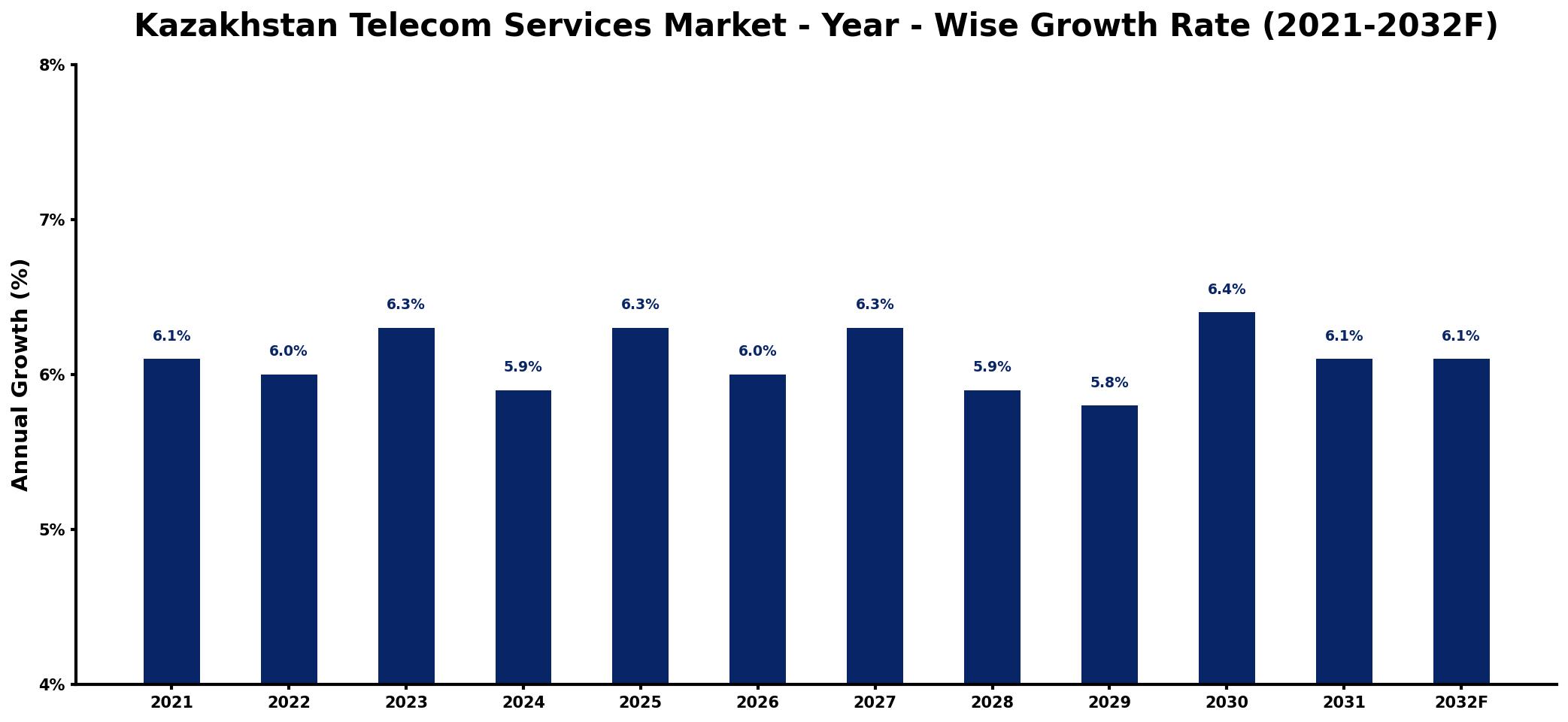
The table below presents the year‑wise growth rates along with the key drivers influencing the market
| Year | Growth Rate | Major Drivers |
| 2021 | 6.1% | increased digital infrastructure investments |
| 2022 | 6.0% | expansion of mobile broadband access |
| 2023 | 6.3% | growing demand for IoT applications |
| 2024 | 5.9% | rising consumer subscription adoption |
| 2025 | 6.3% | enhanced network coverage initiatives |
| 2026 | 6.0% | investment in fiber optic networks |
| 2027 | 6.3% | development of smart city projects |
| 2028 | 5.9% | growing enterprise communication solutions |
| 2029 | 5.8% | increased focus on cybersecurity measures |
| 2030 | 6.4% | increased pharmaceutical industry usage |
| 2031 | 6.1% | adoption of cloud-based solutions |
| 2032 | 6.1% | rise in digital content consumption |
Note: Market size estimations and growth projections presented in this report are based on 6Wresearch's proprietary forecasting methodology, utilizing the latest available industry data, government publications, and primary research inputs.
Kazakhstan Telecom Services Market Synopsis
In Kazakhstan, the push for advanced telecommunications services is underscored by a robust demand for high-speed internet. As the nation embraces digital transformation, both businesses and consumers are seeking integrated telecom solutions, paving the way for significant innovations in the sector.
Major players in the market are responding to consumer needs by enhancing their service portfolios beyond traditional offerings. This includes the introduction of value-added services such as content streaming and digital payment solutions, which align with the shifting preferences of an increasingly tech-savvy population.
Kazakhstan Telecom Services Market Key Takeaways
- The market is poised for substantial growth with a projected CAGR of 5.2% from 2026 to 2032.
- Government initiatives are strongly focused on improving digital infrastructure and connectivity.
- The demand for 5G technology is rapidly increasing, set to transform service delivery across the country.
- Integrated solutions, including IoT and cloud services, are becoming essential components for telecom providers.
- Intense competition is shaping service offerings, leading to innovative and consumer-centric solutions.
Evaluation of Restraints in Kazakhstan Telecom Services Market
Despite promising growth, the Kazakhstan Telecom Services Market faces several restraints that could hinder its potential. The competitive landscape is intensifying, which exerts pressure on pricing strategies and profit margins. Furthermore, regulatory challenges could restrict market entry for new players, limiting innovation. Infrastructure development remains uneven, particularly in remote areas, impacting service delivery. Addressing these constraints will require strategic planning and robust investment in infrastructure.
Kazakhstan Telecom Services Market Trends
Several key trends are shaping the Kazakhstan Telecom Services Market. The adoption of 5G technology is a dominant theme, as consumers and enterprises demand faster, more reliable connectivity. Alongside this, there is a strong shift towards digitalization, with telecom companies increasingly offering integrated services such as IoT, cloud computing, and cybersecurity. Moreover, investments in network infrastructure are vital to enhance coverage in underserved areas, further amplifying market growth.
Kazakhstan Telecom Services Market Opportunities
Investment opportunities abound in the Kazakhstan Telecom Services Market, especially in the development of broadband infrastructure and the rollout of 5G networks. Collaborations with local operators can unlock pathways to innovative offerings, particularly in areas like cloud services and cybersecurity. As the government promotes digitalization, opportunities to contribute to enhanced connectivity initiatives are also increasingly viable, making this market attractive for investors looking to capitalize on emerging trends.
Government Initiatives in the Kazakhstan Telecom Services Market
The regulatory framework governing the Kazakhstan Telecom Services Market is designed to enhance competition and service quality. Under the oversight of the Ministry of Digital Development, Innovation, and Aerospace Industry, various policies are in place to support telecom operators, including licensing requirements and spectrum allocation. Government efforts also focus on promoting digital infrastructure, ensuring that all regions benefit from improved connectivity and access to high-quality services.
Future Insights of the Kazakhstan Telecom Services Market
Looking ahead to 2026-2032, the Kazakhstan Telecom Services Market is expected to thrive. Factors such as the increasing demand for high-speed internet and mobile connectivity will drive expansion. The gradual implementation of 5G technology will further elevate the market, paving the way for new applications and services. Additionally, government initiatives aimed at enhancing digital inclusion will foster an environment ripe for investment and innovation, making this sector an exciting space for growth.
Kazakhstan Telecom Services Market Latest Developments (2025 - 2026)
Recent developments in the Kazakhstan Telecom Services Market highlight a continuing trend toward improved infrastructure and technology adoption. Operators are increasingly focused on upgrading their networks to facilitate 5G services, and partnerships are forming to enhance service offerings. The government remains proactive in its support of digital initiatives, contributing to an overall favorable environment for telecom innovation and expansion.
Kazakhstan Telecom Services Market - Key Attractiveness of the Report
- 10 Years of Market Numbers
- Historical Data Starting from 2022 to 2025
- Base Year: 2025
- Forecast Data until 2032
- Key Performance Indicators Impacting the Market
- Major Upcoming Developments and Projects
Key Highlights of the Report:
- Kazakhstan Telecom Services Market Outlook
- Market Size of Kazakhstan Telecom Services Market, 2025
- Forecast of Kazakhstan Telecom Services Market, 2032
- Historical Data and Forecast of Kazakhstan Telecom Services Revenues & Volume for the Period 2022-2032F
- Kazakhstan Telecom Services Market Trend Evolution
- Kazakhstan Telecom Services Market Drivers and Challenges
- Kazakhstan Telecom Services Price Trends
- Kazakhstan Telecom Services Porter's Five Forces
- Kazakhstan Telecom Services Industry Life Cycle
- Historical Data and Forecast of Kazakhstan Telecom Services Market Revenues & Volume By Service Type for the Period 2022-2032F
- Historical Data and Forecast of Kazakhstan Telecom Services Market Revenues & Volume By Fixed Voice Services for the Period 2022-2032F
- Historical Data and Forecast of Kazakhstan Telecom Services Market Revenues & Volume By Fixed Internet Access Services for the Period 2022-2032F
- Historical Data and Forecast of Kazakhstan Telecom Services Market Revenues & Volume By Mobile Voice Services for the Period 2022-2032F
- Historical Data and Forecast of Kazakhstan Telecom Services Market Revenues & Volume By Mobile Data Services for the Period 2022-2032F
- Historical Data and Forecast of Kazakhstan Telecom Services Market Revenues & Volume By Pay-TV Services for the Period 2022-2032F
- Historical Data and Forecast of Kazakhstan Telecom Services Market Revenues & Volume By Machine-to-Machine (Mobile IoT) Services for the Period 2022-2032F
- Historical Data and Forecast of Kazakhstan Telecom Services Market Revenues & Volume By Transmission for the Period 2022-2032F
- Historical Data and Forecast of Kazakhstan Telecom Services Market Revenues & Volume By Wireline for the Period 2022-2032F
- Historical Data and Forecast of Kazakhstan Telecom Services Market Revenues & Volume By Wireless for the Period 2022-2032F
- Historical Data and Forecast of Kazakhstan Telecom Services Market Revenues & Volume By End-use for the Period 2022-2032F
- Historical Data and Forecast of Kazakhstan Telecom Services Market Revenues & Volume By Consumer/Residential for the Period 2022-2032F
- Historical Data and Forecast of Kazakhstan Telecom Services Market Revenues & Volume By Business for the Period 2022-2032F
- Kazakhstan Telecom Services Import Export Trade Statistics
- Market Opportunity Assessment By Service Type
- Market Opportunity Assessment By Transmission
- Market Opportunity Assessment By End-use
- Kazakhstan Telecom Services Top Companies Market Share
- Kazakhstan Telecom Services Competitive Benchmarking By Technical and Operational Parameters
- Kazakhstan Telecom Services Company Profiles
- Kazakhstan Telecom Services Key Strategic Recommendations






































