Kenya Apparel Accessories Market Size, Share & Growth Rate
The Kenya Apparel Accessories Market was estimated at USD 311 Million in 2025 and is projected to reach USD 437 Million by 2032, growing at a CAGR of 5.0% from 2026 to 2032. This growth trajectory is significantly driven by rising disposable incomes and a burgeoning fashion-conscious demographic eager to express individuality through diverse and trendy accessories. As urban centers expand and e-commerce continues to flourish, consumers increasingly seek unique offerings that resonate with their personal style.
Kenya Apparel Accessories Market Year-wise Growth Rate and Key Drivers
This graph highlights how the Kenya Apparel Accessories Market has steadily grown over the years, supported by major growth factors.
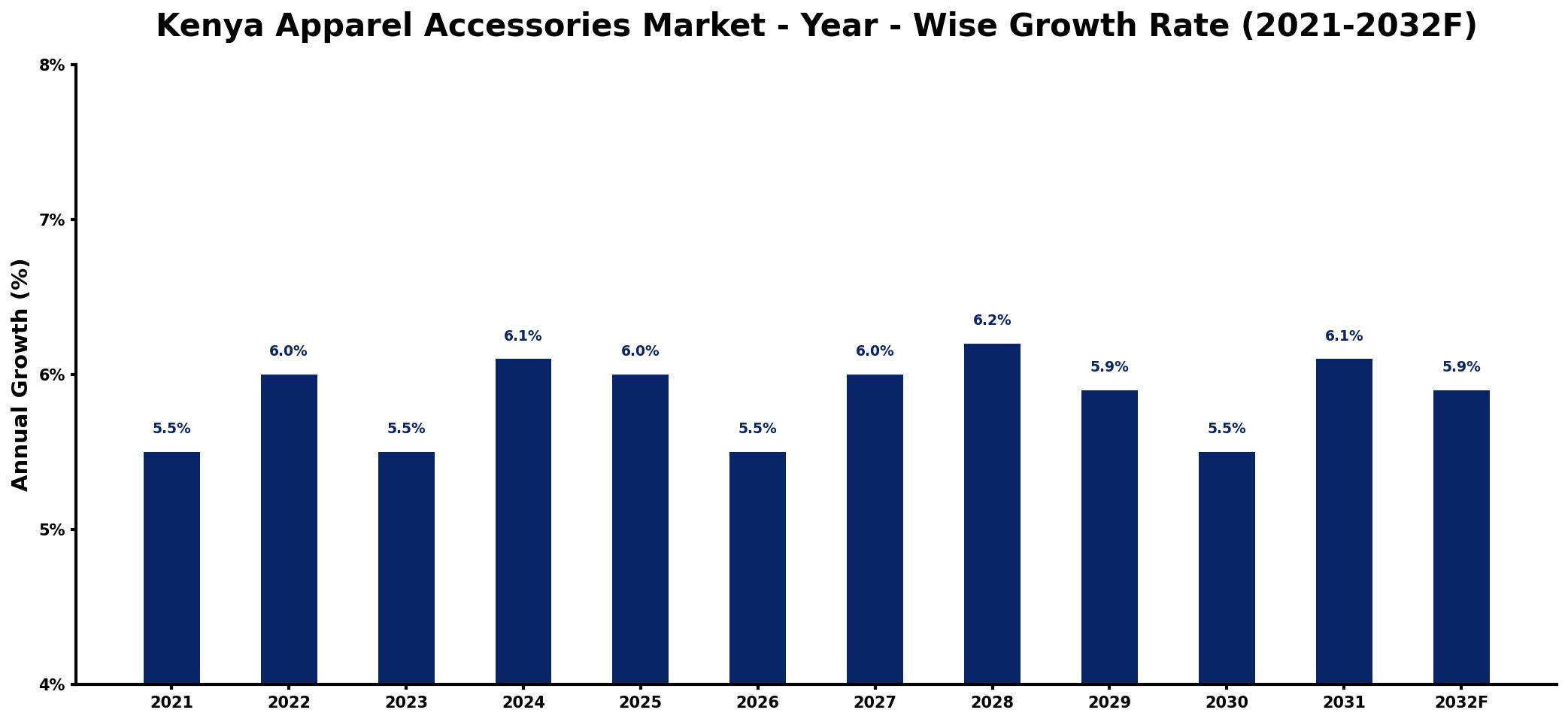
The table below presents the year‑wise growth rates along with the key drivers influencing the market
| Year | Growth Rate | Major Drivers |
| 2021 | 5.5% | Rising consumer disposable income |
| 2022 | 6.0% | Increased online shopping trends |
| 2023 | 5.5% | Expansion of retail outlets |
| 2024 | 6.1% | Growth in fashion industry collaborations |
| 2025 | 6.0% | Emerging youth fashion influences |
| 2026 | 5.5% | Sustainable production practices adoption |
| 2027 | 6.0% | Technological advancements in manufacturing |
| 2028 | 6.2% | Increase in social media marketing |
| 2029 | 5.9% | Diverse cultural fashion preferences |
| 2030 | 5.5% | Enhanced distribution network efficiency |
| 2031 | 6.1% | Rise of local designer brands |
| 2032 | 5.9% | Growing demand for personalized services |
Note: Market size estimations and growth projections presented in this report are based on 6Wresearch's proprietary forecasting methodology, utilizing the latest available industry data, government publications, and primary research inputs.
Kenya Apparel Accessories Market Synopsis
The primary force shaping the Kenya apparel accessories market today is the growing preference for locally made and sustainable products. Consumers are not only looking for fashionable items but are increasingly aware of the ethical and environmental implications of their purchases, driving demand for eco-friendly accessories. This shift is fostering opportunities for local artisans and designers to thrive by offering culturally inspired, unique products.
Additionally, the influence of social media is critical in shaping consumer trends. Online platforms allow fashion influencers to showcase trendy accessories, leading to a new wave of consumer preference focused on originality and personal expression. This dynamic is creating a vibrant marketplace where innovation and sustainability take center stage.
Kenya Apparel Accessories Market Key Takeaways
- Local craftsmanship is gaining traction as consumers demand unique, culturally significant accessories.
- Eco-friendly and sustainable products are increasingly favored, reflecting consumer awareness of environmental issues.
- Social media significantly influences fashion trends, creating a demand for distinctive, trend-driven accessories.
- The rise of e-commerce is broadening access to a wider range of apparel accessories, impacting purchasing behavior.
- The market is well-positioned for growth, supported by government initiatives promoting local manufacturing and consumption.
Evaluation of Restraints in Kenya Apparel Accessories Market
Despite the promising growth trajectory, the Kenya apparel accessories market faces notable constraints. Intense competition from cheaper imported products, especially from Asian markets, poses a significant challenge for local manufacturers. This pressure necessitates enhancements in product quality and branding efforts to remain competitive. Furthermore, supply chain inefficiencies and infrastructural shortcomings can disrupt production and distribution timelines, potentially stifling market growth. Companies must navigate fluctuating exchange rates and trade policies as well, which can influence the costs of imported materials and pricing strategies.
Kenya Apparel Accessories Market Trends
Several trends are currently shaping the Kenya apparel accessories market. The demand for versatile accessories that complement multiple outfits is on the rise, as consumers increasingly prefer minimalist yet functional fashion choices. Additionally, collaborations between local artisans and modern brands are becoming more prevalent, merging traditional craftsmanship with contemporary designs. The integration of sustainable practices is also a critical trend, with more consumers opting for ethically produced accessories that minimize environmental impact.
Kenya Apparel Accessories Market Opportunities
The market presents lucrative investment opportunities as the fashion landscape evolves in Kenya. With the increasing purchasing power of the middle class, there is a notable demand for diverse accessories, including handbags, jewelry, and scarves. Investors can capitalize on this trend by establishing partnerships with local brands or creating retail spaces in high-traffic areas. Moreover, the growing interest in sustainable products opens avenues for businesses to innovate and cater to eco-conscious consumers, further enhancing market appeal.
Government Initiatives in the Kenya Apparel Accessories Market
The Kenyan government is actively promoting the apparel accessories market through various initiatives. Programs such as the Kenya National AGOA Strategy aim to enhance exports to international markets under the African Growth and Opportunity Act. Additionally, the "Buy Kenya, Build Kenya" campaign encourages local consumption of homegrown products, creating a favorable market environment. The government is also committed to improving infrastructure, which is crucial for reducing logistical costs and enhancing the competitiveness of the apparel accessories sector.
Future Insights of the Kenya Apparel Accessories Market
Looking ahead to 2026-2032, the Kenya apparel accessories market is expected to maintain its upward trajectory. Driven by increased disposable income and an expanding middle-class population, consumer demand will continue to grow. The rise of e-commerce will facilitate greater accessibility to a broader array of products. As local designers capture consumer interest with unique offerings, the emphasis on sustainability and ethical production will likely further solidify the market's development, presenting myriad opportunities for innovative players.
Kenya Apparel Accessories Market Latest Developments (2025 - 2026)
Recent developments in the Kenya apparel accessories market reflect a shift toward digital transformation. More brands are enhancing their online presence and leveraging social media for marketing, capitalizing on the growing trend of e-commerce. Additionally, there is a notable increase in collaborations between local artisans and established brands aimed at promoting unique, culturally inspired designs. Sustainability remains a core focus, with several companies investing in eco-friendly materials and production methods to meet consumer demand.
Kenya Apparel Accessories Market - Key Attractiveness of the Report
- 10 Years of Market Numbers
- Historical Data Starting from 2022 to 2025
- Base Year: 2025
- Forecast Data until 2032
- Key Performance Indicators Impacting the Market
- Major Upcoming Developments and Projects
Key Highlights of the Report:
- Kenya Apparel Accessories Market Outlook
- Market Size of Kenya Apparel Accessories Market, 2025
- Forecast of Kenya Apparel Accessories Market, 2032
- Historical Data and Forecast of Kenya Apparel Accessories Revenues & Volume for the Period 2022-2032F
- Kenya Apparel Accessories Market Trend Evolution
- Kenya Apparel Accessories Market Drivers and Challenges
- Kenya Apparel Accessories Price Trends
- Kenya Apparel Accessories Porter's Five Forces
- Kenya Apparel Accessories Industry Life Cycle
- Historical Data and Forecast of Kenya Apparel Accessories Market Revenues & Volume By Product for the Period 2022-2032F
- Historical Data and Forecast of Kenya Apparel Accessories Market Revenues & Volume By Belts for the Period 2022-2032F
- Historical Data and Forecast of Kenya Apparel Accessories Market Revenues & Volume By Handbags for the Period 2022-2032F
- Historical Data and Forecast of Kenya Apparel Accessories Market Revenues & Volume By Scarves for the Period 2022-2032F
- Historical Data and Forecast of Kenya Apparel Accessories Market Revenues & Volume By Eye wear for the Period 2022-2032F
- Historical Data and Forecast of Kenya Apparel Accessories Market Revenues & Volume By Jewelry for the Period 2022-2032F
- Historical Data and Forecast of Kenya Apparel Accessories Market Revenues & Volume By Neckties for the Period 2022-2032F
- Historical Data and Forecast of Kenya Apparel Accessories Market Revenues & Volume By Gloves for the Period 2022-2032F
- Historical Data and Forecast of Kenya Belts Apparel Accessories Market Revenues & Volume By Others for the Period 2022-2032F
- Historical Data and Forecast of Kenya Apparel Accessories Market Revenues & Volume By Demographic for the Period 2022-2032F
- Historical Data and Forecast of Kenya Apparel Accessories Market Revenues & Volume By Men for the Period 2022-2032F
- Historical Data and Forecast of Kenya Apparel Accessories Market Revenues & Volume By Women for the Period 2022-2032F
- Historical Data and Forecast of Kenya Apparel Accessories Market Revenues & Volume By Children for the Period 2022-2032F
- Historical Data and Forecast of Kenya Apparel Accessories Market Revenues & Volume By Price for the Period 2022-2032F
- Historical Data and Forecast of Kenya Apparel Accessories Market Revenues & Volume By Economical Apparel Accessories for the Period 2022-2032F
- Historical Data and Forecast of Kenya Apparel Accessories Market Revenues & Volume By Mid-range Apparel Accessories for the Period 2022-2032F
- Historical Data and Forecast of Kenya Apparel Accessories Market Revenues & Volume By Premium Apparel Accessories for the Period 2022-2032F
- Historical Data and Forecast of Kenya Apparel Accessories Market Revenues & Volume By Super-premium Apparel Accessories for the Period 2022-2032F
- Historical Data and Forecast of Kenya Apparel Accessories Market Revenues & Volume By Sales Channel for the Period 2022-2032F
- Historical Data and Forecast of Kenya Apparel Accessories Market Revenues & Volume By Apparel Accessories Sold through Modern Trade for the Period 2022-2032F
- Historical Data and Forecast of Kenya Apparel Accessories Market Revenues & Volume By Apparel Accessories Sold at Franchise Outlets for the Period 2022-2032F
- Historical Data and Forecast of Kenya Apparel Accessories Market Revenues & Volume By Apparel Accessories Sold at Specialty Stores for the Period 2022-2032F
- Historical Data and Forecast of Kenya Apparel Accessories Market Revenues & Volume By Others for the Period 2022-2032F
- Kenya Apparel Accessories Import Export Trade Statistics
- Market Opportunity Assessment By Product
- Market Opportunity Assessment By Demographic
- Market Opportunity Assessment By Price
- Market Opportunity Assessment By Sales Channel
- Kenya Apparel Accessories Top Companies Market Share
- Kenya Apparel Accessories Competitive Benchmarking By Technical and Operational Parameters
- Kenya Apparel Accessories Company Profiles
- Kenya Apparel Accessories Key Strategic Recommendations






































